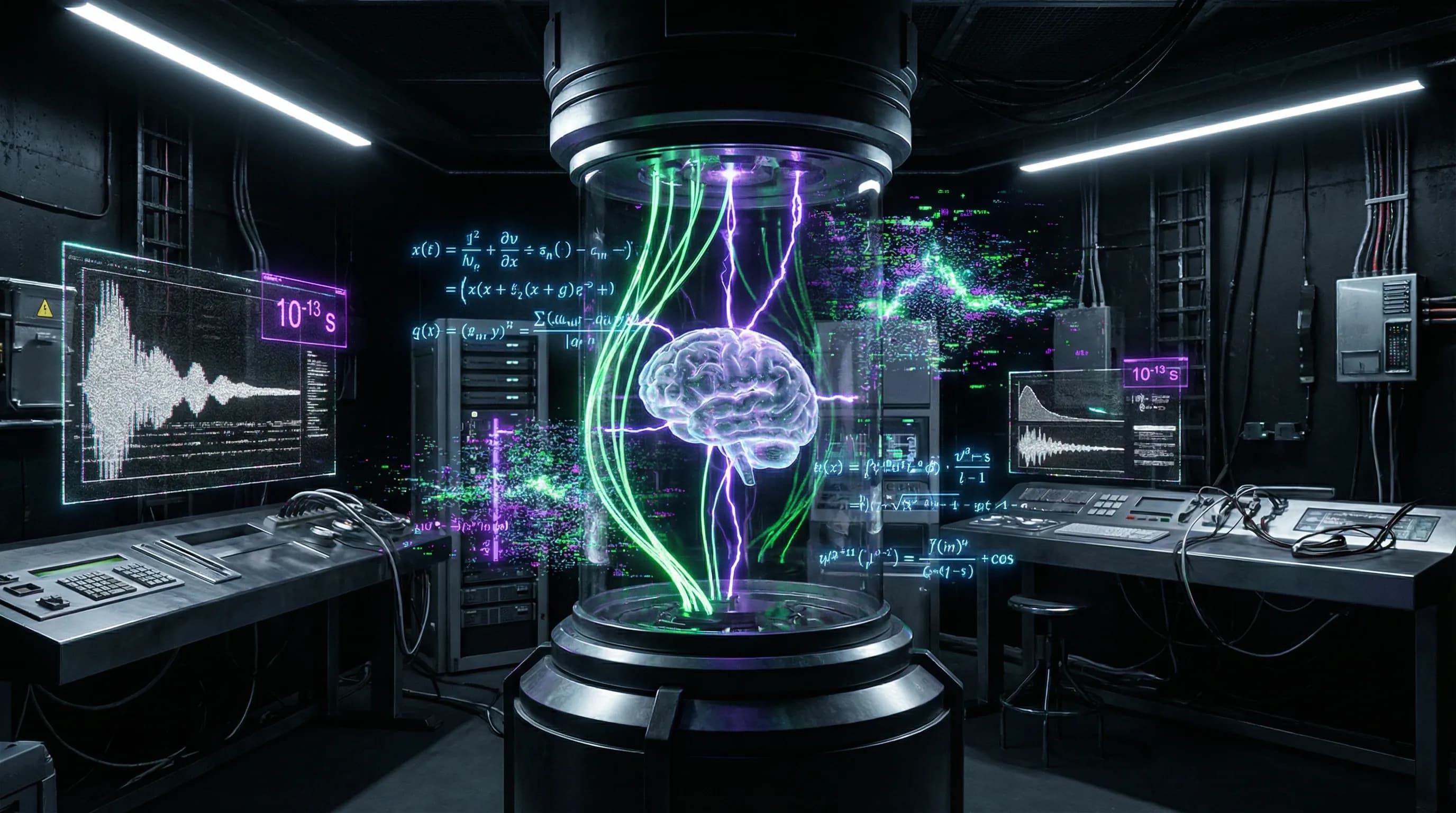
What exactly the quantum consciousness hypothesis claims — and where the boundary lies between physics and metaphysics
The central claim of the quantum consciousness hypothesis: human consciousness plays a fundamental role in quantum measurement, causing the collapse of the wave function from superposition into a single outcome. This differs radically from the standard interpretation, where "observation" means any physical interaction capable of extracting information — a detector, photographic plate, air molecule (S002).
Substituting a technical term with an everyday word creates the illusion of scientific justification for philosophical idealism. Historically, this confusion traces back to the founders of quantum mechanics: Heisenberg and von Neumann used "observer" in a mathematical sense — as an abstract boundary between the quantum system and classical apparatus. However, Wigner and Wheeler began interpreting this literally, proposing a special role for consciousness (S003).
Wheeler advanced the concept of a "participatory universe": observers don't merely register reality, but actively participate in its creation through the act of measurement. This is a philosophical claim packaged in physical terminology.
🧩 Three levels of claims: from weak to radical
Weak version: quantum effects may play a role in brain function — for example, in neuronal microtubules (Penrose-Hameroff theory). Doesn't require consciousness to collapse the wave function, but proposes that quantum coherence could persist in biological systems long enough to influence neural processes (S005).
Medium version: consciousness is necessary for wave function collapse, but the mechanism isn't explained. A position close to the von Neumann-Wigner interpretation: the chain of quantum correlations breaks only upon interaction with a conscious observer. The problem — absence of an operational definition of "consciousness" and explanation for why macroscopic instruments can't perform the same function. More details in the section Paranormal Abilities.
Radical version: consciousness is fundamental and primary relative to physical reality (quantum idealism). Matter arises from consciousness, and quantum mechanics supposedly substantiates this metaphysical claim (S001, S004). This version exceeds the bounds of empirical testability and becomes philosophical belief in scientific packaging.
🔎 Operational definitions: what counts as "observation"
- Observation in standard quantum mechanics
- Any interaction that entangles a quantum system with its environment such that information about the state becomes available in principle — regardless of whether a conscious being registers it (S002). A particle detector leaving a trace in photographic emulsion performs an "observation" even if no one ever looks at that plate.
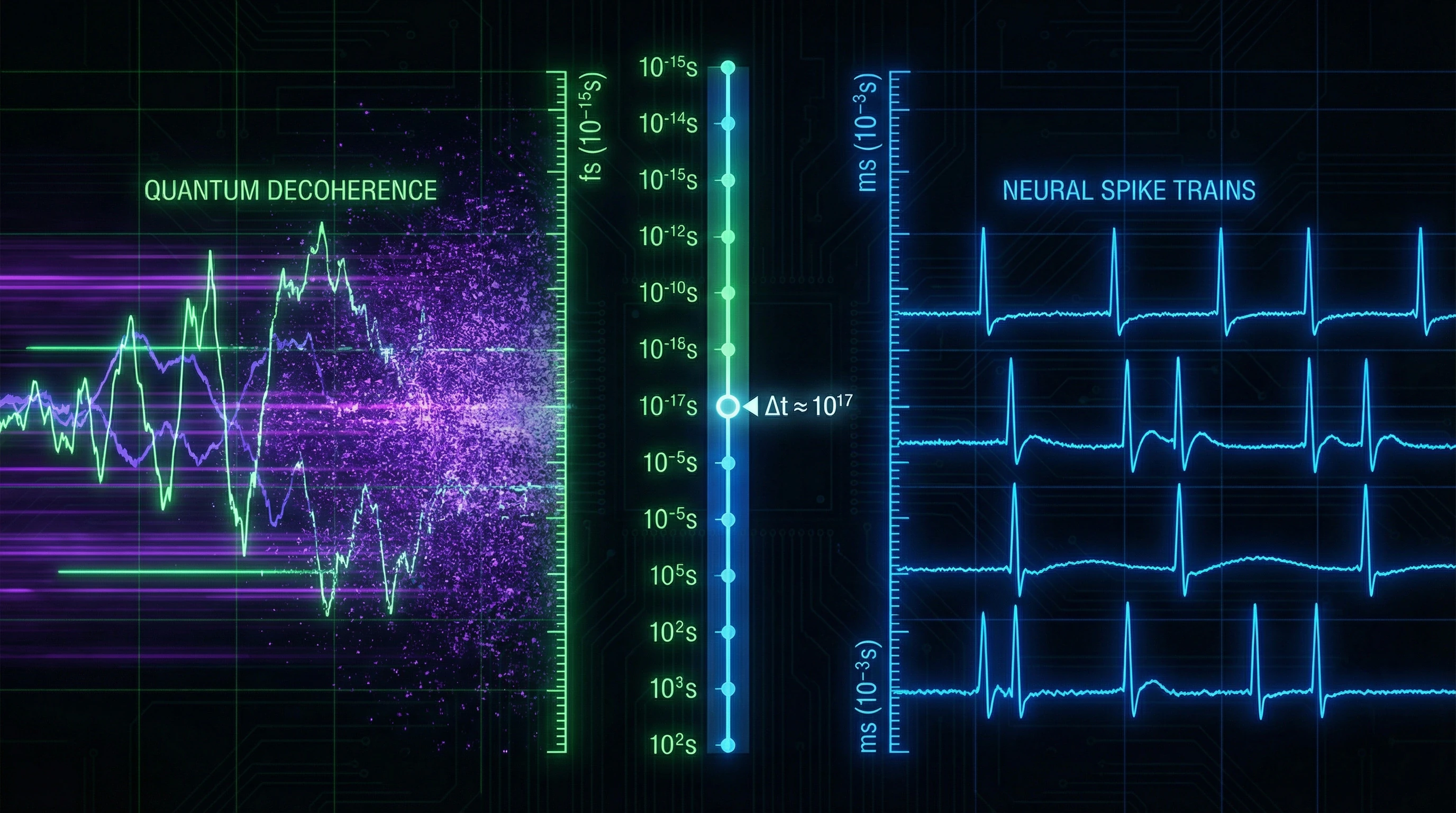
The key process — decoherence: interaction of a quantum system with its environment leads to loss of quantum coherence and emergence of classical behavior. For macroscopic objects at room temperature, this occurs on timescales of 10⁻²⁰ seconds — many orders of magnitude faster than neural processes (millisecond range) (S002).
| System level | Decoherence time | Typical neural process | Compatibility |
|---|---|---|---|
| Macroscopic object | ~10⁻²⁰ sec | ~10⁻³ sec (millisecond) | Incompatible |
| Molecule | ~10⁻¹² sec | ~10⁻³ sec | Incompatible |
This fundamental mismatch of timescales makes direct influence of quantum effects on brain function extremely unlikely without extraordinary protective mechanisms that have never been experimentally detected.
The boundary between physics and metaphysics runs here: physics requires operational definitions and testable predictions. Quantum consciousness in its radical version offers neither.
Steel Version of the Argument: Five Strongest Cases for Quantum Consciousness
Before examining the criticism, it's necessary to present the proponents' arguments in their most convincing form—this is the "steel man" principle, opposite to the "straw man." Even erroneous theories often contain a rational kernel, and understanding why intelligent people believe in quantum consciousness helps identify real gaps in our understanding. More details in the section Secret Devices.
🔬 The Measurement Problem Argument: Consciousness as Solution to a Fundamental Mystery
The measurement problem in quantum mechanics has remained unsolved for over a century. The mathematical formalism describes wave function evolution through the unitary Schrödinger equation, but doesn't explain why during measurement we observe only one of the possible outcomes, not a superposition. The standard Copenhagen interpretation postulates wave function collapse as a separate postulate, but doesn't explain its mechanism (S005).
Quantum consciousness proponents point out that introducing consciousness as the collapse agent solves this problem elegantly: the wave function collapses precisely when information reaches a conscious observer. This explains why we never observe macroscopic superpositions (Schrödinger's cat simultaneously alive and dead)—because our consciousness automatically collapses such states upon observation. This argument is attractive because it links two great mysteries—the nature of quantum measurement and the nature of consciousness—into a unified framework.
📊 The Delayed-Choice Experiment Argument: Observer Influences the Past
Delayed-choice experiments, first proposed by John Wheeler, demonstrate that the experimenter's decision about the type of measurement can influence photon behavior, even if this decision is made after the photon has passed through the interferometer (S003). In the classic version of the experiment, a photon passes through a beam splitter and can behave as a wave (creating interference) or as a particle (registering in one of the detectors), depending on the measurement apparatus configuration.
Quantum consciousness proponents interpret this as proof that the experimenter's conscious choice retroactively determines which path the photon "took." However, the standard interpretation explains these results without invoking consciousness: a quantum system has no definite properties before measurement, and the experimenter's "choice" simply determines which observable corresponds to the measurement. No information is transmitted to the past, and no causality violation occurs.
- The wave function describes potentialities, not actual system properties.
- Measurement selects which observable we register, but doesn't influence the past.
- Decoherence explains the transition from quantum to classical without invoking consciousness.
🧠 The Unity of Conscious Experience Argument: Quantum Connectivity as Explanation
One of the central mysteries of consciousness is the binding problem: how does the brain unite information from millions of neurons into a single coherent experience? Classical neural mechanisms based on activity synchronization don't fully explain the phenomenological unity of consciousness. Quantum approach proponents suggest that quantum entanglement could provide instantaneous correlation between distant brain parts, creating a global quantum state corresponding to unified conscious experience (S005).
The Penrose-Hameroff theory specifies this mechanism, proposing that microtubules in neurons can maintain quantum coherence at physiological temperatures due to special biophysical conditions. If so, quantum computations in microtubules could explain not only consciousness unity but also its computational power exceeding classical neural networks. However, experimental data on quantum coherence in microtubules remains contradictory and unconfirmed by independent research.
The binding problem remains unsolved in classical neurobiology, but this doesn't mean quantum mechanics is the only solution. Neural activity synchronization, neuromodulatory systems, and hierarchical information processing explain most aspects of experience unity without invoking quantum effects.
🕳️ The Non-Computability of Consciousness Argument: Gödel's Theorem and Quantum Gravity
Roger Penrose advanced an argument based on Gödel's incompleteness theorems: human mathematical thinking can understand the truth of statements that are underivable in formal systems, which supposedly proves consciousness is non-computable. If consciousness is non-computable in the classical sense, it must use physical processes beyond algorithmic computation (S005).
Penrose proposes that such non-computable processes are linked to objective reduction of the wave function (OR—objective reduction), caused by quantum gravitational effects at the Planck scale. When quantum superposition reaches a certain threshold of mass-energy difference, spacetime becomes unstable and spontaneous collapse occurs. In neuronal microtubules, this process supposedly occurs at a frequency corresponding to brain gamma rhythms (40 Hz), associated with conscious perception.
Critics point out that Penrose's argument from Gödel's theorems contains a logical error: from the fact that a formal system cannot prove its own consistency, it doesn't follow that the human mind has access to non-computable truths. Moreover, quantum gravity at the Planck scale (10⁻³⁵ meters) cannot influence macroscopic biological structures without extraordinary protective mechanisms against decoherence.
👁️ The Philosophical Parsimony Argument: Consciousness as Fundamental Property
Panpsychism and neo-idealism offer a metaphysical alternative to materialism: instead of explaining how consciousness emerges from inanimate matter (a problem that remains unsolved), one can postulate consciousness as a fundamental property of reality, like mass or charge (S001), (S004). Quantum mechanics with its observer-dependence supposedly provides physical justification for this position.
According to this logic, matter and consciousness are two sides of one reality, and the quantum wave function describes potentialities that are actualized through conscious observation. This solves David Chalmers' "hard problem of consciousness," explaining why physical processes are accompanied by subjective experience: because subjectivity is built into the very fabric of reality at the quantum level.
- Philosophical Parsimony
- The principle of minimizing entities: don't introduce new postulates if existing ones explain observed phenomena. Panpsychism violates this principle by postulating consciousness everywhere it cannot be observed.
- The Scaling Problem
- If consciousness is a fundamental property, why does it manifest only in complex biological systems, not in electrons or rocks? The answer requires additional postulates, which complicates rather than simplifies the theory.
- Decoherence as Alternative
- Classical mechanisms of neural information processing, enhanced by decoherence, explain observed phenomena without invoking metaphysics. Why introduce additional entities?
All five arguments contain a rational kernel: the measurement problem is indeed unsolved, the binding problem is indeed complex, Gödel's theorems are indeed interesting. But a rational kernel isn't the same as proof. The attractiveness of an idea doesn't equal its truth. This is precisely why critical analysis of these arguments requires not denying their logic, but identifying gaps between premises and conclusions.
Evidence Base: What Experiments Show and Where Physics Ends
The quantum consciousness hypothesis in its strong versions is practically unfalsifiable: it makes no specific quantitative predictions that would differ from standard quantum mechanics with decoherence (S002).
📊 Quantum Biology Experiments: Where Quantum Effects Actually Work
Quantum biology is a legitimate field where quantum effects genuinely play a role. Photosynthesis uses quantum coherence for efficient energy transfer in light-harvesting complexes; magnetoreception in birds relies on quantum entanglement in cryptochromes for orientation by magnetic field (S002).
But these examples don't support the quantum consciousness hypothesis. Quantum effects are protected by special biophysical mechanisms: protein structures isolate processes from thermal noise, occurring on picosecond timescales—too fast for decoherence. Crucially: these effects aren't connected to consciousness. Plants and bacteria use quantum energy transfer, but no one claims they're conscious. More details in the section Torsion Fields and Bioenergetics.
Attempts to detect quantum coherence in neuronal microtubules have yielded contradictory results. Some studies report quantum effects in isolated microtubules at low temperatures, but there's no convincing evidence that such coherence persists under the physiological conditions of the brain—at 98.6°F, in an aqueous environment, with constant metabolic noise (S002).
🧪 "Conscious Observation" Experiments: Methodological Problems
Several groups have attempted to test whether conscious observation affects quantum systems differently than automatic detection. A classic example—experiments with random number generators (RNG), where subjects supposedly influence the outcomes of quantum processes through intention.
Meta-analyses show statistically significant but extremely small effects that disappear under rigorous methodological control (S002). Problems: absence of pre-registration of hypotheses, multiple testing without correction, publication bias, insufficient statistical power.
| Methodological Defect | Consequence | Why This Is Critical |
|---|---|---|
| Absence of pre-registration | Researcher can select hypothesis after obtaining data | Turns random noise into a "discovery" |
| Multiple testing without correction | Probability of false positive grows exponentially | With 20 tests, probability of at least one false result ≈ 64% |
| Publication bias | Positive results get published, negative ones don't | Literature systematically overestimates real effect |
| Absence of physical mechanism | No explanation for how consciousness collapses wave function | If effect is real, there should be macroscopic, reproducible results |
🧾 Neuroimaging and Correlates of Consciousness: What We Know for Sure
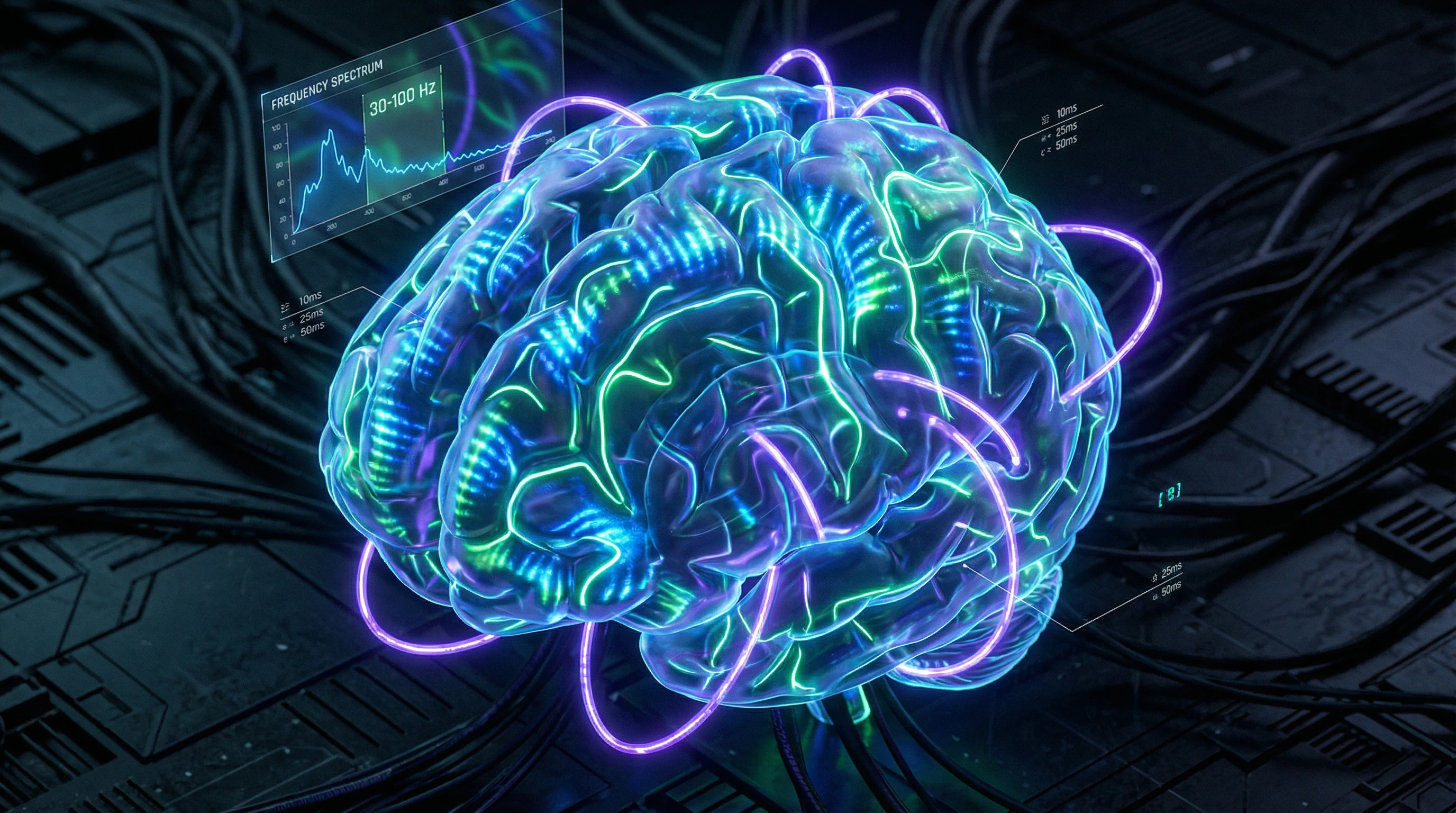
Modern neuroscience has identified neural correlates of consciousness (NCC)—patterns of brain activity correlating with conscious experience. Functional MRI, EEG, and invasive recordings show: conscious perception is linked to global synchronization of activity in distributed neural networks, especially in the gamma range (30–100 Hz) (S002).
These data are fully consistent with classical neural mechanisms and require no quantum explanations. The timescales of neural activity (milliseconds) exceed decoherence times (femtoseconds) by many orders of magnitude, making direct influence of quantum effects impossible.
Consciousness is disrupted in predictable ways by brain damage, anesthesia, and other interventions—this points to dependence on classical neural processes, not hypothetical quantum states. The connection between brain structure and consciousness is too reliable and reproducible to be the result of quantum fluctuations.
🔁 Decoherence in Biological Systems: Physical Constraints
Decoherence—the process by which a quantum system loses coherence due to interaction with its environment—is a fundamental constraint for any theory of quantum consciousness. Decoherence rate is proportional to temperature, environmental density, and system size.
- Under brain conditions (98.6°F, aqueous environment, metabolic noise)
- Decoherence times for macromolecular structures: 10⁻²⁰ – 10⁻¹³ seconds (S002).
- Synaptic transmission (the fastest neural process)
- Occurs over milliseconds (10⁻³ seconds).
- The gap between them
- 10–17 orders of magnitude. For quantum effects to influence consciousness, a mechanism is needed to protect quantum coherence over these incredibly long (by quantum standards) timescales.
- Status of such a mechanism
- Not found in the brain and contradicts basic principles of statistical mechanics.
This isn't just absence of evidence—it's physical impossibility. Quantum effects in the brain don't vanish because no one is looking hard enough. They vanish because brain conditions—temperature, humidity, metabolic activity—systematically destroy quantum coherence faster than it can influence neural processes.
Mechanisms and Causality: Why Correlation Doesn't Mean Quantum Connection
Even if we discovered a correlation between quantum processes and conscious experience, this wouldn't prove a causal relationship. Establishing causality requires controlled experiments where we can manipulate the presumed cause and observe changes in the effect, excluding alternative explanations. More details in the Debunking and Prebunking section.
⚙️ The Problem of Causal Direction: What Influences What
Suppose we discovered a correlation between quantum processes in the brain and conscious experience. This could mean four things:
- quantum processes cause consciousness;
- consciousness causes quantum processes;
- both are consequences of a third factor;
- the correlation is coincidental.
The quantum consciousness hypothesis assumes option (2), but without additional evidence, options (1) and (3) are more plausible from a physics perspective (S002).
Classical neural activity is inevitably accompanied by quantum processes at the molecular level—ion movement through membrane channels, conformational changes in proteins, neurotransmitter release. All these processes are described by quantum mechanics at the microscopic level, but their macroscopic consequences are entirely determined by classical physics due to decoherence.
Discovering quantum processes in the brain is no more surprising than discovering quantum processes in any other chemical system. This doesn't prove a functional role for quantum effects in consciousness.
🧷 Confounders and Alternative Explanations
Many phenomena attributed to quantum consciousness have simpler explanations. The unity of conscious experience may result from global synchronization of neural activity through thalamo-cortical loops—a mechanism well-studied in neuroscience that doesn't require quantum entanglement (S002).
The brain's computational power, while impressive, doesn't exceed the theoretical limits of classical neural networks given their parallel architecture. Phenomena that seem "incomputable"—creativity, intuition, insight—may result from stochastic processes in neural networks rather than quantum computation.
| Phenomenon | Quantum Explanation | Classical Explanation | Testability |
|---|---|---|---|
| Unity of consciousness | Quantum entanglement of neurons | Synchronization through thalamo-cortical loops | High (neuroimaging) |
| Creativity and insight | Quantum computation in microtubules | Stochastic processes in neural networks | Low (both explain observations) |
| Information processing speed | Quantum parallelism | Massive parallelism of classical neurons | Medium (requires direct measurement) |
Randomness in neural networks is a powerful tool for exploring the space of possibilities. It doesn't require quantum mechanics and adequately explains the flexibility and adaptability of behavior.
The problem with quantum consciousness is that it doesn't offer new predictions that differ from classical models. If a theory cannot be refuted by experiment, it ceases to be physics and becomes metaphysics. This doesn't mean it's false—it means it lies outside the domain of science.