 ⚛️ Quantum Mysticism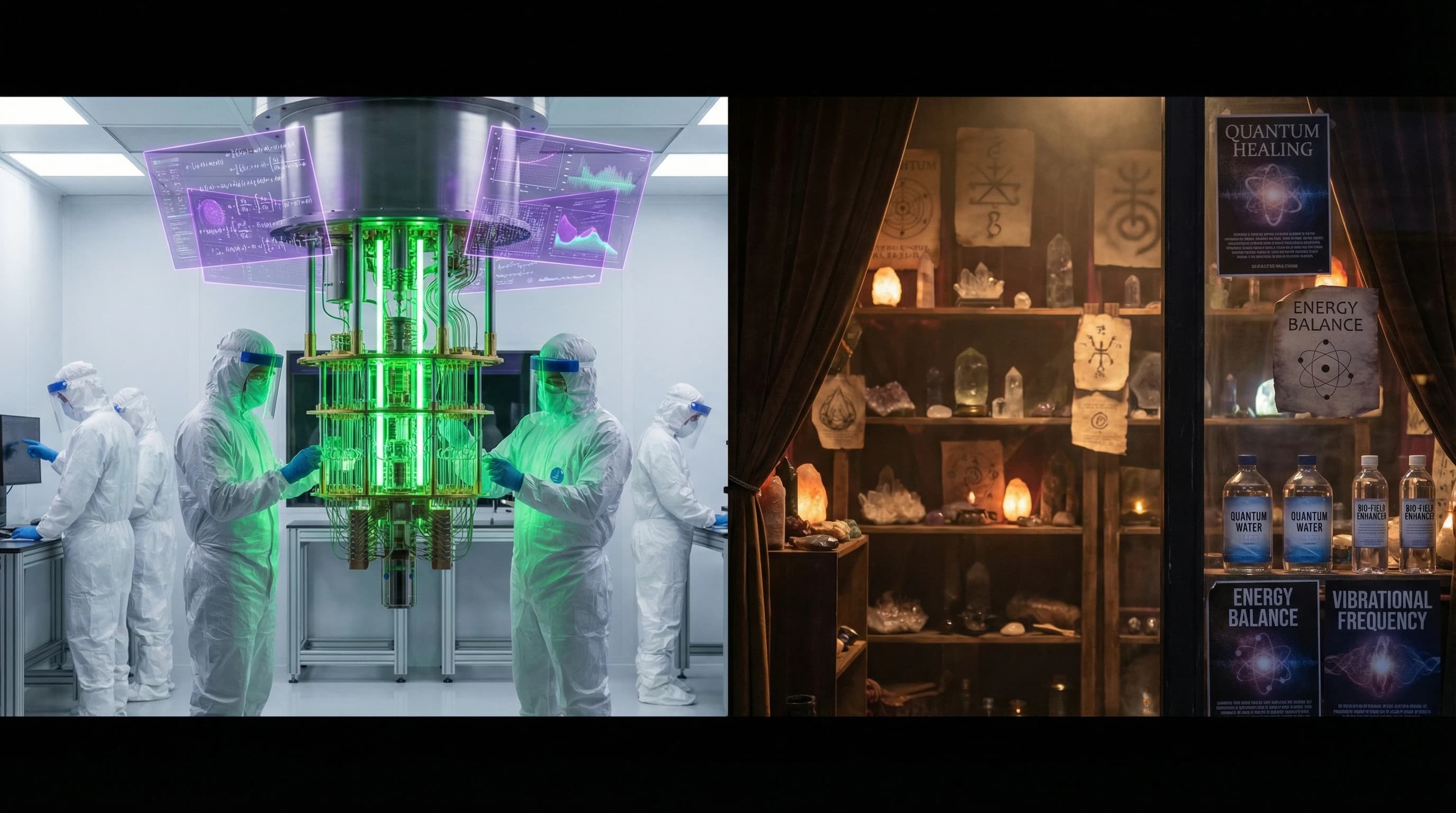
Quantum Mysticism: When Physics Gets Hijacked for Pseudoscienceλ
Exposing the misuse of quantum mechanics to justify supernatural beliefs, alternative medicine, and mystical practices without scientific basis.
Overview
Quantum mechanics describes the behavior of particles at the subatomic level — and only there. Mystics appropriate terms ("superposition," "observer," "entanglement") 🧬 and transfer them to consciousness, healing, manifestation of desires — domains where quantum effects are physically impossible due to decoherence. Physicists are unanimous: the "observer" in an experiment is an instrument, not a human; the macroscopic world obeys classical mechanics, and "quantum healing" is marketing wrapping for placebo.
🛡️
Laplace Protocol: Verify whether quantum concepts are applied in their valid domain (atomic scale), whether there is mathematical formalization, whether claims are published in peer-reviewed physics journals, and whether they are being used to sell products or services.
Reference Protocol
Scientific Foundation
Evidence-based framework for critical analysis
Protocol: Evaluation
Test Yourself
Quizzes on this topic coming soon
Sector L1
Articles
Research materials, essays, and deep dives into critical thinking mechanisms.
⚛️ Quantum Mysticism ⚛️ Quantum Mysticism
 ⚛️ Quantum Mysticism
 ⚛️ Quantum Mysticism
 ⚛️ Quantum Mysticism
⚡
Deep Dive
Quantum Mysticism: How Scientific Terminology Becomes a Tool for Deception
Quantum mysticism is the systematic misuse of quantum mechanics terminology to justify pseudoscientific, metaphysical, or esoteric beliefs. The primary mechanism is "vocabulary hijacking": legitimate concepts like superposition, entanglement, and the observer effect are ripped from context and applied to macroscopic phenomena where quantum effects are negligibly small.
In the English-speaking scientific community, this phenomenon is called "quantum woo" or "quantum quackery," emphasizing its invalidity from a physics standpoint.
The Mechanism of "Vocabulary Hijacking" and Its Consequences
The key problem is the substitution of scientific content with the emotional appeal of terms. Words like "quantum," "energy," and "frequency" sound modern and authoritative, making them ideal marketing tools.
| Product/Service | Claim | Reality |
|---|---|---|
| "Quantum bracelets" | Heal through quantum energy | No mathematical formalism or reproducible data |
| "Quantum healing" | Influence biological processes | Ignore fundamental limitations of quantum mechanics |
| "Quantum meditation" | Synchronize consciousness with the quantum field | No experimental basis |
Manufacturers of such products provide no experimental data. The academic community regularly publishes critical analyses, but the gap between scientific consensus and public perception remains significant.
Boundary of Applicability: Where Quantum Mechanics Ends
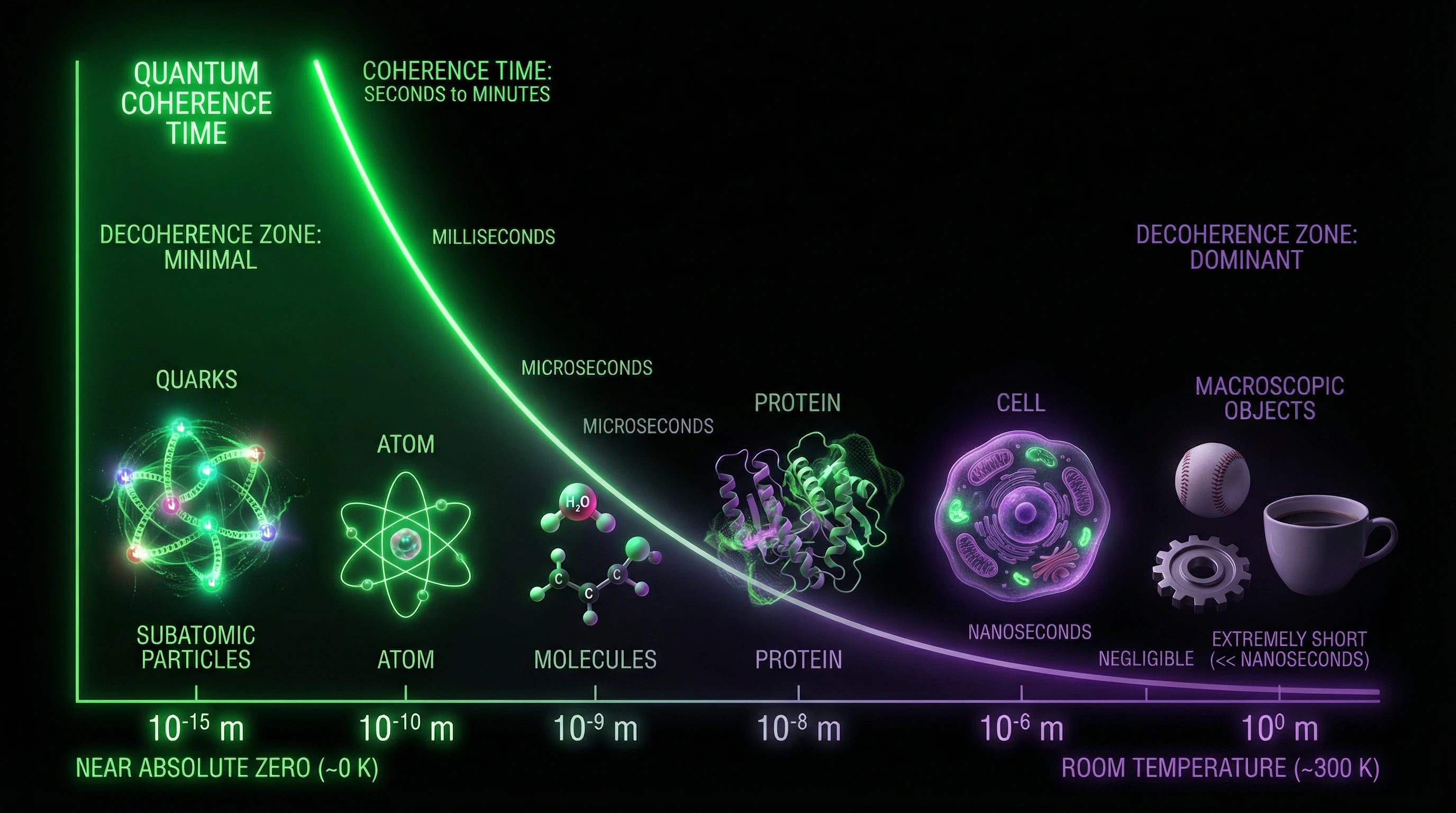
Quantum effects manifest at atomic and subatomic scales but become insignificant at the macroscopic level due to decoherence—the process of quantum state destruction through interaction with the environment.
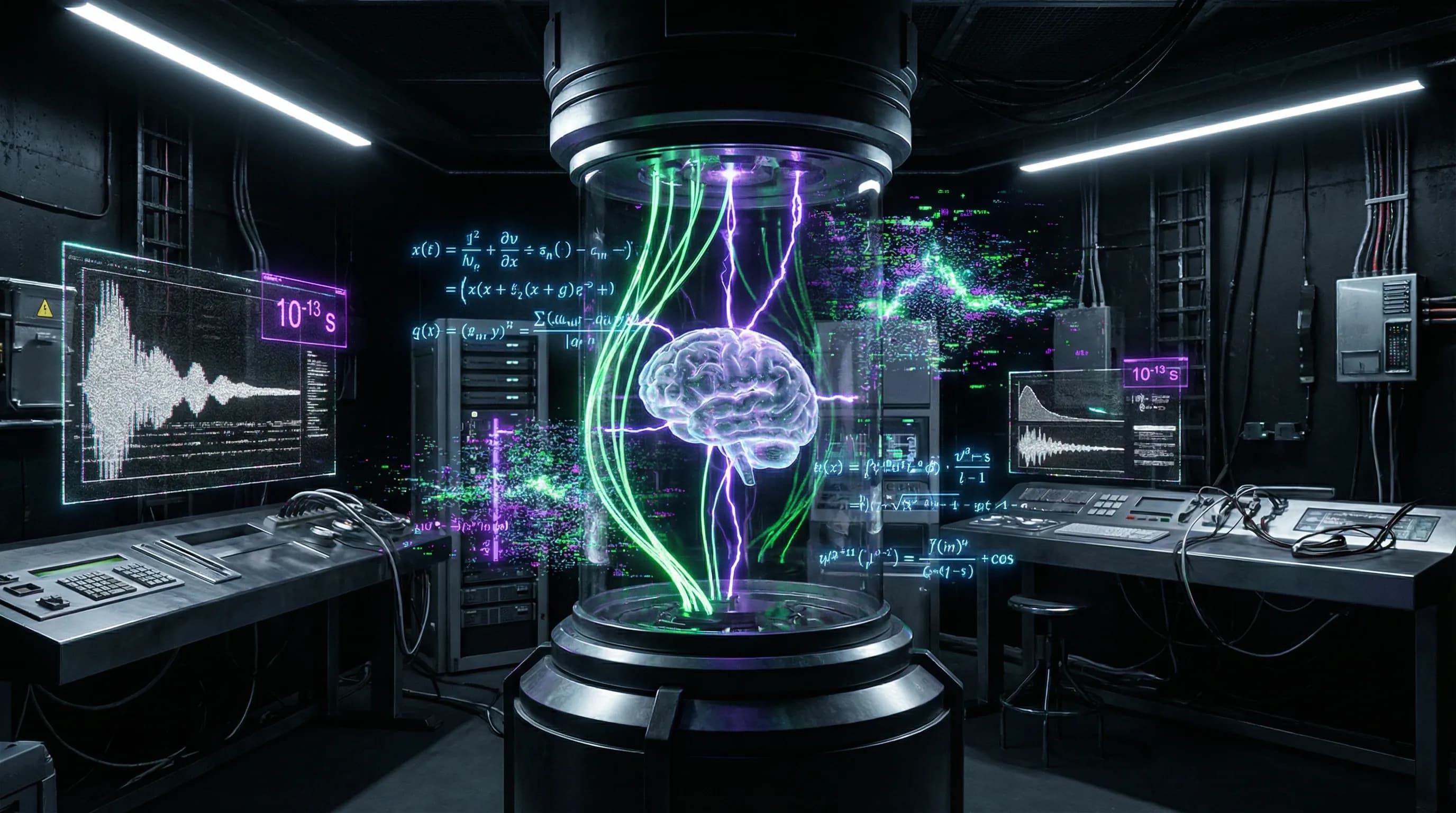
Typical decoherence time for a molecule at room temperature is 10⁻¹³ seconds. This makes the existence of quantum superposition in biological systems impossible on timescales relevant to consciousness or health.
Claims that quantum mechanics directly influences human consciousness, thoughts, or everyday events ignore this fundamental limitation.
- Decoherence
- The destruction of quantum states when a system interacts with its environment. At macroscopic scales, this occurs instantaneously, excluding quantum effects from biology and psychology.
- "Vocabulary Hijacking"
- Extracting a scientific term from context and reapplying it to phenomena where the original theory does not apply. Creates an illusion of scientific validity without substance.
Five Major Myths About Quantum Physics in Popular Culture
Myth One: Consciousness Creates Reality Through Observation
"Observation creates reality" — a radical distortion of the measurement problem in quantum mechanics. In physics, an "observer" is any measuring device or system capable of interacting with a quantum object, not human consciousness.
Delayed-choice and quantum eraser experiments show: results are determined by physical interactions, not the presence of consciousness. Decoherence theory explains wave function collapse through interaction with the environment — consciousness is not required.
Myth Two: Quantum Entanglement Explains Telepathy and Distance Healing
Quantum entanglement — a correlation between particle states, but it does not transmit information faster than light. The no-cloning theorem and the no-communication theorem prove this mathematically.
- At room temperature, organisms cannot maintain quantum entanglement — interaction with the environment destroys such states within femtoseconds.
- Claims about telepathy or healing through entanglement have neither theoretical foundation nor experimental confirmation in peer-reviewed literature.
Myth Three: The Uncertainty Principle Means We Can't Know Anything Precisely
Heisenberg's uncertainty principle — not a philosophical statement about the impossibility of knowledge, but a specific mathematical relationship: ΔxΔp ≥ ℏ/2, where ℏ is the reduced Planck constant.
The principle establishes a fundamental limit on the simultaneous precision of measuring complementary variables (position and momentum), but does not apply to macroscopic measurements, where classical mechanics provides precise predictions.
The Observer Effect: Dismantling a Popular Misconception
Measuring Apparatus Versus Human Consciousness
An "observer" in quantum mechanics is not a conscious being, but any physical system that irreversibly interacts with a quantum object and registers information about its state.
The double-slit experiment shows: the interference pattern disappears when a detector is installed regardless of whether anyone looks at the results. Automatic detectors recording data without human participation produce the same wave function collapse.
Consciousness is not required. Physical interaction is sufficient.
Decoherence Theory as Explanation Without Mysticism
Decoherence describes how a quantum system loses its interference properties through interaction with the environment, transitioning to a classical state without postulating a special collapse mechanism.
| Process Stage | What Happens |
|---|---|
| Interaction with environment | Macroscopic objects instantly become entangled with an enormous number of degrees of freedom |
| Loss of coherence | Quantum superpositions become unobservable |
| Classical result | The measurement problem is solved within the framework of unitary evolution |
Experimental confirmations of decoherence have been obtained in systems ranging from photons to fullerene molecules, demonstrating the universality of this mechanism.
There is no need to postulate a special role for the observer or consciousness — physics explains everything.
Red Flags: How to Spot Quantum Woo in 60 Seconds
High-Risk Indicators in Content and Products
Quantum woo uses predictable patterns. Claims about direct influence of quantum effects on consciousness or thoughts are maximum-risk indicators.
Promotion of "quantum healing" without peer-reviewed evidence exploits scientific terminology to bypass medical standards. Claims that quantum mechanics validates ancient mystical traditions ignore the fundamental distinction between the scientific method and religious-philosophical systems.
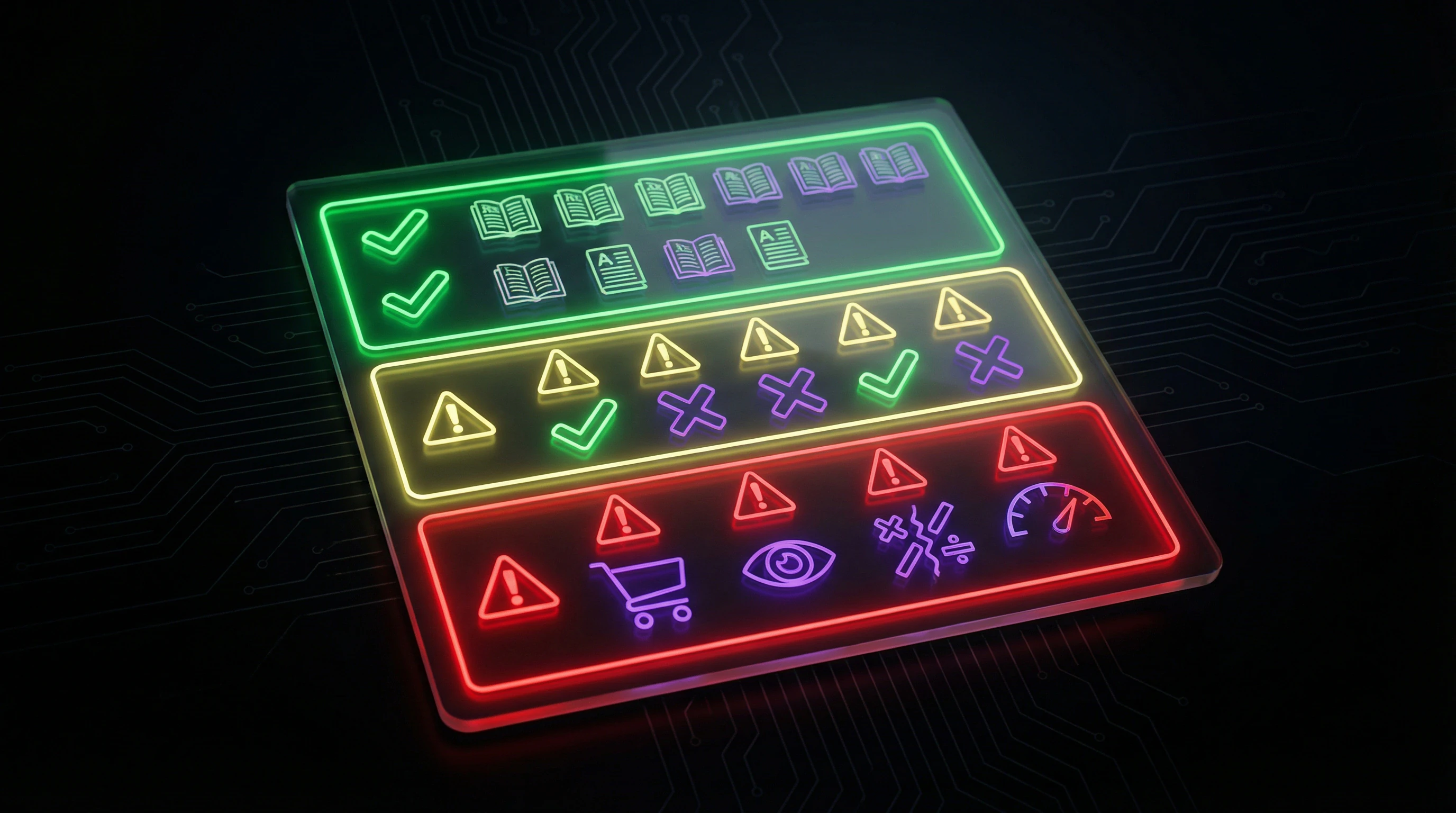
- Quantum terminology without mathematical formalism
- Products with "quantum energy" or "quantum frequencies" — quantum effects require extreme isolation and cannot be packaged into consumer goods
- Bypassing biological science through appeals to quantum mechanics
- Mixing legitimate quantum technologies with consciousness research to create false scientific legitimacy
Questions for Verifying Sources and Claims
Critical analysis requires a structured approach. First question: Is a specific scale of quantum effect applicability specified, or are claims extrapolated to macroscopic systems without justification?
Second: Are quantitative estimates of decoherence time provided, or is the fact ignored that biological systems at room temperature decohere within femtoseconds? Third: Does the source distinguish between "observer" as a measurement device and human consciousness?
Legitimate quantum science operates with Hamiltonians, wave functions, and operators. Their absence indicates superficial use of terminology.
Claims about quantum effects must be accompanied by descriptions of experimental setup, isolation conditions, and detection methods. Checking an author's publication history in peer-reviewed physics journals separates professional physicists from pseudoscience popularizers.
Legitimate Quantum Technologies: Where Science Ends and Fantasy Begins
Quantum Computing and Cryptography as Real Applications
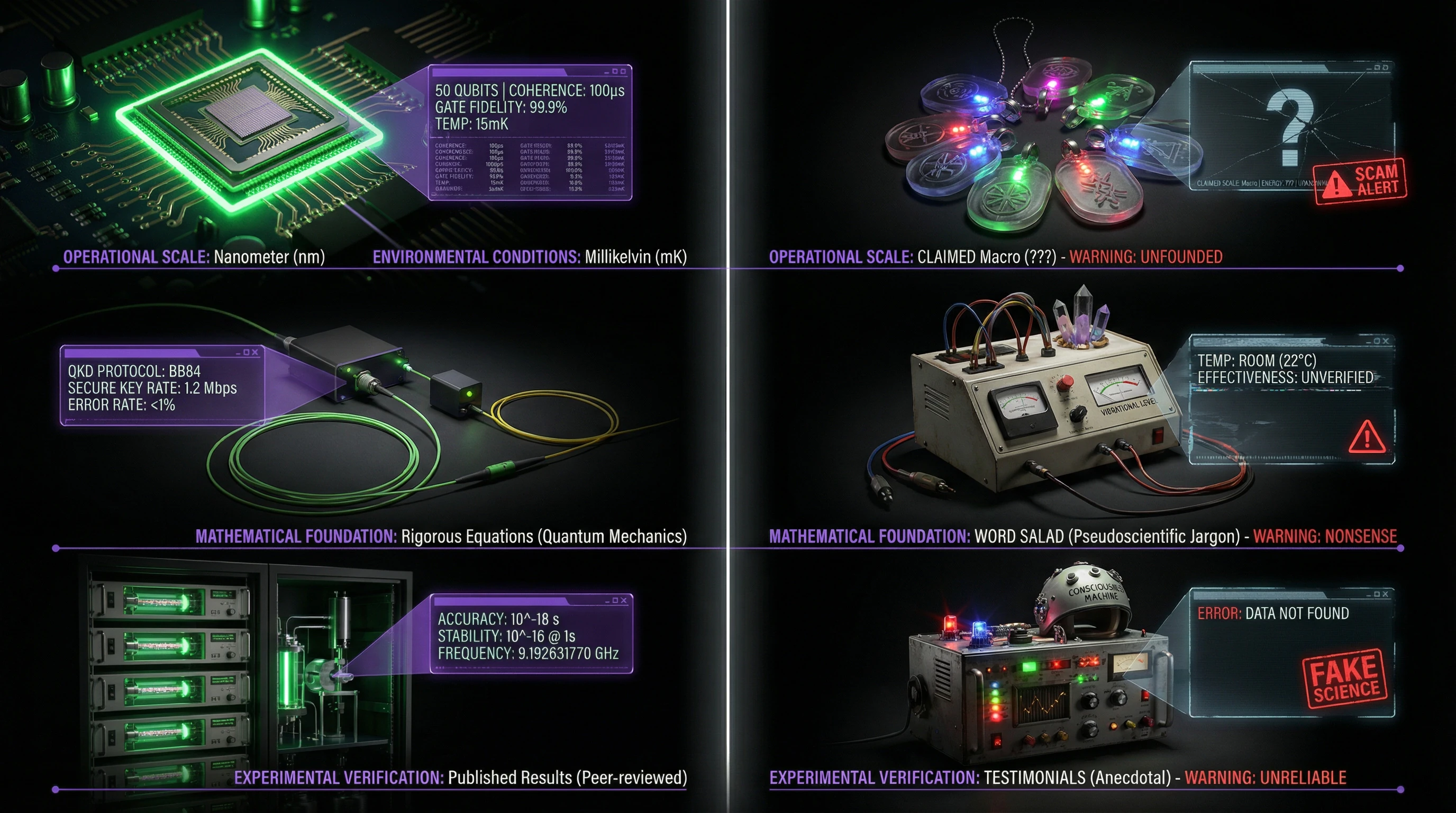
Quantum technologies are not speculation, but engineering reality with measurable results. Quantum computers use superposition and entanglement to solve certain problems exponentially faster than classical systems: cryptanalysis, optimization, molecular simulation.
Quantum cryptography relies on the no-cloning theorem of quantum states—this provides theoretically absolute security for key distribution. Quantum sensors achieve sensitivity limited only by fundamental quantum fluctuations, and are applied in magnetometry and gravimetry.
| Parameter | Real Technology | Mysticism |
|---|---|---|
| Operating Conditions | ~15 mK, vacuum, shielding | Room temperature, open system |
| Verification | Mathematical protocol, reproducibility | Metaphorical language, anecdotes |
| Equipment | Specialized, expensive | Absent or generic |
| Investment | Tens of billions (US, China, EU) | Marketing and sales |
The price of reality—extreme conditions. Modern quantum computers require vacuum, electromagnetic shielding, and highly sophisticated error correction systems due to decoherence. Quantum cryptography has been implemented in fiber-optic networks spanning hundreds of kilometers, but requires specialized equipment for single-photon generation and detection.
Why They Should Not Be Confused with "Quantum Healing" and Consciousness
The fundamental difference lies in scale, conditions, and verifiability. Quantum computers operate with isolated qubits under controlled conditions; the human brain is a warm, wet, noisy environment where quantum coherence is impossible on relevant timescales.
Claims about "quantum healing" provide neither an interaction mechanism, nor an experimental protocol, nor reproducible results. Attempts to link quantum entanglement with telepathy ignore the no-signaling theorem—this is not a detail, this is a fundamental law.
Conflating these domains in public discourse creates epistemological confusion and undermines trust in science. Media coverage of quantum technologies often uncritically includes speculation about consciousness and mysticism, creating a false impression of scientific consensus.
Professional physicists consistently distance themselves from quantum mystification, emphasizing: the mathematical apparatus of quantum mechanics contains no variables corresponding to consciousness or subjective experience. This is not opinion—this is the structure of the theory.
Scientific Consensus: What Physicists Say About Quantum Mysticism
Position of the Professional Physics Community
The academic physics community unanimously rejects quantum mysticism as a distortion of scientific knowledge. Sadri Hasani in "Quanta in Distress" systematically refutes the main claims of quantum mystification, revealing mathematical and conceptual errors in popular interpretations.
Physics World and Skeptical Inquirer regularly publish critical analyses of attempts to link quantum mechanics with paranormal phenomena. Professional physicists emphasize: the measurement problem in quantum mechanics is a technical problem of formalism interpretation, not proof of consciousness's role.
The consensus is based on experimental data about decoherence and scale-dependent quantum effects. Extrapolating quantum principles to macroscopic systems without accounting for decoherence is a fundamental methodological error.
Experiments with fullerene molecule interference (C60 and C70) demonstrate that even relatively small molecules rapidly lose quantum coherence when interacting with their environment. Decoherence time scales inversely proportional to the square of the number of particles and temperature, making macroscopic quantum superpositions practically impossible.
Recommended Reading for Critical Thinking
For scientifically grounded understanding of quantum mechanics, choose sources that combine mathematical rigor with accessibility. "Quantum Theory: Concepts and Methods" by Asher Peres is a rigorous introduction without mystical interpretations. "The Quantum Challenge" by Greenstein and Zajonc examines key experiments and their correct interpretation.
| Source | Focus | Purpose |
|---|---|---|
| "Decoherence and the Quantum-to-Classical Transition" by Schlosshauer | Decoherence mechanism | Understanding limits of quantum effects |
| Skeptical Inquirer | Specific claims of "quantum healers" | Systematic debunking of pseudoscience |
| "Quantum Gods" by Victor Stenger | Attempts to justify religious beliefs | Analysis of mystification motives |
| Annual Review of Physical Chemistry, Reviews of Modern Physics | Current state of theory | Boundaries of quantum mechanics applicability |
Critical analyses are available in works by the skeptical community and science communicators. These sources demonstrate the absence of empirical basis for claims about quantum effects in consciousness, healing, or spirituality.
Knowledge Access Protocol
FAQ
Frequently Asked Questions
It's the use of quantum physics terminology (entanglement, superposition) to justify pseudoscientific ideas like telepathy or 'quantum healing.' The problem is that quantum effects only work at the atomic level and disappear in the macroscopic world due to decoherence. This is a classic example of 'hijacking scientific vocabulary' to sell dubious services.
No, this is a distortion of quantum mechanics. The 'observer' in physics is a measuring device, not human consciousness. The wave function collapses upon physical interaction with apparatus, regardless of the presence of a sentient being.
Absolutely not. Entanglement doesn't transmit information faster than light and requires specially prepared quantum systems at temperatures close to absolute zero. Biological organisms at room temperature cannot maintain quantum coherence long enough for such effects.
Real quantum technologies (computers, cryptography) operate in laboratories with extreme cooling and have publications in peer-reviewed journals. Red flags: promises of healing, consciousness enhancement, 'quantum water,' or products without technical documentation. Always verify the presence of independent scientific confirmation.
Because of decoherence—interaction with the environment instantly destroys quantum states at the macro level. Quantum superposition exists for fractions of a second even for individual atoms at room temperature. For humans or any large objects, quantum effects average out to classical physics.
Most consider them superficial metaphors without scientific value. Similarities between quantum mechanics and Eastern philosophy are purely linguistic, not conceptual. These are different epistemological systems, and attempts to merge them ignore the mathematical rigor of physics.
No, this is a gross distortion. Heisenberg's principle only concerns pairs of conjugate quantum variables (position-momentum), not general knowledge. Macroscopic measurements remain predictable and precise within the framework of classical physics.
Absolutely none. Not a single study in peer-reviewed journals has confirmed the effectiveness of 'quantum medicine' beyond placebo. The term is used exclusively for marketing purposes without connection to real quantum physics.
Ask three questions: Are there publications in Nature/Science/Physical Review? What specific quantum system is being used? At what temperature does the device operate? Lack of clear answers is a sign of fraud.
Quantum computers are real technology with qubits at millikelvin temperatures, solving specific mathematical problems. 'Quantum water' is a marketing fabrication without a physical mechanism of action. The former has patents and scientific papers, the latter only advertising.
There is no evidence of such influence. Experiments with "quantum consciousness" are not reproducible and contradict decoherence theory. The brain operates as a classical system, where quantum effects are averaged out at the neuronal level.
It is the process of quantum state destruction through interaction with the environment, transforming a quantum system into a classical one. Decoherence explains why we don't observe superposition in the macroscopic world without invoking consciousness. This is a key argument against quantum mysticism.
No, this is a misinterpretation. The many-worlds interpretation of quantum mechanics is a mathematical model with strict constraints, not a justification for magical thinking. Branching occurs according to the laws of quantum mechanics, not creating arbitrary realities.
"Quanta in Distress" by Sadri Hassani systematically dismantles all popular misconceptions. Articles in Physics World and Skeptical Inquirer are also useful. For general audiences, works by scientists like Victor Stenger on pseudoscience are valuable.
Quantum mechanics is counterintuitive, creating an information vacuum filled by mystifications. The terminology sounds scientific and authoritative, which is ideal for marketing. People seek simple explanations for complex phenomena and are willing to believe in "scientifically validated" miracles.
Yes, but indirect: MRI uses quantum properties of nuclear spin, PET scanners use positron annihilation. However, these are engineering applications of quantum effects, not "quantum healing." The difference lies in having an understandable physical mechanism and clinical trials.