 ⚛️ Quantum Mysticism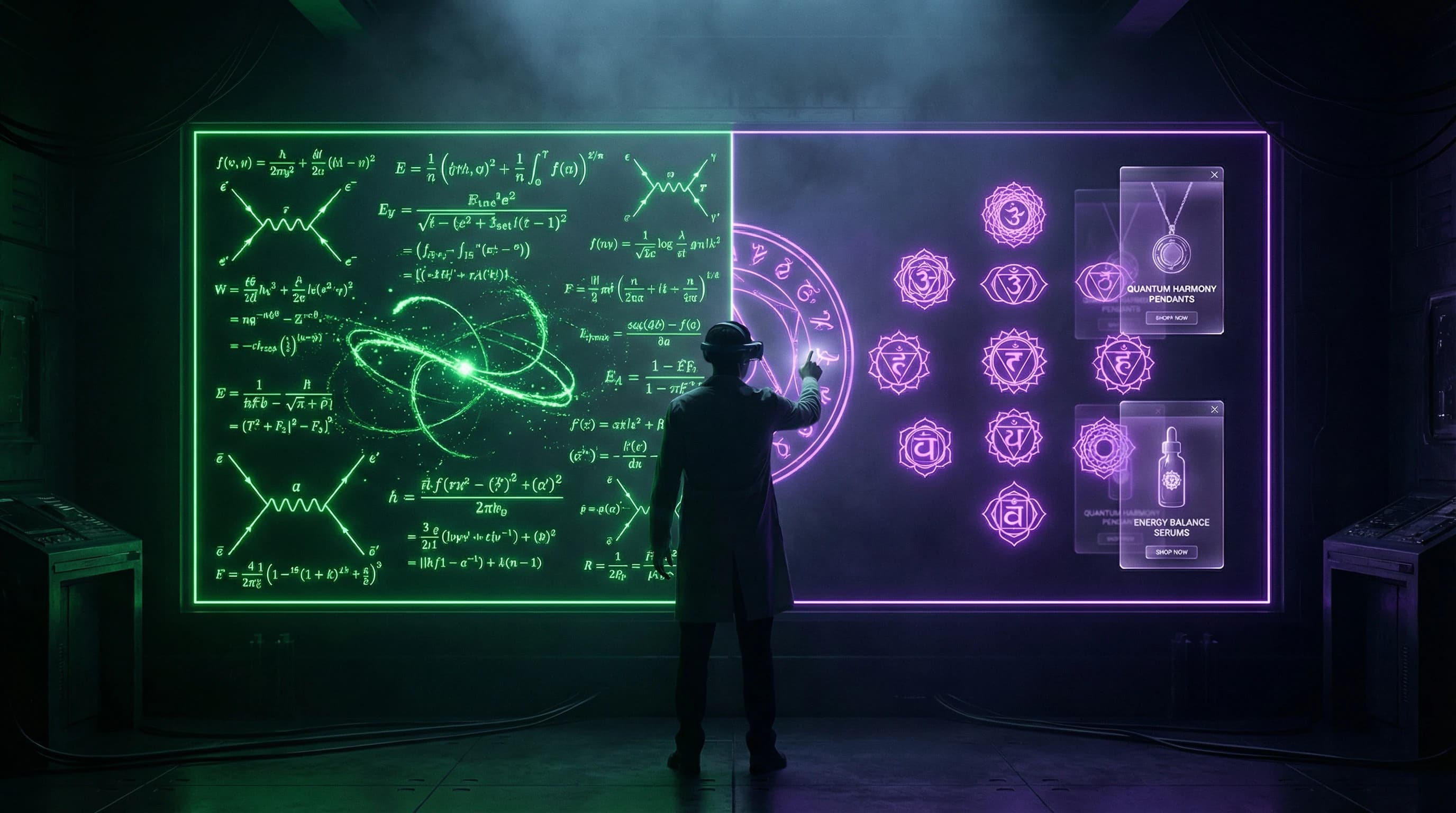
Quantum Mystification: When Physics Becomes Pseudoscienceλ
Exposing the abuse of quantum physics in marketing, healing, and mysticism — how to distinguish real science from pseudoscientific manipulation
Overview
Quantum mechanics operates at the atomic level — but scammers transpose it onto "thought energy" and "healing vibrations." Superposition, entanglement, wave function 🧬: the terms sound convincing, so they're exploited to sell supplements, seminars, and "quantum" amulets. We dissect the mechanics of substitution: where physics ends and manipulation of trust begins.
🛡️
Laplace Protocol: Critically evaluate any claims using quantum terminology outside the context of particle physics. Demand mathematical justification, peer-reviewed sources, and experimental evidence. Remember: real quantum mechanics is a precise mathematical theory, not mystical philosophy.
Reference Protocol
Scientific Foundation
Evidence-based framework for critical analysis
Protocol: Evaluation
Test Yourself
Quizzes on this topic coming soon
Sector L1
Articles
Research materials, essays, and deep dives into critical thinking mechanisms.
⚛️ Quantum Mysticism ⚛️ Quantum Mysticism
 ⚛️ Quantum Mysticism
 ⚛️ Quantum Mysticism
 ⚛️ Quantum Mysticism
⚡
Deep Dive
What lies behind the term "quantum mystification" and why it matters
Quantum mystification is the systematic misuse of quantum physics concepts to promote pseudoscientific claims, mystical beliefs, or commercial products. Legitimate principles of quantum mechanics (superposition, entanglement, observer effect) are inappropriately applied to consciousness, spirituality, healing—domains where quantum effects are scientifically irrelevant.
The term sounds complex and authoritative. Marketers exploit this to lend credibility to products without scientific foundation.
Four mechanisms of mystification
- Terminology appropriation
- Complex terms are used without proper scientific context, creating an illusion of depth.
- Marketing exploitation
- Scientific-sounding language increases the perceived value of a product or service.
- Scale conflation
- Quantum effects at the microscopic level are inappropriately extrapolated to macroscopic phenomena of everyday life.
- Appeal to authority
- Reference to physics is used to legitimize claims unrelated to quantum mechanics.
Quantum physics is genuinely counterintuitive and difficult to explain—this creates fertile ground for manipulation. The metaphorical language of popular science is often misinterpreted, while the mathematical rigor of actual quantum mechanics is absent in mystical appropriations.
From scientific debates to industry
The phenomenon traces back to the 1920s, when quantum mechanics was formulated during the positivist era, generating various philosophical interpretations. But legitimate scientific debates about interpretations are fundamentally different from mystical appropriations.
The gap between rigorous mathematical theory and its simplified explanations created space for speculation. Today, quantum mystification is a multimillion-dollar industry: books, courses, devices, supplements using quantum terminology without scientific evidence.
Five Major Myths About Quantum Physics That Scammers Exploit
Myth One: Consciousness Creates Physical Reality
The most widespread misconception claims that quantum physics proves consciousness can create reality through observation. In reality, the observer effect refers to measurement disturbance, not conscious observation—measuring devices, not consciousness, affect quantum systems.
Wave function collapse occurs through interaction with a measuring instrument, which can be completely automated and requires no conscious observer present.
- Mystical claim: thought materializes desires through quantum mechanism → Physical mechanism: wave function collapses through physical interaction with apparatus
- Mystical claim: "quantum manifestation" and "law of attraction" work through power of thought → Physical mechanism: no physical channel exists for consciousness to influence quantum systems
Myth Two: Entanglement Explains Telepathy and Mystical Connections
Quantum entanglement is often misrepresented as scientific justification for telepathy, mystical connections between people, or instantaneous information transfer across distances. The reality: entanglement cannot transmit information faster than light and does not create causal connections between distant events in the way mystical claims suggest.
Entanglement describes correlations between particles, but these correlations do not allow message transmission or influence on distant objects.
| Mystical Claim | Physical Fact |
|---|---|
| Entanglement = instantaneous connection across distance | Entanglement = correlations without information transfer |
| Nonlocality = telepathy | Nonlocality = correlations described by Bell's theorem |
| Can influence distant objects with thought | No mechanism for faster-than-light communication |
Myth Three: Quantum Mechanics Validates Ancient Mysticism
A widespread claim states that quantum mechanics scientifically confirms ancient mystical traditions and spiritual teachings. While both domains may use similar metaphorical language, quantum mechanics is a precise mathematical theory, not a validation of mystical traditions.
Similarity in phrasing does not mean conceptual equivalence. Quantum physics operates through rigorous equations and experimental predictions, while mystical traditions are based on subjective experience and metaphors.
Attempts to find parallels between quantum physics and Eastern philosophy ignore the fundamental difference between scientific method and spiritual practice. This is not a criticism of philosophy—it's an indication that different knowledge systems address different problems.
Anatomy of manipulation: how quantum deception works
Exploiting complex terminology to create an illusion of scientific credibility
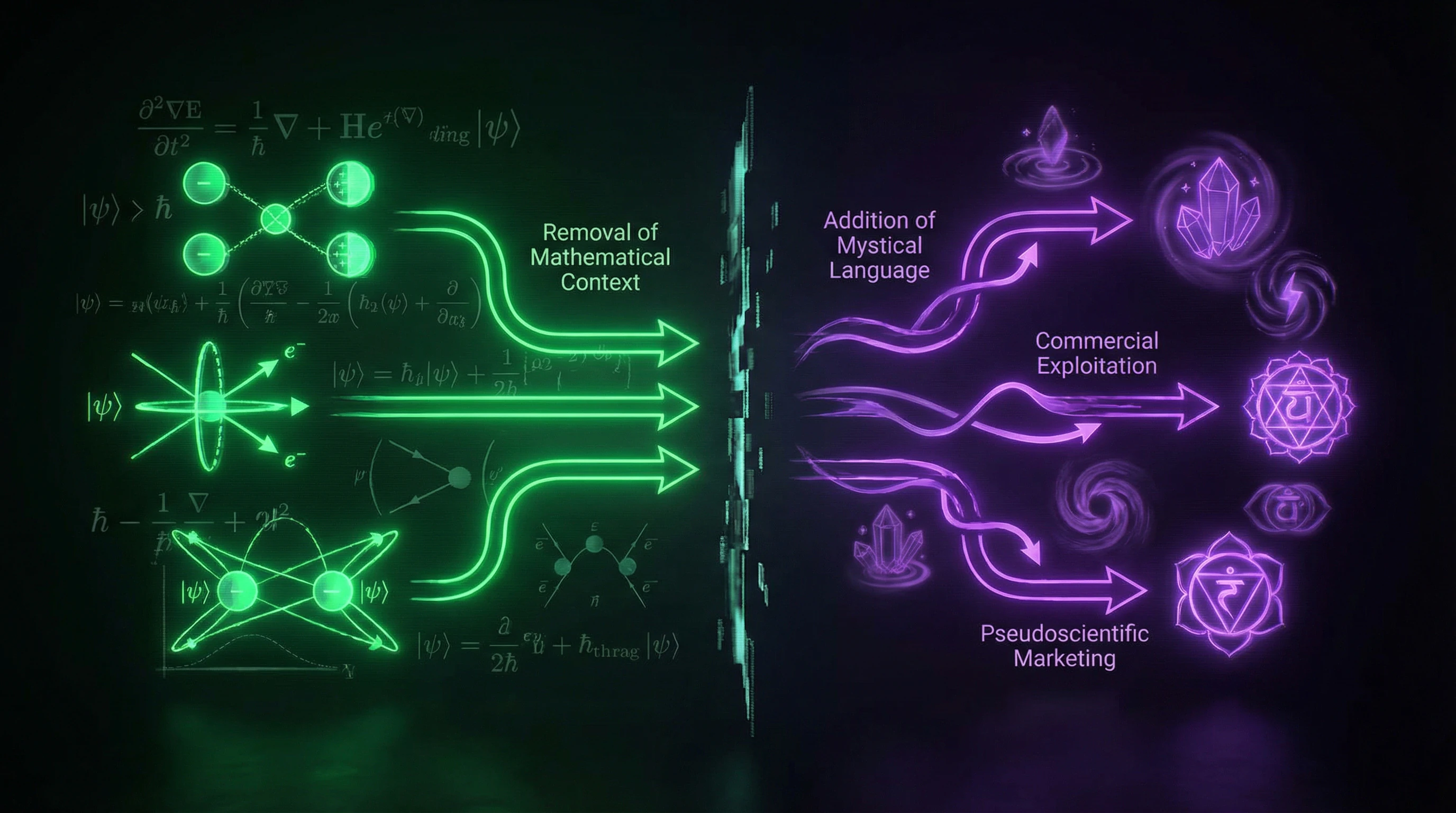
Quantum mystification appropriates terms from quantum physics without scientific context. "Quantum field," "wave function," "superposition," "collapse" — torn from their mathematical framework and inserted where they lose all meaning.
The strategy is simple: most people don't understand quantum mechanics, but recognize these terms as markers of cutting-edge science. Microscopic phenomena are applied to macroscopic everyday objects without justification.
- Term sounds scientific → creates halo of authority
- Context is blurred → meaning is lost
- Verification is difficult → audience cannot refute
Marketing strategies of quantum products
"Quantum energy," "quantum healing," supplements and devices with the quantum prefix — commercial exploitation of physics' prestige. Marketers add scientific-sounding language to products without scientific basis.
Typical scheme: create a pseudoscientific term that sounds impressive but has no operational definition or method of verification. Price is inflated precisely because of the "quantum" prefix.
- Courses promise to teach "quantum manifestation" or "quantum consciousness"
- None of these products have empirical support — only marketing.
- Target audience
- People seeking quick solutions and believing in hidden forces.
Appeal to authority and distortion of consensus
Pseudoscientific sources quote real physicists out of context, distort scientific debates about interpretations of quantum mechanics, or present marginal hypotheses as accepted theories.
This consensus is systematically ignored or distorted in commercial contexts to create a false impression of scientific support for mystical claims. Result: audiences believe the fraud has scientific foundation.
| Mystifiers' claim | Scientific consensus |
|---|---|
| Consciousness collapses the wave function | Collapse is linked to measurement apparatus, not observer |
| Quantum effects operate on macroscopic objects | Relevant only at atomic and subatomic scales |
| Quantum mechanics is mystical philosophy | Mathematical framework with precise predictions |
What Quantum Physics Actually Says
The Observer Effect and Measurement
The observer effect in quantum mechanics describes a fundamental change in a quantum system during measurement, but has nothing to do with conscious observation. The measuring apparatus—a physical device interacting with the quantum system—causes the collapse of the wave function, regardless of whether a conscious observer is present.
Mystifiers substitute the concept of "measurement" with "conscious observation," creating the false impression that human consciousness possesses a special ability to influence physical reality.
| What Physics Says | What Mystification Says |
|---|---|
| Wave function collapse is the result of physical interaction between the measuring device and the system | Human consciousness "observes" reality into existence |
| Automatic detectors without human participation produce identical effects | Consciousness possesses a special ability to influence matter |
Scale Limits of Quantum Effects
Quantum effects are relevant at atomic and subatomic scales, where Planck's constant becomes significant compared to the characteristic quantities of the system. At the macroscopic level, quantum coherence rapidly breaks down through decoherence—interaction with the environment that occurs within femtoseconds for everyday-scale objects.
Attempts to apply quantum superposition to the human body or consciousness ignore the fundamental limitations of decoherence.
Consciousness and the body are too "warm" as systems for quantum effects. Exceptional cases of macroscopic quantum phenomena (superconductivity, superfluidity) require extreme conditions and do not support mystical claims about quantum healing.
Scientific Consensus
Quantum mechanics is a mathematical framework with precise predictions confirmed by decades of experiments, not a mystical philosophy. The scientific community recognizes various interpretations (Copenhagen, many-worlds, de Broglie-Bohm), but all remain within strict mathematical formalization.
Quantum entanglement describes correlations between particles, but cannot transmit information faster than light and does not create causal connections between distant events in the manner suggested by mystical claims about telepathy.
- Quantum mechanics is a tool for calculations, not a key to mysticism
- Popularization through metaphors often leads to misinterpretations
- Misinterpretations are then exploited to promote pseudoscience
- Quantum mechanics does not validate ancient spiritual traditions nor explain consciousness

Red Flags and Signs of Mystification
Commercial Claims and Products
Products featuring "quantum energy," "quantum healing," or quantum terminology without scientific evidence represent classic exploitation of scientific prestige. Supplements, bracelets, devices, and courses promising "quantum manifestation" or "quantum consciousness" are systematically absent from peer-reviewed literature and have not undergone controlled trials.
Marketers use complex quantum terminology because it creates a false impression of scientific legitimacy among people without technical education. Regulatory agencies prosecute manufacturers for false advertising, but the problem remains widespread in online commerce.
Conceptual Errors
Applying quantum concepts to macroscopic objects without justification constitutes a fundamental category error that ignores the scale-dependence of physical phenomena. Claims about direct influence of thoughts on reality through quantum mechanics conflate subjective experience with objective processes without mechanistic explanation.
Concepts like "quantum doubles," "DNA energy," or "quantum twins" represent illegitimate extensions of scientific terms. Particularly problematic is the presentation of the many-worlds interpretation as literal parallel universes accessible through meditation, which distorts mathematics into mystical cosmology.
Linguistic Markers of Deception
Using quantum terminology without mathematical formalization or references to specific equations is a reliable indicator of pseudoscience. Phrases like "quantum field of consciousness," "quantum vibration," or "quantum frequency" have no defined meaning in physics and serve exclusively to create an impression of scientific legitimacy.
- Appeal to authority through mentioning famous physicists without precise citations or with quotes taken out of context.
- Conflating metaphorical language from popularization with literal physical claims.
- Absence of mathematical apparatus or references to experimental data.
- Using quantum terminology to explain psychological, spiritual, or social phenomena.
Conceptual confusion between metaphor and reality is the primary tool of mystifiers. When a science communicator speaks of a "probability wave" as a metaphor, that's one thing. When a mystifier presents the metaphor as a literal description of reality accessible through consciousness—that's something entirely different.
Quantum Claims Verification Checklist
Criteria for Legitimate Science
Legitimate scientific claims about quantum effects include mathematical formalization and specific references to Schrödinger's equation or other fundamental equations of quantum mechanics. Reproducibility of results by independent research groups and consistency with established physical principles are mandatory requirements.
Publication in high-level peer-reviewed journals (Physical Review, Nature Physics, Science) serves as a necessary condition for scientific credibility. Boundaries of applicability must be explicitly stated: scales, experimental conditions, statistical significance.
| Criterion | Legitimate Science | Mystification |
|---|---|---|
| Mathematical Foundation | Reference to fundamental equations | Only verbal description, no formulas |
| Source | High-level peer-reviewed journals | Blog, YouTube, self-published |
| Reproducibility | Independent groups obtained same results | Result not reproducible or unique |
| Consistency | Does not violate energy conservation, causality, locality | Violates principles without revolutionary revision |
Signs of Pseudoscience
Absence of falsifiable predictions and use of ad hoc hypotheses to explain contradictory data are classic markers of pseudoscience. Immunizing theory from criticism through appeals to "limitations of materialistic science" blocks any possibility of verification.
Exaggerating scientific consensus, presenting marginal hypotheses as accepted theories, and ignoring contradictory evidence are systematically encountered in quantum mysticism. Using anecdotal evidence instead of controlled experiments indicates methodological collapse.
If a theory cannot be disproven, it's not science—it's dogma. Falsifiability is not a weakness, but a sign of scientific validity.
- Absence of falsifiable predictions—theory cannot be disproven
- Ad hoc hypotheses to explain contradictions—each objection requires a new adjustment
- Immunization from criticism through appeals to "limitations of science"—blocks verification
- Exaggerating consensus and marginalizing contradictory data—distorting scientific status
- Anecdotal evidence instead of controlled experiments—substituting proof with stories
- Commercialization before scientific validation and resistance to independent verification—financial interest instead of truth
Recommendations for Content Creators
Consultation with qualified physicists before using quantum terminology is a minimum standard. Clear distinction between metaphorical and literal use of scientific terms prevents unintentional mystification.
Avoiding simplified analogies that may be misinterpreted as literal explanations, and explicitly stating the limitations of popularization are necessary conditions for responsible content.
- Consultation with qualified physicists before publication
- Explicit distinction between metaphor and literal meaning
- Warning about simplified analogies and their boundaries
- References to primary sources and quantum mechanics textbooks
- Explicit warning about common misconceptions and commercial exploitation

Knowledge Access Protocol
FAQ
Frequently Asked Questions
Quantum mysticism is the misuse of quantum physics terminology to promote pseudoscientific ideas, mystical beliefs, or commercial products. The phenomenon includes improper application of legitimate quantum concepts (superposition, entanglement) to consciousness, spirituality, or health, where quantum effects are scientifically irrelevant. Marketers use complex terminology to lend credibility to unfounded claims.
Quantum mechanics sounds complex and authoritative, making it attractive for manipulation. Counterintuitive concepts are difficult to explain in simple language, creating space for distortions. The prestige of physics as a science automatically adds apparent legitimacy to any claims with the prefix "quantum."
No, this is a common myth. The observer effect refers to measuring instruments, not conscious observation. Measuring devices (not consciousness) affect quantum systems through physical interaction. Scientific consensus does not support the idea that thoughts create material reality.
No, entanglement cannot transmit information faster than light and does not create causal connections between events. It is a correlation between particles, not a mystical link. Attempts to use entanglement to explain telepathy contradict fundamental principles of quantum mechanics and relativity theory.
Quantum effects manifest predominantly at atomic and subatomic levels. At the macroscopic level (everyday objects, people), quantum phenomena decohere almost instantaneously. Applying quantum concepts to macro-objects without rigorous scientific justification is a sign of mystification.
Quantum healing is a pseudoscientific field that uses quantum physics terminology to promote unproven treatment methods. There is no scientific evidence that quantum effects can be applied to healing at the biological level. This is a typical example of commercial exploitation of scientific terminology.
Legitimate science operates with mathematical models, testable experiments, and publications in peer-reviewed journals. Mystification uses vague metaphors, promises miraculous results, and avoids specific measurable predictions. A red flag is commercial products with the prefix "quantum" without technical documentation.
No, this is a false analogy. While both fields may use similar metaphorical language, quantum mechanics is a precise mathematical theory with specific predictions. Superficial similarity in phrasing does not mean scientific confirmation of mystical traditions formulated millennia ago without an experimental basis.
Typical examples: "quantum" health bracelets, devices for "energy harmonization," supplements with "quantum activation," devices for "quantum diagnostics." Also popular are trainings on "quantum leaps of consciousness" and books about "quantum thinking." All exploit scientific terminology without actual application of quantum physics.
Yes, real quantum technologies exist: quantum computers, quantum cryptography, quantum sensors. These developments are based on rigorous mathematics, undergo scientific peer review, and have measurable technical specifications. They are fundamentally different from pseudoscientific "quantum" products for health or consciousness.
The problem isn't popularization itself, but distortions that occur during simplification. The metaphorical language of popular science is often misinterpreted, creating fertile ground for mystification. The mathematical rigor of actual quantum mechanics gets lost, leaving only mysterious formulations that are easily exploited.
Marketers add the word "quantum" to products to create an impression of scientific credibility and innovation. Complex terminology discourages critical questions and creates an aura of expertise. The strategy works because most consumers don't understand quantum physics and trust scientific-sounding claims.
The many-worlds interpretation is a scientific hypothesis that all quantum possibilities are realized in different branches of reality. Mystifiers distort it into an idea about "parallel universes" that you can "jump into" through the power of thought. The scientific interpretation doesn't suggest conscious access to alternative realities.
Direct application of quantum mechanics to psychology is not scientifically justified, as the brain operates at a macroscopic level. Some researchers are studying possible quantum effects in neurons, but this is a speculative area without consensus. Most "quantum-psychological" methods are pseudoscience.
Typical markers: "quantum leap of consciousness," "energy vibrations," "DNA activation," "quantum field of possibilities." Also suspicious are phrases like "scientists have proven" without references to specific studies. An abundance of metaphors combined with absence of mathematics or measurable parameters is a clear sign of mystification.
Verify sources through peer-reviewed scientific journals, consult with physicists, avoid simplifications that distort the essence. Clearly distinguish between scientific facts, hypotheses, and metaphors. If you're not confident in your understanding of a quantum concept—it's better not to use it at all than to spread mystification.