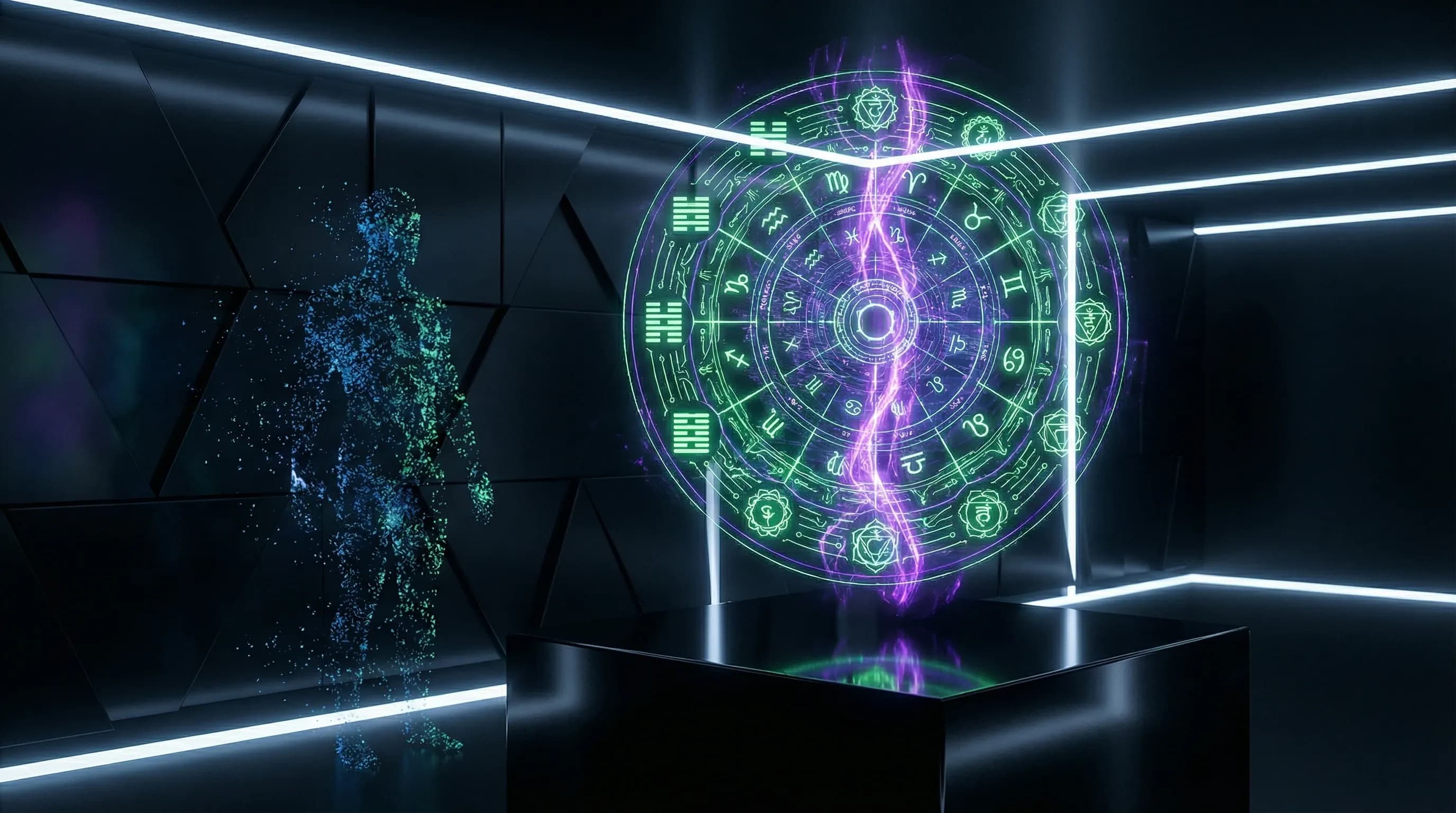
What is Human Design and why it's called "the next big thing" in the wellness industry
Human Design positions itself as a synthetic self-knowledge system combining elements of Western astrology, the Chinese I Ching, the Hindu chakra system, Kabbalah, and quantum physics. The system's creator, Ra Uru Hu (real name Robert Alan Krakower), claimed he received this knowledge in 1987 during a mystical experience on the island of Ibiza. More details in the Cryptozoology section.
The system classifies people into five "types" (Manifestor, Generator, Manifesting Generator, Projector, Reflector) based on date, time, and place of birth, promising to reveal a person's "true nature" and purpose.
| System Component | Source | Scientific Status |
|---|---|---|
| Astrology (zodiac, planets) | Western tradition | No empirical support |
| I Ching (hexagrams, lines) | Chinese philosophy | System of symbolism, not prediction |
| Chakras (energy centers) | Hindu tradition | Metaphorical system, not anatomy |
| Kabbalah (tree of life) | Jewish mysticism | Symbolic system |
| Quantum physics (terminology) | Modern science | Used metaphorically, no connection to actual physics |
Terminological camouflage: how ancient concepts are repackaged as a modern product
A key feature of Human Design is its use of scientific-sounding terminology to describe esoteric concepts. The system employs terms like "bodygraph" (chart of energy centers), "authority" (decision-making mechanism), "profile" (combination of I Ching lines), "gates," and "channels" (connections between centers).
This terminology creates an impression of complexity and scientific rigor, though none of these terms have operational definitions that can be empirically tested.
Marketing mechanics of "the next big thing": why the wellness industry needs constant renewal
The term "next big thing" in the wellness context isn't describing a scientific breakthrough—it's a marketing strategy. The wellness industry needs a constant stream of new products and services to sustain growth.
- Why Human Design is ideal for this logic
- Complex enough to require paid consultations and courses; personalized enough to create a sense of uniqueness; vague enough to avoid falsification.
- How it works
- The concept of "wellness as the next big thing" reflects not scientific progress, but the industry's economic need for constant product innovation (S001).
Boundaries of analysis: what we can and cannot test in the Human Design system
Critical analysis of Human Design faces a fundamental problem: the system is constructed to be unfalsifiable. Predictions are formulated so vaguely that they cannot be disproven.
- The claim "Generators should wait for life to respond" can be interpreted in infinite ways
- We can verify whether scientific evidence exists for the system's effectiveness
- We can analyze the psychological mechanisms behind its appeal
- We cannot "disprove" the system itself in a strict sense—it makes no testable predictions
This means Human Design analysis should focus not on attempting to prove it false, but on understanding why people believe in it and what psychological mechanisms explain this. Psychology of belief shows that unfalsifiability isn't a bug—it's a feature for attracting and retaining adherents.

The Steel-Man Argument: Seven Reasons Why People Believe Human Design Works
Before examining the system's weaknesses, it's necessary to understand its strengths — not in terms of scientific validity, but in terms of psychological persuasiveness. The steel-man argument requires presenting the opponent's position in its strongest form. For more details, see the section on Paranormal Phenomena and UFOlogy.
Seven reasons why Human Design works for millions of people, even if it doesn't work in a scientific sense.
💎 Personalization as a Drug: Why Individual Approach Beats Statistics
Human Design offers not generic advice, but a personalized chart created based on precise birth data. This creates a powerful sense of relevance.
People are willing to pay significantly more for personalized products and services, even when personalization is superficial (S001). In an era where Netflix and Spotify algorithms create the illusion that technology "understands" us, Human Design exploits the same need for personalized attention, but in the realm of self-knowledge.
🧠 The Barnum Effect in Action: Why Vague Descriptions Seem Accurate
Type descriptions in Human Design are formulated so that most people find something relevant to themselves. This is the classic Barnum effect — people's tendency to accept vague, general personality descriptions as accurately describing their individuality.
Phrases like "you are sensitive to other people's energy" or "it's important for you to follow your inner authority" apply to most people, but are perceived as unique insights. This is a mechanism that works independently of the system's content — only the structure of vagueness matters.
🔁 Self-Fulfilling Prophecy: How Belief in the System Creates Confirming Evidence
When a person learns they are a "Projector" who should "wait for the invitation," they begin interpreting their experience through this lens. Instances where waiting led to success are remembered and reinforce belief in the system.
Instances where waiting led to missed opportunities are ignored or reinterpreted. Belief in the system changes behavior, which then creates experiences that confirm the belief — a closed loop that requires no objective validity.
🧩 Community and Identity: The Social Currency of Belonging to the "Knowing"
Human Design creates a community of like-minded individuals with a shared language and coordinate system. Knowing your type becomes a form of social currency, a way to signal belonging to a particular group.
In an era of fragmenting traditional identities, alternative systems like Human Design fill the vacuum, offering a sense of belonging. This is especially powerful in the context of belief psychology, where group identity reinforces conviction.
⚙️ Cognitive Offloading: Outsourcing Complex Decisions to an External System
Decision-making is a cognitively expensive process, especially under conditions of uncertainty. Human Design offers a ready-made algorithm: "follow your authority," "wait for the invitation," "trust your sacral response."
This reduces cognitive load and anxiety associated with choice. Even if the system doesn't objectively improve decision quality, it can improve the subjective sense of confidence and reduce stress from having to choose.
🧬 Narrative Coherence: The System as a Tool for Creating Meaning from Experiential Chaos
Human Design offers a narrative framework for interpreting life experience (S002). Past failures are explained by the person "not living according to their design." Current difficulties — by "not yet being fully deconditioned."
Future successes — as the result of "following your strategy." This narrative coherence creates a sense of meaning and control, even if causal relationships are illusory. Humans are story-creating beings, and a system that helps create a coherent story about oneself possesses powerful psychological appeal.
💡 The Placebo Effect in Self-Knowledge: When Belief in a Tool Creates Real Changes
If a person believes that Human Design helps them better understand themselves, this belief can lead to real changes in behavior and self-perception. This doesn't mean the system works as it claims.
The placebo effect is real and measurable, especially in contexts related to subjective well-being, self-esteem, and interpersonal relationships. Human Design can function as a self-knowledge ritual that triggers real psychological processes, regardless of the validity of the underlying theory. For more on the mechanisms of such influence, see the article on pseudopsychology and its tools.
- Personalization exploits the need for individual attention
- The Barnum effect makes vagueness an advantage, not a flaw
- Self-fulfilling prophecy creates a closed loop of confirmation
- Community provides social reinforcement of belief
- Cognitive offloading reduces subjective stress from choice
- Narrative framework transforms chaos into meaning
- Placebo effect produces real psychological changes
Evidence Base: What Science Says About Systems Like Human Design
No published peer-reviewed research exists confirming the validity or reliability of Human Design. This doesn't mean disproof — the system has simply never been tested according to scientific method standards. More details in the Alternative History section.
However, we can analyze the evidence base for the components that make up Human Design, and for similar personality typology systems.
📊 Astrology and Predictive Validity
One of Human Design's key components is astrology. Meta-analyses consistently show no connection between astrological variables (planetary positions at birth) and personality characteristics, career preferences, or life events.
Correlations, when found, don't exceed chance levels and disappear when controlling for multiple comparisons. Astrology may be useful as a reflection tool, but its predictive claims are not empirically supported.
Lack of empirical validity doesn't mean lack of psychological effect. It means the mechanism doesn't work the way the system claims.
🧪 I Ching as a Predictive System
The I Ching (Book of Changes) is an ancient Chinese text used for divination. Human Design incorporates the 64 hexagrams of the I Ching as "gates" in its system.
However, the I Ching has never been subject to systematic empirical testing in the context of predicting future events or describing personality characteristics. It's a cultural and philosophical artifact, not a tool with proven predictive validity.
- Borrowed Authority
- Human Design's use of the I Ching is borrowing cultural authority, not scientific validity. A text's antiquity doesn't equal empirical validity of its predictive mechanisms.
🧾 Energy Centers: Metaphor Versus Physiology
Human Design uses a concept of nine energy centers, partially based on the Hindu chakra system. Chakras are a metaphorical system used in traditional meditation and yoga practices, not anatomical structures.
No physiological evidence exists for "energy centers" in the sense Human Design describes them. Meditation and yoga have proven health benefits, but these benefits don't depend on chakras being real as physical objects.
🔎 Personality Typologies: Scientific Models Versus Pseudoscientific
Scientifically validated personality models exist, such as the Big Five (Five Factor Model), which have undergone decades of empirical testing. They differ from Human Design fundamentally.
| Criterion | Big Five | Human Design |
|---|---|---|
| Data Source | Factor analysis of large behavioral datasets | Theoretical speculation based on astrology and I Ching |
| Test-Retest Reliability | Proven; measurement stability over time | Not tested |
| Predictive Validity | Confirmed for career, relationships, health | Not confirmed |
| Openness to Falsification | Constantly revised based on new data | Closed; contradictions explained as interpretation errors |
Human Design meets none of these criteria. This doesn't mean the system is psychologically useless — see psychology of belief and cognitive biases to understand the mechanisms of its influence.
However, lack of scientific foundation means any claims about Human Design's predictive or diagnostic validity remain unsubstantiated. This places Human Design alongside other typology systems that don't withstand scientific scrutiny, despite their popularity.

Mechanisms of Influence: Why Human Design Works Psychologically but Not Scientifically
The key question isn't whether Human Design works (in terms of corresponding to reality), but why it seems to work for those who use it. The gap between subjective perception of effectiveness and objective validity isn't a bug—it's a feature of the system. More details in the Statistics and Probability Theory section.
Understanding the psychological mechanisms that create this perception is critically important for assessing the real risks and benefits of the system.
🧬 Confirmation Bias: How We Find What We're Looking For
Confirmation bias is the tendency to search for, interpret, and remember information in ways that confirm our existing beliefs (S001). When someone learns their Human Design type, they begin noticing examples that confirm the description while ignoring or forgetting examples that contradict it.
This isn't conscious deception—it's an automatic cognitive process that operates in everyone. Systems like Human Design are specifically constructed to maximize opportunities for confirmation bias.
Vague type descriptions work better than precise ones: the more gaps in the portrait, the more room for the person to fill them with their own experience.
🔁 Illusion of Causality: Correlation That Doesn't Exist and Causation We Invent
People tend to see cause-and-effect relationships even where only random coincidence exists. If someone follows a Human Design recommendation and then experiences a positive outcome, they're inclined to attribute the result to the recommendation, ignoring other possible causes: changed circumstances, natural mood variability, placebo effect, regression to the mean.
This is the illusion of causality—we see patterns and connections that don't exist because our brains evolved to detect patterns, even at the cost of false positives (S002).
- Regression to the Mean
- A statistical phenomenon: if you're in an extreme state (very bad, very good), the next measurement will likely be closer to average. Human Design is often recommended during crisis moments—improvement will occur regardless of the system.
- Placebo Effect
- The expectation of improvement activates real physiological mechanisms. This doesn't mean the system works, but it explains why people feel results.
🧷 Anchoring Effect: How the First Description Determines All Subsequent Perception
The anchoring effect is a cognitive bias where initial information disproportionately influences subsequent judgments. When someone first reads their Human Design type description, that description becomes an anchor for self-perception.
All subsequent self-observations are interpreted relative to this anchor. Even if the description is vague or partially inaccurate, it creates a framework through which the person begins to see themselves. This resembles the psychology of belief—the anchor works more powerfully than logic.
| Mechanism | How It Works in Human Design | Result |
|---|---|---|
| Anchor | "You're a Manifestor with Line 3" | All behavior gets reinterpreted through this category |
| Confirmation | You notice moments when you actually initiate | You forget moments when you wait or respond |
| Causality | Success after following a recommendation | You attribute success to the system, not circumstances |
⚙️ Cognitive Dissonance and Sunk Cost Fallacy: Why It's Hard to Abandon the System After Investment
Cognitive dissonance is the discomfort arising from conflicting beliefs or from inconsistency between beliefs and behavior. If someone has invested time, money, and emotional energy in studying Human Design, acknowledging that the system doesn't work creates strong dissonance.
It's psychologically easier to rationalize the investment by finding confirmations of the system's effectiveness than to admit the investment was wasted. This is the sunk cost fallacy, which operates not only for financial but also for psychological investments. Compare with other pseudopsychological systems—the pattern is identical.
- Person pays for a consultation or course
- System doesn't deliver expected results
- Instead of abandoning it, person looks for the problem in themselves: "I'm applying it wrong," "I need a deeper consultation"
- Investment grows, abandonment becomes psychologically impossible
The system works not because it's true, but because the person has invested resources in it. The more invested, the stronger the belief in its effectiveness.
Conflicts and Uncertainties: Where Sources Diverge and What It Means
Analysis of available sources reveals a fundamental problem: the absence of scientific literature on Human Design makes it impossible to identify conflicts between studies. However, we can identify conflicts between the system's claims and scientific consensus in related fields. More details in the Scientific Method section.
🧩 Quantum Physics in Human Design: Borrowing Authority vs. Real Content
Human Design frequently appeals to quantum physics to justify claims about "energy fields" and "neutrinos." This is a classic example of quantum mysticism—the illegitimate use of quantum mechanics terminology to justify esoteric claims.
Quantum effects do exist, but they manifest at the subatomic level and have no relation to macroscopic phenomena such as personality or decision-making.
Physicists consistently criticize such use of quantum terminology as scientifically illiterate. The mechanism is simple: terms from an authoritative field (physics) are transferred to a domain without empirical foundation, creating an illusion of scientific validity. This works psychologically because most people cannot distinguish between quantum mechanics and its popular interpretations.
🔎 Determinism vs. Free Will: The Philosophical Conflict at the System's Core
Human Design contains an internal contradiction: the system claims your type is determined at birth and unchangeable (determinism), yet simultaneously urges you to "follow your design" and "decondition yourself" (which presupposes freedom of choice).
- Determinism in Human Design
- Your type is fixed by birth coordinates and does not change. This creates a sense of predetermination and removes responsibility for choice.
- Free Will in Human Design
- You are urged to actively "decondition" and make decisions according to your type. This requires agency and personal responsibility.
The system does not resolve this fundamental philosophical conflict but masks it behind complex terminology. Users get the convenience of predetermination and simultaneously the illusion of control—psychologically this is a powerful combination, but logically it is a contradiction.
📊 Universality vs. Cultural Specificity: Does the System Work the Same Everywhere
Human Design claims universality—the system should work identically for all people regardless of cultural context. However, the concepts used in the system (chakras, I Ching, astrology) have culturally specific origins and meanings.
| System Component | Cultural Origin | Universalization Problem |
|---|---|---|
| Chakras | Indian tradition | No evidence of validity outside origin context |
| I Ching | Chinese philosophy | Reinterpreted for Western audiences |
| Astrology | Ancient systems from various cultures | Meaning varies depending on cultural context |
| Personality typology | Western psychology | Assumes fixedness alien to many cultures |
There is no evidence that these concepts have equal validity across different cultural contexts. The idea of fixed personality types is more characteristic of Western psychology than of many non-Western cultures, where personality is viewed as contextually dependent and changeable. This means Human Design may function as a cultural artifact of Western thinking rather than as a universal system.
Related materials: Human Design: Quantum Astrology Without Quanta or Design, DNA energy and quantum mechanics.
Cognitive Anatomy of Persuasion: What Psychological Traps Human Design Exploits
Human Design is not just a set of claims about personality, it's a carefully constructed system of persuasion that exploits numerous known cognitive vulnerabilities. Understanding these mechanisms is critically important not only for evaluating Human Design, but also for developing general literacy regarding pseudoscientific systems. More details in the News section.
⚠️ The Barnum Effect in Detail: Anatomy of "Personalized" Descriptions
The Barnum Effect works through a combination of several techniques: statements applicable to most people ("you sometimes doubt your decisions"); double statements covering opposite possibilities ("you can be both outgoing and reserved"); positive statements people want to believe are true about themselves ("you have untapped potential"); vague formulations allowing everyone to find their own interpretation.
Human Design masterfully uses all these techniques simultaneously. Each user receives a description that is both specific (lots of details, terms, numbers) and universal (applicable to their life, whatever it may be). This creates the illusion of hitting the mark precisely.
🕳️ Illusion of Depth: How Complexity Masks Absence of Content
Human Design uses a complex visual system (bodygraph), numerous terms, and multi-level classification. This complexity creates an illusion of depth—a feeling that serious knowledge underlies the system.
Complexity does not equal validity. A system can be arbitrarily complex while having no predictive power. The illusion of depth is a cognitive trap where we confuse complexity with truth, detail with accuracy.
The more details, the more points of contact between the system and the user's reality. Even random coincidences begin to seem like patterns.
🔄 Confirmation Bias and Selective Attention
When a person recognizes themselves in their Human Design description, they begin noticing only those events and character traits that confirm it. Contradictory examples are either ignored or reinterpreted to fit the system.
- Person reads: "You are intuitive and often rely on your inner voice"
- Recalls instances when intuition didn't fail them
- Forgets or reframes instances when intuition did fail them
- Belief in the system's accuracy strengthens
This mechanism works regardless of how accurate the system actually is. Cognitive biases activate automatically, without conscious participation.
💰 Social Proof and Network Effect
Human Design spreads through communities, social networks, and recommendations. When many people say the system works, it creates social proof—a feeling that if others believe it, it must be true.
| Mechanism | How It Works in Human Design | Cognitive Vulnerability |
|---|---|---|
| Friend's recommendation | "It helped me, try it" | Trust in close relationships |
| Community of like-minded people | Social media groups, forums | Belonging, consensus |
| Visible results | People share positive stories | Selective attention to successes |
| Authority | Famous people use the system | Argument from authority |
Social proof is amplified through viral fakes and selective information distribution. People disappointed by the system are less active in criticizing it than people who believe in it.
🎯 Narcissistic Supply: The System as Mirror of Desires
Human Design offers not just a description, but a flattering one. The system says you are unique, that you have a special mission, that you're not just one of billions but a carrier of a particular energy type.
This feeds narcissistic needs—the desire to be special, significant, understood. The system doesn't just explain who you are, it affirms that you matter exactly as you are. This is a powerful psychological hook, especially for people experiencing existential loneliness or identity crisis.
⏱️ Time Factor: How Long-Term Engagement Strengthens Belief
Human Design works as a long-term investment in belief. A person doesn't just read the description once—they return to it, delve deeper into the system, pay for consultations, participate in the community.
- Escalation of commitment
- The more time and money invested, the harder it is to admit the system doesn't work. Psychologically, this is called cognitive dissonance—a person reframes their doubts to align with the choice already made.
- Constant system expansion
- Human Design continuously adds new levels of complexity, new interpretations, new services. This prevents saturation and maintains interest. Each new level requires new investments.
- Community as anchor
- People who've invested in Human Design become part of a community. Leaving the system means losing a social group, which is psychologically painful.
🧠 Why These Traps Are Universal
These mechanisms work not because people are foolish, but because they're built into our cognitive architecture. The psychology of belief shows that even scientists and critical thinkers are susceptible to these traps when it comes to systems that attract them.
Human Design simply uses these mechanisms more skillfully than most other systems. This isn't a conspiracy, it's persuasion engineering—applying known principles of psychology to create a self-sustaining belief system.