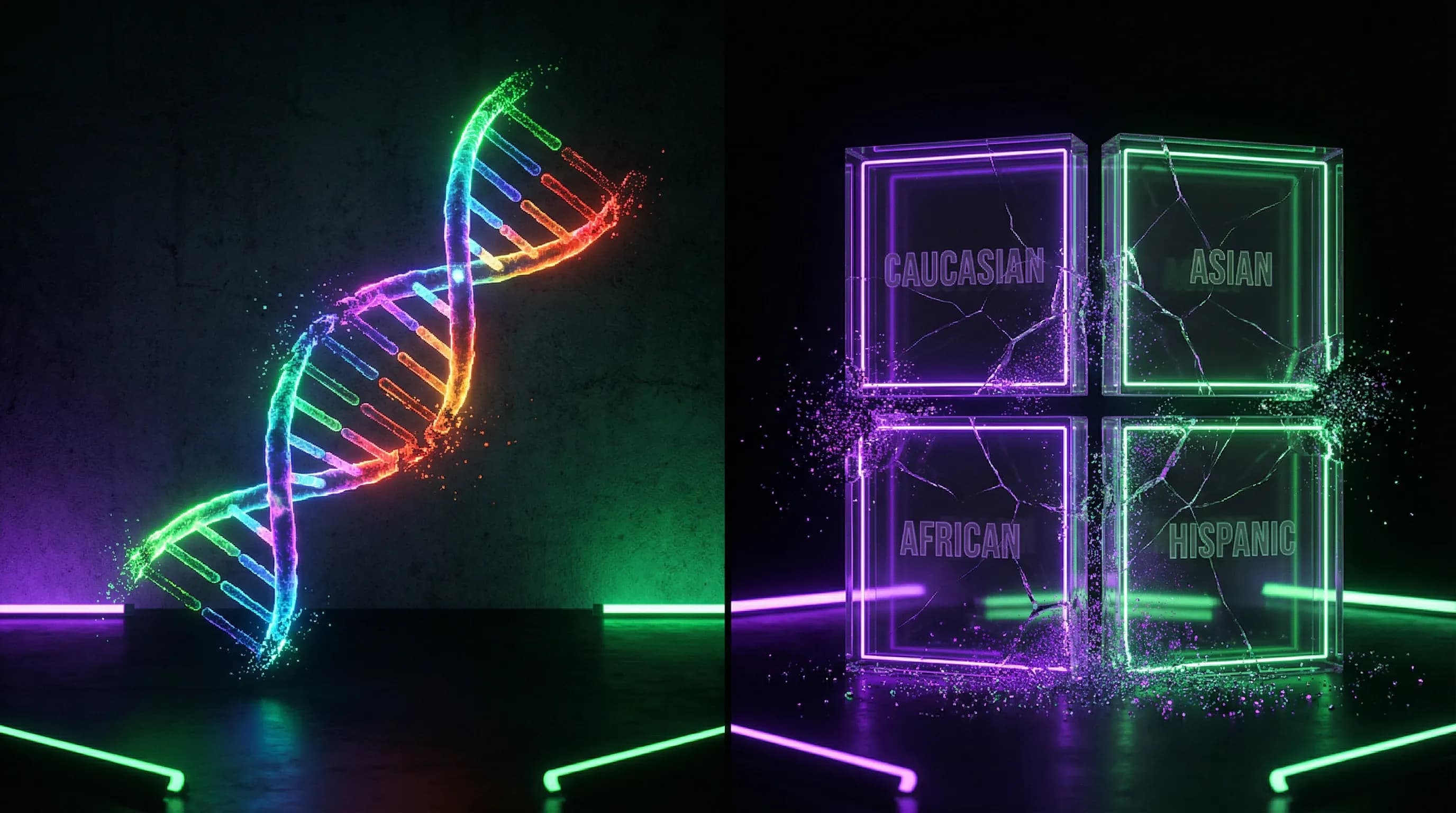
What We're Actually Discussing When We Talk About Race: Terminological Chaos as a Source of Endless Disputes
The first problem with debates about race is that participants use one word to denote completely different phenomena. A biologist talks about population clusters with specific allele frequencies. A sociologist refers to a system of social stratification based on perceived physical differences. A layperson thinks of race as clear, discrete categories of people with common ancestry and appearance. More details in the section Secret Devices.
All three are talking about different things but using the same word—and then wonder why they can't reach agreement.
- Biological Definition
- Population clusters with a certain degree of genetic differentiation and geographic isolation. For some mammalian species, this concept works clearly—for example, chromosomal races of common shrews Sorex araneus with different chromosomal rearrangements serving as the basis for reproductive isolation.
- Sociological Definition
- A system of categorizing people, created and maintained by social institutions, practices, and beliefs. Social constructs may be unreal in origin but have very real consequences (S001).
- Common Understanding
- Race as a self-evident category based on visible physical differences—skin color, facial features, hair texture. Relies on the brain's ability to quickly categorize people by external characteristics.
Genetic Reality: Why Boundaries Are Blurred
Applying the biological model of race to humans encounters a fundamental problem: genetic variability within human populations significantly exceeds variability between them. About 85–90% of all human genetic variation is due to differences between individuals within a single population, and only 10–15% is due to differences between continental groups (S001).
This makes any attempts to draw clear biological boundaries between "races" arbitrary and dependent on the choice of specific genetic markers.
Social Variability: One Word, Different Systems
Racial categories are not natural or inevitable—they vary between cultures and historical periods. What is considered "race" in the United States (the "one-drop rule") differs radically from racial classifications in Brazil (a complex system of intermediate categories) or in South Africa during apartheid (legal definitions included social criteria like "public acceptance").
This variability shows that racial categories are products of specific historical and political contexts, not reflections of biological reality.
Visual Traits: The Illusion of Clarity
The traits we associate with race represent a tiny fraction of human genetic variability and are often the result of convergent evolution. Dark skin independently evolved in populations in different parts of the world as an adaptation to high levels of ultraviolet radiation.
| Trait | Genetic Reality |
|---|---|
| Skin color | Controlled by several genes; convergent evolution in different regions |
| Facial features | High variability within populations; weak correlation with geography |
| Hair texture | Adaptation to climate; not a marker of deep genetic division |
Genetically, an African from Ethiopia may be closer to a European than to an African from West Africa, despite similarity in skin color. Visual differences mask the real genetic structure of populations.
Steel Man: Seven Strongest Arguments for the Biological Reality of Race
Before examining the weaknesses of the biological race concept, we must honestly present the strongest arguments in its favor. Intellectual honesty requires not attacking a straw man, but confronting the most convincing version of the opposing position. More details in the Alternative History section.
🧬 Argument One: Genetic Clusters Correspond to Continental Groups
Modern methods of analyzing genetic population structure—STRUCTURE and principal component analysis (PCA)—reveal clusters that generally correspond to continental groups: Africans, Europeans, Asians, Native Americans, and Oceanians (S001). These clusters are not artifacts of biased analysis—they emerge from objective patterns of genetic similarity and difference.
When analyzing hundreds of thousands of SNPs, clustering algorithms consistently group individuals into categories that correlate with geographic origin. This results from real population history: migrations, isolation, genetic drift.
- Clusters emerge from objective genetic patterns, independent of researcher assumptions
- Correlation between genetic clusters and geography is reproducible across different datasets
- Patterns reflect actual population history, not social categories
📊 Argument Two: Medical Relevance of Racial Categories
Certain diseases and drug responses show different frequencies across racial groups (S002). Sickle cell anemia is more common among people of African descent. Tay-Sachs disease affects Ashkenazi Jews disproportionately. Lactose intolerance varies between populations depending on pastoral history.
The drug BiDil for heart failure was FDA-approved specifically for African Americans based on efficacy differences. If race has no biological significance, how do we explain these medical differences?
🧪 Argument Three: Predictive Power of Race for Genetic Ancestry
Self-identified race predicts genetic ancestry with correlations exceeding 0.9 (S001). Research shows that racial categories, despite being socially constructed, capture real information about genetic population structure.
Forensic genetics successfully uses genetic markers to predict continental ancestry from DNA samples. If race is a pure social construct without biological basis, where does this predictive accuracy come from?
🔁 Argument Four: Evolutionary History and Adaptation to Local Conditions
Human populations were geographically isolated for tens of thousands of years, creating conditions for local adaptation. Light skin in Europeans is an adaptation to low UV radiation levels, necessary for vitamin D synthesis. High-altitude adaptation in Tibetans includes specific genetic variants affecting oxygen metabolism.
Adult lactose digestion ability evolved independently in several populations with dairy farming histories. These adaptations reflect real evolutionary pressures and genetic changes that vary between populations.
Doesn't local adaptation to climate, diet, and altitude prove that human groups differ biologically in ways that go beyond superficial visual traits?
🧾 Argument Five: Archaeological and Paleontological Identification of Race
Physical anthropologists determine racial affiliation from skeletal remains with reasonable accuracy, using morphological features of the skull, pelvis, and other bones (S005). Skull shape, facial proportions, and bone structure vary between populations in measurable and classifiable ways.
Archaeologists use these methods to reconstruct migrations and population history. Forensic anthropologists apply them to identify unknown remains. This practical applicability of morphological differences suggests that racial categories reflect real biological patterns.
🧬 Argument Six: Heritability of Racial Traits
Physical traits associated with race—skin color, hair texture, facial features—are clearly heritable and have genetic bases. Children inherit these traits from parents in predictable patterns. Specific genes affecting skin pigmentation are known: MC1R, SLC24A5, SLC45A2.
If these traits are genetically determined and cluster in populations, doesn't that make race a biological reality?
🔬 Argument Seven: Success of Racial Medicine and Pharmacogenetics
Pharmacogenetics shows that genetic variants affecting drug metabolism are unevenly distributed across populations (S004). Variants of CYP450 genes, which metabolize many drugs, have different frequencies in different racial groups, leading to differences in efficacy and side effects.
Ignoring race in medicine can lead to suboptimal treatment and patient harm. Proponents of the biological race concept argue that denying racial differences out of political correctness endangers patient health and impedes personalized medicine development.
- Key Tension
- All seven arguments rest on real data: genetic clusters exist, medical differences are documented, predictive power of racial categories is measurable. The question is not whether the facts are true, but what they mean and how to interpret them.
What the Data Actually Shows: Detailed Analysis of Genetic, Anthropological, and Medical Evidence
Now, having presented the strongest arguments for biological race, we can honestly assess what the scientific data tells us. The key question isn't whether genetic differences between populations exist — they obviously do. More details in the Pseudoscience section.
The question is whether these differences correspond to traditional racial categories and whether they justify using race as a biological concept.
🔬 Genetic Structure: Clusters Exist, but Boundaries Are Blurred
Clustering methods reveal genetic groups that correlate with geography. But critically: these clusters are not discrete, clearly demarcated categories.
They represent a continuum with gradual transitions. The number of clusters you "find" depends on analysis parameters — you can get 3, 5, 7, or 20 clusters depending on how you configure the algorithm.
Most genetic variation (85–90%) exists within populations, not between them. Two randomly selected Africans may differ genetically more than an African and a European.
Genetic differences between populations are real, but they're quantitative and gradual, not qualitative and discrete.
📊 Medical Differences: Population Frequency Doesn't Equal Racial Causation
The fact that certain diseases occur more frequently in specific populations doesn't prove that race is a useful biological category. Sickle cell anemia is more common among people of African descent not because they're "African," but because their ancestors lived in regions with high malaria prevalence.
There, the sickle cell trait provided protective advantage. This is population genetics, not racial biology.
- The Problem of Racial Categorization in Medicine
- Using race as a proxy for genetic risk is often less accurate than direct genetic testing. An African American with West African ancestry has high risk for sickle cell anemia, but an African American with East African ancestry does not. The racial category "Black" obscures this important variability.
As noted in research on the genetics of complex diseases, the genetic architecture of diseases often doesn't correspond to racial boundaries (S001).
🧬 Predictive Power of Race: Correlation Doesn't Mean Causation
High correlation between self-reported race and genetic clusters doesn't prove that race is a biological category. It proves that social racial categories are largely based on ancestry and that people generally know their ancestors' origins.
This is correlation between a social category and biological fact, not proof that the social category itself is biological.
| Category | Correlates With | Is It Biological? |
|---|---|---|
| Nationality | Language, culture | No — social |
| Race (social) | Genetic ancestry | No — social |
| Height | Genetics, nutrition | Yes — biological trait |
Race is a social category that correlates with genetic ancestry, but is not itself a biological category.
🔁 Local Adaptation: Real, but Doesn't Support Racial Categories
Local adaptation to environment is a well-documented evolutionary process. But adaptations often don't correspond to racial boundaries.
- Lactose tolerance evolved independently in Europeans, some African, and Middle Eastern populations
- High-altitude adaptation in Tibetans and Andean populations involves different genetic mechanisms
- Dark skin in Africans, South Asians, and Australian Aboriginals is the result of convergent evolution, not shared ancestry
These adaptations show that human populations evolved in response to local conditions. They support a model of clinal variation — gradual changes in traits across geographic gradients, not clear, discrete races.
🧾 Skeletal Identification: Accuracy Overestimated, Categories Problematic
The ability of physical anthropologists to determine race from skeletal remains is often overestimated. Accuracy of such determinations ranges from 60% to 85% at best, and it heavily depends on which populations are included in the analysis.
The method works best for extreme cases (e.g., distinguishing West Africans from Northern Europeans), but poorly for intermediate or mixed populations.
Morphological traits used for racial identification themselves vary clinally and don't form clear clusters. Skull shape varies continuously across geographic gradients, and any division into discrete categories is arbitrary.
As noted in research on social constructs, classification systems can be practically useful without being natural or objective categories (S001).
🧬 Heritability of Traits: Genetic Basis Doesn't Mean Racial Category
Yes, physical traits associated with race have a genetic basis and are inherited. But this doesn't make race a biological category.
Height is also inherited and has a genetic basis, but we don't create racial categories based on height. Eye color is inherited, but we don't talk about a "blue-eyed race" and "brown-eyed race."
Heritability of individual traits doesn't mean that grouping people based on these traits creates biologically meaningful categories. Traits used for racial classification represent a tiny fraction of the genome and don't correlate with most other genetic variation.
🔬 Pharmacogenetics: Population Specificity Requires Precision, Not Racial Generalizations
Differences in drug metabolism between populations are real, but using race as a proxy for these differences is a crude and often inaccurate approach. CYP450 variants vary not only between races, but within them.
An Asian from Japan may have a completely different pharmacogenetic profile than an Asian from India, despite both being classified as "Asian."
- Direct genotyping of relevant genes is more accurate than racial generalizations
- Race may be a temporary surrogate in the absence of genetic data
- It is not the optimal biological category for medical purposes
- Population structure matters, but racial categories often don't capture relevant genetic variability
The future of personalized medicine lies in direct genotyping, not in using race as a crude proxy (S001).

Mechanisms and Causality: Why Genetic Differences Don't Create Biological Races
The central question isn't whether genetic differences exist between populations—they do. The question is whether these differences are organized in a way that corresponds to the concept of biological race. More details in the Scientific Method section.
Answer: no. And here's why this matters for cognitive immunology—the error isn't in the data, but in the logic of categorization.
🧬 Clinal Variation vs. Discrete Categories
Most human genetic variation is organized clinally (S001)—traits change gradually along geographic gradients rather than forming clear clusters. Skin color lightens as you move from the equator toward the poles. Allele frequencies shift gradually from region to region.
Traditional racial categories attempt to impose discrete boundaries on this continuum. But where's the boundary between "white" and "Asian"? Between "Black" and "white"? These questions have no biological answer because biologically, such boundaries don't exist.
- Trait A changes smoothly across geography
- Trait B changes smoothly, but along a different gradient
- Attempting to draw a single dividing line is a logical error
🔁 Discordance Between Different Genetic Markers
If race were a biological reality, different genetic markers would group people into the same categories. But that doesn't happen (S006).
| Genetic Marker | Grouping Pattern | Conclusion |
|---|---|---|
| Skin color genes | One pattern | Groups by latitude |
| Blood type | Different pattern | Groups differently |
| Lactose metabolism | Third pattern | Groups another way |
This phenomenon is called genetic trait discordance. It shows: there's no single way to divide humanity into biological races. Any classification depends on which genes you choose—making it arbitrary.
🧷 Recent Common Origin and Limited Time for Divergence
Modern humans evolved in Africa 200–300 thousand years ago and began migrating only 70–100 thousand years ago (S001). This is a very short period on evolutionary timescales.
Deep genetic divergence requires millions of years. We've had tens of thousands. That's not enough to form subspecies in the biological sense.
Compare: subspecies of other mammal species are separated by hundreds of thousands or millions of years of evolution. Humans are separated by geography, but not by time. The genetic distance between any two human populations is minimal by evolutionary standards.
⚙️ Why Mechanism Matters
- Clinal variation
- Traits change smoothly. This precludes discrete racial categories. Mechanism: adaptation to local conditions (solar radiation, diet) occurs independently in different regions.
- Marker discordance
- Different genes group people differently. This shows: there's no single biological basis for racial classification. Mechanism: each trait evolves under its own selection pressure.
- Recent origin
- Too little time has passed for subspecies to form. Mechanism: genetic drift and local selection haven't had time to create deep differences.
These three mechanisms work together. They explain why genetic differences between populations exist, but aren't organized the way the concept of biological race requires (S003).
This doesn't mean the differences aren't real. It means they don't correspond to the categories we're trying to impose. The trap here is confusing "differences exist" with "differences are organized the way we label them." These are different statements.
Cognitive immunology: when the data says "yes, but not like that," you need to hear the "not like that"—not mishear it as the familiar "yes."