
Love Bombing as Cultural Construct: What Exactly Are We Trying to Find in Databases
The term "love bombing" wasn't born in psychology, but in descriptions of 1970s cult practices — a recruitment technique through excessive displays of affection. Its migration into romantic relationships occurred in the English-speaking internet over the last decade. More details in the Alternative History section.
Academic mentions are rare: only chapters in Taylor & Francis publications (S001), without empirical data or systematic research.
Psychological concepts spread in mass culture 100 times faster than scientists study them. Love bombing is a classic example of this gap.
Semantic Gap: One Phenomenon, Different Names
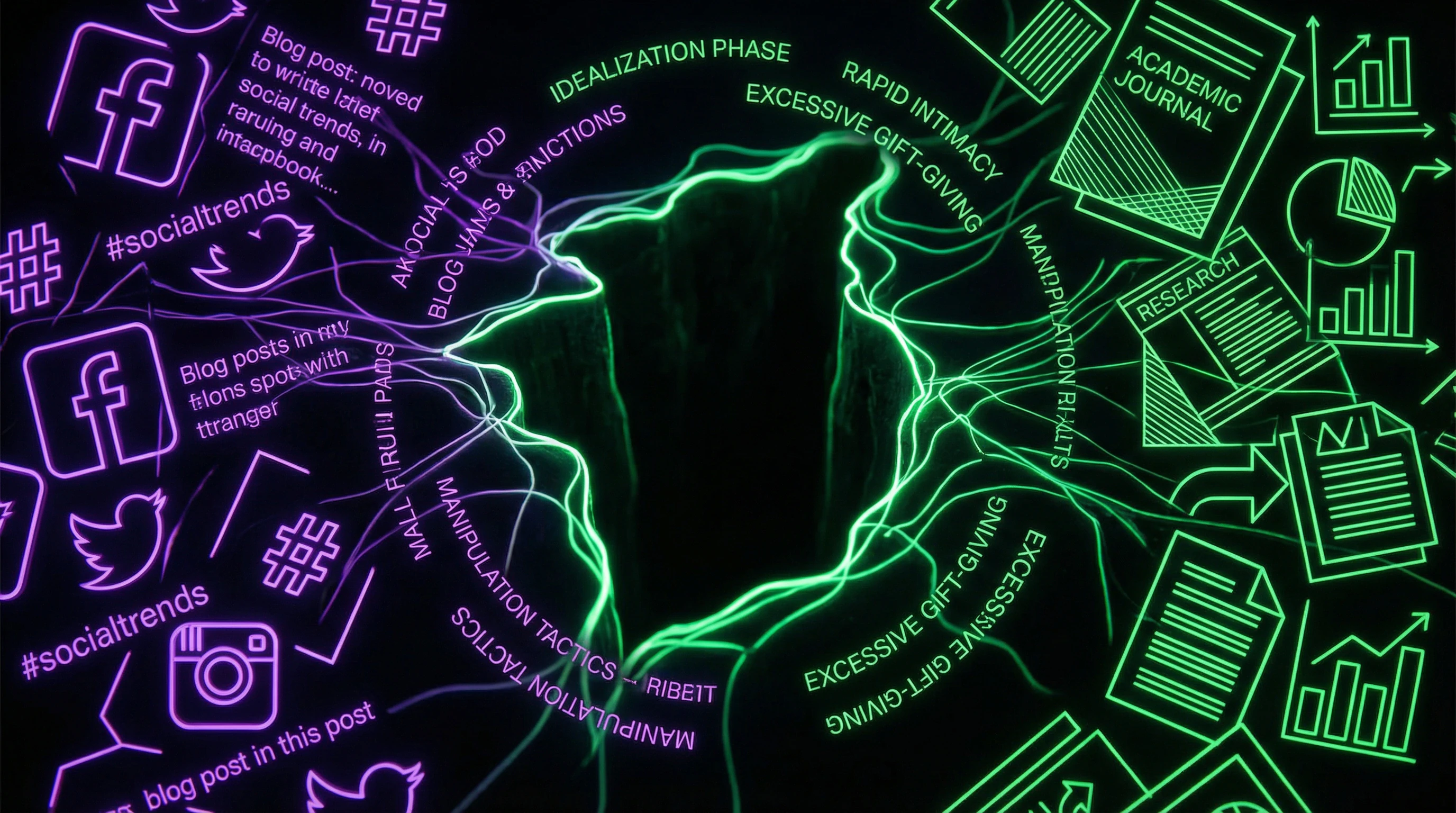
When we search for "love bombing" in scientific databases, we encounter what researchers call a semantic gap. The same phenomenon appears as:
- "excessive gift-giving in early relationship stages";
- "rapid intimacy escalation";
- "idealization phase in narcissistic relationships";
- a component of manipulative behavior in broader patterns.
Academic literature does study components of love bombing, but fragmentarily: narcissism research describes the idealization phase, manipulation studies analyze the creation of emotional dependency, attachment psychology examines accelerated intimacy formation (S002). No field has created an integrated model corresponding to popular understanding.
Operationalization: Why It's More Complex Than It Seems
Scientific research requires operationalization — turning an abstract concept into measurable variables. With love bombing, this creates methodological traps:
| Question | Why It's a Problem |
|---|---|
| How to distinguish genuine infatuation from manipulation? | Requires access to intentions that cannot be measured directly |
| Where's the boundary between generosity and excessive gift-giving? | Norms depend on culture, age, social class |
| When does relationship development become "too fast"? | No universal temporal standard exists |
Each criterion requires accounting for cultural context — courtship norms differ radically between cultures and social environments.
Two Ways to Interpret the Absence of Data
- Interpretation 1: the phenomenon exists but hasn't been studied
- Love bombing is a real phenomenon that simply hasn't received attention due to academic system inertia and operationalization complexity. It requires time and methodological innovation.
- Interpretation 2: the concept is too broad
- Popular understanding of love bombing combines heterogeneous phenomena under one term, making it unsuitable for rigorous scientific study. It needs decomposition into specific, measurable components.
The truth likely lies in the middle. The phenomenon exists, but requires breaking down into more precise parts — as happens with any complex psychological phenomenon transitioning from popular culture into science.
Steelman: Five Most Compelling Arguments for Love Bombing as a Real Phenomenon
Before critiquing the concept for lacking scientific foundation, it's necessary to present it in its strongest form. The "steelman" principle requires examining the best, not the worst, arguments for the existence of love bombing as a real and significant phenomenon. More details in the section Paranormal Abilities.
Even in the absence of direct academic research, there exists indirect evidence and theoretical grounds that support the idea that a certain behavioral pattern at the beginning of relationships can serve as a predictor of subsequent abuse.
🔬 First Argument: Convergent Validity Through Clinical Experience of Specialists
Thousands of licensed psychotherapists working with victims of domestic violence and emotional abuse independently describe a similar pattern: relationships began with a period of intense attention, rapid development of intimacy, and excessive displays of attachment, followed by an abrupt shift in dynamics.
While this is anecdotal evidence, its scale and consistency across different cultural contexts and therapeutic schools creates what methodologists call "convergent validity"—when multiple independent observers arrive at similar conclusions.
🧠 Second Argument: Neurobiological Plausibility of the Dependency Mechanism
Even without specific studies of love bombing, the neurobiology of attachment provides a plausible mechanism for explaining the effectiveness of this technique (S003). Intense positive reinforcement at the beginning of relationships activates dopaminergic reward pathways, creating a strong association between the partner and positive emotions.
When this reinforcement suddenly stops or becomes unpredictable, a state analogous to withdrawal syndrome emerges. This mechanism doesn't require the existence of a conscious manipulative strategy—it can work even with unconscious behavioral patterns.
📊 Third Argument: Predictive Validity of Retrospective Reports
Multiple surveys and qualitative studies of people who have experienced toxic relationships show that retrospectively they identify the period of intense courtship at the beginning as a "red flag" they didn't recognize in time.
- Predictive Validity
- If a certain behavioral pattern systematically precedes negative outcomes and is retrospectively recognized as a warning sign, this gives the concept validity, even if prospective studies have not yet been conducted.
- Retrospective Bias
- The problem is that people may overestimate early signals after learning about the negative outcome. Completely ignoring these patterns would be methodologically unjustified, but absolute trust also requires caution.
🧬 Fourth Argument: Alignment with Cycle of Violence Models
The concept of love bombing integrates well into existing, empirically validated models of the domestic violence cycle, such as Lenore Walker's model (S002). The "honeymoon phase" in the cycle of violence describes a period of remorse and intense attachment after an episode of abuse, which is functionally similar to love bombing.
If we acknowledge the validity of the cycle of violence—one of the most well-documented concepts in domestic violence literature—it's logical to assume that a similar mechanism may operate at the beginning of relationships, establishing a pattern that will then repeat cyclically.
⚙️ Fifth Argument: Cross-Cultural Replication of the Pattern in Different Contexts
Descriptions of behavior corresponding to the concept of love bombing appear not only in the context of romantic relationships, but also in studies of cult practices, fraudulent schemes, and even in some forms of corporate recruiting.
- Cult practices: rapid creation of attachment to the group and leader as a control mechanism
- Fraudulent schemes: building trust before financial exploitation
- Corporate recruiting: intense attention to candidates before contract signing
- Romantic relationships: intense courtship before the onset of controlling behavior
This cross-contextual replication suggests we're dealing not with an artifact of one specific situation, but with a more universal psychological mechanism. The technique of creating rapid, intense attachment followed by using that attachment for control may be a fundamental pattern of social manipulation that manifests across different domains.
The connection between intensity of initial attention and subsequent control is also found in studies of pseudopsychological systems, where techniques of rapid trust establishment are used to increase suggestibility.
Anatomy of the Evidentiary Vacuum: What Exactly Is Missing from the Scientific Literature
A systematic search of academic databases reveals not merely a lack of research, but a structured pattern of absence. This is not a random gap, but the result of specific barriers to studying the phenomenon. More details in the section Geometry and Vibrations.
Understanding exactly which types of evidence are missing helps assess the seriousness of the gap and what will be required to fill it.
🧪 Absence of Operational Definitions and Validated Measurement Instruments
The scientific literature lacks a consensus definition of love bombing that would allow for the creation of a reliable measurement instrument. Sources mention the term in the context of a Taylor & Francis publication, but do not provide operational criteria.
Without a validated scale or questionnaire, it is impossible to conduct quantitative research, compare results across studies, or establish normative data.
This is a fundamental methodological barrier that must be overcome before large-scale empirical research can begin. The problem is not researchers' unwillingness, but that without operational clarity, any study will be vulnerable to criticism of methodological validity.
📊 Absence of Prospective Longitudinal Studies
All existing evidence about love bombing is based on retrospective reports from people who have already experienced toxic relationships. There are no prospective studies that track couples from the beginning of their relationship and document which behavioral patterns predict subsequent abuse.
Such studies require significant resources, extended observation periods, and resolution of ethical issues: how should a researcher act if they observe the development of potentially dangerous relationships?
Without prospective data, it is impossible to establish causal relationships and separate true predictors from retrospective reconstruction.
🧾 Absence of Controlled Comparisons with Normative Relationships
A critically important question: how do we distinguish love bombing from normal enthusiasm at the beginning of healthy relationships? To answer this requires research comparing the intensity and behavioral patterns between couples who subsequently developed healthy dynamics and couples where abuse developed.
- Intensity of attention and gifts in the first month
- Speed of escalation of commitments and shared time
- Response to partner's boundaries and refusals
- Communication patterns during conflicts
- Long-term behavioral stability after 6–12 months
Such controlled comparisons are absent. Without them, we cannot establish where the boundary between normal and pathological lies, and we risk pathologizing ordinary romantic behavior or missing genuine warning signs.
🔎 Absence of Research on Mechanisms and Mediators
Even if we accept the phenomenon's existence, we do not understand the mechanisms of its action. What specific neurobiological, cognitive, and social processes make love bombing an effective technique for creating dependency?
- Individual Differences
- Attachment style, relationship history, personality traits—which make a person more vulnerable?
- Contextual Factors
- Social isolation, financial dependence, cultural norms—how do they moderate the effect?
- Neurobiological Substrates
- Which reward and attachment systems are activated, and why does intense attention create dependency?
Research on mechanisms is necessary not only for theoretical understanding, but also for developing effective interventions and prevention programs. Without it, any recommendations remain intuitive rather than evidence-based.
The connection between this vacuum and the viralization of the concept online is not coincidental: see epistemology basics and the mechanisms by which undefined constructs become cultural narratives.

Neurobiology of Attachment: Why Intense Beginnings Can Create Dependency
While specific research on love bombing is absent, the neurobiology of attachment and addiction provides a theoretical framework for understanding potential mechanisms. The brain doesn't distinguish between sources of reward — whether it's a substance, gambling, or intense romantic relationships. More details in the Psychology of Belief section.
All of these activate similar neural pathways and can create patterns of dependency under certain reinforcement conditions (S002).
🧬 Dopaminergic Reward Pathways and Association Formation
Romantic love in its initial phase activates the ventral tegmental area and nucleus accumbens — key components of the brain's reward system. These same areas are activated during drug use and other forms of addiction.
Intense positive reinforcement at the beginning of a relationship creates strong dopaminergic associations between the partner and feelings of euphoria. The more intense and unpredictable this reinforcement, the stronger the association forms — a principle well-known from operant conditioning research.
The brain doesn't distinguish whether it's receiving dopamine from cocaine, a casino win, or a message from a loved one. The neural pathways are identical; only the triggers differ.
🔁 Variable Reinforcement and Resistance to Extinction
Classic studies by B.F. Skinner showed that behavior reinforced on a variable schedule is most resistant to extinction. If love bombing at the beginning of a relationship creates an expectation of constant intense reinforcement, and then this reinforcement becomes unpredictable or stops, a situation analogous to a variable reinforcement schedule emerges.
This may explain why victims continue to stay in relationships, hoping for a return to the initial intensity — they're in a state neurobiologically similar to gambling addiction.
- Intense reinforcement at the start → expectation formation
- Intermittent reinforcement later → intensified reward-seeking
- Rare moments of intensity return → powerful reinforcement of hope
- Cycle repeats → behavior becomes resistant to extinction
🧷 Oxytocin, Vasopressin, and the Neurochemistry of Attachment
Physical closeness, emotional intimacy, and sexual activity stimulate the release of oxytocin and vasopressin — neuropeptides critically important for attachment formation (S003). Rapid development of physical and emotional closeness at the beginning of a relationship can create stronger neurochemical attachment than gradual development.
This attachment doesn't disappear instantly when a partner's behavior changes, creating a biological basis for why leaving toxic relationships can be physically painful and why victims return to abusers.
Oxytocin isn't just the love hormone. It's a molecule that literally rewrites the brain's reward map, binding it to a specific person. Reversing this attachment is a physiological process that requires time.
⚙️ Prefrontal Cortex and Impaired Critical Thinking
Intense emotional states characteristic of the beginning of romantic relationships are associated with decreased activity in the prefrontal cortex — the brain region responsible for critical thinking, planning, and risk assessment. This neurobiological state, sometimes called "temporary madness of falling in love," may explain why people ignore obvious red flags at the start of relationships.
If a manipulator uses techniques that amplify this state, they effectively bypass the victim's critical cognitive defenses. This isn't a question of intelligence or naivety — it's a question of neurobiology. See also the fundamentals of epistemology for understanding how beliefs form in states of reduced criticality.
- Prefrontal Cortex
- The brain region responsible for rational decision-making. During intense emotions, its activity decreases, allowing the limbic system to dominate.
- Limbic System
- The ancient part of the brain that governs emotions and reward. In the state of being in love, it suppresses danger signals from the prefrontal cortex.
- Amygdala
- The fear and threat processing center. Paradoxically, intense emotions can simultaneously activate and deactivate the amygdala depending on context.
Cognitive Anatomy of the Myth: What Psychological Mechanisms Make the Love Bombing Concept Go Viral
The popularity of the love bombing concept despite lacking scientific foundation is itself a psychological phenomenon. Learn more in the Sources and Evidence section.
🧩 Barnum Effect and Retrospective Interpretation
Love bombing descriptions are often vague enough that most people find elements of their own experience in them—a classic Barnum effect, where people accept general descriptions as accurately characterizing their situation. "He was too attentive at the beginning" or "she talked about the future too quickly" can be interpreted in countless ways.
Retrospectively, after a negative experience, people reinterpret the initial period through the lens of subsequent events, finding "signs" they didn't notice in real time. This isn't memory manipulation—it's a standard cognitive process of seeking causal connections.
🕳️ Confirmation Bias and Selective Attention
Once someone learns about the love bombing concept, they begin selectively noticing information that confirms it while ignoring contradictory data. If a relationship ended badly, a partner's positive behavior gets reinterpreted as manipulation; if successful—as genuine affection.
This bias creates an illusion of the concept's validity, when in reality we're simply applying the label selectively to an already-known outcome.
🧠 Need for Narrative Coherence
People psychologically need explanations, especially for negative events. The love bombing concept provides a simple, understandable explanation for the complex experience of toxic relationships.
It creates a causal narrative: "The relationship was bad because my partner used the love bombing technique." This narrative is psychologically more comfortable than acknowledging complexity, ambivalence, and one's own role in the dynamics. It also removes some blame—"I couldn't recognize the manipulation because it was a sophisticated technique."
🔁 Social Reinforcement and Echo Chambers
Online communities dedicated to discussing toxic relationships create an environment of intense social reinforcement for using the love bombing concept. When someone shares their story and receives validation from hundreds of others, it creates a powerful sense of confirmation.
- Alternative interpretations aren't welcomed in echo chambers
- The concept gets applied increasingly broadly and uncritically
- Social status within the community grows with each story of survived abuse
- Economic incentives (content, books, consulting) reinforce the narrative
This doesn't mean people are lying or that their pain isn't real. It means the cognitive mechanisms that help us find meaning can also create systematic distortions in how we interpret experience.
Compare this to the mechanisms that make other psychological concepts go viral—from NLP to Human Design. They all exploit the same cognitive vulnerabilities: vague descriptions, confirmation bias, need for narrative, and social reinforcement.
Verification Protocol: Seven Questions to Distinguish Care from Control
Without scientifically validated criteria, how can you assess whether intense attention early in a relationship represents genuine attachment or manipulation? The following protocol is based on principles of healthy relationships and markers of controlling behavior, not proven signs of love bombing. Learn more in the How Artificial Intelligence Works section.
✅ Question One: Does Your Partner Respect Your Boundaries and Pace
The key distinction between enthusiasm and problematic behavior is the response to boundary-setting. If you ask to slow down and your partner agrees without pressure, guilt, or resentment—that's a good sign.
Any attempt to slow the pace met with emotional manipulation ("I thought you loved me," "Why are you so cold," "Others would be thrilled with this attention") is a red flag regardless of intentions.
✅ Question Two: Do You Maintain Autonomy Outside the Relationship
Healthy relationships, even intense ones early on, don't require complete dissolution into your partner. If you maintain friendships, hobbies, professional interests, and your partner supports this—that's a good sign.
If the intensity begins isolating you from other connections, if your partner expresses jealousy toward friends or dissatisfaction with time spent outside the relationship—this is a marker of control, not love.
✅ Question Three: Can Your Partner Talk About Themselves Honestly Without Dramatization
People who use manipulation often construct narratives where they're either victim or savior. If your partner discusses their past with self-criticism, acknowledges mistakes, and doesn't demand rescue—this is a sign of maturity.
If your partner's life story is a series of betrayals where they're always right and everyone else is to blame, this may indicate patterns that will repeat in their relationship with you.
✅ Question Four: How Does Your Partner React to Criticism and Disagreement
Healthy relationships include conflicts. The question is how they're resolved. If your partner can hear criticism without counterattacking or silent punishment—that's a good sign.
If criticism is met with accusations of ingratitude, threats of breakup, or cold silence—this is a pattern of emotional control.
✅ Question Five: Does Your Partner Have a Life Independent of You
People with stable identities have their own goals, friends, and interests. If your partner is completely focused on you, if you become their sole source of meaning and validation—this isn't romance, it's dependency.
Dependency can be mutual and appear as intimacy, but it creates a fragile system where any disappointment can lead to manipulation or aggression.
✅ Question Six: Do Your Partner's Words Match Their Actions
People prone to manipulation often say one thing and do another. They promise to change, but patterns repeat. They profess love but act from control.
Track not beautiful words but behavioral consistency. If promises aren't backed by actions, that's a signal.
✅ Question Seven: How Do You Feel in the Relationship—Expanding or Contracting
This is the most important question. Healthy relationships expand you: you become braver, more confident, more open. You feel seen and accepted.
If you're constantly walking on eggshells, guessing your partner's mood, fearing their reaction, suppressing your needs—you're in a controlling relationship, regardless of how it started. This isn't love bombing, it's a trap.
The protocol doesn't guarantee a diagnosis. It helps distinguish healthy attention from controlling behavior. If you're in doubt—consult a therapist, not the internet.
Remember: critical thinking requires source verification, and your own sense of safety is the most reliable source of information about relationship quality.