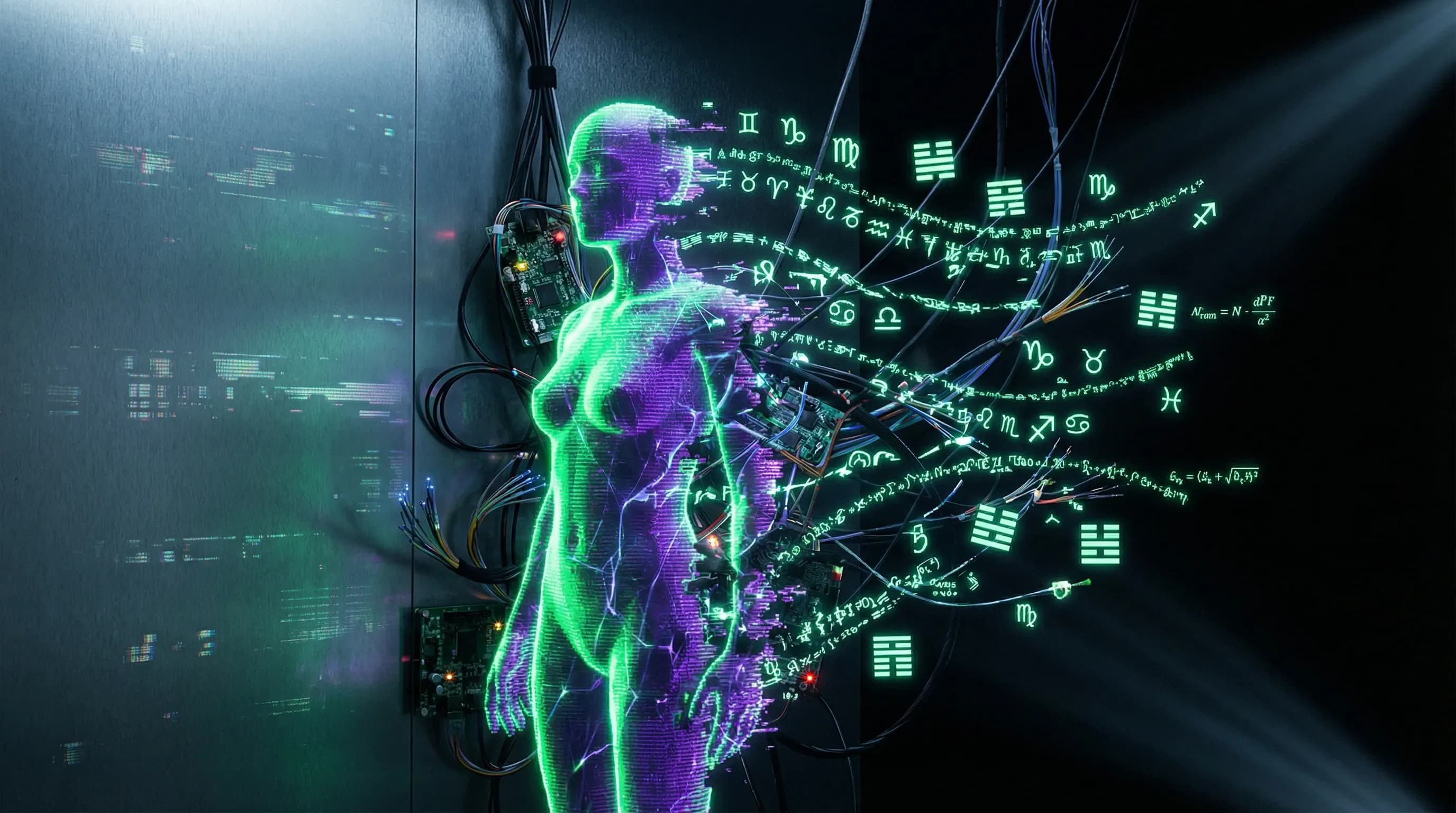
What Human Design Is: The System's Claimed Ontology and Limits of Applicability
Human Design positions itself as a "science of differentiation" — a method for determining a person's unique energetic configuration based on precise time and place of birth. The system claims that the positions of planets, Sun, and Moon at birth and 88 days prior imprint a structure of nine centers, 36 channels, and 64 gates corresponding to I Ching hexagrams. More details in the Alternative History section.
This structure allegedly determines personality type, decision-making strategy, and authority — an internal compass that should guide all life choices. The system provides no official data on type distribution in the population, making independent verification of its core claims difficult.
Four Types and Their "Strategies"
Human Design divides humanity into four types with prescribed behavioral strategies:
| Type | Claimed Role | Prescribed Strategy |
|---|---|---|
| Manifestors | Initiators, independent actors | Inform others before acting |
| Generators and Manifesting Generators | "Workhorses," responding to external stimuli | Wait to respond to their energy |
| Projectors | Managers and advisors | Wait for invitation |
| Reflectors | Mirrors of society | Wait 28 days (lunar cycle) |
Violating one's strategy allegedly leads to "resistance" and life failures. However, the system doesn't define how to measure "resistance" or distinguish it from ordinary life difficulties.
Nine Centers and "Conditioning"
Human Design's nine centers (Head, Ajna, Throat, G-Center, Heart, Solar Plexus, Sacral, Spleen, Root) visually resemble chakras from Hindu tradition, but with terminology borrowed from quantum physics and genetics. Centers can be "defined" (active) or "undefined" (passive).
The system claims that undefined centers amplify others' energies, creating a "false self" — behavior inconsistent with one's true nature. None of these mechanisms have physiological or psychological basis.
Channels, Gates, and the I Ching
Human Design's 64 gates directly correspond to the 64 hexagrams of the "Book of Changes" (I Ching) — an ancient Chinese divination text. Channels form when two gates connect and allegedly determine talents and life themes.
- Astrological Layer
- Planetary positions in zodiac signs are translated into gate numbers without explanation of the correspondence mechanism.
- Kabbalistic Layer
- The Tree of Life is used as a metaphor for center structure, adding symbolic depth.
- Result
- The multi-layered approach creates an impression of scientific rigor, but is actually an arbitrary compilation of unrelated esoteric traditions without unified methodological foundation.
The system borrows terminology from pseudopsychology and typological systems, but provides no mechanism explaining how astrological data influences psychological characteristics.
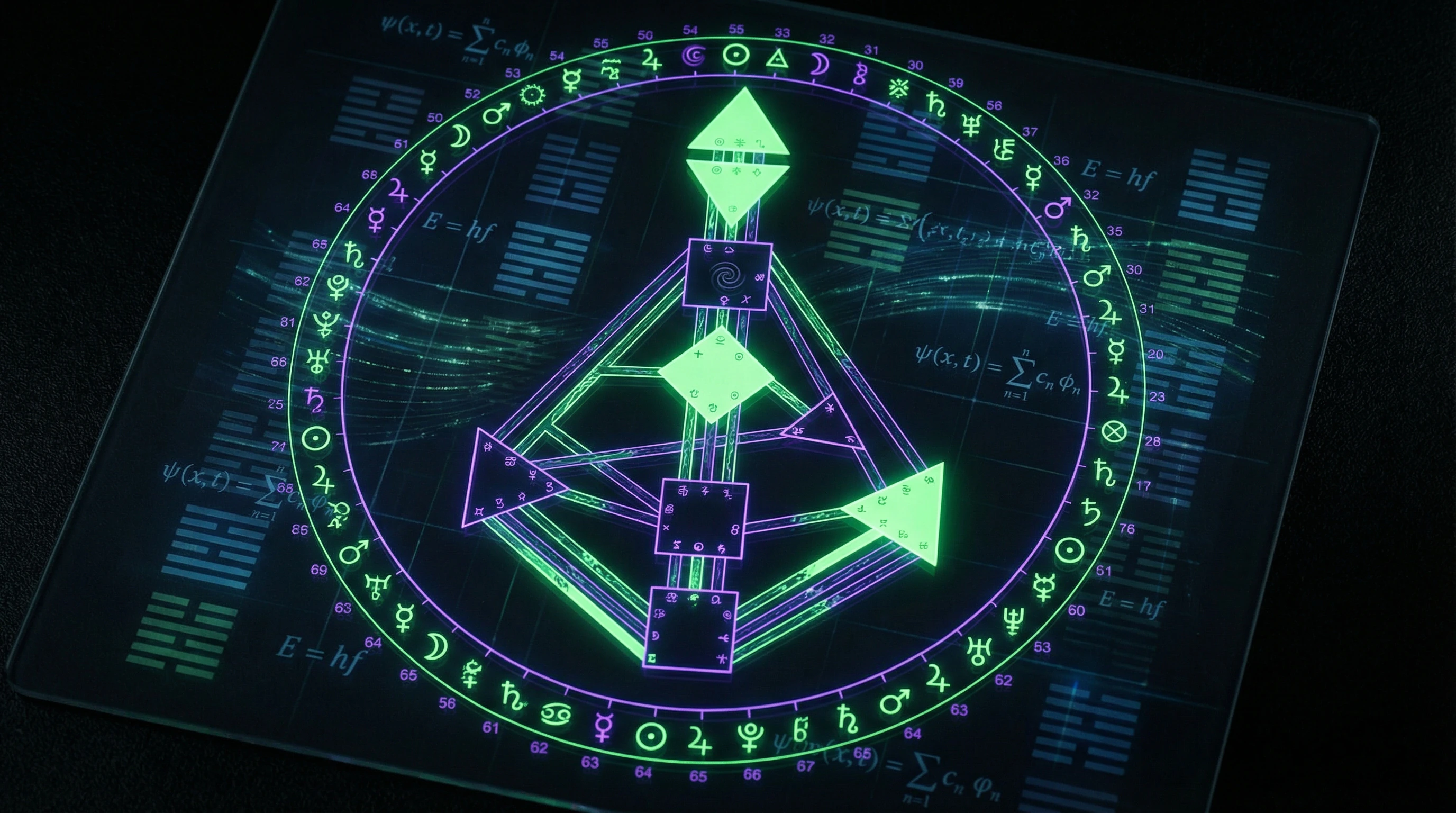
Steelman Arguments: Five Strongest Claims from Human Design Proponents
Before examining the system's flaws, it's necessary to present it in its most convincing form—the "steelman" method (opposite of a straw man). Human Design proponents offer arguments that appear compelling at first glance, especially to people without scientific training or in states of cognitive vulnerability. More details in the Pseudoscience section.
🧩 Argument 1: "The System Works—Thousands Confirm the Accuracy of Descriptions"
The most common claim: "I read my bodygraph, and it's 100% me." Proponents cite personal experience and testimonials from other users, asserting that such widespread validation cannot be coincidental.
Online communities are filled with stories about how Human Design helped find one's calling, improve relationships, or make important decisions. This argument exploits subjective validity: if a description resonates emotionally, it's perceived as true, even when objective verification is impossible.
🧩 Argument 2: "The System Integrates Ancient Wisdom and Modern Science"
Human Design positions itself as a synthesis of time-tested traditions (astrology, I Ching, Kabbalah, chakras) and cutting-edge scientific concepts (quantum physics, genetics, neutrinos). Proponents claim that Alan Krakower (Ra Uru Hu) received a revelation that unified disparate knowledge into a coherent system.
The mention of neutrinos—elementary particles passing through matter—supposedly explains the mechanism of information imprinting at the moment of birth. This argument leverages the authority of both science and antiquity simultaneously, creating an impression of interdisciplinary depth.
- Mixing scientific terminology with esoteric concepts
- Appeal to authority (ancient traditions + modern physics)
- Absence of a mechanism explaining the connection between neutrinos and personality
- Using complexity as a marker of truth
🧩 Argument 3: "Calculations Are Based on Precise Astronomical Data"
The bodygraph is constructed using ephemerides—tables of celestial body positions used in astronomy. Proponents emphasize that the system requires precise birth time (accurate to the minute) and geographical coordinates, which supposedly guarantees scientific rigor.
Software for calculating bodygraphs uses the same algorithms as professional astronomical programs. This argument conflates computational accuracy (which is indeed high) with interpretive validity (which remains unverified).
🧩 Argument 4: "The System Doesn't Predict the Future, It Describes Potential"
Unlike classical astrology, Human Design doesn't claim to predict events. Instead, the system describes "energetic mechanics"—how a person is designed to interact with the world.
Proponents argue this makes the system more scientific: it doesn't violate the principle of falsifiability since it makes no specific predictions, only offers recommendations. This argument employs a defensive strategy: vague statements are impossible to refute, creating an illusion of invulnerability to criticism.
🧩 Argument 5: "Professional Consultants Undergo Years of Training"
Certified Human Design analysts complete courses lasting from several months to several years, studying a complex system of interpretation. International organizations exist (International Human Design School, Jovian Archive) that issue diplomas and maintain practice standards.
- Training duration is perceived as a marker of legitimacy
- Institutionalization creates an appearance of scientific status
- Certification doesn't guarantee validity—astrology and homeopathy also have developed educational structures
- System complexity hinders criticism and raises the barrier to entry for skeptics
Evidence Base: What Research Says About the Validity of Typological Systems
No peer-reviewed study has confirmed the validity of Human Design. The system has not passed any of the standard tests applied to psychometric instruments: test-retest reliability, construct validity, criterion validity, or discriminant validity. For more details, see the section Quantum Mysticism.
The absence of publications in scientific journals is not coincidental, but a consequence of methodological inadequacy. This distinguishes Human Design from other pseudopsychological systems that at least attempt validation.
🧪 The Barnum Effect: Why Generic Descriptions Feel Personal
The Barnum Effect (Forer effect) is a cognitive bias in which people accept vague statements as accurate descriptions of their personality. In Bertram Forer's classic 1948 experiment, students received supposedly individualized psychological profiles that were actually identical compilations from horoscopes.
The average accuracy rating was 4.26 out of 5—even though all participants received the same text.
Human Design uses the same technique: type descriptions contain statements applicable to most people ("you are sensitive to the energy of those around you," "it's important for you to follow your inner authority"), but are presented as unique insights (S008).
🔬 Absence of Mechanism: Why Neutrinos Cannot Transmit Information
Human Design claims that neutrinos—subatomic particles passing through Earth by the trillions every second—carry information about planetary positions and imprint it into humans. This contradicts fundamental principles of physics.
Neutrinos interact with matter extremely weakly: the probability of a single neutrino interacting with an atom in the human body over an entire lifetime is negligible. They do not carry structured information and are not dependent on astrological configurations (S002).
| Human Design Claim | Physical Reality |
|---|---|
| Neutrinos transmit information about planets | Neutrinos do not carry structured information; interaction with matter is negligible |
| Quantum effects influence personality | Quantum phenomena do not scale to macroscopic objects and personality |
| Planetary positions at birth determine character | Gravitational and electromagnetic influence of planets is negligible compared to nearby objects |
📊 Astrology as Predecessor: Why Planetary Positions Don't Affect Character
Human Design inherits astrology's central premise: the position of celestial bodies at birth determines personality. However, numerous studies have refuted this connection.
Shawn Carlson's meta-analysis (1985, Nature) showed that professional astrologers cannot match natal charts with psychological profiles better than random guessing. Peter Hartmann and colleagues' study (2006) of 15,000 people found no correlation between zodiac sign and personality traits according to the Big Five model (S011).
🧬 Genetics and Personality: What Actually Influences Individual Differences
Modern behavioral genetics shows that personality traits have heritability of approximately 40-60% (based on twin studies), but this influence is distributed across thousands of genes, each with a small effect.
The remaining variability is explained by environmental factors (upbringing, culture, random events) and their interaction with genes. No single gene or set of genes determines a personality "type" in the Human Design sense.
- Epigenetic mechanisms depend on real physical and chemical factors: nutrition, stress, toxins.
- Planetary positions are not among the factors influencing gene expression.
- Human Design offers a simplified deterministic model, ignoring the complexity of genetics and environment.
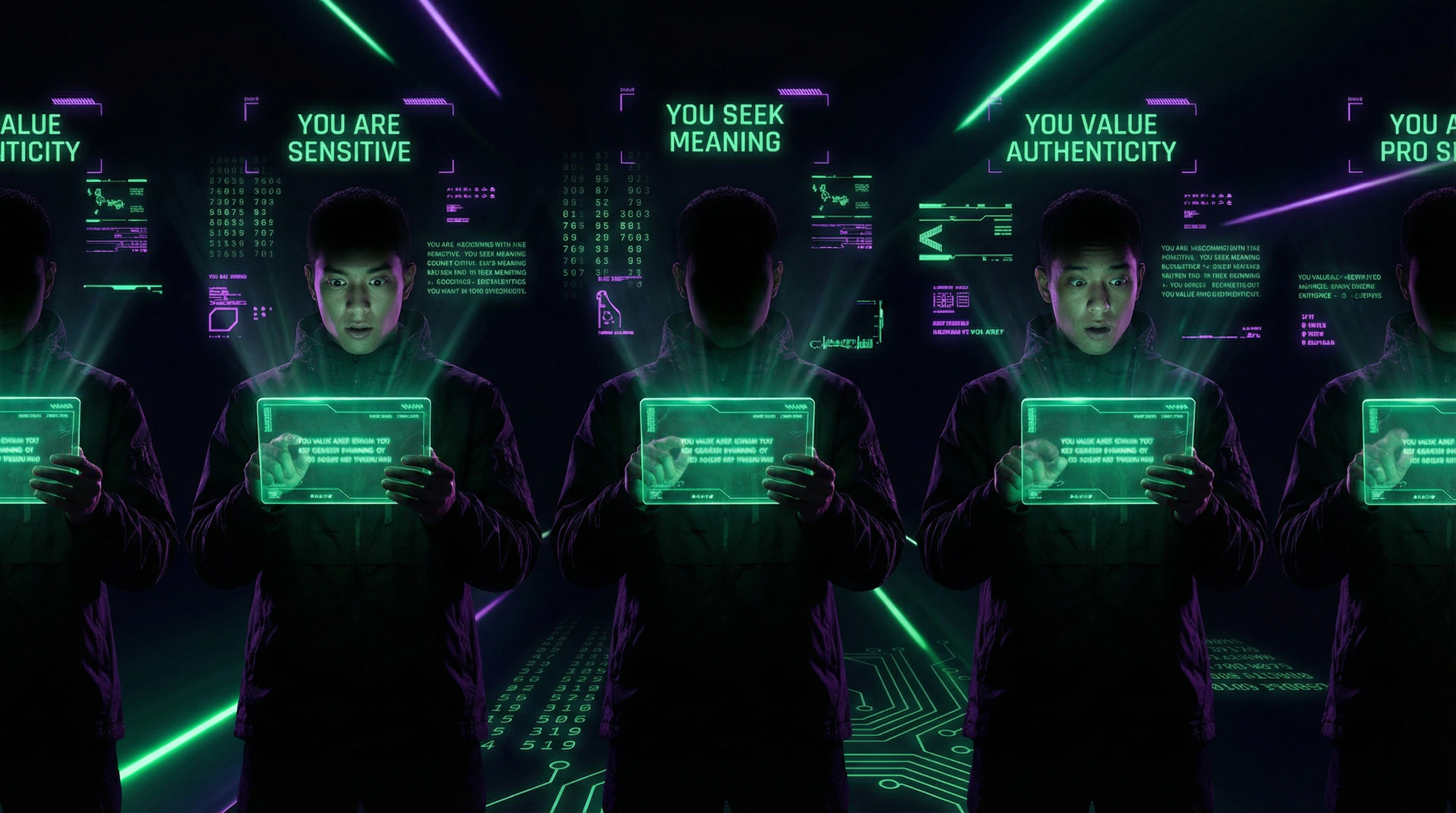
The Mechanism of Appeal: Why People Believe in Human Design
The success of Human Design is explained not by evidence, but by psychological mechanisms that make the system attractive. Understanding these mechanisms is critical for evaluating any typological systems—from MBTI to socionics. More details in the Mental Biases section.
🧩 Need for Identity and Meaning: Existential Hunger
People experience a fundamental need to understand themselves and their place in the world. In conditions of social fragmentation, economic instability, and information overload, this need intensifies.
Human Design offers a ready-made narrative framework: "You're a Projector, so you need to wait for an invitation"—a simple explanation for complex life situations. The system relieves the anxiety of uncertainty by providing clear instructions ("follow your strategy"), which is especially attractive during identity crises (S002).
🧠 Illusion of Control and Agency: "Now I Know How to Act"
The belief that knowing your type gives you control over life creates an illusion of agency. Even if the system recommends "waiting" (Generators, Projectors), this is perceived as an active strategy rather than passivity.
The illusion of control reduces stress and increases subjective well-being, even when actual control doesn't increase. Human Design exploits this effect by offering "authority" (inner compass) as a decision-making tool.
This creates a sense of self-determination (S004).
🧷 Confirmation Bias: Selective Attention to Confirmations
After learning about their bodygraph, people begin noticing events that confirm the description while ignoring contradictions. If a Projector receives an invitation to work and it leads to success, this is perceived as proof of the system.
- No invitation comes, the person acts independently with the same success—this is either ignored or interpreted as an exception
- Confirmation bias is amplified in communities of like-minded individuals where only positive stories are shared
- The echo chamber of validation reinforces belief even in the absence of objective evidence
⚙️ Complexity as a Marker of Authority: "If It's This Complex, It Must Be Profound"
Human Design is intentionally complicated: 64 gates, 36 channels, 9 centers, 12 profiles, 6 lines, multiple variables (tone, color, base). This complexity creates the impression that the system cannot be superficial—"so many details can't be made up."
| Complexity Component | Psychological Effect | Result |
|---|---|---|
| Multiple variables and parameters | People attribute authority to complex explanations | System is perceived as scientific |
| Visual complexity of bodygraph | Diagram with lines and symbols creates "wow factor" | First impression strengthens trust |
| Specialized terminology | Jargon creates entry barrier and sense of elitism | Community becomes more cohesive |
Research shows that people tend to attribute authority to complex explanations, even when simpler explanations are more accurate (S003).
Conflicts and Uncertainties: Where Sources Diverge
Within the Human Design community, there are disagreements on key issues—a sign of lacking an objective foundation. If the system described real mechanisms, interpretations would converge as data accumulated. More details in the Media Literacy section.
Instead, we observe fragmentation into schools and branches, each with its own version of "truth."
🧩 Different Schools—Different Interpretations
After the death of founder Ra Uru Hu (2011), the system split into several directions. The official organization Jovian Archive maintains the "orthodox" line, but alternative schools exist with modifications: new variables, altered profile interpretations, integration with astrology and numerology.
Each interpreter introduces subjective elements, and there's no way to determine which version is "correct." This is a typical sign of a pseudo-psychological system where an objective referent is absent.
🔎 Contradictions in Type Descriptions
Type descriptions contain enough general statements to apply to different people. Upon detailed analysis, contradictions emerge: Generators are prescribed to "wait for response," yet many successful entrepreneurs with this type act proactively.
The system explains any deviation through "conditioning" or "misunderstanding the strategy." This makes it unfalsifiable: any behavior is explained post-hoc, but impossible to predict in advance.
Such logic is characteristic of narcissistic narratives, where the system is always right, and the error lies with the interpreter or client.
- Test: Can the system predict a specific person's behavior before their actions?
- Test: Is there an independent way to validate interpretation, or does everything depend on the practitioner's belief?
- Test: Why do different schools give contradictory recommendations for the same type?
The absence of a unified standard and the ability to explain any outcome—this is not a sign of depth, but a sign of lacking predictive power.
Cognitive Anatomy of the Myth: Which Biases Human Design Exploits
Human Design is a textbook example of how pseudoscience exploits vulnerabilities in human thinking. Understanding these mechanisms helps develop immunity to similar systems. More details in the section Fasting as a Panacea.
🧩 Halo Effect: Transferring Scientific Authority to Unscientific Claims
Mentioning quantum physics, neutrinos, and genetics creates a "halo effect"—positive impressions from one aspect transfer to the entire system. People without physics backgrounds cannot verify claims about neutrinos, but the presence of these terms creates an impression of scientific legitimacy.
This is a classic tactic: borrowing the prestige of science without adhering to its methods (S002).
🧠 Apophenia: Seeing Patterns Where None Exist
Apophenia is the tendency to find meaningful connections in random data. Human Design offers a rich symbolic system (hexagrams, planets, centers), and people begin seeing correspondences between their lives and the descriptions.
If the bodygraph indicates "gate 27—nurturing," a person recalls instances when they showed care and ignores instances of selfishness. The brain actively seeks confirmation, creating the illusion of a pattern.
🔁 Hindsight Bias: "Now Everything Makes Sense"
After learning about Human Design, people reinterpret their past through the system's lens: "Now I understand why that job didn't work out—I'm a Projector, and I wasn't invited." Hindsight bias creates the feeling that the system explains the past.
In reality, the person is fitting memories to a new framework. This isn't prediction but postdiction—after-the-fact explanation that cannot be falsified.
⚙️ Social Proof: "Millions Can't Be Wrong"
Human Design's popularity (millions of users, thousands of consultants, active social media communities) creates social proof: if so many people believe it, it must be true.
- Popularity doesn't correlate with truth—astrology, homeopathy, and flat Earth also have mass followings.
- Social proof exploits the "follow the crowd" heuristic, which is evolutionarily useful but leads to errors in evaluating factual claims.
- Compare with other pseudopsychological systems—the attraction mechanism is identical.
💰 Economic Incentive: Consultants Are Invested in Client Belief
Human Design has created an ecosystem of consultants who earn money interpreting bodygraphs. The more complex and personalized the system appears, the higher the demand for paid consultations.
- Conflict of Interest
- A consultant cannot say: "Your type has no scientific basis." Their income depends on the client's belief in the system.
- Confirmation Bias
- Consultants interpret events to align with Human Design, reinforcing the illusion of accuracy.
🎭 Narrative Appeal: Stories Beat Statistics
Human Design offers a ready-made narrative: you're not just a person, you're a Manifestor, Generator, or Reflector with a unique strategy. This is more appealing than statistical data about typological systems.
Stories about how Human Design "saved a life" or "helped find purpose" spread through communities faster than research showing lack of validity. The brain remembers narratives, not numbers.
This doesn't mean the stories are false—they simply aren't evidence. One story about a coincidence weighs more in perception than a thousand cases where no coincidence occurred.
🔐 Defense Against Criticism: "You Just Don't Understand the System"
Human Design uses a classic defense against refutation: any criticism is interpreted as misunderstanding. If the system doesn't work, it's not the system's fault but an error in application.
This makes the system logically invulnerable—it cannot be disproven because any contradiction is explained by insufficient understanding. Compare with mechanisms used by other closed systems.