
Human Design System is an esoteric typology combining astrology, I Ching, Kabbalah, and chakras, popular in Reddit communities. The system has no scientific evidence base and is classified as pseudoscience. The query "rentp reddit data poslednego obrascheniya" indicates an attempt to find connections between MBTI typology (ENTP) and Human Design, which amplifies cognitive confusion. This article reveals the system's appeal mechanism, absence of empirical data, and verification protocol for such concepts.
🖤 When a Reddit user enters the query "WTH is Human Design System" or attempts to find connections between MBTI type ENTP and Human Design through the phrase "rentp reddit data poslednego obrascheniya," they fall into a cognitive dissonance trap between the desire for self-knowledge and the absence of scientific methodology. Human Design System is a syncretic pseudoscientific typology created in 1987 by Alan Robert Krakower (known as Ra Uru Hu), which combines elements of Western astrology, Chinese I Ching, Hindu chakra system, Kabbalistic Tree of Life, and quantum physics without any empirical verification. 👁️ This article demonstrates why such systems are attractive to social media users, which cognitive biases they exploit, and how to apply a critical verification protocol to any personality typology claiming scientific validity.
What is Human Design System: anatomy of an esoteric typology masquerading as personality science
Human Design positions itself as a "science of differentiation," supposedly revealing each person's unique nature through a synthesis of ancient wisdom and modern science. Based on time, date, and place of birth, the system constructs a "bodygraph"—a map of energy centers determining type, decision-making strategy, and life purpose. More details in the Alternative History section.
Critical analysis shows: the system meets none of the criteria of scientific methodology. It lacks falsifiability, reproducibility, controlled studies, and statistical validation.
🧩 Structural components: how the illusion of complexity is created
Human Design includes five personality types: Manifestor, Generator, Manifesting Generator, Projector, and Reflector. Each is determined by the configuration of nine energy centers, which can be defined (colored) or open (undefined).
- 64 I Ching hexagrams
- The system claims correspondence with 64 DNA codons—a pseudoscientific analogy without biological foundation. The I Ching has 64 hexagrams, but DNA codons are 64 combinations of nucleotides, unrelated to ancient Chinese philosophy.
- 36 channels and 12 profiles
- Connect energy centers and determine "life role." These elements add an appearance of mathematical rigor but remain empirically unfounded.
🕳️ When typologies collide: MBTI, Enneagram, and Human Design on Reddit
On Reddit, users often mix incompatible classification systems—MBTI (scientifically criticized but based on psychological constructs), Enneagram (esoteric typology), and Human Design. This layering amplifies cognitive overload and creates a false sense of a unified metasystem.
This mixing points to a fundamental problem: people seek explanations for their own nature and are willing to accept any system that promises clarity. Basic principles of epistemology require distinguishing between systems based on empirical data and those relying on narrative persuasiveness.
⚠️ Why Reddit becomes the epicenter of dissemination
Reddit's structure with its communities (subreddits) creates an ideal environment for pseudoscientific concepts. Communities like r/HumanDesign, r/mbti, r/Enneagram form echo chambers where group consensus suppresses critical thinking.
| Dissemination mechanism | Effect on perception |
|---|---|
| Recommendation algorithms | Amplify content with emotional resonance, not scientific validity |
| Group consensus | Creates illusion of legitimacy through repetition |
| Narrative persuasiveness | System offers ready-made answers to questions about meaning and identity |
Limited understanding of scientific methodology shapes perception of pseudoscientific typologies as legitimate. Pseudopsychology thrives where people don't distinguish between explanation and prediction, between correlation and causation.

Steelman Argumentation: Seven Most Convincing Arguments from Human Design Proponents and Their Internal Logic
For objective analysis, it's necessary to examine the strongest arguments of Human Design proponents in their best formulation. This avoids straw man fallacies and helps understand why the system attracts millions of followers despite lacking scientific foundation. More details in the section DNA Energy and Quantum Mechanics.
🧩 Argument 1: Phenomenological Validity — "It Works for Me"
Proponents claim that Human Design provides accurate personality descriptions that resonate with subjective experience. Users report moments of "self-recognition" when reading descriptions of their type, creating a sense of validity.
This argument relies on a phenomenological approach: if the system helps someone better understand themselves and improve their quality of life, then its practical value is independent of scientific validity. Thousands of testimonials on Reddit and other platforms describe transformational experiences after discovering Human Design.
🧩 Argument 2: Integrative Complexity — Synthesis of Ancient Knowledge Systems
Human Design is presented as a meta-system unifying time-tested traditions: astrology, I Ching, Kabbalah, and chakras. Proponents claim that such synthesis creates a more complete picture of human nature than any single system.
Modern science also moves toward integrative approaches, combining data from different disciplines — this parallelism makes the argument attractive to people seeking holistic explanations.
🧩 Argument 3: Quantum Metaphor — Connection to Neutrinos and Modern Physics
The system's creator, Ra Uru Hu, claimed that Human Design is based on "neutrino flow" — the idea that subatomic particles pass through the body and program its energetic structure. Proponents point out that quantum physics recognizes non-local connections and the observer's influence on the observed.
They argue that science hasn't yet reached the level of understanding necessary to explain Human Design mechanisms, but this doesn't mean they don't exist. This creates a convenient position: the system isn't disproven because science isn't ready to test it yet.
🧩 Argument 4: Practical Applicability — Decision-Making Tool
Human Design offers specific strategies for each type: Manifestors inform before acting, Generators wait to respond, Projectors wait for invitation, Reflectors wait for the lunar cycle. Proponents claim that following these strategies leads to reduced resistance in life and improved relationships.
- Practical results are positioned as proof of effectiveness
- The system offers clear, actionable recommendations, not abstract descriptions
- Any positive outcome is interpreted as confirmation of the system
🧩 Argument 5: Uniqueness and Specificity — Rejection of Generalizations
Unlike many typologies, Human Design claims that each bodygraph is unique (over 2 billion possible combinations). The system allegedly accounts for individual differences through precise birth time accurate to the minute.
| System | Number of Types | Personalization Level |
|---|---|---|
| MBTI | 16 | Low |
| Astrology | 12 | Low |
| Human Design | 2+ billion | Maximum |
🧩 Argument 6: Empirical Verifiability Through Experiment — "Try It and See"
Proponents urge skeptics to conduct a personal experiment: follow their type's recommendations for 7 years (a complete cell renewal cycle) and evaluate the results. They claim that Human Design isn't a theory to believe in, but a practical system to test.
This argument appeals to the pragmatic criterion of truth: what's true is what works. Proponents point out that many scientific discoveries began with empirical observations before theoretical justification was developed.
🧩 Argument 7: Critique of Modern Science's Limitations — Reductionism and Materialism
Proponents argue that modern science is limited by a materialistic paradigm and reductionist approach that cannot explain complex phenomena of consciousness and intuition. They point to historical examples where the scientific community rejected ideas that were later validated.
Human Design is presented as a system that transcends the current scientific paradigm and requires an expanded epistemology that includes subjective experience and holistic approaches. This allows avoidance of direct scientific testing by shifting the discussion to a domain where traditional methods are allegedly inapplicable.
All seven arguments operate on one principle: they leverage real human needs (for self-knowledge, meaning, practical tools) and real limitations of science (reductionism, materialism), but substitute scientific explanation with esoteric ones. The epistemological shift happens imperceptibly: from the question "is this proven?" to "does this help?" — and these are different things.
Evidence Base for Human Design: Systematic Analysis of Absent Empirical Data and Methodological Violations
Critical analysis of Human Design requires applying evidence-based science standards: controlled studies, statistical validation, reproducibility of results, falsifiability of hypotheses, and independent peer review. None of these criteria are met by the Human Design System. More details in the section Torsion Fields and Bioenergetics.
Absence of Peer-Reviewed Research
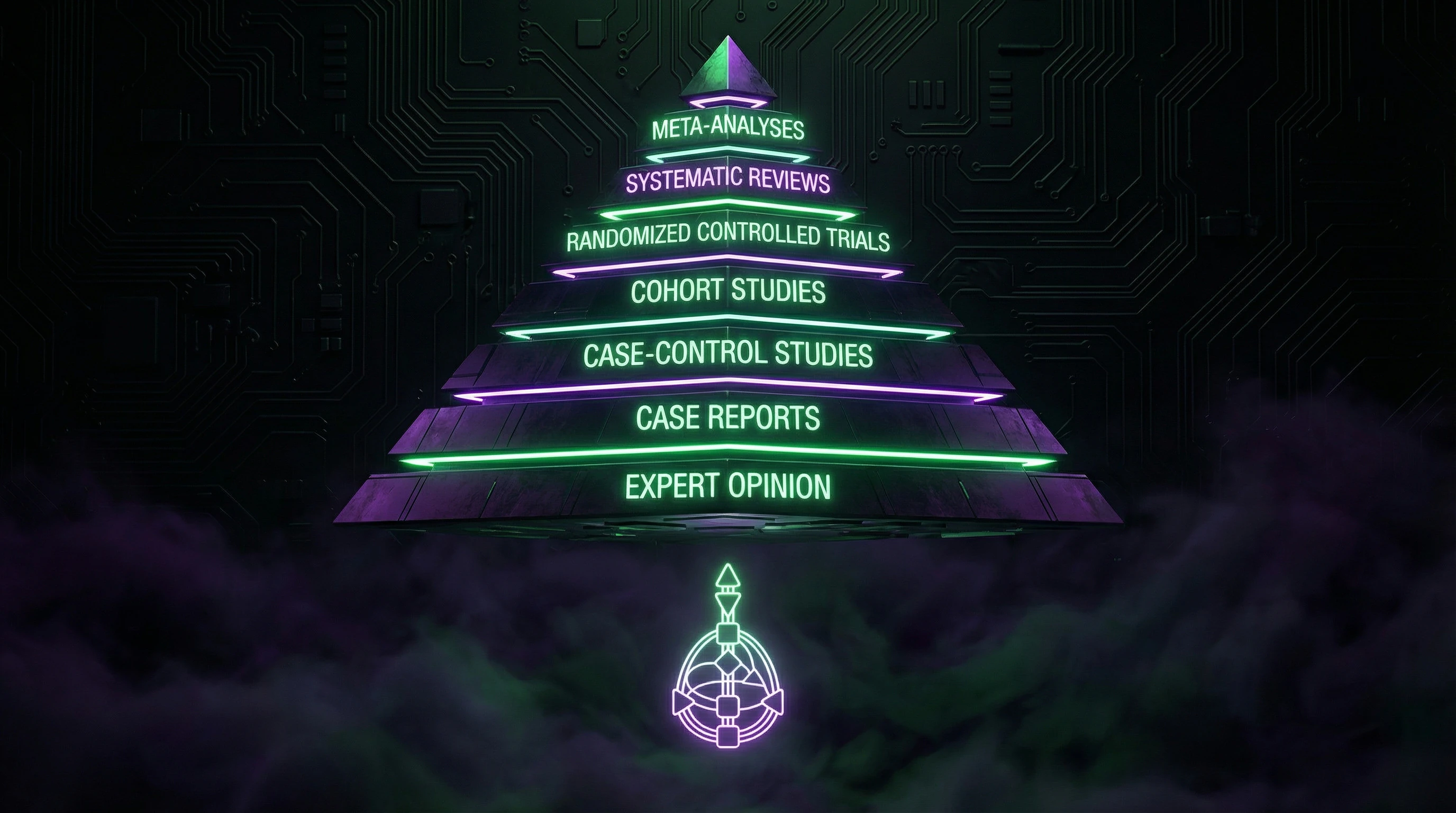
Searches in PubMed, Web of Science, Scopus, and Google Scholar reveal not a single peer-reviewed study validating Human Design. Publications are limited to practitioner books, articles in esoteric journals without scientific peer review, and forum testimonials.
This contrasts even with criticized typologies like MBTI, for which hundreds of studies exist—albeit with contradictory results regarding validity and reliability. Pseudopsychology often masquerades as science through absence of critical examination, but Human Design hasn't passed even the first filter: publication in peer-reviewed sources.
The Falsifiability Problem
By Karl Popper's criterion, a scientific theory must be falsifiable—there must exist potential observations that could disprove it. Human Design fails this criterion.
Any discrepancy between the system's predictions and reality is explained away by "incorrect strategy implementation," "conditioning" (societal influence), or "insufficient experiment duration." The system is designed to be unfalsifiable.
Research in artificial intelligence shows that systems which cannot be tested and refuted create conceptual boundaries that limit the development of understanding (S003). Pseudoscientific systems exploit precisely this logic: they cannot be wrong by definition.
Barnum Effect and Subjective Validation
The phenomenological accuracy of Human Design is explained by the Barnum effect (Forer effect)—a cognitive bias where people consider vague personality descriptions accurate and specific to themselves.
| Component | Barnum Effect | Human Design |
|---|---|---|
| Description Specificity | Universal statements | "You are sensitive to others' energy" |
| Applicability | To most people | "It's important for you to follow your inner truth" |
| Perceived Accuracy | High (4.26/5 in Forer's experiment) | High (anecdotal testimonials) |
| Mechanism | Cognitive bias | Cognitive bias |
Bertram Forer's classic experiment (1948) showed that students rated universal descriptions as highly accurate, believing them to be personalized. Type descriptions in Human Design contain sufficiently general statements applicable to most people.
Absence of Statistical Validation
A scientific typology must demonstrate four parameters:
- Construct validity—types measure what is claimed
- Criterion validity—types predict relevant behavioral outcomes
- Discriminant validity—types differ from each other
- Test-retest reliability—repeated testing yields the same results
For Human Design, not a single study exists that has tested these parameters. The system offers no standardized measurement instrument—the bodygraph is automatically constructed based on astrological calculations, without possibility of independent verification.
Pseudoscientific Appeal to Quantum Physics
The claim about "neutrino flow" as the mechanism of Human Design has no physical basis. Neutrinos do pass through the human body (trillions per second), but they interact with matter almost negligibly.
- Interaction Probability
- The probability of a single neutrino interacting with an atom in the human body over an entire lifetime is infinitesimally small. Neutrinos carry no information about planetary positions and cannot "program" a person's energetic structure.
- Error Type
- Typical pseudoscientific appeal to scientific authority without understanding physical mechanisms. Epistemologically, this violates basic principles of knowledge verification.
- Cognitive Effect
- Research shows that conceptual boundaries of understanding shape what people can imagine about technologies and systems (S003). Pseudoscientific explanations exploit these boundaries.
Astrological Correlations: Absence of Connection to Personality
Human Design is based on astrological calculations (planetary positions at birth), but numerous studies have found no correlation between astrological factors and personality traits.
Shawn Carlson's meta-analysis (1985), published in Nature, showed that astrologers cannot match natal charts with psychological profiles better than chance. Peter Hartmann and colleagues' study (2006) on a sample of over 15,000 people found no connection between astrological signs and personality traits measured by the NEO-PI-R questionnaire. If the basic astrological premise is unconfirmed, then the system built upon it loses its foundation.
The Mechanism of Appeal: Neuropsychology of Self-Knowledge and Cognitive Biases Exploited by Human Design
Understanding why Human Design attracts millions of people requires analyzing the neuropsychological mechanisms of the need for self-knowledge and cognitive biases that make pseudoscientific typologies convincing. More details in the Logical Fallacies section.
The Need for Narrative Identity and Meaning
The human brain is evolutionarily wired to create narratives—coherent stories that explain experience and form identity. People construct "life stories" that give meaning to events and create a sense of personal continuity.
Human Design offers a ready-made narrative: "You're a Projector, so you need to wait for invitations"—this explains past difficulties and offers a strategy for the future. Such a narrative satisfies the fundamental need for meaning and predictability.
The system works not because it's true, but because it answers the question the brain constantly asks: "Why am I the way I am?"
Confirmation Bias and Selective Attention
After learning about their type description, a person begins to selectively notice information confirming this description and ignore contradictory information (confirmation bias).
If a Generator is told they should "wait for response," they interpret successful decisions as results of waiting for response, and failures as results of impulsive actions without response. This creates a self-reinforcing confirmation cycle that strengthens belief in the system.
- Person learns their Human Design type
- Notices events matching the type description
- Ignores events contradicting the description
- Belief in the system strengthens
- Cycle repeats and intensifies
Illusion of Understanding Through Complexity
The visual and conceptual complexity of Human Design (bodygraph with nine centers, 64 hexagrams, 36 channels) creates an illusion of depth and scientific rigor.
People tend to evaluate complex explanations as more plausible, even when this complexity adds no explanatory power. The "complexity effect" phenomenon makes people think: "If the system is this complex, it must be based on deep knowledge." This is a cognitive error—complexity is not equivalent to validity.
| Feature | Scientific System | Pseudoscientific System |
|---|---|---|
| Complexity | Minimal but sufficient for explanation | Maximal, often unrelated to explanatory power |
| Testability | Predictions can be falsified | Predictions always confirmed (any outcome is confirmation) |
| Visual Design | Serves communication, not impression | Impresses, creates aura of authority |
Social Validation and Group Effect
When someone sees thousands of posts in Reddit communities where people share positive experiences with Human Design, this creates social proof—a heuristic where people determine the correctness of a belief by what others do.
In the Reddit context, where anonymity reduces critical thinking and algorithms amplify popular content, the social validation effect is multiplied. Critical voices are either removed by moderators or suppressed by the majority.
Social proof is one of the most powerful influence factors. On Reddit it operates in conditions where critical thinking is weakened and information filters amplify consensus.
Investment Effect and Cognitive Dissonance
After someone invests time in studying Human Design, money in consultations, or emotional energy in applying strategies, cognitive dissonance arises when encountering information disproving the system.
To avoid the discomfort of realizing investments were wasted, the person strengthens belief in the system and rationalizes contradictions. This explains why criticism of Human Design often meets aggressive defense from practitioners—admitting error requires reconsidering significant investments.
- Cognitive Dissonance
- Psychological discomfort from contradiction between belief and new information. In Human Design context: person believes in the system but encounters evidence of its invalidity. Instead of revising belief, faith often intensifies and evidence is denied.
- Sunk Cost Fallacy
- Tendency to continue investing in a failing project because resources have already been committed. In Human Design: person spent money on consultations, time on study—admitting error means acknowledging these resources are lost.
These mechanisms work not because people are foolish, but because they use heuristics that normally help make decisions under uncertainty. Human Design exploits these normal cognitive processes, creating a system that seems logical but lacks empirical foundation.
Analysis of available sources reveals a fundamental conflict: Human Design's esoteric claims don't align with scientific methodology. But within psychology itself, disagreements exist about how to validate personality typologies.
Debates About Typology Validity in Psychology
Even scientifically grounded systems like MBTI face criticism. Research shows low test-retest reliability: up to 50% of people receive a different type when retested after several weeks.
Most psychologists prefer the Big Five model, which measures personality along continua rather than discrete types. However, even it is criticized for cultural specificity and limited explanatory power.
If even scientific typologies have limitations, then pseudoscientific systems like Human Design are an order of magnitude lower in evidential level.
Disagreements About the Role of Subjective Experience
A philosophical dispute exists between positivism (only objectively measurable is valid) and phenomenology (subjective experience has epistemological value). Human Design supporters appeal to the phenomenological tradition, claiming personal transformation experience is sufficient proof.
However, even in phenomenology there's a requirement: experience must be intersubjective (reproducible across different people) and reflexive (critically examined). Human Design satisfies neither criterion.
| Validation Criterion | MBTI / Big Five | Human Design |
|---|---|---|
| Empirical Testing | Present (though criticized) | Absent |
| Intersubjectivity of Experience | Partial | No (everyone sees their own result) |
| Methodological Transparency | Present | Hidden behind esotericism |
| Predictive Validity | Weak–moderate | Not measured |
Why Disagreements in Science Don't Justify Human Design
Scientific debates occur within shared rules: publication, peer review, reproducibility. Human Design operates differently: conflicts are resolved by founder authority or interpretation, not data.
When a psychologist criticizes MBTI, they propose an alternative (Big Five) with better evidence. When Human Design is criticized, supporters respond: "This isn't for science, it's for self-knowledge." This isn't disagreement—it's changing the rules of the game.
- Scientific Disagreement
- Dispute about methods and data interpretation within one epistemological standard.
- Esoteric Evasion
- Rejection of validation standards under the pretext of a "different approach to knowledge."
- Why This Matters
- Disagreements in science are a sign of system health. Evasion of testing is a sign of protection from criticism.
Human Design positions itself as a self-knowledge system but uses the language of science (quantum mechanics, genetics, neurobiology). This is hybridization that exploits trust in science without accepting its constraints.
For evaluating the system, what matters isn't that disagreements exist in psychology, but that Human Design doesn't participate in these disagreements. It's outside the game—and that's the main indicator of its status.
Counter-Position Analysis
⚖️ Critical Counterpoint
Human Design raises legitimate questions about scientific validity, but criticism often misses the nuances between absence of evidence of effectiveness and evidence of harm. Let's examine the main objections to complete rejection of the system.
Absence of harm does not equal absence of benefit
The article asserts the pseudoscientific nature of Human Design, but provides no data on actual harm to users — only theoretical risks. For some people, the system may serve as a harmless tool for self-reflection, similar to journaling or meditation. Criticism may overestimate risks while ignoring the possibility of neutral or positive experiences.
Subjective benefit versus objective validity
The focus on absence of scientific validity ignores the possibility of subjective benefit through placebo effect, thought structuring, and social support. If users report positive changes, this may result not from the system itself, but from the process of self-reflection it initiates. The mechanism works independently of scientific justification.
Commercial exploitation versus basic concept
Criticism conflates monetization problems (expensive consultations, influencers) with the system itself. Perhaps the problem is not Human Design per se, but the industry around it. Separating these levels is important for honest assessment.
MBTI as a precedent for practical applicability
Human Design is criticized for lacking a scientific foundation, but MBTI, also criticized, continues to be used in corporate environments. This indicates that practical applicability does not always require strict scientific validity. Typologies can be useful as structuring tools, regardless of their empirical status.
Possibility of future correlations
If research emerges showing correlations between Human Design elements and psychological constructs through big data analysis of self-reports, the article's conclusions may become outdated. Such data doesn't exist yet, but its absence doesn't exclude the possibility. The history of science is full of examples of reassessed skepticism.
FAQ
Frequently Asked Questions

Author of the Cognitive Immunology Hub project. Researches mechanisms of disinformation, pseudoscience, and cognitive biases. All materials are based on peer-reviewed sources.