 💭 Pseudopsychology
Pseudopsychology: How to Distinguish Science from Commercial Manipulationλ
Critical analysis of pseudoscientific psychological practices, popular literature, and methods that masquerade as scientific psychology but lack empirical foundation.
Overview
Pseudopsychology masquerades as science: 🧠 it uses terminology, promises results, but ignores empirical verification. It can be distinguished from evidence-based psychology by three markers—absence of reproducible research, conflation of clinical concepts with esotericism, resistance to criticism. The commercialization of knowledge has transformed psychology into a market of quick fixes, where demand for simplicity displaces the requirement for evidence.
🛡️
Laplace Protocol: This material is based on critical analysis of available sources, predominantly English-language forums and blogs. For comprehensive scientific coverage of the topic, peer-reviewed academic research from PsycINFO and PubMed databases is required.
Reference Protocol
Scientific Foundation
Evidence-based framework for critical analysis
Protocol: Evaluation
Test Yourself
Quizzes on this topic coming soon
Sector L1
Articles
Research materials, essays, and deep dives into critical thinking mechanisms.
💭 Pseudopsychology 💭 Pseudopsychology
 💭 Pseudopsychology
 💭 Pseudopsychology
 🧠 Pseudopsychology
 💭 Pseudopsychology
 💭 Pseudopsychology
 💭 Pseudopsychology
 💭 Pseudopsychology
⚡
Deep Dive
Pseudopsychology: How to Distinguish Science from Imitation in the Age of Information Noise
The Boundary Between Scientific Psychology and Pseudoscientific Practices
Pseudopsychology is a collection of practices and theories that borrow terminology and external attributes of scientific psychology but do not rely on empirical research and systematic hypothesis testing.
| Scientific Psychology | Pseudopsychology |
|---|---|
| Controlled experiments, statistical analysis, reproducible results | Anecdotal evidence, subjective interpretations, oversimplified explanations |
| Hypothesis verification before publication | Avoidance of scientific scrutiny, promises of quick fixes |
Pseudopsychological concepts masquerade as innovative approaches, using scientific-sounding vocabulary to create an illusion of legitimacy. The blending of psychology with esotericism, philosophy, and alternative medicine blurs the boundaries of professional competence.
Post-Soviet Space as a Breeding Ground for Pseudopsychology
After the collapse of the USSR, a vacuum emerged in psychological services that was quickly filled with unregulated practices and commercial ventures. Decades of restrictions on certain psychological approaches and the absence of a developed culture of psychological care created favorable conditions for the spread of pseudoscientific methods.
Low psychological literacy among the population, combined with high demand for quick solutions to personal problems, made the market particularly vulnerable to pseudopsychological products.
The absence of strict regulation of professional psychological practice and weak certification systems allowed self-proclaimed experts to offer services without proper qualifications. The commercialization of psychology led to market success of books or trainings being perceived as indicators of their scientific validity—which contradicts the principles of scientific inquiry.

Popular Pseudopsychological Movements and Their Characteristic Features
Reality Transurfing and the Law of Attraction Concept
"Reality Transurfing" by Vadim Zeland and "The Secret" by Rhonda Byrne promise control over reality through the power of thought. They claim that visualization and positive thinking materialize desires, ignoring objective social, economic, and biological factors.
Emotionally charged success stories compensate for the absence of empirical evidence. Appeals to quantum physics sound convincing but are not based on its actual principles.
- Mechanism of Appeal
- Magical thinking reduces anxiety about uncertainty. People gain an illusion of control instead of the need to act under conditions of risk.
- Real Harm
- People postpone seeking professional help, relying on positive thinking. Failures are explained by the victim's insufficient positivity—this is victim-blaming that exacerbates psychological problems.
System-Vector Psychology and Rigid Typology
System-vector psychology divides people into eight fixed types with predetermined characteristics. The system has not undergone validation and contradicts contemporary understanding of psychological plasticity.
Rigid categorization using oversimplified schemes ignores individual differences, contextual factors, and developmental possibilities.
Oversimplified Personality Typology in Popular Culture
"Men Are from Mars, Women Are from Venus" by John Gray reduces interpersonal differences to biological determinism. This ignores research data: within-group variability (differences within one gender) significantly exceeds between-group variability (differences between genders) for most psychological characteristics.
- Simplicity and reassurance explain the popularity of such books
- They foster stereotypical thinking
- They prevent understanding of the real complexity of human relationships
Criteria for Identifying Pseudoscientific Psychological Practices
Absence of Empirical Foundation and Resistance to Verification
The primary indicator of pseudopsychology is the absence of publications in peer-reviewed scientific journals and systematic research on method effectiveness. Pseudopsychological approaches avoid scientific verification, citing the "uniqueness" of their methods or the "limitations" of the scientific method.
Scientific psychology constantly revises theories based on new data. Pseudopsychology presents concepts as definitive truths not subject to criticism.
Legitimate psychology relies on reproducible experiments and meta-analyses. Pseudopsychology uses selective success examples and ignores failures—the absence of transparent methodology makes it fundamentally unscientific by Popper's criterion.
Conflation of Psychology with Esotericism and Mysticism
Pseudopsychology integrates elements of astrology, numerology, and occult practices, presenting this as a "holistic" approach. Such conflation blurs the boundaries between scientific knowledge and beliefs.
- Undefined concepts ("energy," "vibrations," "information fields") without operational definitions
- Impossibility of objective verification of claims
- Illusion of equivalence among all explanatory systems
Commercial Orientation and Marketing Promises
Pseudopsychological products are characterized by aggressive marketing, promises of rapid guaranteed results, and high costs despite lacking evidence of effectiveness. Commercial success substitutes for scientific validity.
The popularity of a book or training program is presented as proof of value. Ethical psychologists acknowledge method limitations and don't make unrealistic promises—pseudopsychologists guarantee solutions to any problems in a short timeframe.
Misuse of Psychological Terminology in Popular Culture
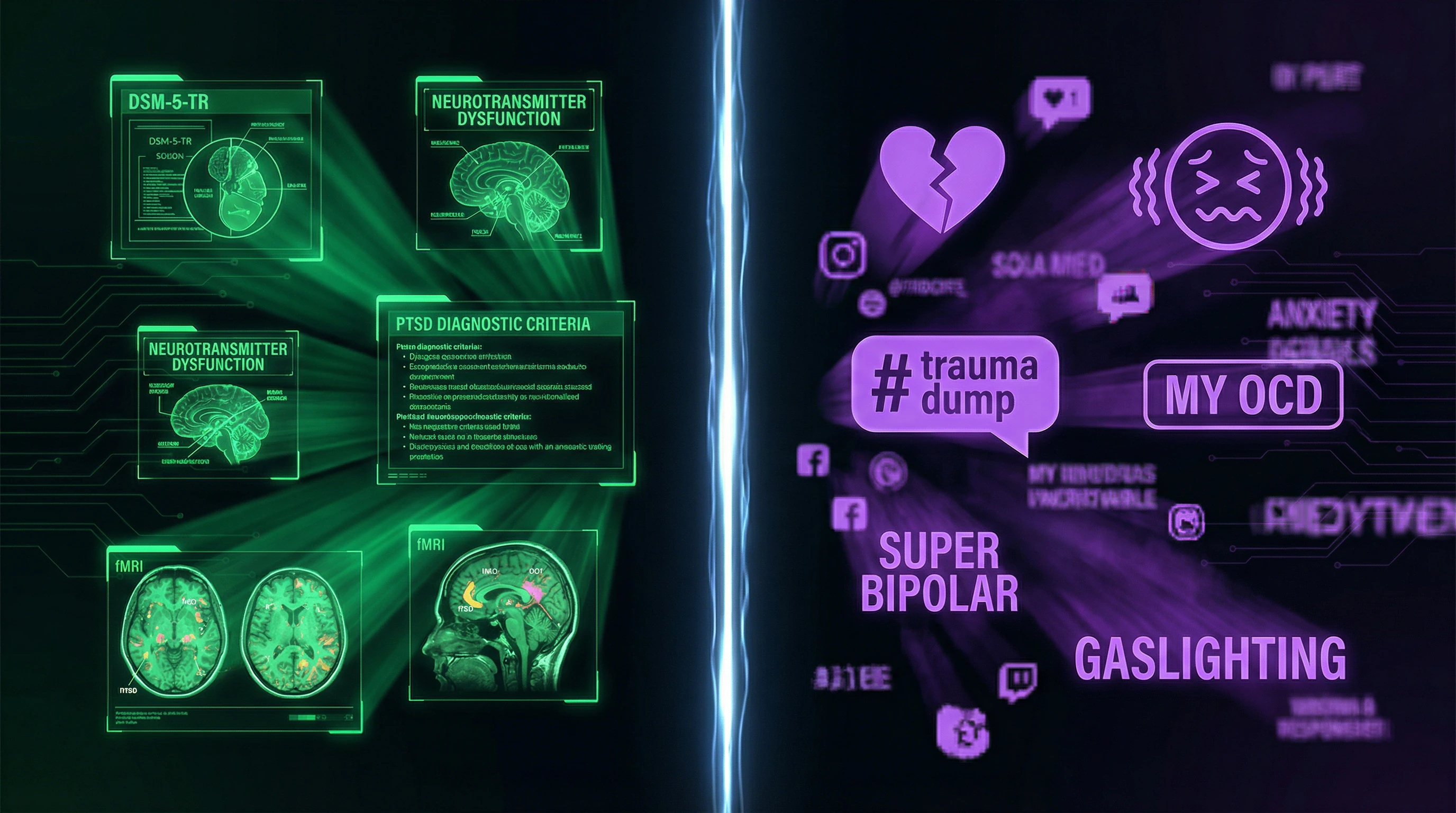
One of the most dangerous trends in modern pseudopsychology is the uncontrolled use of clinical terms in everyday discourse. Concepts that require precise diagnosis and professional context are being turned into labels for describing ordinary behavior.
This blurs the boundaries between normal and pathological, creating a false impression of competence among people without specialized training.
A clinical term in the hands of a non-professional is not just an inaccuracy. It's a tool that redefines reality for others and for the speaker themselves.
Incorrect Use of Clinical Terms
Terms like "depression," "bipolar disorder," and "obsessive-compulsive disorder" are used to describe temporary states or personality traits that have nothing to do with clinical diagnoses. A person experiencing sadness calls themselves "depressed," while someone who prefers order labels themselves as having "OCD."
Such usage devalues the seriousness of actual mental disorders and prevents timely seeking of professional help.
- Sadness ≠ depression (temporary state vs. clinical syndrome with dysfunction)
- Tidiness ≠ OCD (personality trait vs. intrusive thoughts + compulsions causing distress)
- Worry ≠ anxiety disorder (adaptive response vs. maladaptive pattern)
Popularization of "Toxicity" and "Narcissism" Concepts
The terms "toxic person" and "narcissism" have become universal explanations for any interpersonal conflicts, losing their clinical meaning. Narcissistic personality disorder is a complex diagnosis with clear DSM-5 criteria requiring professional assessment, but in popular discourse any selfish act is interpreted as "narcissism."
The concept of "toxicity" has become a tool for avoiding responsibility: instead of analyzing relationship dynamics, people simply label others as "toxic" and terminate interaction.
- Narcissism (clinical)
- Personality disorder with patterns of grandiosity, lack of empathy, need for admiration. Diagnosed per DSM-5 when 5+ criteria are present. Trap: any selfishness is called narcissism, diluting the diagnosis.
- Toxicity (popular)
- Vague concept for designating "harmful influence." Problem: allows avoidance of analyzing one's own role in conflict and developing communication skills.
This oversimplification prevents the development of constructive conflict resolution skills and emotional maturity.
Knowledge Access Protocol
FAQ
Frequently Asked Questions
Pseudopsychology refers to practices and teachings that present themselves as scientific psychology but lack empirical foundation and fail scientific verification. These methods often mix psychological terminology with esotericism, promise simple solutions to complex problems, and are not supported by peer-reviewed research. In post-Soviet regions, pseudopsychology developed actively after restrictions on psychological practices were lifted.
Scientific psychology relies on empirical research, peer-reviewed publications, and rigorous methodology, while pseudopsychology uses anecdotal evidence and unverified claims. Real psychologists have recognized education and follow ethical standards of professional organizations. Pseudopsychological practices often resist scientific criticism and cannot be falsified.
Pseudopsychological literature includes "Reality Transurfing," "The Secret" by Rhonda Byrne, and "Men Are from Mars, Women Are from Venus" by John Gray. These bestsellers oversimplify complex psychological processes, offer universal solutions without scientific basis, and often mix psychology with mysticism. Such books are popular due to promises of quick results but are not supported by research.
System-vector psychology is a pseudoscientific personality typology that divides people into eight "vectors" and claims to explain all human behavior. This system has no scientific confirmation, is not published in peer-reviewed journals, and is criticized by the professional community for oversimplification and determinism. It is popular in commercial training programs but is not recognized by academic psychology.
"Reality Transurfing" mixes psychological concepts with esotericism and quantum mysticism, promising control over reality through the power of thought without scientific evidence. The book uses pseudoscientific terminology, does not rely on empirical research, and promotes magical thinking instead of verified psychological methods. Professional psychologists classify it as commercial literature exploiting people's desire to quickly change their lives.
After the collapse of the USSR, a vacuum emerged in psychological services that was quickly filled with unverified practices and commercial training programs. The absence of strict regulation and low psychological literacy among the population facilitated the spread of pseudopsychology. Western pseudoscientific concepts mixed with local esoteric traditions, creating a unique phenomenon of mass pseudopsychology.
Classical Freudian psychoanalysis has limited scientific basis and many of its concepts are not confirmed by contemporary research, but it remains part of psychology's history. Problems arise with simplified and dogmatic application of Freudian ideas in popular culture without critical examination. Modern evidence-based psychology uses methods with confirmed effectiveness, moving beyond classical psychoanalysis.
Clinical terms "toxic" and "narcissism" in popular psychology are used to describe any unpleasant behavior, losing their diagnostic meaning. Actual narcissistic personality disorder is a serious diagnosis with clear criteria, not simply selfishness or self-absorption. Such misuse of terminology devalues professional psychology and creates a false impression of competence among non-specialists.
Check for relevant education (psychology degree), membership in professional organizations, and adherence to ethical codes. A real specialist uses evidence-based methods, does not promise quick miracles, and is ready to explain the scientific basis of their approach. Avoid "psychologists" who mix therapy with esotericism, fortune-telling, or promise to solve all problems in a few sessions.
Evidence-based psychology uses methods and techniques whose effectiveness is confirmed by scientific research and systematic reviews. It relies on randomized controlled trials, meta-analyses, and reproducible results. Evidence-based methods include cognitive-behavioral therapy, EMDR for trauma, and other protocols with confirmed effectiveness.
Pseudopsychology can be dangerous because it diverts people from getting real help, creates false hope, and sometimes causes psychological harm. People waste time and money on ineffective methods instead of seeking qualified professionals. In severe cases (depression, trauma), rejecting scientific help in favor of pseudopsychology can lead to worsening conditions.
Pseudopsychology promises simple solutions to complex problems, which is attractive to people in difficult situations. It uses accessible language, avoids complex terminology, and gives an illusion of control over life. Commercial orientation, aggressive marketing, and low psychological literacy among the population contribute to its spread.
Some pseudopsychological books contain general self-help advice that may be useful as motivation or support. However, it's important not to accept them as scientific truth and not to use them instead of professional help for serious problems. Critical thinking helps separate reasonable recommendations from pseudoscientific claims and magical thinking.
The law of attraction claims that thoughts are material and attract corresponding events into life, but this contradicts physics and psychology. There is no scientific evidence that positive thinking by itself changes external reality, although it can influence motivation and behavior. This concept was popularized in the book "The Secret" and is criticized for blaming victims for their problems.
Pseudopsychology often borrows esoteric concepts (energies, chakras, karma) and presents them as psychological phenomena without scientific basis. This mixing creates confusion between evidence-based psychology and mystical practices, undermining trust in real science. Professional psychology clearly separates itself from esotericism and relies only on verifiable phenomena.
In the United States, this is the American Psychological Association (APA), and internationally there are other national psychology organizations. These bodies establish ethical standards, educational requirements, and promote evidence-based practices. Membership in such organizations is one sign of professionalism, though not an absolute guarantee of service quality.