
What UFOs Actually Are: How the Term "Unidentified" Became Synonymous with "Alien"—and Why This Is a Logical Fallacy
The term "unidentified flying object" (UFO) literally means one thing: the observer was unable to immediately identify a phenomenon seen in the sky (S003). This definition contains no indication of the object's origin—terrestrial, extraterrestrial, or otherwise.
However, in the popular consciousness, a substitution of concepts has occurred: "unidentified" automatically came to mean "alien spacecraft." This isn't an observer error—it's a logical error embedded in the very structure of reasoning. For more details, see the Alternative History section.
🧩 The Logical Fallacy of "Argument from Ignorance"
This substitution represents the classic logical fallacy argumentum ad ignorantiam—"argument from ignorance" (S001). The pattern is simple: "I cannot explain this phenomenon through ordinary causes, therefore it must be something extraordinary."
The absence of an explanation does not prove a specific alternative hypothesis. If you see a light in the sky and cannot identify it, this indicates only a lack of information, not the presence of aliens.
The logical error here is twofold: first, the unknown is equated with the impossible (by ordinary causes), then the impossible is equated with the specifically miraculous (aliens). There is no logical bridge between these steps.
🔎 Historical Context: How the Phenomenon Emerged
The modern wave of UFO sightings began on June 24, 1947, when American pilot Kenneth Arnold reported nine strange objects near Mount Rainier in Washington State (S003). He described their movement as "like a saucer skipping across water."
Journalists interpreted this as a description of shape, and the term "flying saucer" was born. Before this moment, there was no established cultural image of alien craft having precisely this shape—it was created by media interpretation of a single observation. This demonstrates how social construction of meaning can precede reality itself.
⚙️ Three Categories of Explanations
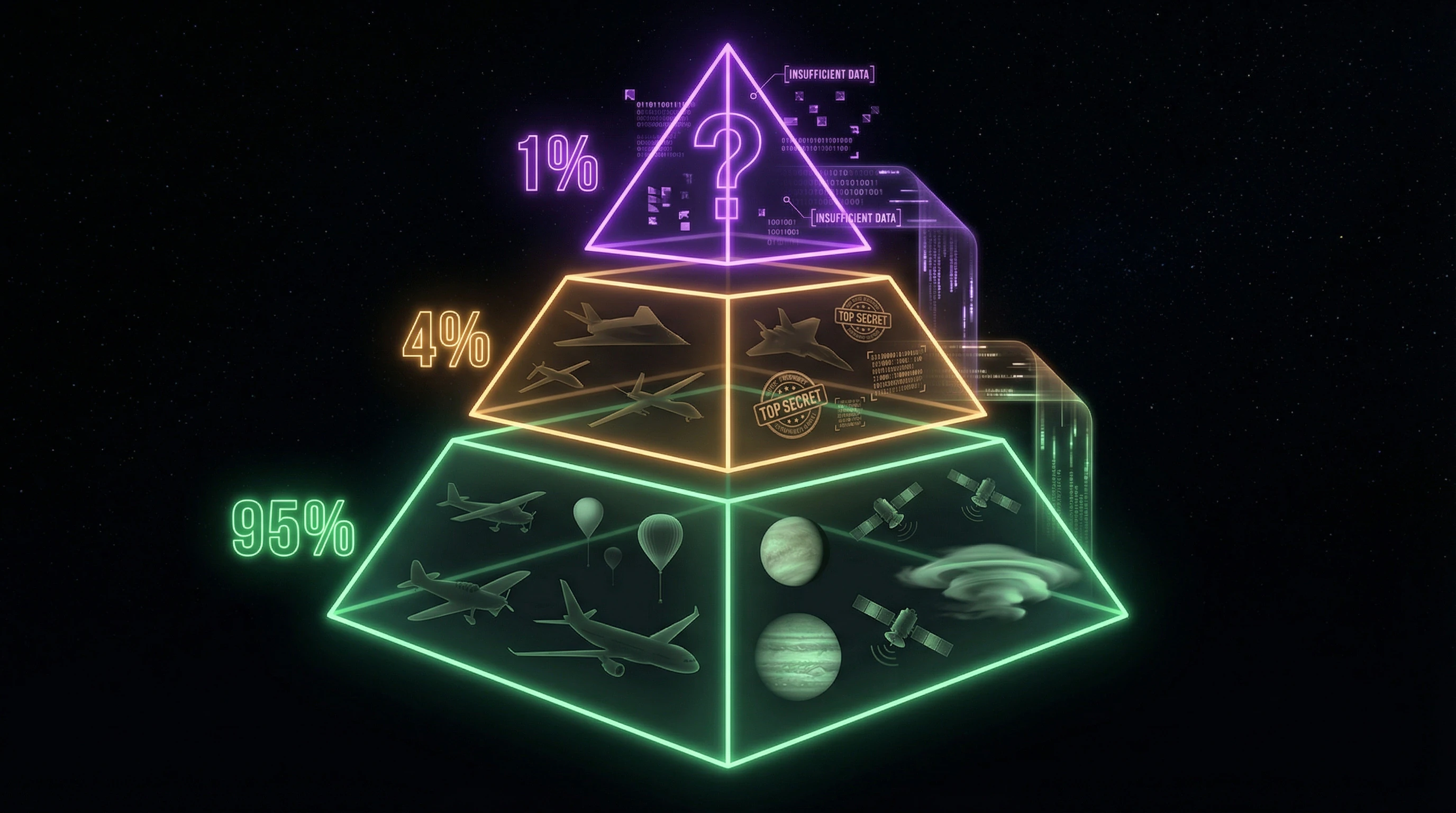
- Identified Objects
- Cases where investigation established the nature of the phenomenon: planets, aircraft, weather balloons, atmospheric phenomena (S002).
- Insufficient Data
- Information too sparse for any conclusion. This means neither that the object is of unknown origin nor that it doesn't exist.
- Unidentified
- Extremely rare cases where sufficient data exists but no explanation has been found. Critically important: this category does not mean "extraterrestrial," it means "requires further study."
Substituting the third category for "proof of the extraterrestrial hypothesis" is not a scientific conclusion but a cognitive trap that transforms ignorance into certainty.
The Steel Version of the Argument: Seven Most Compelling Arguments for the Extraterrestrial Hypothesis — and Why They Deserve Serious Consideration
Before examining the weaknesses of the extraterrestrial hypothesis, it's necessary to present it in its strongest form — this is called the "steelman" principle, the opposite of a "strawman." Proponents of the extraterrestrial origin of UFOs rely on several arguments that cannot simply be dismissed. More details in the section Water Memory.
🔬 Argument 1: Testimony from Trained Observers
The most compelling UFO reports come not from random passersby, but from military pilots, air traffic controllers, and astronomers — people professionally trained to identify objects in the sky (S003). These observers know what aircraft, meteorological phenomena, and astronomical objects look like.
When an experienced fighter pilot with thousands of flight hours reports an encounter with an object demonstrating impossible maneuvers, this requires an explanation more serious than perceptual error.
📊 Argument 2: Radar Confirmation of Visual Observations
Some cases include simultaneous visual observation and radar detection of objects demonstrating unusual behavior (S006). When a pilot sees an object and ground radar simultaneously tracks a target in the same location performing maneuvers impossible for known technology, this complicates explanations through hallucination or optical illusion.
Radar is not subject to psychological perceptual distortions — it's a physical instrument registering electromagnetic reflection.
🧾 Argument 3: Government Investigation Programs
The fact that official government programs to study UFOs existed (Project Blue Book in the U.S., similar programs in the USSR) indicates that the phenomenon was taken seriously enough at the state level (S006). If all cases were obvious perceptual errors, why would governments spend resources on multi-year investigations?
The recent creation of the U.S. office to study "unidentified aerospace phenomena" (UAP) shows that interest has not waned.
| Program | Period | Scale |
|---|---|---|
| Project Blue Book (USA) | 1952–1969 | 12,618 reports |
| Soviet programs | 1960–1990 | Classified |
| UAP Office (USA) | 2021–present | Ongoing investigations |
⚠️ Argument 4: Physical Traces and Effects
In some cases, physical traces of alleged UFO landings are reported: burned vegetation, radiation anomalies, electromagnetic interference in electronics (S001). If these traces are real and cannot be explained by known causes, they represent physical evidence beyond subjective eyewitness testimony.
🧬 Argument 5: Statistical Probability of Extraterrestrial Life
The Drake Equation and modern astronomical data on the prevalence of exoplanets in the habitable zone suggest that life in the universe may not be a unique phenomenon (S008). If intelligent life exists elsewhere and has reached the technological level of interstellar travel, it's logical to assume it might visit other planets, including Earth.
Absence of evidence is not evidence of absence — this is a logical distinction often ignored by both sides of the debate.
🕳️ Argument 6: Patterns in Reports Across Different Cultures
Proponents of the extraterrestrial hypothesis point to similarities in UFO descriptions across different cultures and time periods, including ancient texts and images interpreted as evidence of contact (S007). If people in different parts of the world, with no contact with each other, describe similar phenomena, perhaps they are observing a real phenomenon rather than creating independent myths.
- Ancient texts (Bible, Vedas, Chinese chronicles) contain descriptions of flying objects and beings from the sky
- Medieval engravings depict disc-shaped objects over cities
- 20th century: waves of UFO reports in different countries simultaneously
- 21st century: video recordings from military aircraft, confirmed by the Pentagon
🧪 Argument 7: Unexplained Movement Characteristics
Some observations describe objects demonstrating characteristics impossible for known terrestrial technology: instantaneous acceleration without sonic boom, sharp directional changes at speeds that would destroy any known structure, hovering without visible means of lift (S003). If these observations are accurate, they point to technology superior to ours.
- Instantaneous Acceleration
- Object transitions from stationary to high speed without a transitional period — physically impossible for known engines and structures.
- Sharp Turns at High Speed
- 90-degree directional changes without an arc trajectory — requires either absence of inertia or an unknown principle of motion.
- Hovering Without Visible Means
- Object remains motionless in the air without helicopter rotors, jet engines, or other known lift mechanisms.
Evidence Base Analysis: What Declassified Archives, Scientific Studies, and Independent Investigations Show — Numbers vs. Myths
Having presented the strongest arguments for the extraterrestrial hypothesis, we must now subject them to rigorous scrutiny. More details in the Paranormal Phenomena and Ufology section.
📊 Project Blue Book Statistics: 12,618 Cases Over 17 Years
The most comprehensive official UFO investigation — the American Project Blue Book (1952-1969) — analyzed 12,618 reports (S003). Results: 11,917 cases (94.4%) were identified as ordinary objects or phenomena (aircraft, weather balloons, astronomical objects, atmospheric phenomena).
Only 701 cases (5.6%) remained "unidentified" — but this means "insufficient data for conclusion," not "confirmed aliens." Not a single case was officially classified as an "extraterrestrial spacecraft."
| Category | Number | Percentage | Interpretation |
|---|---|---|---|
| Identified Objects | 11,917 | 94.4% | Aircraft, balloons, planets, phenomena |
| Unidentified | 701 | 5.6% | Insufficient data, not "aliens" |
| Classified as Extraterrestrial | 0 | 0% | No official confirmation |
🧾 What Governments Were Hiding: Motives for Secrecy
Declassified documents show that government interest in UFOs was motivated not by searching for aliens, but by two terrestrial reasons (S006): national security — verifying whether "UFOs" were secret enemy developments (especially relevant during the Cold War); information control — preventing panic and disinformation.
Secrecy is explained by standard military security protocols, not by concealing contact with aliens.
🔎 Analysis of "Unexplained" Maneuvers: Physics vs. Perception
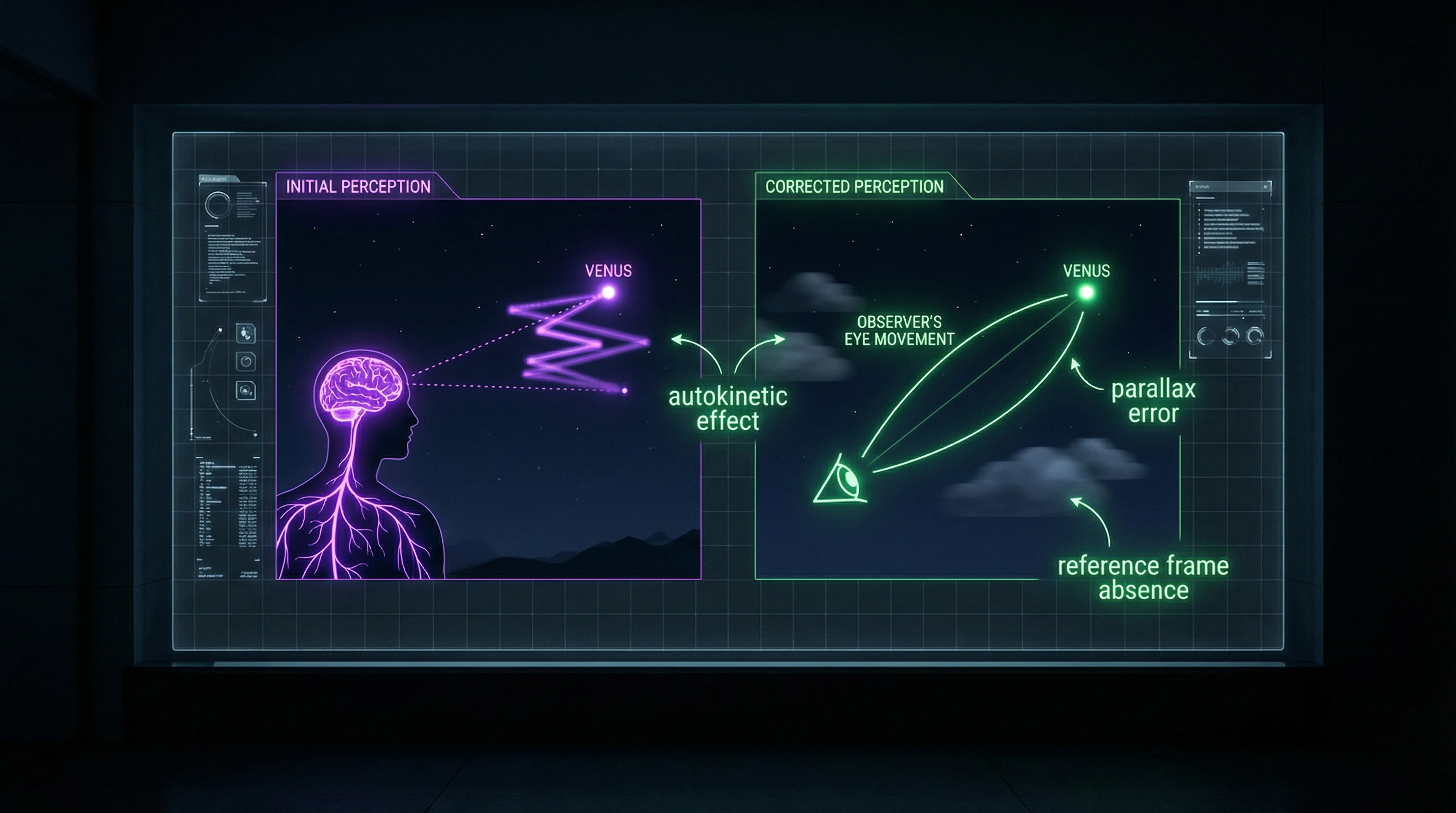
Detailed analysis of reports about "impossible" UFO maneuvers reveals systematic perception errors (S004). When an observer sees a distant object without reference points (for example, in the night sky), the brain cannot accurately determine distance, size, and speed.
- An object moving in a straight line may appear to make sharp turns due to observer movement or changing viewing angle
- The bright planet Venus, observed through moving clouds, creates the illusion of a rapidly maneuvering object
- Absence of reference objects in the field of view amplifies distortion in trajectory assessment
🧪 Radar Data: Technical Artifacts
Radar detection cases cited as proof of UFO reality, upon detailed analysis, are often explained by technical artifacts (S002). Radars can detect atmospheric inversion layers creating false reflections; flocks of birds or meteorological phenomena; interference from other radar systems; software glitches in signal processing systems.
Radar detects radio wave reflections, not an "object" in the everyday sense. Signal interpretation requires expertise and context.
⚠️ Physical Traces: The Verification Problem
Reports of physical UFO traces face a fundamental problem: absence of controlled conditions and chain of custody for evidence (S001). Burned vegetation may result from ordinary fire, lightning, or human activity.
Radiation anomalies require immediate measurement with calibrated instruments — measurements taken days or weeks after an event are useless. Not a single case has provided a physical material sample that, upon laboratory analysis, showed extraterrestrial origin.
🧬 The Interstellar Distance Problem: Fermi Paradox
While the probability of extraterrestrial life existing may be high, this doesn't make interstellar travel probable (S008). The nearest star is 4.24 light-years away — with current technology, the journey would take tens of thousands of years.
If aliens exist and visit Earth regularly (judging by the number of reports), why is there not a single irrefutable proof of contact?
The Mechanics of Illusion: How the Cognitive Trap "Unidentified Equals Alien" Works — The Neurobiology of UFO Belief
The UFO phenomenon is less a question of astronomy than one of perception psychology and social dynamics. Understanding the cognitive mechanisms explains why millions of people sincerely believe in the extraterrestrial origin of UFOs despite the absence of evidence. More details in the section Psychology of Belief.
🧩 Expectation Effect and Confirmation Bias
When a person expects to see something unusual, the brain actively seeks confirmation of that expectation — this is called confirmation bias (S002). If you've heard about a "UFO wave" in your region and see an unusual light in the sky, the brain automatically interprets it as a UFO, ignoring simpler explanations (airplane, satellite, meteor).
Experiments show: people who are shown a blurry image and told "this might be a UFO" see a "flying saucer" significantly more often than a control group without such a prompt.
🔁 Autokinetic Effect: When Stationary Appears Moving
One of the key mechanisms of perceptual errors is the autokinetic effect: when a person looks at a stationary point of light in darkness without reference points, it appears to move (S004). This explains numerous reports of "maneuvering" lights in the night sky.
A bright star or planet observed for several minutes creates the illusion of complex movement trajectories. The effect intensifies if the observer is moving (for example, in a car) — relative motion is interpreted as object movement.
🧷 Social Reinforcement and Availability Cascade
When one person reports a UFO sighting, it triggers an availability cascade: other people begin paying attention to the sky and interpreting ordinary phenomena as UFOs (S005). Media coverage amplifies the effect: the more people talk about UFOs, the more people "see" them.
This isn't deception — it's sincere reinterpretation of ordinary stimuli under the influence of social context. Statistics show: the number of UFO reports correlates not with actual events, but with media activity on the topic.
- Media wave about UFOs launches
- People begin observing the sky more actively
- Ordinary phenomena are reinterpreted as unusual
- New reports amplify public attention
- The cycle repeats and expands
🧠 Need for Meaning and Agency
The human brain is evolutionarily tuned to detect patterns and attribute agency to events — intentional action by an intelligent subject (S008). This was useful for survival (better to mistakenly take a rustle in the bushes for a predator than to miss a real threat), but creates a systematic error: we see intention and intelligence where there is none.
An unexplained light in the sky is automatically interpreted as "someone is controlling this," rather than as an impersonal natural phenomenon. This reinterpretation occurs at the perceptual level, before conscious analysis.
Conflicts in Sources and Zones of Uncertainty: Where Data Contradicts Itself — and What This Means for Conclusions
Honest analysis requires acknowledgment: not all sources agree with each other, and there are areas where data is incomplete or contradictory. More details in the section Cognitive Biases.
🔎 Contradiction: Estimating the Percentage of Unexplained Cases
Different studies provide different estimates of the proportion of "truly unexplained" UFO cases. Project Blue Book indicates 5.6% (S003), but independent researchers using stricter criteria reduce this figure to 1-2%, while others insist it is higher.
The problem lies in the criteria: what constitutes "sufficient data" to classify a case? This is a subjective judgment, and different experts apply different standards.
- Criterion 1: Is a single eyewitness testimony sufficient?
- Criterion 2: Is physical evidence or video recording required?
- Criterion 3: How should cases where data is lost or classified be accounted for?
- Criterion 4: Is independent verification from multiple sources necessary?
🧾 Contradiction: Reliability of Military Witness Testimony
One source emphasizes the high reliability of testimony from trained military observers (S003), while another points out that military pilots are also susceptible to perceptual errors, especially under stressful conditions or when observing unfamiliar phenomena (S002).
Training increases accuracy in identifying known objects, but does not protect against systematic cognitive biases when encountering genuinely unusual stimuli.
Both positions have merit. The question is not who is right, but rather what observational conditions strengthen or weaken the reliability of testimony.
⚙️ Zone of Uncertainty: Classified Technologies
Some UFO cases may be explained by observations of classified military developments that the public only learns about decades later (S006). This creates a fundamental problem: we cannot test this hypothesis while the technology remains classified.
It's possible that some "unexplained" cases from the 1950s-60s were observations of U-2 or SR-71 prototypes, but confirming this retrospectively is difficult due to destruction or classification of documents. This does not refute the extraterrestrial hypothesis, but shows that alternative explanations remain in the zone of uncertainty.
Anatomy of Persuasion: Which Cognitive Biases and Persuasion Techniques the UFO Industry Exploits — and Why They Work Even on Skeptics
Belief in the extraterrestrial origin of UFOs is sustained not only by perceptual errors but also by an entire arsenal of persuasion techniques, many of which are consciously employed by the UFO content industry. More details in the Comments and Questions section.
⚠️ Technique 1: Gish Gallop and Evidence Overload
Proponents of the extraterrestrial hypothesis often use the "Gish gallop" technique: presenting an enormous quantity of weak evidence that cannot be individually refuted within a reasonable timeframe (S005).
"Here are 500 sighting cases! You can't explain each one!" Quantity doesn't compensate for quality: 500 anecdotal testimonies without physical evidence are no stronger than one, while refuting each requires disproportionately more effort than presenting it.
🕳️ Technique 2: Exploiting Knowledge Gaps
A classic strategy — pointing to gaps in scientific knowledge and filling them with the extraterrestrial hypothesis: "Science can't explain how the pyramids were built, therefore aliens did it" (S007).
This is "god of the gaps" in new packaging. Knowledge gaps are filled by research, not speculation — the history of science shows: every time we found an explanation for the "unexplainable," it turned out to be natural.
🧠 Technique 3: Appeal to Authority and Conspiracy
"A former military officer / scientist / government official confirms the existence of UFOs" — appeal to authority (S006).
Authority in one field doesn't transfer to another, and "former" status often means lack of access to current information. When skeptics point to the absence of evidence, conspiracy theory kicks in: "The government is hiding it!" This makes the hypothesis unfalsifiable — any absence of evidence is interpreted as evidence of concealment.
🔁 Technique 4: Emotional Investment and Identity
Belief in UFOs often becomes part of personal identity: "I'm someone who knows the truth that's being hidden from the masses" (S005).
This provides psychological benefits: a sense of being chosen, belonging to a community of like-minded individuals, a feeling of control over chaos. When identity is tied to a belief, criticism of the belief is perceived as a personal attack.
- A person invests emotionally in the hypothesis
- Criticism of the hypothesis activates defense mechanisms
- Counterarguments are rejected or reinterpreted
- The belief is reinforced through cognitive biases
🎭 Technique 5: Narrative and Storytelling
The UFO industry builds compelling narratives: Roswell as the beginning of a hidden history, contactees as the chosen ones, government as the enemy. A good story is remembered better than a set of facts.
Narrative activates the brain's emotional centers, not logical ones. Even if individual facts in the story are questionable, the coherence of the narrative creates an impression of plausibility.
⚡ Technique 6: Social Proof and the Barnum Effect
"Millions of people believe in UFOs, so it can't be completely false" — social proof. The Barnum effect: vague statements ("aliens are observing humanity") seem personally significant to everyone.
When a person sees that millions share their belief, it strengthens confidence. Communities around UFOs create echo chambers where alternative viewpoints are rarely heard.
🛡️ Why This Works Even on Skeptics
A skeptic may be immune to one technique but vulnerable to another. Appeal to authority won't work on a critically thinking person, but a narrative about hidden truth may activate their desire to be "in the know."
Moreover, the UFO industry adapts: when the scientific community rejects the extraterrestrial hypothesis, this is reinterpreted as proof of conspiracy, which further reinforces belief. The system becomes self-protecting.
| Technique | Mechanism | Vulnerability |
|---|---|---|
| Gish Gallop | Overload with weak evidence | Cognitive fatigue, inability to verify each claim |
| God of the gaps | Filling the unknown with speculation | Desire to explain the unexplainable immediately |
| Appeal to authority + conspiracy | Authority + unfalsifiability | Trust in status, fear of the hidden |
| Identity | Belief as part of "self" | Self-esteem protection when criticized |
| Narrative | Emotional coherence instead of logic | Brain prefers stories to facts |
| Social proof | Mass acceptance as validation | Conformity and echo chambers |
The key to resilience — not rejecting the belief, but understanding its mechanics. When you see how a persuasion technique works, you become less vulnerable to it, even if it's emotionally appealing.