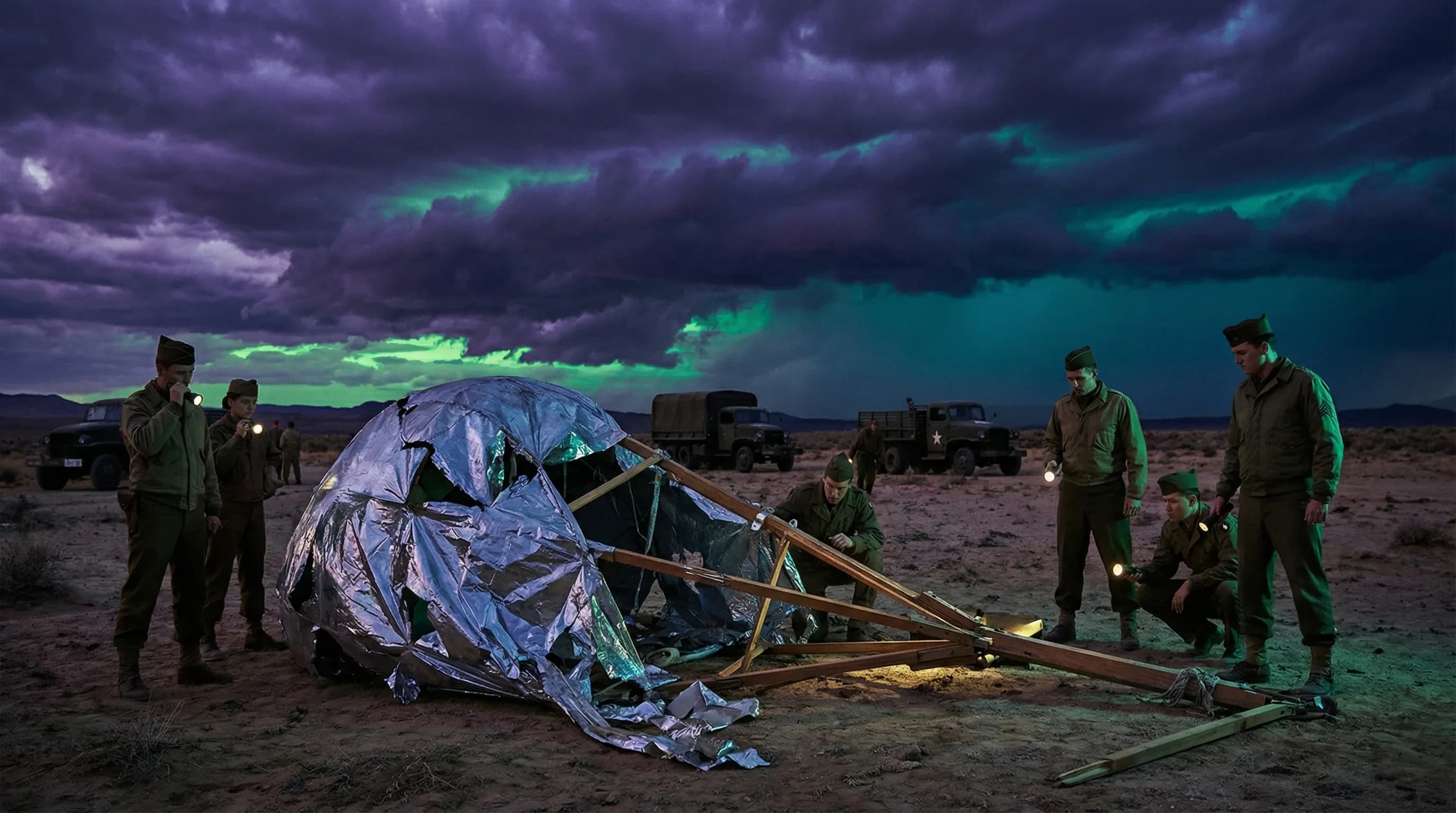
What exactly the Roswell myth claims and why its boundaries are blurred beyond recognition
The central claim: in July 1947, an alien spacecraft crashed near Roswell, the military recovered alien bodies, everything was classified. But even proponents disagree on details—the number of crashes, number of bodies, their appearance, location, dates vary depending on the source. More details in the Alternative History section.
This blurring of boundaries is not accidental. It's a sign that the myth functions not as a hypothesis, but as a narrative that adapts to any new data.
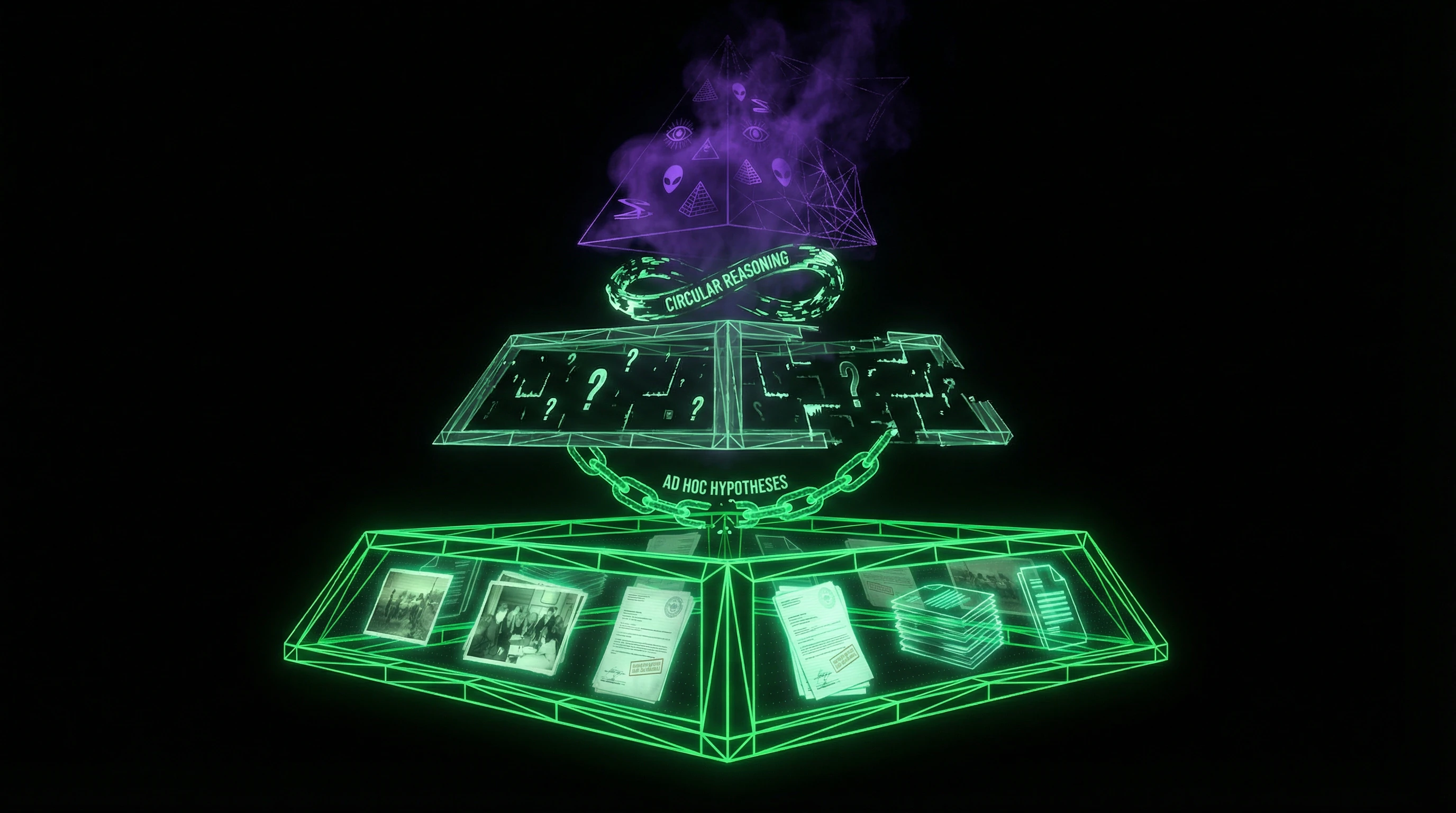
Any absence of evidence becomes evidence of concealment. Any explanation becomes a cover-up. Such logic is unfalsifiable and falls outside the bounds of science.
🧩 Evolution of the narrative: from press release to global myth
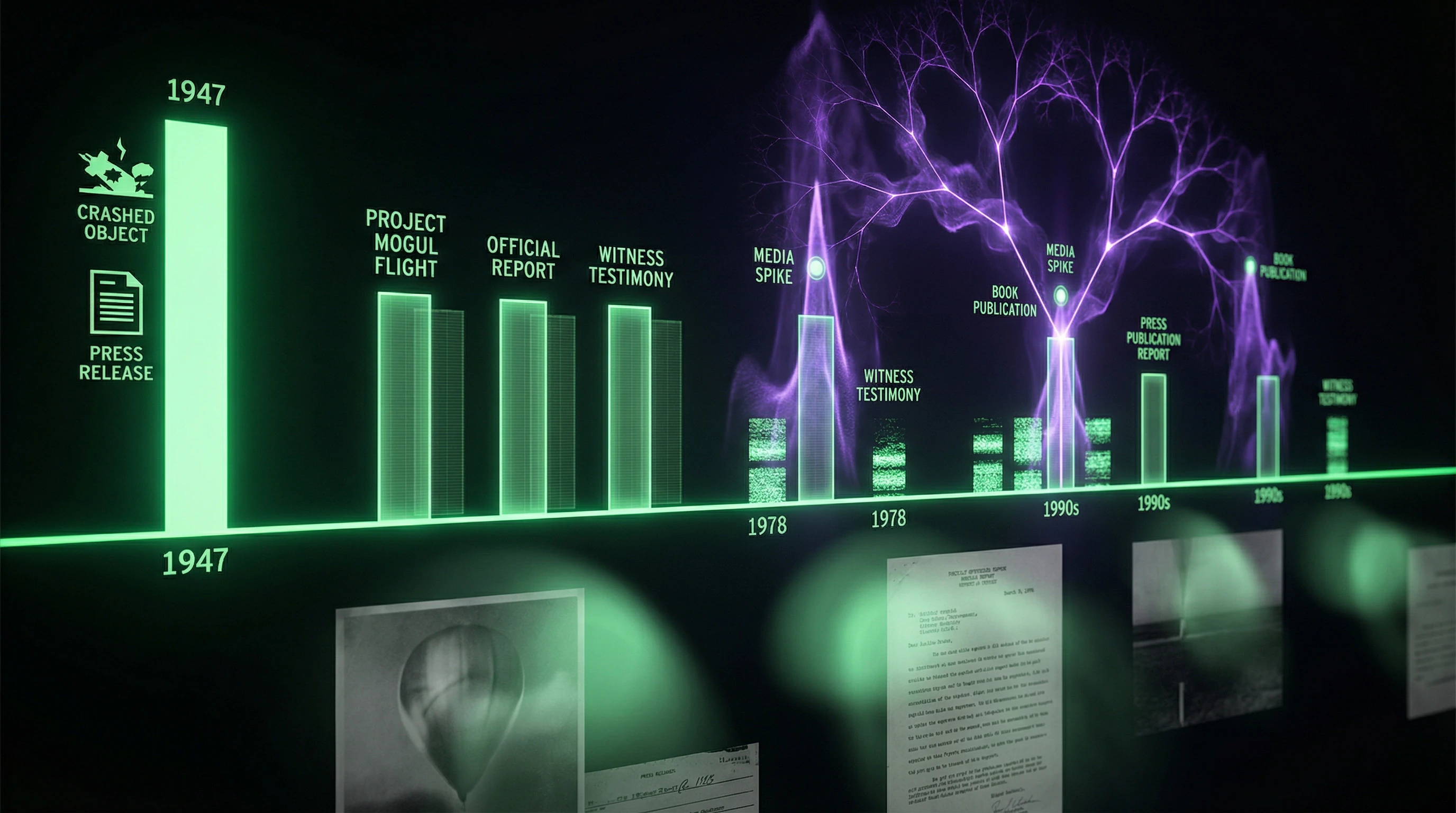
On July 8, 1947, Roswell Army Air Field issued a press release about finding a "flying disc." The next day—a retraction: the recovered object turned out to be a weather balloon.
Then 30 years of silence. The first book reviving interest was published only in 1980. This contradicts the logic of "the greatest cover-up in history": if the government was hiding contact with an extraterrestrial civilization, why did the topic remain marginal for three decades?
| Period | Event Status | Explanation |
|---|---|---|
| 1947 (July–August) | Public, then retracted | Weather balloon |
| 1947–1980 | Marginal, rare mentions | Forgotten or actively suppressed? |
| 1980+ | Global cultural phenomenon | Books, films, tourism |
🔎 Methodological trap: unfalsifiability
The Roswell myth demonstrates a classic epistemological trap. When the U.S. government declassified documents about Project Mogul (a secret high-altitude balloon program for monitoring Soviet nuclear tests), proponents of the alien version perceived this not as an explanation, but as a "cover-up of the cover-up."
- Unfalsifiability
- An argumentative structure in which any contrary evidence is interpreted as part of the conspiracy. No data can refute the claim because the absence of evidence itself becomes evidence.
- Why this is a problem
- Such logic places the claim outside scientific discourse. Science requires the possibility of being wrong—if a hypothesis cannot be disproven, it is not scientific.
🧱 Three levels of claims: what we're testing
For proper analysis, we need to separate the levels:
- Level 1: an object crashed in Roswell—a fact, documented.
- Level 2: the object was of extraterrestrial origin—an extraordinary claim requiring extraordinary evidence.
- Level 3: the government is hiding evidence—a meta-claim explaining the absence of Level 2 evidence.
Confirmation of Level 1 is not proof of Level 2. Level 3 is an ad hoc logical fallacy: a hypothesis invented specifically to explain the absence of evidence.
Next, we'll test each level separately—and see where the myth starts to crack.
The Steel Version: Seven Most Compelling Arguments from Extraterrestrial Hypothesis Proponents
Intellectual honesty requires examining opponents' strongest arguments before refuting them. The "steelman" principle — opposite of a straw man — involves formulating the opposing position in its most convincing form. More details in the Quantum Mysticism section.
🔬 The Military Witness Testimony Argument
Major Jesse Marcel, intelligence officer of the 509th Bomb Group, was first to arrive at the crash site and later claimed the debris resembled no aircraft known to him. Marcel had experience identifying aviation debris and, according to this argument, could not have mistaken a weather balloon for something unusual.
Additionally cited are statements from Colonel William Blanchard, base commander, who authorized the initial press release about a "flying disc." The professional status of witnesses is a key element of this argument.
📊 The Changing Official Story Argument
Official explanations evolved: "flying disc" (July 8, 1947) → weather balloon (July 9) → Project Mogul (1994 report) → crash test dummies (1997 report). Multiple reformulations are interpreted as evidence of post factum explanation-fitting.
| Date | Official Version | Critics' Interpretation |
|---|---|---|
| July 8, 1947 | "Flying disc" | Initial honesty or error |
| July 9, 1947 | Weather balloon | First reformulation |
| 1994 | Project Mogul | Declassification or new cover-up |
| 1997 | Crash test dummies | Explanation for "alien bodies" |
🧾 The Project Mogul Secrecy Argument
If the debris belonged to Project Mogul — a classified program to detect Soviet nuclear tests — then the military had grounds to conceal the find in 1947. However, proponents ask: why did secrecy persist for decades after the Cold War ended, when the program was declassified?
If initial concealment was justified by national security, continuing secrecy points to something more.
🧬 The Unusual Material Properties Argument
Witnesses described debris possessing unusual properties: metallic foil that returned to its original shape after crumpling, beams with incomprehensible symbols, materials of extraordinary lightness and strength. Marcel claimed the material wouldn't burn and couldn't be cut.
Proponents note: 1947 technology couldn't produce materials with such characteristics, especially for weather balloons. This creates a logical gap between the official version and the described properties.
⚙️ The UFO Wave Temporal Coincidence Argument
The Roswell incident occurred during the height of a "flying disc" sighting wave in summer 1947, beginning with Kenneth Arnold's famous case on June 24. Multiple independent sightings of unidentified objects during that period create a context in which an extraterrestrial craft crash becomes more probable.
Statistical clustering of sightings is interpreted as evidence of real activity, not mass delusion. The temporal coincidence is viewed as non-random.
🕳️ The Deathbed Confession Argument
Several event participants allegedly made deathbed confessions. Walter Haut, Roswell base public information officer, in a sealed affidavit opened after his death in 2005, claimed he saw an alien craft and bodies.
Proponents believe people on death's threshold have no motive to lie, especially if it might damage their reputation. The absence of material incentive to lie is viewed as a marker of credibility.
🧷 The Institutional Concealment Patterns Argument
The U.S. government did conceal information from the public for decades: radiation exposure experiments, the MKUltra program, Cold War operation details. This pattern establishes precedent.
- If the government can keep other secrets for decades, it can conceal Roswell materials
- Institutional capacity for long-term secrecy makes the conspiracy hypothesis technically feasible
- Absence of leaks doesn't disprove a secret's existence — only its effective concealment
All seven arguments rely on logic: if X is possible, and Y is observed, then Z (the extraterrestrial hypothesis) becomes a rational explanation. The strength of these arguments lies in not requiring belief — only acknowledgment of logical consistency.
Evidence Base: Systematic Analysis of Each Claim with Source Verification
Moving from the steel version of arguments to their critical analysis requires methodological rigor. Each claim must be tested against evidence criteria: reproducibility, independent verification, compliance with physical laws, presence of alternative explanations with fewer assumptions (Occam's razor). More details in the section Free Energy and Perpetual Motion Machines.
Systematic review of the evidence base shows that none of the key claims withstand rigorous scrutiny (S009, S010).
📊 Analysis of Witness Testimony: The Problem of Retrospective Memory
Major Marcel's testimony, frequently cited by proponents of the extraterrestrial hypothesis, was not given in 1947 but in interviews from 1978–1980—more than 30 years after the event. Cognitive psychology documents that human memory is not an accurate recording of events, but rather a reconstructive process subject to distortions, confabulation, and influence from subsequent information.
Research shows that memories of events from 30 years prior can contain significant distortions, especially when a person has repeatedly retold the story or been exposed to media narratives (S009).
In 1947, Marcel made no public statements about the unusual nature of the debris. His initial actions—delivering materials to command and participating in a photo session with weather balloon debris—are inconsistent with the behavior of someone convinced of the extraterrestrial origin of the find.
The change in testimony three decades later, during a period of active interest in UFOs and after publication of several books on the topic, suggests possible influence of cultural context on memory reconstruction.
🧪 Project Mogul: Documented Alternative
The 1994 U.S. Air Force report "The Roswell Report: Fact vs. Fiction in the New Mexico Desert" provided detailed documentation of Project Mogul—a classified program launching high-altitude balloon trains for acoustic monitoring of possible Soviet nuclear tests.
| Match Criterion | Project Mogul | Find Description |
|---|---|---|
| Launch date and location | June 4, 1947, Alamogordo, New Mexico | Flight #4 was not recovered |
| Trajectory | Matches Foster ranch location | Find location matches calculated trajectory |
| Materials | Neoprene balloons, mylar film, balsa beams | Debris descriptions match components |
| Markings | Reinforced tape with geometric patterns | "Hieroglyphics" in pink and purple |
Project Mogul documentation includes technical specifications, photographs of identical constructions, flight records, and testimony from program participants—a level of evidence incomparable to anecdotal accounts about aliens.
🧾 Chronology of Official Version Changes: Context Matters
Critics point to changes in the official version as evidence of cover-up, but detailed chronological analysis reveals a different picture. The initial press release about a "flying disc" was issued by public information officer Walter Haut on orders from base commander Blanchard, but without detailed examination of materials by higher command.
When debris was delivered to General Roger Ramey in Fort Worth, he immediately identified it as weather balloon remains—which was announced the next day. This is not a version change for cover-up purposes, but correction of mistaken identification after expert assessment.
- Delay in explaining Project Mogul until 1994
- The program remained classified until the end of the Cold War—standard practice for military projects.
- Mention of dummies in the 1997 report
- Referred not to 1947 events but to 1950s tests that some witnesses retrospectively linked to Roswell—a typical example of temporal compression in long-term memory.
🔎 Materials with "Unusual Properties": Technological Context of 1947
Descriptions of materials that "returned to original shape" and "wouldn't burn" are often cited as proof of extraterrestrial technology. However, these properties fully correspond to materials used in Project Mogul: neoprene balloons possessed elasticity and recovered shape after deformation; aluminized mylar film was lightweight, durable, and had shape-memory effect; balsa beams reinforced with aluminum foil combined lightness with strength.
Key point: these materials were unusual to the general public and even to most military personnel in 1947, but were not extraterrestrial. Mylar was developed by DuPont in the 1940s specifically for military applications. Metallized films were used in radar reflectors.
For someone unfamiliar with advanced materials of the time, these properties could seem inexplicable—a classic example of argument from ignorance: "I don't know what this is, therefore it's alien."
📌 1947 UFO Sighting Wave: Social Epidemic or Reality
Summer 1947 did see a spike in "flying saucer" reports, beginning with Kenneth Arnold's sighting on June 24. However, sociological analysis reveals a classic pattern of mass hysteria and social contagion.
After widespread press coverage of Arnold's case, the number of reports grew exponentially—a typical sign of media-induced phenomenon. Most sightings were explained as misidentification of ordinary objects: aircraft, weather balloons, planets, meteors.
- The pattern of sightings followed media coverage rather than preceding it
- This contradicts the hypothesis of actual extraterrestrial activity
- Fully consistent with social construction model
- The term "flying saucer" created a perceptual category into which people began placing any unusual visual stimuli
The phenomenon is analogous to other documented cases of mass illusions: "airships" of the 1890s, "phantom aircraft" of the 1930s, "black helicopters" of the 1970s (S009). For more on mechanisms of social construction of UFO narratives, see the article "UFOs: How Mass Illusion Became an Industry."
🧬 Deathbed Confessions: Motivation and Reliability
Walter Haut's affidavit, opened after his death in 2005, does contain claims about observing an alien craft and bodies. However, critical analysis must consider several factors.
- Time gap
- The document was composed in 2002, 55 years after the event, when Haut was 83 years old.
- Social context
- During the preceding decades, Haut actively participated in the ufology community and was co-founder of the International UFO Museum in Roswell.
- Financial interests
- His income was tied to maintaining the alien narrative.
The assumption that people on their deathbed don't lie is a romanticization not supported by psychological research. People at life's end may seek to dramatize their role in historical events, may sincerely believe distorted memories, or may wish to leave a "legacy."
Moreover, the affidavit was not composed spontaneously but with participation of ufologists, raising questions about influence and leading questions. The absence of contemporary 1947 documents confirming these claims critically undermines their credibility. On cognitive mechanisms that allow people to believe such narratives, see "Reality Check."
Mechanisms of Causality: Why Correlation Between Secrecy and Myth Doesn't Mean Conspiracy
The central logical error of the Roswell myth is conflating correlation with causation. The U.S. government concealed information about Project Mogul in 1947, creating an information vacuum. But this doesn't mean the concealed information concerned extraterrestrials. More details in the Cognitive Biases section.
Analysis of causal relationships requires considering alternative explanations and evaluating their relative probability while applying the principle of parsimony (S010).
The correlation between secrecy and myth is explained by the Cold War, not by the presence of aliens. This isn't a conspiracy—it's standard national security logic.
🔁 Confounders: The Cold War as an Explanatory Variable
In 1947, the United States was in intense geopolitical competition with the USSR. Project Mogul was designed for early detection of Soviet nuclear tests through acoustic monitoring of the upper atmosphere—a critically important intelligence objective.
Revealing program details would have informed the adversary about American intelligence capabilities and stimulated countermeasures. This explanatory variable fully accounts for the observed secrecy without additional assumptions.
| Hypothesis | Required Assumptions | Documented Examples |
|---|---|---|
| Extraterrestrial Version | Extraterrestrial life, interstellar travel, presence on Earth, technology crash, multi-decade secret involving thousands of people | Zero |
| Cold War | Governments conceal military secrets | Thousands of examples |
🧷 Reverse Causality: How the Myth Creates Its Own "Evidence"
The Roswell case demonstrates reverse causality in the formation of conspiracy narratives. Belief shapes the interpretation of evidence, not the other way around. After publication of the first books about the extraterrestrial version in the 1980s, "witnesses" began appearing whose memories remarkably matched details from these books.
This is the result of a process psychologists call false memory implantation. Research by Elizabeth Loftus has shown that human memory is reconstructive: each time we recall an event, we partially rewrite the memory, integrating new information (S009).
- False Memory Implantation
- When a person reads a detailed description of an event, these details can integrate into their own memories, creating a sincere but false sense that they personally witnessed these details. The myth doesn't reflect reality—it creates a pseudo-reality in the minds of believers.
⚙️ Amplification Mechanism: Why Refutations Strengthen Belief
Official refutations often strengthen conspiracy beliefs instead of weakening them. This is a paradox known as the "backfire effect." When someone already believing in the extraterrestrial version receives information contradicting their belief, they interpret this information as additional proof of conspiracy.
The logic is simple: if the government concealed aliens, then it will deny their existence. Denial becomes confirmation. This closed logical system makes the conspiracy narrative resistant to factual refutation—any contradiction is interpreted as part of the conspiracy.
A system that interprets refutations as evidence cannot be refuted by facts. It can only be understood as a cognitive trap.
🔍 Social Function of the Myth: Identity and Belonging
The Roswell myth serves a social function that explains its persistence better than any factual arguments. Belief in aliens creates identity: a person becomes part of a community of "those who know," opposing official lies.
This social function operates independently of the truth of the claims. Even if all facts point to a weather balloon, the social reward of belonging to a community of believers can be stronger than the cognitive dissonance from contradictory evidence. This explains why the mass illusion became an industry despite the absence of scientific proof.
- The myth provides an explanation for uncertainty (what happened in Roswell?)
- The myth provides an explanation for secrecy (why is the government silent?)
- The myth provides social identity (I'm someone who knows the truth)
- The myth provides protection from refutation (any refutation is part of the conspiracy)
These four functions work synergistically, creating a cognitive system that is self-sustaining independent of external facts. The Roswell myth is not a logical error that can be corrected with facts. It's a social and psychological system that satisfies deep human needs for meaning, belonging, and control over uncertainty.
The myth doesn't die because it doesn't live on facts. It lives on the functions it performs in the psyche and society of believers.