What exactly proponents of psychic abilities claim — and where the boundary lies between assertion and fantasy
Before analyzing the phenomenon, it's necessary to clearly define what we're discussing. The term "psychic abilities" encompasses a wide spectrum of claims: from the ability to read minds (telepathy) to predicting the future (clairvoyance) and perceiving information without using known sensory organs. More details in the section Paranormal phenomena and ufology.
The key assertion: there exists a channel of information transmission that science has not yet discovered, but which is accessible to select individuals.
⚠️ Basic categories of paranormal claims
- Telepathy
- Direct transmission of thoughts, images, or emotions from one person to another without using known sensory channels. Tested under conditions where all alternative pathways of obtaining information are excluded.
- Clairvoyance
- Obtaining information about events, objects, or people that are inaccessible to ordinary perception at a given moment in time. Requires reproducibility under blind conditions.
- Psychokinesis
- The influence of consciousness on physical objects without physical contact. The most demanding claim in terms of control — any movement of an object must be recorded independently of the subject's actions.
All these categories share one thing: the absence of reproducible evidence under controlled conditions (S004).
A person may sincerely believe they experienced telepathic contact, but this does not make telepathy a real phenomenon. Subjective certainty is a psychological fact requiring explanation through neurobiology and cognitive psychology, not proof of the existence of a paranormal communication channel.
🧩 Why defining boundaries is critically important
Proponents of psychic abilities often use vague formulations that make their claims untestable. "I sense energy" — what exactly is being measured? What is the unit of measurement? Under what conditions is the effect reproduced?
Without operational definitions, any claim becomes unfalsifiable, and therefore unscientific. An assertion that cannot be refuted even in principle is not scientific (S003).
| Defense strategy | Pseudoscience indicator | Example |
|---|---|---|
| Moving the goalposts | Ad hoc hypotheses | "Skeptics' negative energy interferes" |
| Changing conditions after failure | Lack of predictive power | "Laboratory conditions block abilities" |
| Limiting the audience | Unverifiability | "This only works with believers" |
🔎 Cultural context and commercialization
Belief in supernatural abilities exists in all cultures and eras. Anthropological research shows that paranormal beliefs serve social functions: they reduce anxiety about uncertainty, create an illusion of control, strengthen group identity (S006).
In modern society, psychic abilities have transformed into a commercial industry with its own media formats, educational programs, and certification systems. Television shows create an illusion of legitimacy through the format of competition and "tests" that in reality do not meet scientific standards of control.
The entertainment format masks the absence of a real evidence base. This makes it necessary to examine the mechanisms that create the convincingness of the illusion — see also how the brain creates the illusion of understanding and the ideomotor effect.
The Most Convincing Arguments for the Existence of Psychic Abilities — and Why They Deserve Serious Consideration
Intellectually honest analysis requires examining the strongest arguments from the opposing side. This is called the steelman principle — as opposed to strawman, where opponents are presented in caricature. Proponents of psychic phenomena present several categories of arguments that at first glance seem convincing and require detailed examination. More details in the section Geometry and Vibrations.
📊 The Argument from Personal Experience and Mass Testimony
Millions of people worldwide report personal experiences they interpret as telepathic or clairvoyant. "I thought about a friend, and they immediately called" — such stories are told everywhere.
Proponents argue: if so many people independently report similar experiences, this cannot be mere coincidence. The mass of testimony is offered as a form of evidence.
- Personal experience seems like the most reliable source of knowledge — in daily life we constantly rely on our own perceptions.
- Human memory and perception are systematically distorted in predictable ways (S001).
- These distortions are especially strong in cases involving emotionally significant events.
- Coincidence + emotional significance + selective memory = illusion of pattern.
🧪 The Argument from Scientific Parapsychology Research
There exists an academic discipline called parapsychology that has conducted experiments studying psychic phenomena for decades. Some studies published in peer-reviewed journals report statistically significant results.
Experiments with Zener cards, where a subject attempts to guess the symbol another person sees in an isolated room, sometimes show results slightly above chance level. Proponents point to meta-analyses that combine results from multiple studies and find a small but persistent effect.
Skeptics ignore this data due to bias, not because of research quality — so proponents claim. Some parapsychologists hold academic degrees and work at universities, creating an appearance of scientific legitimacy (S004).
⚙️ The Argument from the Limitations of Modern Science
The history of science is full of examples where phenomena considered impossible later received explanation. Radio waves, X-rays, quantum entanglement — all once seemed like mysticism.
Proponents of psychic abilities argue: absence of explanation today doesn't mean absence of phenomenon. Perhaps science simply hasn't yet discovered the mechanism underlying telepathy. This argument appeals to intellectual humility: we don't know everything, and it would be arrogant to deny the possibility of a phenomenon simply because it doesn't fit the current paradigm.
| Historical Example | Status Then | Status Now | Conclusion for Telepathy? |
|---|---|---|---|
| Radio Waves | Impossible | Proven, measurable | Yes, science was wrong |
| Quantum Entanglement | Seemed like mysticism | Reproducible in laboratory | Yes, reality is strange |
| Telepathy | Not detected under controlled conditions | Not detected under controlled conditions | Logical fallacy: analogy doesn't work |
🧬 The Argument from Quantum Mechanics and Nonlocality
Some proponents attempt to justify telepathy through quantum entanglement — a phenomenon where two particles remain connected regardless of the distance between them. Measuring the state of one particle instantaneously affects the state of the other.
Popularizers of this idea point out that quantum effects have been discovered in biological systems: photosynthesis, bird navigation, possibly even processes in neurons. If quantum mechanics works in the brain, why couldn't quantum entanglement provide connection between consciousnesses?
This sounds scientific and uses terminology from modern physics, lending weight to the argument. But quantum entanglement doesn't transmit information faster than light — this is a fundamental limitation that makes it unsuitable for explaining telepathy (S001).
🔁 The Argument from Evolutionary Utility of Intuition
Evolution has honed human abilities for millions of years. Intuition — the ability to make quick decisions without conscious analysis — is often accurate. Mothers "sense" when something is wrong with their child. People feel danger before consciously recognizing its source.
Proponents argue: these abilities may include elements of extrasensory perception that provided evolutionary advantage. Social animals, including humans, have developed complex mechanisms for reading nonverbal signals and predicting others' behavior.
- Maternal Intuition
- Explained by micro-signals (changes in breathing, smell, sound of the child) that the brain processes subconsciously. Doesn't require telepathy.
- Sensing Danger
- Peripheral vision, sounds, smells, micro-expressions — all processed faster than consciousness recognizes the threat. This is ultra-fast information processing, not extrasensory perception.
- Telepathy as Extreme Manifestation
- Perhaps we pick up micro-signals we don't consciously register and interpret the result as "mind reading." But this is still processing physical signals, not direct thought transmission.
All these arguments appeal to real phenomena: memory is indeed unreliable, science has indeed been wrong, intuition does indeed work. The problem is they conflate real phenomenon with incorrect explanation. This requires detailed examination in the context of controlled research — see how the brain creates the illusion of understanding and the ideomotor effect.
What Controlled Studies Show — Detailed Analysis of the Evidence Base with Source Citations
Moving from arguments to facts, it's necessary to examine what studies conducted with scientific methodology actually show. The key distinction between science and pseudoscience lies in the ability to reproduce results under controlled conditions where alternative explanations are excluded. More details in the section Quantum Mysticism.
This is precisely where claims of paranormal abilities systematically fail.
📊 Systematic Reviews and Meta-Analyses of Parapsychological Research
Systematic review methodology involves rigorous selection of studies according to predetermined quality criteria, which minimizes publication bias and methodological errors (S003). When this methodology is applied to parapsychological research, the results are disappointing for proponents of extrasensory perception.
The largest meta-analyses of telepathy experiments show that after excluding studies with methodological flaws (absence of double-blind controls, inadequate randomization, selective publication of results), the effect disappears or becomes indistinguishable from statistical noise (S004).
The file drawer effect problem — where only positive results are published while negative ones remain in the "desk drawer" — is particularly acute in parapsychology.
If you conduct thousands of experiments, some will show "significant" results simply by the laws of probability, even if no real effect exists. This is called the multiple comparisons problem. Parapsychology has accumulated an enormous number of experiments over decades, and selective publication of randomly successful ones creates the illusion of an effect.
🧪 The James Randi Prize and the Failure of Psychics Under Controlled Conditions
The James Randi Foundation offered a prize of one million dollars to anyone who could demonstrate paranormal abilities under controlled conditions agreed upon with the claimant. Over more than 50 years of the prize's existence, thousands of people applied, but not one passed even the preliminary test.
Critically important is that the testing protocol was developed jointly with the claimant. The "psychic" themselves determined the conditions under which their abilities should manifest. Any excuses like "unsuitable environment" or "negative energy" were excluded. Nevertheless, results invariably corresponded to random guessing.
This is compelling evidence that the claimed abilities do not exist.
Some well-known "psychics" refused to participate in testing, explaining that they "don't want to prove their abilities to skeptics" or "money is the wrong motivation." If the abilities are real, demonstrating them under controlled conditions should be a trivial task, and a million dollars a pleasant bonus.
🧾 Analysis of Television Shows and Public Performances by Psychics
Television programs featuring "psychics" create the illusion of proof through editing, material selection, and absence of independent verification. Research on information sources shows how important data verification and methodological transparency are — precisely what is lacking in paranormal media formats (S007).
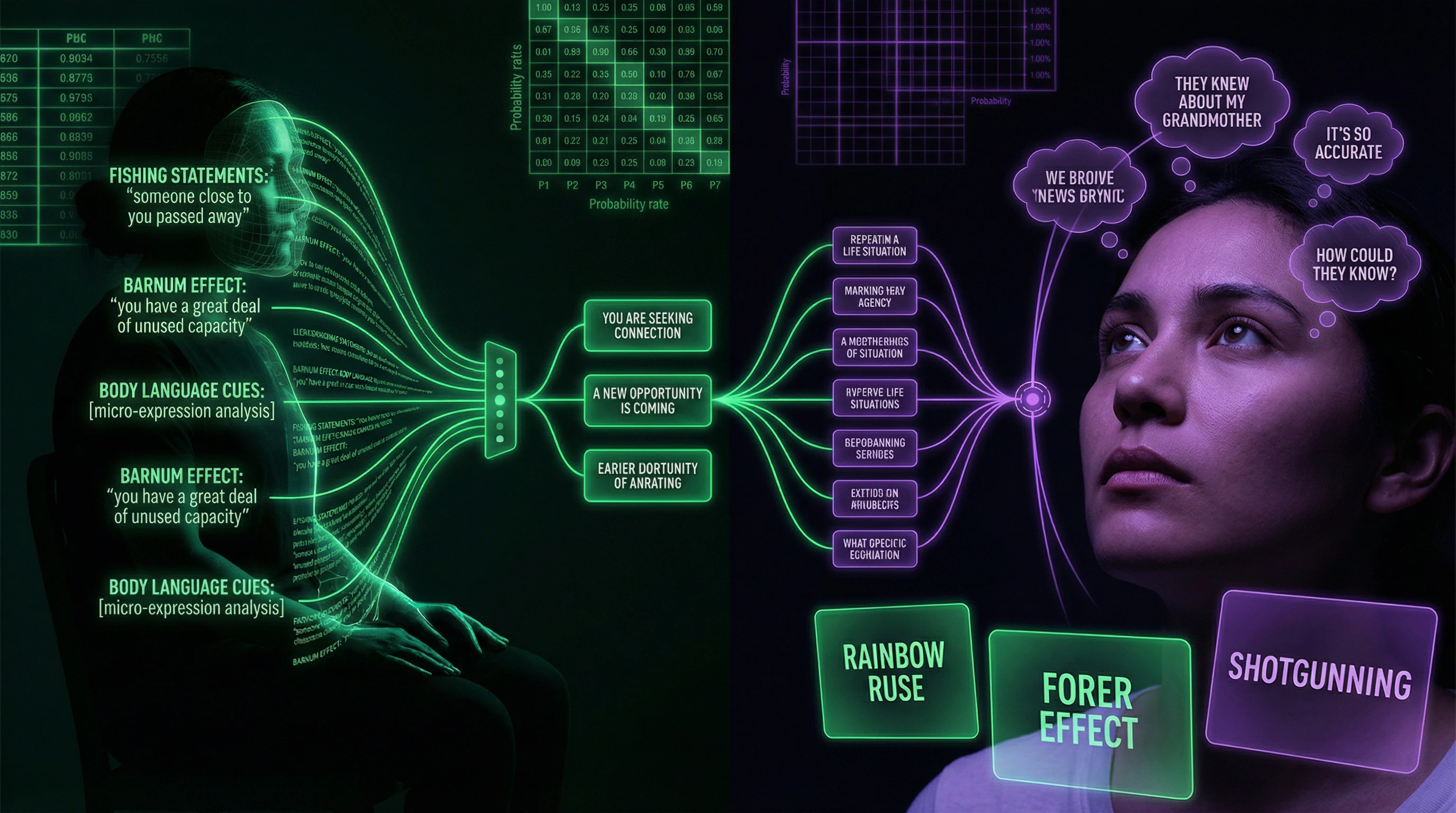
Viewers see only successful "hits," failures are cut during editing. Detailed analysis of performances reveals the use of cold reading techniques, hot reading (preliminary gathering of information about the client), and the Barnum effect (general statements applicable to most people).
| Technique | Mechanism | Example |
|---|---|---|
| Cold Reading | General statements applicable to most people | "I see problems in your personal life" |
| Hot Reading | Preliminary gathering of information about client | Social media search before session |
| Barnum Effect | Vague phrases true for most people | "You've lost someone close to you" |
When independent researchers gain access to complete session recordings (unedited), the picture changes dramatically. The number of failed attempts, generic phrases, and leading questions becomes obvious. The "psychic" makes dozens of statements, most of which are incorrect or so vague they cannot be verified, but viewers remember only a few "hits."
🔎 Neurobiological Research on "Extrasensory" Experience
Modern neurobiology offers explanations for subjective experiences that people interpret as paranormal, without invoking supernatural mechanisms. Research shows that certain brain states — induced by meditation, sensory deprivation, hypnosis, or even magnetic stimulation of the temporal lobes — can create sensations of "another's presence," "out-of-body experience," or "merging of consciousness" (S001).
Experiments with transcranial magnetic stimulation demonstrate that stimulation of specific brain areas induces experiences that subjects describe in terms similar to descriptions of mystical experience. This shows that such experience has a neurobiological basis that doesn't require postulating new physical forces.
The phenomenon of synchronicity — when a person thinks of someone and that person calls — is explained by a combination of selective attention and memory errors.
We don't remember the thousands of times we thought of someone and they didn't call, but we remember rare coincidences. This is a classic example of confirmation bias — the tendency to notice and remember information confirming our beliefs while ignoring contradictory information. More on the cognitive mechanisms of this phenomenon in the analysis of the illusion of understanding.
📌 The Reproducibility Problem in Parapsychology
A fundamental criterion of scientific knowledge is reproducibility of results by independent researchers. If a phenomenon is real, it should manifest consistently when certain conditions are met. Parapsychology systematically fails this test.
Studies reporting positive results are not reproduced in laboratories of skeptically-minded scientists. Even within the parapsychological community, there is no consensus on which experiments to consider successful. Different researchers use different protocols, different statistical methods, different success criteria.
- When independent researchers attempt to reproduce the most well-known parapsychological experiments with more rigorous controls, the effect disappears.
- This is called the decline effect — the tendency for an effect to diminish as research methodology improves.
- In normal science, improving methodology makes the effect clearer; in parapsychology — the opposite.
- This is strong evidence that initial results were artifacts of methodological errors.
For systematic analysis of methodological problems in parapsychology, see the review of systematic approaches to evaluating paranormal claims.
Causation vs. Correlation — Why Coincidences Don't Prove Telepathy
The human brain evolved to rapidly detect patterns and causal relationships because this provided a survival advantage. Better to mistakenly see a predator in rustling leaves than to miss a real threat. More details in the section Cognitive Biases.
This tendency toward hyperactive agency detection is one reason why people see causal relationships where only random correlations exist (S001).
🧬 Apophenia and Pareidolia — How the Brain Creates Meaning from Noise
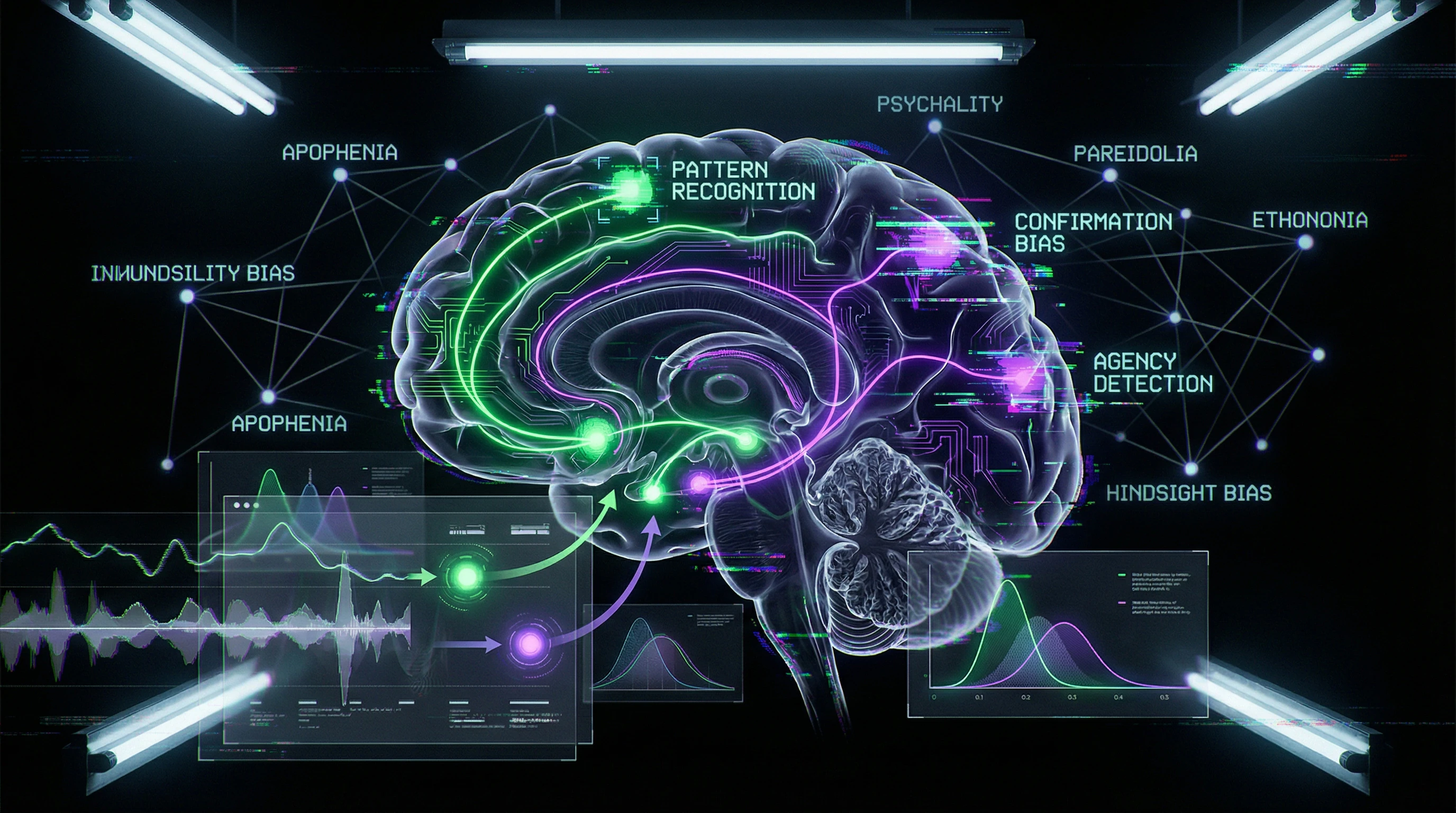
Apophenia is the tendency to perceive meaningful connections between unrelated phenomena. Pareidolia is a specific case of apophenia where we see familiar images (faces, figures) in random patterns.
These mechanisms explain why people find "messages" in random events and interpret coincidences as telepathic connections (more on the illusion of pattern recognition).
Neurobiological research shows that apophenia is linked to heightened activity in the brain's dopaminergic system. Dopamine is involved in detecting significant stimuli and forming associations.
When the dopaminergic system is hyperactive (which can occur during certain mental states or under the influence of substances), a person begins to see connections everywhere, even where none exist.
This explains why people experiencing stress, anxiety, or grief are particularly prone to paranormal interpretations. Emotional state affects brain neurochemistry, making the pattern detection system more sensitive.
A person who has lost a loved one may interpret any unusual event as a "sign" from the deceased because their brain is actively seeking connection with the lost attachment figure.
🔁 Hindsight Bias and the Illusion of Prediction
Hindsight bias is the tendency, after an event has occurred, to believe that we "knew it in advance" or "had a premonition." Memory is reconstructive, not reproductive: we don't replay the past like a video recording but reconstruct the memory each time, and current knowledge influences what we "remember."
This creates the illusion that we predicted an event when we actually just rewrote the memory after the fact.
| Mechanism | How It Works | Result in Psychic Context |
|---|---|---|
| Vague predictions | "I see trouble on the road" | Fits traffic jam, accident, delay — any event |
| Selective memory | Client remembers hits, forgets misses | Psychic appears accurate though most predictions are wrong |
| Post-hoc fitting | General statement reinterpreted as specific | "That's what I meant" — client believes in accuracy |
Experimental memory research demonstrates how easily false memories can be created (S003). People can "remember" events that never happened if provided with appropriate cues.
In the psychic context, this means a client may sincerely believe the "psychic" said something specific when the statement was actually general, with specificity added to memory later.
⚠️ Base Rate Neglect and Ignoring Statistics
People systematically misjudge probabilities and ignore base statistical patterns. If a million people live in a city, numerous coincidences will occur on any given day — simply by laws of probability.
A person thinks about their friend, and the friend calls. This seems miraculous, but in reality we think about hundreds of people each day, and some will call purely by chance.
- Estimate the base probability of the event (how often it occurs randomly)
- Count how many times you thought about the person but they didn't call
- Divide the number of hits by the total number of attempts
- Compare the result to the probability of random coincidence
- If the result is close to chance — it's not telepathy, it's statistics
Psychics exploit precisely this cognitive blindness. They make hundreds of predictions, and the client notices only the hits, forgetting most of the misses (S004).
This is called selection bias: we see only cases that confirm our hypothesis and ignore those that refute it.
Controlled parapsychology studies show that when psychics don't know what result is expected, their accuracy drops to the level of random guessing (S007). This is direct proof that "abilities" work only when information leakage or observer cognitive errors are present.
When experimental conditions eliminate the possibility of obtaining information through ordinary channels (vision, hearing, microexpressions), "telepathy" disappears. This is not coincidence — this is mechanism.
People who believe in the paranormal often demonstrate weaker critical thinking skills and statistical literacy (see systematic review of cognitive functions). This doesn't mean they're unintelligent — it means cognitive errors are universal, but some people compensate for them better.
Protection against these errors isn't intelligence but protocol: written prediction before the event, control of variables, counting all attempts rather than just hits.