
🖤 A pendulum over a map, over a photograph, over a list of options — and there it swings, providing an answer. Thousands of people use pendulums for decision-making: from choosing fresh vegetables to identifying a spouse, from finding water to diagnosing diseases. The tool seems simple, neutral, objective — after all, you're not moving the pendulum, it's "answering on its own." But scientific evidence shows: every pendulum movement is the result of the ideomotor effect, involuntary micro-contractions of hand muscles controlled by your own subconscious expectations. The accuracy of these "answers" doesn't exceed random chance, yet the psychological mechanism works as a crutch, allowing you to bypass conscious analysis and shift responsibility for the decision to an external "source of knowledge."
📌 What is a decision-making pendulum and why do millions of people trust a piece of metal on a string more than their own minds
A dowsing pendulum is a weight suspended on a thread, used to obtain answers to questions by observing the direction of its oscillations. Practitioners claim the pendulum swings "yes" (forward-back), "no" (left-right), or in circles, indicating the correct choice. More details in the Pseudoscience section.
Applications range from everyday decisions to medical "diagnoses": people use pendulums to choose food products, determine the sex of an unborn child, find lost objects, select a place to live, and even choose a marriage partner (S011).
- Historical trajectory
- Dowsing with a pendulum or divining rod was historically used to search for underground water and minerals. In the 20th century, the practice migrated into the realm of "intuitive choice" and "biolocating." Modern pendulums are sold in esoteric shops with instructions promising access to "higher knowledge" or "subconscious wisdom."
- Cultural legitimacy
- Sustained by anecdotal testimonials, books, and online communities where users share "successful" cases of pendulum use. Each story reinforces social trust in the tool.
🧩 Psychological appeal: illusion of objectivity and removal of responsibility
The key appeal of the pendulum lies in creating the illusion of an external, objective source of information. A person doesn't "choose themselves," but "asks the pendulum," which psychologically removes the anxiety of choice and responsibility for consequences.
The pendulum becomes a tool for delegating decisions — not to another person, but to a "neutral object," creating a sense of safety in situations of uncertainty where rational analysis is difficult or emotionally overwhelming.
🔎 Boundaries of the phenomenon: what exactly we're analyzing
The focus is on using the pendulum for decision-making and obtaining information, not on orthodontic appliances or physical models of oscillation. We analyze the psychological and neurophysiological mechanism underlying pendulum movement in dowsing — the ideomotor effect (S004) — as well as empirical data on the accuracy of "answers" and cognitive biases that sustain belief in its effectiveness.
| Level of analysis | What we include | What we exclude |
|---|---|---|
| Psychological | Illusion of objectivity, delegation of responsibility | User's personal beliefs |
| Neurophysiological | Ideomotor effect, motor cortex, subconscious expectations | Energy fields or paranormal mechanisms |
| Empirical | Controlled studies of accuracy, comparison with chance | Anecdotal testimonials |
🧱 Steelman Arguments: Seven Most Compelling Cases for Real Pendulum Effectiveness in Decision-Making
Before critical analysis, we need to present the strongest arguments from pendulum proponents — not a straw man, but a steelman argument worthy of serious consideration. More details in the Quantum Mysticism section.
🔮 First Argument: Thousands of Anecdotal Reports of Successful Application
Dowsing practitioners report numerous "hits": the pendulum pointed to fresh produce, helped choose a house, predicted a baby's gender. These stories circulate in communities, appear in books, and create an impression of statistically significant effects.
Proponents argue: if the pendulum worked randomly, there wouldn't be this many coincidences. The probability of random guessing with this volume of observations should have produced far more errors.
🧘 Second Argument: Access to Subconscious Knowledge and Intuition
Pendulum advocates suggest it serves as an interface to subconscious information. The subconscious processes more data than consciousness, and the pendulum allows "extracting" this hidden knowledge through ideomotor movements.
The pendulum is not a source of information, but a channel between consciousness and subconsciousness, making it a legitimate psychological tool rather than a mystical artifact.
🌊 Third Argument: Historical Success of Dowsing in Finding Water and Minerals
Proponents cite historical examples of using rods and pendulums to find underground water in rural areas where geological maps didn't exist. They claim some dowsers demonstrated high accuracy in locating aquifers.
The logic is simple: if dowsing worked for finding water, why couldn't it work for decision-making?
🧪 Fourth Argument: Reduced Bias Compared to Verbal Responses
Research showed that using a pendulum reduces conscious response bias compared to verbal answers (S011). This can be interpreted as evidence that the pendulum helps bypass conscious distortions and obtain a more "honest" answer from the subconscious.
- The pendulum reduces bias — possibly improving decision quality in certain contexts
- Verbal responses are subject to social desirability and self-censorship
- Physical movement may be less consciously controllable than speech
🔬 Fifth Argument: Ideomotor Effect as a Legitimate Psychological Mechanism
The ideomotor effect is a recognized scientific phenomenon where thoughts trigger involuntary movements (S002), (S004). Proponents argue: if the mechanism is real and reproducible, then the pendulum is simply a tool using this mechanism to externalize internal processes.
This isn't magic, but applied psychophysiology. Denying the pendulum's effectiveness means denying the ideomotor effect itself.
🎯 Sixth Argument: Subjective Quality of Life Improvement for Users
Many pendulum users report reduced anxiety, increased confidence in decisions, and overall improved well-being. If a tool helps people feel better and make decisions without paralyzing doubt, doesn't that make it effective from a pragmatic standpoint?
Subjective well-being is a legitimate criterion for evaluating psychological practices, especially if it causes no harm and doesn't replace critically important decisions.
🧬 Seventh Argument: Personality Predictors of Successful Pendulum Use
Research identified that certain personality traits correlate with pendulum accuracy (S010), (S011). This may indicate that the pendulum doesn't work for everyone, but for a specific group of people with high ideomotor sensitivity it can be an effective tool.
| Position | Conclusion |
|---|---|
| Universal Effectiveness | The pendulum should work equally for everyone |
| Individual Variability | Lack of universality doesn't negate benefits for specific individuals |
🔬 Evidence Base: What Controlled Studies Show About Pendulum Answer Accuracy and Movement Mechanisms
Let's turn to the empirical data. The key study directly testing pendulum accuracy for decision-making was conducted in 2017 and published in open access (S011).
📊 Accuracy Study: 57% in Verbal Mode vs. 53% with Pendulum — Statistically Indistinguishable from Chance
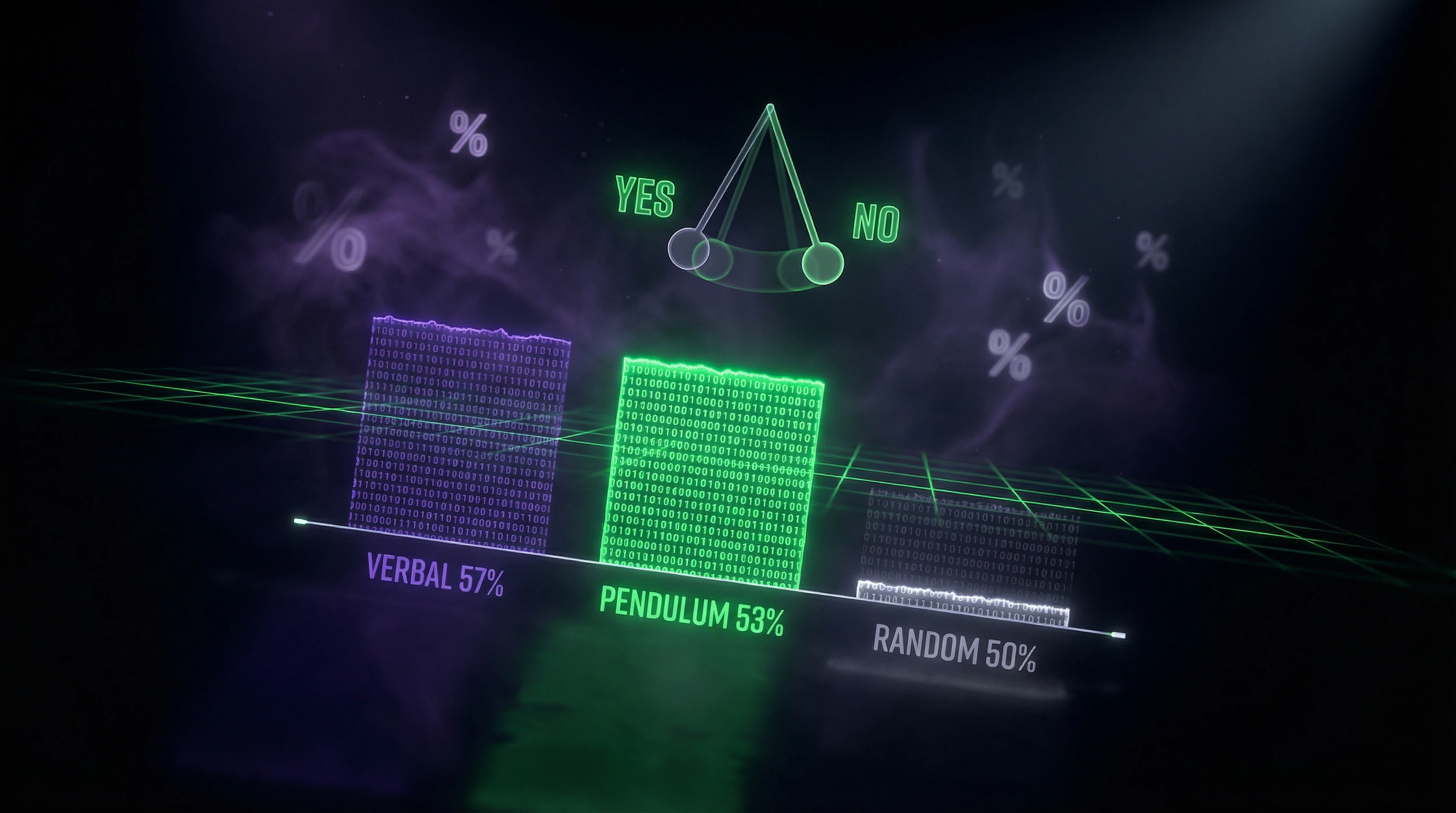
In the experiment, participants performed a visual stimulus detection task under two conditions: verbally reporting the answer and using a pendulum. Accuracy was measured using signal detection theory, which separates sensitivity from bias. Results: 57% in the verbal condition, 53% with the pendulum (S011).
Both values are statistically indistinguishable from the 50% chance probability. The pendulum provides no information beyond random guessing. More details in the section Free Energy and Perpetual Motion Machines.
Reduced bias with the pendulum did not improve accuracy — the tool simply made responses more "random," not more correct.
🧾 Bias Reduction: d=1.10 in First Study, d=0.47 in Second
The study identified a significant difference in response bias: in the verbal condition, bias was higher (d=1.10) than with the pendulum (S011). The effect was confirmed in a second study with 40 participants (d=0.47) (S011).
Bias is a systematic tendency to answer "yes" or "no" regardless of the actual stimulus. Reduced bias with the pendulum means participants relied less on conscious strategies, but this did not lead to increased accuracy.
🔁 Ideomotor Effect as the Sole Mechanism
The ideomotor effect is a phenomenon where thoughts about an action cause involuntary execution of that action without conscious intention (S002), (S012). Classic examples: Ouija boards, automatic writing, dowsing rod movements.
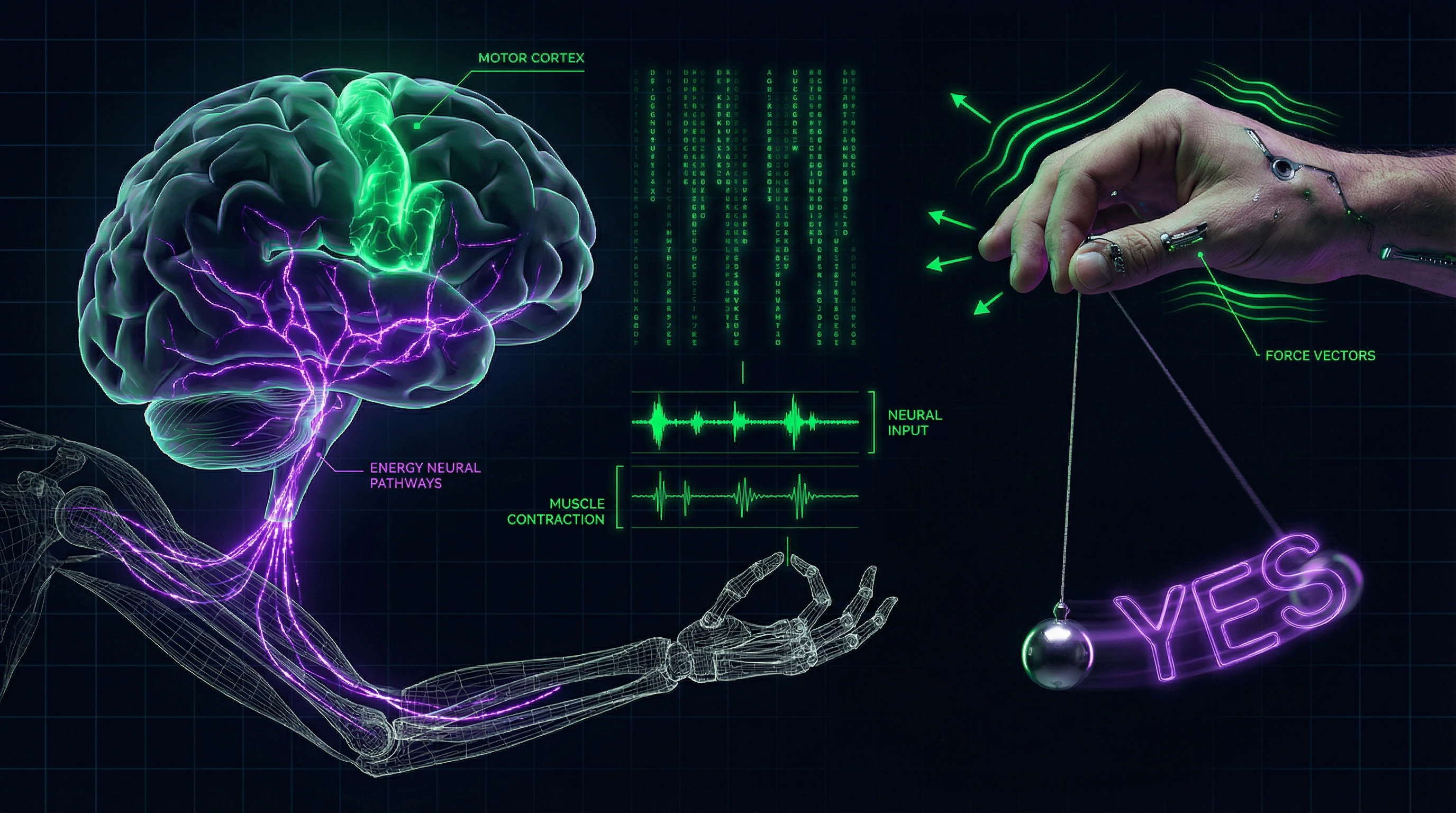
Electromyography studies show that pendulum movements correlate with micro-contractions of the hand muscles holding the string (S006). These contractions are so small they aren't consciously felt, but sufficient to transfer impulse to the pendulum.
| Condition | Mechanism | Accuracy |
|---|---|---|
| Verbal response | Conscious decision | 57% (above chance due to bias) |
| Pendulum | Ideomotor micro-movements | 53% (close to chance) |
| Pendulum + mechanical fixation | No channel for micro-movements | 50% (pure chance) |
🧪 No Effect When Ideomotor Channel Is Eliminated
The critical test: if the hand is mechanically fixed, eliminating the possibility of micro-movements, the pendulum stops "responding." Experiments where participants held the pendulum through a rigid structure that excluded transmission of muscular impulses showed no directional movements (S002).
This confirms: the source of movement is not external forces or "energy fields," but exclusively the person's own involuntary actions.
🧬 Personality Predictors: Who Is More Prone to Ideomotor Effects
Research (S010), (S011) examined which personality traits predict pendulum accuracy. Participants completed questionnaires including an internal locus of control scale (mean score 102.78, SD=11.07, range 79–126) (S011). Internal consistency of scales was high (α=0.80 and 0.89) (S011).
However, specific personality predictors of accuracy remained unknown (S011). Even if certain individuals demonstrate more pronounced ideomotor effects, this doesn't mean their pendulum gives more accurate answers — only stronger movements.
- Locus of Control
- A person's belief about whether they control events in their life (internal) or whether events are controlled by external forces (external). May influence ideomotor effect intensity but not pendulum accuracy.
- Ideomotor Sensitivity
- Individual susceptibility to involuntary movements in response to expectations. Varies between individuals but doesn't correlate with actual information the pendulum supposedly provides.
🔎 Comparison with Other Ideomotor Tools
The pendulum is one of a class of ideomotor tools using the same mechanism to create the illusion of an external information source. Ouija boards work through involuntary hand movements moving the planchette across letters (S002), (S011). Automatic writing — through involuntary movements of the hand holding a pen (S011). Dowsing — through micro-movements of hands holding rods (S002).
All these tools demonstrate identical accuracy: no better than chance. Studies of dowsing for water under controlled conditions showed no effect exceeding chance (S002). Historical "successes" are explained by high probability of finding water in certain geological conditions and retrospective selection of cases.
For deeper understanding of the cognitive mechanisms underlying belief in such tools, see research on paranormal beliefs and cognitive functions.
🧠 The Causality Mechanism: How Subconscious Expectations Transform into Physical Pendulum Movements Through the Motor Cortex
The ideomotor effect is not magic, but a well-studied neurophysiological process. Understanding the mechanism is critically important for evaluating claims about the pendulum "working." More details in the Reality Check section.
🧬 The Neurophysiological Chain: From Expectation to Motor Cortex Activation and Muscle Contractions
When a person thinks about movement or expects a specific outcome, the same areas of the motor cortex are activated as during actual execution of the action (S004). This activation can be so weak that it doesn't reach the threshold of conscious perception, yet sufficient to initiate muscle micro-contractions.
In the case of the pendulum: expecting a "yes" answer activates motor patterns associated with forward-backward hand movement; expecting "no" activates left-right movement. These patterns are transmitted through the string to the pendulum, which begins to oscillate in the corresponding direction (S008).
The person doesn't feel they're moving their hand because the movements are subthreshold, but objective measurements (EMG) detect them. This isn't deception—it's the boundary between conscious control and automatism.
🔁 The Feedback Loop: How Observing Pendulum Movement Reinforces Expectation and Deepens the Ideomotor Effect
The process is not linear but cyclical. Initial expectation causes micro-movement, the pendulum deflects slightly, the person observes this deflection and interprets it as the beginning of an "answer," which reinforces expectation and increases the amplitude of ideomotor movements.
This positive feedback loop rapidly leads to obvious pendulum oscillations. Instructions given to pendulum users amplify this effect: "Think about 'yes,' and the pendulum will swing back and forth" (S002)—such instruction directly programs the ideomotor response.
| Cycle Stage | What Happens in the Brain | What the User Sees |
|---|---|---|
| 1. Expectation | Motor cortex activation, micro-contractions | Pendulum barely noticeably deflects |
| 2. Perception | Visual cortex registers movement | "The pendulum started moving!" |
| 3. Interpretation | Reinforced expectation, hypothesis confirmation | "It's working, the pendulum is answering" |
| 4. Amplification | Stronger ideomotor impulses | Obvious pendulum oscillations |
⚙️ The Role of Attention and Concentration: Why "Relaxed State" Amplifies Ideomotor Movements
Ideomotor effects manifest more strongly in a state of relaxed attention, when conscious control over motor function is reduced (S003). This explains why dowsing practitioners recommend "don't think," "relax," "trust the pendulum."
These instructions don't open a channel to "higher knowledge," but simply reduce conscious suppression of involuntary movements, allowing ideomotor effects to manifest more strongly. Paradoxically, attempting to "not influence" the pendulum amplifies the influence of subconscious expectations.
🧩 Confounders: Why the Pendulum Sometimes "Guesses" Correctly—The Role of Chance and Apophenia
Even with random 50% accuracy, the pendulum will be "right" half the time. The human brain is prone to apophenia—perceiving patterns in random data.
- Selective Memory
- When the pendulum gives a correct answer, it's remembered and interpreted as confirmation of its effectiveness. When the answer is wrong, it's explained by "incorrect question formulation," "poor concentration," or "external interference."
- Information Processing Asymmetry
- This asymmetry creates an illusion of accuracy exceeding reality. The brain actively seeks hypothesis confirmation and ignores contradictory data—this isn't a perceptual error, but a built-in mechanism for conserving cognitive resources.
- Statistical Blindness
- Most people don't keep systematic records of pendulum hits and misses. Without a controlled experiment, it's impossible to distinguish real accuracy from random coincidence.
The connection between paranormal beliefs and cognitive functions shows that these mechanisms operate independently of education or intelligence—they're built into the architecture of human perception.
🧾 Conflicts and Uncertainties in the Data: Where Sources Diverge and Which Questions Remain Unanswered
⚠️ Study Limitation: Small Sample and Specific Task
The key pendulum accuracy study has limitations. The sample consisted of 40 participants in the second experiment—sufficient for large effects, but may miss smaller ones. More details in the Sources and Evidence section.
The task (visual stimulus detection) is not representative of real-world situations: questions about life decisions are more complex than binary detection. It's unknown whether the pattern would persist with more ecologically valid tasks.
The study did not track whether accuracy changes with experience. Practicing dowsers claim the skill develops over time—but there are no controlled longitudinal data.
🔬 Absence of Long-Term Data: Practice and the Illusion of Mastery
It's possible that with practice, what increases is not accuracy but confidence in interpreting pendulum movements. This deepens the illusion of effectiveness without actual improvement in results—a classic recognition aura mechanism, where the brain creates an impression of understanding where none exists.
🧬 Personality Predictors: Who Is More Susceptible to Ideomotor Effects
The study raised the question of personality predictors but provided no answer: which traits are associated with strong ideomotor effects remains unknown (S008).
This is a critical gap: if certain people are more prone to ideomotor effects, this explains why some pendulum users report subjectively high effectiveness, even when objective accuracy remains at chance level.
| Source of Uncertainty | What Is Known | What Is Unknown |
|---|---|---|
| Sample and Methodology | 40 participants, binary detection task | Results on complex life decisions |
| Skill Development | Practitioners claim development occurs | Longitudinal data on accuracy improvement |
| Individual Differences | Ideomotor effect exists | Personality predictors of susceptibility |
📊 Divergences in Interpretation: When Data Support Different Conclusions
The study (S008) showed that string length and finger movement amplitude determine success in the Chevreul pendulum illusion. But this can be interpreted in two ways: either as evidence of a pure ideomotor mechanism, or as an indication that physical parameters influence perception of the outcome.
Pendulum proponents may argue this simply shows how to use it correctly. Critics see this as confirmation that the result depends on technique, not on an information channel.
The same data about physical pendulum parameters can support opposite conclusions—depending on which mechanism is assumed initially.
🔍 Gaps in Effectiveness Research: Why Controlled Studies Are So Rare
Most data on pendulum effectiveness come from anecdotal reports and uncontrolled observations. Controlled studies are rare, creating an asymmetry: success stories are easy to find, systematic accuracy assessments are difficult to find.
This doesn't mean the pendulum is ineffective—it means the question remains open in a scientific sense. Absence of evidence is not evidence of absence, but neither does it justify confidence in effectiveness without data. The connection between paranormal beliefs and cognitive functions shows that belief in such tools often correlates with logical errors in thinking.
⚠️ Cognitive Anatomy of the Myth: Which Psychological Biases Make People Believe in Pendulum Effectiveness Despite the Data
Belief in the pendulum is sustained not by one, but by an entire complex of cognitive biases working synergistically. More details in the section Buddhism.
🧩 Illusion of Control and Agency: "I'm Not Moving the Pendulum, It Moves on Its Own"
Ideomotor movements are not perceived as voluntary, creating the illusion of an external agent (S004). The brain interprets the pendulum's movement as independent of one's own actions, reinforcing belief in its objectivity.
This is a classic example of attribution error: the real source of action (one's own muscles) is not recognized, and the action is attributed to an external force (S002).
When we are unaware of our own participation in the process, any result appears to be an objective fact rather than a consequence of our expectations.
🕳️ Confirmation Bias: Selective Memory of "Hits" and Forgetting Misses
People tend to remember instances when the pendulum gave a correct answer and forget or rationalize cases of error. This creates a subjective impression of high accuracy, even when objective statistics show randomness.
Keeping a systematic log of all pendulum uses (hits and misses) destroys this illusion within a few weeks.
| Cognitive Bias | Mechanism | Result |
|---|---|---|
| Illusion of control | Unconscious movements interpreted as external | Pendulum appears to be an independent agent |
| Confirmation bias | Selective memory of coincidences | Subjective accuracy higher than actual |
| Apophenia | Pattern-seeking in random data | Random coincidences interpreted as patterns |
🔮 Apophenia and Pareidolia: Seeing Meaning in Noise
The brain evolved to seek patterns—this aided survival. But under conditions of uncertainty, this system becomes hyperactive: we see faces in clouds, hear voices in white noise, find patterns in random pendulum oscillations.
The pendulum moves unpredictably, but each movement is interpreted as an answer to a question. The brain automatically connects the question with the movement, even if the connection is purely random.
🎭 Social Proof and Authority: "If Others Believe It, It Must Work"
The pendulum is popular in certain communities (esoteric practices, alternative medicine, spiritualism). Social environment reinforces belief: if everyone around uses the pendulum and reports its effectiveness, critical thinking recedes.
Authority figures (healers, gurus, popular bloggers) legitimize the practice, even if their competence in neurobiology or statistics is zero.
💰 Motivated Reasoning: Belief as Investment
A person has invested time, money, emotional energy in the pendulum. Admitting it doesn't work means admitting one's own mistake. Psychologically, it's easier to continue believing than to reconsider the decision.
This is especially strong when the pendulum is used in the context of paranormal beliefs or alternative medicine—areas where people often seek hope under conditions of uncertainty.
🧠 Dissociation Between Knowledge and Belief
A person can simultaneously know that the pendulum works through the ideomotor effect and believe that it provides objective answers. This is not a contradiction—it's the norm of human thinking.
Rational knowledge (the pendulum moves via muscles) and intuitive belief (the pendulum knows the answer) exist in different information processing systems. The first system is slow, the second is fast. Under conditions of stress or uncertainty, the second system takes over.
Belief in the pendulum is not a logical error, but the result of normal brain function under conditions of uncertainty. The brain chooses a convenient explanation over an accurate one.
🔬 Why Even Knowledge of the Mechanism Doesn't Destroy Belief
Research (S008) shows that even when people are explained the ideomotor effect and shown how string length affects oscillation amplitude, they continue to believe in the objectivity of the pendulum's answers.
Information about the mechanism is not integrated into the belief system because belief in the pendulum serves a psychological function: it provides an illusion of control, reduces anxiety about uncertainty, confirms belonging to a community.
Such belief can only be destroyed through direct experience: systematic logging of errors, blind tests, comparison with a control group. But even this doesn't always work—motivated reasoning is too strong.