
What Counts as a Superpower in the Age of CRISPR and Neural Interfaces — Defining the Boundaries Between Fiction and Technological Reality
The term "superpowers" lost its clear contours the moment genetic engineering transitioned from theoretical models to clinical trials of embryo editing. The boundary between fiction and reality is determined not so much by technical feasibility as by verification methodology: science fiction serves as a tool for philosophical investigation, creating thought experiments to test ethical and ontological hypotheses (S002).
Popular culture systematically conflates three categories of phenomena: proven physiological effects (e.g., the impact of growth hormone on muscle mass), hypothetical technologies with theoretical justification (genetic enhancement of cognitive functions), and speculative concepts without empirical basis (telepathy, simulation hypothesis). More details in the Pseudoscience section.
| Level | Examples | Verification Status |
|---|---|---|
| Biochemical Interventions | Growth hormone, steroids, nootropics | Measurable effects, side effects documented |
| Genetic Modifications | CCR5 editing, intelligence enhancement | Technically feasible for monogenic traits; polygenic traits face epigenetic complexity barriers |
| Philosophical Constructs | Simulation hypothesis, telepathy | Unfalsifiable; do not meet Popperian criteria |
🧩 Biochemical Manipulations: Where Effect Ends and Myth Begins
Growth hormone demonstrates a classic pattern: systematic review and meta-analysis show statistically significant increases in muscle mass in healthy young adults, but effects on strength metrics remain contradictory and depend on training protocols (S012). Media headlines about "super strength" ignore dose-dependence, side effects, and individual response variability.
A 2–3 kg increase in muscle mass with concurrent risk of arthralgia, carpal tunnel syndrome, and hyperglycemia is not a superpower, but a managed side effect.
⚠️ Genetic Enhancement: Why Embryo Editing Doesn't Equal Designer Babies
Editing single genes (as in the case of CCR5 mutation for HIV resistance) is technically achievable (S005). However, promises of "designer babies" with enhanced intelligence run into a fundamental problem: intelligence is encoded by thousands of loci interacting through epigenetic networks that we understand only superficially.
- Polygenic Trait
- A characteristic determined by multiple genes, each with small effect. Intelligence, height, disease predisposition — all are polygenic traits. Editing one gene doesn't guarantee the desired outcome, as the effect depends on the context of other genes and environment.
- Epigenetic Network
- A system of chemical DNA modifications that turn genes on and off without changing the sequence itself. These modifications are sensitive to stress, nutrition, and experience. Even if a gene is edited "correctly," its expression may be suppressed by epigenetic mechanisms.
🔍 Philosophical Constructs Masquerading as Science
The hypothesis that reality is a computer simulation represents an unfalsifiable claim that, by Popper's definition, cannot be considered scientific (S001). Such concepts serve a heuristic function — stimulating reflection on the nature of consciousness — but their transfer into the realm of empirical claims creates an illusion of scientific validity (S003).
The problem is compounded by the fact that transcendent mind and mythological perception of wholeness are often presented as alternative "ways of knowing" equivalent to the scientific method. In reality, they operate in fundamentally different epistemological frameworks: science requires falsifiability and reproducibility, philosophy and mythology require interpretive coherence.
📋 Legal Reality: When Emoji Become Evidence
One of the most concrete intersections of fiction and reality occurs in the legal domain. Analysis of case law shows that emoji are transitioning from informal communication to legally significant evidence: contextual interpretation of symbols (e.g., gun + skull) can serve as grounds for charges of threats (S004).
Digital artifacts without physical substrate acquire legal force through social consensus about their meaning. This expands the concept of "reality" faster than philosophy can conceptualize it.

Steel Version of Arguments "For": Seven Most Compelling Cases for the Reality of Superpowers and Their Scientific Basis
Intellectual honesty requires starting with the strongest version of the opposing position — what analytical philosophy calls "steelmanning." Arguments for the reality or achievability of superpowers rest on a combination of empirical data, technological trends, and philosophical premises that cannot be dismissed with simple skepticism. More details in the section UFOlogy and Contactees.
🧬 Argument from Genetic Variability: Natural "Mutants" as Proof of Concept
The existence of people with genetic variants providing extraordinary abilities demonstrates the biological feasibility of "superhuman" characteristics. Mutation in the MSTN gene leads to doubled muscle mass without training; deletion in the CCR5 gene provides resistance to HIV; the EPOR gene variant in Tibetans enables efficient functioning at altitudes of 4000+ meters.
Gene engineering capabilities involve not creating fundamentally new functions, but replicating variants already existing in nature, which lowers the technological barrier and ethical risks of unpredictable consequences (S005). If evolution randomly created these variants, directed editing can reproduce and combine them.
- Natural genetic variants = proof of biological possibility
- Editing = replication of existing, not creation of new functions
- Risk reduction through use of nature-"tested" solutions
📊 Argument from Systematic Reviews: Hormonal Interventions with Proven Efficacy
Meta-analysis of randomized controlled trials shows that exogenous growth hormone statistically significantly increases lean body mass in healthy young adults (average effect 2.1 kg over 20 days of therapy) (S012). This confirms the fundamental possibility of pharmacological enhancement of physical parameters beyond the natural range.
While the effect on strength indicators is less clear-cut and depends on training protocol, the very fact of measurable change in body composition through biochemical manipulation demonstrates: the boundary between "normal" and "enhanced" is a continuum, not a discrete category. This creates precedent for other forms of biochemical enhancement of cognitive and physical functions.
🔬 Argument from Revision of Scientific Dogmas: Blood Microbiome as Example of Paradigm Shift
Literature review on the blood microbiome of clinically healthy people demonstrates how a concept recently considered a "myth" (blood is sterile) transitions into the category of actively researched reality (S010). Accumulation of empirical data on the presence of bacterial DNA and cultivable microorganisms in the bloodstream of healthy individuals shows: scientific consensus can change radically with the emergence of new detection methods.
What was rejected yesterday as pseudoscience becomes today the subject of systematic research. Current boundaries of the "possible" may be artifacts of methodological limitations, not ontological necessity.
Extrapolation of this logic to other "impossible" phenomena (e.g., epigenetic inheritance of acquired traits) suggests that skepticism toward new data may be a conservative error.
⚙️ Argument from Technological Convergence: Synergy of CRISPR, Neural Interfaces, and AI
The combination of three technological platforms — genetic editing (third-generation CRISPR-Cas9 with single-nucleotide precision), direct brain-computer interfaces (Neuralink with 1024 electrodes), and artificial intelligence for analyzing polygenic interactions — creates qualitatively new possibilities (S005).
AI can identify combinations of genetic variants associated with complex traits (intelligence, longevity), CRISPR can introduce these changes, and neural interfaces can compensate for limitations of the biological substrate through direct connection to computational resources. The synergistic effect may exceed the sum of components.
🧠 Argument from Neuroplasticity: Brain as Reprogrammable System
Neuroplasticity research demonstrates that the human brain retains capacity for structural reorganization throughout life: London taxi drivers have enlarged hippocampus (spatial memory), musicians have enhanced motor cortex and corpus callosum, polyglots have increased gray matter density in the left inferior parietal cortex.
If intensive practice causes measurable anatomical changes, then directed interventions (transcranial stimulation, nootropics, gene therapy with neurotrophic factors) could potentially accelerate or amplify these processes, creating "superpowers" through optimization of neural networks (S003).
📱 Argument from Digital Reality: Virtual Abilities as New Ontological Category
If emoji can serve as legal evidence (S004), and virtual assets can have economic value (NFTs, cryptocurrencies), then "abilities" in digital space acquire real status independent of physical substrate.
A gamer with 150 ms reflexes in an esports discipline possesses a "superpower" in the context of that reality, even if it doesn't transfer to the physical world. As humanity spends more time in digital environments (work, socialization, entertainment), the boundary between "real" and "virtual" abilities blurs: programming skill becomes more valuable for survival than physical strength.
- Digital assets have legal and economic status
- Abilities in virtual environments are real in the context of actual habitat
- Redefinition of "superpower" through lens of relevance, not physical substrate
🕳️ Argument from Philosophical Underdetermination: Simulation Hypothesis as Limiting Case
If we take the simulation hypothesis seriously (S001), then the distinction between "real" and "fantastical" abilities collapses: in simulated reality any rules can be changed by the programmer, and "laws of nature" are merely code parameters.
We cannot prove that current limitations of human abilities are ontologically necessary, rather than contingent parameters of our particular reality.
While the hypothesis is unfalsifiable and cannot be a scientific theory in the strict sense, philosophy of the fantastic demonstrates that thought experiments with alternative realities perform a legitimate heuristic function (S002). Even if the simulation hypothesis is false, it forces reconsideration of confidence in the absoluteness of current limitations.
Evidence Base Under the Microscope: What Systematic Reviews Say About Each "Breakthrough" — From Vitamin D to Gene Therapy
The transition from philosophical arguments to empirical verification requires a strict hierarchy of evidence. Systematic reviews and meta-analyses of randomized controlled trials (RCTs) represent the highest level of evidence (1a on the Oxford scale), while individual cases, mechanistic hypotheses, and expert opinions occupy the lower tiers (levels 4-5). More details in the Torsion Fields section.
Critical analysis of sources reveals a dramatic gap between media claims and actual strength of evidence. Systematic reviews are weapons against academic noise, allowing us to separate real effects from artifacts and bias.
📊 Growth Hormone and Muscle Mass: Where the Effect Ends and Side Effects Begin
A systematic review with meta-analysis of growth hormone effects on healthy young adults (S012) provides the most reliable data. Pooled analysis shows a statistically significant increase in lean body mass of 2.1 kg over a 20-day treatment period, confirming an anabolic effect.
However, critical nuances ignored by popular sources: the effect on strength metrics remains contradictory and depends on training protocol — in some studies, strength gains did not exceed the placebo group.
The mass increase is partially explained by fluid retention rather than exclusively by muscle fiber hypertrophy. Side effects include insulin resistance, arthralgias, and increased risk of acromegaly with prolonged use.
- Evidence level for body composition effect
- 1a (highest level), but extrapolation to "super-strength" is not supported by data.
🧪 Vitamin D in Eastern European Populations: When Systematic Review Shows Deficiency, Not Super-Effects
A systematic review with meta-analysis elements of serum 25-hydroxyvitamin D in populations of Russia, Ukraine, and Belarus (S011) demonstrates the opposite situation: instead of evidence for "miraculous" effects of vitamin D megadoses, data show widespread deficiency (levels <20 ng/mL in 50-80% of those surveyed depending on region and season).
This is a classic example of concept substitution in popular literature: correcting deficiency to normal levels improves health (reduced risk of osteoporosis, infections), but this doesn't create "superpowers" — it merely eliminates a pathological state.
| Scenario | Evidence Level | Actual Effect |
|---|---|---|
| Correcting deficiency to normal | 1a | Restoration of normal function |
| Supraphysiological doses in healthy individuals | Absent | No proven benefits in cognitive function, strength, or longevity |
🧬 Genetic Engineering: The Gap Between Technical Possibility and Clinical Reality
Analysis of genetic engineering capabilities (S005) reveals a critical distinction between editing monogenic diseases (sickle cell anemia, beta-thalassemia) and attempts to "enhance" polygenic traits (intelligence, athleticism, longevity).
For monogenic pathologies, CRISPR-Cas9 demonstrates clinical efficacy with evidence level 2b. However, extrapolation to complex traits encounters fundamental barriers.
- Polygenicity — intelligence is associated with thousands of genetic variants, each contributing a microscopic effect (<0.1% of variance).
- Pleiotropy — genes have multiple effects, and altering one can unpredictably influence other systems.
- Epigenetics — gene expression depends on context (methylation, histone acetylation), which is not controlled by DNA sequence.
Promises of "designer babies" with enhanced IQ lack technological foundation given current understanding of the genetic architecture of cognitive abilities.
🔎 Blood Microbiome: From "Myth" to "Actively Researched Hypothesis" — But Not to Proven Fact
A literature review on the blood microbiome of clinically healthy individuals (S010) illustrates an intermediate state of scientific knowledge. Accumulated data include detection of bacterial DNA in blood of healthy donors by high-throughput sequencing and isolated cases of culturing live bacteria in the absence of clinical signs of infection.
However, critical questions remain unresolved: contamination of samples during blood collection or laboratory processing, viability of microorganisms, and their functional significance in the physiology of healthy individuals.
- Presence of DNA does not prove the existence of live, metabolically active microorganisms.
- Even if microbes are present, their role in health is not established.
- Most studies do not completely exclude sample contamination.
This is an example of how a hypothesis transitions from the "myth" category to "requires further research," but it is premature to declare it "proven reality." The evidence level for the concept is 3b (individual cohort studies with methodological limitations).
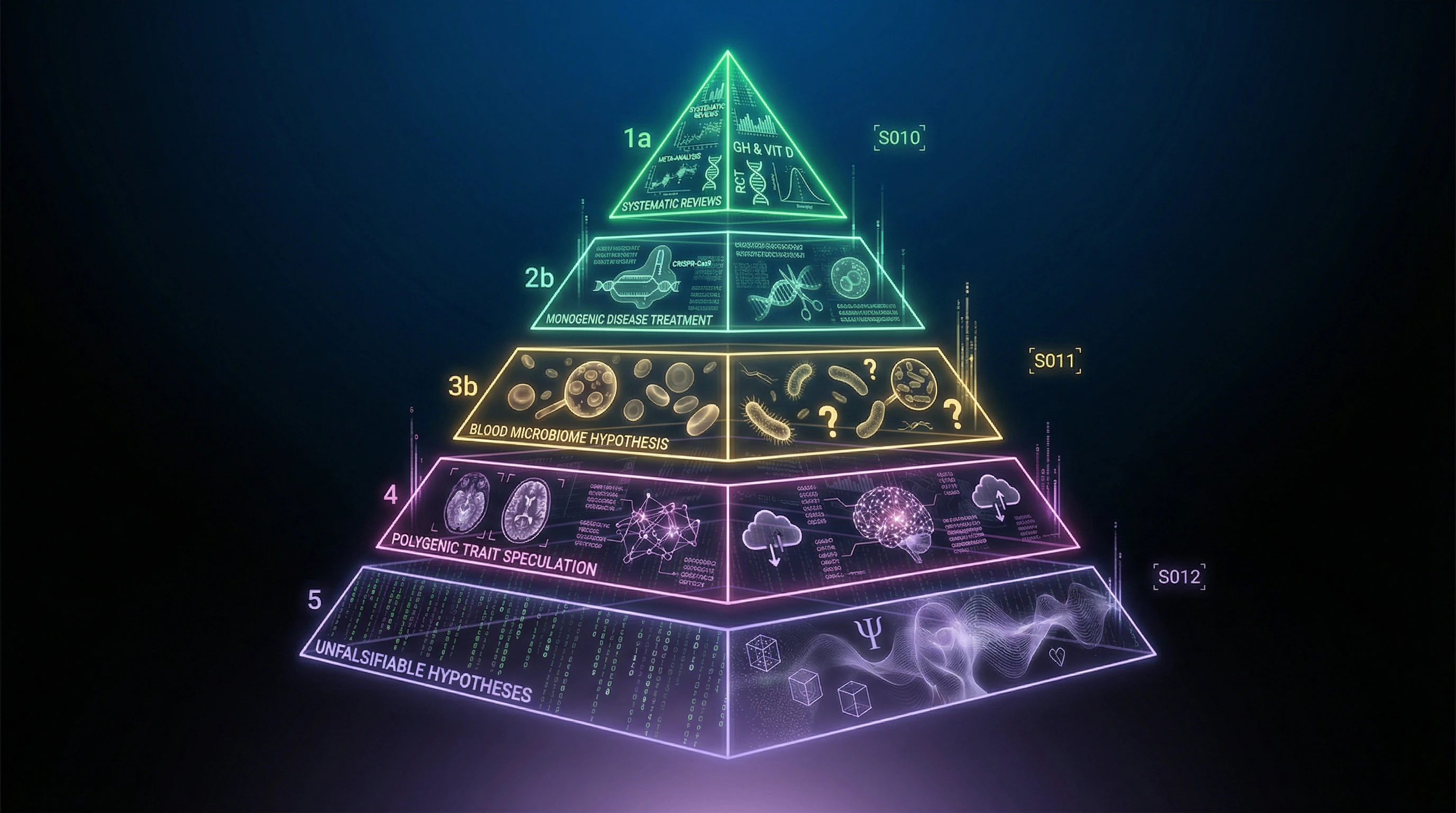
Mechanisms and Causality: Why Correlation Between Genes and IQ Does Not Mean Genetic Intelligence Enhancement Is Possible
The central error in popular interpretations of scientific data is conflating correlation with causality and ignoring the complexity of biological systems. Even when the association between a genetic variant and phenotype is statistically significant and reproducible, this does not guarantee that manipulating the gene will lead to predictable changes in the trait. For more details, see the section on Statistics and Probability Theory.
🔁 Polygenicity and Additivity: Why a Thousand Genes at 0.1% Each Don't Add Up to a Controllable Effect
Genome-wide association studies (GWAS) for cognitive abilities have identified thousands of single nucleotide polymorphisms (SNPs), each associated with microscopic changes in IQ (typically <0.1 points). Mathematically, if effects are strictly additive, combining "favorable" alleles across all loci could theoretically produce a substantial cumulative effect.
However, this logic ignores three fundamental problems.
- Epistasis — interactions between genes are nonlinear, and allele combinations can produce effects different from the sum of individual contributions (synergy or antagonism).
- Pleiotropy — genes that positively affect one trait may negatively affect others. Variants associated with high IQ correlate with increased risk of autism and anxiety disorders.
- Genotype-environment interaction — genotype effects manifest only under specific conditions (nutrition, education, stress). Changing genes without changing environment may not yield expected results.
Polygenic risk scores for IQ explain ~7% of population variance. The remaining 93% is environment, epigenetics, developmental randomness, and their interactions with genes.
⚙️ Genotype-Phenotype: Why Editing a Gene Does Not Equal Editing a Trait
Even monogenic diseases (cystic fibrosis, sickle cell anemia) demonstrate phenotypic variability with the same mutation. Patients with identical genetic errors have different symptom severity, age of onset, and treatment response.
For polygenic traits like intelligence, this variability is exponentially higher. Reasons:
- Epigenetic silencing
- An edited gene may be methylated or packaged in inactive chromatin, and its expression will not change.
- Compensatory mechanisms
- Cells may activate alternative pathways, neutralizing the editing effect.
- Critical developmental periods
- Editing in a mature organism will not restore disruptions that occurred during critical windows of brain development (in utero, early childhood).
- Systemic effects
- A gene edited in one tissue may have unforeseen consequences in other organs.
📊 From Correlation to Causality: Why GWAS Does Not Predict Intervention Outcomes
GWAS identifies population-level associations, not causality. A genetic variant may be a marker, not a driver of the trait.
| Scenario | What GWAS Shows | What Happens with Editing |
|---|---|---|
| Causal variant | Association with IQ | IQ change (if environment is favorable) |
| Marker in linkage disequilibrium | Association with IQ | No effect (editing marker, not cause) |
| Variant correlated with environment | Association with IQ | No effect (cause is environment, not gene) |
| Pleiotropic variant | Association with IQ | IQ improvement + deterioration of another trait |
Mendelian randomization and experimental animal models show that most GWAS associations for cognitive traits do not withstand causality testing. This means that even if we edit all "favorable" variants, intelligence will not change predictably.
Practical conclusion: genetic intelligence enhancement remains science fiction not because CRISPR technology is insufficiently precise, but because we don't know which genes to edit and how their editing will affect the integrated system of brain and organism.