What is the Kirlian Effect and Why It's Called "Aura Photography" — Defining the Boundaries of the Phenomenon
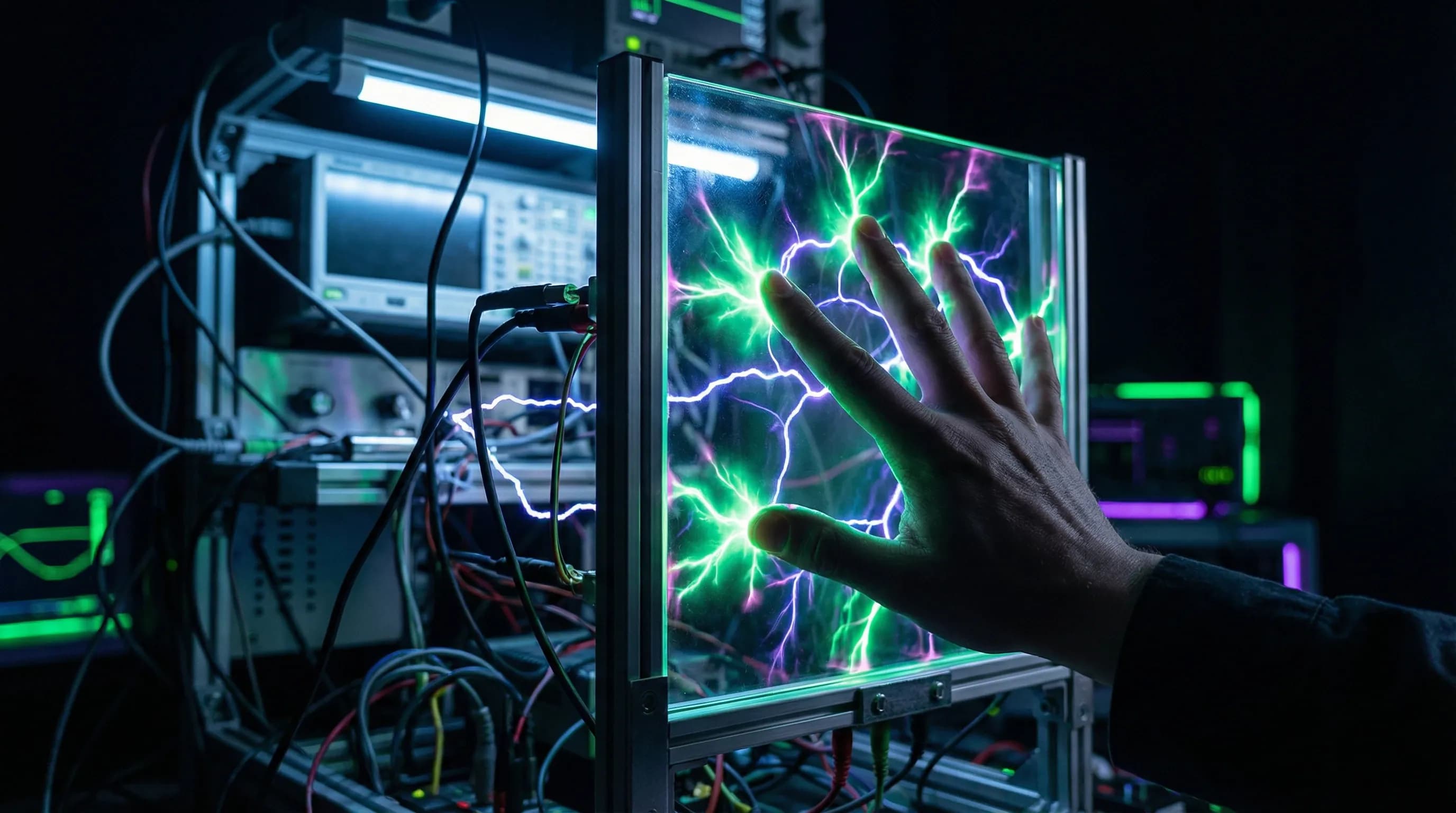
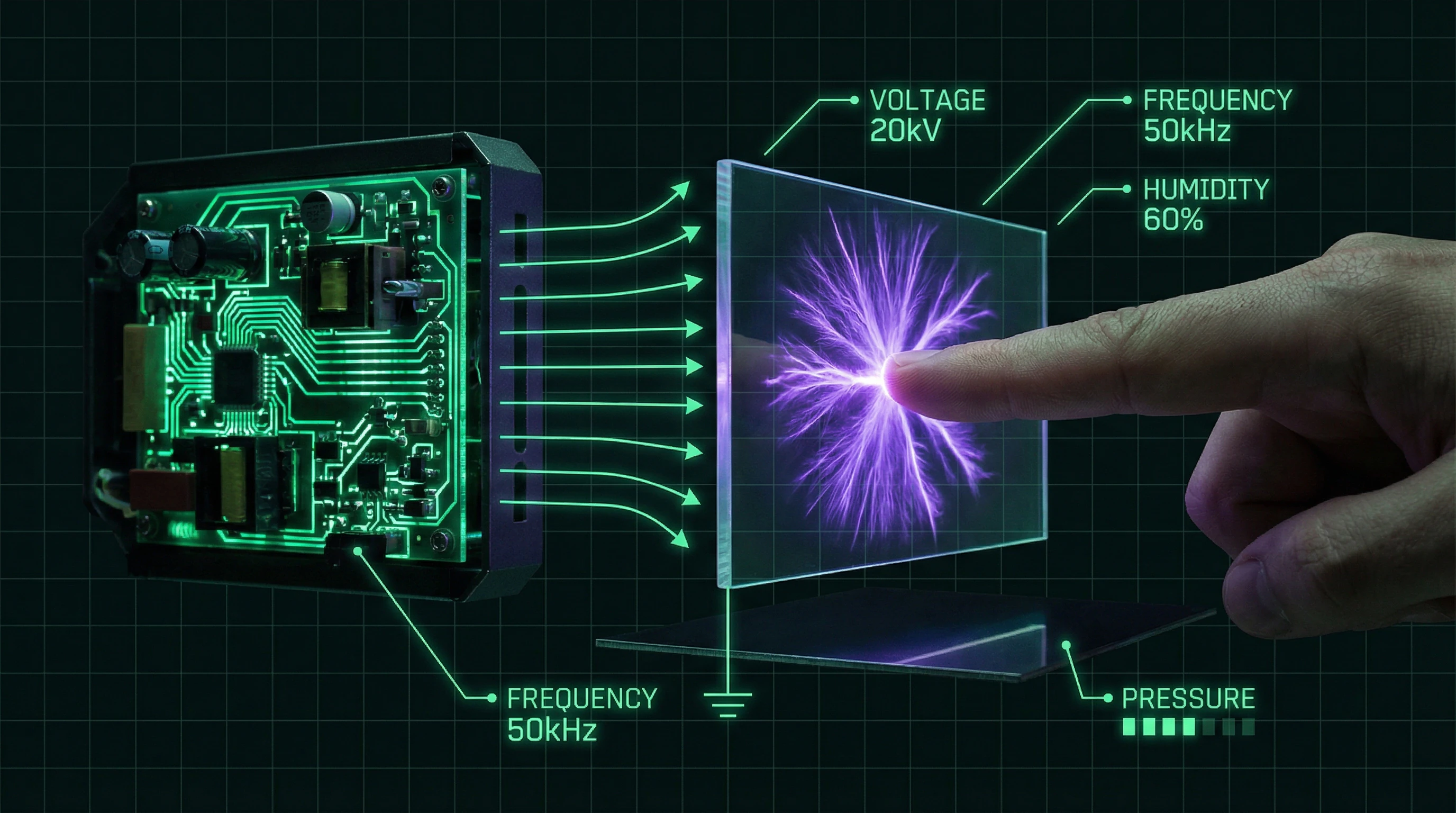
The Kirlian effect is a visualization of corona discharge that occurs when an object is placed on a photographic plate or digital sensor in a high-voltage, high-frequency electric field (typically 10–30 kV at 10–100 kHz). Air ionization around the object creates a glowing halo that is captured on light-sensitive material. More details in the Alternative History section.
The method was popularized by Soviet inventors Semyon and Valentina Kirlian in 1939, though similar experiments were conducted as early as the 1890s (S001).
- Typical Setup
- A high-voltage AC generator, transparent electrode (glass plate with conductive coating), grounded photographic plate or digital camera. The object—most commonly a finger or plant leaf—is placed between the electrode and the light-sensitive surface. When voltage is applied, an electric field of approximately 1–3 kV/mm is created, sufficient to break down air and form streamers—thin channels of ionized gas.
🧩 From Physics to Myth: How Corona Discharge Became "Aura"
In the 1970s, riding the wave of interest in parapsychology, the Kirlian effect was reinterpreted as a visualization of the "biofield" or "aura"—a hypothetical energy field surrounding living organisms (S002). This interpretation ignored the physical nature of the phenomenon and attributed diagnostic significance to changes in the corona: color, brightness, and shape of the glow supposedly reflected emotional state, health, or "energy balance."
Corona discharge is a real physical effect. Its interpretation as an "aura" is not. These are different things, and they're confused either deliberately or through ignorance.
⚙️ What Actually Affects Corona Parameters
- Object conductivity (depends on skin moisture, mineral composition)
- Contact pressure against the electrode
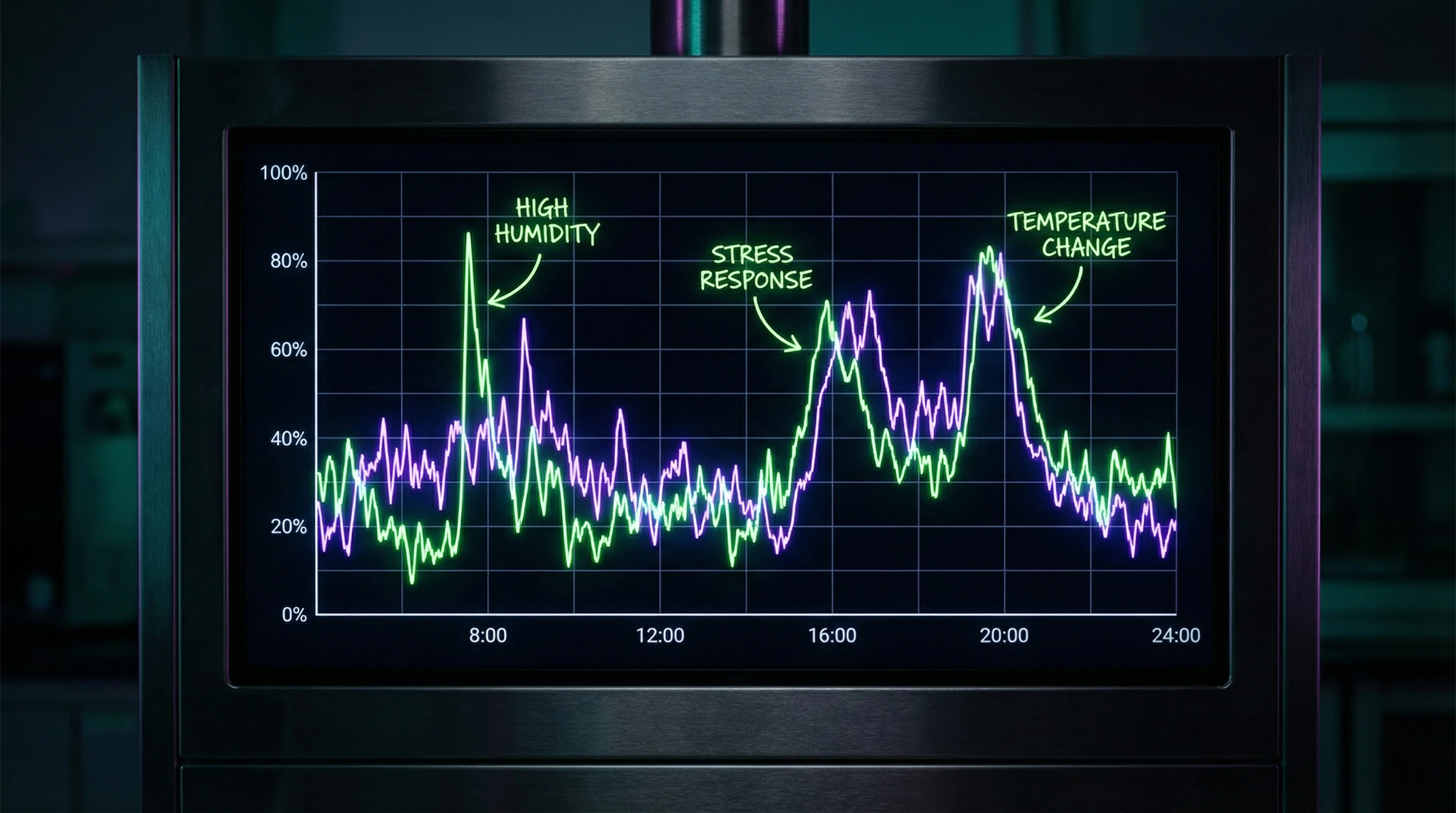
- Air temperature and humidity
- Electric field parameters (voltage, frequency)
- Skin surface condition (contamination, microcracks, perspiration)
All these factors are physically explainable and don't require introducing new entities like "biofields." Studies attempting to link corona parameters with health status face reproducibility problems: results vary from session to session for the same person due to changes in the listed physical parameters (S007).
| Physical Factor | Effect on Corona | Controllability |
|---|---|---|
| Skin moisture | Direct (conductivity increases) | Low—changes within an hour |
| Contact pressure | Direct (contact area) | Low—depends on operator |
| Air humidity | Inverse (higher humidity—weaker corona) | Low—depends on environment |
| Generator voltage | Direct (higher voltage—brighter corona) | High—adjustable |
The boundary between physical effect and esoteric interpretation runs here: corona discharge is measurable and reproducible under laboratory conditions. Its connection to disease diagnosis is not.
Seven Arguments from Kirlian Photography Diagnostic Proponents — Steelman Version of Claims
To fairly evaluate claims about the diagnostic value of Kirlian photography, it's necessary to examine the strongest arguments of its proponents in their best formulation. This avoids attacking a straw man and focuses on the real weaknesses of the hypothesis. More details in the section Paranormal Phenomena and UFOlogy.
🔬 Argument 1: Reproducible Corona Changes with Physiological States
Proponents claim that corona discharge parameters systematically change with physiological state: stress, fatigue, illness allegedly reflect in the brightness, color, and shape of the glow. Some studies do record correlations between corona parameters and physiological indicators, such as skin conductivity (which changes with stress-related perspiration) or finger temperature (which changes with blood flow variations).
However, these correlations are explained by changes in the physical properties of skin, not by a "biofield" (S001).
🧬 Argument 2: "Phantom Leaf Effect" as Proof of Energy Field
One of the most famous arguments is the "phantom leaf effect": allegedly, after cutting off part of a plant leaf, the Kirlian photograph still shows a corona from the missing part, which is interpreted as a trace of the "energy body." Controlled experiments have shown that this effect arises from residual moisture on the cut surface and electrostatic charge on the photographic plate from previous exposure of the whole leaf.
With thorough cleaning of the apparatus between shots, the effect disappears.
📊 Argument 3: Statistical Correlations with Diagnoses in Clinical Studies
Some studies report statistically significant correlations between Kirlian image parameters and medical diagnoses. For example, a study using machine learning methods to analyze "aura" images claims the ability to diagnose chakra imbalances and associated diseases (S002).
- Methodological problems in such studies:
- Small samples without adequate power calculation
- Lack of researcher blinding
- Multiple testing without correction for multiple comparisons
- Absence of independent validation on new data (S007)
🧾 Argument 4: Thousands of Practitioners and Positive Client Testimonials
Proponents point to the widespread practice: thousands of specialists worldwide offer Kirlian photography diagnostics, and many clients report positive experiences. The popularity of a method is not proof of its effectiveness.
Positive testimonials are explained by the Barnum effect (the tendency to accept vague general descriptions as accurate personal characteristics), the placebo effect, and confirmation bias.
🔁 Argument 5: Corona Changes Correlate with Subjective Well-being
Some studies show that people who report improved well-being after therapeutic interventions also demonstrate changes in Kirlian image parameters. This is interpreted as confirmation of the connection between "aura" and health.
However, subjective well-being correlates with multiple physiological parameters (stress level, muscle tension, blood flow) that affect skin conductivity and temperature — physical factors that determine corona discharge.
🧷 Argument 6: Impossibility of Explaining All Observed Patterns by Discharge Physics Alone
Proponents claim that some patterns in Kirlian images are too complex and specific to be explained only by variations in moisture and conductivity. Corona discharge is a nonlinear phenomenon, sensitive to microscopic surface irregularities of skin, distribution of sweat glands, and local pressure variations.
| Factor | Influence on Corona Discharge |
|---|---|
| Skin microtopography | Determines local electric field concentration |
| Sweat gland distribution | Affects conductivity at different points |
| Local electrode pressure | Changes contact and gap between electrode and skin |
| Temperature gradients | Affect gas ionization around the finger |
Pattern complexity doesn't require introducing new entities — it naturally emerges from the interaction of multiple physical factors.
⚙️ Argument 7: Integration with Other "Energy Diagnostic" Methods Yields Consistent Results
Practitioners often combine Kirlian photography with other "energy diagnostic" methods (bioresonance diagnostics, meridian analysis, iridology) and claim that results are consistent across methods (S004).
This agreement is explained by common cognitive biases of the interpreter and the Barnum effect, not by actual diagnostic validity of the methods. None of these methods has passed independent validation under controlled conditions.
For more on the cognitive mechanisms that make such methods convincing, see the analysis of the illusion of understanding and the ideomotor effect.
What Systematic Analysis of Kirlian Photography Research Shows — Evidence Base Review
A systematic review of biofield imaging analysis methods reveals critical problems in Kirlian photography research (S001). Most studies suffer from methodological flaws that render their conclusions unreliable.
📊 Reproducibility: Why Results Don't Replicate
The key problem is low reproducibility. Corona parameters for the same person vary from measurement to measurement: skin moisture changes throughout the day, finger temperature depends on blood flow, electrode pressure cannot be standardized without specialized equipment. More details in the section Genetics Myths.
Research analyzing abnormal energy levels in aura images acknowledges: variability in corona parameters makes it difficult to establish reliable diagnostic criteria (S002).
🧪 Blinding and Control Groups
Most studies don't use blinding: researchers analyzing images know the subject's diagnosis, creating risk of confirmation bias (S007). Control groups are often absent or poorly matched.
Without blinding and adequate controls, it's impossible to distinguish real diagnostic signal from interpretation artifacts.
🔎 Multiple Testing Without Correction
Many studies analyze dozens of parameters (brightness, corona area, fractal dimension, color characteristics) and search for correlations with multiple variables. With this approach, the probability of finding a statistically significant correlation by chance is very high.
| Methodological Defect | Consequence | Frequency in Literature |
|---|---|---|
| Lack of multiple testing correction | False positive results | Most studies |
| Lack of blinding | Confirmation bias | Systematic |
| Lack of independent validation | Results don't replicate outside the lab | Typical |
🧾 Independent Validation: Why Results Aren't Confirmed Outside the Lab
Even with statistically significant results, independent validation is critical: can other researchers reproduce the results on new data? Most claims about the diagnostic value of Kirlian photography haven't passed this test (S004).
Machine learning models trained on data from one lab don't work on data from other labs due to differences in equipment and imaging protocols.
🧬 Fitting to the Answer: Post-Hoc Interpretation
Many studies use exploratory data analysis: they search for any patterns correlating with variables of interest, then create post hoc explanations. This approach generates hypotheses but doesn't test them.
- Pre-registration of hypotheses
- Researcher records hypothesis and analysis method before data collection. Prevents fitting to results.
- Independent validation sample
- Model is trained on one dataset, tested on another. Reveals overfitting and artifacts.
- Absence of both elements
- Research using AI to diagnose chakras from auras demonstrates exactly this approach: the model is trained and tested on the same data (S006).
Systematic analysis shows: research on Kirlian photography as a diagnostic tool doesn't meet evidence-based medicine standards. Problems with reproducibility, lack of blinding, multiple testing without correction, and absence of independent validation make conclusions unreliable. For more on methodological rigor, see systematic reviews as a tool against academic noise.
Physics of Corona Discharge vs. Biofield Hypothesis — Mechanism and Alternative Explanations
To understand why the Kirlian effect does not require the concept of a "biofield," it's necessary to examine the physical mechanism of corona discharge and demonstrate how all observed phenomena are explained by known physical processes. For more details, see the Media Literacy section.
⚡ Corona Discharge Mechanism: Air Ionization in Non-Uniform Electric Fields
Corona discharge occurs when the electric field strength near a conductor exceeds a threshold value (approximately 3 kV/mm for air under normal conditions) sufficient to ionize gas molecules. In a Kirlian photography setup, a person's finger touching the electrode creates a non-uniform electric field: field strength is maximum near protruding points (skin irregularities, nail edges) and minimum on flat areas.
Ionization begins in regions with maximum field strength, creating luminous streamers — thin channels of ionized gas propagating from the object to the grounded plate (S007).
🔁 Why Corona Parameters Depend on Physical Skin Properties, Not "Biofield"
The shape, brightness, and color of corona discharge are determined by several physical factors:
| Factor | Mechanism of Influence | Physiological Trigger |
|---|---|---|
| Skin Conductivity | Depends on ion concentration in sweat and moisture in the stratum corneum | Stress, physical activity, ambient temperature |
| Surface Geometry | Microscopic irregularities create local electric field enhancements | Constant for a specific finger, but changes with age and skin condition |
| Contact Pressure | Affects contact area and current distribution | Depends on operator's applied force, not controlled by subject |
| Skin Temperature | Affects moisture evaporation and electrical conductivity | Cold lowers finger temperature, stress raises it |
All these factors change depending on physiological state, but these changes are explained by known physiological mechanisms, not a "biofield" (S002).
🧪 Experiments with Inanimate Objects: Coins and Metal Plates Also Have "Auras"
A critical experiment refuting the biofield hypothesis: inanimate objects (coins, metal plates, water droplets) also produce corona discharge in Kirlian photography setups (S001). The shape and brightness of the corona depend on the object's shape, electrical conductivity, and surface irregularities.
If "aura" is a manifestation of life energy, why does it appear around inanimate objects? The physical explanation has no such problem: corona discharge is a property of the electric field, not the object.
🧷 Why Corona Color Carries No Diagnostic Information
The color of corona discharge is determined by the composition of the gas in which ionization occurs and the energy of electrons. In air under normal conditions, blue-violet luminescence predominates (emission from excited nitrogen molecules) (S005).
- Color Changes at Elevated Humidity
- Water vapor alters the emission spectrum and can create reddish tones through emission from excited oxygen molecules.
- Organic Substances on Skin
- Evaporate and ionize, adding new emission lines to the spectrum unrelated to health status.
- Photographic Process Parameters
- Film or sensor sensitivity to different wavelengths creates the illusion of diagnostic information in color.
Interpreting color as an indicator of emotional state or health has no physical basis. To examine claims about diagnosis, see the methodological analysis of Kirlian photography.
Cognitive Traps in Kirlian Photography Interpretation — Why People Believe in Aura-Based Diagnosis
The method's popularity despite lacking an evidence base is explained not by fraud, but by how human perception works. The brain systematically makes the same mistakes — and these mistakes are predictable. More details in the Debunking and Prebunking section.
🧩 The Barnum Effect: Vagueness as a Universal Key
The Barnum Effect (Forer Effect) — people accept vague, general descriptions as accurate individual characteristics. A Kirlian photography interpretation sounds like this: "Your aura shows signs of stress and fatigue" — a statement applicable to 80% of the population in developed countries.
The client perceives this as an accurate hit, though the information contains nothing specific. The more vaguely a statement is formulated, the higher the probability that a person will find correspondence with their own experience.
🕳️ Confirmation Bias: Counting Only One Side
Confirmation bias causes people to notice information that confirms expectations and ignore contradictory information. If an interpretation contains ten statements, of which two seem accurate — those two are what remain in memory.
Eight misses are forgotten, two hits become proof. This isn't deception — it's the architecture of attention.
🧠 Apophenia: The Brain Sees Faces in Clouds
Apophenia — seeing meaningful patterns in random data. Corona discharge creates complex, visually appealing structures that the brain automatically interprets as information-bearing.
Evolutionarily this made sense: seeing a predator in the bushes was more useful than missing it. But when this system is applied to electrical discharge, it produces false positives.
🔁 Expectation Effect: Belief Rewrites Experience
If a person believes in the diagnostic value of the method, any changes in well-being after a session are interpreted as confirmation. The placebo effect creates real subjective improvements — they arise from expectations, not from actual diagnosis.
| Trap | Mechanism | Result |
|---|---|---|
| Barnum | Vague interpretation | Anyone finds themselves in the description |
| Confirmation | Selective attention | Hits are remembered, misses forgotten |
| Apophenia | Pattern-seeking in noise | Random structures appear meaningful |
| Expectation | Placebo effect | Subjective improvements attributed to method |
These mechanisms work independently of education and intelligence. They're built into the architecture of perception. Understanding them is the first step toward protection from the illusion of recognition, when the brain creates an impression of understanding where none exists.
This is precisely why fact-checking requires protocol, not intuition. When stakes are high — health, money, decisions — a verification system is needed that compensates for these built-in errors.
Protocol for Evaluating Kirlian Photography Diagnostic Claims — Critical Analysis Checklist
This protocol allows you to systematically assess the reliability of claims about the diagnostic value of Kirlian photography and avoid cognitive traps. For more details, see the Conspiracy Theories section.
✅ Step 1: Check for Controlled Studies with Blinding
Ask: Were controlled studies conducted in which researchers analyzing Kirlian images did not know the diagnosis or condition of the subject? If blinding is absent, results may be an artifact of the interpreter's cognitive biases.
Most studies do not use blinding (S007). This means the diagnostician sees the patient, knows their complaints, and subconsciously looks for confirmation of expectations in the image.
✅ Step 2: Assess Sample Size and Statistical Power
Small samples (fewer than 30 participants per group) have low statistical power: they cannot reliably detect an effect even if it exists, and are prone to false positives due to random fluctuations.
Check whether a required sample size calculation was performed before the study began. If sample size was chosen arbitrarily or post hoc, this is a sign of weak methodological control.
✅ Step 3: Check for Independent Validation of Results
Were the results reproduced by an independent research group on new data? Absence of independent validation is a red flag: results may be specific to a particular laboratory or an artifact of the methodology.
One laboratory, one author, one methodology — this is not proof, it's a hypothesis. Reproducibility is the minimum standard of reliability.
✅ Step 4: Examine the Mechanism — Physics or Mysticism?
Do the authors explain results through corona discharge, skin moisture, electrical conductivity, or through "biofield," "energy," "aura"? If the explanation appeals to unobservable entities without a physical mechanism, this is a sign of pseudoscientific thinking.
Corona discharge is a well-studied physical process (S001). If the diagnostic value of Kirlian photography is real, it should be explained through known physics, not through new hypothetical forces.
✅ Step 5: Check for Alternative Explanations
| Observation | Alternative Explanation | How to Test |
|---|---|---|
| Different patients have different corona discharge patterns | Differences in skin moisture, temperature, electrical conductivity, epidermal thickness | Measure these parameters independently and compare with patterns |
| Diagnostician sees connection between pattern and diagnosis | Confirmation bias or random coincidence | Blind test: diagnostician analyzes images without patient information |
| Patient feels improvement after session | Placebo effect, natural disease course, diagnostician's attention | Control group with placebo procedure |
✅ Step 6: Check for Conflicts of Interest
Who funds the research? Who sells Kirlian photography equipment? If the researcher or clinic has a vested interest in positive results, this increases the risk of systematic bias.
Commercial interest does not automatically mean falsification, but requires heightened skepticism and verification through independent sources.
✅ Step 7: Compare with Gold Standard Diagnostics
What is the sensitivity and specificity of Kirlian photography compared to clinical diagnosis, laboratory tests, or instrumental diagnostics? If Kirlian photography does not outperform standard methods or add new information, its diagnostic value is questionable.
If a method is no better than what already works, it doesn't deserve to replace it. The burden of proof lies with proponents of the new method.
✅ Step 8: Check the Logic of Causality
Do the authors claim that Kirlian photography patterns cause disease or that disease causes the pattern? Or are they simply correlated? Correlation does not mean causation: both phenomena may be consequences of a third factor (such as dehydration or stress).
- Determine what exactly is being claimed: causation or correlation?
- If causation — demand a mechanism and experimental proof.
- If correlation — check whether third variables were controlled.
- Remember: even strong correlation does not prove causation.
Final Checklist
If the answer to most questions is "no" or "unknown," the claim about the diagnostic value of Kirlian photography remains unproven. This does not mean the method is useless, but it means it cannot be used as a basis for medical decisions without additional evidence.
Critical analysis is not hostility to new ideas, but protection against cognitive traps. Apply this protocol to all diagnostic claims, including those that seem intuitively plausible. Intuition is often wrong. Methodology is not.
For deeper understanding of research methodology, see systematic reviews as a tool for critical analysis.