
What is the "recognition aura"—and why your brain constantly deceives you about what you "know"
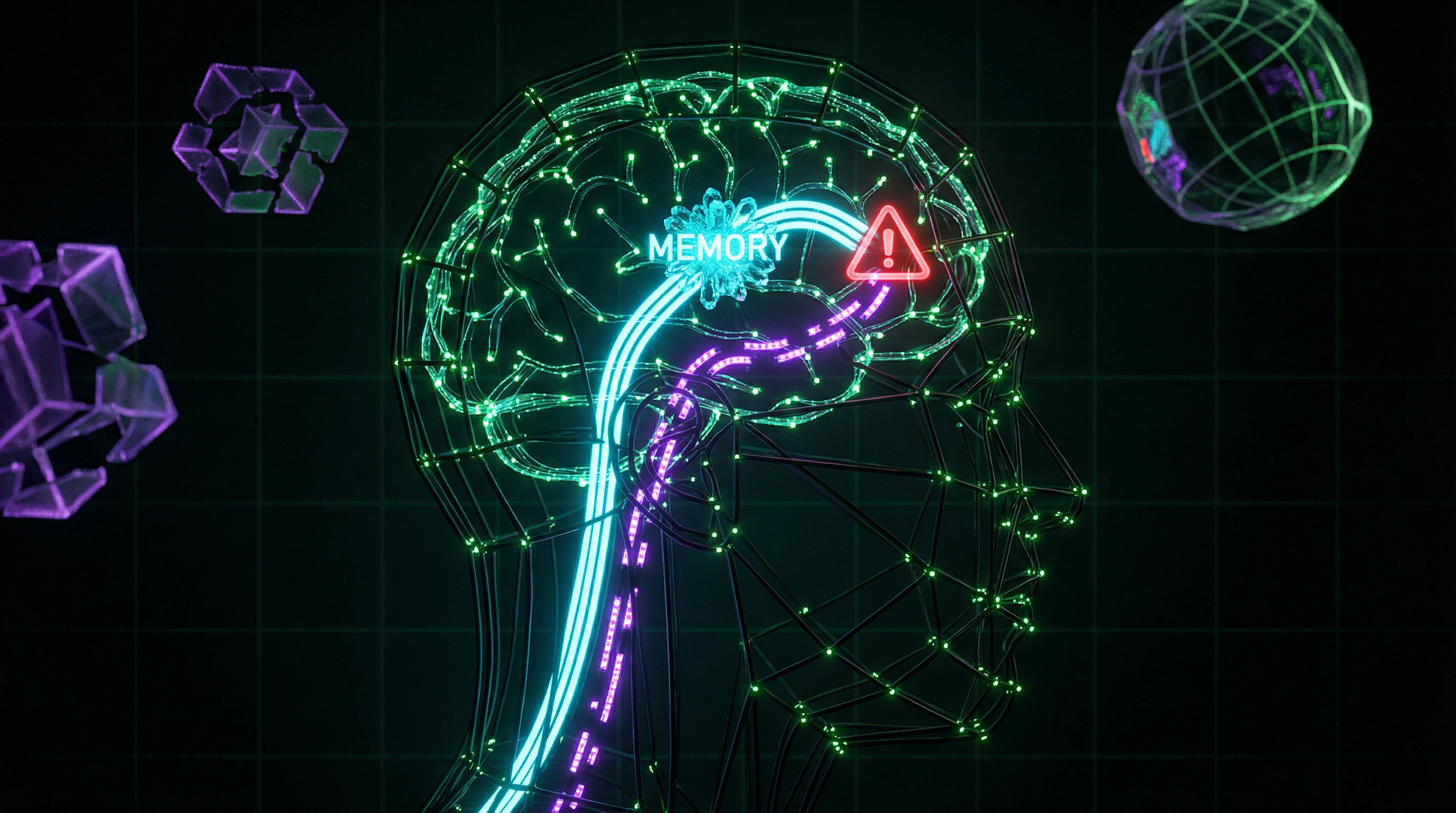
The term "recognition aura" describes a cognitive state in which the brain generates a subjective feeling of familiarity, understanding, or recognition in the absence of actual experience or knowledge. This isn't a metaphor—it's a measurable neurophysiological phenomenon where the same brain regions activate as during genuine recognition, but without corresponding content in memory (S002).
🧩 Three components of the aura: feeling, confidence, and emptiness
The recognition aura consists of three elements: (1) subjective experience of familiarity—"I know this," (2) high confidence in this experience—"I definitely know this," and (3) absence of actual content—inability to reproduce, explain, or apply the supposed knowledge. More details in the section Genetics Myths.
The brain can generate a persistent sensation of pattern recognition even in random noise. This isn't a system error—it's the basic architecture.
⚠️ Why the illusion of understanding is more dangerous than complete ignorance
A person who knows they don't know seeks information and verifies it. A person who is confident they know (but actually doesn't) acts based on illusion—and sees no need for verification.
- Recognition aura
- creates a false sense of competence that blocks critical thinking. This makes it an ideal tool for manipulation: simply activate the feeling of familiarity, and a person will accept information without analysis.
🔎 Boundaries of the phenomenon: where normal heuristics end and pathology begins
Adaptive use of recognition heuristics—quick judgments based on patterns that work in most cases—is an evolutionarily advantageous strategy for conserving cognitive resources.
| Normal heuristics | Pathological aura |
|---|---|
| Quick judgment with readiness to revise | Persistent illusion of knowledge in its absence |
| Preservation of metacognitive monitoring | Loss of awareness of one's knowledge boundaries |
| Rarely exploited | Systemic vulnerability to manipulation |
The boundary lies where the subject loses the capacity for metacognitive monitoring—awareness of the limits of their own knowledge. It's precisely this loss that makes the recognition aura a tool of disinformation and a cognitive vulnerability.
Seven Arguments in Defense of the "Recognition Aura" — Why This Phenomenon May Be a Feature, Not a Bug, of Evolution
Before examining the dangers of the recognition aura, we must consider the strongest arguments in its favor. Evolution does not preserve dysfunctional mechanisms — if the recognition aura exists, it must have adaptive functions. More details in the section Cryptozoology.
🧠 First Argument: Conservation of Cognitive Resources Under Information Overload
The brain processes approximately 11 million bits of information per second, but can consciously hold only 40–50 bits. The recognition aura allows decision-making based on a "feeling of familiarity" without fully loading information into working memory.
This is critically important in situations requiring rapid response: it's better to mistakenly recognize a threat than to miss real danger. Research shows that recognition illusions occur more frequently under cognitive load — when the system is operating at its limit (S002).
🔁 Second Argument: Social Cohesion Through Shared Illusions of Understanding
Groups of people often function more effectively when they share a common "sense of understanding" of a situation, even if that understanding is superficial. The recognition aura creates an illusion of consensus that reduces the transaction costs of communication.
Rather than verifying each time whether everyone truly understands the same thing, the group acts on the assumption of shared knowledge. This accelerates coordination, though it creates the risk of systemic errors.
⚙️ Third Argument: Availability Heuristic as an Adaptive Strategy in Stable Environments
In stable, predictable environments, the "feeling of familiarity" correlates with real experience. If you've lived in the same city for 20 years, your sense of "I know this street" is highly likely to correspond to reality.
The recognition aura works as a fast heuristic that is effective when the environment doesn't change radically. Problems begin in unstable, rapidly changing, or deliberately deceptive environments — but evolution didn't prepare us for such conditions.
🧬 Fourth Argument: Neuroplasticity and Learning Through "Anticipation" of Patterns
The recognition aura may be a byproduct of the predictive coding mechanism — the brain's ability to predict incoming information based on past experience (S002). When the brain "anticipates" a pattern before its full manifestation, a sense of familiarity arises.
This accelerates learning: instead of processing information from scratch each time, the brain uses predictions. The illusion of understanding is the price we pay for learning speed.
🕳️ Fifth Argument: Protection from Cognitive Dissonance and Preservation of Worldview Integrity
Constant awareness of the boundaries of one's own knowledge is psychologically exhausting. The recognition aura creates a "buffer zone" between knowing and not knowing, allowing a person to function without constant anxiety of uncertainty.
- This is especially important in situations where complete knowledge is unattainable, but action is necessary.
- The illusion of understanding reduces stress and allows decision-making under incomplete information.
- Without such a buffer, a person would be paralyzed by uncertainty.
📊 Sixth Argument: Cultural Transmission Through Imitation Without Full Understanding
Many cultural practices are transmitted through imitation: people reproduce actions without fully understanding them. The recognition aura ("I know how this is done") allows cultural information to spread faster than if complete understanding of each element were required.
This is especially important for complex technologies and rituals, where full understanding may be unavailable to most, but practical reproduction is possible. Culture is transmitted not through complete knowledge, but through knowledge sufficient for action.
🧰 Seventh Argument: Metacognitive Calibration Through Recognition Errors
Paradoxically, the experience of false recognition can improve metacognitive skills. When a person faces the consequences of an illusion of understanding (for example, cannot perform a task they "definitely knew how to do"), this creates feedback for calibrating confidence.
- Feedback Through Error
- A person discovers the gap between the feeling of knowledge and the actual ability to act.
- Confidence Calibration
- The brain learns to distinguish between real and illusory knowledge based on repeated errors.
- Development of Metacognitive Skills
- People who regularly test their assumptions are better at distinguishing real from illusory knowledge (S002).
All seven arguments point to one thing: the recognition aura is not simply a brain bug, but a compromise between speed and accuracy, between action and analysis. The problem arises when this compromise becomes a tool of manipulation or when the environment changes so rapidly that the heuristic stops working.
Evidence Base: What Neurophysiology, Perception Psychology, and Disinformation Research Tell Us About Recognition Aura
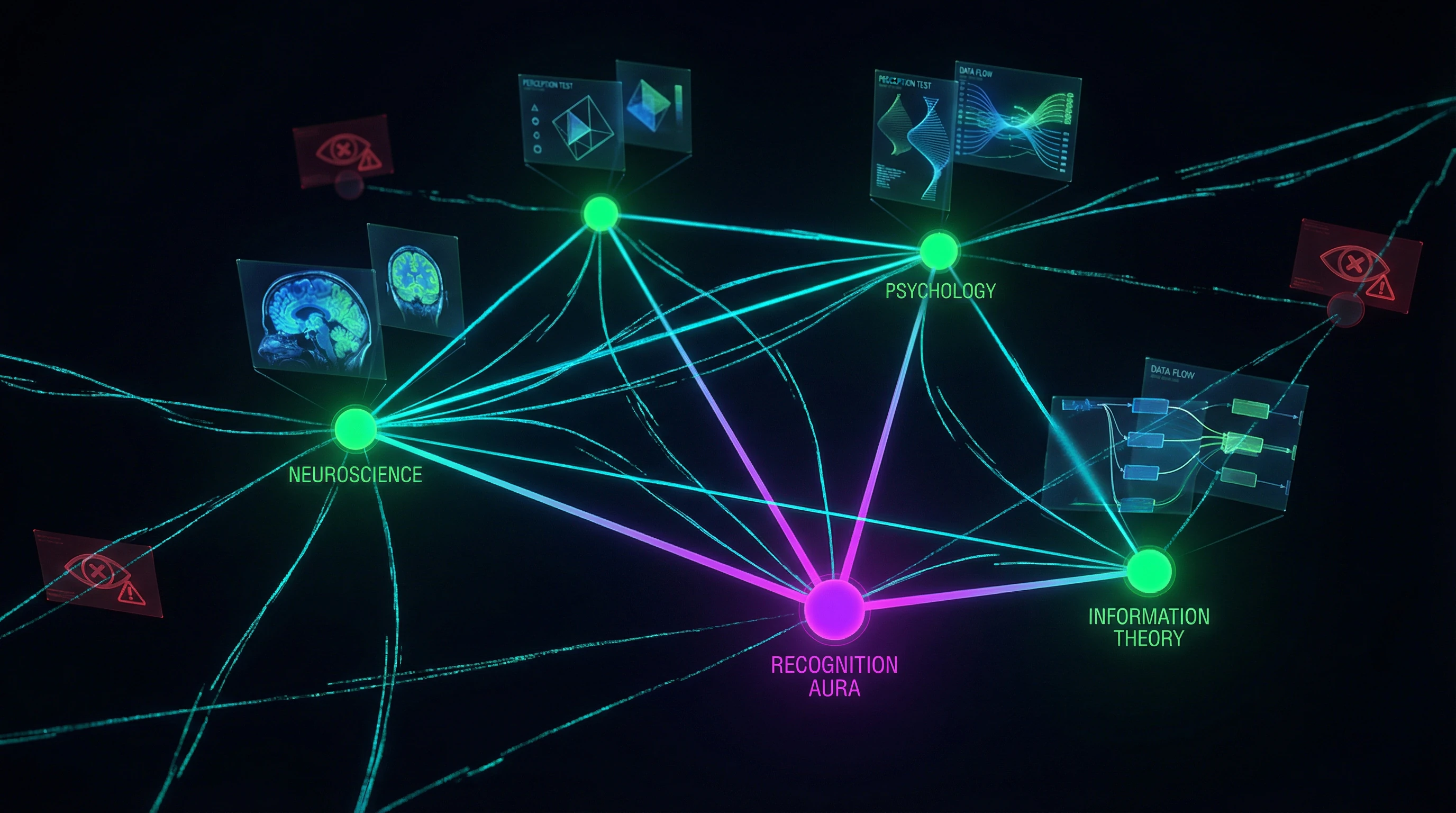
The recognition aura phenomenon is studied across multiple disciplines under different names: "illusion of knowledge," "familiarity effect," "false recognition," "metacognitive error." More details in the Secret Devices section.
🧪 Neurophysiology of Illusions: How the Brain Creates a Sense of Familiarity Without Real Content
Research on visual illusions demonstrates that the brain can generate stable perceptual experiences that don't correspond to reality. Work on the tilt illusion and orientation sensitivity (S002) shows that the visual system systematically distorts perception of angles and object orientation depending on context.
Critically important: subjects report high confidence in their erroneous judgments. This is a direct analogy to recognition aura—the brain creates subjective certainty of experience independent of its objective accuracy.
An illusion is a perceptual error that can be corrected upon closer examination. A mystification is deliberate deception that persists even after exposure. Recognition aura can function in both modes simultaneously.
📊 Systematic Reviews of Metacognitive Errors: When Confidence Doesn't Correlate With Accuracy
A systematic review on the question "does the patient want treatment" reveals a critical pattern: physicians systematically overestimate their ability to determine patient wishes based on "clinical intuition"—a form of recognition aura. The correlation between physician confidence and actual patient preferences approaches zero in complex cases.
Professional experience doesn't protect against the illusion of understanding—on the contrary, it can amplify it by creating a false sense of expertise. A systematic review on "musical pronunciation" in choral performance asks: is this term a real phenomenon or a myth? Analysis shows that many musicians and educators use the term with high confidence but cannot provide an operational definition or demonstrate measurable differences.
| Context | Subject Confidence | Correlation With Accuracy | Aura Mechanism |
|---|---|---|---|
| Physician clinical intuition | High | Close to zero | Experience creates false sense of expertise |
| Musical term without definition | High | Not measurable | Term creates illusion of shared understanding |
| Visual illusion | High | Zero | Brain generates certainty independent of reality |
🧾 Physics of Information and Materialization of Illusions: Why "Understanding" Doesn't Equal "Knowledge"
Work on physical aspects of information raises a fundamental question: can information be materialized, or is it a "great illusion"? Applied to recognition aura, this means: is the subjective experience of "I understand" a sufficient criterion for the presence of knowledge?
Analysis shows that information exists only in the context of interpretation—without the ability to reproduce, apply, or transmit, "understanding" remains an epiphenomenon, an illusion without content. This connects to a broader problem: paranormal beliefs often rely on precisely such illusions of understanding, where subjective certainty replaces verifiable knowledge.
🔎 Illusion and Mystification: When Perception Becomes a Tool of Manipulation
Research on the trompe-l'oeil technique—an artistic method of creating optical illusions—asks: is this illusion or mystification? The distinction is critical for understanding recognition aura.
- Illusion
- A perceptual error that can be corrected upon closer examination. The brain errs on its own, without deliberate deception.
- Mystification
- Deliberate deception that persists even after exposure. Someone activates a false sense of familiarity purposefully.
- Recognition aura in both modes
- Can function as both involuntary illusion and exploitable vulnerability simultaneously. This makes it particularly dangerous in the context of disinformation.
🧬 Meta-Analysis of Physiological Research: When Data Contradicts Intuition
A systematic review and meta-analysis of growth hormone's effect on muscle mass demonstrates how recognition aura operates in the scientific community. There's a widespread belief that growth hormone significantly increases muscle mass in healthy individuals—this is "common knowledge" in the fitness industry.
Meta-analysis shows the effect is substantially smaller than assumed and accompanied by significant side effects. The illusion of understanding ("everyone knows growth hormone works") persisted for decades despite the absence of convincing evidence.
A similar pattern is found in a systematic review of vitamin D levels in populations of Russia, Ukraine, and Belarus. There's a persistent belief about "vitamin D deficiency" as a mass problem, but systematic analysis reveals significant data variability and methodological issues in studies.
- Belief forms based on partial data or authority
- Belief spreads through professional communities and media
- Recognition aura ("everyone knows") creates an illusion of consensus
- Critical data is ignored or reinterpreted
- Belief persists for decades without reliable evidence base
This demonstrates that systematic reviews as a methodology are critically important for overcoming academic noise and exposing recognition aura even in scientific disciplines.
Mechanisms of Aura Formation: Why the Brain Prefers the Illusion of Understanding to Real Ignorance
Understanding the mechanisms of recognition aura requires analyzing how the brain processes information and makes decisions about stimulus "familiarity." This isn't a single process, but a cascade of interacting systems, each of which can generate false signals. More details in the Logic and Probability section.
🔁 Predictive Coding and Prediction Errors: When the Brain "Sees" What It Expects
Modern neurophysiology views the brain as a predictive machine: instead of passively processing incoming information, it constantly generates predictions about what should happen and compares them with reality (S002). Recognition aura occurs when a prediction is activated (creating a sense of familiarity) but isn't confirmed by actual data.
Critically important: the subjective experience arises at the prediction stage, before verification—which is why it can be very convincing even in the absence of real correspondence. The brain "believes" its prediction before receiving feedback.
Prediction error isn't a malfunction. It's a mechanism that allows the brain to conserve energy by assuming familiarity instead of reanalyzing reality each time. Recognition aura is a byproduct of this efficiency.
🧷 Availability Heuristic and Question Substitution: How the Brain Answers an Easy Question Instead of a Hard One
When the brain faces a difficult question ("do I actually know this?"), it often substitutes a simpler one ("do I feel familiarity?"). The availability heuristic—the tendency to assess probability or truth based on the ease with which examples come to mind—creates an illusion of knowledge (S008).
If something "sounds familiar," the brain interprets this as "I know this," without checking whether you can actually reproduce or apply that knowledge. This is especially dangerous in the context of paranormal beliefs and cognitive errors, where familiarity with an image often substitutes for real understanding of the mechanism.
- Difficult question: "Is this true?" → Simple question: "Does this sound familiar?"
- Familiarity is interpreted as truth
- Verification of actual knowledge is skipped
- Confidence grows without foundation
⚠️ Processing Fluency Effect: Why Ease of Perception Creates an Illusion of Truth
Information that is processed easily (high perceptual fluency) is perceived as more true and familiar (S005). This explains why repeating a statement increases belief in it, even if it's false: repeated exposure increases processing fluency, which the brain interprets as a signal of familiarity and credibility.
Recognition aura exploits this mechanism: it's enough to make information "easily perceivable" (simple language, familiar images, rhythmic structure) to create an illusion of understanding. This applies to both water chemistry myths and AI myths—the simpler the formulation, the higher the sense of familiarity.
| Parameter | High Fluency | Low Fluency |
|---|---|---|
| Perception of Truth | High (even for lies) | Low (even for truth) |
| Sense of Familiarity | Strong | Weak |
| Cognitive Effort | Minimal | Maximal |
| Confidence in Answer | High | Low |
The fluency mechanism works independently of content. Beautiful font, familiar melody, rhythmic text—all of this increases processing fluency and, consequently, the sense of truth. This is why aura photography and the Kirlian effect are so visually convincing: electrical discharge is processed easily, creating an illusion of understanding what is supposedly happening.
Data Conflicts and Uncertainty Zones: Where Sources Diverge and What It Means
Analysis of sources reveals several areas where data is contradictory or insufficient. These uncertainty zones are critically important for understanding the boundaries of applicability of the recognition aura concept. More details in the Media Literacy section.
🕳️ Contradiction Between Adaptiveness and Pathology: When Illusion Is Useful and When It's Dangerous
Sources don't provide a definitive answer to whether recognition aura is an adaptive mechanism or cognitive pathology. On one hand, research on visual illusions (S002) shows this is a systemic feature of perception that doesn't disappear even when the illusion is recognized.
On the other hand, the illusion of understanding leads to systematic errors in professional activity. The answer likely depends on context: in stable environments, recognition aura may be a useful heuristic; in unstable or manipulative environments, it becomes a dangerous vulnerability.
| Context | Role of Recognition Aura | Risk |
|---|---|---|
| Stable environment, repeating patterns | Accelerates decision-making, reduces cognitive load | Minimal with feedback present |
| Unstable environment, novel scenarios | False sense of competence | Critical — errors without correction |
| Manipulative environment (disinformation, advertising) | Vulnerability to suggestion | Maximum — systematic distortion of judgment |
🧩 Gap Between Laboratory and Field Data: What Works in Experiments vs. Real Life
Most illusion research is conducted under controlled laboratory conditions with artificial stimuli. It's unclear how applicable these results are to complex real-world situations where multiple factors interact simultaneously.
Research on artistic illusions (S006) analyzes geometric paradoxes but provides no data on how analogous mechanisms work in digital interfaces or political communication. This is a critical gap: most contemporary manipulation occurs precisely in these domains.
Applying cognitive errors to real scenarios requires accounting for social context, motivation, prior experience, and emotional state. Laboratory conditions exclude these variables, making extrapolation risky.
📊 Lack of Data on Compensation Mechanisms and Metacognitive Correction
Sources thoroughly describe how recognition aura emerges but poorly address how people and systems overcome it. Which strategies actually work? Is specialized training required or is awareness sufficient?
- Explicit training in metacognitive skills (source verification, seeking counterarguments)
- Structured decision-making protocols (checklists, multidisciplinary teams)
- Technological barriers (interfaces that slow judgment and require justification)
- Social mechanisms (culture of doubt, encouraging criticism, ethical communication)
Data on the effectiveness of each approach is fragmentary. Systematic reviews show that simply informing people about cognitive errors is ineffective, but long-term effects of structured training remain unclear.
Cognitive Anatomy of Manipulation: Which Psychological Vulnerabilities Does the Recognition Aura Exploit
Understanding the mechanisms of the recognition aura allows us to identify specific manipulation techniques that exploit it. This isn't abstract theory—these are practical methods used in design, marketing, politics, and disinformation. More details in the AI Myths section.
⚠️ Technique One: Semantic Overload—Using Familiar Words to Create the Illusion of Understanding
The manipulator uses terms that sound familiar but lack clear definition. Example: the term "musical pronunciation" creates the illusion that everyone understands what's being discussed, even though no operational definition exists.
In politics, this manifests as the use of marker words ("freedom," "justice," "tradition") that activate the recognition aura without conveying specific content. A person feels they "understand" what's being discussed and doesn't ask clarifying questions.
A familiar word without definition isn't communication—it's a trap. The brain fills the gap with its own expectations and declares this understanding.
🕳️ Technique Two: Visual Mimicry—Creating Interfaces That "Look Familiar"
Research on visual illusions (S006) shows that the brain makes familiarity decisions based on surface features. Manipulative interfaces use visual patterns that mimic familiar and trusted sources: color schemes, fonts, element placement.
This creates a recognition aura ("this looks like a reliable site") that blocks critical verification. Phishing sites exploit precisely this mechanism.
- Visual Familiarity
- Surface similarity to a trusted source activates the recognition aura before content verification kicks in.
- Why This Works
- The brain processes visual cues faster than semantics. By the time you start reading the text, the trust decision has already been made.
🧠 Technique Three: Social Proof Through the Illusion of Consensus
The manipulator creates the impression that "everyone knows this" or "everyone thinks this way." This activates the recognition aura through a social channel: if information is presented as common knowledge, the brain interprets this as a signal of familiarity and credibility.
Digital platforms create the illusion of consensus through content curation (S007): if you see information repeatedly in your feed, it begins to seem "common knowledge," even if it's the result of algorithmic filtering.
Repetition in an algorithmic feed isn't proof of truth—it's proof that the algorithm showed you the same thing many times.
🔁 Technique Four: Exploiting the Fluency Effect Through Repetition and Simplification
Repeating a false statement increases its perceived truthfulness by increasing processing fluency (S002). The simpler the formulation, the faster the brain processes it, and the stronger the feeling of familiarity.
The manipulator simplifies a complex phenomenon into a single phrase, repeats it in different contexts, and the recognition aura transforms the simplification into "truth."
| Complexity Level | Processing Speed | Feeling of Familiarity | Manipulation Risk |
|---|---|---|---|
| Complex explanation with caveats | Slow | Low | Low |
| Simplified version | Fast | High | High |
| Single phrase repeated 5+ times | Very fast | Very high | Critical |
🎭 Technique Five: Emotional Anchor—Linking the Recognition Aura to Feeling
The manipulator connects information to a strong emotional state (fear, anger, pride). The emotion becomes an anchor that activates the recognition aura automatically, without critical thinking involvement.
When you see information that evokes the same emotion, the brain interprets this as "I already know this"—because the emotion is familiar. This is particularly effective in political disinformation and pseudo-debunking.
An emotion you recognize doesn't mean you recognize the information. These are two different systems, but the manipulator conflates them.
🔐 Technique Six: Authority Through Visual Markers
The manipulator uses visual markers of authority (white coat, academic degree, official logo) that activate the recognition aura through association with reliability. The brain sees the marker, activates the aura, and critical verification shuts down.
This works even if the marker is fake or used out of context. Research (S003) shows that visual signals of authority influence cognitive information processing at the level of neurovegetative regulation.
- Check: does the source have real competence in this area, or only visual markers?
- Check: is the authority marker being used in its original context, or repurposed?
- Check: can authority in one area be applied to another area without losing validity?
🌀 Technique Seven: Circular Confirmatory Information
The manipulator creates a closed information system where all sources reference each other and confirm the same claim. This creates the illusion that information has been verified and confirmed by multiple independent sources.
In reality, it's one source cited many times. The recognition aura activates through repetition and the apparent independence of sources. This is particularly dangerous in pseudoscientific communities, where circular references create the appearance of scientific consensus.
If all sources reference one study, that's not consensus—it's an echo chamber. Check the primary source.
🛡️ Protection Protocol: How to Recognize Manipulation Through Aura
- When you feel you "understand" information, stop and ask: what exactly do I understand? Can I explain this in my own words without using the original terms?
- If you can't—it's the recognition aura, not understanding. Return to definitions.
- Check visual markers: are they authentic or imitation? Are they being used in the correct context?
- Find the primary source of information. If you only see secondary references—it's a circular system.
- Separate emotion from information. What emotion does this information evoke? Does it activate the recognition aura through emotion rather than meaning?
- Check consensus: is this actually common knowledge, or the result of algorithmic filtering?
The recognition aura isn't a brain error that needs to be completely eliminated. It's an adaptive mechanism that speeds up information processing under uncertainty. But the manipulator exploits precisely this adaptability, creating conditions where the aura activates without real understanding.
Protection isn't about disabling the aura, but calibrating it. Learning to distinguish when it signals real familiarity versus surface similarity. This requires practice, but it's possible.