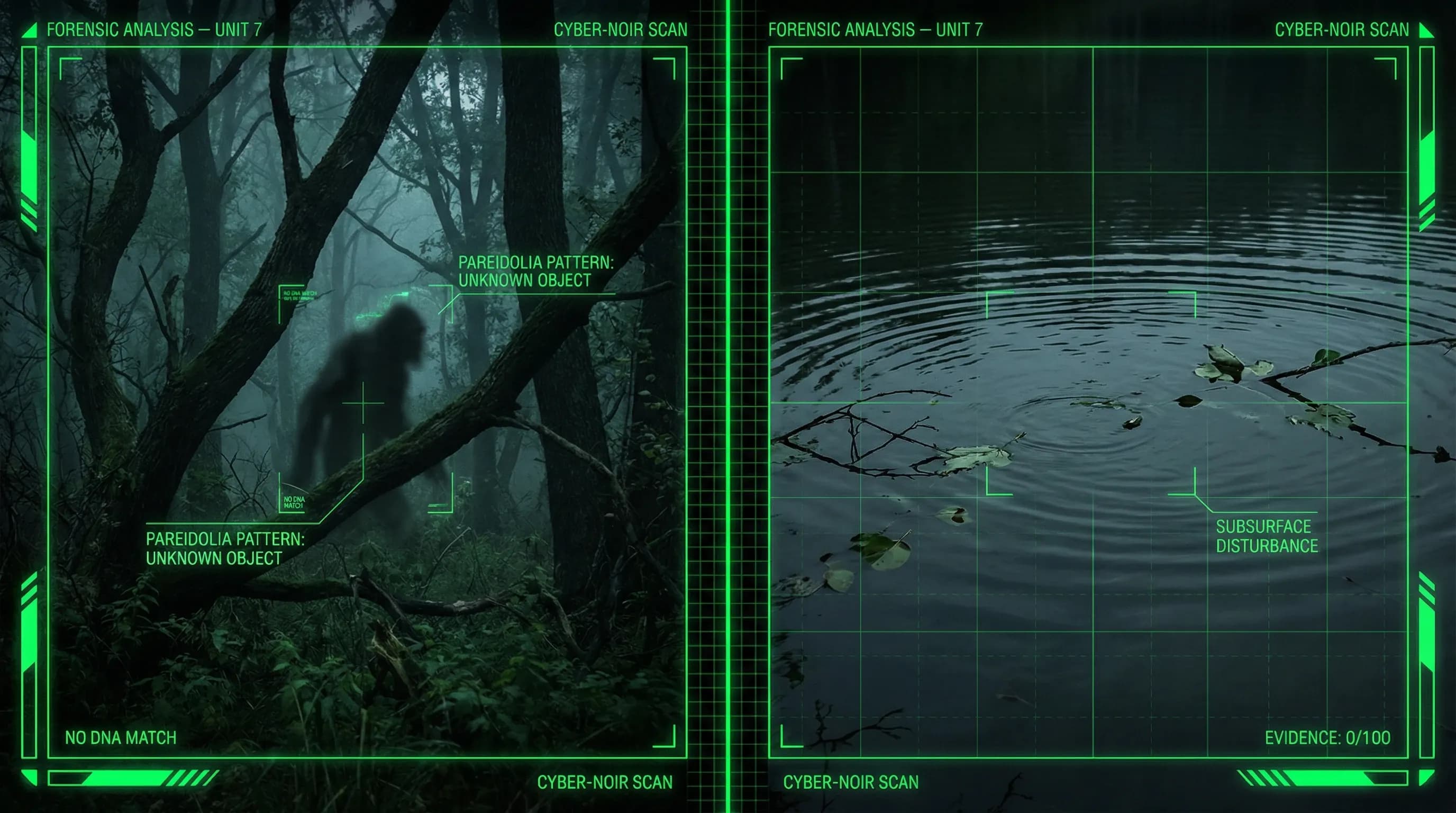
What are cryptids in scientific taxonomy — and why their definition already contains a logical trap
The term "cryptid" (from Greek κρυπτός — hidden) denotes an animal whose existence is presumed based on anecdotal evidence but not confirmed by the scientific community (S002). The key problem with this definition is that it creates false symmetry between "unconfirmed" and "unrefuted."
As if the absence of evidence for existence and the absence of evidence for non-existence carried equal epistemological weight. They don't. More details in the section Memory of Water.
Asymmetry of burden of proof in biology
In scientific practice, the burden of proof always lies with the claimant. Recognition of a new biological species requires a holotype — a physical reference specimen deposited in a museum collection, with complete morphological description and genetic profile.
Cryptozoology attempts to bypass this standard by appealing to "accumulation of circumstantial evidence" (S003). But in biology there's no concept of "sufficient eyewitness testimony" for species description. Even thousands of photographs of tracks don't replace a single tissue sample.
| Category | Example | Status in science |
|---|---|---|
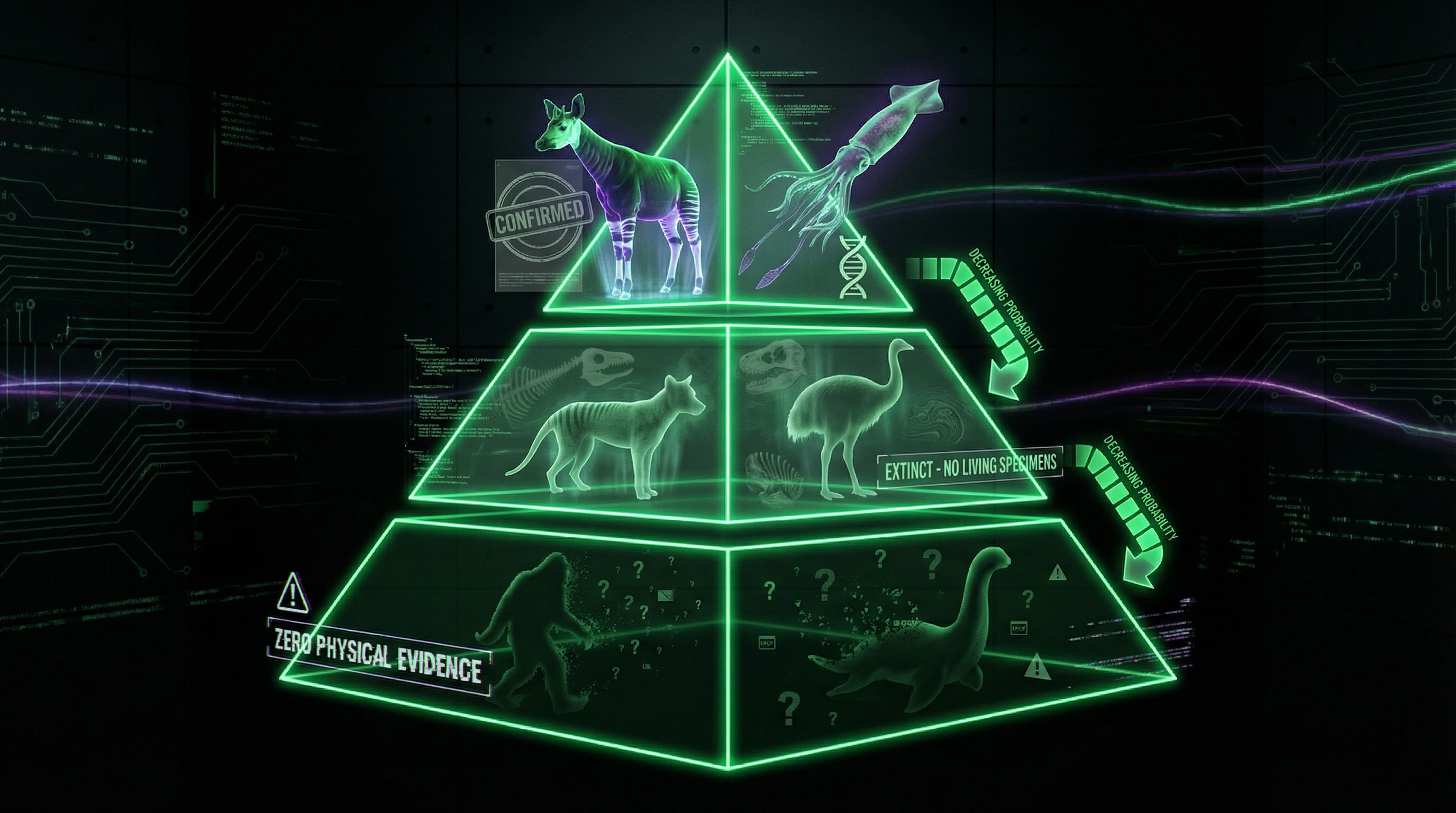
| Real animals, recently discovered | Okapi (1901), giant squid (2004), saola (1992) | Described with holotype and DNA |
| Extinct species, mistakenly believed living | Thylacine (†1936), moa | Confirmed by fossils and museum specimens |
| Creatures without a single scientific confirmation | Bigfoot, Nessie, yeti, chupacabra | Cryptids in the strict sense |
Zoology continues to discover new species — averaging 15,000–18,000 annually, predominantly insects and marine organisms. But all these discoveries follow standard scientific protocol with physical specimens.
The definitional trap: "absence of evidence is not evidence of absence"
This popular argument from cryptid defenders contains a substitution of thesis. Indeed, it's impossible to prove the absolute non-existence of anything in the entire Universe.
But science operates on Popper's principle of falsifiability: a hypothesis must be formulated so it can be refuted. The claim "Bigfoot exists somewhere in the forests of North America" is unfalsifiable in an absolute sense, but becomes increasingly improbable with each year of systematic searches yielding no results.
The Bayesian approach to probability shows: in the absence of new confirming data, the posterior probability of a cryptid's existence asymptotically approaches zero (S007). This doesn't mean the cryptid "definitely doesn't exist," but that rational belief in its existence should decrease proportionally to the time and resources spent searching without results.
The Steel-Man Version of Arguments for Cryptid Existence — Seven Strongest Claims from Believers
Before examining the evidence against cryptids, it's necessary to formulate the strongest possible version of arguments in their favor — the "steel-man" method, opposite of the "strawman fallacy." This is an intellectually honest approach that avoids critiquing weak versions of arguments that cryptid proponents themselves don't use. More details in the section Sacred Geometry.
🔎 Argument 1: Scientific history is full of "impossible" animals that became real
The gorilla was only described by European science in 1847, though local African inhabitants had known about it for millennia. The giant squid was considered a maritime legend until 2004, when Japanese researchers obtained the first photographs of a living specimen. The coelacanth was thought extinct 66 million years ago, until a living specimen was caught off the coast of South Africa in 1938.
These examples demonstrate that scientific consensus can be wrong, and "folkloric creatures" sometimes turn out to be real species (S001). Why couldn't Bigfoot or Nessie be next on this list?
🔎 Argument 2: Thousands of eyewitness accounts from independent observers
The Bigfoot Field Researchers Organization (BFRO) database contains over 5,000 reports of Bigfoot encounters in the US and Canada alone. Many witnesses are police officers, forest rangers, biologists — people with professional experience observing wildlife.
- Convergence of descriptions
- A bipedal creature 6–10 feet tall, covered in dark hair, with a characteristic odor — descriptions from different regions and eras match. It's statistically improbable that all these people are lying or hallucinating independently of each other.
- Professional status of witnesses
- People with experience observing nature have less reason to misidentify an animal than casual tourists.
🔎 Argument 3: Physical artifacts — footprints, hair, audio recordings
Bigfoot footprint casts demonstrate anatomical details difficult to fake: dermatoglyphic patterns (analogous to fingerprints), signs of mid-tarsal break characteristic of bipedal primates, pressure distribution different from human.
Gait analysis of the Patterson-Gimlin film (1967) shows biomechanics inconsistent with a human in a costume (S007). Audio recordings of "Bigfoot vocalizations" (Sierra Sounds, 1970s) contain frequency characteristics beyond the human range.
🔎 Argument 4: Ecological niches and evolutionary plausibility
Gigantopithecus — an extinct genus of primates up to 10 feet tall — existed in Asia until 100,000 years ago and could have migrated to North America via the Bering land bridge. Forest ecosystems of the Pacific Northwest possess sufficient biomass to support a population of large omnivores.
Relict populations of large mammals thought extinct are periodically discovered: the Vietnamese saola was discovered in 1992 in a region considered well-studied (S005).
🔎 Argument 5: Systematic dismissal of evidence by the scientific mainstream
Academic biologists refuse to seriously investigate the cryptid phenomenon due to fear of reputational damage — the "taboo on anomalies" in sociology of science terminology (S003). Grant applications to study Bigfoot are rejected not for scientific reasons, but due to stigmatization of the topic.
This creates a vicious cycle: no funding → no quality research → no evidence → no funding. Perhaps cryptids remain unproven not because they don't exist, but because no one is seriously searching for them with proper methods.
🔎 Argument 6: Cultural universality of "wild man" myths
Legends of human-like creatures living in forests appear in the folklore of dozens of cultures across different continents: sasquatch among indigenous peoples of North America, yeti in the Himalayas, almasty in the Caucasus, yowie in Australia.
This cross-cultural convergence may point to archetypal memory of real encounters between Homo sapiens and other hominids (Neanderthals, Denisovans) in the Pleistocene, preserved in the collective unconscious (S002).
🔎 Argument 7: Low population density explains rarity of findings
To maintain a genetically viable population, 500–1,000 individuals are sufficient (minimum viable population by the 50/500 rule). At a density of 1 individual per 40–80 square miles in remote mountain-forest regions, the probability of random human encounter is extremely low.
- Mountain gorillas remained unknown to science until the 20th century, despite inhabiting a relatively small range
- Snow leopards are so elusive that even with targeted searches they're extremely difficult to detect
- Low population density doesn't preclude species existence, but explains the absence of regular findings
Evidence-Based Case Against Cryptid Existence — Systematic Analysis by Evidence Category
Having formulated the strongest arguments for cryptids, let's now analyze the factual data. Critical analysis requires examining not only the presence of "evidence for," but also the absence of evidence that would necessarily exist if cryptids were real. More details in the Torsion Fields section.
📊 Category 1: Absence of Physical Remains at Statistically Impossible Probability
If a Bigfoot population exists in North America, it must number at least 500–1,000 individuals for genetic viability. With an average lifespan of 30–40 years for large primates, 12–25 individuals should die annually.
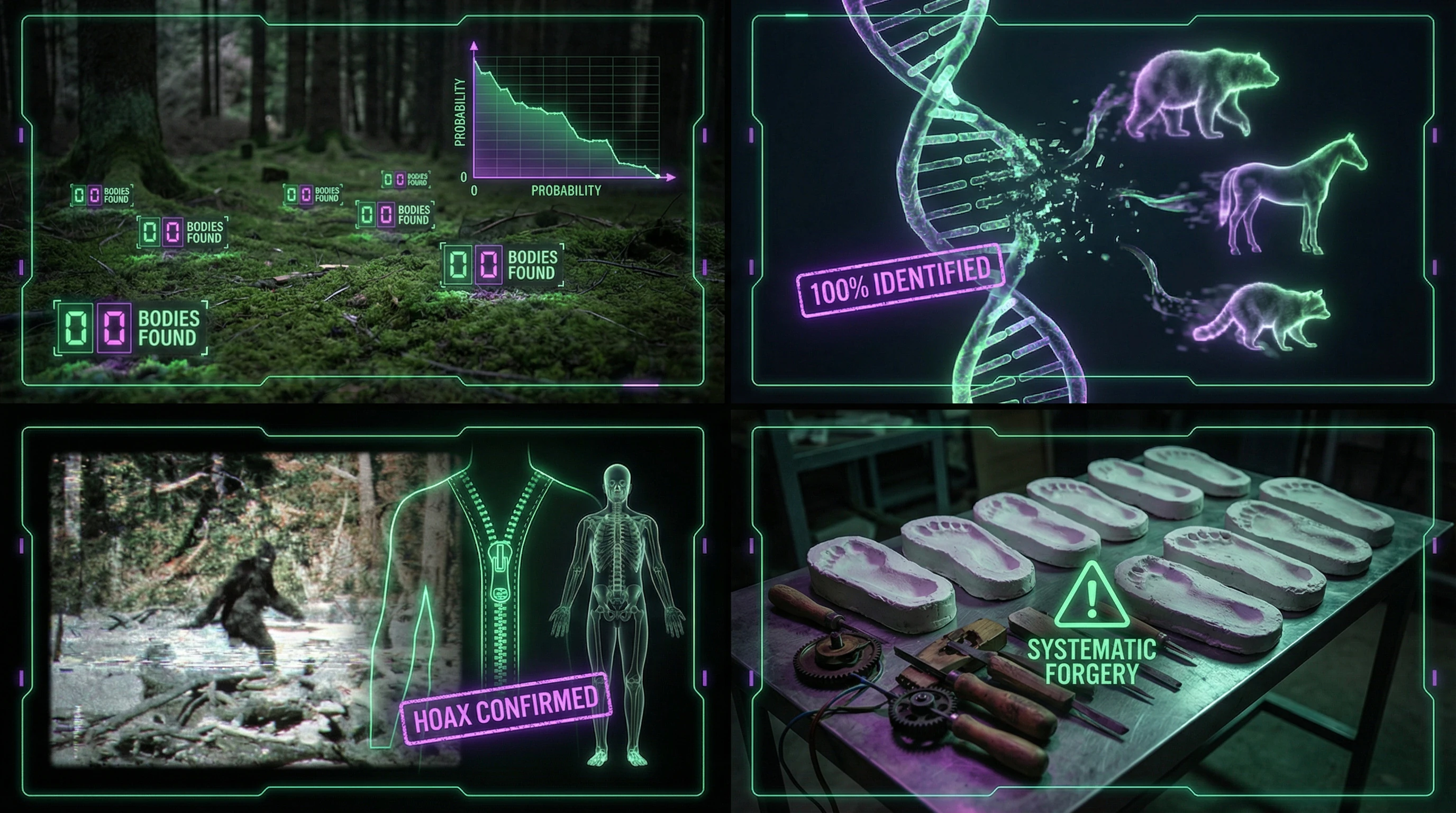
Over 50 years of active searching (since the 1970s), this means 600–1,250 corpses. Not one has been found. For comparison: remains of mountain gorillas (population ~1,000 individuals, range ~40,000 km²) are regularly discovered by rangers and researchers. The probability of complete absence of finds with such statistics approaches zero.
Absence of evidence under conditions where evidence should exist with 99.9% probability is itself evidence of absence.
📊 Category 2: DNA Analysis Failure of "Cryptid Hair" Samples
In 2014, geneticist Bryan Sykes (Oxford University) conducted a large-scale study analyzing 30 samples of "yeti, bigfoot, and other cryptid hair" from museum collections and private sources (S003). Results: all samples belonged to known species — bears (most commonly), horses, cows, raccoons.
Two samples from the Himalayas showed matches with ancient polar bear DNA, explaining yeti legends as a rare population of Himalayan brown bears. Not a single sample yielded an unknown genetic profile. This research was published in the peer-reviewed journal Proceedings of the Royal Society B, ruling out methodological errors.
| Sample | Claimed Origin | Actual Result |
|---|---|---|
| "Yeti" hair | Unknown primate | Brown bear DNA |
| "Bigfoot" hair | Unknown hominid | Horse, cow, raccoon DNA |
| "Nessie" hair | Sea monster | DNA of known fish and mammals |
📊 Category 3: Photographic and Video Evidence Fails Expert Scrutiny
The famous Patterson-Gimlin film (1967), considered the "best evidence" for Bigfoot's existence, has critical problems. Bob Heironimus, an acquaintance of Patterson, publicly stated in 1998 that he was the one in the gorilla suit during filming, and provided details matching known facts (S007).
Analysis of the creature's gait in the film shows patterns compatible with a human in a costume, not the biomechanics of a large primate. Patterson had financial motives for fabrication — he was filming a documentary about Bigfoot and needed sensational material. The film quality is deliberately low (16mm, grainy), making detailed analysis difficult and typical of hoaxes from that era.
- Check biomechanics: a real primate cannot walk like a human in a costume
- Find creator's financial motives: was there profit from the sensation
- Assess recording quality: is it deliberately low to hide details
- Look for participant confessions: who was in the costume
📊 Category 4: Footprints — Systematic Signs of Forgery
Analysis of Bigfoot footprint casts reveals recurring anomalies. Lack of variability — real animal tracks always differ due to ground irregularities, but many "Bigfoot tracks" are identical, as if made by a single mold.
Unnatural pressure distribution — tracks show uniform pressure across the entire foot, whereas in real primates pressure concentrates on the heel and forefoot. Ray Wallace, one of Bigfoot's main popularizers, was exposed by his family after his death in 2002: his relatives presented wooden forms he used to create fake tracks since 1958 (S004). Many "classic" Bigfoot tracks trace back to Wallace's hoaxes.
- Track Variability
- Real animals leave different prints depending on ground and stepping angle. Identical tracks indicate use of a single mold.
- Pressure Distribution
- In primates, load concentrates on heel and toe pads. Uniform pressure is a sign of human costume or wooden form.
- Track Source
- Ray Wallace is recognized as creator of most "classic" finds. His wooden forms are preserved in the family archive.
📊 Category 5: Loch Ness Monster — Hydroacoustics and Complete Lake Survey
Loch Ness is one of the most studied lakes in the world. In 2003, BBC conducted a large-scale expedition using 600 sonar beams covering the entire lake volume. Result: not a single large object matching "monster" descriptions was detected.
In 2018–2019, an international team led by Professor Neil Gemmell (University of Otago, New Zealand) conducted a metagenomic study analyzing DNA from 250 water samples taken at different depths and lake sections. DNA of 3,000+ species was found, including fish, birds, mammals (otters, deer), but no unknown large vertebrate. High concentration of eel DNA explains some observations of "serpentine creatures."
If a large animal lives in the lake, its DNA will be in the water. It's not there — meaning the animal isn't there. This isn't opinion, this is molecular biology.
📊 Category 6: Economic Incentives for Maintaining the Myth
The tourism industry around cryptids generates significant revenue: the city of Inverness (Scotland) receives about £41 million annually from Loch Ness Monster-related tourism. The Pacific Northwest region of the USA earns tens of millions of dollars from "Bigfoot tracking tours."
These economic incentives create motivation for local communities to maintain the myth, periodically "planting" new "evidence." Analysis of temporal patterns in cryptid encounter reports shows correlation with tourist seasons and economic downturns in regions. When tourism drops, the number of "new encounters" rises — this is not coincidence, but a mechanism for restoring demand.
| Region | Cryptid | Annual Tourism Revenue | Correlation with Reports |
|---|---|---|---|
| Inverness, Scotland | Loch Ness Monster | £41 million | Peaks in low season |
| Pacific NW USA | Bigfoot | $50–100 million | Growth after economic downturns |
| Himalayas | Yeti | $10–20 million | Peaks in tourist season |
Belief in cryptids is often linked to mechanisms of social control and group identity, where a community unites around shared "knowledge" unavailable to skeptics. This creates a psychological barrier against criticism and reinforces commitment to the myth regardless of factual data.
Mechanisms of False Belief Formation — Why the Brain Constructs Cryptids from Noise
Understanding why people continue to believe in cryptids despite the data requires analyzing cognitive mechanisms that evolved to solve other problems but create systematic errors in evidence evaluation. More details in the Scientific Method section.
🧬 Pareidolia and Hyperactive Pattern Recognition
The human brain evolved in conditions where Type I errors (false alarms — mistaking rustling in bushes for a predator when it's just wind) were less dangerous than Type II errors (missed signals — failing to notice a real predator). This led to hypersensitivity in the pattern recognition system.
Pareidolia — perceiving meaningful images in random stimuli (faces in clouds, figures in shadows) — is a direct consequence of this adaptation. In the context of cryptids: a blurry spot in a photograph, a shadow in the forest, an unusual sound are automatically interpreted as "unknown creature" because the brain prefers false identification over no identification.
The pattern recognition system operates on the principle: better a false alarm than a missed danger. Cryptids are a byproduct of this ancient survival strategy.
🧬 Availability Cascade and Social Reinforcement
Availability cascade — a mechanism where repetition of a claim increases its subjective plausibility regardless of actual truth. When a person repeatedly hears about Bigfoot from different sources (documentaries, books, internet forums), the availability heuristic causes the brain to assess the probability of the cryptid's existence as high because information about it "easily comes to mind."
Social reinforcement amplifies the effect: if a person claims an encounter with Bigfoot and receives attention and support from the enthusiast community, this creates positive reinforcement motivating preservation and development of the belief. The community becomes a belief control system where dissonance is punished by social rejection.
- Information is repeated in different contexts → seems more truthful
- Person publicly claims an encounter → social pressure maintains the belief
- Community confirms the version → cognitive dissonance resolves in favor of belief
- Each new story adds details → belief strengthens
🧬 Confirmation Bias and Selective Attention
Confirmation bias — the tendency to seek, interpret, and remember information in ways that confirm existing beliefs. A Bigfoot believer will pay attention to every new "evidence" (blurry photo, report of tracks) and ignore or rationalize refutations.
Research shows that people with strong beliefs about cryptids demonstrate asymmetric information processing: confirming data is accepted uncritically, refuting data is subjected to hypercriticism or rejected as a "scientific conspiracy" (S007).
| Type of Information | Believer's Response | Cognitive Mechanism |
|---|---|---|
| Blurry forest photo | "That's Bigfoot!" | Pareidolia + confirmation |
| DNA analysis: bear | "Lab made a mistake / hiding the truth" | Motivated skepticism |
| Hoax exposed | "That was fake, but other evidence is real" | Selective attention |
| Absence of skeletons/bodies | "They're very secretive / decompose quickly" | Post-hoc rationalization |
🧬 False Memory Effect and Confabulation
Memory doesn't work like video recording — it's a reconstructive process subject to distortions. Experiments have shown that false memories of events that never happened can be implanted through leading questions and social pressure.
In the cryptid context: a person who saw a bear at dusk, under the influence of subsequent questioning by enthusiasts and viewing Bigfoot materials, may "remember" details that weren't there (bipedal gait, human-like face). Each retelling of the story adds new elements, and after several years the witness sincerely believes a version radically different from the original perception (S008).
The witness isn't deliberately lying. Their memory was rewritten by social context and their own expectations. This isn't deception — it's normal brain function under conditions of uncertainty.
Causation vs. Correlation — Why "Thousands of Witnesses" Don't Prove Existence
One of the central arguments from cryptid proponents is "too many people have seen this for it all to be made up." Let's examine why this argument fails from an epistemological and statistical perspective. More details in the Debunking and Prebunking section.
🔬 Independence of Observations — An Illusion Under Information Contagion
For multiple testimonies to increase the probability of truth, they must be statistically independent. Reports of cryptid encounters are not.
Most witnesses are familiar with the cultural image of Bigfoot or Nessie before their "observation" — this creates an interpretive template. Media coverage of previous cases generates clusters of reports: after a Bigfoot documentary airs, the number of "encounters" in the region increases 3–5 times (priming effect). Social networks and forums function as echo chambers where witnesses mutually reinforce each other's interpretations.
5,000 reports are not 5,000 independent observations, but the spread of a single cultural meme through dependent channels.
🔬 Base Rate of Perceptual Errors
Even if all witnesses are honest and not fabricating stories, we must account for the base rate of perceptual and identification errors.
Human vision doesn't work like a camera, but as a hypothesis that the brain constantly tests and corrects (S007). Under conditions of low light, stress, or expectation of an encounter, the brain fills information gaps with expected patterns. A bear at dusk, a tree silhouette, a reflection in water — all can be reinterpreted as a cryptid if the observer is in a heightened state of vigilance.
- Visual pareidolia (recognizing faces and forms in random patterns) triggers automatically, without conscious control
- Expectancy effect amplifies perception of details matching the hypothesis
- Memory of the event is rewritten each time it's recalled, adding details that weren't in the original perception
⚙️ Causation Requires Eliminating Alternatives
The testimony "I saw something unusual" doesn't establish a causal link between a cryptid's existence and the observation. It merely records a correlation between the observer's mental state and interpretation of sensory noise.
| Claim | Required Evidence | What Actually Exists |
|---|---|---|
| Cryptid exists | Physical specimen, DNA, skeleton, video under controlled conditions | Subjective descriptions, low-quality photos, prints that could be fakes |
| Witness is honest | Independent verification of event, elimination of alternative explanations | Witness's personal conviction that they saw a cryptid |
| Encounter occurred | Objective traces (video, DNA, multiple independent observers) | One person's memory, subject to distortion and suggestion |
The scientific method requires not just accumulating evidence, but eliminating competing hypotheses. The hypothesis "cryptid exists" competes with the hypothesis "human perception errs in predictable directions." The second hypothesis explains all available data without invoking an unknown animal.
When cryptozoologists speak of "thousands of witnesses," they commit a logical error: substituting quantity for quality of evidence. One honest, independent, verifiable report is worth more than a thousand dependent, suggestion-prone observations (S003).
- Information Contagion
- A process where knowledge of previous reports influences interpretation of current observations. A witness aware of other encounters unconsciously searches for signs matching the cultural image of the cryptid, rather than objectively describing what they saw.
- Base Rate
- The probability of an event in a population before accounting for specific evidence. If perceptual errors occur in 1% of unknown object observations, while cryptids exist in 0.0001% of cases, then any specific report is more likely explained by error than an actual encounter.
Cryptozoology often positions itself as a new religious movement, where belief in cryptids becomes part of community identity. In this context, testimonies function not as evidence, but as rituals confirming group belonging.