What are paranormal phenomena and why they require extraordinary evidence — defining the boundaries of scientific investigation
Paranormal phenomena are those that contradict established laws of physics, biology, and neuroscience: telepathy (transmission of thoughts without a physical medium), clairvoyance (obtaining information about events without sensory access), psychokinesis (mind's influence on matter), precognition of the future. The key difference from scientific hypotheses is the absence of a proposed mechanism compatible with known laws of nature (S005, S008).
Science doesn't reject the paranormal a priori, but demands proportionality of evidence to the scale of the claim: the more radical the assertion, the more rigorous the verification methodology must be. More details in the section Paranormal Phenomena and Ufology.
🔎 Criteria for scientific testability
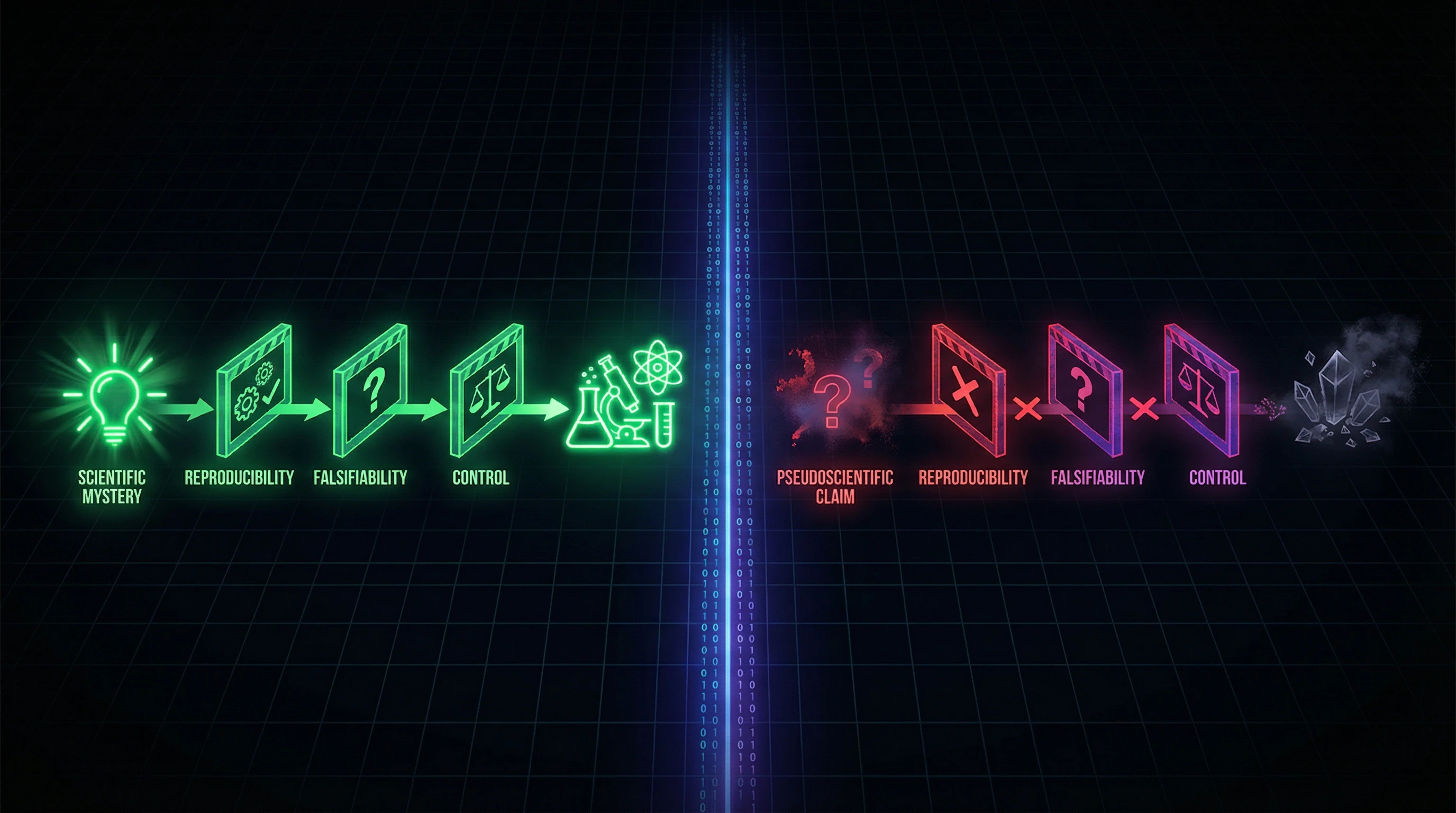
For a paranormal phenomenon to become a subject of scientific investigation, it must satisfy three conditions:
- Reproducibility
- The effect repeats in independent laboratories under identical conditions.
- Falsifiability
- Conditions can be formulated under which the hypothesis would be refuted.
- Controllability
- Alternative explanations through sensory leakage, statistical artifacts, or fraud are excluded.
Parapsychology as a discipline has existed for over a century, but none of the investigated phenomena has passed all three filters simultaneously (S008). This doesn't mean the paranormal is impossible — it means that after thorough examination, no grounds remain to consider it real.
⚠️ Why subjective experience is not evidence
Human perception is subject to systematic distortions: false memories form easily and feel authentic, attention selectively captures coincidences and ignores misses (confirmation bias), the brain constructs causal connections where none exist (illusion of control).
Eyewitness testimony is one of the most unreliable types of evidence even under ordinary conditions. In the context of emotionally charged events (encounter with a "ghost," "prophetic dream"), reliability drops even lower (S002).
This is precisely why science requires objective recording: instruments are not subject to cognitive biases.
🧱 Scientific mystery vs. pseudoscientific claim
| Criterion | Scientific mystery (dark matter) | Pseudoscientific claim (telepathy) |
|---|---|---|
| Reproducible observations | Yes — galaxy rotation anomalies | No — only anecdotes and weak studies |
| Testable hypotheses | Yes — search for candidate particles | No — mechanism not proposed |
| Progress over time | Yes — we know more than 20 years ago | No — remains at the same level of uncertainty |
The key distinction is progress. Scientific mysteries narrow and become more precise over time (S003). Pseudoscientific claims remain at the same point of uncertainty for decades, despite millions of hours of research.
This distinction is critical for understanding the boundaries of scientific investigation. Science is not the enemy of the unknown — it's the enemy of stagnation. If a phenomenon cannot be tested, it falls outside the scientific field, but this doesn't make it "forbidden" or "suppressed." It simply means we don't have the tools to study it — yet.
Five Most Compelling Arguments for the Existence of Paranormal Phenomena — Steel-Manning the Proponents' Position
Intellectually honest analysis requires examining opponents' strongest arguments, not caricatured versions. Proponents of paranormal reality rely on several lines of reasoning that appear convincing at first glance. More details in the Pseudopsychology section.
🔮 Argument from Mass Testimony: Millions of People Cannot Be Wrong Simultaneously
Surveys show that 30% to 70% of the population in developed countries report personal experiences of paranormal phenomena: prophetic dreams, telepathic contact, ghost encounters, premonitions. Proponents argue: such widespread occurrence cannot be coincidental — the distribution of experiences clusters around specific types of events rather than being scattered randomly.
Paranormal experiences are described across different cultures and historical epochs, which allegedly indicates a universal phenomenon rather than a cultural artifact.
📚 Argument from Authority: Scientists and Educated People Also Believe
Among paranormal proponents are people with scientific degrees, including physicists and psychologists. Parapsychological associations exist in several countries, hold conferences, and publish journals.
Proponents point out: if the paranormal were obvious nonsense, it would not attract the attention of educated researchers. Historically, many scientific breakthroughs met with skepticism (heliocentrism, germ theory of disease, quantum mechanics) — perhaps the paranormal is the next area where conservative science lags behind reality.
🧪 Argument from Meta-Analyses: Statistically Significant Effects Across Combined Studies
Some meta-analyses of parapsychological experiments (for example, on precognition or telepathy) show weak but statistically significant deviations from chance when combining hundreds of studies (S006). Proponents claim: even if individual experiments yield contradictory results, the cumulative effect indicates a real, albeit weak phenomenon.
They compare this to medical research, where small effects (such as aspirin's impact on heart attack risk) become visible only in large samples.
🌌 Argument from the Boundaries of Science: Quantum Mechanics and Consciousness
Quantum mechanics demonstrates phenomena that contradict classical intuition: nonlocality, superposition, the role of the observer (S001). Some physicists suggest a connection between quantum processes and consciousness.
Paranormal proponents argue: if consciousness can influence wavefunction collapse, then telepathy or psychokinesis is not a violation of the laws of physics, but their unstudied consequence. Science has not yet explained the nature of consciousness, and the paranormal may be part of this puzzle.
- Quantum nonlocality creates a precedent for "instantaneous interaction at a distance"
- The observer's role in wavefunction collapse suggests consciousness influences physical reality
- The incompleteness of modern physics leaves room for unstudied mechanisms
🛡️ Argument from Skeptic Bias: Institutional Resistance to New Ideas
Proponents point to cases where the scientific community rejected ideas later proven correct: meteorites, plate tectonics, the bacterial nature of stomach ulcers. They argue: skepticism toward the paranormal is ideological bias, not a methodological position.
Career risks for scientists studying the paranormal create an institutional barrier: even if effects are real, they are difficult to investigate due to lack of funding and reputational costs (S007). Absence of evidence may be an artifact of the system rather than a reflection of reality.
Why None of These Arguments Withstand Scrutiny — Detailed Analysis of the Evidence Base and Methodological Errors
Each of the presented arguments contains logical fallacies, ignores alternative explanations, or is based on incorrect interpretation of data. The scientific method requires not just the presence of arguments, but their resilience to critical analysis. More details in the section Geometry and Vibrations.
📊 Mass Testimony Explained by Universal Cognitive Biases
The fact that millions of people report paranormal experiences does not prove their reality — it proves the universality of how the human brain works. Cognitive psychology research shows: all people are subject to the same systematic errors of perception and memory (S002). Apophenia (tendency to see patterns in random data), pareidolia (perception of meaningful images in noise), retrospective memory distortion (rewriting memories to fit current beliefs) — these mechanisms work identically in all people, regardless of culture. This is precisely why paranormal experiences cluster around certain types: the brain uses the same templates to interpret uncertainty.
🧠 Correlation Between Intuitive Thinking and Belief in the Paranormal
Research shows a robust negative correlation between analytical thinking and belief in the paranormal: people with high cognitive reflection scores (ability to suppress intuitive but incorrect answers) are significantly less likely to believe in telepathy, astrology, and other paranormal phenomena (S002, S012). This does not mean believers are less intelligent — it means paranormal beliefs flourish when relying on intuition and weaken when analytical thinking is engaged. The mass nature of belief reflects not the reality of the phenomenon, but the dominance of intuitive information processing mode in everyday life.
⚠️ Argument from Authority — A Logical Fallacy, Not Evidence
The presence of scientists among paranormal proponents does not make claims more credible — this is a classic logical fallacy (argumentum ad verecundiam). Scientific truth is determined not by expert voting, but by data reproducibility. Moreover, surveys show: belief in the paranormal inversely correlates with level of scientific education and expertise in relevant fields (physics, neuroscience, statistics) (S008). Parapsychologists constitute a tiny minority of the scientific community, and their work systematically fails replication in independent laboratories.
🔍 Historical Analogies with Scientific Breakthroughs Are Incorrect
Comparing the paranormal with heliocentrism or germ theory is erroneous: these ideas met resistance but quickly accumulated reproducible evidence (Galileo's observations, Pasteur's experiments). The paranormal has been studied for over a century without progress — effects don't become stronger, mechanisms don't clarify, predictive power doesn't grow (S008). This is the pattern of pseudoscience, not an emerging scientific discipline. True scientific revolutions are characterized by rapid accumulation of concordant data, not decades of disputes about basic reproducibility.
📉 Meta-Analyses of Parapsychological Research: Statistical Artifacts Instead of Real Effects
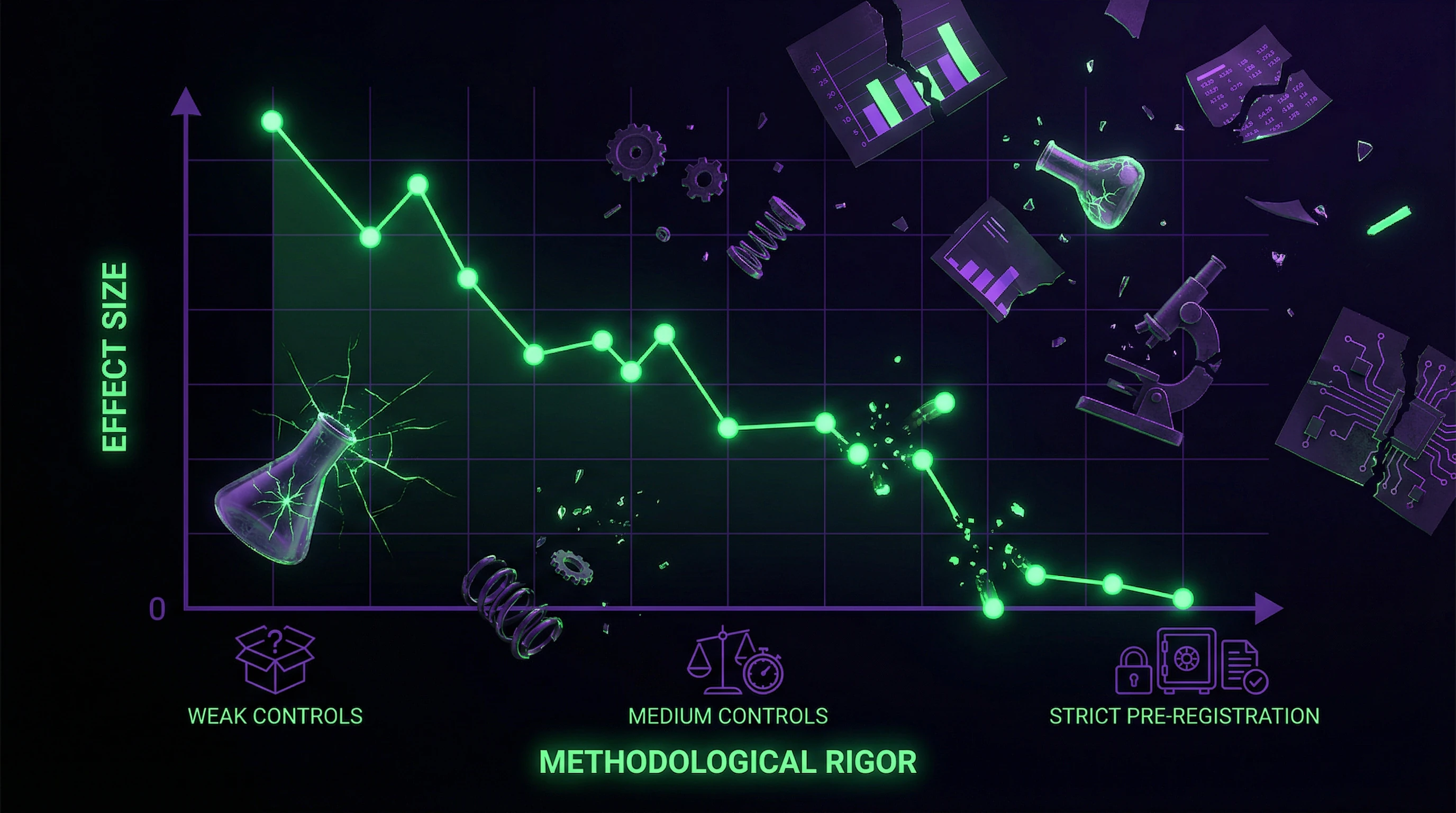
Weak statistically significant effects in meta-analyses of parapsychological research are explained by systematic errors, not real phenomena (S008). First, publication bias: studies with positive results are published more often than those with null results, distorting the overall picture. Second, p-hacking (manipulation of data analysis to achieve statistical significance): when hypotheses are not pre-registered, researchers can unconsciously fit the analysis to the desired result. Third, low methodological quality: many studies included in meta-analyses have weak control for sensory leakage, insufficient randomization, small samples.
🧪 Critical Analysis of the "Presentiment Effect" in Meta-Analyses
One of the most cited meta-analyses in parapsychology concerns the "presentiment effect": supposedly physiological reactions (skin conductance, pulse) change several seconds before presentation of an emotionally charged stimulus. The meta-analysis showed a weak but statistically significant effect. However, independent replications with stricter control (protocol pre-registration, larger samples, protection against experimenter effects) did not confirm the result (S008). This is a classic example of how methodological weaknesses create the illusion of an effect that disappears when scrutiny increases.
🌌 Quantum Mechanics Does Not Support the Paranormal
Appeals to quantum mechanics to explain the paranormal are an abuse of science. Quantum effects (superposition, entanglement) manifest at the scale of individual particles and disappear when transitioning to macroscopic systems due to decoherence. The brain is a warm, wet, noisy environment where quantum coherence cannot be maintained on timescales relevant to cognitive processes (S008). Moreover, even if quantum effects played a role in consciousness, this does not explain telepathy: quantum entanglement does not transmit information faster than light and does not create a communication channel between brains. References to "quantum consciousness" in the context of the paranormal are not a scientific hypothesis, but a disguise of ignorance under scientific-sounding terminology.
🛡️ Institutional Resistance — A Myth, Not Reality
Claims of scientific community bias are refuted by the history of parapsychology: this field received significant funding (including U.S. and Soviet military programs during the Cold War), research was conducted at prestigious universities, results were published in specialized journals (S008). The problem is not lack of research opportunities, but lack of reproducible results. When scientists from other fields attempt to replicate parapsychological experiments with stricter controls, effects disappear. This is not bias — this is the scientific method at work.
📌 Absence of Evidence After Thorough Investigation — Itself Evidence
The philosophical principle "absence of evidence is not evidence of absence" is valid for unexplored areas, but not for thoroughly tested claims. The paranormal has been studied for over a century, thousands of experiments conducted, millions of dollars spent — and not a single reproducible positive result has been obtained that is resistant to methodological criticism (S008). Under such conditions, absence of evidence becomes significant negative testimony. The burden of proof lies with those who claim the phenomenon exists, not with those who reject it.
Mechanisms of Paranormal Belief Formation — Why the Brain Creates the Illusion of the Supernatural Where None Exists
Understanding the cognitive mechanisms that generate paranormal experiences explains why these beliefs are so persistent despite the absence of objective evidence. The brain is not a passive recorder of reality, but an active interpreter using heuristics and patterns for rapid information processing. More details in the Reality Verification section.
🧠 Apophenia and Pareidolia: The Brain as a Pattern Detector with High False Positive Rates
Evolution optimized the human brain to detect patterns even under conditions of incomplete information: it's better to mistakenly interpret a rustle in the bushes as a predator than to miss a real threat. This adaptation creates a systematic tendency to see patterns where none exist — apophenia (S002).
Pareidolia (perceiving faces in clouds, voices in white noise) is a specific case of this mechanism. Paranormal experiences often arise under conditions of sensory deprivation, fatigue, stress — precisely when the brain relies maximally on internal models rather than external data.
Better to err in detecting a pattern than to miss a real threat — this evolutionary logic creates a systematic bias toward paranormal interpretations.
🔁 Confirmation Bias and Selective Memory
People involuntarily focus attention on information confirming their beliefs and ignore contradictory information (confirmation bias). In the paranormal context, this means: a person remembers instances when "a premonition came true" and forgets dozens of cases when it didn't (S002).
Research shows: if you ask people to keep a diary of all premonitions and their outcomes, the percentage of matches turns out to be at chance level. But without systematic recording, memory creates an illusion of pattern.
| Scenario | What's Remembered | What's Forgotten | Result |
|---|---|---|---|
| Premonition matched | Vivid, emotional | — | "It works!" |
| Premonition didn't match | Minimally | Most cases | Forgotten |
| Random coincidence | Interpreted as signal | Context of randomness | Reinforces belief |
⚙️ Illusion of Control and Agency
The brain tends to attribute events to the action of agents (people, spirits, forces), even when they're caused by random processes. This is evolutionarily conditioned: in a social environment, it's important to quickly determine others' intentions.
But this tendency creates a false sense that behind random coincidences stands someone's will or supernatural force (S002). The illusion of control — the feeling that thoughts or actions influence independent events — intensifies in situations of uncertainty, when a person tries to restore a sense of predictability.
- Agency
- Attributing intentions and will to events that are actually random. Evolutionarily useful in social environments, but creates paranormal interpretations.
- Illusion of Control
- The feeling of influencing events that are beyond control. Intensifies under stress and uncertainty — precisely when a person seeks ways to restore predictability.
🧩 Role of Emotional State and Context
Paranormal experiences occur more frequently in emotionally charged situations (grief, fear, ecstasy), when critical thinking is suppressed. Research shows: inducing anxiety or uncertainty increases susceptibility to paranormal interpretations.
Context also plays a role: in a "supposedly mystical" place (old house, cemetery), people interpret ordinary sensory stimuli (creaking, shadows) as paranormal. This isn't deception, but automatic brain function using contextual cues to interpret ambiguous data.
Emotional arousal disables critical thinking and activates maximum pattern sensitivity mode — ideal conditions for paranormal interpretations.
🔬 Neurobiological Correlates of Paranormal Experiences
Neuroimaging studies show: paranormal experiences (sense of presence, out-of-body experiences, mystical states) correlate with activity in the temporo-parietal junction, responsible for integrating sensory information and constructing the body model (S008).
Stimulation of this area can artificially induce the sensation of "another's presence." This doesn't mean the experiences are "not real" — they're subjectively real, but generated by internal brain processes rather than external supernatural forces.
- The temporo-parietal junction activates during sensory signal integration and body image construction.
- Disruption in this area creates sensations of dissociation, out-of-body experiences, presence of another.
- Stimulation produces the same experiences as spontaneous paranormal episodes.
- Conclusion: the experience is real, but its source is the brain, not an external supernatural force.
Cognitive Anatomy of Paranormal Beliefs — Which Mental Traps Are Exploited and How to Recognize Them
Paranormal beliefs don't arise in a vacuum — they're supported by an entire complex of cognitive biases that mutually reinforce each other. Understanding this "anatomy" allows you to recognize persuasion mechanisms before they take effect. Learn more in the Epistemology section.
🕳️ The Availability Trap: Vivid Stories Displace Statistics
The availability heuristic causes people to judge the probability of an event by the ease with which examples come to mind (S002). A vivid story about a "prophetic dream" is remembered better than thousands of nights without predictions.
Media amplifies this effect by publishing sensational cases while ignoring base rates. People overestimate the prevalence of paranormal events because examples are easy to recall, even though statistically they're extremely rare or nonexistent.
One memorable story about a coincidence weighs more than a million nights without predictions. This isn't a logic error — it's the architecture of memory.
🧩 The Representativeness Trap: Coincidences Seem Non-Random
People poorly understand what randomness looks like: random sequences contain clusters and coincidences that intuitively seem "too non-random" (S002). A deceased relative's birthday coincides with an important event — this is perceived as a sign, even though with enough dates in life, coincidences are inevitable.
The brain searches for patterns everywhere, even where none exist. This was useful for survival (better to err and see a predator in the bushes than miss a real one), but in the modern world it leads to seeing patterns in noise.
🔄 The Confirmation Trap: A Filter That Only Lets "Right" Facts Through
Confirmation bias causes people to seek, interpret, and remember information that confirms pre-existing beliefs (S002). If you believe in telepathy, you'll notice the moment when you thought of a friend and they called, but forget the thousands of times you thought of them and nothing happened.
Contradictory facts are either ignored or reinterpreted to fit the existing model. This isn't lazy thinking — it's an active process of filtering reality.
| Trap | Mechanism | How to Recognize |
|---|---|---|
| Availability | Vivid examples seem frequent | Ask: how many times did this NOT happen? |
| Representativeness | Coincidences seem like patterns | Calculate probability under randomness |
| Confirmation | We seek facts confirming beliefs | Actively seek contradictions, don't ignore them |
| Apophenia | We see patterns in random data | Test: will the pattern persist in new data? |
🎯 Apophenia and Pareidolia: The Brain as Meaning Generator
Apophenia is seeing meaningful patterns in random data. Pareidolia is recognizing familiar images (faces, figures) in unstructured stimuli. Both mechanisms result from the brain predicting incoming signals (S001), rather than simply registering them.
When data is incomplete or ambiguous, the brain fills gaps with expectations. This conserves energy but creates illusions. Faces in clouds, messages in random numbers, hidden meanings in texts — all apophenia, not reality.
💭 Motivated Reasoning: Beliefs We Need
People don't just make logical errors — they actively defend beliefs that satisfy psychological needs (S002). Belief in the paranormal can provide a sense of control, meaning, connection with the deceased, or hope for justice.
When facts threaten these needs, motivated reasoning kicks in: we find reasons to reject evidence, reinterpret data, or doubt the source. This isn't stupidity — it's protecting psychological comfort.
The most persistent beliefs are those that solve emotional problems. Facts don't compete with logic, but with the need for meaning and control.
🔍 Recognition Protocol: How to Check Your Own Thinking
- Ask: which examples do I remember? Are they vivid cases or a representative sample?
- Calculate the base rate: how often does this happen by chance?
- Actively seek contradictions: what facts would disprove my hypothesis?
- Check motivation: what do I gain if this belief is true? What do I lose if it's false?
- Demand reproducibility: can this be tested independently, under controlled conditions?
Cognitive traps aren't signs of stupidity. They're built into the brain's architecture. But they can be circumvented if you know where they are. Systematic thinking isn't a natural gift, it's a skill that requires constant practice and tools for verification.