What is Human Design: anatomy of an esoteric system masquerading as neutrino science
Human Design System positions itself as a "synthesis of ancient wisdom and modern science," combining astrology, the Chinese Book of Changes (I Ching), the Kabbalistic Tree of Life, the Hindu chakra system, and quantum physics. More details in the Paranormal Abilities section.
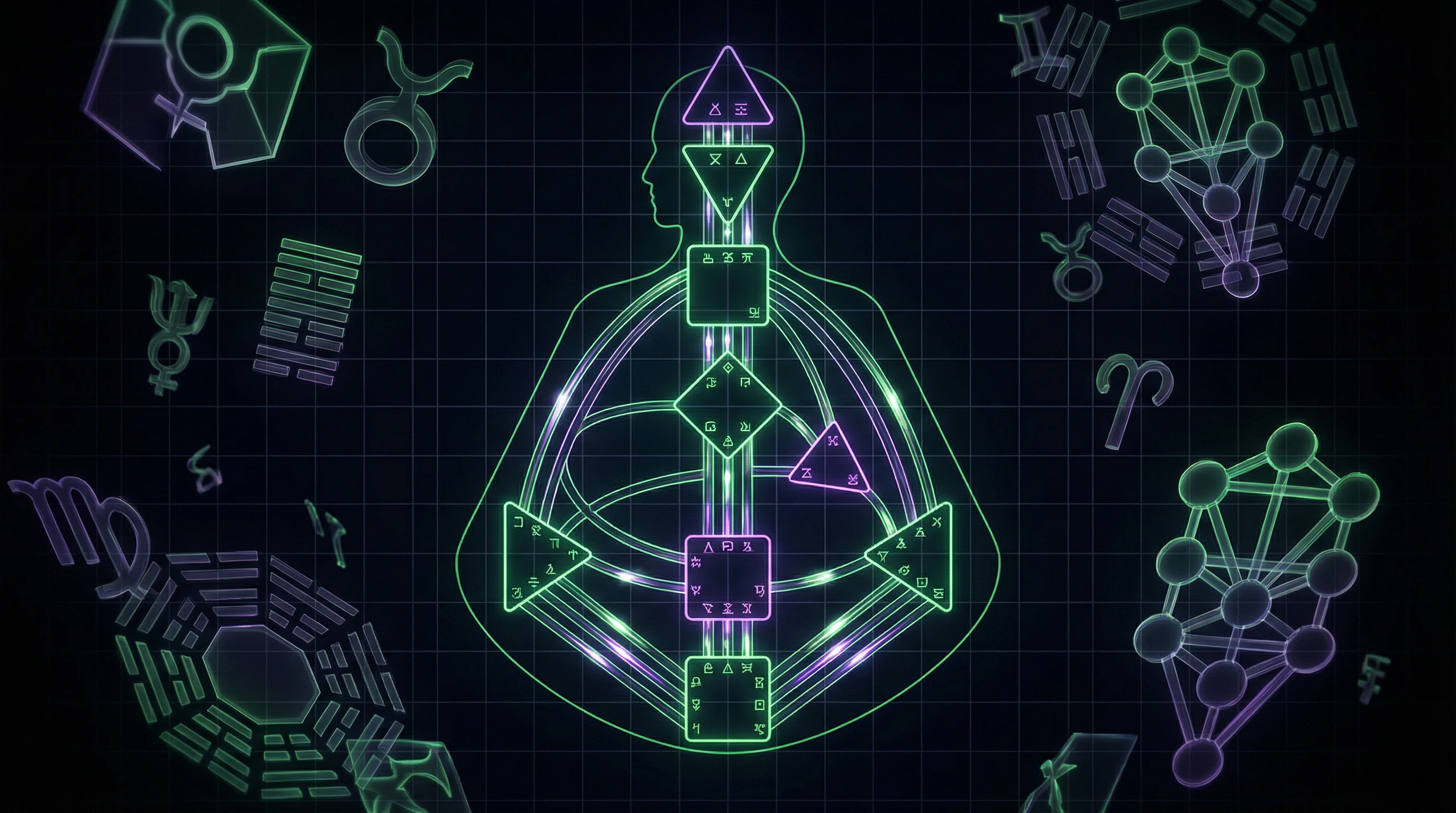
The system's foundation rests on the claim that neutrinos—elementary particles discovered by physicists in the 20th century—carry information and "program" a person twice: 88 days before birth (design) and at the moment of birth (personality). The result of this "programming" is a unique chart called a bodygraph, consisting of nine centers (analogous to chakras), 36 channels, and 64 gates (corresponding to I Ching hexagrams).
The system classifies all people into five types: Manifestors (about 9% of the population), Generators (37%), Manifesting Generators (33%), Projectors (20%), and Reflectors (1%). Each type is assigned specific decision-making strategies.
- Generators
- Advised to "wait to respond"—await external signals before taking action.
- Projectors
- Advised to "wait for invitation"—await recognition and requests from others.
- Manifestors
- Advised to "inform before acting"—notify their environment of intentions.
- Inner Authority
- Decision-making mechanism that can be emotional, sacral, splenic, ego authority, self-projected, mental, or lunar (for Reflectors).
🔎 The neutrino hypothesis: how a physical particle became a mystical information carrier
Human Design's central claim: neutrinos, passing through the Sun and planets, become "imprinted" with their energy and then transmit this information to humans. The system relies on the fact that neutrinos do have mass—a fact confirmed by physicists in 1998.
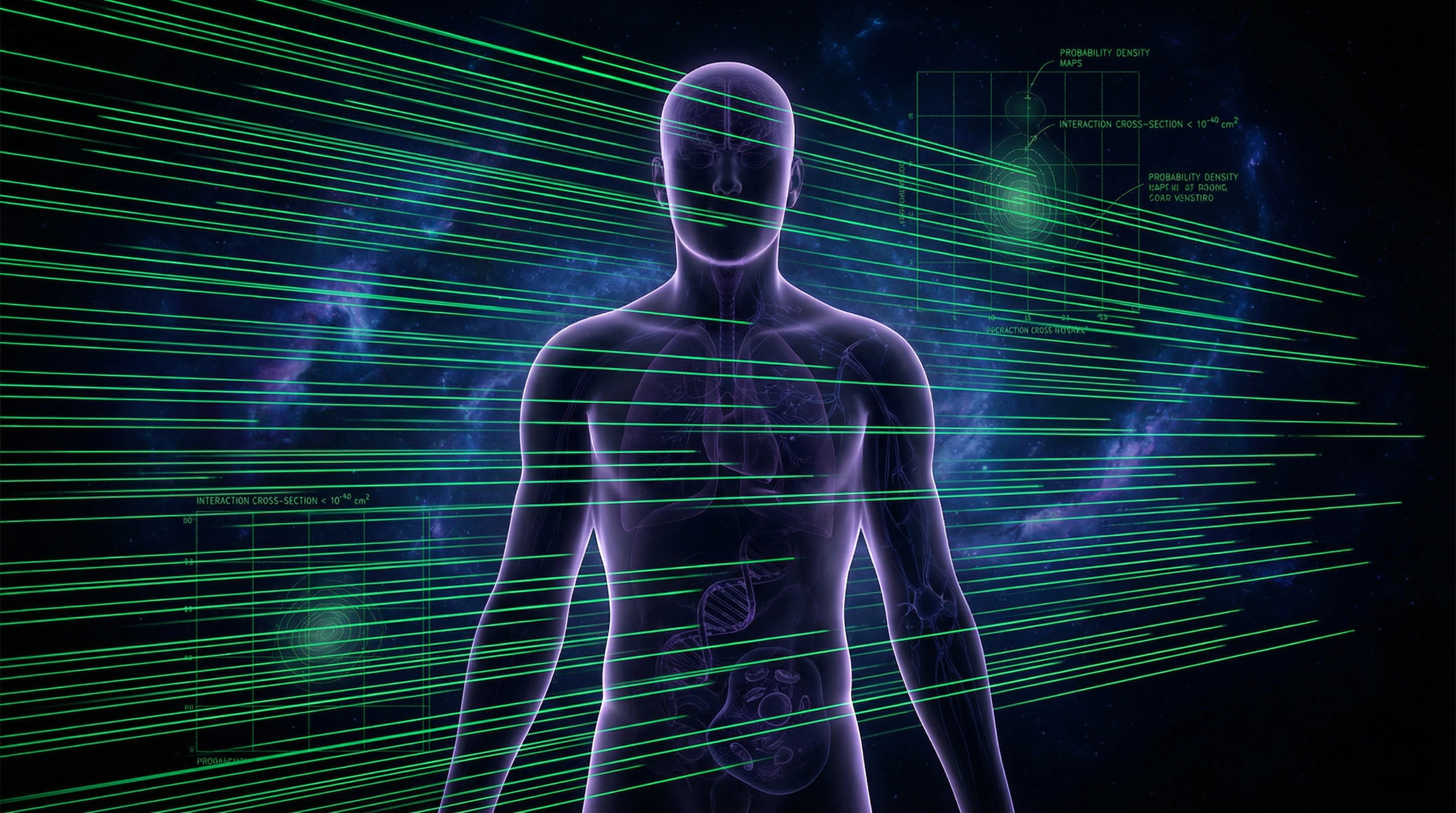
However, in actual physics, neutrinos have extremely small mass (less than 0.12 eV) and interact with matter so weakly that trillions of neutrinos pass through the human body every second without any effect. The probability of a single neutrino interacting with an atom in the human body over an entire lifetime is negligibly small.
| Property | System's Claim | Physical Reality |
|---|---|---|
| Neutrino mass | Enables information carrying | Less than 0.12 eV; does not support information function |
| Interaction with matter | Programs humans | Weak; trillions pass through body without effect |
| Information carrier | Transmits planetary "imprints" | No mechanism for encoding or decoding information |
🧱 Syncretism as camouflage: mixing incompatible systems
Human Design is a classic example of syncretic pseudoscience: the system borrows elements from various, often incompatible traditions and scientific terms to create an illusion of depth and legitimacy.
- Astrology (Western tropical)—calculation of planetary positions
- I Ching—64 hexagrams as the basis for "gates"
- Kabbalah—Tree of Life structure for connecting centers
- Hindu chakras—transformed into nine bodygraph centers
None of these systems has proven predictive power or scientific foundation. Their combination does not create a new explanatory model—it only complicates verification of claims and makes identifying logical contradictions more difficult. This is a typical mechanism that protects the system from criticism: the more layers, the harder it is to find the point of failure.
Connection to the scientific method is absent. The system offers no falsifiable hypotheses, conducts no controlled experiments, and does not allow revision of its foundations based on empirical data—hallmarks that distinguish science from pseudoscience.
Steelman Arguments: Seven Most Convincing Claims by Human Design Proponents
Objective analysis requires presenting the opposing position in its best form. The steelman approach means honest engagement with the strongest arguments before refuting them. More details in the UFOlogy and Contactees section.
⚡ Argument from Subjective Accuracy: "My chart describes me with incredible precision"
People report that their bodygraph "surprisingly accurately" reflects their character, tendencies, life patterns, and specific events. When someone pays for a consultation and receives 20–30 pages of detailed description, psychological pressure to interpret the information as relevant increases exponentially.
Consultants use cold reading: they ask clarifying questions, adapt interpretation to client reactions, creating an illusion of personalized accuracy. This is a classic confirmation bias mechanism—people notice hits and ignore misses.
Subjective description accuracy does not correlate with a system's predictive power. A horoscope can be "accurate" for millions of people simultaneously.
🔬 Argument from Scientific Terminology: "The system uses real physical discoveries"
Ra mentioned neutrino mass in 1987, a decade before experimental confirmation in 1998. This is presented as proof of mystical insight or being ahead of science.
The system actively borrows terms from quantum physics, genetics (64 DNA codons linked to 64 gates), neurobiology. Such vocabulary creates a cognitive legitimacy effect: if the system speaks the language of science, it must be scientific. This substitutes scientific rhetoric for scientific method.
- Scientific terminology vs. scientific method
- Using correct words doesn't make a system scientific. Astrology talks about gravity and electromagnetism, but doesn't predict the future better than chance.
📊 Argument from Complexity: "The system is too detailed to be random"
Human Design includes 5 types, 7 authorities, 12 profiles, 6 lines for each of 64 gates, various center definitions. Mathematically this yields millions of unique configurations.
Proponents claim such complexity cannot result from deception—it requires deep systemic logic. This exploits a cognitive bias: the more convoluted a system appears, the harder it is to refute and the more "profound" it seems.
System complexity does not correlate with its truth. Combinatorial power is not proof, but a tool for creating the illusion of personalization.
🧬 Argument from Convergence of Traditions: "Ancient systems couldn't all be wrong the same way"
Defenders point out that Human Design unites independently arising traditions: Chinese I Ching, Indian chakras, Jewish Kabbalah, Western astrology. If all these systems "point to the same thing," this supposedly testifies to objective reality.
This argument ignores that all listed systems are products of human drive for patterns and meaning. Their "convergence" results from selective choice and interpretation, not independent confirmation. Indian traditions and Kabbalah developed in different contexts and addressed different needs.
💼 Argument from Practical Utility: "The system helps people make better decisions"
Consultants and clients report positive changes: improved relationships, career success, reduced stress. The argument appeals to pragmatic criteria: if the system works, its theoretical foundation is secondary.
However, this effect is explained by placebo, the Hawthorne effect (behavior change due to awareness of observation), regression to the mean, and the simple fact of paying attention to one's life. (S008) shows that people resist correcting beliefs even when faced with contradicting facts—practical benefit may result from self-fulfilling prophecy.
🎓 Argument from Institutionalization: "International schools and certifications exist"
Human Design has extensive infrastructure: International Human Design School (IHDS), national associations, multi-level certification programs, annual conferences. This institutionalization creates an impression of seriousness and academic rigor.
Proponents note that thousands have completed training, supposedly testifying to validity. However, pseudoscience institutionalization is a common phenomenon. Homeopathy, astrology, detox industry also have "academies" and "certifications." Institutionalization is not a criterion for scientific validity.
| Feature | Scientific System | Pseudoscientific System |
|---|---|---|
| Certification | Based on verifiable competencies and examinations | Based on learning system methodology, not its validity |
| Conferences | Include critical analysis and hypothesis refutation | Serve to strengthen belief in the system |
| Schools | Prepare for independent verification of results | Prepare for further transmission of the system |
🔮 Argument from Mystical Authority: "Knowledge received through revelation, inaccessible to ordinary science"
Ra claimed he received the system in an eight-day mystical experience from "The Voice"—an entity he described as an external information source. For part of the audience, this gives the system sacred knowledge status, beyond scientific verification.
The argument builds on epistemological relativism: not everything is knowable through rational methods, forms of knowledge exist accessible through altered states of consciousness or spiritual practices. This shields the system from criticism by placing it in the "faith" category rather than "knowledge." Logic and probability don't apply here—the system becomes unfalsifiable by definition.
- Revelation cannot be independently verified
- Contradictions are explained by incorrect understanding of revelation
- Criticism is interpreted as the critic's spiritual immaturity
- The system becomes hermetic and self-confirming
Evidence Base: Systematic Analysis of the Scientific Validity of the Neutrino Hypothesis and Predictive Power of the System
Critical analysis of any system claiming to describe reality requires evaluation of its evidence base. For Human Design, this means testing two key assertions: (1) can neutrinos physically perform the personality programming function attributed to them, and (2) does the system possess predictive power exceeding chance. More details in the section Quantum Mysticism.
⚛️ Neutrino Physics: Why "Neutrino Programming" Is Impossible
Neutrinos are electrically neutral leptons that interact only through the weak nuclear force and gravity. The cross-section for neutrino interaction with matter is approximately 10⁻⁴⁴ cm² for a 1 MeV neutrino.
This means a neutrino could pass through a light-year of lead before interacting with a single atom. Every second, about 65 billion solar neutrinos pass through each square centimeter of Earth, but only a negligible fraction interacts with matter. Detecting neutrinos requires massive installations (Super-Kamiokande, IceCube) with thousands of tons of detector material, and even these register only isolated events.
The claim that neutrinos can be "imprinted" with information from planets and transmit it to humans contradicts basic principles of physics. Neutrinos have no mechanism for encoding complex information: they possess only energy, momentum, and spin.
Even assuming a hypothetical mechanism for "recording" information, there is no mechanism for biological systems to "read" it. DNA, proteins, neurons—all biological structures operate through electromagnetic and chemical interactions, to which neutrinos have no connection.
No research in neurobiology, genetics, or biophysics has discovered a mechanism through which neutrinos could influence organism development or personality formation. This is not merely absence of evidence—it is absence of even a theoretical pathway through which such influence could be realized.
📉 Absence of Controlled Studies and Reproducible Results
In nearly 40 years of the system's existence, not a single peer-reviewed study has been published demonstrating the predictive power of Human Design. No studies exist showing that people of one type differ statistically significantly from people of another type on measurable psychological, behavioral, or physiological parameters.
No blind experiments have been conducted where independent experts attempted to match bodygraphs with real people better than random guessing. All "evidence" of the system's effectiveness is based on anecdotal testimony, subjective reports, and client testimonials—forms of evidence most susceptible to cognitive biases.
- Independent Verification Attempts
- Astrological systems, which form the basis of bodygraph calculation, consistently show absence of effect under controlled testing. A meta-analysis of astrology research conducted by Shawn Carlson and published in Nature (1985) demonstrated that astrologers cannot match natal charts with psychological profiles better than chance.
- Implications for Human Design
- Since Human Design uses astrological calculations as its foundation, the lack of validity in astrology automatically calls into question the validity of the derivative system. This is not criticism but logical consequence: if the foundation fails verification, the superstructure cannot be more reliable.
🧬 Genetics and Epigenetics: What Actually Shapes Personality
Modern personality science relies on data from behavioral genetics, neurobiology, developmental psychology, and epigenetics. Twin studies show that heritability of personality traits (by the Big Five model) is 40-60%, with the remainder attributed to unique environment and random developmental factors.
Genetic influences are realized through complex polygenic effects—thousands of genes with small effects, interacting with environmental factors. Epigenetic mechanisms (DNA methylation, histone modifications) modulate gene expression in response to environmental influences, beginning in the prenatal period.
| Personality Formation Factor | Mechanism | Connection to Astronomy |
|---|---|---|
| Genetics | Polygenic effects, gene-environment interaction | None |
| Prenatal environment | Maternal hormones, nutrition, infections | None |
| Early experience | Attachment, trauma, socialization | None |
| Epigenetics | DNA methylation, histone modifications | None |
| Planetary positions at birth | ? | Assumed but not proven |
Birth time (day, hour, minute) does not correlate with genetic variants, prenatal conditions, or early environmental influences in a way that could explain systematic personality differences.
Birth season does show small correlations with some characteristics (for example, schizophrenia risk is slightly higher for winter births), but these effects are explained by maternal infections, vitamin D, and other biological factors, not astrological influences. This demonstrates that environmental factors linked to season do matter—but they work through known biological mechanisms, not through neutrinos.
🎲 Barnum Effect and Subjective Validation: Why Descriptions Seem Accurate
The Barnum effect (or Forer effect) is a psychological phenomenon where people rate vague, general personality descriptions as highly accurate and personalized. Bertram Forer's classic experiment (1948) showed that students rated a supposedly individual psychological profile at an average of 4.26 out of 5 for accuracy, though all received identical text compiled from horoscopes.
Descriptions work by using universal statements ("You need approval from others but also value independence"), double-barreled statements ("Sometimes you're extroverted, sometimes introverted"), and positive characteristics (people tend to accept flattering descriptions).
- Consultant provides vague type description (e.g., "Generator")
- Client actively interprets description, applying it to their experience
- Confirmation bias causes noticing matches, ignoring mismatches
- Subjective validation creates impression of accuracy and personalization
- Positive consultation experience reinforces belief in the system
Human Design consultations are structured to maximize the Barnum effect. Type descriptions contain sufficiently general statements applicable to most people, but presented as unique insights.
The statement "Generators must wait for response before acting" can be interpreted in multiple ways, and the client will find examples from their life confirming this. Confirmation bias causes people to notice and remember matches while ignoring mismatches.
If a consultant says "You have a defined emotional center, so you experience emotional waves," the client will recall episodes of emotional fluctuation, forgetting periods of stability. This is not deception by the consultant—it's the natural operation of human thinking, which seeks patterns and confirmation of its beliefs. The system simply exploits this cognitive architecture. More on these influence mechanisms in the scientific method and how to expose pseudoscience.
Mechanisms of Influence: How Human Design Exploits the Architecture of Human Thinking
Understanding why people believe in Human Design requires analyzing the cognitive mechanisms that make us vulnerable to pseudoscientific systems. These mechanisms are not thinking defects — they are evolutionarily adaptive heuristics that work effectively in most contexts but can be exploited. More details in the Logical Fallacies section.
🔁 Pattern Detection and Apophenia: The Brain That Sees Connections Everywhere
The human brain evolved to detect patterns — the ability to see connections between events provided survival advantages. However, this system is hypersensitive and often generates false positives — apophenia, the perception of meaningful patterns in random data.
Human Design provides a ready-made system of patterns: your type is connected to your behavior, planetary positions are connected to your traits, specific centers are connected to your decisions. The brain, receiving such a system, begins actively seeking confirmations, and finds them — not because the connections are real, but because the pattern-seeking system doesn't distinguish between correlation and causation, coincidence and regularity.
Apophenia is not a perceptual error, but a hyperactive recognition system that under conditions of uncertainty prefers a false signal to a missed threat. Pseudoscientific systems exploit precisely this asymmetry.
🧩 Need for Narrative and Identity: "Who Am I?" as an Existential Question
Human Design offers a ready-made identity narrative in an era when traditional sources of identity (religion, class, lifelong profession) have weakened. The system provides answers to fundamental questions: "Who am I?", "Why am I this way?", "How should I live?".
These answers are structured, detailed, and personalized — unlike scientific explanations of personality, which speak of probabilities, continuums, and multiple factors. The bodygraph provides a visual map of yourself, concrete types and strategies — this psychologically satisfies the need for certainty and meaning.
| Source of Answer | Structure | Psychological Effect |
|---|---|---|
| Scientific explanation of personality | Probabilities, factors, continuums | Uncertainty, requires integration |
| Human Design | Concrete types, visual map, strategies | Certainty, ready-made narrative, satisfaction |
⚙️ Illusion of Control and Agency: "Now I Understand How to Make the Right Decisions"
The system offers concrete strategies and authorities for decision-making, which creates an illusion of control over life. Instead of the uncertainty and complexity of the real world, where decisions depend on multiple unpredictable factors, Human Design offers simple rules: "Follow your authority", "Wait for invitation", "Inform before acting".
These rules provide a sense of agency — the feeling that you know what to do. When decisions made according to these rules lead to positive outcomes, this is attributed to the system (ignoring the base rate of success). When outcomes are negative, this is explained by incorrect application of the system or "resistance to design".
The illusion of control is not a weakness, but an adaptive mechanism. People who believe they control the situation act more confidently and often achieve better results. Pseudoscience simply redirects this confidence toward itself.
🎭 Social Validation and Group Identity: Community of Believers
Human Design creates a community with its own language, rituals, and hierarchy. Belonging to this community becomes part of identity, and criticism of the system is perceived as a personal attack (S005).
Social validation works on two levels: horizontal (other believers confirm your belief) and vertical (authorities — consultants, teachers, Ra Uru Hu himself — legitimize the system). When you invest time and money in training, you fall into the trap of cognitive dissonance: acknowledging that the system is false means acknowledging that you wasted resources.
- You join the community and pay for training
- You invest time in studying the system and applying it to yourself
- You begin to see confirmations (apophenia + selective attention)
- Criticism of the system becomes a threat to your identity and investments
- You defend the system to defend yourself
📊 Barnum Effect and Personalization: "This Is About Me"
Human Design uses the Barnum effect — people's tendency to accept vague, general descriptions as accurately applying to them personally. Descriptions of types, authorities, and strategies are abstract enough that everyone can find themselves in them, but concrete enough to seem personalized.
When the system says you are a "Manifestor with sacral center authority", it sounds specific, but in reality can apply to many people. However, psychologically this is perceived as a unique description of precisely you, which strengthens attachment to the system (S008).
Personalization is not deception, it's the architecture of perception. The system doesn't lie, it simply uses language that the brain interprets as "this is about me", even if the description applies to most people.
🔄 Closed Logic and Defense Against Criticism: A System That Cannot Be Wrong
Human Design is constructed to be unfalsifiable. If the system doesn't work, this is explained not by its error, but by your error: you applied the strategy incorrectly, you're resisting your design, you haven't yet understood the system deeply enough.
This logic creates a closed loop: any outcome is interpreted as confirmation of the system. Success? The system works. Failure? You didn't follow the system correctly. Criticism? The critic doesn't understand the system or is resisting it. Such architecture makes the system psychologically invulnerable to external criticism (S005).
This is not unique to Human Design — it's characteristic of all closed ideological systems, from religious cults to political movements. The mechanism is the same: the system defines the criteria of its own truth, which makes it logically unfalsifiable.
Defense against criticism also works at the community level: people who have invested resources in the system are motivated to defend it, because its criticism threatens their investments and identity. This creates social pressure on doubters and critics.
- Cognitive Dissonance
- Psychological discomfort from contradictory beliefs. In the Human Design system it is resolved not by revising beliefs, but by deepening faith and criticizing critics.
- Selective Attention
- The brain notices information that confirms existing beliefs and ignores contradictory information. Human Design provides a ready-made system of categories that direct this attention.
- Barnum Effect
- People accept vague descriptions as accurately applying to them. The system uses this by providing descriptions that sound specific but apply to most people.
🧬 Why This Works: Evolutionary Vulnerability
All these mechanisms — pattern detection, need for narrative, illusion of control, social validation — are not defects. They are evolutionarily adaptive: a brain that sees patterns everywhere survives better than a brain that misses them. People who believe they control the situation act more confidently. People who belong to a community have more resources for survival.
Human Design simply exploits these adaptive mechanisms in a context where they become vulnerabilities. The system works not because it is true, but because it is well-designed to activate deep psychological needs and cognitive processes.
This means that criticism of Human Design should not be directed at people who believe in it. They are not stupid or weak — they are simply people who encountered a well-designed system that activates their cognitive vulnerabilities. Criticism should be directed at the mechanisms the system uses, and at how to distinguish adaptive heuristics from their exploitation.
For a deeper understanding of how similar mechanisms work in other contexts, see the analysis of methods for debunking pseudoscience and logic and probability. Similar patterns can be found in the history of homeopathy and myths about free energy.