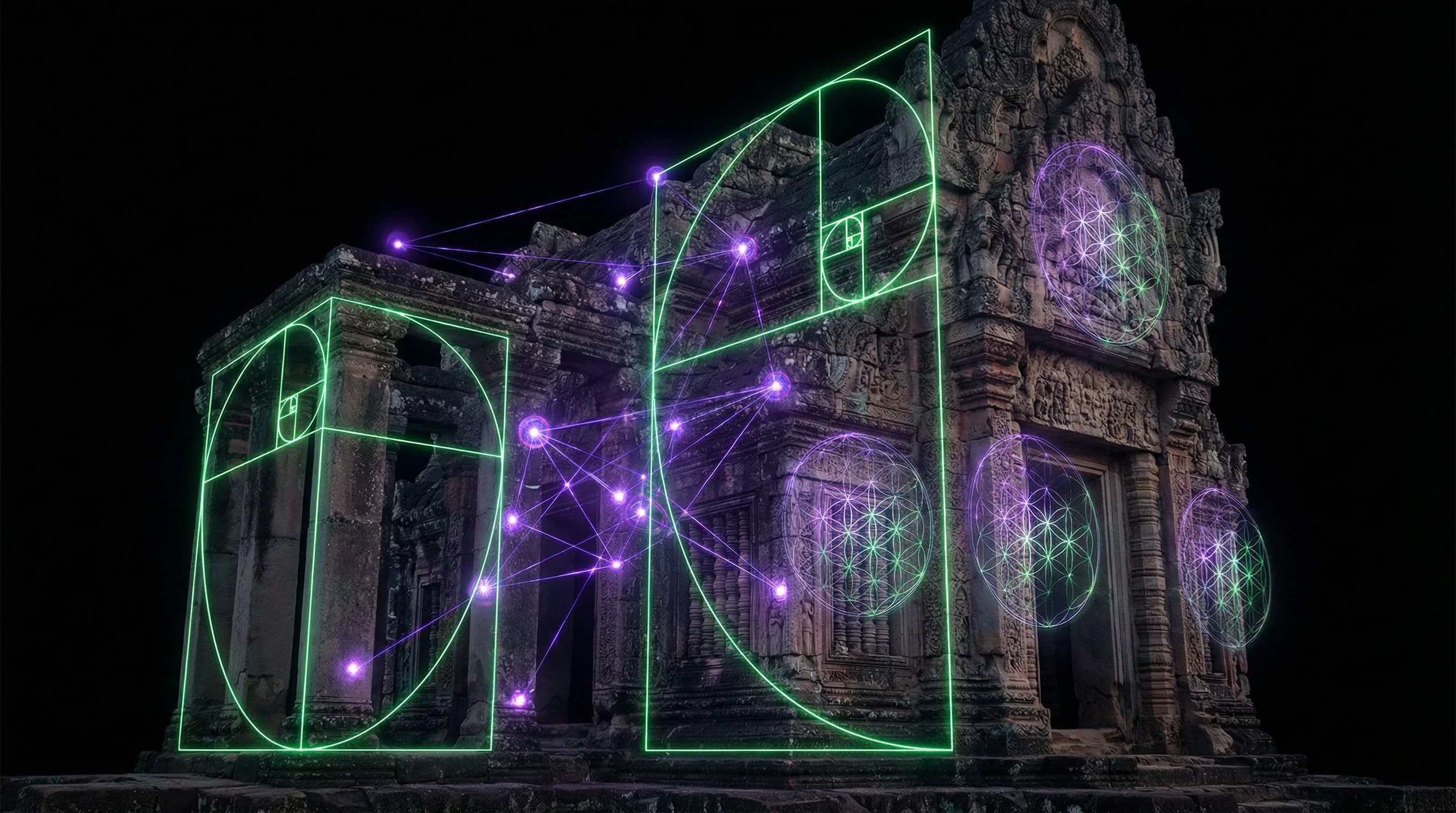
Sacred Geometry: The Ancient Code of the Universe in Forms and Proportionsλ
An interdisciplinary field of knowledge at the intersection of mathematics, philosophy, and art, studying geometric forms as carriers of cosmic meaning and universal order.
Overview
Sacred geometry — a system of beliefs where the circle, triangle, and spiral become the 🧩 "language of the Universe," a code of harmony and cosmic order. Pythagoras called it "the secret science of God," and temples from Egypt to India were built according to its canons — mandalas, the Flower of Life, the golden ratio. This is the intersection of mathematics, myth, and mystical experience, where form = meaning, and proportion = path to consciousness expansion.
🛡️
Laplace Protocol: Sacred geometry is studied both by academic researchers (in the context of architectural history, art history, cultural studies) and esoteric practitioners. It's important to distinguish scientifically verified geometric principles in ancient architecture from mystical interpretations without empirical foundation.
Reference Protocol
Scientific Foundation
Evidence-based framework for critical analysis
Protocol: Evaluation
Test Yourself
Quizzes on this topic coming soon
⚡
Deep Dive
What lies behind the term "sacred geometry": from mysticism to science
Sacred geometry is a system of representations about geometric forms and proportions as carriers of cosmic meaning. It exists at the intersection of mathematics, philosophy, religion, and art, not as a modern invention, but as a practice that has been used throughout all times and across all cultures.
Pythagoras called it "the most sacred science of God." In modern science, this is not merely an esoteric practice—academic publications exist that study geometric principles in ancient architecture from a scientific perspective, including connections to geodesy.
Sacred geometry functions as a universal language describing the mathematics of beauty and harmony in nature and art. Its key characteristics are a system of knowledge encoded in the architecture and symbols of ancient civilizations, and a methodology for expanding consciousness through geometric models of existence.
How different cultures approached geometry
The academic approach distinguishes sacred geometry from ordinary geometry by the presence of a symbolic, cosmological dimension. Each culture developed its own specific approach:
- Eastern traditions
- Created mandalas and yantras—geometric structures for meditation and cosmological modeling.
- European tradition
- Explored the golden ratio and its manifestations in nature and art.
- Ancient Egyptian civilization
- Applied geometric principles in monumental architecture—temple complexes and pyramids.
Interdisciplinary nature of research
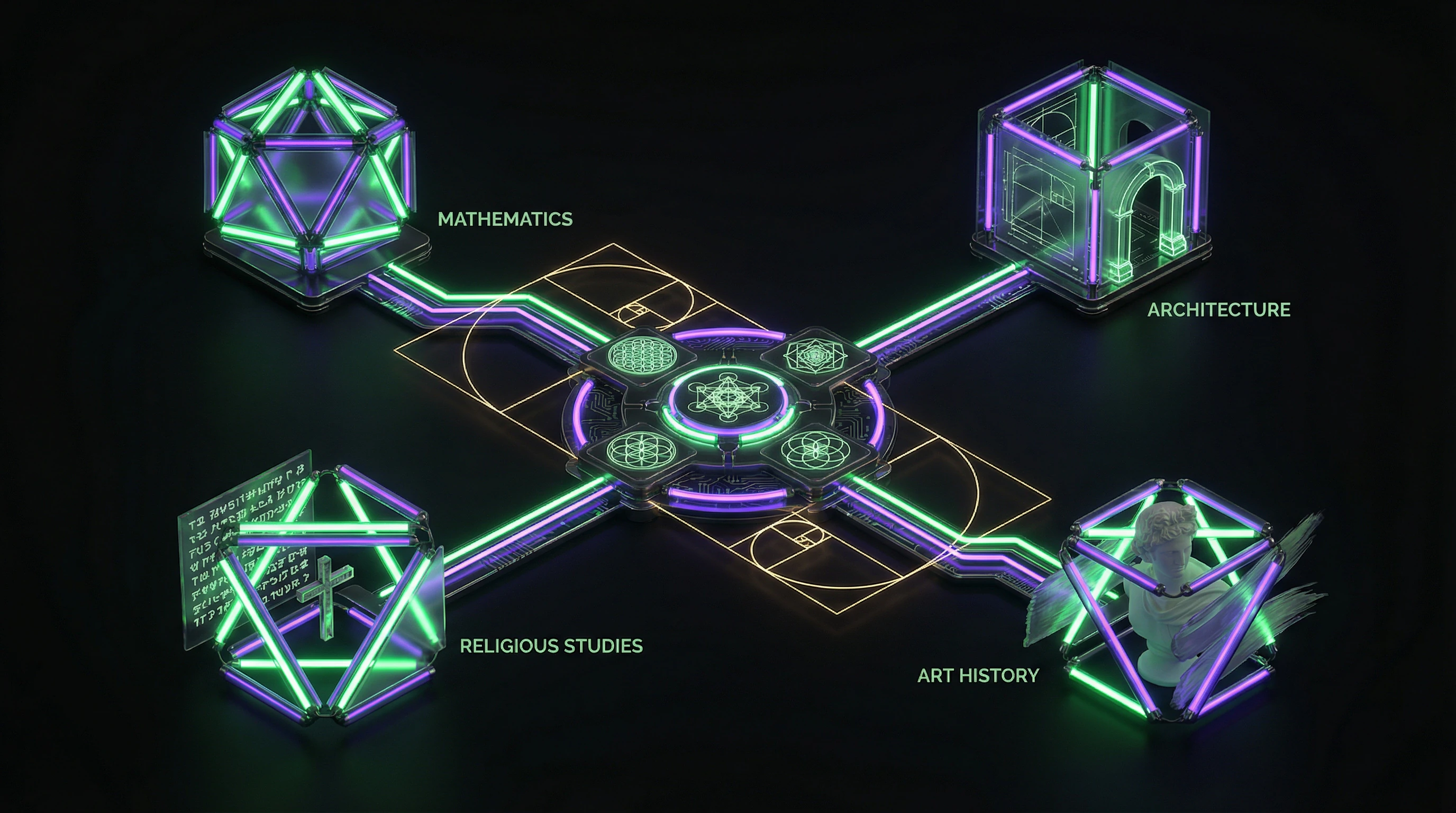
Contemporary scientific research encompasses the history of architecture, religious studies, cultural studies, mathematics, and art history. Works on geodesy demonstrate the practical application of geometric principles in ancient measurements and construction.
Research on Ancient Egyptian art reveals the systematic use of geometric proportions in temple complexes. This allows us to view geometry and vibrations not only as a mystical concept, but also as a tool of practical knowledge for ancient engineers.
Basic Forms: From Simple Shapes to Complex Symbols
Fundamental geometric forms constitute the foundation of sacred geometry and appear across all cultural traditions. The circle symbolizes infinity and unity, the square represents the material world and stability, the triangle embodies trinity and dynamic equilibrium.
These basic elements are not arbitrary symbols — their use in the architecture of ancient civilizations is confirmed by archaeological and historical research.
| Form | Symbolic Meaning | Application in Architecture |
|---|---|---|
| Circle | Infinity, unity, perfection | Temples, mandalas, astronomical observatories |
| Square | Material world, stability, four cardinal directions | City planning, sacred spaces |
| Triangle | Trinity, dynamic equilibrium, triune nature | Pyramids, temple pediments |
Circle, Square, and Triangle in Architecture
The circle as a perfect form without beginning or end was used in the layout of temples, mandalas, and astronomical observatories throughout the world. The square, with its four equal sides and right angles, became the foundation for planning cities and sacred spaces.
The triangle, especially the equilateral triangle, was employed in the construction of pyramids and temple pediments, representing the divine trinity.
The combination of these forms created complex geometric compositions. The superimposition of a circle on a square generated the symbol of "squaring the circle" — an attempt to reconcile the celestial and terrestrial, the spiritual and material. Studies of monuments from the Middle East to various continents demonstrate the universality of these principles.
Mandalas, Yantras, and the Flower of Life
Mandalas are complex circular compositions used in Eastern spiritual practices as tools for meditation and visualization of cosmic order. Yantras are geometric diagrams in Hindu and Buddhist traditions, consisting of interwoven triangles, circles, and lotus petals.
The Flower of Life — a pattern of overlapping circles forming a floral structure — appears in various cultures and is considered one of the most ancient sacred symbols.
- Each element of mandalas and yantras carries specific symbolic meaning
- These complex forms are visual models of cosmological concepts, not merely decorative elements
- Academic studies of specific locations demonstrate systematic application of geometric principles in architectural planning
Historical Context: From Antiquity to Modernity
Sacred geometry has a documented history of application spanning millennia across various civilizations. Archaeological and historical evidence confirms the use of geometric principles in the construction of monumental structures, urban planning, and the creation of religious art.
The myth that sacred geometry is a modern invention of esoteric movements is refuted by the history of architecture itself.
Ancient Civilizations and Architectural Monuments
Ancient civilizations applied geometric principles with astonishing precision long before the development of modern mathematics. Mesopotamian ziggurats, Greek temples with their golden ratio proportions, and Roman basilicas demonstrate a profound understanding of geometric relationships.
These principles were not accidental—they were transmitted through generations of builders and priests as sacred knowledge. The connection to geodesy is particularly evident in ancient measurement systems and the astronomical orientation of structures.
- Mesopotamian ziggurats: stepped structures with geometric progression of heights
- Greek temples: proportions based on the golden ratio and modular systems
- Roman basilicas: geometric axes defining sacred space
- Astronomical orientation: alignment with solstices and stellar directions
Art and Architecture of Ancient Egypt
Ancient Egypt represents one of the most studied examples of systematic application of sacred geometry. The pyramids of Giza demonstrate the use of precise geometric proportions, including ratios related to π and the golden ratio.
The temple complexes of Luxor and Karnak were built with astronomical orientations and geometric axes that create sacred space. Specialized research reveals the use of canonical proportions in sculpture and painting, based on geometric grids.
- Canonical Proportions
- A formalized system of geometric relationships transmitted in temple schools and workshops. Not intuitive, but the result of systematic knowledge.
- Geometric Grids
- A tool for reproducing proportions in art. Allowed masters to scale compositions without losing harmony.
- Astronomical Orientation
- Alignment of architectural axes with celestial events. Connected earthly space with cosmic order in the worldview of the ancients.
Contemporary academic publications continue to study these geometric systems using methods of mathematical analysis and computer modeling.
Eastern and Western Traditions of Sacred Geometry: Two Paths to Harmony
Eastern Sacred Geometry: Mandalas, Yantras, and Cosmic Architecture
The Eastern tradition developed within the context of Buddhist and Hindu philosophy, where geometric forms served as tools for meditation and visualization of cosmic order.
Mandalas are concentric compositions symbolizing the journey from the periphery of the material world to the center of spiritual enlightenment. Yantras are geometric diagrams of tantric practices, constructed from triangles, circles, and lotus petals for concentration of consciousness.
- The architecture of Buddhist stupas and Hindu temples reflects cosmological concepts about the structure of the Universe
- Geometry is viewed as a living language of interconnection between microcosm and macrocosm
- The Flower of Life is a pattern of intersecting circles, interpreted as a visual expression of creation
European Approach and Geodesy: From Pythagoras to Modern Research
The Western tradition is rooted in the Pythagorean school, where numbers and geometric forms were considered the foundation of reality.
Medieval cathedrals were built according to mathematical ratios connected to musical harmonies and astronomical cycles. Research by M.L. Sinyanskaya (2013) reveals connections between sacred geometry and geodesy, demonstrating that ancient builders possessed precise knowledge of the Earth's surface.
| Aspect | East | West |
|---|---|---|
| Source | Buddhism, Hinduism | Pythagoreanism, Christianity |
| Tool | Meditation, visualization | Architecture, geodesy |
| Foundation | Symbolic meaning of forms | Mathematical ratios |
Geodesic principles were applied in orienting temples to cardinal directions and astronomical alignments, creating a geometric network of sacred sites. The work of G.N. Teterin documents the use of geometric instruments in ancient civilizations, confirming that sacred geometry had a practical, measurable foundation.
Modern research on specific locations applies mathematical analysis to reconstruct the geometric principles embedded in the layout of historic cities and religious complexes.
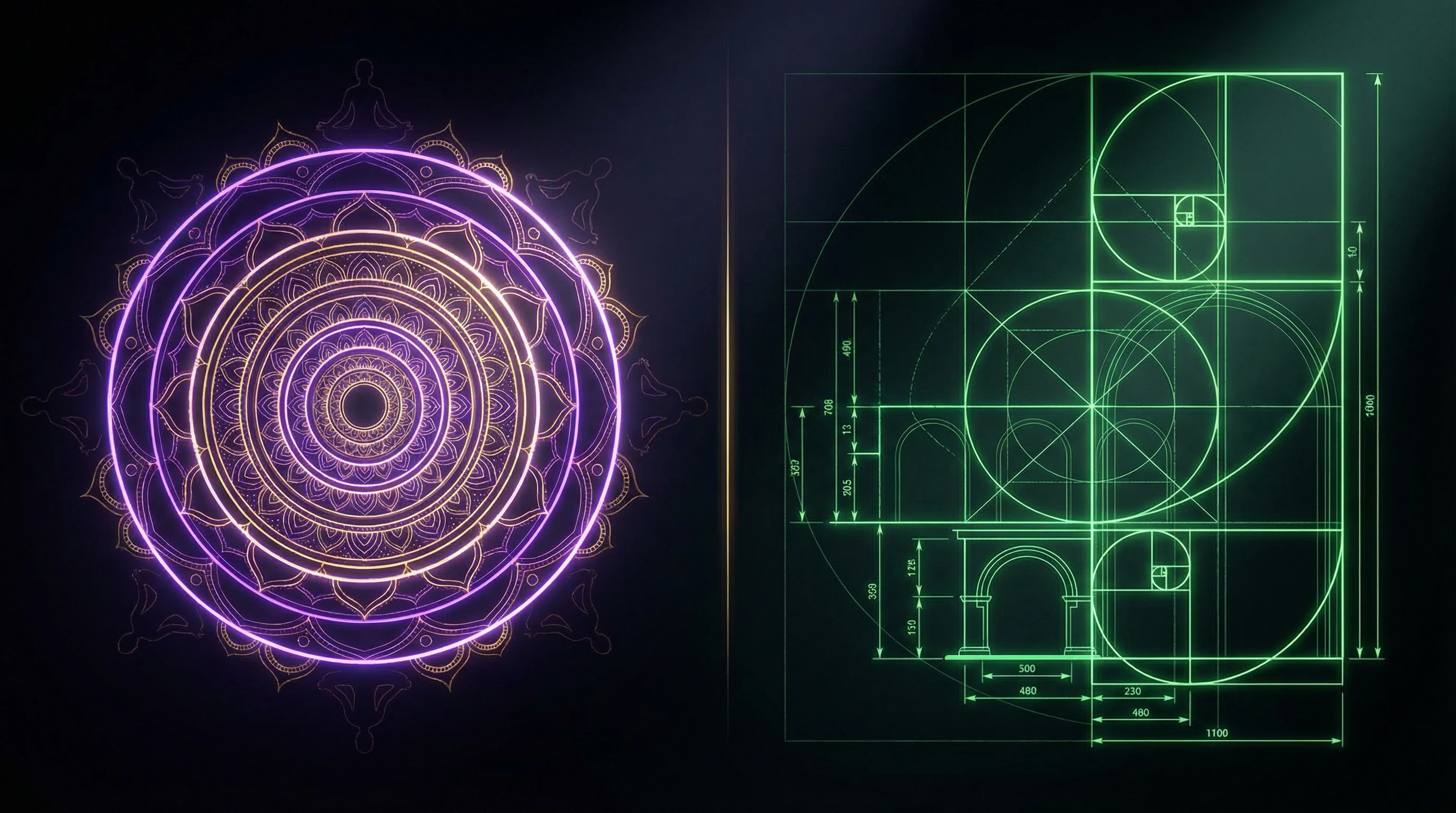
Scientific Research and Academic Approach to Geometric Principles
Connection to Mathematics and Geodesy: Academic Publications
Academic research on sacred geometry unites mathematics, architectural history, and cultural studies. M.L. Sinyanskaya's work "Sacred Geometry and Geodesy" (2013) demonstrates that geometric principles of ancient structures are based on precise geodetic measurements and astronomical observations.
Publications on Cyberleninka and ResearchGate confirm the academic status of this research and peer review process. Mathematical analysis of ancient monuments reveals the golden ratio, Fibonacci numbers, and other mathematical constants — results of advanced measurement knowledge, not coincidence.
- Geodetic research shows that sacred sites form geometric networks with precise angular and linear relationships
- Computer modeling reconstructs geometric systems of ancient civilizations with high accuracy
- Monument placement requires advanced knowledge of cartography and measurement
Contemporary Research on Geometric Proportions in Nature and Architecture
Geometric proportions are found in natural structures: spiral forms of shells, leaf arrangement on stems, crystal structures demonstrate the same mathematical patterns as sacred architecture.
Research on Ancient Egyptian art reveals the use of canonical proportions based on geometric grids — a formalized knowledge system, not intuition. Fibonacci numbers and the golden ratio indicate the universality of these principles.
| Application Context | Mechanism of Action | Scientific Basis |
|---|---|---|
| Natural structures | Growth and energy optimization | Biological patterns |
| Ancient architecture | Geodetic measurements and astronomy | Mathematical constants |
| Human perception | Neurophysiological response to proportions | Harmony of golden ratio |
Contemporary architecture and design use sacred geometry principles with scientific justification for their aesthetic and functional impact. Perception research shows that geometric proportions based on the golden ratio are perceived as more harmonious — this has a neurophysiological explanation.
Academic programs, including HSE Design courses, study sacred geometry in the context of art history and contemporary design, recognizing its significance as both a cultural and practical phenomenon.
Myths, Misconceptions, and Critical Analysis of Sacred Geometry
Common Myths About Sacred Geometry
The first myth: sacred geometry is pure esotericism without scientific foundation. In reality, academic publications on Cyberleninka and ResearchGate document it as a subject of architectural history, mathematics, and cultural studies.
The second myth attributes sacred geometry to the New Age movement, ignoring its millennia-long history of application in Egypt, India, and other ancient civilizations—a fact confirmed by archaeology.
- The third myth: universality of forms across all cultures. Scientific analysis reveals substantial differences between Eastern and Western traditions in the choice of symbols and methods.
- The fourth misconception: the ancients possessed mystical knowledge inaccessible to science. Research shows that their achievements were based on practical observations and empirical methods, not supernatural sources.
- The fifth myth: any geometric form in ancient architecture has sacred meaning. In practice, functional, technical, and aesthetic factors often determined decisions independently of symbolism.
The Boundary Between Science and Esotericism: A Critical Approach
Critical analysis requires distinguishing between documented historical practices and contemporary esoteric interpretations, often lacking historical foundation.
| Scientific Approach | Esoteric Interpretation |
|---|---|
| Verifiable mathematical proportions, geodetic measurements, historical evidence | Universal energetic or spiritual properties without empirical proof |
| Analysis of primary sources, archaeological data, mathematical modeling | Claims about "vibrations," "energies," or "universal consciousness" |
| Comparative cultural studies with verification methodology | Interpretations without verification methodology |
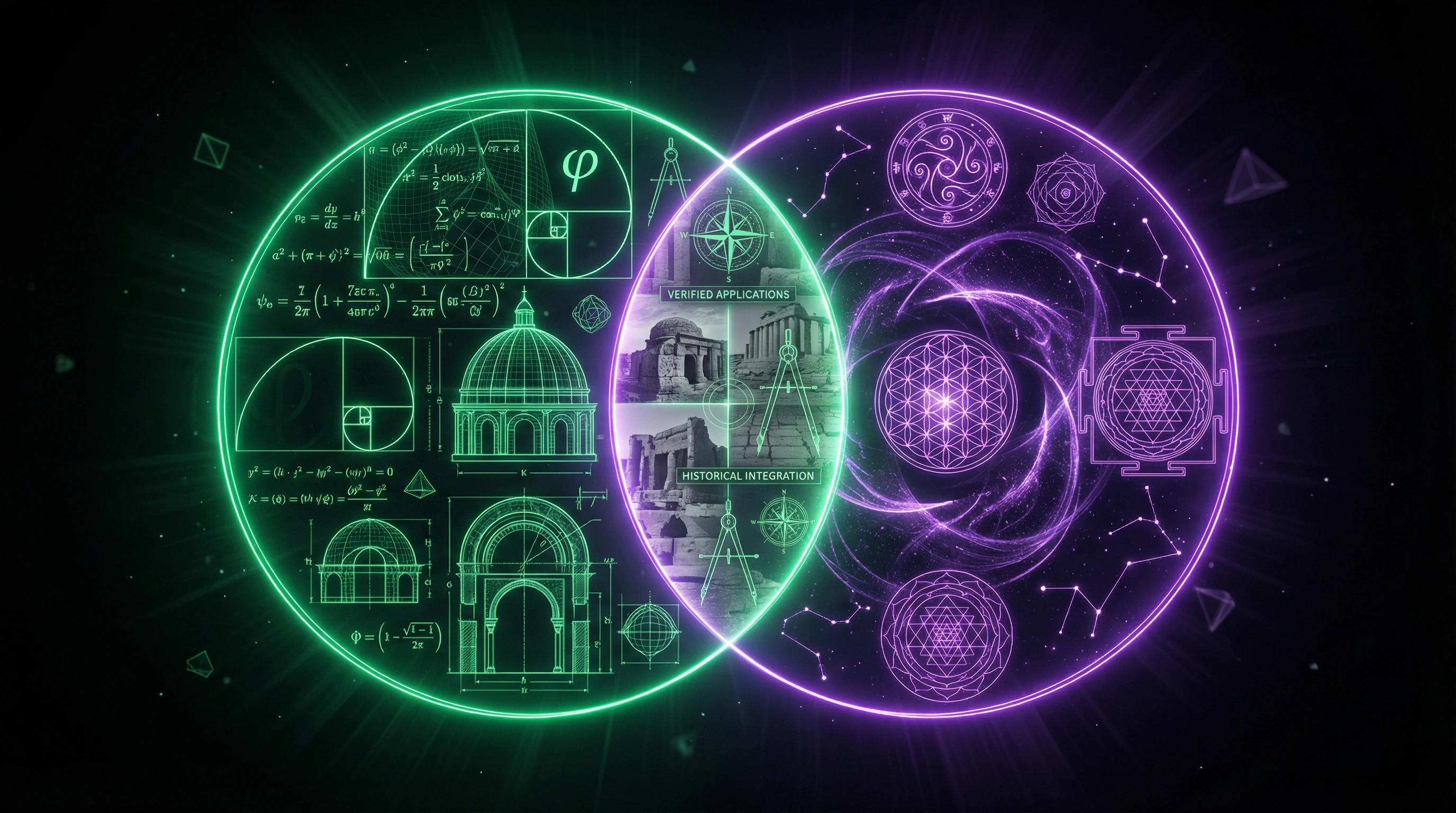
The boundary between science and esotericism lies where verifiable claims end and unprovable assertions begin.
The academic community recognizes the cultural and historical significance of sacred geometry as a phenomenon of human civilization, without requiring acceptance of mystical interpretations that fall outside the scope of scientific methodology.
Knowledge Access Protocol
FAQ
Frequently Asked Questions
Sacred geometry is a system of knowledge about geometric forms and proportions believed to carry cosmic and spiritual significance. It exists at the intersection of mathematics, philosophy, religion, and art, studying universal patterns of the Universe. Pythagoras called it 'the most sacred science of God,' and ancient civilizations used these principles in architecture and art.
The basic forms are the circle, square, and triangle, along with more complex structures—mandalas, yantras, and the Flower of Life. These geometric elements symbolize various aspects of creation and are used in spiritual practices. Each form carries specific symbolic meaning across different cultural traditions.
No, that's a myth. Sacred geometry has a documented history of application in ancient civilizations and is the subject of academic research. Scientific publications exist studying geometric principles in Ancient Egyptian architecture, temples, and monuments. While mystical aspects exist, the foundation has real historical and mathematical basis.
Ancient civilizations used it in the architecture of temples, pyramids, and sacred structures from Egypt to the East. Geometric principles were applied in religious art, surveying, and city planning. Middle Eastern monuments, European cathedrals, and Eastern temples were built incorporating this knowledge.
Begin by studying basic forms—the circle, square, triangle, and their symbolic meaning in different cultures. Practice constructing simple geometric patterns and mandalas, study examples from ancient architecture. It's recommended to combine theoretical knowledge with practical drawing and analysis of historical monuments.
Yes, the golden ratio and Fibonacci numbers are important elements of sacred geometry. These mathematical proportions appear in nature, architecture, and art, considered expressions of universal harmony. Ancient builders consciously used these ratios when designing temples and sacred structures.
The Eastern tradition focuses on mandalas, yantras, and symbols of meditative practices connected to Buddhism and Hinduism. The Western approach is more linked to architecture, surveying, and Christian symbolism in cathedrals. Both traditions use geometry to express spiritual concepts, but with different cultural emphases.
Scientific research confirms the use of mathematical proportions in ancient architecture, but mystical effects lack rigorous proof. Academic work studies geometric principles as a cultural-historical phenomenon and engineering achievement. It's important to distinguish between documented historical facts and esoteric interpretations.
Yes, principles of sacred geometry are actively applied in contemporary architecture, graphic design, and decorative arts. Geometric patterns create visually harmonious compositions and can enhance aesthetic perception of space. Many designers use the golden ratio and symmetry to create balanced works.
The Flower of Life is a geometric pattern of overlapping circles forming a floral design, considered one of the most ancient symbols. It appears in various cultures and contains within it many other geometric forms and proportions. This symbol is used in meditative practices and is considered a reflection of the structure of creation.
This is an oversimplification. Many ancient structures did indeed use geometric principles, but not all and not always consciously. Academic research confirms the application of mathematical proportions in significant temples and pyramids. However, attributing secret geometric knowledge to all buildings is often an exaggeration.
Research shows a connection between sacred geometry and ancient geodesy—the science of measuring the Earth. Ancient civilizations used geometric knowledge for precise measurements, orientation of structures, and cartography. This connection is studied in academic works as part of the history of science and engineering.
Yes, anyone can create basic mandalas with a compass, ruler, and understanding of simple geometric principles. Start by dividing a circle into equal parts and building symmetrical patterns from the center. Practice and patience matter more than specialized education, and numerous guides make the process accessible.
Regular geometry is a branch of mathematics that studies spatial forms and their properties objectively. Sacred geometry adds symbolic, philosophical, and spiritual meaning to geometric forms, viewing them as reflections of cosmic order. The former is an exact science, the latter is an interdisciplinary field at the intersection of science, art, and philosophy.
Yes, academic research examines geometric principles in ancient architecture, art, and culture from a scientific perspective. Publications on platforms like Cyberleninka analyze specific monuments and mathematical foundations. However, the scientific approach focuses on historical and cultural aspects, avoiding unverifiable mystical claims.
There is no scientific evidence that geometric forms influence "energy"—this belongs to the realm of esotericism. However, geometry does genuinely affect the psychological perception of space, creating feelings of harmony or discomfort. These effects are explained by perceptual psychology and aesthetics, not mystical energies.