Geometry and Vibrations: The Mathematics of Forms in Nature and Cultureλ
An exploration of geometric patterns, mathematical proportions, and their manifestations in architecture, nature, and cultural traditions through the lens of scientific analysis
Overview
Geometric patterns — from DNA spirals to the proportions of the Parthenon — 🧩 a universal language of nature and culture. Modern science unites crystallography, biomechanics, and archaeology to separate measurable regularities from mystical interpretations. The challenge: understanding where mathematics explains form, and where culture ascribes meaning to it.
🛡️
Laplace Protocol: Content is based on peer-reviewed research in architectural history, mathematics, and cultural studies. Verifiable mathematical facts are clearly distinguished from cultural interpretations. Metaphysical claims are presented as cultural beliefs, not scientific facts.
Reference Protocol
Scientific Foundation
Evidence-based framework for critical analysis
Protocol: Evaluation
Test Yourself
Quizzes on this topic coming soon
⚡
Deep Dive
Mathematical Foundations of Geometric Patterns in Nature and Culture
Geometric patterns that humanity has considered sacred are based on strict mathematical principles, independent of cultural interpretations. Fundamental forms—circles, triangles, squares, pentagons, hexagons—appear in the architecture of ancient civilizations as a result of practical application of mathematical knowledge, not by chance.
Modern science validates these observations: geometric patterns are found in fractals, crystalline structures, and biological forms. This confirms that ancient builders relied on real patterns in nature.
Golden Ratio and Fibonacci Numbers: Facts and Myths
The golden ratio (φ ≈ 1.618) and the Fibonacci sequence are mathematically valid concepts. However, their application in ancient structures is often exaggerated: many claims about the presence of the golden ratio result from selective measurements or confirmation bias.
| Civilization | Approximation of π | Nature |
|---|---|---|
| Babylonian | ≈ 3.125 | Practical approximation |
| Egyptian | ≈ 3.1605 | Practical approximation |
Ancient civilizations used various proportional systems that reflected practical needs, not esoteric knowledge. Nevertheless, some structures do demonstrate proportions close to φ—this reflects builders' intuitive understanding of harmonious ratios.
Platonic Solids: Geometry and Physics
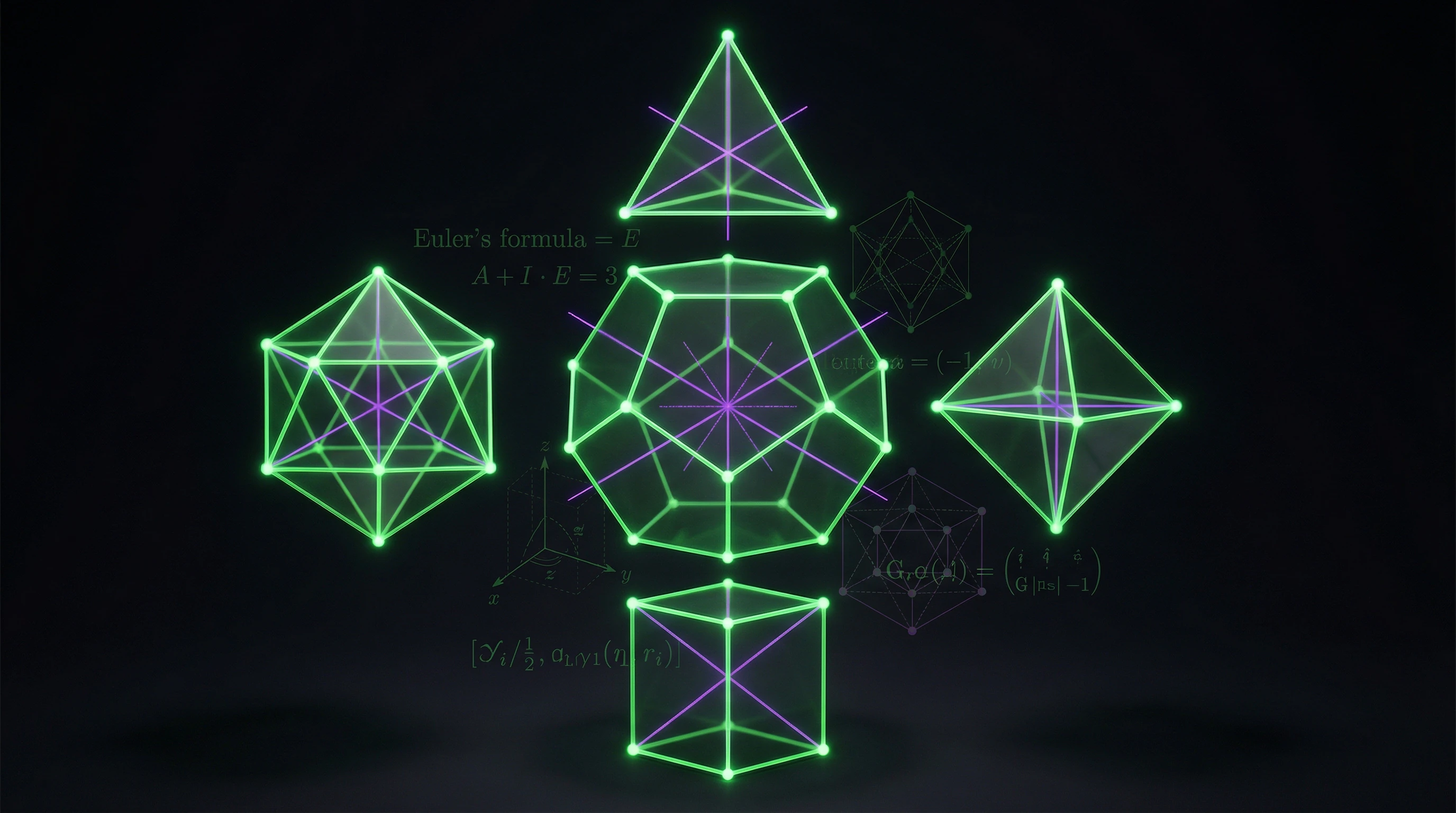
The five Platonic solids are the only convex polyhedra with identical regular faces and equal angles. They possess mathematical elegance and are found in crystalline structures, molecular geometry, and biological organisms.
- Symmetry in Platonic Solids
- Not a mystical property, but a reflection of fundamental principles of energy minimization and structural stability in physical systems.
- Neurobiology of Perception
- Perception of symmetrical forms activates specific neural patterns associated with aesthetic pleasure. This explains the cross-cultural recognition of geometric harmony.
The geometry of nature requires no mystical explanations—it operates through physical laws that ancient builders intuitively applied without fully understanding them.
Geometry in Ancient Architecture: From Practice to Symbolism
Ancient structures demonstrate systematic application of geometric principles, but the question remains open: is this conscious embodiment of sacred principles or practical construction solutions? Geometric proportions influence spatial perception and aesthetic experience — this is confirmed by architectural psychology research.
Egyptian and Babylonian Proportional Systems
The Indus Valley Civilization (circa 3000 BCE) left some of the earliest evidence of systematic application of geometry in urban planning. Egyptians used practical approximations of mathematical constants: the value π ≈ 3.1605 in pyramids reflects not mystical knowledge, but empirical measurement methods.
Babylonian mathematicians developed the sexagesimal number system and applied geometric calculations for astronomical observations and surveying work. The accuracy of ancient measurements remains a subject of research: observed ratios could have been either intentional design or coincidental approximations.
- Egyptian pyramids: empirical methods, not mystical constants
- Babylonian sexagesimal system: practical application in astronomy and surveying
- Question of accuracy: intentional design or coincidence?
Islamic Geometric Tradition and Decorative Patterns
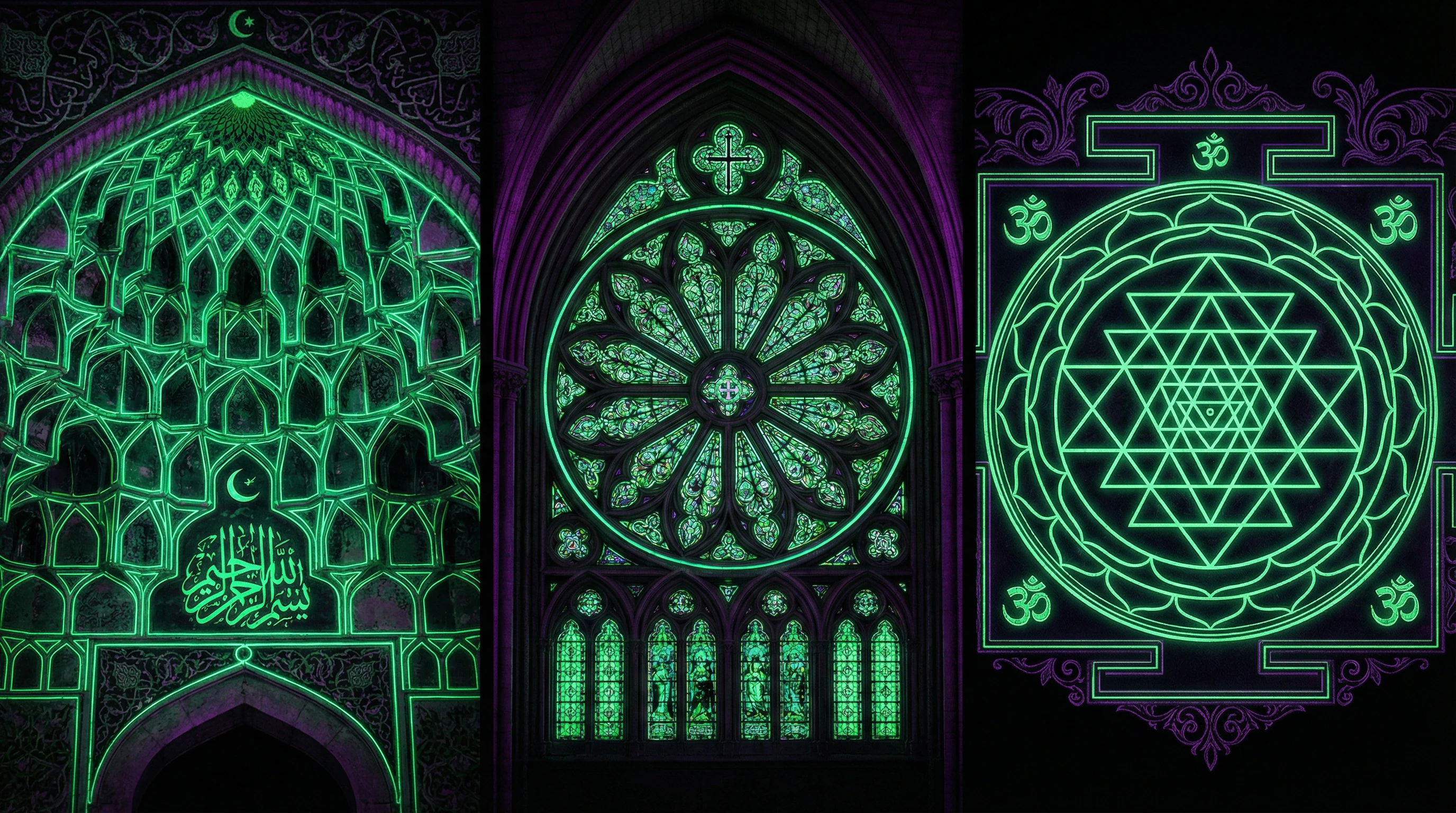
Islamic architecture demonstrates the most systematic and documented application of geometric patterns in a religious context. Geometric motifs served not only as decoration, but also reflected theological concepts of unity and infinity through repeating patterns.
Islamic craftsmen created quasicrystalline patterns, which Western mathematics formalized only in the 20th century — using only compass and straightedge.
These patterns demonstrate a high level of geometric literacy among medieval craftsmen, transmitted through practical guild traditions.
Gothic Cathedrals and Proportional Systems
Gothic architecture represents the culmination of medieval application of geometric principles in religious construction. Builders used proportional systems based on squares, triangles, and ad quadratum constructions to create vertical spaces directing the gaze toward the heavens.
The geometric proportions of Gothic cathedrals influence acoustics, lighting, and spatial perception, creating a specific psychological effect. However, the question remains open: to what extent did medieval masters consciously apply esoteric geometric principles, rather than simply following proven practical methods?
Natural Geometric Structures: From Molecules to Ecosystems
Modern science confirms the presence of geometric patterns at all levels of matter organization — from subatomic particles to galactic structures. These patterns reflect fundamental physical principles of energy minimization, structural stability, and efficiency.
Recognition of geometric patterns in nature validates observations from ancient cultures, though it requires scientific rather than metaphysical explanation.
Fractals and the Principle of Self-Similarity in Biological Systems
Fractal geometry describes self-similar structures that repeat their form at different scales — from coastlines to blood vessels. Biological systems use fractal principles to maximize surface area while minimizing volume.
- Bronchial tree of the lungs
- Neural networks of the brain
- Root systems of plants
The mathematical formalization of fractals by Benoit Mandelbrot in the 1970s provided tools for quantitative analysis of patterns that ancient cultures recognized intuitively. Fractal dimension allows measurement of the complexity of natural structures, demonstrating that apparent chaos obeys strict mathematical laws.
Ancient intuitions about nature's harmony find confirmation not in mysticism, but in the mathematics of nature itself.
Crystal Lattices and Molecular Geometry
Crystalline structures are three-dimensional periodic lattices of atoms or molecules, organized according to principles of symmetry and energy minimization. Seven crystal systems encompass all possible types of three-dimensional periodic symmetry.
| System | Geometry | Examples |
|---|---|---|
| Cubic | Cube | Table salt, gold |
| Hexagonal | Hexagonal prism | Ice, graphite |
| Trigonal | Rhombohedron | Calcite, corundum |
Molecular geometry is determined by quantum mechanical principles: Valence Shell Electron Pair Repulsion (VSEPR) theory predicts molecular geometry based on minimization of electrostatic repulsion. Platonic solids manifest directly in molecular structures: methane forms a tetrahedron, benzene demonstrates hexagonal symmetry, fullerenes form icosahedral structures.
Geometric principles that ancient cultures considered sacred are fundamental properties of physical reality, governed by the laws of quantum mechanics and thermodynamics.
Cultural Interpretations of Geometry: From Symbol to Practice
Symbolism in Different Traditions
Geometric patterns function as a universal language of spiritual concepts across various cultural contexts, though their interpretations differ substantially. Islamic tradition uses geometric ornamentation as an expression of divine unity (tawhid), avoiding anthropomorphic imagery: eight-pointed stars symbolize the throne of Allah, interwoven patterns reflect the infinity of creation.
Christian architecture of Gothic cathedrals applies geometric proportions to create vertical aspiration and light effects, where the circle represents divine perfection, the square—earthly existence, and their combination symbolizes the connection between celestial and material. Hindu and Buddhist traditions use geometry in mandalas and yantras as meditation tools, where concentric circles and symmetrical patterns represent cosmic order and the path to enlightenment.
| Tradition | Geometric Element | Function |
|---|---|---|
| Islam | Eight-pointed star, interwoven patterns | Expression of tawhid, symbol of infinity |
| Christianity | Circle, square, their combination | Divine perfection, earthly realm, connection of worlds |
| Hinduism/Buddhism | Concentric circles, symmetrical patterns | Cosmic order, path to enlightenment |
Archaeological research demonstrates that the geometric knowledge of ancient civilizations was predominantly practical construction tools, not esoteric secrets. Babylonian mathematicians used the approximation π ≈ 3.125 for area calculations, Egyptian architects applied π ≈ 3.1605 in pyramid construction, indicating empirical methods rather than mystical revelation.
The Indus Valley civilization (circa 3000 BCE) demonstrated advanced understanding of geometry in urban planning with rectangular street grids and standardized building proportions. Modern research shows that many claims about the presence of the golden ratio in ancient structures result from selective measurements and confirmation bias: statistical analysis of Parthenon and Egyptian pyramid proportions reveals no systematic use of φ ≈ 1.618.
Selective measurements and confirmation bias—classic mechanisms through which pseudoscience transforms random coincidences into supposed patterns.
Mandalas, Yantras, and Sacred Diagrams
Mandalas and yantras represent structured geometric compositions used in Hindu and Buddhist practices as tools for concentration and visualization. Tibetan sand mandalas are constructed according to strict geometric principles with a central point (bindu), concentric circles, and symmetrical sectors representing cosmic architecture and the path of spiritual transformation.
The Sri Yantra, consisting of nine interlocking triangles forming 43 smaller triangles around a central point, is used in tantric practice as a visual representation of cosmic creation and a meditation tool. Neuropsychological research shows that contemplating symmetrical geometric patterns activates brain regions associated with visual processing and attention, which may explain their effectiveness as meditative objects, though this does not confirm metaphysical claims about their properties.
- Dividing the circle into equal segments
- Constructing nested geometric figures
- Observing color symbolism
- Concentration and precision in the creation process
The process of constructing mandalas is regarded as a meditative practice requiring concentration and precision, while the subsequent destruction of sand mandalas symbolizes the impermanence of material forms. Contemporary research in art therapy demonstrates that creating geometric patterns can reduce anxiety levels and improve emotional state, which is linked to activation of the parasympathetic nervous system during focused creative activity, not to mystical properties of geometry.
Modern Applications and Research: From Temples to Laboratories
Architecture of Contemplative Spaces
Contemporary architecture of contemplative spaces applies geometric principles to create environments conducive to meditation and reflection. The Rothko Chapel in Houston uses simple rectangular forms and controlled natural lighting to minimize visual distractions.
Research in architectural psychology shows: high ceilings and vertical proportions activate conceptual thinking and feelings of transcendence. This explains the effectiveness of Gothic cathedrals and modern contemplative spaces with pronounced verticality.
- Design of interfaith prayer rooms uses neutral geometry — circles, squares, natural lighting.
- Such spaces are inclusive and not tied to any specific religious tradition.
- Effects are explained by neurobiological mechanisms of visual and acoustic information processing, not by metaphysical properties of geometry.
Experiments using virtual reality have shown: symmetrical spaces with harmonious proportions reduce heart rate and cortisol levels compared to asymmetrical configurations.
Domed structures create unique reverberation patterns that amplify vocal sounds and promote acoustic intimacy — this explains their prevalence in religious architecture across various cultures.
STEAM Education and Interdisciplinarity
Sacred geometry provides a pedagogical platform for integrating science, technology, engineering, art, and mathematics, connecting abstract mathematical concepts with cultural context.
Educational programs use construction of geometric patterns to teach proportions, symmetry, trigonometry, and fractal geometry. Research shows: an interdisciplinary approach increases student motivation and improves understanding of mathematical concepts, especially among learners with visual-spatial learning styles.
- Projects recreating Islamic geometric ornaments
- Require application of geometric constructions, understanding of symmetry, and measurement precision, developing technical skills through culturally meaningful activity.
- Parametric modeling
- Allows students to experiment with geometric transformations, create complex fractal structures, and analyze mathematical properties of traditional ornaments.
Computer modeling demonstrates improvement in spatial thinking and understanding of mathematical relationships. Effective educational programs clearly distinguish between mathematical facts and cultural interpretations, teaching critical thinking and methodology for evaluating historical claims about geometric knowledge of ancient civilizations.
Critical Analysis and Myths: Separating Science from Speculation
Distinguishing Facts from Interpretations
Critical analysis of claims about sacred geometry requires distinguishing between verifiable mathematical facts and cultural interpretations. Mathematical properties of geometric forms—symmetry, proportions, topological characteristics—are objective and universal, whereas their symbolic meaning varies depending on cultural context and historical period.
The widespread claim that ancient civilizations possessed "lost" geometric knowledge is not supported by archaeological evidence. Surviving mathematical texts demonstrate gradual development of geometric methods through practical application and empirical observation, rather than sudden emergence of advanced knowledge.
The phenomenon of pareidolia—the tendency to perceive meaningful patterns in random data—explains many claims about hidden geometric codes in ancient structures.
Pseudoscientific claims about "healing" or "energetic" properties of geometric forms lack empirical support in controlled studies. Systematic literature review has revealed no reproducible evidence that geometric patterns possess physical effects beyond psychological responses to visual aesthetics and cultural symbolism.
Documented positive effects of contemplating geometric forms—stress reduction, improved concentration—are explained by neuropsychological mechanisms of visual information processing, placebo effect, and contextual environmental factors, rather than mystical properties of geometry.
Methodology for Evaluating Historical Claims
Scientific evaluation of claims about geometric knowledge in ancient civilizations requires rigorous methodology, including archaeometry, statistical analysis, and control for cognitive biases. Measurements of ancient structures must account for construction tolerances, material erosion, and deformation over time.
- Define a priori hypotheses before measurements
- Use complete datasets rather than selective examples
- Apply statistical tests to assess probability of random coincidence
- Account for construction tolerances and natural variations
Statistical analysis shows that many "precise" correspondences to the golden ratio fall within random variations and construction tolerances. Research demonstrates: when rigorous statistical criteria are applied, most claims about systematic use of specific proportions in ancient architecture do not withstand scrutiny.
Interpretation of ancient builders' intentions requires caution and reliance on documentary sources when available. Surviving architectural treatises—such as the works of Vitruvius or medieval construction manuals—show that ancient architects used practical proportional systems based on modules and simple ratios, rather than complex mathematical constants.
The distinction between conscious application of geometric principles and retrospective interpretation is critical. The fact that modern observers find geometric patterns in ancient structures does not prove that builders intentionally embedded them.
The scientific approach acknowledges the cultural and historical value of geometric traditions while rejecting unfounded speculation and pseudoscientific claims.

Knowledge Access Protocol
FAQ
Frequently Asked Questions
Sacred geometry is the study of geometric shapes and proportions attributed with symbolic or spiritual significance. It includes fundamental forms (circles, triangles, Platonic solids), mathematical relationships (golden ratio, Fibonacci numbers), and their application in architecture and art. Historically used in temples, cathedrals, and religious structures across different cultures.
Yes, but the precision of their knowledge varied. Egyptians used π ≈ 3.1605, Babylonians used π ≈ 3.125, demonstrating practical application of proportions in construction. However, many modern claims about "secret knowledge" are exaggerations—these were practical tools of craftsmen rather than esoteric secrets.
Geometric structures are ubiquitous in nature: shell spirals follow Fibonacci numbers, snowflakes demonstrate hexagonal symmetry, crystals form regular lattices. Fractals manifest in tree branches, coastlines, and blood vessels. These patterns emerge from physical laws and principles of energy efficiency.
Apply golden ratio proportions (1:1.618) when arranging furniture and selecting decor sizes. Use symmetrical compositions, mandalas, or geometric patterns in textiles and wall art. Research shows that harmonious proportions create a sense of balance and contribute to a contemplative atmosphere in spaces.
Partially true, but with caveats. Egyptian pyramids do contain mathematical relationships close to π and φ, but this could have resulted from practical construction methods rather than mystical knowledge. Modern researchers debate whether these proportions were intentional or coincidental outcomes of using simple measuring tools.
There are five Platonic solids: tetrahedron (4 faces), cube (6), octahedron (8), dodecahedron (12), and icosahedron (20). These are the only convex polyhedra with identical regular faces. Plato associated them with elements (fire, earth, air, ether, water), but mathematically they're important as examples of perfect symmetry.
Islamic tradition developed highly complex geometric ornaments while avoiding depictions of living beings. Star polygons, interlacing patterns, and mosaics based on mathematical principles of symmetry are used. These designs adorn mosques, madrasas, and palaces, symbolizing infinity and the unity of creation.
Empirical evidence is currently insufficient for definitive conclusions. Preliminary research shows that harmonious proportions and symmetry positively affect aesthetic perception and may promote relaxation. However, claims about "spiritual vibrations" or "energy fields" lack scientific confirmation and remain in the realm of subjective experience.
The Flower of Life is a geometric pattern of overlapping circles forming a floral structure. Found in ancient temples of Egypt, India, China, and other cultures. Mathematically it represents circle packing, symbolically interpreted as a blueprint of creation, though historical evidence about its meaning is limited.
Integrate it into STEAM programs, connecting mathematics, art, and history. Use practical assignments: constructing the golden ratio with compass, creating Islamic patterns, studying symmetry in nature. Research confirms that such an interdisciplinary approach increases student engagement and understanding of abstract mathematical concepts.
Yes, this is a myth without scientific basis. There is no evidence that geometric forms or symbols possess healing properties or emit "energy." Any positive effects are related to the psychological impact of aesthetics, meditative practices, or the placebo effect. Geometric patterns should not replace medical treatment.
A mathematical connection exists through harmonic ratios. Musical intervals are based on simple numerical proportions (octave 2:1, fifth 3:2), which also appear in geometry. However, claims about "healing frequencies" or "sacred vibrations" (such as 432 Hz) lack scientific confirmation and are pseudoscientific concepts.
Gothic masters applied proportional systems based on squares, triangles, and "ad quadratum" (squaring). Ratios of √2, √3, and the golden ratio were used to determine nave heights, column placement, and window dimensions. These methods ensured structural stability and created a sense of vertical aspiration.
Fractals are self-similar structures that repeat at different scales (as in the Pythagorean tree or Mandelbrot set). They occur in nature in clouds, mountains, and plants. Some traditional ornaments (African patterns, Indian rangoli) demonstrate fractal properties, though they were created intuitively, without modern mathematical theory.
Yes, modern technologies (laser scanning, photogrammetry) allow precise measurement of ancient structures. Results show impressive but not absolute accuracy—deviations in pyramids amount to centimeters over hundreds of meters. This indicates high builder craftsmanship but refutes myths about "impossible" precision requiring extraterrestrial technology.
Check sources: scientific research is published in peer-reviewed journals with methodology and data. Esoteric claims often appeal to "ancient wisdom" without evidence, use vague terms ("energy," "vibrations"), and ignore alternative explanations. The mathematical properties of geometry are objective, but their symbolic interpretations are subjective and culturally conditioned.