Secret Devices: From Cryptographic Protection to Covert Surveillanceλ
Interdisciplinary analysis of the concept of covert devices in the context of machine learning, journalist safety, clinical psychiatry, and IoT technologies
Overview
The term "secret devices" lacks a unified academic definition—it manifests across disciplines with fundamentally different meanings. In technical literature, these are cryptographically protected computational nodes 🧩 (SMPC, homomorphic encryption, TEE); in journalism—temporary communication tools for source protection; in clinical psychiatry—elements of persecutory delusional systems; in IoT—potentially covert monitoring devices.
🛡️
Laplace Protocol: The absence of systematic reviews on this topic requires contextualization of each mention and separation of technical, clinical, and ethical aspects. All claims must be accompanied by disciplinary context to avoid conceptual confusion.
Reference Protocol
Scientific Foundation
Evidence-based framework for critical analysis
Protocol: Evaluation
Test Yourself
Quizzes on this topic coming soon
⚡
Deep Dive
Cryptographic Secret Devices: How Federated Learning Protects Data Without Revealing It
In the context of distributed computing, the term "secret devices" refers to computational nodes that employ cryptographic protocols to preserve data confidentiality during collaborative machine learning. Federated learning enables multiple participants to train a shared model without centralized collection of raw data, but requires protection against leakage through gradients and intermediate parameters.
These devices are contrasted with "open devices," which process data without additional protective measures, relying solely on network isolation and the honesty of the central server.
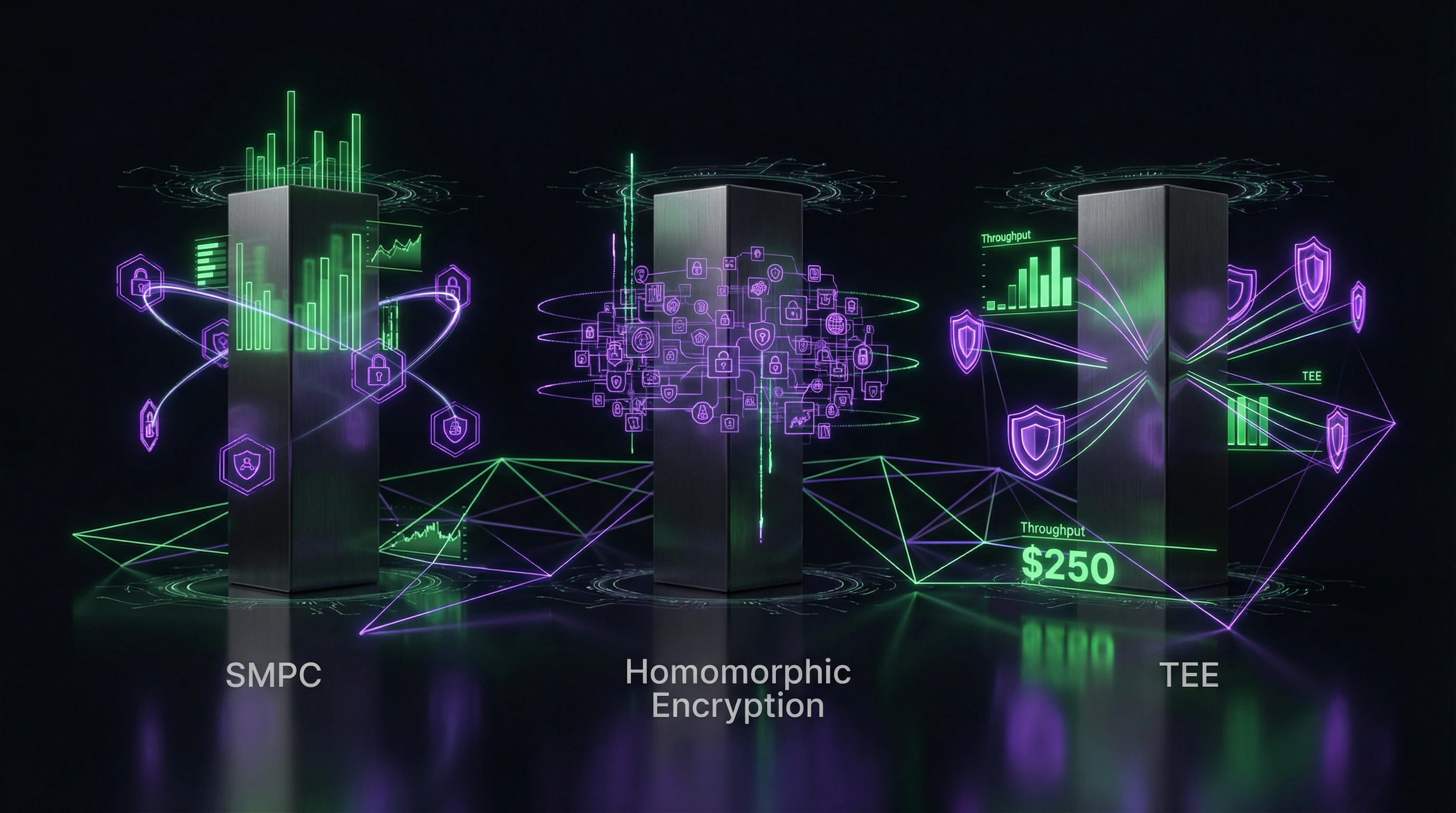
Three Protection Technologies: SMPC, Homomorphic Encryption, and Trusted Environments
- Secure Multi-Party Computation (SMPC)
- Splits data into cryptographic shares among participants, enabling computation of functions without revealing input values. Each node sees only a meaningless fragment, but together they obtain the correct result. Provides theoretically provable security, but requires intensive network exchange and slows computations by 10–100× compared to open operations.
- Homomorphic Encryption (HE)
- Allows mathematical operations to be performed directly on encrypted data, so the aggregation server processes models without access to their plaintext content. Minimizes communication overhead, however computational complexity of operations on encrypted data substantially exceeds open computations for fully homomorphic schemes.
- Trusted Execution Environments (TEE)
- Such as Intel SGX, create isolated hardware enclaves within the processor where computations are protected even from the operating system and administrator. Offer the best performance with overhead under 10%, but are vulnerable to hardware side-channel attacks and require trust in the processor manufacturer.
Open and Secret Devices: Trade-offs
Open devices in federated learning exchange gradients and model parameters in unencrypted form. This approach provides maximum training speed and implementation simplicity, but is vulnerable to data reconstruction attacks: from neural network gradients, original images or texts can be reconstructed with high accuracy, especially in early training iterations.
Open architecture does not protect against a curious or compromised aggregation server, which gains full access to all intermediate results from participants.
Secret devices solve the trust problem through cryptographic guarantees, but introduce substantial practical limitations.
| Parameter | Open Devices | Secret Devices |
|---|---|---|
| Training Speed | Baseline (1×) | Slowdown of 10–1000× depending on technology |
| Energy Consumption | Minimal | Increases proportionally to computational costs |
| Development Complexity | Standard programming | Requires specialized cryptographic knowledge |
| Leakage Protection | None | Cryptographic guarantees |
Energy consumption is critical for mobile devices and IoT sensors with limited batteries. Development and debugging of applications for secret devices is substantially more complex than traditional programming, which slows adoption of the technology in industrial systems.
Operational Security for Journalists: When Device Secrecy Becomes a Matter of Life and Death
Journalists working with confidential sources or in authoritarian regimes use specialized devices to protect communications and information sources. The term "burner device" refers to a temporary communication device, purchased anonymously and used for a limited number of contacts before disposal.
These practices are not paranoia: communication metadata—who, when, and how long people communicated—can reveal sources even when message content is encrypted.
Burner Devices and Multi-Layered Source Protection
Proper use of burner devices requires strict protocols that go beyond simply buying a new phone.
- Purchase with cash at a location without surveillance cameras
- Activation using a prepaid SIM card, also purchased anonymously
- Power on only in locations unconnected to the journalist's real identity—not at home, not at the office, not near personal phone
- Physical destruction after communication concludes, not simply powering off or factory reset
Critical mistake: powering on a burner device and personal phone simultaneously in the same location creates correlation in cell tower data, allowing the anonymous device to be linked to a specific person.
Multi-layered protection combines burner devices with additional counter-surveillance measures. Journalists use separate devices for different sources so that compromise of one channel doesn't reveal the entire contact network.
Communications are conducted through encrypted messengers with perfect forward secrecy support, such as Signal. Physical meetings are planned through a chain of temporary devices that are destroyed after transmitting meeting location information, creating an "air gap" between planning and execution.
Covert Communication Methodologies Under Active Surveillance
Covert communications rely on the principle of minimizing digital traces and separating identities. The "digital hygiene" methodology prescribes using separate devices for personal life, professional activities, and confidential investigations.
For internet access, public Wi-Fi networks in high-traffic locations are used, where physical surveillance is difficult to establish, and traffic is masked through VPN or Tor. It's critically important to avoid patterns: using the same coffee shop or the same time of day creates predictability that adversaries can exploit.
- "Dead drops" in digital space
- Shared email accounts where messages are saved as drafts and never sent. Eliminates transmission logs and provider IP addresses.
- Steganography
- Hiding messages inside innocuous images or audio files published on social media. Masks the fact of communication as ordinary activity.
- Time delays between receipt and publication
- Break temporal correlation between an event and its coverage, making it harder to trace the source by chronology.
A single mistake—logging into a personal account from a secret device—can compromise years of precautions.
Clinical Manifestations in Psychiatry: When Secret Devices Exist Only in the Patient's Mind
In psychiatric practice, conviction in the existence of secret surveillance or control devices is a common type of persecutory delusional ideation. Patients describe implanted chips, hidden cameras in walls, or invisible rays that read thoughts or cause physical pain.
These beliefs differ from legitimate surveillance concerns in their imperviousness to contradictory evidence, specificity of details, and integration into broader delusional systems.
Technology-Themed Persecutory Delusional Systems in Contemporary Clinical Practice
The content of delusional ideation evolves alongside the technological context of the era. While mid-20th century patients described radio waves and X-rays, contemporary delusional systems incorporate GPS trackers, neural interfaces, and artificial intelligence.
A patient may assert that a government agency implanted a microchip during a routine medical procedure, which now broadcasts their thoughts to a remote server or controls their emotions through electrical impulses. A characteristic feature: patients often demonstrate detailed "technical" explanations of how these devices function, mixing genuine technological terminology with fantastical elements.
Delusional beliefs about secret devices are often accompanied by specific avoidance and protective behaviors: covering walls with foil, refusing mobile phones, avoiding certain locations. Some patients attempt physical removal of imaginary implants, resulting in self-injury requiring emergency medical intervention.
The key distinction from justified concerns about digital privacy: delusional beliefs are not amenable to correction through logical argumentation and substantially impair social and occupational functioning.
Differential Diagnosis and Comorbid Mental Disorders
Delusional beliefs about secret devices occur across several mental disorders requiring different therapeutic approaches.
| Diagnosis | Characteristics of Delusional Ideation | Associated Symptoms |
|---|---|---|
| Schizophrenia | Technology-themed delusional ideation within broader psychotic disorder context | Hallucinations, thought disorganization, negative symptoms |
| Delusional Disorder | Isolated, systematized beliefs with preservation of other functions | Patient may successfully work and maintain relationships outside the sphere of delusion |
| Depression with Psychosis | Persecutory delusional ideation as part of overall guilt presentation | Depressed mood, hopelessness, suicidal ideation |
Differential diagnosis requires exclusion of organic causes: delirium, brain tumors, neurodegenerative diseases, and psychoactive substance intoxication can produce secondary psychotic symptoms with technological content.
Comorbid obsessive-compulsive disorder may manifest as intrusive thoughts about surveillance that the patient critically evaluates as irrational, unlike uncritical delusional beliefs. Post-traumatic stress disorder in victims of actual surveillance or persecution creates diagnostic complexity: it is necessary to distinguish justified hypervigilance from pathological delusional interpretations.
IoT and Hidden Monitoring Devices: From Smart Homes to Corporate Surveillance
The Internet of Things has created a new category of "secret devices" — legitimate consumer products that collect data in ways opaque to users. Smart thermostats, security cameras, doorbells, and voice assistants continuously transmit information about owners' behavior, location, and habits.
Most users don't realize the volume of data being collected and don't read privacy policies exceeding 10,000 words of legal text. This isn't laziness — it's cognitive overload, designed into the system.
- Device collects data continuously (background process).
- User cannot see what exactly is transmitted or where.
- Consent given at installation, when attention is minimal.
- Policy changes occur without re-signing.
Blockchain Protection and Cryptographic Solutions for IoT Ecosystems
Academic research proposes blockchain technologies as a mechanism to protect IoT devices from unauthorized access and data manipulation. Decentralized ledgers provide immutable records of all transactions between devices, enabling detection of anomalous activity.
Practical implementation faces a fundamental problem: most sensors cannot perform the cryptographic operations required to participate in blockchain networks. Hybrid architectures, where lightweight devices interact through secure gateways with blockchain nodes, remain the subject of active research without widespread commercial deployment.
Unauthorized Tracking in Consumer Products
Documented cases of hidden monitoring include built-in GPS trackers in General Motors vehicles transmitting location and driving behavior data to insurance companies without explicit owner consent.
Legal analysis shows that user agreements often contain data collection permissions worded so vaguely that consumers cannot assess real consequences.
| Jurisdiction | Consent Requirement | Enforcement Practice |
|---|---|---|
| European GDPR | Explicit consent for personal data processing | Fines predominantly on large tech companies |
| Mid-size IoT manufacturers | Vague wording in agreements | Avoid sanctions under inconsistent enforcement |
Ethical and Legal Aspects: The Conflict Between Innovation and Privacy
Legal regulation of "secret devices" is fragmented across jurisdictions and technological contexts. Cryptographic "secret devices" in federated learning are legal and encouraged as data protection mechanisms, while hidden cameras and trackers fall under surveillance and privacy laws.
The absence of unified terminology creates legal uncertainty: the same term describes protective technologies, journalistic security tools, and illegal surveillance devices.
Informed Consent and Information Asymmetry
The concept of informed consent, borrowed from medical ethics, applies to data collection technologies with significant limitations. The average user spends less than 30 seconds reading a user agreement before installing an application, while full understanding requires legal expertise and technical knowledge.
Information asymmetry between device developers and consumers makes formal consent a fiction: users agree to terms they don't understand, under pressure from the necessity of using critical services.
Proposals for "opt-in by default" (instead of opt-out) meet industry resistance, citing reduced usability.
Regulatory Frameworks Across Jurisdictions
The European GDPR establishes strict requirements for personal data processing, including the right to be forgotten and data portability, but its extraterritorial application is limited by enforcement complexities outside the EU.
- GDPR (EU): right to be forgotten, data portability — enforcement difficulty outside EU
- CCPA (California): right to know, request deletion — does not prohibit collection itself
- PIPL (China): data localization, government approval for cross-border transfers — barriers for international IoT platforms
The absence of international standards leads to "regulatory arbitrage," where companies register devices in jurisdictions with minimal privacy requirements.
Methodological Limitations of Research: An Interdisciplinary Impasse
"Secret devices"—a term each discipline defines differently. Computer science sees cryptographic nodes, psychiatry sees delusional content, journalism sees security tools, law sees objects of regulation.
A systematic literature review revealed a critical absence of unified research frameworks. None of the identified studies constitute specialized systematic reviews or meta-analyses—mentions appear as incidental elements in work on federated learning, delusional disorders, or journalist security.
Attempts to create interdisciplinary taxonomies are absent from peer-reviewed literature. This obstructs comparative analysis: it's impossible to assess prevalence of a phenomenon when each discipline measures different constructs under the same label.
Four Categories Instead of One Term
The proposed classification distinguishes:
- Protective cryptographic devices (nodes with data protection)
- Legitimate security tools (for journalists, activists)
- Unauthorized surveillance devices (corporate, governmental)
- Psychopathological constructs (content of persecutory delusions)
Each category requires its own methodology, metrics, and validity criteria. Without this distinction, any comparison is comparing apples to oranges.
Why Academia Cannot Solve This Alone
Institutional structure impedes cross-disciplinary work. Machine learning specialists don't cite psychiatric literature, clinicians ignore technical cryptography papers, legal scholars don't integrate empirical data from computer science.
Funding is organized along disciplinary grant programs, disincentivizing cross-disciplinary projects. Career incentives work against integration.
- Unified Terminology
- Requires consensus conferences with participation from all stakeholder disciplines. Without this, each field will continue speaking its own language.
- Methodological Expansion
- Mixed-methods research: quantitative prevalence analysis + qualitative interviews + clinical cases. No single method alone captures the full complexity.
- Longitudinal Effects
- Long-term studies of IoT device impact on mental health and social trust. Current work provides snapshots, not trajectories.
- Regulatory Effectiveness
- Randomized controlled trials of privacy protection approaches. Evidence is needed, not declarations.
The solution requires institutional reconfiguration: interdisciplinary research centers with joint funding, reassessment of career advancement criteria, restructuring of grant programs.
Without this, "secret devices" will remain four different phenomena that happen to share one name.

Knowledge Access Protocol
FAQ
Frequently Asked Questions
In cryptography, these are computational nodes with data protection through SMPC, homomorphic encryption, or TEE. Used in federated learning to preserve confidentiality during distributed computing. Contrasted with open devices without cryptographic protection (Zhang et al., 2023).
No, context determines purpose. In cryptography they protect privacy, journalists use burner phones for source protection. Only unauthorized surveillance devices and hidden cameras without user consent are malicious.
They employ temporary burner devices to protect sources and operational security. These are additional phones or computers that conceal identity and location from surveillance. Standard practice in investigative journalism (McGregor et al., 2015).
Yes, in psychiatry these are persecutory delusions about hidden surveillance equipment. Patients are convinced that secret devices are tracking them or causing harm. Requires differential diagnosis and treatment of the underlying condition (Ricci et al., 2023).
Blockchain technologies and cryptographic encryption ensure smart home security. They protect thermostats, cameras, and doorbells from hacking and covert monitoring. Critical due to the growing number of connected devices (ResearchGate, 2025).
No, specialized meta-analyses do not exist. The term appears fragmentarily in research on privacy, security, and clinical psychiatry. There is no unified research program or methodology for study.
Check the OBD port, under the dashboard, and in hidden cavities for unknown devices. Use RF signal detectors to locate GPS transmitters. Some manufacturers install built-in tracking without explicit notification (SSRN).
Secret devices apply cryptography (SMPC, HE, TEE) to protect data during model training. Open devices operate without encryption, faster but risk information leakage. Choice depends on project confidentiality requirements (Springer, 2024).
Yes, in most jurisdictions this is legal for privacy protection. Journalists, activists, and business people use them for operational security. Illegal only when used for criminal activity or circumventing court orders.
The main issue is lack of informed consent for data collection. Covert monitoring violates the right to privacy and autonomy. Clear regulatory frameworks are needed to protect users across different countries.
No, this is a myth. The term includes software cryptographic protocols, virtual nodes in distributed systems, and physical hardware. It also encompasses delusional beliefs in psychiatry, where devices don't actually exist.
Use strong unique passwords, enable two-factor authentication, and regularly update firmware. Segment IoT devices into a separate network from main computers. Check app permissions for access to cameras and microphones.
The term is used across unrelated disciplines: cryptography, journalism, psychiatry, IoT security. Each field assigns its own meaning without interdisciplinary dialogue. It's a descriptive term, not an established scientific category.
Technically difficult, as they deliberately mask data through encryption. Traffic appears as encrypted streams without obvious content indicators. Detection requires analyzing metadata and communication patterns, not content.
Interdisciplinary systematic reviews with unified terminology are necessary. Research on prevalence, protection effectiveness, and social impact is required. Ethical frameworks and regulatory standards for different application contexts are critically important.
In clinical contexts—yes, as symptoms of paranoid disorders with technological themes. In reality, documented cases of unauthorized surveillance exist (GM tracking). It's important to distinguish legitimate privacy concerns from pathological beliefs.