Zero-point energy is a real quantum phenomenon recognized by physicists. However, the idea of extracting it to power devices contradicts fundamental laws of thermodynamics. Scammers exploit scientific terminology, promising "free energy from the vacuum" to attract investments in demonstrably impossible projects. We examine the mechanics of the fraud, the actual physics, and a protocol for verifying such claims.
🖤 A 16th-century English proverb states: "A fool and his money are soon parted" (S009). In the 21st century, this wisdom has taken on a new dimension—fraudsters have learned to wrap old schemes in the packaging of quantum physics, turning real scientific concepts into bait for investors. Zero-point energy has become the perfect tool: real enough to sound convincing, complex enough that victims cannot verify it, and enticing enough to disable critical thinking. This article is an anatomy of fraud built on the boundary between quantum mechanics and thermodynamics.
📌 What is Zero-Point Energy: Where Physics Ends and Fantasy Begins
The term "zero-point energy" (ZPE) has at least two meanings—one benign and scientifically grounded, the other exploited by scammers. The concept of zero-point energy as a quantum mechanical phenomenon is accepted by physicists and is not considered controversial. More details in the Quantum Mystification section.
Understanding this distinction is critically important for recognizing fraud.
Scientific Definition: Minimum Energy of a Quantum System
In classical physics, a system at rest possesses no energy. Imagine a pendulum: when the ball is motionless at its lowest point, its energy is minimal and equals zero.
Quantum mechanics introduces a fundamental correction: even in the ground state—the point of minimum possible energy—the system retains residual vibrational energy. According to Heisenberg's uncertainty principle, even "empty" space cannot be absolutely empty—virtual particles are constantly being created and annihilated within it.
- Vacuum Zero-Point Energy
- The ground state of all fields in space. Research on phonon energy and zero-point oscillations in compressed crystalline noble gases confirms the existence of this phenomenon at the level of condensed matter (S001).
The Seductive Illusion: From Real Physics to Promises of Free Energy
According to quantum theory, the amount of zero-point energy in a volume the size of a light bulb would be sufficient—if it could be released—to boil all the Earth's oceans. Key phrase: "if it could be released."
This "if" is precisely where the entire fraudulent scheme is built. Scammers exploit the gap between scientific reality (the energy exists) and technological possibility (it cannot be extracted for useful work).
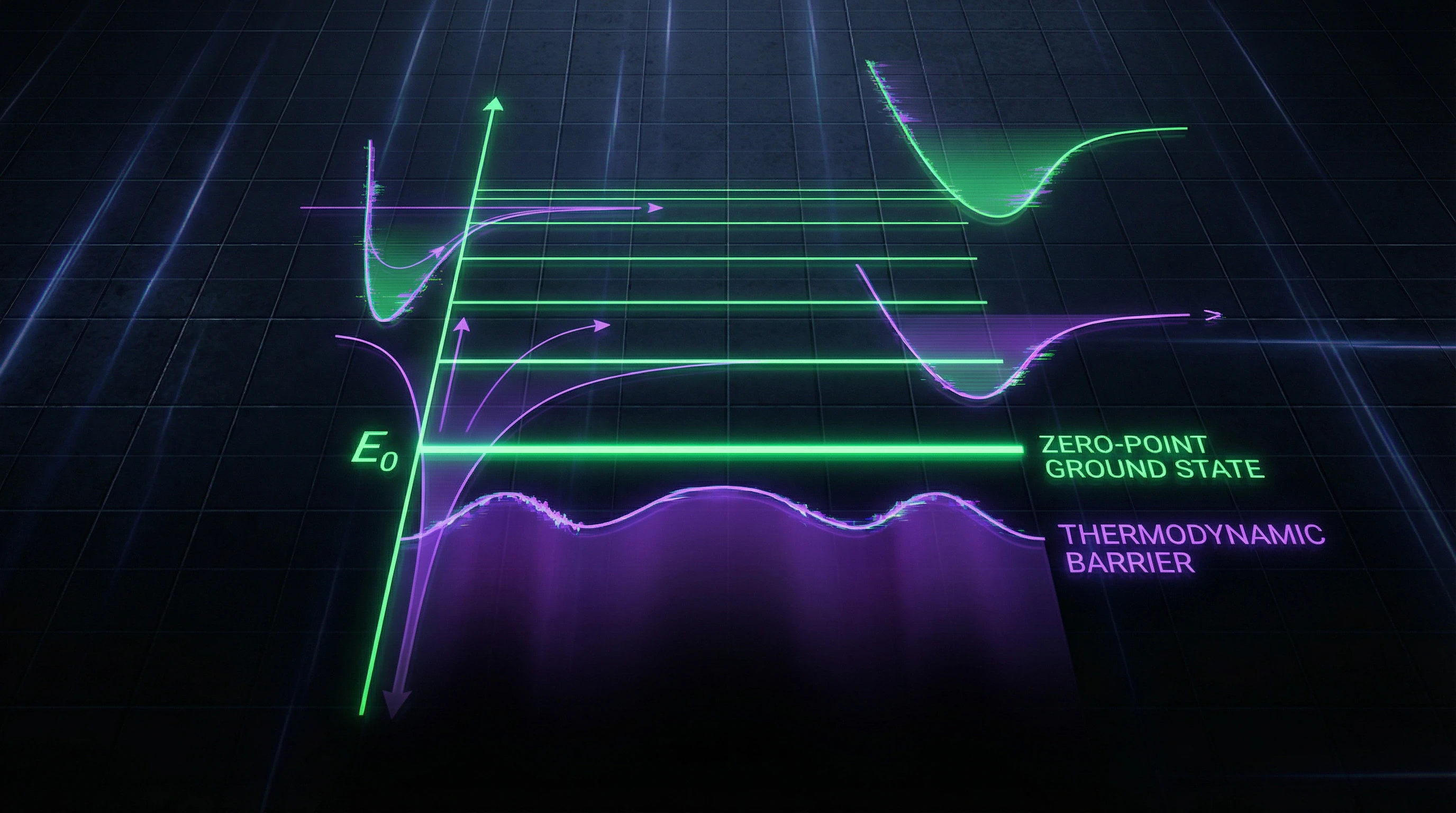
The promise of "zero-point energy" as a power source is a promise to extract energy from the ground state of a system. This is equivalent to trying to pump water from the very bottom of a well when there's nowhere lower to go.
Thermodynamic Boundaries: Why Extraction is Impossible
The idea that this energy can be used as a power source is in direct conflict with the modern understanding of zero-point physics.
| Principle | Consequence |
|---|---|
| Second Law of Thermodynamics | Energy is extracted only when a gradient exists—a difference between high and low energy states |
| Zero-Point Energy by Definition | The minimum state below which the system cannot descend |
| Conclusion | Extracting energy from the vacuum violates fundamental conservation laws |
Attempting to extract energy from the vacuum is analogous to trying to build a perpetual motion machine of the first kind—a device that produces work without external energy input. Physics does not prohibit the existence of zero-point energy, but it categorically prohibits its use for performing useful work.
Steel Man: Five Arguments Used by "Vacuum Energy" Sellers
To understand the mechanism of deception, we need to examine the most convincing arguments from proponents of zero-point energy extraction. The "steel man" method requires presenting the opponent in their strongest form — only then do the true weaknesses of the position become apparent. More details in the section Genetics Myths.
🎯 Argument One: The Casimir Effect as Proof of Reality
ZPE technology proponents cite the Casimir effect — an experimentally confirmed phenomenon where two uncharged metal plates in a vacuum attract each other. This attraction arises from the difference in density of virtual particles between the plates and outside them.
The argument goes: if vacuum energy can create a measurable force, then it can be used to perform work.
The problem: the Casimir effect does demonstrate the reality of zero-point energy, but doesn't prove the possibility of extracting it for useful work. The Casimir force arises from a gradient in vacuum energy, but creating this gradient requires external work (bringing the plates together). The energy that can be "extracted" when bringing the plates together doesn't exceed the energy spent on their initial separation.
🎯 Argument Two: Quantum Fluctuations as an Inexhaustible Source
The second popular argument is based on the constancy of quantum fluctuations: the vacuum continuously generates virtual particles, therefore it's an inexhaustible energy source that can be "tapped" by a device. This argument exploits the misunderstanding of the difference between energy existing in a system and energy available for extraction.
- Virtual particles exist for a time determined by Heisenberg's uncertainty principle.
- They cannot be "captured" to perform macroscopic work.
- Attempting to extract energy from these fluctuations is equivalent to trying to build a water wheel on waves moving in all directions simultaneously — the average energy flow equals zero.
🎯 Argument Three: Analogy with Other "Impossible" Technologies
Fraudsters often use historical analogies: heavier-than-air flight was once considered impossible, and now we have airplanes. Similarly, zero-point energy seems impossible today but will become reality tomorrow. This argument appeals to progress and the openness of the scientific method.
- Critical Error
- Flight didn't violate fundamental laws of physics — it only required an engineering solution within known laws of aerodynamics. Extracting energy from a system's ground state violates the second law of thermodynamics — not a technological limitation, but a fundamental principle confirmed by all experiments over the past 150 years.
- The Difference Between "Technically Difficult" and "Physically Impossible"
- Is absolute. The first is overcome by engineering, the second is not.
🎯 Argument Four: Classified Research and Conspiracy Theory
When scientific arguments are exhausted, fraudsters turn to conspiracy theory: the technology works, but oil companies and governments suppress research to maintain control over the energy market. This argument is untestable by definition — the absence of evidence is explained by the conspiracy itself.
Logical problem: if the technology worked, it would be impossible to suppress globally. Physical laws are the same in all countries, and any working technology would be independently reproduced in dozens of laboratories. The history of science shows: truly revolutionary discoveries (X-rays, radioactivity, superconductivity) spread rapidly despite any attempts at control.
🎯 Argument Five: Obscure Mathematics as Proof
The most sophisticated fraudsters provide "mathematical models" and "theoretical calculations" demonstrating the possibility of energy extraction. These documents are saturated with equations, Greek letters, and references to quantum field theory, creating an illusion of scientific rigor.
| Sign of Fraud | What's Actually Happening |
|---|---|
| References to quantum field theory without context | Asymptotics of zero-point oscillations are studied in the context of non-ideal plasma (S003), but have no relation to energy extraction |
| Hidden errors in calculations | Improper approximations, ignoring boundary conditions, substitution of concepts |
| Absence of peer review | None of these models have passed peer review in serious physics journals |
The difference between persuasiveness and truth is the key trap. Fraudsters know: most people don't check the math, and complexity itself creates an impression of authority. This works until someone asks them to explain every step.
Evidence Base: What Modern Physics Says About Zero-Point Energy
The scientific consensus is clear: zero-point energy is real, but its use as an energy source is impossible. Let's examine the key experimental and theoretical findings. More details in the Pseudopsychology section.
📊 Experimental Confirmation of ZPE Existence
Zero-point energy is observed in numerous physical systems. Research on phonon energy in compressed crystalline noble gases demonstrates quantum effects at low temperatures (S001). These experiments confirm quantum mechanical predictions about the minimum energy of the ground state.
The Casimir effect, first measured in 1948, remains the most direct evidence of vacuum energy reality. Modern experiments measure the Casimir force with sub-percent accuracy, fully consistent with quantum field calculations.
No experiment has demonstrated net energy extraction from the vacuum — all observed effects require external energy input.
🧪 Thermodynamic Constraints: Why the Second Law Cannot Be Overcome
The second law of thermodynamics states that the entropy of an isolated system cannot decrease. Extracting energy from the ground state is equivalent to reducing entropy without compensation — a direct violation of this law.
The concept of "available energy" (Gibbs or Helmholtz free energy) formalizes the constraint: work can only be extracted from the difference between a system's current state and its equilibrium state. Zero-point energy is by definition the energy of the equilibrium state at absolute zero temperature — a state below which the system cannot descend.
- A system cannot go below its ground state
- Ground state = equilibrium state
- Work is extracted only from deviation from equilibrium
- Therefore, extracting ZPE violates the second law
🔎 Analysis of Claims About "Working" ZPE Devices
Over recent decades, dozens of devices allegedly extracting energy from the vacuum have been announced. None have passed independent verification.
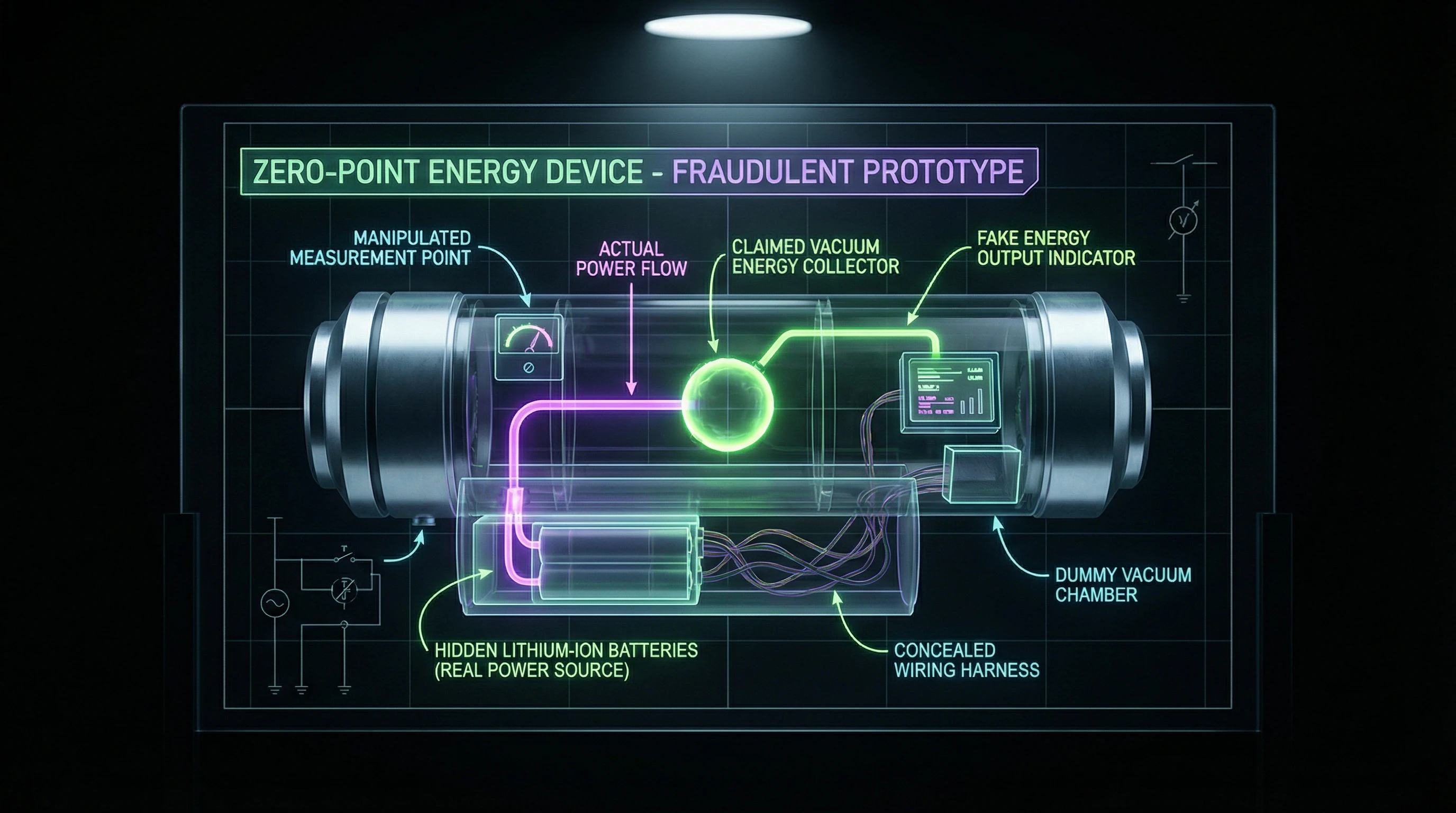
The typical pattern: demonstration under inventor-controlled conditions, refusal of independent testing under the pretext of "protecting intellectual property," disappearance after collecting investments. Analysis of claimed devices invariably reveals hidden energy sources — batteries, capacitors, external electromagnetic fields — or measurement errors creating the illusion of excess energy.
| Feature | Legitimate Research | ZPE Fraud |
|---|---|---|
| Independent verification | Welcomed, results reproducible | Declined, citing "IP protection" |
| Energy balance | Fully accounted, sources explicit | Hidden batteries, capacitors, external fields |
| Publication of results | Peer-reviewed journals, open data | Only press releases and YouTube videos |
| Scaling | Gradual, with explanation of limitations | Promise of "soon" without technical details |
📈 Fraud Statistics: Scale of the Problem
Precise statistics on financial losses from "alternative energy" fraud are unavailable, as many victims don't report crimes due to shame. However, analysis of public cases shows: a typical scheme attracts between 100 and 10,000 investors, each investing from $1,000 to $100,000.
Cumulative losses from a single scheme can reach tens of millions of dollars. Zero-point energy schemes fall into the category of large-scale investment fraud, where stakes are significantly higher than selling ineffective homeopathic remedies or devices with questionable efficacy.
- Why ZPE fraud is particularly dangerous
- Uses real physical phenomena (Casimir effect, quantum fluctuations) to lend legitimacy to fiction. Victims often have technical education and believe they understand the subject.
- Where to look for red flags
- Refusal of independent verification, promises of "revolutionary breakthrough," demands for investment before demonstration, absence of publications in peer-reviewed journals, appeals to conspiracy of scientists.
The Deception Mechanism: How Quantum Terminology Disables Critical Thinking
The success of zero-point energy fraud is based not on the quality of scientific arguments, but on psychological mechanisms that exploit cognitive vulnerabilities in potential victims. Learn more in the Mental Errors section.
🧬 The "Scientific Halo" Effect: When Complexity Replaces Proof
The use of quantum terminology creates a "scientific halo"—a cognitive bias where the complexity of an explanation is perceived as proof of its validity. Adding irrelevant neuroscientific information to psychological explanations significantly increases their perceived credibility, even when this information adds no explanatory power.
Fraudsters exploit this effect by saturating presentations with terms like "quantum fluctuations," "vacuum energy," "nonlocality," and "superposition." To someone without a physics background, these terms sound impressive and create the illusion of deep understanding possessed by the "inventor."
- Critical thinking is suppressed by fear of appearing ignorant
- Complex terminology becomes a barrier to fact-checking
- People prefer to remain silent rather than ask a "stupid" question
- Absence of objections is interpreted as agreement
🔁 The Confirmation Loop: How the Illusion of Consensus Is Created
ZPE fraud schemes create an ecosystem of mutually reinforcing sources: websites, forums, "scientific" conferences where technology proponents cite each other. This creates the illusion of scientific consensus for outside observers unfamiliar with actual scientific literature.
A victim conducting "research" finds dozens of sources confirming the technology's feasibility. The confirmation loop closes: each new "source" found strengthens confidence, even though all these sources originate from a single fraudulent network.
A few skeptical voices are easily dismissed as "closed-minded skeptics" or "agents of oil companies." Dissenting voices in the echo chamber are perceived as hostile.
⚙️ Exploiting Hope: The Energy Crisis as a Psychological Lever
ZPE fraud exploits legitimate concerns about climate change, energy security, and fossil fuel depletion. The promise of "clean, unlimited energy" resonates with a deep desire to solve these problems.
When a solution to a problem seems critically important, people lower their standards of evidence. "What if it's true?" becomes sufficient justification for investment, even in the absence of convincing proof.
- Artificial Urgency
- "Invest now before the government shuts down the project"—creates pressure to make decisions without analysis.
- Emotional Appeal
- The idea of saving the planet suppresses rational analysis of the technology's feasibility.
- Cognitive Dissonance
- A person who has already invested money or reputation begins actively seeking confirmation to justify their choice.
Conflicts and Uncertainties: Where Physicists Disagree (and Where Everyone Agrees)
Scammers exploit areas of scientific uncertainty while ignoring areas of solid consensus. The distinction between them is key to debunking. More details in the Psychology of Belief section.
🧩 Open Questions in Vacuum Physics
Vacuum physics contains unsolved problems. The cosmological constant problem — a discrepancy between the theoretically calculated vacuum energy density and the observed value by 120 orders of magnitude — remains one of the greatest mysteries of modern physics.
The nature of dark energy, which comprises 68% of the Universe's energy, is unknown. These uncertainties are real and actively researched.
However, they have no bearing on the possibility of extracting energy from the vacuum for practical use. The cosmological constant problem concerns the global vacuum energy of the Universe, not local energy extraction under laboratory conditions.
✅ Areas of Solid Consensus: What Is Not in Doubt
Despite open questions, there are areas of absolute consensus. The Second Law of Thermodynamics has no known exceptions in macroscopic systems.
- All attempts to build a perpetual motion machine of the second kind (a device that extracts energy from a single heat reservoir) have failed.
- Zero-point energy is the minimum energy of a system — this is a consequence of quantum mechanics, confirmed by all experiments.
- The concept of zero-point energy as a quantum mechanical phenomenon is accepted by physicists and is not considered controversial.
What is controversial is only the claim that it can be extracted, and this controversy was settled long ago: extraction is impossible without violating fundamental laws.
🔬 Why the Absence of Publications in Peer-Reviewed Journals Is Critical
Not a single device claimed to be a zero-point energy generator has been described in a peer-reviewed physics journal with positive results. This is not coincidence and not conspiracy.
- Peer Review
- A process in which independent experts verify methodology, calculations, and conclusions before publication. This is a fundamental quality control mechanism in science.
- Absence of Publications Means
- Either inventors do not submit their results for verification (which is suspicious for a revolutionary discovery), or they do submit but the work is rejected due to fundamental errors.
References to "alternative" journals or conferences that do not require peer review are a classic marker of pseudoscience. Legitimate discoveries go through the standard process, even if they contradict accepted views.
When an inventor avoids peer review, they are avoiding not a "conspiracy" but verification. This is equivalent to refusing diagnosis before surgery.