 ♾️ Free Energy and Perpetual Motion Machines
Free Energy: From Neuroscience to Thermodynamic Mythsλ
Distinguishing legitimate scientific concepts of free energy in physics and neuroscience from pseudoscientific claims about perpetual motion machines and over-unity devices
Overview
The term "free energy" operates in two non-intersecting worlds: 🧠 in neuroscience, Karl Friston describes how the brain minimizes uncertainty, while in thermodynamics it refers to Gibbs and Helmholtz energy. Pseudoscientific movements exploit this term for perpetual motion machines and "over-unity" devices that violate the laws of thermodynamics. Distinguishing legitimate science from myths is a matter of cognitive hygiene.
🛡️
Laplace Protocol: This section strictly delineates three contexts of the term "free energy": (1) the free energy principle in cognitive neuroscience, (2) thermodynamic functions in physical chemistry and materials science, (3) pseudoscientific claims about perpetual motion machines. All sources are verified for academic credibility, pseudoscientific assertions are explicitly marked and refuted.
Reference Protocol
Scientific Foundation
Evidence-based framework for critical analysis
Protocol: Evaluation
Test Yourself
Quizzes on this topic coming soon
Sector L1
Articles
Research materials, essays, and deep dives into critical thinking mechanisms.
♾️ Free Energy and Perpetual Motion Machines⚡
Deep Dive
The Free Energy Principle in Neuroscience: How the Brain Predicts Reality
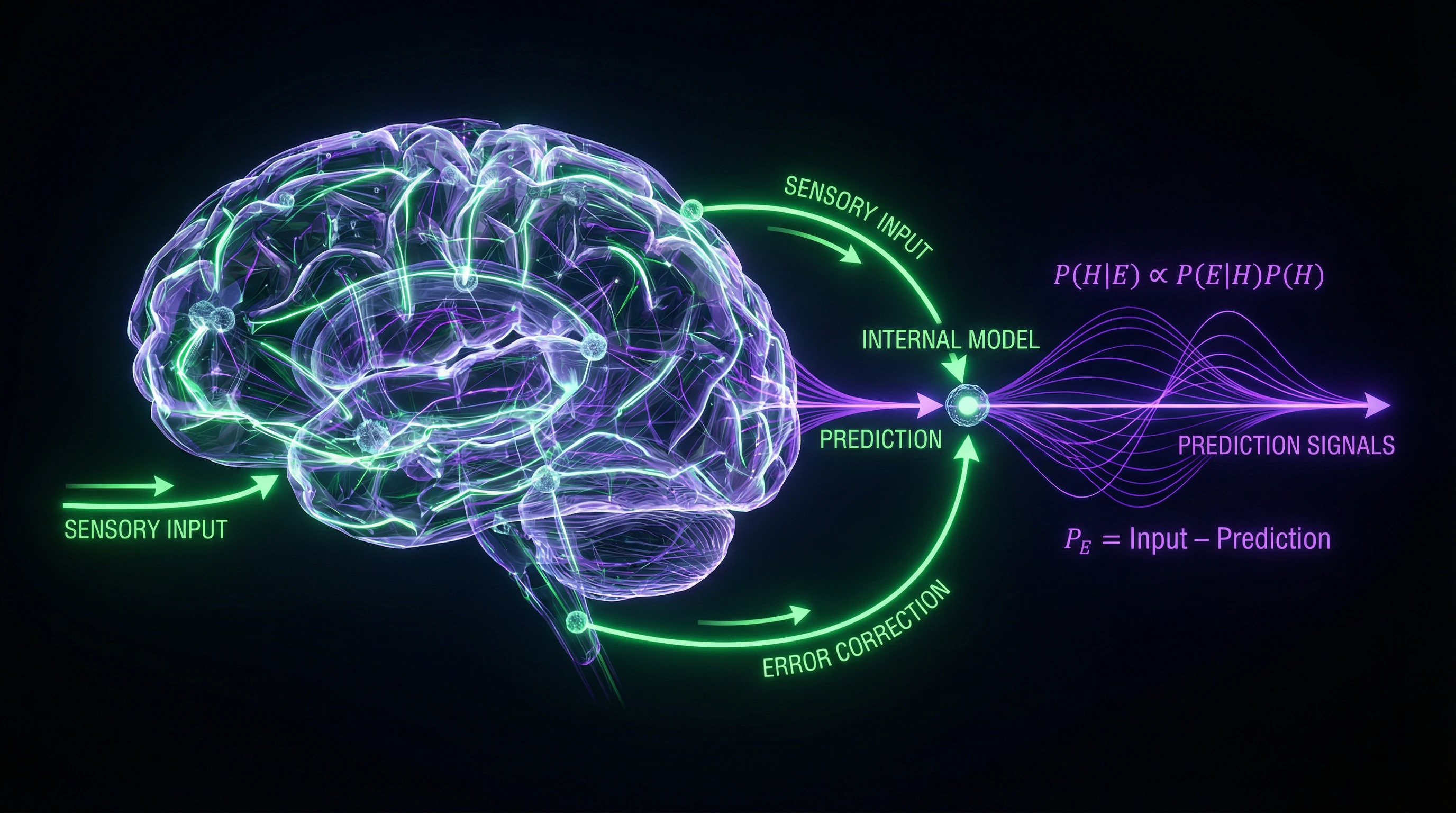
The Free Energy Principle, developed by Karl Friston, explains brain function through Bayesian inference and uncertainty minimization. The brain constantly generates predictions about the state of the surrounding world and updates them based on sensory data, striving to minimize the difference between expected and observed—the "free energy."
This approach unifies perception, learning, and decision-making into a single computational framework, where all cognitive processes are directed toward reducing the entropy of the organism's internal states.
- Free Energy in Neuroscience
- An information-theoretic quantity measuring the mismatch between an internal model of the world and actual sensory data. Not physical energy, but a measure of uncertainty.
- Bayesian Inference Machine
- The brain maintains probabilistic models of the causes of sensory inputs and updates them through predictive coding. Minimizing free energy is equivalent to maximizing Bayesian evidence for the internal model.
- Dual Process of Adaptation
- The organism not only passively perceives the world but actively changes it in accordance with its expectations—perceptual inference plus active inference.
Mathematical Foundation
Free energy F is defined as an upper bound on the surprise of sensory data: F = −ln P(s|m), where s represents sensory data and m represents the internal model. By minimizing F, the brain simultaneously improves prediction accuracy and optimizes actions to obtain expected sensory data.
The organism maintains homeostasis not through passive perception, but through active reconstruction of the environment in accordance with its internal model.
Applications in Artificial Intelligence and Cognitive Modeling
Neural network architectures based on predictive coding and variational inference demonstrate unsupervised learning and adaptation to new tasks with minimal examples. Active inference models are used in robotics to create agents capable of autonomously exploring environments and forming internal representations of their structure.
| Application Domain | Mechanism | Outcome |
|---|---|---|
| Psychological Phenomena | Disruptions in balance between predictions and sensory data | Explanation of illusions, attention, consciousness |
| Clinical Disorders | Imbalance in predictive coding | Modeling of schizophrenia, autism |
| Artificial Intelligence | Variational inference and predictive coding | Flexible, adaptive AI systems |
The Free Energy Principle provides a unified language for describing biological and artificial intelligence, opening the path to creating more adaptive systems.
Thermodynamic Free Energy in Physics and Chemistry: Foundation of Molecular Calculations
In physical chemistry, free energy is the portion of a system's internal energy available to perform useful work under specific conditions. Two main types: Helmholtz energy (F) for isothermal processes at constant volume and Gibbs energy (G) for processes at constant temperature and pressure.
These quantities predict the direction of chemical reactions, phase transitions, and equilibrium states of molecular systems.
Helmholtz and Gibbs Energy: Definitions and Applications
Helmholtz energy: F = U − TS, where U is internal energy, T is temperature, S is entropy. It is minimized at thermodynamic equilibrium for isochoric-isothermal processes and connects microscopic states with macroscopic properties in statistical mechanics.
Gibbs energy: G = H − TS = U + PV − TS, where H is enthalpy, P is pressure, V is volume. Spontaneity criterion: ΔG < 0 for spontaneous reactions, ΔG = 0 for equilibrium.
- Calculation of equilibrium constants: ΔG° = −RT ln K (K is the equilibrium constant)
- Electrochemistry: ΔG = −nFE (n is the number of electrons, F is Faraday's constant, E is potential)
- Prediction of product yields and optimization of synthesis conditions
- Design of electrochemical devices
Free Energy Calculations in Molecular Dynamics and Biopolymers
In computational chemistry, free energy calculations are essential for modeling ligand-protein binding, predicting biopolymer structure, and studying phase transitions. Molecular dynamics methods use thermodynamic integration and free energy perturbation (FEP) to calculate free energy differences between system states.
Calculation accuracy is critical for rational drug design: predicting the binding affinity of potential drugs to target proteins is essential.
For biopolymers, free energy determines the stability of secondary and tertiary structures. Calculations include van der Waals interactions, electrostatics, hydrogen bonds, and entropic effects of conformational freedom.
Modern methods—umbrella sampling and metadynamics—overcome energy barriers and explore rare events: protein folding, conformational transitions. These approaches provide quantitative understanding of molecular mechanisms of biological processes at the atomistic level.
Free Energy in Materials Science: Predicting Stability and Phase Diagrams
In materials science, first-principles free energy calculations enable prediction of thermodynamic stability of crystalline structures, phase transitions, and alloy properties. Density functional theory (DFT) methods combined with the quasiharmonic approximation account for electronic and vibrational contributions at finite temperatures.
These calculations are critical for developing new materials: high-temperature alloys, thermoelectrics, materials for energy applications.
First-Principles Calculations of Material Stability
First-principles calculations solve the Schrödinger equation for the electronic subsystem of a crystal via DFT, obtaining the ground state energy at zero temperature. Temperature effects are added through the vibrational contribution, computed from the phonon spectrum: F_vib = k_B T Σ ln[2sinh(ℏω_i/2k_B T)], where ω_i are phonon mode frequencies.
The quasiharmonic approximation accounts for the volume dependence of phonon frequencies, modeling thermal expansion and thermoelastic properties.
- Construction of phase diagrams for binary and multicomponent systems through the condition of equal chemical potentials at phase boundaries
- Calculations of defect and grain boundary formation energies for understanding degradation mechanisms
- Microstructure optimization through prediction of stable atomic configurations
- For high-entropy alloys: combination of first-principles calculations with statistical thermodynamics (CALPHAD) to predict unique property combinations
Influence of Electronic and Thermal Contributions on Phase Transitions
Phase transitions are determined by competition between the electronic contribution (dominant at low temperatures) and the entropic contribution from lattice vibrations (increases with temperature). The electronic contribution includes chemical bonding energy, exchange interactions in magnetic materials, and correlation effects.
Vibrational entropy can stabilize high-temperature phases with higher symmetry, even if their ground state energy is higher.
The BCC-to-FCC transition in iron at 1185 K demonstrates this mechanism: the FCC phase is stabilized by higher vibrational entropy, despite having higher energy at T = 0 K.
In alloys, ordering of different atomic species is controlled by the balance between enthalpic gain from ordering and entropic losses, described by Ising-type models with parameters from first-principles calculations. Electronic entropy, associated with thermal broadening of the Fermi-Dirac distribution, affects electronic heat capacity and thermoelectric properties of metals and semiconductors.
Pseudoscientific Claims About "Free Energy" and Perpetual Motion Machines
Perpetual Motion Machines and Violations of Thermodynamic Laws
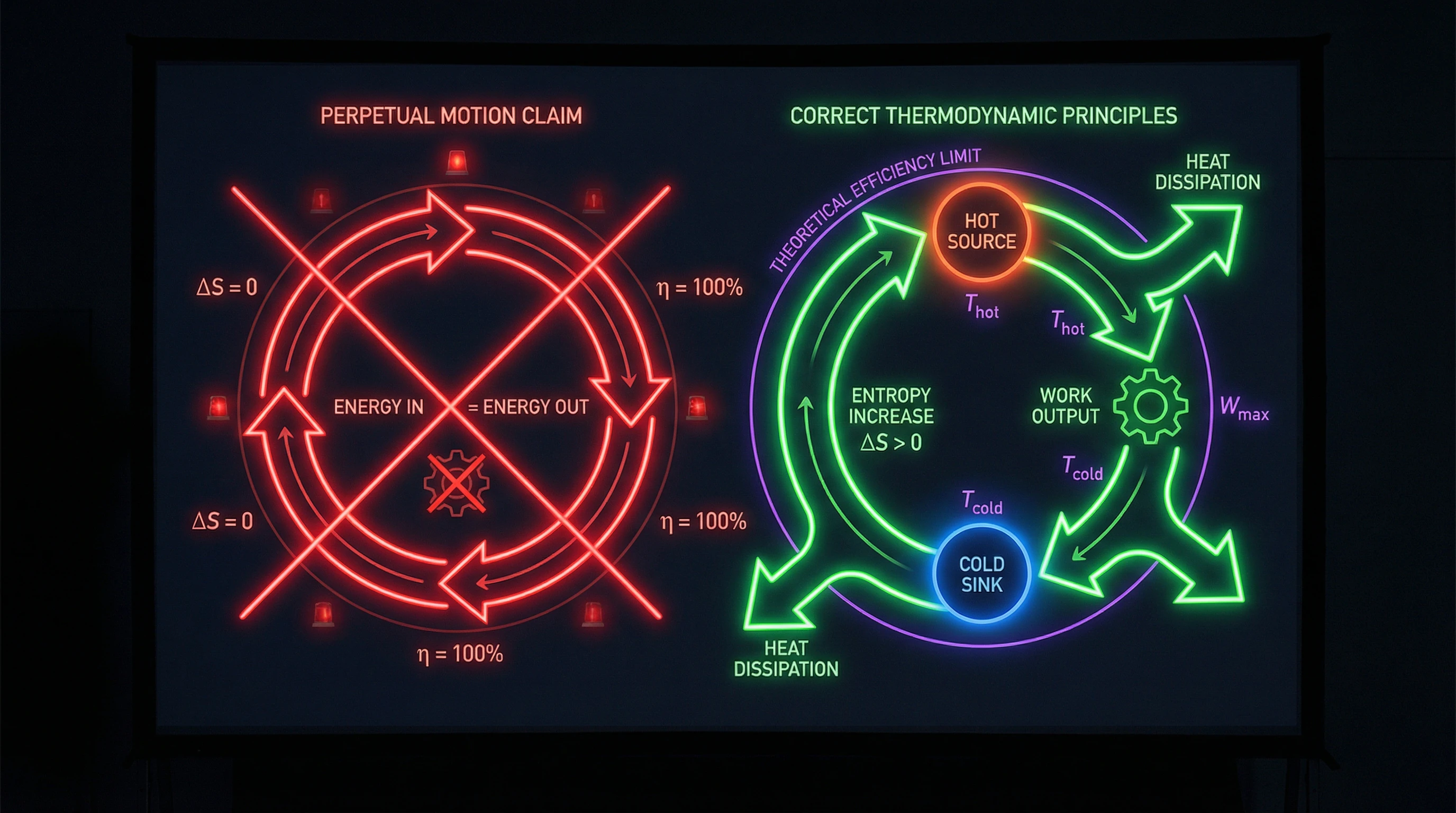
Pseudoscientific concepts of "free energy" are based on claims of creating devices that produce energy without an external source or with efficiency exceeding 100%. Such claims directly contradict the first law of thermodynamics (law of conservation of energy): energy cannot be created or destroyed, only transformed from one form to another.
Perpetual motion machines of the first kind allegedly produce work without consuming energy, while those of the second kind supposedly convert heat entirely into work without releasing energy to a heat sink. Both are physically impossible according to established thermodynamic principles. Numerous patent applications and public demonstrations of such devices invariably turn out to be either fraud or the result of measurement errors that fail to account for hidden energy sources (batteries, electromagnetic fields, chemical reactions).
Second law of thermodynamics: the entropy of an isolated system cannot decrease. This makes it impossible to create a device that cyclically converts thermal energy into mechanical work with 100% efficiency.
Any real heat engine inevitably releases part of its energy to the environment. Its maximum theoretical efficiency is limited by the Carnot cycle, which depends on the temperatures of the hot and cold reservoirs. Claims of violating these fundamental laws require extraordinary evidence, which has never been provided in peer-reviewed scientific literature.
Critical Analysis and Debunking Myths About Over-Unity Devices
Critical analysis of "free energy" claims reveals recurring patterns: absence of reproducible experiments, disregard for established physical laws, appeals to conspiracy theories about technology suppression by large corporations or governments.
- Professional physicists demonstrate that publicly presented "over-unity" devices contain hidden energy sources or are based on incorrect measurements.
- Devices based on "magnetic motors" always consume energy overcoming friction, air resistance, and internal losses.
- Such systems are incapable of self-sustaining operation without external energy supply.
The distinction between legitimate research and pseudoscience is critical. Genuine scientific breakthroughs in energy (improved solar cells, thermoelectric materials) are published in peer-reviewed journals with complete methodology descriptions and reproducible results.
Pseudoscientific claims are characterized by secrecy, refusal of independent verification, demands for investment before demonstrating a working prototype, and use of scientific terminology outside its correct context. Secret devices are a classic marker of absent scientific validity.
Distinguishing Science from Pseudoscience in Energy Research
Criteria for Evaluating Quality Sources on Free Energy
Reliable sources on free energy are published in peer-reviewed academic journals, where independent experts verify methodology, data, and conclusions. They contain detailed descriptions of experimental setups, explicit mathematical models, statistical error analysis, and references to prior research.
Authors of legitimate work are affiliated with recognized scientific institutions, have a publication history in their field, and are open to criticism and reproduction of results.
| High Quality | Red Flag |
|---|---|
| Peer-reviewed journals (arXiv.org, ScienceDirect.com) | Absence of peer review or academic affiliation |
| Clear distinction between meanings of the term "free energy" | Conflation of scientific and pseudoscientific definitions |
| Specific physical calculations demonstrating limitations | Appeals to conspiracy theories about technology suppression |
Indicators of Research Reliability and Pseudoscience Red Flags
Reliable research uses established mathematical frameworks: Bayesian inference for the free energy principle, statistical mechanics for thermodynamic calculations. They are reproducible and acknowledge thermodynamic constraints.
Work in computational neuroscience is published in specialized journals, cites Karl Friston's original papers, and applies variational Bayesian inference. Molecular dynamics uses standard packages (GROMACS, AMBER, LAMMPS), describes force fields in detail, and provides statistical error estimates.
Pseudoscience about perpetual motion machines rests on three pillars: violation of energy conservation laws, methodological secrecy, and demands for investment before independent verification.
Pseudoscientific sources misuse terminology, employing "quantum energy," "torsion fields," or "vacuum energy" without correct mathematical definitions. They demand financial investment before verification, refuse to publish in peer-reviewed journals under the pretext of protecting intellectual property, and promise revolutionary results without intermediate publications.
Critical analyses of pseudoscience on technical platforms are valuable when they contain specific physical calculations demonstrating the impossibility of claimed effects. Mechanisms underlying energy devices are revealed through analysis of incentives (financial, social) and cognitive traps, rather than through labels.
Practical Applications of Legitimate Free Energy Research
Free Energy in Drug Development and Protein Engineering
Free energy binding calculations predict the affinity of candidate molecules to target proteins before synthesis and testing. Molecular dynamics methods (FEP, TI) are used by pharmaceutical companies to optimize drug structure, predict solubility, membrane permeability, and enzyme selectivity.
The accuracy of modern calculations reaches 1–2 kcal/mol, corresponding to a 5–10-fold change in binding constant and reducing the number of compounds requiring synthesis.
| Application | Method | Result |
|---|---|---|
| Drug design | FEP, TI | Affinity and selectivity prediction |
| Protein engineering | QM/MM + MD | Mutant stability, thermostability |
| Biocatalysis | First principles | Reaction energy barriers |
In protein engineering, free energy calculations predict the stability of mutant forms, design of thermostable enzymes, and folding mechanisms associated with neurodegenerative diseases.
Quantum mechanics methods combined with classical molecular dynamics model conformational transitions, calculate energy barriers of catalytic reactions, and predict pH effects on protein structure. These approaches are applied in developing biocatalysts for green chemistry, biosensors, and protein nanomaterials.
Predicting Alloy Stability and Material Phase Diagrams
First-principles free energy calculations of crystalline phases predict phase diagrams of multicomponent alloys without lengthy experiments. DFT methods with vibrational entropy calculations through phonon spectra and configurational entropy determine stability regions of different structures depending on temperature and composition.
These approaches are applied in developing high-temperature alloys for aircraft engines, structural materials for nuclear energy, and functional shape-memory alloys.
Accounting for electronic entropy is critically important for metals and semiconductors: temperature broadening of the Fermi-Dirac distribution affects electronic heat capacity, thermoelectric properties, and magnetic phase stability.
Free energy calculations for magnetic materials include contributions from spin fluctuations and magnons, enabling prediction of Curie temperatures and order-disorder phase transitions in magnetic alloys.
Modern materials databases (Materials Project, AFLOW, OQMD) contain results of first-principles free energy calculations for tens of thousands of compounds, providing infrastructure for high-throughput materials screening and accelerating the development cycle of new functional materials.

Knowledge Access Protocol
FAQ
Frequently Asked Questions
This is a theoretical concept by Karl Friston, according to which the brain minimizes free energy through Bayesian inference. The principle explains how the brain processes information, makes predictions, and learns by constantly reducing the difference between expectations and actual signals. It is actively applied in cognitive modeling and AI development.
Helmholtz free energy describes work at constant temperature and volume, while Gibbs free energy describes work at constant temperature and pressure. Both quantities show what portion of a system's internal energy is available to perform useful work. In chemistry, Gibbs free energy is more commonly used to predict the direction of reactions.
They violate the first and second laws of thermodynamics—energy cannot be created from nothing, and entropy always increases. Any device loses energy to friction, heat, and other processes, so efficiency is always less than 100%. All claims of working perpetual motion machines have turned out to be either fraud or measurement errors.
Methods such as thermodynamic integration, umbrella sampling, or metadynamics are used to investigate energy barriers. Calculations allow prediction of protein-ligand binding, conformational stability, and chemical reaction rates. This is a standard tool in drug development and materials science.
Pseudoscientists use this term for hypothetical devices that supposedly produce energy without cost or with efficiency above 100%. Such claims contradict fundamental laws of physics and have no scientific confirmation. The term is used to attract investment in fraudulent projects or sell useless devices.
Check for publication in peer-reviewed journals, presence of mathematical framework, and reproducible experiments. Scientific papers use the term in the context of thermodynamics or neuroscience, while pseudoscientific ones promise perpetual motion machines. Red flags: claims of conspiracies, absence of formulas, promises of revolutionary technologies without evidence.
First-principles free energy calculations predict phase stability, melting temperatures, and phase diagrams of alloys. Electronic contributions and thermal atomic vibrations are accounted for in accurate modeling. This is critically important for developing new materials with desired properties.
Yes, this principle inspires the development of machine learning algorithms that mimic brain function. Systems based on free energy minimization can efficiently learn from incomplete data and make predictions. The approach is actively researched in active inference and robotics.
The second law of thermodynamics requires that some energy always dissipates as heat, increasing entropy. Friction, resistance, radiation, and other processes inevitably reduce efficiency. Even theoretically ideal Carnot cycles don't reach 100% due to temperature limitations.
Binding free energy calculations predict how tightly a drug molecule will attach to a target protein. This allows selection of promising candidates before costly experiments and optimization of drug structures. The method significantly accelerates and reduces the cost of developing new medications.
No, this is a common myth used by pseudoscience proponents to explain the absence of evidence. Scientific research on thermodynamic free energy is published openly in thousands of articles annually. Conspiracy claims typically accompany fraudulent schemes selling non-existent devices.
This is a model in which the brain constantly generates probabilistic predictions about the world and updates them based on sensory data. Minimizing free energy is equivalent to maximizing prediction accuracy while minimizing model complexity. The concept unifies perception, action, and learning into a single theoretical framework.
Zero-point energy exists in quantum physics, but it cannot be extracted to perform work without violating the laws of thermodynamics. It is the minimum energy level of a system, not a source of infinite energy. All claims about devices using vacuum energy lack scientific basis.
As temperature increases, thermal fluctuations of atoms increase system entropy, which lowers free energy and can trigger phase transitions. Accounting for these contributions is critical for predicting melting temperatures, solubility, and stability of crystalline structures. First-principles calculations include both electronic and phononic contributions.
Yes, thermodynamic free energy is a fundamental concept in physics, chemistry, and materials science with thousands of publications. The free energy principle in neuroscience is an active research area for cognitive processes. Pseudoscientific claims about perpetual motion machines have no relation to these legitimate scientific fields.
Magnetic fields do not create energy, they only transform it, with losses from hysteresis, eddy currents, and friction. Maintaining motion requires a constant external energy input. All demonstrations of "working" magnetic motors either conceal the power source or quickly stop due to losses.