 ♾️ Free Energy and Perpetual Motion Machines
Energy Devices: Science vs. Perpetual Motion Mythsλ
We examine real energy harvesting technologies and debunk pseudoscientific claims about "free energy" that violate the laws of thermodynamics.
Overview
In scientific literature, there is no confirmation of "free energy" devices — perpetual motion machines or systems that violate the laws of thermodynamics. The term "free energy" in legitimate science refers to thermodynamic potentials (Gibbs free energy, Helmholtz free energy) or technologies for harvesting energy from the environment: 🧬 solar panels, wind turbines, piezoelectric elements. All real energy technologies obey the first law of thermodynamics — energy is neither created nor destroyed, only transformed with inevitable losses.
🛡️
Laplace Protocol: Any claims about devices with efficiency greater than 100% (over-unity) or about perpetual motion machines contradict fundamental laws of physics and have no reproducible experimental confirmation in peer-reviewed scientific literature.
Reference Protocol
Scientific Foundation
Evidence-based framework for critical analysis
Navigation Matrix
Subsections
[free-energy-perpetual]
Free Energy and Perpetual Motion Machines
Distinguishing legitimate scientific concepts of free energy in physics and neuroscience from pseudoscientific claims about perpetual motion machines and over-unity devices
Explore
[secret-devices]
Secret Devices
Interdisciplinary analysis of the concept of covert devices in the context of machine learning, journalist safety, clinical psychiatry, and IoT technologies
Explore
Protocol: Evaluation
Test Yourself
Quizzes on this topic coming soon
Sector L1
Articles
Research materials, essays, and deep dives into critical thinking mechanisms.
♾️ Free Energy and Perpetual Motion Machines⚡
Deep Dive
Why Perpetual Motion Machines Remain Fantasy: The Iron Laws of Thermodynamics
The idea of a device that produces energy from nothing or operates indefinitely without an external source has captivated humanity for centuries. However, fundamental laws of physics make such devices absolutely impossible.
Understanding thermodynamic principles explains why all claims about free energy contradict scientific consensus — not as opinion, but as description of repeatable facts.
First Law: Energy Doesn't Arise from Emptiness
The first law of thermodynamics states that energy cannot be created or destroyed, only transformed from one form to another. Any device can only convert existing energy — chemical, mechanical, thermal — into another form.
- Claims about machines producing more energy than they consume
- Directly violate the first law. All real energy systems require an input energy stream: fuel, sunlight, motion.
Second Law: Entropy Always Wins
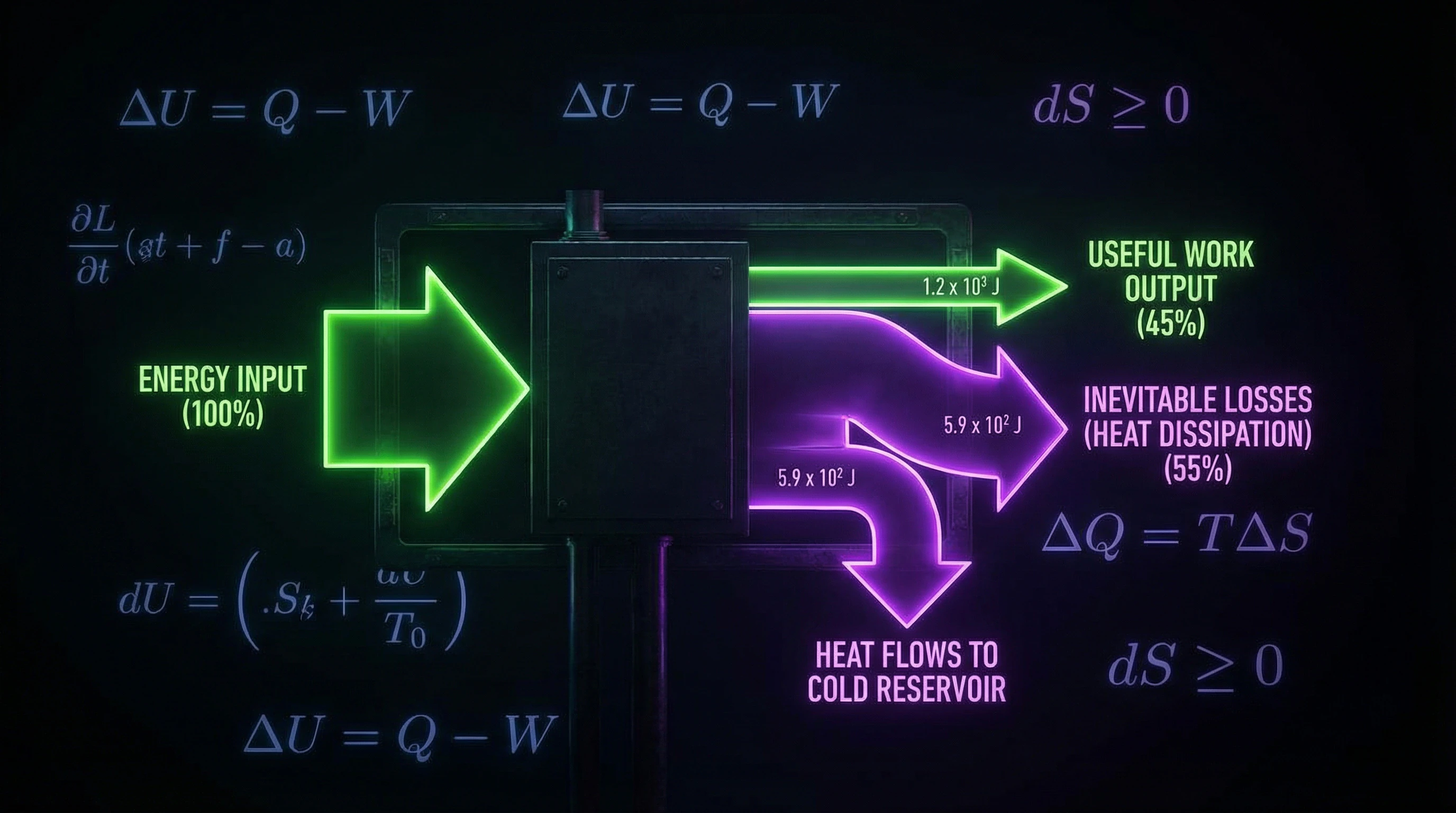
The second law of thermodynamics establishes that entropy in an isolated system always increases, and useful energy inevitably dissipates as heat. Even a perfectly designed machine loses part of its energy to friction, resistance, and thermal radiation.
| Type of Perpetual Motion Machine | Law Violated | Physical Result |
|---|---|---|
| First kind (creates energy) | First law | Impossible — energy doesn't arise from nothing |
| Second kind (operates without losses) | Second law | Impossible — entropy always increases |
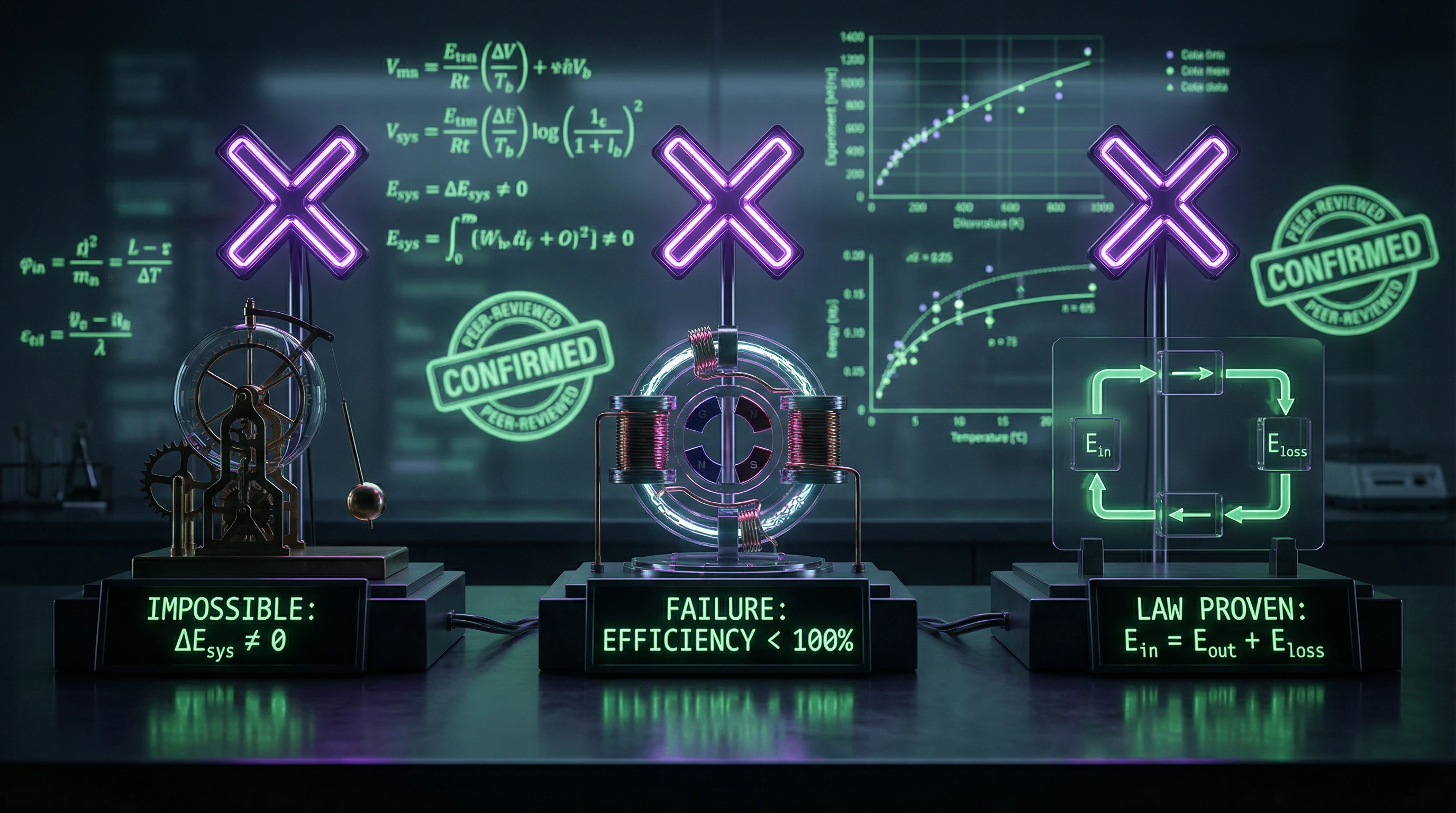
| Over-unity (output > input) | Both laws | Absurd — efficiency always < 100% |
Why Over-Unity Claims Don't Withstand Scrutiny
Devices allegedly demonstrating efficiency coefficients above unity, when independently tested, always reveal hidden energy sources or measurement errors. Typical explanations: unaccounted batteries, electromagnetic fields from the environment, incorrect instrument calibration.
- No such device has ever passed reproducible scientific verification under controlled conditions.
- Patent offices issue patents for thermodynamically impossible inventions because they don't always verify physical feasibility.
- This creates a false impression of legitimacy, though a patent is an administrative tool, not a scientific one.
The mechanism of attraction to such ideas is simple: they promise a solution to the energy crisis without costs. When hope meets ignorance in physics, the perfect environment for pseudoscience is born.
Real Energy Harvesting Technologies: What Works Within Physics
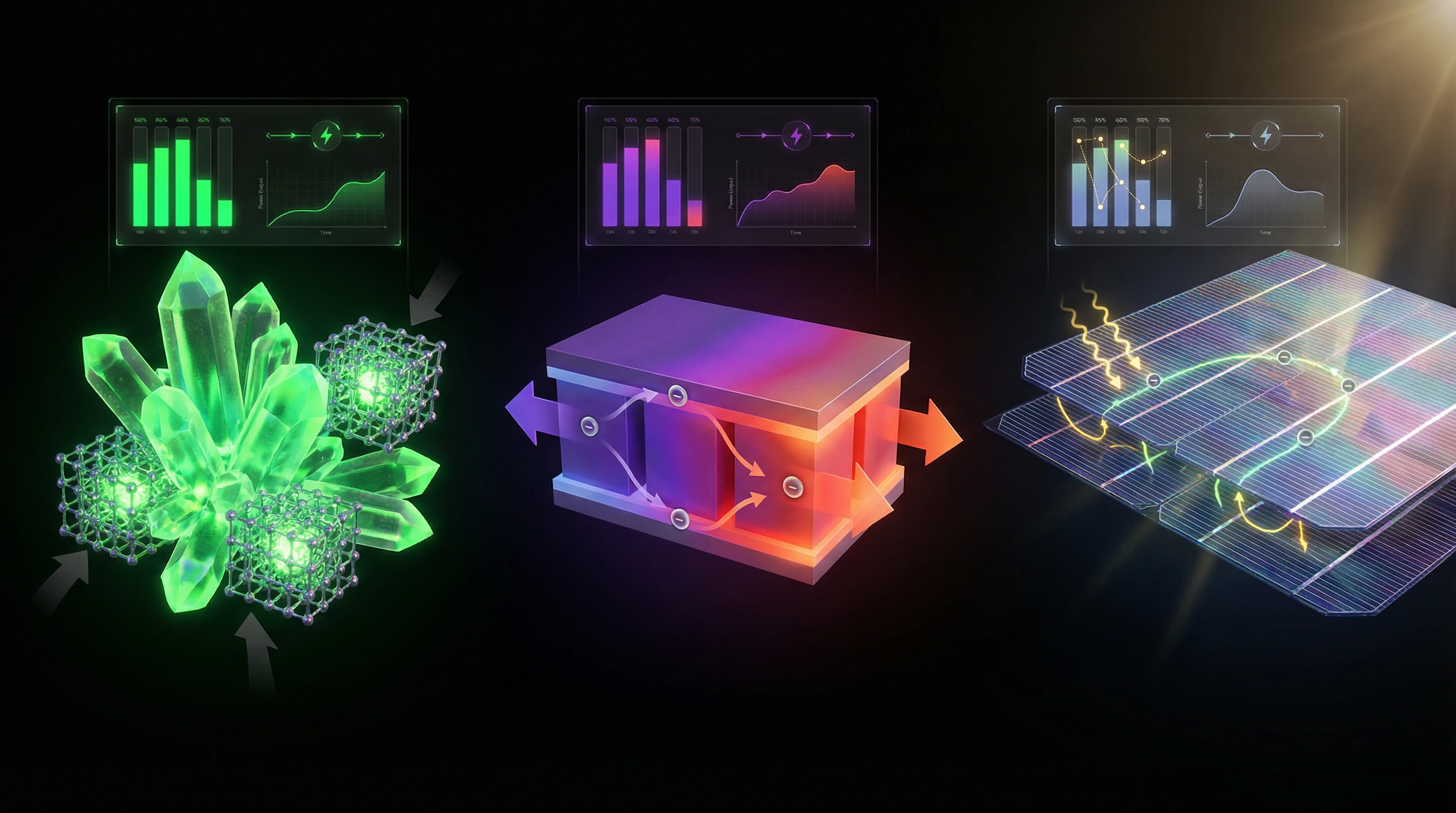
Legitimate energy harvesting technologies convert existing ambient energy into electricity to power low-power devices. These systems don't violate thermodynamics—they capture energy that would otherwise dissipate as waste.
Efficiency is limited by the physical properties of materials and environmental conditions. None of them create energy from nothing.
Piezoelectric Generators: Energy from Mechanical Vibrations
Piezoelectric materials generate electrical charge when mechanically deformed, converting kinetic energy from vibrations, pressure, or motion into electricity.
- Applications
- Sensors, wearable electronics, infrastructure monitoring systems, power from footsteps, machine vibrations, road traffic.
- Power Output
- Microwatts to milliwatts—sufficient for wireless sensors, but inadequate for energy-intensive applications.
- Conversion Efficiency
- Rarely exceeds 10–30% due to mechanical losses and material imperfections.
Thermoelectric Converters: Heat Gradients into Electricity
Thermoelectric generators use the Seebeck effect to convert temperature differences between two surfaces into electrical voltage.
Applied for waste heat recovery in industry, automobiles, and wearable devices powered by body heat.
- Commercial efficiency: 5–8%
- Laboratory prototypes at high gradients: 15–20%
- Requirement: constant heat source and heat sink
- Limitation: unsuitable for autonomous operation without external energy
Photovoltaics: Proven Technology with Known Limits
Solar cells convert light energy into electrical energy through the photovoltaic effect. Commercial efficiency of silicon panels is 15–22%, while multi-junction laboratory structures reach 47%.
The theoretical Shockley-Queisser limit for single-junction cells is approximately 33% due to fundamental photon absorption constraints.
Performance depends on illumination, angle of light incidence, and temperature. Photovoltaics don't create energy, but convert solar radiation, which itself is the result of thermonuclear reactions in the Sun.
Free Energy in Science: A Term Without Magic
The term "free energy" in legitimate science has nothing to do with perpetual motion devices. It refers to thermodynamic potentials and theoretical concepts that describe energy available to perform work in physical and biological systems.
Understanding these concepts is critical for distinguishing science from pseudoscience.
Gibbs and Helmholtz Energy: Available Work in Chemistry
Gibbs free energy (G) and Helmholtz free energy (F) are thermodynamic state functions that define the maximum useful work a system can perform at constant temperature and pressure or volume, respectively.
- The term "free"
- Means "available for work," but obeys the laws of energy conservation without exception.
- Change in ΔG
- Negative for spontaneous processes; total energy of the system and surroundings remains constant.
- Practical application
- A tool for calculating spontaneity of chemical reactions and phase transitions, not an energy source.
Free Energy Principle in Neuroscience: Not About Energy Generation
The Free Energy Principle in cognitive science and neurobiology is a theoretical framework explaining how biological systems minimize uncertainty through Bayesian inference and predictive coding.
The name derives from mathematical analogy with variational free energy in statistical physics, but the application context differs radically—this is a model of brain function, not an energy device.
- In neuroscience, it concerns information theory and statistical mechanics.
- The brain minimizes prediction error, not generating "free energy" in the physical sense.
- Confusion arises from a shared term used across different disciplines with different meanings.
Myths About "Free Energy" and Their Debunking: Why Science Rejects These Claims
Pseudoscientific claims about "free energy" rely on several persistent myths that contradict fundamental laws of physics. These myths exploit misunderstandings of thermodynamics, quantum mechanics, and the history of technology, creating the illusion of conspiracy or hidden discoveries.
The scientific community consistently refutes these claims through reproducible experiments and mathematical proofs, but the myths continue to circulate in popular culture and conspiracy theories.
The Myth of Suppression by Oil Corporations
One of the most common claims is that free energy devices exist but are suppressed by major energy companies and governments. The scientific method requires reproducibility: any working device can be independently tested in thousands of laboratories worldwide.
A breakthrough energy technology would immediately receive recognition from the scientific community and a Nobel Prize—the economic incentives for its implementation would be enormous even for existing energy companies.
Patent offices do issue patents for thermodynamically impossible devices, but this occurs because patent examiners don't always verify compliance with the laws of physics. A patent is not proof of functionality.
Misinterpretation of Nikola Tesla's Work
Nikola Tesla is often cited as an inventor of free energy technologies, but his actual work concerned wireless energy transmission, not creating energy from nothing. Wardenclyffe Tower was designed to transmit electrical power over distance through the atmosphere using existing energy sources—this is energy transfer, not generation in violation of thermodynamics.
| Tesla's Actual Work | Conspiracy Interpretations |
|---|---|
| Wireless energy transmission through the atmosphere | "Free energy from the ether" |
| Alternating current and transformers | "Hidden technologies suppressed by competitors" |
| Experimental projects (unfinished) | "Proof of perpetual motion" |
| Compliance with laws of energy conservation | "Violation of physics hidden from the public" |
Quantum Mechanics and Zero-Point Energy
Zero-point energy does exist as a quantum mechanical effect—the minimum energy possessed by a quantum system even at absolute zero temperature. However, extracting useful work from this energy would violate the second law of thermodynamics: the system is already in its ground state, and further energy reduction is impossible without external intervention.
- Quantum Mechanics and Conservation Laws
- Quantum mechanics does not override the laws of energy conservation—it merely describes them at the microscopic level accounting for probabilistic effects. This means that even at the quantum level, energy cannot be created from nothing.
- Independent Verification of Devices
- All attempts to create devices for extracting zero-point energy have failed independent verification and contained methodological errors in measurements or hidden energy sources.
- Popular Interpretations
- Articles about "quantum engines" often confuse theoretical speculation with experimentally confirmed physics, creating the impression of breakthroughs that don't actually exist.

Artificial Intelligence in Energy Management: Real Optimization Technologies
AI and machine learning increase energy system efficiency not through energy creation, but through optimization of its distribution, storage, and consumption. Algorithms analyze production and demand data, predict peak loads, manage renewable sources, and balance grids in real time.
These technologies already operate at industrial scale with measurable reductions in losses and costs.
Energy System Optimization Through Predictive Analytics
AI-based systems forecast electricity demand with 95–98% accuracy, allowing energy companies to adjust production in advance and avoid excess generation. Algorithms process weather data, historical consumption patterns, calendar events, and social media information.
- In renewable energy, AI predicts generation changes hours and days ahead — critical for integrating unstable sources into the main grid.
- Neural networks identify anomalies and potential equipment failures before they occur, reducing downtime by 20–30%.
Smart Grids and Energy Storage Systems
Intelligent energy systems (smart grids) use distributed algorithms to balance loads across thousands of nodes, automatically redirecting energy from surplus areas to deficit areas.
- Battery and Accumulator Management
- AI determines optimal charging and discharging moments based on price and demand forecasts. Algorithms extend battery lifespan by 15–25%, optimizing cycles and preventing degradation through adaptive temperature management.
- Microgrids and Home Energy Systems
- AI coordinates solar panels, batteries, electric vehicles, and household appliances, minimizing dependence on the central grid and reducing bills by 30–50%.
How to Recognize Pseudoscientific Claims: Criteria for Evaluating Energy Technologies
Distinguishing legitimate energy innovations from pseudoscience is critically important for investors, journalists, and the general public. There exists a set of clear criteria, based on the scientific method and principles of thermodynamics, that allow rapid identification of unreliable claims.
Understanding these red flags protects against financial losses and helps direct attention toward genuinely promising technologies.
Red Flags of Pseudoscience in Energy Claims
Key indicators of pseudoscientific claims: assertions of "over-unity" or efficiency exceeding 100%; promises of unlimited energy from vacuum, ether, or other undefined sources; refusal of independent testing or publication in peer-reviewed journals.
Additional red flags: conspiratorial explanations for lack of recognition ("technology suppression"); requests for investment before demonstrating a working prototype; vague or contradictory explanations of operating mechanisms without mathematical justification.
Legitimate researchers always provide detailed technical specifications, welcome independent verification, and publish results in scientific journals before commercialization.
Appeals to "revolutionary physics" without formal theoretical foundation and use of scientific terminology out of context (quantum, torsion, scalar energy) are reliable signs of bad faith.
Criteria for Evaluating Energy Claims
- Presence of peer-reviewed publications in recognized scientific journals with detailed methodology descriptions
- Independent reproduction of results in multiple laboratories
- Compliance with laws of thermodynamics with clear indication of energy source and efficiency below 100%
- Transparency regarding input and output energy measurements accounting for all losses
- Willingness to undergo testing by independent experts without preconditions
- Existence of working prototypes, not merely theoretical calculations or computer models
Genuine innovations in energy—from thermoelectric generators to perovskite solar cells—always undergo this validation process before commercial deployment.
Legitimate Research Directions in Energy
Real breakthroughs occur in areas that do not violate fundamental laws of physics: improving photovoltaic efficiency (perovskite and tandem solar cells with efficiency up to 30–33%); thermoelectric materials with enhanced figure of merit for converting waste heat.
Also advancing are solid-state batteries with lithium-metal anodes for increased energy density and catalysts for efficient water electrolysis and hydrogen production.
| Direction | Status | Energy Source |
|---|---|---|
| Materials for fusion energy (ITER, private projects) | Active research | Nuclear reaction |
| Graphene-based supercapacitors | Commercialization | Electric field |
| Piezoelectric and triboelectric generators | Prototyping | Mechanical deformation |
All these directions have solid theoretical foundations, are published in Nature, Science, Advanced Materials and other leading journals, and demonstrate measurable progress within known physical constraints.
Knowledge Access Protocol
FAQ
Frequently Asked Questions
In science, "free energy" is a thermodynamic potential (Gibbs or Helmholtz energy) that determines a system's capacity to perform work. It's not free or infinite energy, but rather the portion of a system's internal energy available for use. The term is also used in neuroscience as a theoretical model of brain function.
Perpetual motion machines violate the first and second laws of thermodynamics, confirmed by all experiments over 200+ years. Energy cannot be created from nothing (first law), and any system loses energy due to friction and heat (second law). All claimed devices had hidden energy sources or measurement errors.
Energy harvesting is the collection of small amounts of energy from the environment (vibrations, heat, light) to power low-consumption devices. The technology doesn't create energy but converts already existing dispersed energy into electricity. Used in sensors, wearable electronics, and IoT devices with efficiency up to 10-20%.
No, over-unity devices (with output energy greater than input) don't exist and contradict the law of conservation of energy. All claims about such devices have failed independent verification or contained measurement errors. No device has been reproduced under controlled conditions in the entire history of science.
Piezoelectric generators convert mechanical pressure or vibration into electrical current through crystal deformation. They're used in lighters, pressure sensors, and for harvesting energy from footsteps or vehicle movement. Efficiency is 5-30%, with energy coming from mechanical action, not from "nowhere."
No, this is a conspiracy myth without evidence. Scientists actively research renewable energy, and breakthrough technologies immediately receive recognition (Nobel Prizes). Patent offices register thousands of energy inventions annually, but none violate thermodynamics when verified.
No, Tesla worked on wireless energy transmission, not creating it from nothing. His Wardenclyffe Tower was designed to transmit electricity over distance but required a powerful power plant as a source. Modern myths distort his real achievements in alternating current and radio.
Check for peer-reviewed publications, reproducible results, and compliance with thermodynamics. Red flags: promises of >100% efficiency, refusal of independent verification, references to conspiracies, demands for investor prepayment. Legitimate technologies always publish methodology and undergo expert review.
TEGs convert temperature differences into electricity through the Seebeck effect in semiconductors. Used in spacecraft, remote sensors, and waste heat recovery from engines. Efficiency is 5-8% for commercial devices, with energy coming from thermal gradients, not being created.
No, although quantum zero-point energy exists, extracting it violates thermodynamics and the uncertainty principle. The Casimir effect demonstrates quantum fluctuations but doesn't allow useful work to be obtained. All claims about zero-point energy devices are experimentally unconfirmed.
AI optimizes energy distribution in smart grids, forecasts consumption, and manages batteries for maximum efficiency. Machine learning reduces losses by 10-30% through load balancing and renewable energy integration. AI doesn't create energy—it improves the use of existing energy.
Promising areas include: fusion energy (ITER), perovskite solar cells (25%+ efficiency), solid-state batteries, hydrogen energy, and supercapacitors. All directions comply with thermodynamics and have theoretical foundations. Research is published in Nature, Science, and specialized peer-reviewed journals.
Patent examiners don't always verify thermodynamic validity, focusing on design novelty instead. A patent doesn't confirm functionality—it's a legal document, not scientific validation. Many "free energy" patents exist, but no device works under independent verification.
It's a theoretical model by Karl Friston explaining brain function through minimizing "free energy" (the difference between expectations and reality). The principle relates to Bayesian inference and predictive coding, but has nothing to do with generating electricity. It's a mathematical abstraction for describing biological systems.
The theoretical Shockley-Queisser limit for silicon cells is 33.7%; commercial panels achieve 22-24%. Multi-junction cells for space reach 47%, but are very expensive. Perovskite and tandem technologies promise 30%+ with lower costs, but energy still comes from the Sun, not created from nothing.
Theoretically yes for an ideal reversible system, but practically impossible due to inevitable losses from friction, heat, and resistance. The second law of thermodynamics guarantees entropy increase in real processes. Best modern systems: electric motors 95-98%, turbines 60%, internal combustion engines 40%.