Cryptids vs. Myths: The Boundary No One Can Draw Clearly
Attempts to separate cryptids from myths encounter a fundamental problem: both phenomena serve identical cultural functions and rely on similar mechanisms of belief. According to definitional analysis (S001), cryptids and myths are "essentially the same thing, with minor differences," and when research is conducted, "it becomes clear there is no historical basis for these stories."
The blurring of the boundary between cryptid and myth is not a classification error, but evidence that both categories solve the same problem: filling the void of the unknown with culturally acceptable narrative.
⚠️ Defining Cryptids: Creatures at the Border of Science and Fantasy
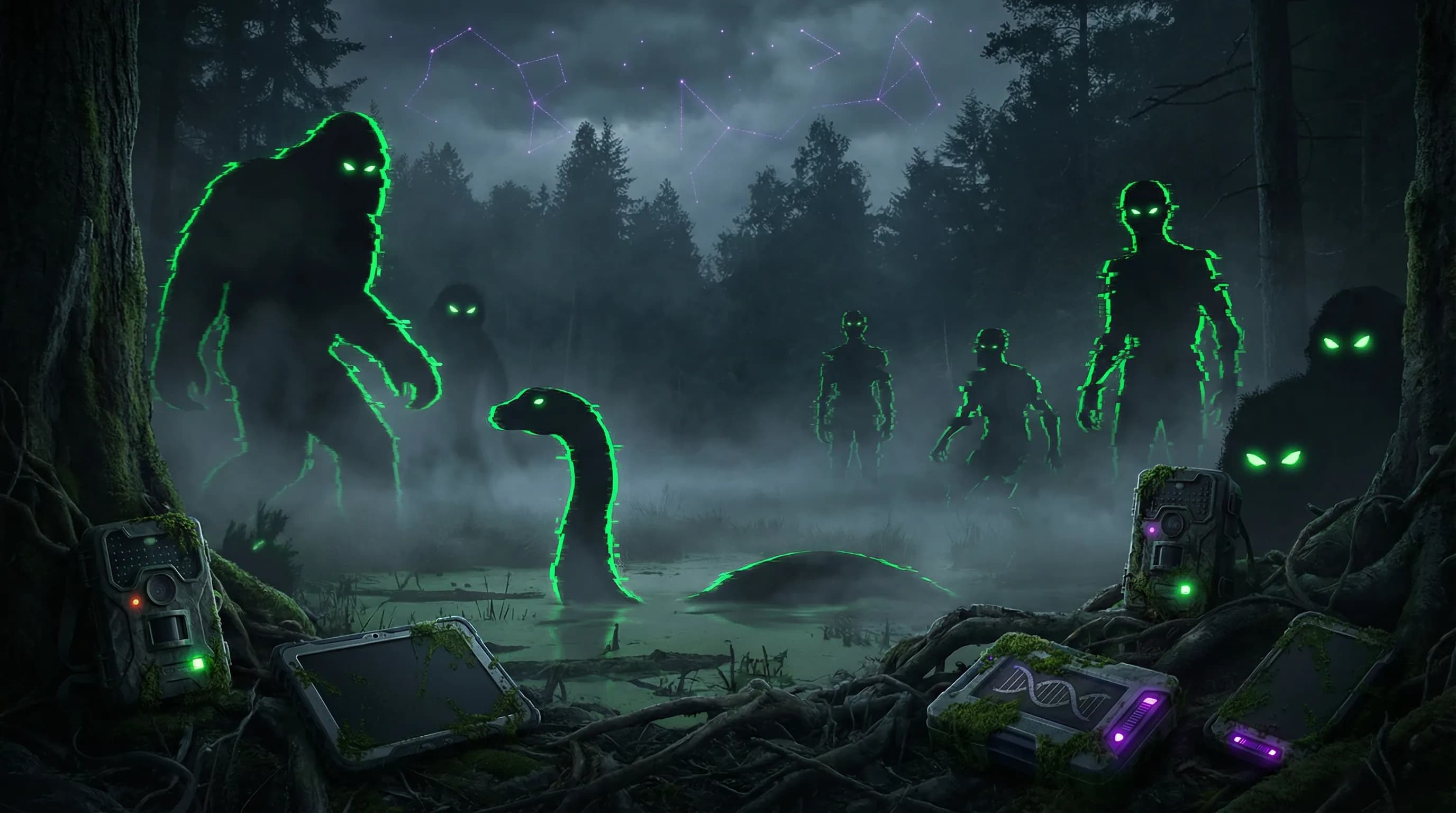
Cryptids are defined as creatures whose existence is proposed based on eyewitness testimony, folklore, or circumstantial evidence, but not confirmed by scientific consensus. The key distinction from mythical creatures is claimed contemporaneity: cryptids are allegedly seen today, their tracks are found, their existence could theoretically be verified through biological methods. More details in the section Genetics Myths.
- Bigfoot (North America)
- A hairy humanoid allegedly inhabiting the forests of the Pacific Northwest.
- Loch Ness Monster (Scotland)
- An aquatic creature, presumably a plesiosaur, allegedly living in Loch Ness.
- Mokele-Mbembe (Amazon)
- A supposed surviving dinosaur in Congolese swamps.
- Skunk Ape (Florida)
- An unknown primate-like cryptid with a distinctive odor.
All these creatures share one thing: they allegedly exist in the present time and can be discovered through scientific methods (S008).
🧩 Myths as Cultural Memory: Traditional Stories Without Claims to Evidence
Myths are traditional narratives, often explaining natural phenomena, cultural practices, or moral principles. Unlike cryptids, myths do not claim contemporary biological reality. The Japanese Kappa, African Mokele-Mbembe, or European dragons function as symbolic figures within cultural context.
However, the boundary blurs when mythical creatures begin to be considered potentially real cryptids—this is exactly what happens with Mokele-Mbembe, which some cryptozoologists consider a surviving dinosaur (S008).
🔁 Legends as an Intermediate Category: Stories Claiming Historicity
Legends occupy an intermediate position: these are stories passed through generations with claimed historical basis, often with exaggerations or embellishments of real events. The distinction between legends and myths can be subtle and depends on context (S001).
| Category | Reality Claim | Time Horizon | Verification Method |
|---|---|---|---|
| Myth | Symbolic, not literal | Timeless or ancient | Cultural analysis |
| Legend | Historical basis + exaggeration | Past with claim to documentation | Historical research |
| Cryptid | Literal biological reality | Present time | Scientific method |
Many cryptids begin as legends—local stories about strange creatures—and then transform into objects of cryptozoological investigation, acquiring pseudoscientific status. This transformation is a key mechanism that allows cultural narrative to gain the appearance of scientific legitimacy.
The Steel Man of Cryptozoology: Seven Arguments That Make You Believe the Impossible
Before examining the evidence base, we need to present the strongest arguments from cryptid proponents. This isn't a straw man, but a steel man — the most convincing version of the position, which we'll then test. More details in the Paranormal Abilities section.
🔎 The Argument from Incomplete Scientific Knowledge: We Discover New Species Every Year
Science regularly discovers new animal species, including large mammals. The mountain gorilla was described in 1902, the okapi in 1901, and the giant squid was long considered a myth.
If we continue to find unknown species, why is the existence of Bigfoot or other cryptids impossible? The argument appeals to the real incompleteness of the planet's biological catalog.
🧬 The Argument from Extinct Species: Cultural Memory of Megafauna
Gigantopithecus — an extinct ape up to 10 feet tall — is considered a possible prototype for Bigfoot and the yeti (S006). The theory suggests that small populations of these creatures could have survived in isolated regions.
Mokele-Mbembe is linked to surviving sauropods. The argument relies on real paleontological findings.
👁️ The Argument from Multiple Witnesses: Thousands of Independent Observations
Cryptozoologists collect thousands of eyewitness accounts from different regions and eras. If hundreds of people independently describe similar creatures, doesn't that point to a real phenomenon?
It's unlikely that all witnesses are mistaken or lying in the same way — that's the essence of the statistical argument. But there's a trap here: the independence of observations is illusory when the cultural narrative has already been formed.
🧪 The Argument from Circumstantial Evidence: Tracks, Hair, Photographs
Physical artifacts exist: footprints of unusual size, hair samples not identified as belonging to known species, photographs and video recordings.
The famous 1967 Patterson-Gimlin film showing an alleged Bigfoot is still debated. Proponents argue that the totality of circumstantial evidence demands explanation.
🕳️ The Argument from Geographic Isolation: Vast Unexplored Territories
Despite satellite mapping, vast territories remain difficult to access: the Amazon rainforests, the Himalayan mountain systems, deep lakes. Cryptids could exist in these isolated ecosystems, avoiding detection.
- Real difficulty of field research in extreme conditions
- Limited resources for systematic searches
- Possibility of populations existing below the detection threshold
⚙️ The Argument from Cultural Universality: Similar Myths in Different Cultures
Stories about humanoid creatures, water monsters, and other cryptids appear in cultures that had no contact with each other (S007). If different peoples independently create similar myths, perhaps they're based on real encounters with unknown animals.
Cross-cultural convergence is used as proof of reality. However, verification is needed here: do the details match, or only the general archetype?
🧭 The Argument from Scientific Conservatism: Science Rejects the New
The scientific community is conservative and rejects evidence of cryptids due to bias, not lack of proof — so proponents claim. The history of science knows examples when new discoveries were met with skepticism.
This argument positions cryptozoologists as scientific revolutionaries fighting dogma. But it's important to distinguish: skepticism toward methodology isn't bias, it's the scientific method.
Evidence Under the Microscope: What Happens When Myths Meet Scientific Method
Let's examine each argument through the lens of available data and scientific methodology. More details in the Torsion Fields section.
📊 Discovery of New Species: Statistics vs. Cryptids
Science discovers approximately 18,000 new species annually. The overwhelming majority are insects, plants, microorganisms, and small marine creatures.
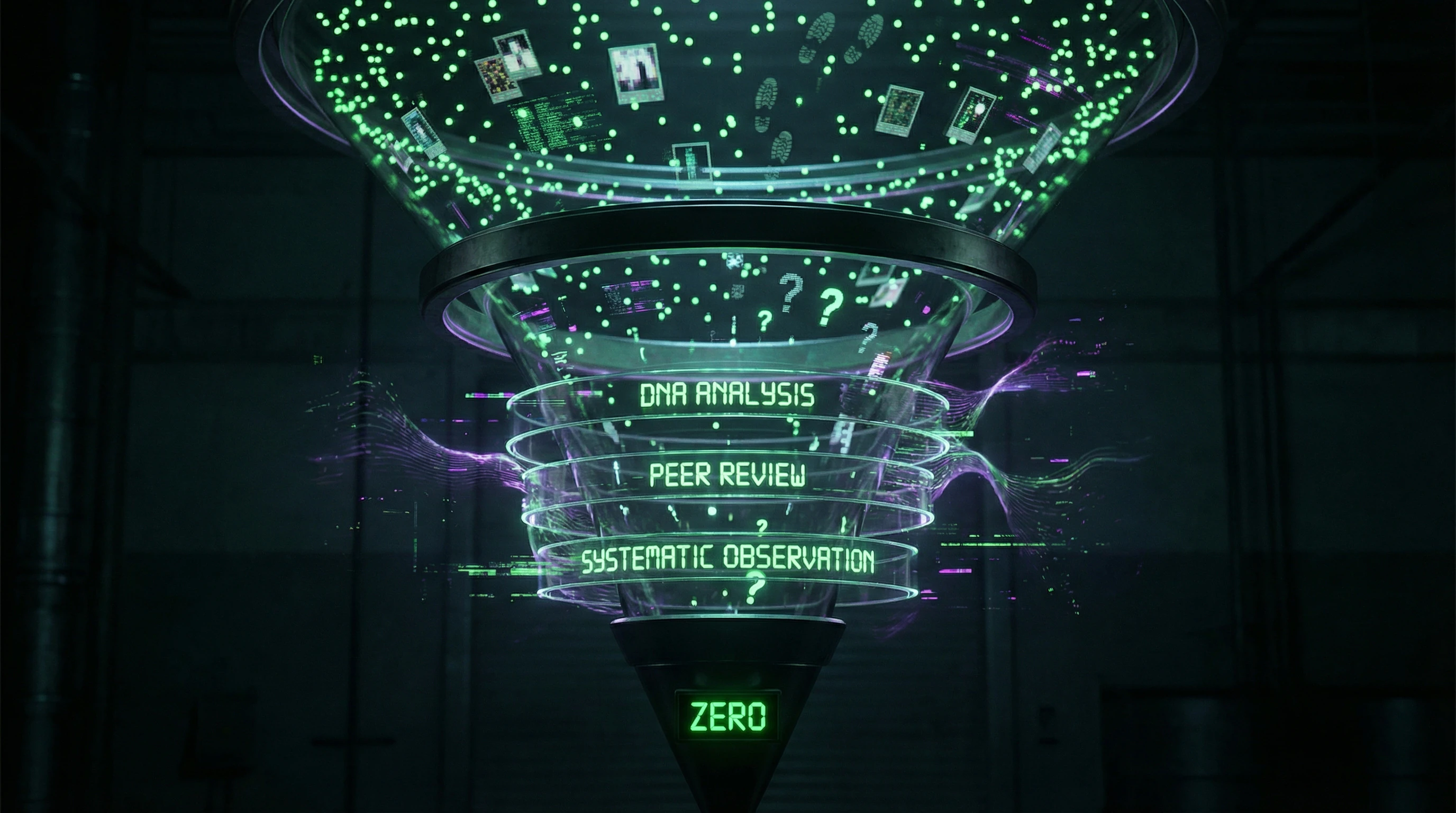
Large terrestrial mammals are discovered extremely rarely, almost always in remote tropical forests or deep-sea zones. Critically: none of these discoveries occurred through cryptozoological methods. All new species were found through systematic biological research with DNA analysis, camera traps, and field expeditions following scientific methodology.
| Discovery Type | Detection Method | Cryptozoology Involved? |
|---|---|---|
| New insect, plant species | Systematic collection, DNA analysis | No |
| Large mammals (rare) | Scientific expeditions, camera traps | No |
| Deep-sea organisms | Bathymetric research, genetics | No |
🧬 Gigantopithecus and the Temporal Gap Problem
The connection between Bigfoot and Gigantopithecus faces a fundamental problem: Gigantopithecus went extinct approximately 100,000 years ago according to paleontological data.
For a population of large primates to survive 100,000 years without a single bone discovery, without genetic traces in the ecosystem, without camera trap detection requires an explanation that contradicts everything known about population biology. The minimum viable population for large mammals is hundreds of individuals. Such a population cannot remain invisible in an era of total monitoring.
The absence of bones, DNA, and ecological traces over 100,000 years isn't just rare. It contradicts the laws of population biology.
⚠️ Eyewitness Testimony: Cognitive Unreliability
Multiple testimonies don't compensate for their low quality. Psychological research demonstrates extreme unreliability of eyewitnesses: pareidolia (seeing patterns in random stimuli), confabulation (unconscious creation of false memories), influence of expectations and cultural narratives.
When people expect to see Bigfoot in a region, they interpret ambiguous visual stimuli (shadows, distant animals) through this lens. The independence of testimonies is questionable: cryptid stories spread through media, creating a cultural template that influences subsequent "sightings."
- Expectation creates perceptual bias
- Ambiguous stimuli are interpreted to favor the hypothesis
- Media narrative reinforces cultural template
- New "sightings" copy previous descriptions
- Result: illusion of independent testimony
🧾 Physical Artifacts: Laboratory Analysis Results
When alleged physical evidence undergoes scientific analysis, results are consistent: hair samples are identified as belonging to known animals (bears, horses, raccoons) or turn out to be synthetic materials.
DNA analysis has never revealed unknown primates. Footprint casts either prove to be hoaxes (admitted by the hoaxers themselves) or lack sufficient detail for identification. Low-quality photos and videos cannot serve as evidence in an era of accessible CGI.
- Hair and Tissue
- DNA analysis: always known species or synthetics. Not a single unknown primate.
- Footprint Casts
- Either admitted hoaxes or insufficiently detailed for identification. No reproducible samples.
- Video and Photos
- Low quality excludes them as evidence. CGI is accessible to amateurs.
🧭 Geographic Isolation in the Era of Total Monitoring
The argument about unexplored territories was convincing in the 20th century but loses force with technological advancement. High-resolution satellite mapping, drones, automatic camera traps, environmental DNA analysis (eDNA)—these tools have radically increased detection capabilities.
Large mammals leave an ecological footprint: they consume food, leave excrement, shed hair, die. Modern eDNA methods allow detection of species presence through microscopic DNA traces in water or soil. None of these methods have revealed cryptids.
eDNA technologies detect species through microscopic traces. If a species exists, it leaves a genetic signature. Cryptids don't leave one.
🔁 Cultural Universality: Convergent Evolution of Myths
The similarity of myths across cultures is explained not by real creatures but by universal features of human psychology and common ecological contexts. People worldwide face similar fears (darkness, predators, the unknown), similar natural phenomena (forest sounds, shadows, unusual tracks), and have similar cognitive architecture prone to agent detection.
This creates convergent evolution of myths without requiring real cryptids. The archetype of "unknown forest predator" emerges from universal conditions, not from encounters with a single species.
⚙️ Scientific Conservatism: Distinguishing Skepticism from Dogma
Accusations of scientific conservatism conflate healthy skepticism with dogmatism. Science requires extraordinary evidence for extraordinary claims—this is a methodological principle, not bias.
When compelling evidence appears, the scientific community accepts it: the discovery of coelacanths, thought extinct, or the giant squid occurred through physical specimens and reproducible data. Cryptozoology hasn't provided such evidence despite decades of attempts (S001, S004).
The difference between media literacy and belief in cryptids lies in evidence quality requirements. Science doesn't reject cryptids from prejudice. It rejects them because the methods that work for all other species don't work for them.
Mechanisms of Belief: Why the Brain Chooses Myth Over Emptiness
The key question isn't "do cryptids exist?" but "why do people continue believing in them despite the absence of evidence?" The answer lies in the cognitive architecture of the human brain and the cultural functions of myths. More details in the section Psychology of Belief.
🧩 Agent Detection: A Brain That Sees Intentions Everywhere
Evolution shaped the human brain with a hypersensitive agent detection system—the ability to perceive intentional actions and living beings even in ambiguous stimuli. This is an adaptation: it's better to mistakenly interpret rustling in the bushes as a predator than to miss a real threat.
The cost of a false positive (running from the wind) is lower than the cost of a false negative (being eaten). This system creates a tendency to see creatures where none exist—the foundation for perceiving cryptids (S007).
🔁 Pareidolia and Apophenia: Patterns from Chaos
Pareidolia is the tendency to see familiar images (especially faces and figures) in random patterns. Apophenia is the broader inclination to find meaningful connections in unrelated data.
The brain actively constructs meaning, filling gaps in incomplete information. A blurry photograph becomes evidence, a random track becomes confirmation of existence.
🧬 Confirmation Bias: Seeing What You Want to See
People who believe in cryptids are disproportionately attentive to information confirming their beliefs and ignore contradictory data. If you expect to find evidence of Bigfoot, you'll interpret ambiguous clues in its favor.
Skeptical explanations (a bear on its hind legs, a person in a costume) will be rejected as "too simple" or "part of a conspiracy." This confirmation bias operates independently of education and intelligence (S001).
🕳️ Availability Heuristic: Vivid Stories vs. Boring Statistics
Dramatic stories about cryptid encounters are psychologically more available and memorable than statistical data about the absence of evidence. One vivid eyewitness account outweighs thousands of hours of fruitless scientific searches in subjective perception.
- Emotional coloring of the story → easier to remember
- Personal testimony → seems more convincing than abstract numbers
- Repetition within the community → strengthens the sense of reality
- Absence of proof → interpreted as "they're hiding the truth," not as absence of the phenomenon
This is the availability heuristic: we assess the probability of events by the ease with which examples come to mind, not by actual frequency. To understand this mechanism, see media literacy and the scientific method.
Cognitive Anatomy of the Myth: How Cryptids Exploit the Architecture of Belief
Belief in cryptids is not a random error, but a systematic exploitation of predictable features of human cognition. Let's examine the mechanisms that make monster myths so persistent. More details in the section Statistics and Probability Theory.
🧷 Narrative Appeal: Stories vs. Data
The human brain evolved to process information in the form of stories, not statistics. A story about a person who encountered Bigfoot in the forest has narrative structure: a protagonist, conflict, uncertainty, emotional charge.
The scientific statement "50 years of systematic searches have found not a single DNA sample from an unknown primate" lacks narrative appeal. Stories beat data in the competition for attention and memorability.
The brain remembers stories 22 times better than bare facts. Cryptids are not information, they are experience.
👁️ The Need for Mystery: The Psychological Function of the Unknown
According to an analysis of the cultural function of cryptids (S002), "in a world increasingly explained by science, cryptids and myths offer a touch of magic, a reminder that mysteries may still exist." This is not an error, but a psychological need.
A fully explained world is perceived as impoverished, stripped of wonder. Cryptids fill this existential void, providing space for amazement and uncertainty.
- Science explains → the world becomes predictable
- Predictability → sense of control, but loss of wonder
- Cryptids restore balance → the world contains mysteries again
🧭 Identity and Belonging: Communities of Believers
Belief in cryptids is often linked to belonging to a community of like-minded individuals. Cryptozoological conferences, forums, expeditions create social bonds and shared identity.
Abandoning belief means not just changing one's mind, but potentially losing a social group. This makes beliefs resistant to counter-evidence: the social cost of changing position may be higher than the cognitive dissonance from contradictory data.
| Level of Attachment | Strength of Resistance to Evidence | Mechanism |
|---|---|---|
| Personal belief | Medium | Cognitive dissonance is resolvable |
| Group identity | High | Social cost of defection |
| Professional reputation | Critical | Loss of status and income |
⚙️ Epistemic Populism: "I Saw It With My Own Eyes" vs. Expertise
Cryptozoology often appeals to epistemic populism: the personal experience of an eyewitness is placed above expert analysis. "I know what I saw" becomes an irrefutable argument, while scientific explanations are dismissed as "elitist arrogance."
This reflects a broader cultural conflict between expert knowledge and populist distrust of institutions. The problem: personal experience is often mistaken (pareidolia, memory errors, media literacy in information processing), but subjectively irrefutable.
- Pareidolia
- The brain sees familiar patterns (faces, silhouettes) in random stimuli. A shadow in the forest becomes Bigfoot because the brain searches for threats.
- Confabulation
- Memory does not record events, but reconstructs them. Each retelling of a story adds details that were not in the original perception.
- Halo Effect
- If a source seems authoritative (cryptozoologist, researcher), their errors are perceived as truth.
Compare with the methodology for testing pseudoscience: cryptids use the same cognitive vulnerabilities as homeopathy (S005) or water memory.
Verification Protocol: Seven Questions That Dismantle Any Cryptid Myth in Two Minutes
How do you distinguish a substantiated claim about an unknown species from a cryptozoological myth? Use this checklist for rapid assessment. More details in the Science News section.
- Is there a physical specimen available for independent verification? Real biological discoveries include a physical specimen: a body, bone, tissue that can be studied by independent researchers. If the claim relies only on photographs, videos, or eyewitness testimony—red flag. Question: "Where is the specimen for DNA analysis in three independent laboratories?"
- Are the results published in a peer-reviewed scientific journal? Scientific discoveries undergo peer review—independent expert evaluation of methodology and conclusions. If the claim is disseminated through YouTube, blogs, or self-publishing—this indicates an inability to pass scientific scrutiny. Question: "In which journal with an impact factor is this published?"
- Is the phenomenon explained by known animals or phenomena? Occam's Razor principle: the simplest explanation is preferable. Most Bigfoot "sightings" are explained by bears on hind legs, people in costumes, or perceptual errors at a distance. Question: "Why can't this be a known animal, and what specific details exclude a simple explanation?"
- Is the claim consistent with population biology? Species survival requires a minimum population (typically 500–1,000 individuals). If Bigfoot exists, there should be corpses, bones in paleontological layers, genetic traces in animal populations. Question: "Where is the paleontological evidence, remains, genetic markers in contemporary populations?"
Absence of evidence is not evidence of absence. But absence of evidence after active searching for centuries—that's a very strong signal.
- Is there an alternative explanation through cognitive errors? Media literacy requires verification: pareidolia (seeing faces in clouds), apophenia (finding patterns in randomness), confabulation (memory rewrites details). Question: "Could this be a perceptual error rather than a real animal?"
- Who funds the research and what interest do they pursue? Cryptozoology is often funded through tourism, books, documentaries. Conflict of interest distorts methodology. Question: "Who profits from belief in this cryptid, and how does that affect the conclusions?"
- Is the hypothesis tested by a method that could refute it? The scientific method requires falsifiability: a hypothesis must be testable in a way that could disprove it. If any absence of evidence is interpreted as "the cryptid hides well"—that's not science, it's belief. Question: "What result would refute this hypothesis?"
If the answer to most questions is "no" or "unknown"—you're facing a myth, not a scientific claim. This isn't demeaning to believers: it's simply the boundary between the scientific method and other ways of constructing reality.
Cryptids remain in culture not because science rejects them, but because they fill a psychological niche: the unexplored, mystery, the possibility of wonder. That's normal. But calling it science—that's an error worth correcting.