
Breaking Down Myths About DNA and Genetic Predeterminationλ
Scientific analysis of common misconceptions about genetics: from genetic essentialism to the real capabilities of DNA testing and the role of epigenetics
Overview
Genetic essentialism — 🧬 a cognitive trap where DNA becomes "destiny" and environmental influence disappears from view. This myth distorts clinical practice, testing decisions, and people's ability to manage genetic risks. We examine the mechanisms of misconception: from overestimating the predictive power of genes to the real capabilities of epigenetics and DNA analysis.
🛡️
Laplace Protocol: We analyze systematic reviews, meta-analyses, and academic research to separate scientifically validated facts about genetics from widespread myths and misconceptions.
Reference Protocol
Scientific Foundation
Evidence-based framework for critical analysis
Protocol: Evaluation
Test Yourself
Quizzes on this topic coming soon
⚡
Deep Dive
Genetic Essentialism: The Cognitive Trap That Distorts Our Understanding of DNA
Genetic essentialism is a cognitive bias where genes are attributed deterministic power, ignoring environment, epigenetics, and polygenic interactions. This explains why genetic myths are so persistent.
When a person encounters genetic information, specific thinking traps are activated: overestimation of genetic influence, oversimplification of complex mechanisms, and ignoring context.
| Thinking Trap | Mechanism | Consequence |
|---|---|---|
| Genetic Determinism | Genes completely control outcomes, without accounting for gene-environment interactions and epigenetics | Treatment refusal, incorrect testing decisions |
| Mechanism Oversimplification | "One gene = one trait" instead of polygenic interactions | Ineffective adaptation strategies |
| Context Ignorance | Isolating genetic factors from environment and lifestyle | Incorrect risk predictions |
Genes are neither a sentence nor a recommendation. They establish probabilities within environmental context, not absolute destinies.
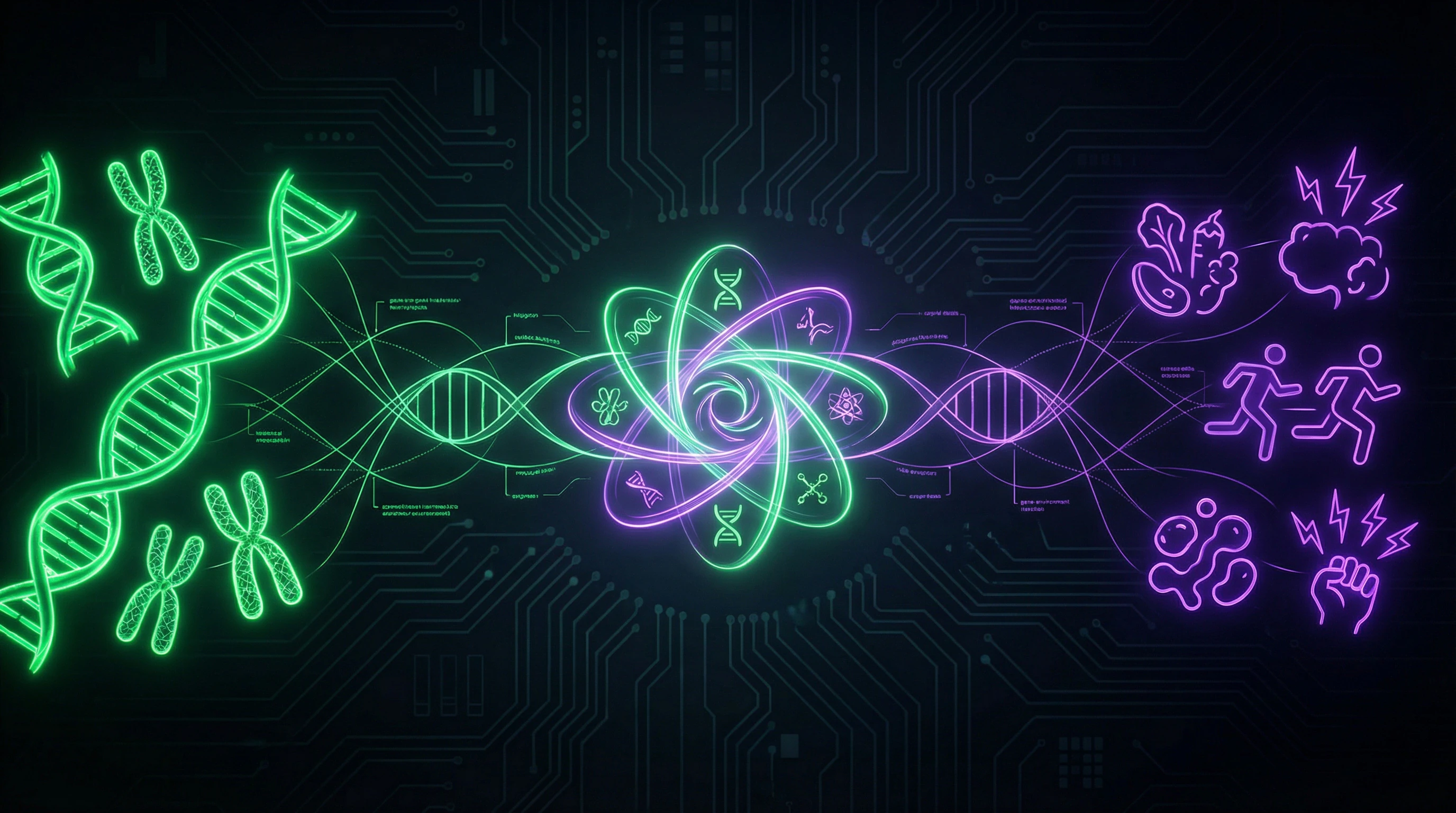
Six Major DNA Myths That Modern Genetics Debunks
Myth One: "If It's Genetic, Nothing Can Be Done About It"
Genetic predisposition does not equal destiny. Genetic conditions are often manageable through medical interventions, lifestyle changes, environmental modifications, and early detection.
Twin and adoption studies show: genetic contribution to alcohol use disorder is approximately 49%. This means more than half of the variability is determined by non-genetic factors.
- Genetic Predisposition
- Increased risk under certain conditions. A marker for screening and prevention, not a sentence.
- Genetic Marker
- A signal of susceptibility. A basis for strategy, not for despair.
Myth Two: "Genetic Traits Follow Simple Inheritance Laws"
Most human traits are polygenic—involving multiple genes. Popular beliefs about simple patterns ignore the minimal genetic influence on such traits.
Gene-environment interactions are critical. Epigenetic modifications—DNA methylation patterns—arise from environmental factors, including childhood trauma, and alter gene expression without changing the DNA sequence itself.
The genetic code is not a script, but a set of instructions that the environment rewrites on the fly.
Myth Three: "Genetic Testing Provides Absolute Answers"
Genetic tests reveal probabilities and risk factors, not certainties. Interpretation requires expertise; many variants have unknown significance.
Primary care providers face systematic barriers when integrating genetic services: gaps in healthcare worker knowledge, information complexity, time and resource limitations.
- Tests show probability, not diagnosis
- Variants may have unknown clinical significance
- Results require context: age, sex, ethnicity, medical history
- Interpretation must be conducted by a specialist
What Genetics Can Actually Predict and What It Categorically Cannot
Risk Assessment and Heritability: Real Capabilities of Genetics
Genetics measures genetic contribution through twin and adoption studies. Genetic markers identify increased susceptibility to certain conditions — this is the foundation for risk assessment.
Complex traits demonstrate polygenic influence: a meta-analysis of 80,000 individuals identified more than 40 genes associated with cognitive abilities. DNA methylation patterns show how epigenetic changes arise from environmental factors, creating measurable biological signatures of experience.
Critical Limitations of Predictive Power
Genetics does not predict deterministic outcomes: predisposition does not equal destiny. Most traits do not follow simple inheritance patterns — this is rare in human biology.
- Genetic Risk
- Probability of developing a condition when certain variants are present. Does not guarantee manifestation — depends on environment, choices, circumstances.
- Genetic Variability
- Explains part of the differences between people, but rarely the majority. Environmental factors often dominate in complex traits.
- Epigenetic Signal
- Shows current state of gene activity under the influence of experience. Does not predict the future without context of environment and choices.
Environmental factors, education, nutrition, and social circumstances explain a significant portion of variability in intelligence and other complex traits.
Gene-environment correlations complicate interpretation: genetic predispositions influence choice of environment, which in turn influences gene expression. This is a closed system where cause and effect are intertwined.
Genetic information is probability, not a verdict. It shows where to look for leverage points, but does not guarantee outcomes.
Epigenetics Destroys the Myth of Unchangeable Genetic Destiny
DNA Methylation as Biological Trace of Childhood Trauma
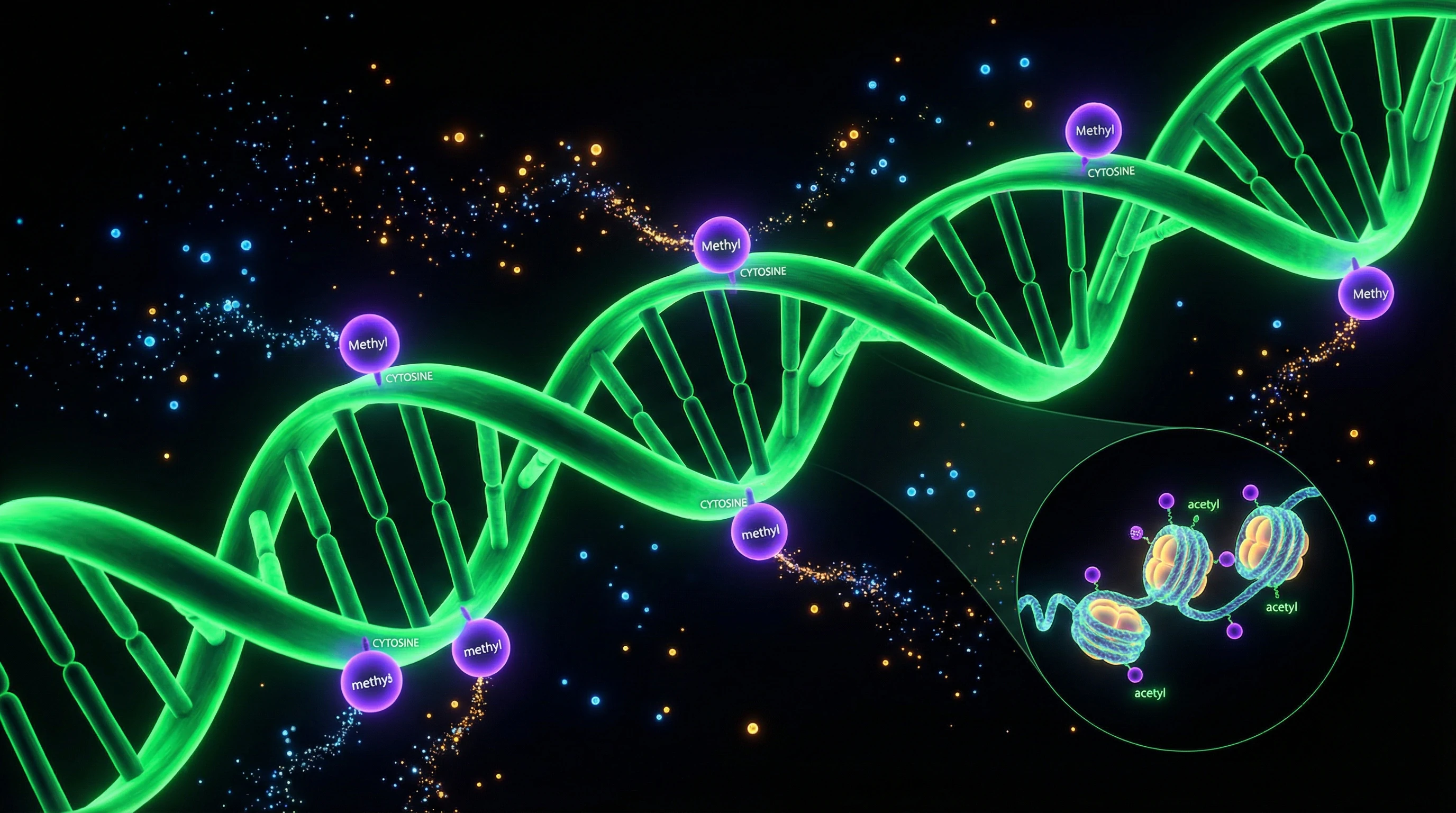
Epigenetic changes show that environment physically modifies gene expression without changing the DNA sequence itself. DNA methylation — attachment of methyl groups to cytosine bases — serves as the molecular mechanism through which childhood trauma leaves long-term biological imprints.
Methylation patterns are transmitted across generations, creating biological memory of stressful events that affects descendants even in the absence of direct trauma exposure.
Epigenetic modifications are reversible unlike DNA mutations. Therapeutic interventions, lifestyle changes, and improved social conditions can correct pathological epigenetic patterns.
This refutes the fatalistic view of genetic heritage as inevitable destiny. Epigenetics demonstrates dynamic interaction between genes and environment, where changes are possible throughout life.
Genetics of Addiction: Heritability Versus Determinism
Twin and adoption studies have established that genetic factors explain approximately 49% of variability in alcohol use disorders. This figure is often misinterpreted as evidence of genetic determinism.
- Genetic Factors (49%)
- Population-level differences associated with DNA, not individual destiny. No single gene determines addiction development — genetic variants create a spectrum of vulnerability.
- Environment and Experience (51%)
- Social conditions, substance availability, individual choices. Realization of genetic risk depends on specific life circumstances.
- Polygenic Nature
- Multiple genes with small effects interact with each other. Gene-environment correlations complicate the picture: genetic predispositions influence choice of environment, which then amplifies or attenuates genetic risks.
Patient Misconceptions Create Barriers to Effective Treatment
How Myths About Genetic Control Influence Medical Decisions
Patients with monogenic diseases, such as Huntington's disease, often mistakenly believe they can control the disorder through willpower or behavior change. These misconceptions hinder effective coping strategies and distort genetic testing decisions.
Key trap: patients fail to distinguish between monogenic disorders (one gene = disease) and polygenic predispositions (multiple genes + environment). This creates unrealistic expectations that behavior can override genetic inevitability.
| Disorder Type | Role of Genetics | Role of Behavior/Environment | Patient Trap |
|---|---|---|---|
| Monogenic (Huntington's) | Deterministic (single gene) | Minimal | Belief that effort can override inevitability |
| Polygenic (diabetes, cancer) | Predisposition | Critical | Despair: "Genes decide everything" |
Genetic testing provides probabilities and risk factors, not absolute answers. Patients often interpret results as definitive predictions of fate.
Many genetic variants have unknown clinical significance and require expert interpretation in the context of family history and phenotype. Misunderstanding the nature of genetic information affects reproductive decisions and psychological adaptation to diagnosis.
- Patient receives test result: "60% risk"
- Interprets as: "Disease will occur with 60% probability" (correct)
- But forgets: this doesn't mean 40% effort will save them (incorrect for monogenic disorders)
- Result: treatment refusal or false hope for behavioral miracle
Systemic Barriers to Integrating Genetic Services into Primary Care
Primary care providers face systematic obstacles: knowledge gaps among healthcare workers, complexity of genetic information, and time constraints. Genetic counseling remains inaccessible to most patients.
- Lack of specialized physician training
- Physicians cannot properly interpret test results and explain to patients the difference between risk and diagnosis. Retraining in medical education is required.
- Appointment time limitations
- Genetic counseling requires 30–60 minutes, but general practitioners have 15 minutes. Solution: multidisciplinary teams and telemedicine.
- Insufficient funding for genetic services
- Inequality in access to diagnostics depends on region and socioeconomic status. Systemic changes in healthcare organization are required.
The need for expert interpretation of results requires creating multidisciplinary teams and improving communication between geneticists and general practitioners. Healthcare resource constraints create inequality in access to modern diagnostic capabilities.
Overcoming these barriers requires not just patient education, but systemic changes in medical education, clinical protocols, and healthcare organization.
Practical Checklist for Evaluating Genetic Claims
Red Flags of Pseudoscientific Genetics Claims
Claims that a single gene determines complex behavior or personality traits are immediate indicators of pseudoscience. Ignoring environmental factors, epigenetics, and the polygenic nature of most human characteristics reveals a simplistic understanding of genetics.
Promises of "genetic tests" supposedly predicting talent, success, or the perfect diet without acknowledging scientific limitations exploit genetic essentialism for commercial gain.
- Absence of references to peer-reviewed research
- Anecdotal evidence instead of systematic data
- Exaggeration of result certainty
- "Revolutionary discoveries" contradicting scientific consensus without compelling evidence
- Commercial tests with personalized recommendations lacking clinical validation
Hallmarks of Scientifically Sound Genetic Information
Reliable sources clearly distinguish established facts, current hypotheses, and areas of uncertainty. Acknowledging the complexity of genetic mechanisms—polygenic inheritance, epigenetics, gene-environment interactions—indicates scientific integrity.
| Criterion | Scientific Approach | Marketing Claim |
|---|---|---|
| Publication | Peer-reviewed journals, large samples, controlled variables | Blogs, press releases, absence of independent verification |
| Methodology | Transparent limitations, effect sizes, confidence intervals | Hidden methods, exaggerated results |
| Data Synthesis | Meta-analyses and systematic reviews of multiple studies | Cherry-picked examples, single studies |
| Expertise | Certified genetic counselors and medical geneticists | Self-proclaimed "experts" without credentials |
Consultation with certified genetic counselors and medical geneticists provides expert interpretation of results in clinical context, considering individual history and phenotype.

Knowledge Access Protocol
FAQ
Frequently Asked Questions
This is a cognitive bias where people attribute absolute power to genes over traits and behavior, ignoring environmental influence. This thinking leads to the belief that genes completely determine a person's fate without possibility of change. The concept explains the persistence of many genetic myths in society.
Yes, genetic predisposition is not a sentence. Medical interventions, lifestyle changes, preventive measures, and early diagnosis can significantly reduce risks or manage conditions. Epigenetic modifications also show that gene expression changes under environmental influence.
No, this is a myth. Intelligence is a polygenic trait involving 40+ genes, but they explain only part of the variability. Education, nutrition, social conditions, and environment play a critical role in cognitive development.
Mendel's laws describe inheritance of traits controlled by a single gene with two alleles. However, most human traits are polygenic and don't follow simple patterns. Even popular examples like hand-folding preference have weak genetic basis.
Genetic tests show probabilities and risk factors, not absolute answers. Interpretation requires expertise and context, many variants have unknown significance. It's a risk assessment tool, not a fate predictor.
No, this is a dangerous misconception. Patients with Huntington's disease often mistakenly believe they can control symptoms through willpower, which interferes with proper treatment. While lifestyle affects some predispositions, it cannot override monogenic disorders.
Red flags: promises of 100% accuracy, ignoring environment, oversimplified explanations of complex traits. Scientific sources indicate probabilities, acknowledge limitations, cite peer-reviewed research, and emphasize gene-environment interactions.
Epigenetics studies changes in gene function without altering the DNA sequence itself. DNA methylation and other mechanisms can turn genes on or off under environmental influence, stress, nutrition. For example, childhood trauma leaves epigenetic marks.
Humans share 99.9% of DNA sequences. The remaining 0.1% creates individual differences, but claims about complete uniqueness of each genome oversimplify reality. Genetic similarity between humans is enormous.
Heritability is a statistical estimate of the proportion of genetic contribution to trait variability in a population. For example, for alcohol dependence it's ~49%. This doesn't mean 49% of the disease is "genetic" in a specific individual—it's a population measure.
Genetic essentialism creates an illusion of simplicity and predictability for complex phenomena. People are prone to deterministic thinking, and media often oversimplify scientific data. Lack of genetic literacy reinforces the spread of misconceptions.
Yes, substantially. Gene-environment interactions (GxE) determine most complex traits. Nutrition, stress, toxins, and social conditions alter gene function through epigenetic mechanisms. Genes set potential, environment realizes it.
Complexity of result interpretation, insufficient physician training, high costs, and ethical concerns. Primary care is often unprepared to integrate genetic services due to lack of expertise and resources.
No, except for rare monogenic disorders. Most diseases are multifactorial, involving multiple genes and environment. Genetics provides risk assessment but doesn't guarantee disease development or absence.
Childhood trauma and stress cause changes in DNA methylation—epigenetic modifications affecting gene expression. These changes can persist long-term and influence mental health, stress resilience, and disease risk in adulthood.
This is a false dichotomy—both factors are inseparably linked. Genes and environment interact at all developmental levels through complex mechanisms. Modern science rejects the 'nature vs nurture' opposition in favor of an integrative approach.