Pareidolia of the Mind: Why Pattern Recognition Became Our Evolutionary Curse and Blessing Simultaneously
The question "randomness or pattern?" is not a philosophical abstraction, but a fundamental problem across all sciences. From quantum physics, where researchers distinguish between "quantum fingerprints of chaos" and true "quantum chaos" (S006), to linguistics analyzing grammatical disruptions in spontaneous speech (S005), scientists everywhere separate signal from noise.
But the human brain operates by different rules. We see faces in clouds, conspiracies in coincidences, destiny in random sequences. More details in the section Quantum Mystification.
🧩 Defining Boundaries: What Counts as a Pattern vs. Projection of Desire
A pattern in the strict sense is a repeating structure that can be described algorithmically and predicts future observations better than a random model. Apophenia, however — the tendency to perceive connections between unrelated phenomena — operates without these constraints.
Research on implicit learning of spatial regularities (S011) shows: the brain automatically extracts statistical regularities even without conscious intention. This happens before conscious analysis — an evolutionary mechanism that allowed ancestors to quickly adapt to environmental structures.
- Apophenia
- Perception of connections between unrelated phenomena. Adaptive under conditions of uncertainty, but becomes a vulnerability in information environments where manipulators deliberately create illusory patterns.
- Signal vs. Noise
- Signal is information that predicts the future better than chance. Noise is everything else. The boundary between them is blurred and depends on context and observer goals.
⚠️ Cognitive Asymmetry: Why False Positives Are More Advantageous Than Missed Signals
An ancestral hunter heard rustling in the bushes. If he interprets it as a predator and is wrong — he loses calories fleeing. If he doesn't interpret it and is wrong — he loses his life. Natural selection weeded out those who underestimated threats.
Result: modern humans are genetically programmed for hypersensitivity to patterns, even imaginary ones. This asymmetry creates a systematic bias toward detecting regularities where none exist.
Under conditions of uncertainty, the brain prefers to err on the side of "better safe than sorry." This makes us vulnerable to manipulations that exploit this predisposition.
🔁 Spectrum from Chaos to Determinism: Why Binary Thinking Doesn't Work
Reality rarely fits into the dichotomy of "randomness or pattern." Most complex systems exhibit properties of both poles.
| System | Pattern | Randomness | Result |
|---|---|---|---|
| Maya Collapse | Climate cycles, resource depletion, social tensions (S001) | Specific timing and forms of disintegration | Appeared as mysterious collapse, in reality — identifiable patterns with element of randomness |
What seemed like a mysterious collapse represents the manifestation of identifiable patterns. But within these patterns, random factors operated, determining the specific timing and forms of disintegration.
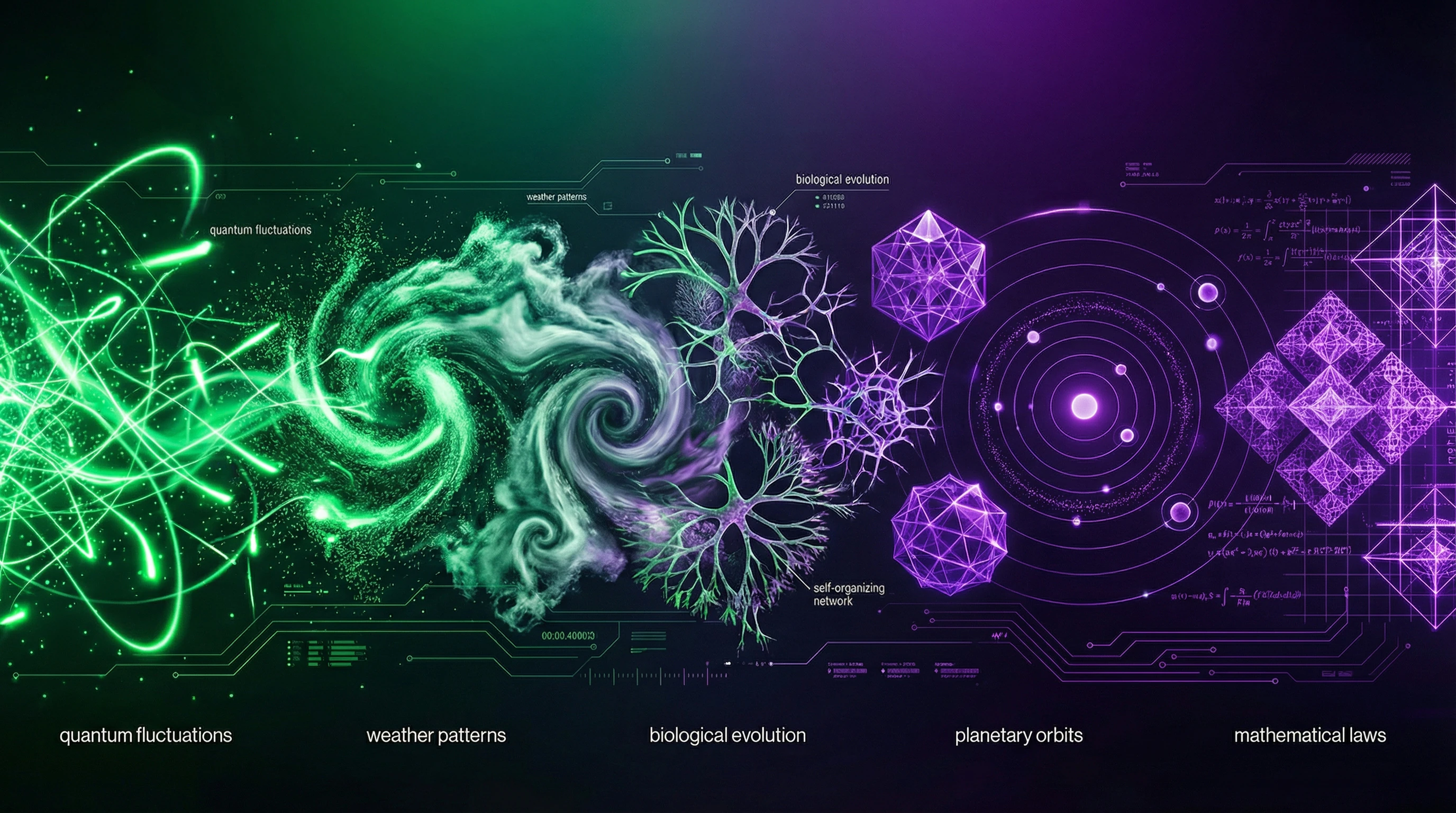
Steel Version of the Argument: Seven Reasons Why Belief in Hidden Patterns Can Be a Rational Strategy
Before dissecting the illusions of pattern recognition, it's necessary to honestly present the strongest arguments in favor of the idea that our tendency to see patterns is not a bug, but a feature. This is the steel man principle: attack the strongest version of the opposing position, not a straw man. More details in the section Quantum Mysticism.
🔬 First Argument: The History of Science Is the History of Discovering Hidden Patterns in Apparent Chaos
Mendeleev's periodic table, Kepler's laws, DNA structure, quantum mechanics — all great scientific discoveries began with the intuition that behind visible disorder lies order. Research on the segregation of α- and β-globin gene clusters during vertebrate evolution (S004) poses the question: is the observed separation of gene clusters random or patterned?
The answer turns out to be nontrivial — it's a pattern driven by functional constraints and evolutionary pressure. If scientists hadn't searched for patterns aggressively, most fundamental laws of nature would have remained undiscovered.
Skepticism toward patterns can be just as dangerous as credulity.
📊 Second Argument: Statistical Methods Confirm the Existence of Non-Random Structures in Data
Modern statistics has powerful tools for distinguishing random fluctuations from meaningful patterns. Analysis of the frequency and other possible causes of grammatical errors in spontaneous speech (S005) uses quantitative methods to determine whether observed errors are random or reflect systematic linguistic processes.
Results show regularities related to cognitive load and language structure. Bayesian analysis, randomness tests, time series analysis — all these methods were developed precisely because patterns really exist and can be objectively detected.
🧬 Third Argument: Biological Evolution Created Pattern Recognition Mechanisms for a Reason
If the ability to see patterns were purely a cognitive bias without adaptive value, natural selection would have eliminated it long ago. But instead we observe that pattern recognition is one of the most energy-intensive and highly developed brain functions, occupying a significant portion of the cortex.
Implicit learning of spatial patterns (S011) occurs automatically and rapidly, indicating deep evolutionary optimization of this ability. Organisms that better recognized patterns in prey behavior, herd migrations, and seasonal changes gained enormous survival advantages.
- Predator recognizes prey movement pattern → hunts more accurately → more calories → higher survival chance
- Gatherer sees plant ripening pattern → predicts harvest more accurately → less hunger
- Tribe notices enemy behavior pattern → defends better → higher group survival
🕳️ Fourth Argument: Many "Conspiracy Theories" Turned Out to Be True After the Fact
History is full of examples where what was initially dismissed as paranoid pattern-seeing was later confirmed by documents. The MKUltra program, NSA surveillance, the tobacco industry conspiracy to hide smoking harm data — all of this was once considered conspiracy theory.
Research on "controlled chaos" strategies in international relations (S002) analyzes whether the concept of intentional regional destabilization is myth or reality, and concludes that elements of such strategy are indeed traceable in geopolitical actions. Complete denial of the possibility of hidden patterns and coordinated actions can be a form of naivety just as dangerous as hyper-suspiciousness.
⚙️ Fifth Argument: Complex Systems Demonstrate Emergent Patterns Invisible at the Component Level
Quantum physics shows that at certain scales, classical chaos leaves "quantum fingerprints" — statistical signatures that can be detected in energy spectra and other observables (S006). These patterns are not obvious when observing individual particles, but manifest in the collective behavior of the system.
Similarly, social, economic, and ecological systems generate macro-level patterns that cannot be predicted from individual agent behavior. Ignoring these emergent patterns leads to failures in forecasting and management.
🧠 Sixth Argument: Intuitive Pattern Recognition Often Precedes Formal Analysis
Experts in various fields — from medical diagnosis to financial trading — often "sense" patterns before they can articulate them. This implicit knowledge, based on thousands of hours of experience, allows the brain to extract subtle statistical regularities inaccessible to conscious analysis.
Research shows that such intuition can be surprisingly accurate in domains with high environment validity — where stable cause-and-effect relationships exist and rapid feedback is available.
- Environment Validity
- The degree to which an environment contains stable, repeating cause-and-effect relationships. High validity = intuition works. Low validity = intuition fails.
- Implicit Knowledge
- Patterns learned without awareness. The brain detects them through repetition, but the person cannot explain how they do it. Danger: can be accurate or completely false.
🔁 Seventh Argument: Denying Patterns Can Be a Form of Defense Mechanism Against Unpleasant Truth
Sometimes people refuse to see obvious patterns not because they don't exist, but because acknowledging them requires uncomfortable conclusions or actions. Climate pattern denial, ignoring early signs of systemic crises, inability to recognize toxic relationship patterns — all are examples of motivated skepticism.
The collapse of Maya civilization (S001) demonstrates how ignoring patterns of resource depletion and climate change can lead to catastrophic consequences. Modern societies risk repeating this mistake if they are too skeptical of warning signals.
Motivated skepticism is not rationality, but defense against cognitive dissonance. It masquerades as critical thinking, but actually blocks it.
Evidence-Based Anatomy: Where Science Actually Finds Patterns, and Where It Only Sees High-Resolution Noise
Now we need to systematically understand how to distinguish real patterns from cognitive illusions. This requires understanding research methodology and pattern validity criteria. More details in the section UFOlogy and Contactees.
📊 Replicability Criterion: Patterns Must Appear in Independent Samples
The gold standard of scientific confirmation is replication in independent studies with different samples and methodologies. Analysis of grammatical errors in spontaneous speech (S005) uses large data corpora and statistical methods to verify error stability across speakers and contexts.
The human brain doesn't require replicability to form beliefs. A single vivid example is often enough to create the illusion of a pattern. This explains the persistence of superstitions and false correlations.
🧪 Mechanism Criterion: A Plausible Causal Model Must Exist
A real pattern isn't just statistical correlation—there's an identifiable mechanism behind it. Research on globin gene segregation (S004) doesn't stop at documenting cluster separation, but proposes an evolutionary explanation: functional constraints on gene expression and selective pressure created the observed structure.
Absence of a plausible mechanism is a red flag. If a pattern can't be explained, the probability of a false positive result increases sharply.
Vague claims about patterns ("everything is connected," "there are no coincidences") are unfalsifiable. Scientific patterns must generate specific, testable predictions.
🔎 Specificity Criterion: Patterns Must Make Concrete Predictions
Quantum fingerprints of chaos (S006) predict specific statistical distributions in energy spectra that can be measured and compared with alternative models. The more specific the predictions, the easier it is to test the pattern and the higher its scientific value when confirmed.
🧾 Quantification Criterion: Patterns Must Be Measurable and Have Effect Size
Statistical significance doesn't equal practical significance. A pattern may be detectable but so weak it has no real impact. Research on implicit learning (S011) not only demonstrates the effect's presence but quantifies its magnitude, allowing judgment of cognitive relevance.
Human perception is poorly calibrated for assessing effect strength. We overestimate vivid, memorable patterns and underestimate weak but systematic influences.
- Verify whether the pattern replicates in independent samples
- Find a mechanism explaining why the pattern should exist
- Formulate specific predictions that can be tested
- Measure effect size, not just statistical significance
- Account for the multiple testing problem
⚠️ Multiple Testing Problem: The More You Search, the More False Patterns You Find
If you test enough hypotheses, some will show statistical significance purely by chance. At a significance level of 0.05, every twentieth test of random data will yield a "significant" result. This is the problem of p-hacking and data dredging.
Scientific studies use corrections for multiple testing (Bonferroni, FDR), but the human brain makes no such corrections. We remember coincidences and forget non-coincidences, creating the illusion of pattern from random noise.
🧬 The Maya Case: How to Distinguish Collapse Patterns from Retrospective Narrative
Analysis of Maya civilization collapse (S001) demonstrates the methodological problem of historical research: it's easy to construct a convincing narrative after the fact, linking disparate facts into a causal chain. But this doesn't prove the pattern was predictable in advance.
Researchers identified multiple factors: droughts, wars, soil depletion, demographic pressure. But were these factors sufficient and necessary for collapse? Why didn't the Maya adapt like other civilizations under similar conditions? Answers require not just identifying correlations, but building counterfactual models.
🔁 Quantum Chaos: When Patterns Exist But Are Unpredictable
Research on quantum fingerprints of chaos (S006) reveals a paradoxical situation: classical chaotic systems leave statistical signatures in quantum observables, but these signatures don't allow prediction of specific trajectories. The pattern exists at the distribution level, but not at the individual event level.
The presence of a pattern doesn't always mean predictability. Many real systems demonstrate statistical regularity while maintaining fundamental unpredictability of specific outcomes.

Neurocognitive Mechanics of Illusions: How the Brain Turns Noise into Signal and Why This Was Adaptive in the Savanna but Dangerous in the Information Environment
Understanding why we see patterns where none exist requires diving into the neurobiology of perception and cognitive psychology. This isn't just a philosophical question—it's about how specific neural mechanisms work. More details in the Media Literacy section.
🧩 Apophenia and Pareidolia: When the Recognition System Runs on Idle
Apophenia—the tendency to see meaningful connections in random data—is not a brain defect, but a result of how the pattern recognition system works. Neural networks in the visual cortex are tuned to detect faces, objects, movements even with minimal information.
Pareidolia is a special case of apophenia, when we see familiar images in random stimuli: clouds, stains, textures. Face detectors in the fusiform gyrus have a low activation threshold—better to see a face where there isn't one than to miss the real face of a predator or enemy.
In the savanna, error cost lives. Missing a predator—death. Seeing it in a shadow—just vigilance. Evolution chose asymmetric risk.
🔁 Confirmation Bias: How the Brain Filters Data in Favor of Existing Beliefs
Once a hypothesis about a pattern is formed, the brain begins to selectively process information. We notice and remember data confirming the pattern, and ignore contradictory data—this is an automatic process at the level of attention and memory.
Even when presented with balanced data, people interpret it as supporting preexisting beliefs. This explains why debates rarely change minds—each side sees confirmation of their position in the same facts.
- Hypothesis formed → attention shifts to confirming data
- Contradictory data is either not noticed or reinterpreted
- Memory strengthens the connection between hypothesis and confirmations
- Belief becomes more resistant, even without new evidence
🧬 Agency and Intentionality: Why We See Design in Random Processes
The human brain has a hyperactive agent detection device (HADD). We tend to attribute events to the actions of intelligent agents, even when they result from impersonal processes. This is an evolutionary adaptation: in the social environment of our ancestors, the ability to quickly determine others' intentions was critically important.
Analysis of "controlled chaos" strategies (S002) shows how this tendency manifests in geopolitical thinking: complex, multifactorial destabilization processes are interpreted as the result of a single design, although reality may be a combination of intentional actions, unintended consequences, and random factors.
- Agency
- Attribution of consciousness and intentions to events or processes. Trap: we see an enemy where there's just a system with its own logic.
- Intentionality
- Belief that someone's design lies behind an event. Trap: we miss the role of chance, errors, and unintended consequences.
📊 Clustering Illusion: Why Random Distributions Seem Non-Random
People poorly understand what true randomness looks like. A random distribution of points on a plane will contain clusters and voids—this is statistically expected. But human perception interprets these clusters as meaningful patterns.
A classic example is the bombing of London during World War II. The distribution of hits seemed non-random, spawning theories about spies indicating targets. Statistical analysis showed the distribution corresponded to a random Poisson process—clusters were an inevitable consequence of randomness, not design.
Randomness doesn't look like randomness. It looks like conspiracy, pattern, design. This is the main trap of statistical thinking.
🕳️ Retrospective Predictability: Why the Past Always Seems Inevitable
After an event occurs, we easily construct a narrative explaining why it was inevitable. This is hindsight bias. We forget the uncertainty that existed before the event and overestimate the predictability of the outcome.
Research on the Maya collapse (S001) may suffer from this problem: knowing the civilization collapsed, it's easy to construct a chain of causes leading to this outcome. But was this chain obvious to contemporaries? Could they have prevented the collapse if they had recognized the pattern in time?
| When We Look | What We See | Trap |
|---|---|---|
| Before event | Multiple possible outcomes, uncertainty | Analysis paralysis, risk underestimation |
| After event | One outcome appearing inevitable | Overestimation of predictability, false confidence in understanding causes |
These mechanisms—apophenia, confirmation bias, hyperactive agent detection, clustering illusion, retrospective predictability—don't work in isolation. They reinforce each other, creating a cognitive environment where patterns are seen everywhere. In an information environment where data flows continuously and is often contradictory, these mechanisms become not an adaptation, but a vulnerability.
Cognitive Anatomy of Manipulation: Which Biases Are Exploited by Those Selling You Illusory Patterns
Understanding pattern recognition mechanisms allows you not only to avoid self-deception, but also to recognize when these mechanisms are being used for manipulation. Industries from marketing to political propaganda systematically exploit our cognitive vulnerabilities. More details in the Sources and Evidence section.
🧩 The "Connecting the Dots" Technique: How to Create the Illusion of a Pattern from Unrelated Facts
Manipulators provide a set of facts (often true), but suggest false connections between them. The human brain automatically fills in the gaps, turning disparate events into a unified narrative chain.
The mechanism works because the brain conserves resources: it's easier to accept a ready-made pattern than to verify each connection. This is especially dangerous in conspiracy theories, where unrelated facts (stock price drops, political meetings, article publications) are presented as links in a unified plan.
- Facts are selected to appear connected (chronological proximity, common figures)
- Gaps between them are filled with assumptions presented as logic
- Alternative explanations are ignored or declared part of the conspiracy
- Each new event is interpreted as confirmation of the pattern
Test: if you remove one fact from the chain, does the entire construction collapse? If yes—this isn't a pattern, it's strung beads.
🎯 Selective Attention and Confirmation Bias
The manipulator shows you only the data that confirms their version. You see 10 matches and don't see 100 mismatches—because they simply weren't shown.
If you search for evidence of a hypothesis, you'll find it. If you search for refutations—you'll find those too. The manipulator chooses for you what to search for.
This works through cognitive biases like apophenia (seeing patterns in randomness) and confirmation bias. Marketing exploits this by showing only successful cases. Political propaganda—only facts that confirm the enemy.
🔄 Narrative Closure: A System That Cannot Be Refuted
The most dangerous patterns are those that redefine any contradiction as confirmation. If you believe in a hidden pattern and it doesn't manifest—this proves its mastery of concealment.
Such systems are found in alternative medicine, pseudohistory, and spiritual teachings. Logic becomes circular: absence of evidence = evidence of hiddenness.
- Sign of narrative closure:
- Any fact contradicting the theory is reinterpreted as its confirmation
- Why this is dangerous:
- You cannot exit the system logically—only emotionally or through external authority
- How to test:
- Ask: "What fact would refute this theory?" If there's no answer—this isn't science, it's belief
💰 The Economics of Illusory Patterns
Selling patterns is a profitable business. Books about hidden meanings, courses on decoding secrets, numerology consultations—all work because the brain is willing to pay for the feeling of understanding.
When you believe you've found a pattern, the reward system activates. This feeling is more valuable than skepticism. Influencers and authors monetize precisely this—not truth, but the pleasure of the illusion of control and understanding.