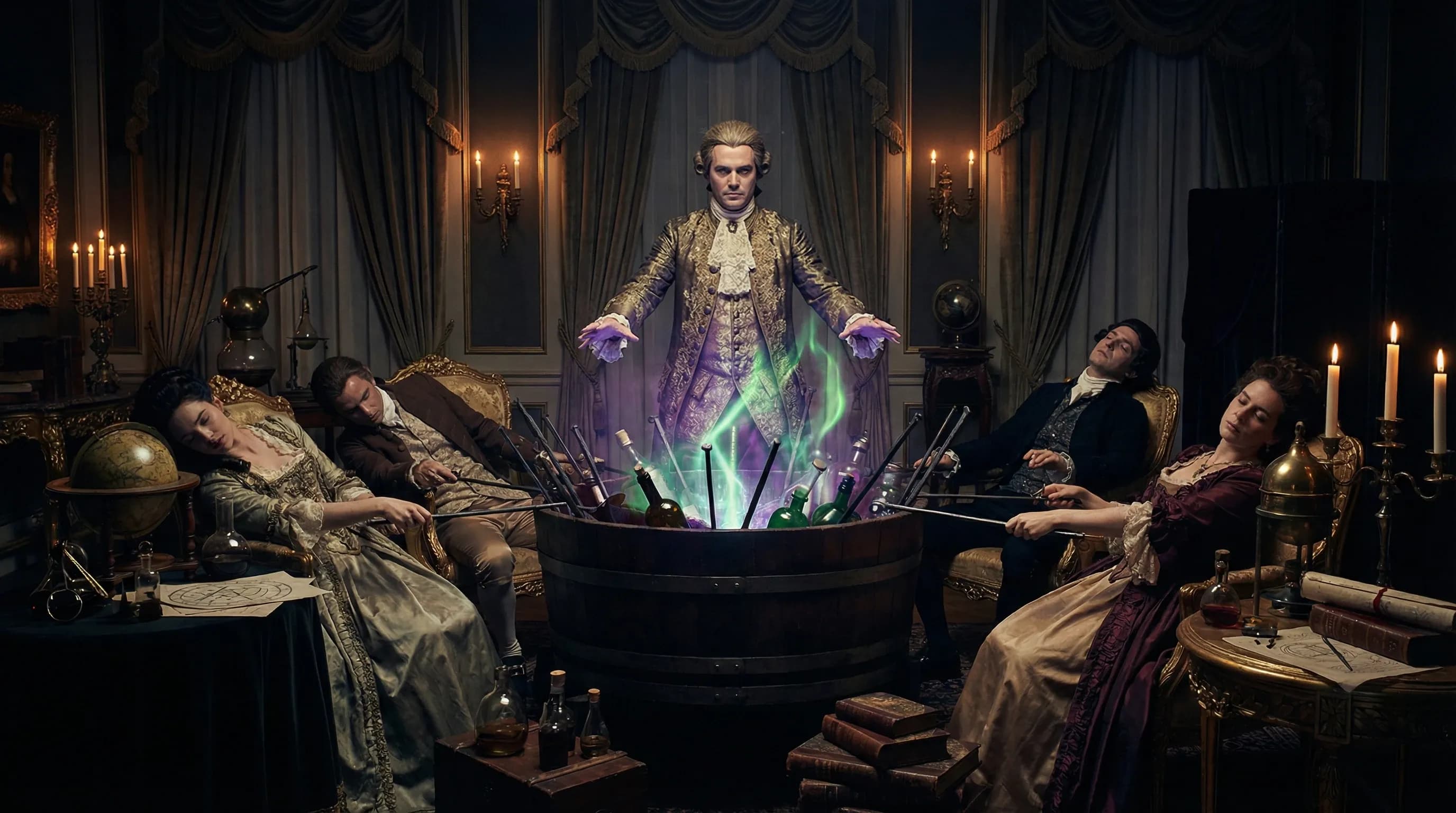
What is Mesmer's animal magnetism and why did this theory captivate Europe in the 1780s
Franz Anton Mesmer (1734–1815) received his medical degree from the University of Vienna in 1766, defending a dissertation on planetary influence on the human body. His theory of "animal magnetism" postulated the existence of a universal fluid—a subtle invisible substance filling the cosmos and penetrating all living organisms (S011).
Mesmer claimed that diseases arose from improper distribution of this fluid in the body, and that a physician could restore balance by manipulating magnetic flows through touch, gestures, and special apparatus (S011).
🧩 Key elements of Mesmer's treatment system
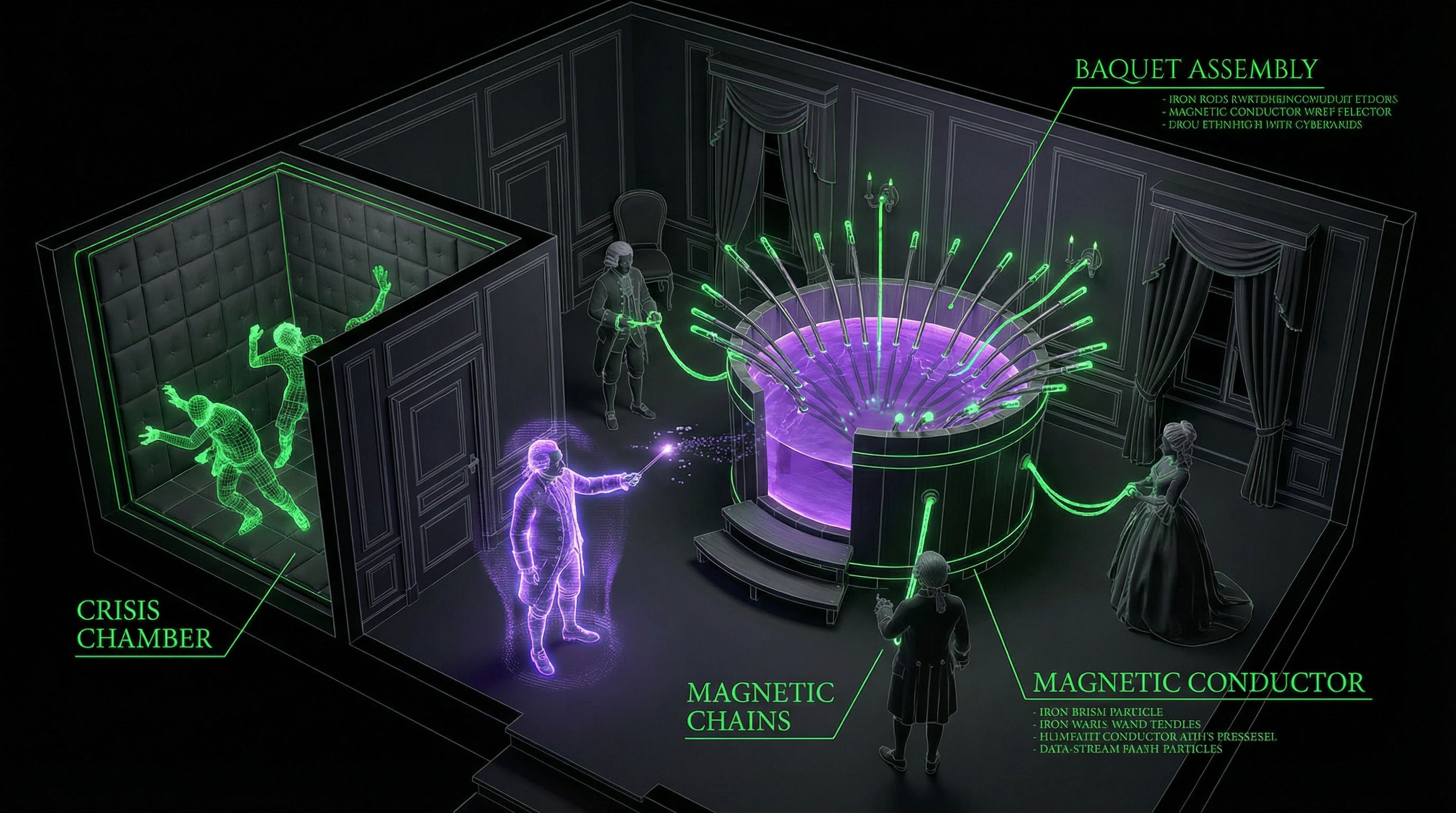
The central instrument was the "baquet"—a wooden tub filled with water, broken glass, iron filings, and "magnetized" bottles (S011). Iron rods protruded from the tub, which patients applied to afflicted areas.
- Sessions took place in darkened halls accompanied by glass harmonica music
- An instrument invented by Benjamin Franklin that produced eerie vibrating sounds, enhancing the immersive effect (S011).
- Mesmer in purple silk robes
- Moved among patients, touching them with an iron wand or his hands, "directing" magnetic flows.
⚠️ The phenomenon of "crisis" as the central element of therapy
Mesmer considered the "magnetic crisis" a key sign of successful treatment—a state where patients fell into convulsions, hysterical laughter or crying, lost consciousness, or experienced seizures (S012).
Mesmer interpreted these reactions as evidence that the fluid was "breaking through blockages" in the organism, after which healing should occur (S011).
For such cases, the salon was equipped with a special "crisis room" with padded walls, where patients could safely thrash about during fits (S011).
🔎 Social context: why mesmerism became fashionable among the aristocracy
By 1778, when Mesmer moved to Paris, his practice had become a cultural phenomenon. Sessions were attended by members of the highest aristocracy, including Queen Marie Antoinette (S011).
| Why mesmerism seemed convincing | Actual mechanism of appeal |
|---|---|
| Used terminology from Newtonian physics (gravity, attraction, fluids) | Appealed to scientific authority, though itself was speculation |
| Referenced recent discoveries in electricity and magnetism | Created illusion of connection to legitimate scientific achievements |
| Promised a simple universal explanation for all diseases | 18th-century medicine lacked effective methods—mesmerism filled the vacuum |
Mesmerism fit perfectly into the pre-Romantic age of sensibility, when educated society was fascinated with occultism, Freemasonry, and the search for "hidden forces of nature" (S011).
The Steel-Man Case for Mesmerism: Why Mesmer's Contemporaries Had Reasons to Believe in Animal Magnetism
To understand mesmerism's persistence, we need to reconstruct the most compelling arguments in its favor — not in caricature form, but in the strongest version as seen by educated 18th-century people. This is an exercise in intellectual honesty: before dismantling a misconception, we must understand why intelligent people believed it. More details in the Cryptozoology section.
🔬 First Argument: Reproducible Observable Effects
Mesmer demonstrated repeating physical reactions: convulsions, breathing changes, loss of consciousness, symptom relief (S011). These effects were observed by independent witnesses, including physicians.
In the 18th century, there was no concept of psychosomatic disorders or the placebo effect — if a patient demonstrated physical changes, this was considered proof of real physical intervention (S010). Mesmer could reasonably claim: "You see the effect with your own eyes — therefore, the cause is real."
🧪 Second Argument: Analogy with Recently Discovered Invisible Forces
In the 1780s, physics actively studied "invisible fluids": electric fluid (Franklin), magnetic fluid, caloric, phlogiston (S011). Newton's gravity was also an "invisible force acting at a distance."
Mesmer used this analogy: if electric fluid exists, why couldn't an "animal" fluid exist, specific to living organisms? His theory didn't appear more fantastical than other scientific hypotheses of the time — it simply postulated another type of imponderable matter.
- Electricity — discovered and being studied
- Magnetism — discovered and being studied
- Animal fluid — hypothesis by analogy
- Logic: if the first two are real, the third could be real
📊 Third Argument: Physician Testimonials of Recovery
Mesmer treated patients with functional disorders — paralyses, blindness, deafness, pain — that had no obvious organic cause (S011). Many genuinely recovered or reported significant improvement.
The famous case of pianist Maria Theresia Paradis, who allegedly regained her sight after Mesmer's treatment (though the effect later disappeared) is well known (S011). Without understanding psychogenic disorders, these cases seemed convincing proof of effectiveness.
🧬 Fourth Argument: Theoretical Elegance
Animal magnetism theory offered a unified explanation for an enormous spectrum of phenomena: from tides to epilepsy, from the Moon's influence on menstrual cycles to mass hysteria (S011). This universality was attractive in an era when science sought grand unifying theories.
Mesmer could explain why his method worked for different diseases: they all reduced to disrupted fluid circulation. This was far more elegant than admitting that medicine simply didn't understand the causes of most illnesses.
⚙️ Fifth Argument: Technological Sophistication
Mesmer created an elaborate system with tubs, iron rods, "magnetized" trees in the garden, special music (S011). This material infrastructure created an impression of serious scientific approach.
The ritual's complexity worked as a credibility signal: if this were charlatanism, why such effort? Mesmer trained students for substantial fees, creating the impression of valuable knowledge transmission (S011).
🧩 Sixth Argument: Institutional Support
At its peak, mesmerism was supported by influential figures, including the Marquis de Lafayette, who attempted to introduce the method to George Washington (S011). Mesmer received patients by referral from court physicians.
"Societies of Harmony" existed — organizations of mesmerism followers in different French cities (S011). This institutionalization created an impression of legitimacy: if so many respected people believe in this, perhaps there's something to it.
🔁 Seventh Argument: Absence of Alternative Explanations
Mesmer's critics could point out that his theory was incorrect, but couldn't offer a better explanation for why patients fell into convulsions and then felt relief. The concept of "imagination" as a cause of physical symptoms existed, but wasn't well developed (S010).
The idea that expectation could cause real physiological changes seemed no less mystical than Mesmer's fluid. Therefore, many preferred a materialist explanation (invisible substance) to an idealist one (power of mind).
The Royal Commission of 1784: How the Scientific Method First Encountered the Placebo Effect and Failed to Recognize It
In 1784, King Louis XVI established two commissions to investigate Mesmer's theory: one from the Royal Academy of Sciences and the Faculty of Medicine, another from the Royal Society of Medicine (S011). The first included Benjamin Franklin, chemist Antoine Lavoisier, astronomer Jean-Sylvain Bailly, physician Joseph-Ignace Guillotin, and other luminaries of science (S011). Their report became one of the first examples of a controlled scientific experiment in medicine—and accidentally laid the groundwork for understanding the placebo effect (S010).
🧪 Experimental Design: The First Controlled Blinded Trials
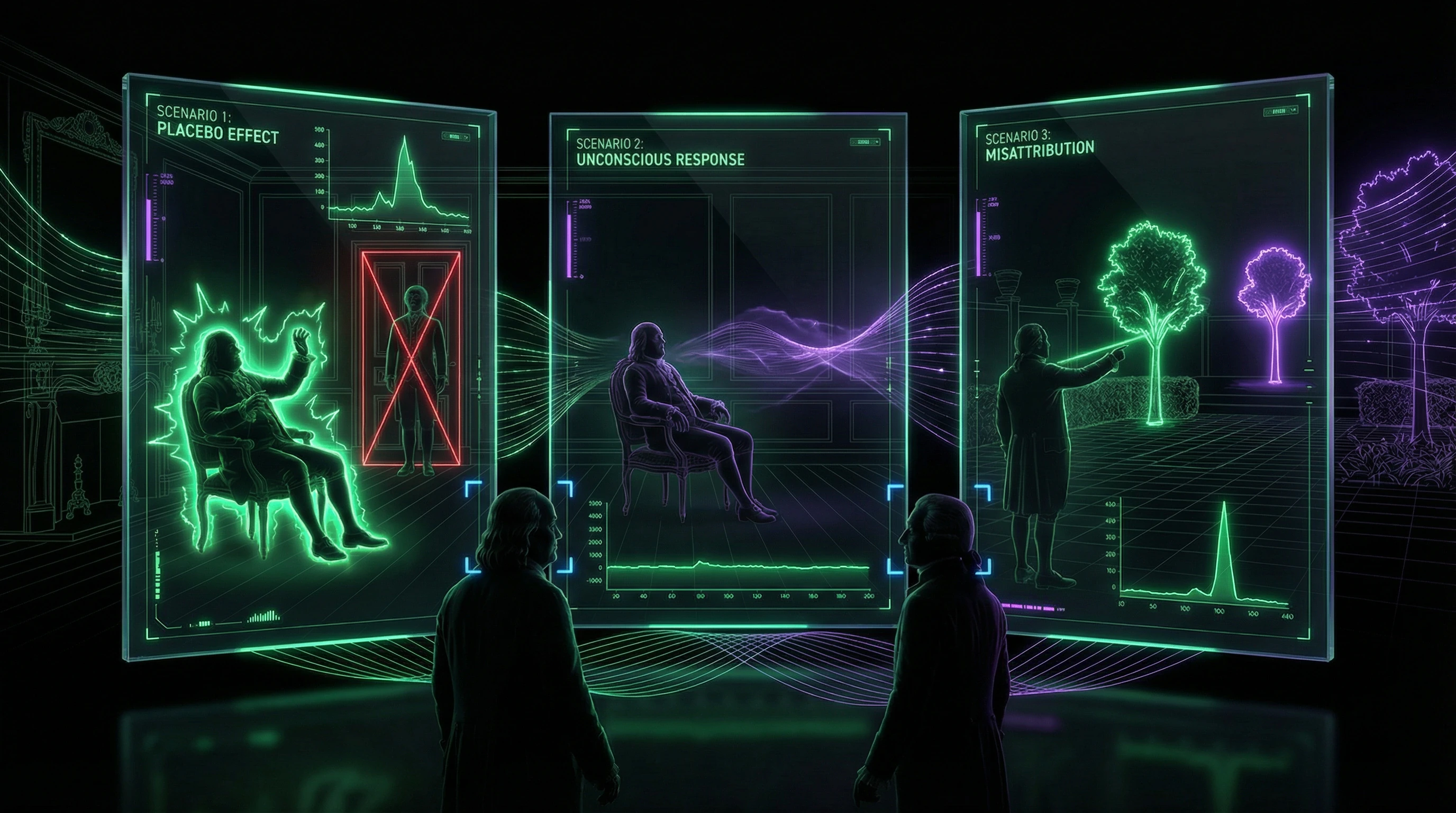
The commission developed a series of experiments that today would be called "blind trials." The key idea: if animal magnetism is a real physical force, it should work regardless of whether the patient knows it's being applied (S011).
- Patients were told they were being "magnetized" through a closed door when no one was doing anything—they still experienced crises (S011).
- Patients were led to a "magnetized" tree in Franklin's garden, but directed to an ordinary tree—the effect manifested at the "correct" tree they were told about (S011).
- Mesmer's student Charles Deslon "magnetized" water in cups, but patients reacted to ordinary water if told it was magnetized (S011).
📊 Results: Imagination as the Sole Active Cause
"Imagination without magnetism produces convulsions... Magnetism without imagination produces nothing" (S011)
The report, published in August 1784, was devastating: animal fluid does not exist, all effects are explained by suggestion, imitation, and patients' excited imagination (S011). The commission also noted the danger of the method: group sessions with physical contact between Mesmer and female patients could induce sexual arousal, which was morally unacceptable (S011). This aspect was relegated to a secret report accessible only to the king and high officials.
🧠 The Paradox: Disproving the Theory Didn't Eliminate the Reality of the Effect
The irony is that the commission proved something more important than the nonexistence of fluid: it demonstrated that patient expectations and beliefs cause real physiological changes (S010). This was the first systematic documentation of what would later be called the placebo effect.
- Why This Wasn't Recognized as a Discovery
- In 1784, the result was interpreted as proof of "deception" and "weakness of imagination," not as a fundamental fact about the mind-body connection (S010). The commission dismissed mesmerism but couldn't explain the mechanism of the observed phenomena—that would require another century and a half of psychology and neuroscience development.
⚠️ Why Scientific Refutation Didn't Kill Mesmerism
Despite the commission's authority, mesmerism didn't disappear. Mesmer left Paris, but his students continued the practice (S011). In the 19th century, mesmerism evolved into hypnotism: the Marquis de Puységur, Mesmer's student, discovered he could induce patients into a somnambulistic state without convulsions, leading to the development of hypnosis techniques (S011).
Scottish surgeon James Braid in the 1840s renamed "animal magnetism" as "hypnotism" (from the Greek "hypnos"—sleep) and began studying it as a psychological phenomenon (S011). The refuted theory spawned a new field of research—the study of altered states of consciousness and suggestibility.
Mechanisms of Action: What Actually Happened in Mesmer's Patients' Bodies and Why It Worked
Modern science allows us to reconstruct the neurobiological and psychological mechanisms that explain the effectiveness of Mesmeric sessions — without invoking the hypothesis of magnetic fluid. Key insight: Mesmer accidentally created a powerful system for activating endogenous (internal) healing mechanisms through ritual, expectation, and social reinforcement. More details in the Pseudopsychology section.
🧠 The Placebo Effect as Neurobiological Reality
The placebo effect is not "imaginary" improvement, but real physiological changes triggered by the expectation of therapeutic benefit (S010). Contemporary research shows that placebo activates the endogenous opioid system (endorphin release), dopaminergic pathways (associated with reward and motivation), and the prefrontal cortex (modulation of pain signals) (S010).
Mesmeric sessions created ideal conditions for maximizing the placebo effect:
- High expectations — patients arrived believing in miraculous healing, reinforced by social proof (others had recovered).
- Ritual complexity — the baquet, iron rods, and music created the impression of powerful intervention.
- Healer authority — Mesmer positioned himself as possessor of secret knowledge.
- High cost — expensive treatment is perceived as more effective (S010).
🔁 Hysteria and Conversion Disorders: Why the Convulsions Were Real
Many of Mesmer's patients suffered from what was called "hysteria" in the 19th century, and is today classified as conversion disorders or somatic symptom disorders (S012). These are conditions in which psychological distress manifests through physical symptoms: paralysis, blindness, deafness, pain — without organic pathology.
Convulsions and "magnetic crises" were a form of catharsis — emotional discharge of suppressed experiences. Mesmer unintentionally created a therapeutic environment where it was socially acceptable to express emotions through dramatic physical manifestations.
After the crisis, patients often felt relief — not because the fluid "broke through a blockage," but because psychological tension had been discharged (S012).
🧷 Social Contagion and Group Dynamics
Mesmeric sessions were conducted in groups, which amplified the effect through the mechanism of social contagion (S012). When one patient fell into convulsions, others observed and unconsciously imitated the behavior — a phenomenon known as "mass psychogenic illness" or "hysterical contagion."
This is not simulation, but a real neuropsychological process: mirror neurons activate when observing others' actions, which can trigger similar motor programs in the observer. The group context also created social pressure: if everyone around is experiencing a "magnetic crisis," lack of response may be perceived as a sign that the treatment isn't working, which increases anxiety and paradoxically raises the likelihood of a crisis.
⚙️ The Role of Touch and Physical Contact
Mesmer actively used touch: he moved his hands along the patient's body, touched "afflicted areas," made eye contact (S011). Physical contact itself has therapeutic effects: it activates the oxytocin system (hormone of attachment and trust), reduces cortisol levels (stress hormone), and activates the parasympathetic nervous system (relaxation) (S010).
- Violation of Norms as Therapeutic Factor
- In the 18th century, physicians rarely touched patients, especially women from high society. Mesmer violated this norm, creating an intense emotional experience. The Royal Commission noted the erotic undertones of these interactions, but failed to understand that physical contact itself can be therapeutic independent of any sexual component.
🧪 Why the Effect Was Temporary and Selective
Mesmerism worked predominantly for functional disorders (psychogenic paralysis, pain, anxiety), but was useless for organic diseases (infections, tumors, fractures) (S011). This aligns with modern understanding of placebo: it modulates subjective symptoms (pain, nausea, fatigue) and can influence the immune system and inflammation, but cannot cure structural damage (S010).
| Type of Disorder | Mesmerism Effective? | Mechanism |
|---|---|---|
| Conversion disorders (psychogenic paralysis, blindness) | Yes, often | Psychological discharge, expectation modification |
| Functional pain and anxiety | Yes, temporarily | Placebo effect, endogenous opioid activation |
| Organic diseases (infections, tumors) | No | Requires intervention on structural damage |
| Fractures and injuries | No | Placebo does not affect bone healing |
The effect was often temporary: after sessions ended, symptoms returned. This is typical of the placebo effect, which requires constant reinforcement of expectations. Cases of "miraculous healings" usually involved patients with conversion disorders, where the symptom is entirely psychogenic and can disappear with changes in psychological state.
Cognitive Anatomy of the Myth: Which Mental Traps Make Mesmerism Convincing Even After Refutation
Mesmerism is a classic example of how cognitive biases sustain false beliefs despite evidence. The Royal Commission of 1784 published its report, but the practice didn't disappear. More details in the Pseudopsychology section.
Why? Because refuting a theory doesn't refute the patient's experience. A person felt relief—that's a fact of their perception, regardless of the mechanism.
- Confirmation bias—the patient notices improvements, ignores lack of effect, or attributes it to other causes.
- Social proof—if hundreds of people believe and report healing, skepticism seems naive.
- Causal attribution—recovery coincided with a session? Then the session must have caused it.
- Investment in belief—a person spent money, time, reputation. Admitting error costs more than continuing to believe.
Refuting the mechanism doesn't equal refuting the result. This is the key asymmetry: science can prove that "animal magnetism" is fiction, but cannot cancel the placebo effect, which is real.
Mesmerism survived the commission because it transformed. Adherents stopped talking about fluids and started talking about "magnetic sensitivity," "nervous energy," later—about hypnosis. The form changed, the essence remained: the brain sees patterns where there are none, and this is used against us.
Today mesmerism is dead as a theory, but alive as a mechanism. Its descendants—from 19th-century spiritualism to 21st-century esotericism—work by the same scheme: unfalsifiable explanation + social reinforcement + personal experience = a belief that logic cannot touch.