
Alternative History as a Literary Genre: Where Fantasy Acknowledges Its Nature
Alternative history is a subgenre of speculative fiction where one or more historical events occur differently than in reality (S001). Authors and readers understand: this is a creative exercise in hypothetical scenarios, not a claim to revealing hidden truth.
Conspiracy theory claims the opposite—it positions itself as revealing what is supposedly being concealed. This fundamental difference determines everything else. More details in the Torsion Fields section.
Point of Divergence: How Alternative Narratives Are Constructed
Alternative history revolves around a "point of divergence"—a moment when history deviates from its known course. Confederate victory in the U.S. Civil War, Napoleon's successful invasion of Russia, prevention of Archduke Franz Ferdinand's assassination.
Authors then extrapolate consequences using historical knowledge, cause-and-effect logic, and imagination (S001). The process is transparent: the reader sees the initial premise and can follow the logic of development.
- Counterfactual Thinking in History
- Allows better understanding of causality in real events—why things happened one way and not another.
- Critical Analysis of the Present
- Through the "what if" lens, vulnerabilities and patterns of the modern world are revealed.
- Artistic Experiment
- A space for creativity that doesn't claim the status of historical research.
Terminological Trap: Alternate vs Alternative
In fan and researcher communities, the terms "alternate history" and "alternative history" are used interchangeably—there is no meaningful distinction between them (S004). This confusion sometimes becomes a tool: conspiracy theorists exploit terminological ambiguity to give pseudoscientific status to their narratives.
The genre works only because it's honest about its nature. The reader enters a contract: "This is fiction, but logical fiction." Conspiracy theory violates this contract from the first sentence.
Alternative history remains within the bounds of acknowledged fiction. Conspiracy theory claims reality—and that changes everything.

Conspiracy Theories: When Truth Claims Lack Evidentiary Support
Conspiracy theories are beliefs that complex historical or political events result from secret plots by powerful groups. Unlike alternative history, conspiratorial narratives claim to describe actual events, but systematically reject scientific consensus and cannot be proven through standard verification methods (S003).
🧩 Structural Characteristics of Conspiratorial Thinking
Conspiracy theories are built around alleged secret government plans and elaborate assassination plots. They deny consensus opinion and resist standard verification (S003).
A key feature of conspiracism is its unfalsifiability: any evidence against the theory is interpreted as part of the conspiracy. This makes the narrative immune to rational criticism and creates a closed logical system. More details in the Geometry and Vibrations section.
| Characteristic | Alternative History | Conspiracy Theory |
|---|---|---|
| Truth Claim | Literary hypothesis | Description of actual events |
| Relationship to Evidence | Acknowledges fictionality | Rejects scientific consensus |
| Falsifiability | Open to criticism | Unfalsifiable |
🕳️ Professional Historians' Stance on Conspiracism
There is a fundamental distinction between studying conspiracy theories as historical phenomena and validating them as historical explanations. Professional historians do not accept conspiratorial narratives as true historical explanations (S002).
Conspiracy theories are beliefs and social movements worthy of study, but not validated historical facts.
🔁 Global Scale of the Conspiratorial Phenomenon
Conspiracy theories touch nearly every sphere of human activity. The belief that complex events—especially tragic or unexpected ones—result from secret conspiracies is widespread across all cultures and eras (S009).
Digital platforms have transformed the scale and speed of conspiratorial narrative dissemination. Recommendation algorithms and echo chambers create conditions where conspiratorial ideas are amplified and spread faster than the facts refuting them. This creates new challenges for public discourse and society's cognitive immunology.
- Conspiratorial narratives use real events as anchors for fictional explanations
- Unfalsifiability makes them resistant to factual criticism
- Global networks and algorithms accelerate the spread and reinforcement of beliefs
- Studying conspiracism as a phenomenon differs from validating it as truth
Five Arguments Used by Defenders of Conspiratorial Thinking — and Why They Seem Convincing
Honest analysis requires examining the strongest arguments in defense of conspiratorial thinking. This doesn't validate them, but reveals the mechanisms of persuasion and psychological appeal. More details in the section Paranormal Abilities.
📌 Argument One: Historical Precedents of Real Conspiracies
Conspiracy defenders point to documented cases: the CIA's MKUltra operation, the Watergate scandal, tobacco companies concealing data about smoking harms. The logic is simple: if some conspiracies were real, then others might be real too.
The appeal of this argument lies in its partial truth. Real conspiracies did exist, creating an illusion of plausibility for any conspiratorial claims (S010).
📌 Argument Two: Distrust of Institutional Authority as a Form of Critical Thinking
Conspiratorial thinking positions itself as healthy skepticism toward authority and official narratives. The argument appeals to democratic values of transparency and accountability.
Conspiracy theorists are portrayed as "free thinkers" resistant to manipulation. This position is reinforced in the context of real cases of abuse of power and institutional corruption.
📌 Argument Three: "Do Your Own Research" as a Call for Intellectual Autonomy
Conspiracy theorists urge audiences to "do your own research" instead of blindly trusting experts. The argument exploits the value of intellectual autonomy and critical thinking.
The appeal of this approach lies in the sense of control and competence in a complex world. People gain the illusion of self-education and independent judgment.
📌 Argument Four: The Explanatory Power of Conspiratorial Narratives
Conspiracy theories offer simple, unified explanations for complex events. Instead of multifactorial causality, randomness, and uncertainty, conspiracism offers a narrative with clear villains, victims, and hidden motives.
This explanatory simplicity is psychologically appealing, especially under conditions of information overload and uncertainty (S008).
📌 Argument Five: Social Identity and Belonging to an "Enlightened Minority"
Belief in conspiracy theories creates a sense of belonging to a group possessing "secret knowledge" unavailable to the "sleeping masses." The conspiracy believer becomes more informed and perceptive than the majority.
- Social Function of Conspiracism
- Exploits the need for social identity and status. Particularly strong in the era of digital communities (S007), where groups of like-minded individuals form closed ecosystems of information and mutual confirmation.
Evidence Base: What Peer-Reviewed Research Says About Conspiratorial Thinking and Its Consequences
Academic research from recent decades provides extensive evidence about the nature, mechanisms, and consequences of conspiratorial thinking. These data allow us to separate empirically grounded conclusions from speculation. More details in the Psychology of Belief section.
🔬 The Link Between Scientific Consensus Rejection and Conspiracy Thinking
Individuals who are aware of scientific consensus but reject its conclusions tend to distrust scientists and scientific institutions (S006). This isn't a matter of lacking information—conspiracy theorists often know about the existence of consensus but actively reject it based on distrust of sources.
The rejection mechanism includes not only cognitive but also motivational factors: protecting existing beliefs, identity, and worldview. This process is described in the context of the predictive brain (S001)—the belief system actively filters incoming information, rejecting data that threatens its integrity.
Conspiracy thinking is not a consequence of ignorance, but the result of motivated rejection of consensus with full awareness of its existence.
📊 Romantic Mentality as a Predictor of Authoritarian Attitudes
Research in Frontiers in Psychology found that a general "romantic" mentality factor is the primary predictor of authoritarian and anti-democratic attitudes. This mentality is characterized by emotionality, intuitionism, distrust of rationality, and a tendency toward mystical thinking.
Conspiratorial thinking correlates with this romantic mentality, representing "the long historical shadow of romanticism" on contemporary political psychology. Important: this doesn't mean all romantics are conspiracy theorists, but conspiracy theorists systematically demonstrate romantic thinking traits.
| Mentality Trait | Scientific Thinking | Romantic Mentality |
|---|---|---|
| Source of Truth | Empirical data, verifiability | Intuition, inner feeling, revelation |
| Attitude Toward Complexity | Acceptance of uncertainty and nuance | Search for simple, elegant explanations |
| Trust in Institutions | Critical, based on results | Suspicious, based on motives |
| Role of Emotions | Tool for motivation, not source of knowledge | Primary channel of cognition and truth |
🧾 Conspiracy Thinking and Right-Wing Extremism: European Commission Data
An official European Commission document analyzes conspiracy theories as a global phenomenon influencing political extremism (S009). Conspiratorial narratives play a key role in the radicalization and mobilization of right-wing extremist movements.
Conspiracy theories provide an ideological framework that legitimizes violence and dehumanization of "enemies" identified in the conspiratorial narrative. This isn't merely a rhetorical tool—research shows a direct correlation between intensity of conspiratorial belief and readiness for extremist action.
Conspiracy thinking functions as ideological glue, uniting disparate groups around a common enemy and justifying violence as defense.
🔎 Digital Platforms and the Spread of Conspiratorial Ideas
Research on the connection between online activism and conspiratorial narratives shows how digital platforms created new distribution mechanisms (S007). Secrecy and suspicion, characteristic of conspiracy thinking, facilitated the mainstreaming of hatred.
Recommendation algorithms, filter bubbles, and network effects transform conspiratorial communities into self-reinforcing systems. A user who becomes interested in one theory receives recommendations for increasingly radical variants, creating a radicalization trajectory.
- Initial curiosity about an alternative explanation
- Algorithm suggests similar content with higher degrees of radicalism
- User joins an online community of like-minded individuals
- Group polarization intensifies beliefs
- Transition from online beliefs to offline actions
🧬 Constitutional and Democratic Challenges
Research from St. Thomas University articulates a fundamental contradiction: democracy and conspiracy theory are polar opposites (S005). Democracy relies on transparency, shared information, and trust in institutions.
Conspiracy thinking undermines these foundations by promoting distrust and alternative narratives. This creates constitutional challenges: widespread conspiratorial thinking undermines the legitimacy of democratic institutions and processes, creating conditions for authoritarian alternatives.
When citizens stop believing in the possibility of objective information and shared facts, democratic dialogue becomes impossible—only the struggle for power remains.
The connection between conspiracy thinking and political extremism is explored in more detail in the context of pseudo-debunkers, who often use conspiratorial narratives to legitimize their own positions. Similar mechanisms operate in other areas—from free energy myths to pseudo-pharmaceuticals, where conspiratorial thinking serves as protection from criticism.
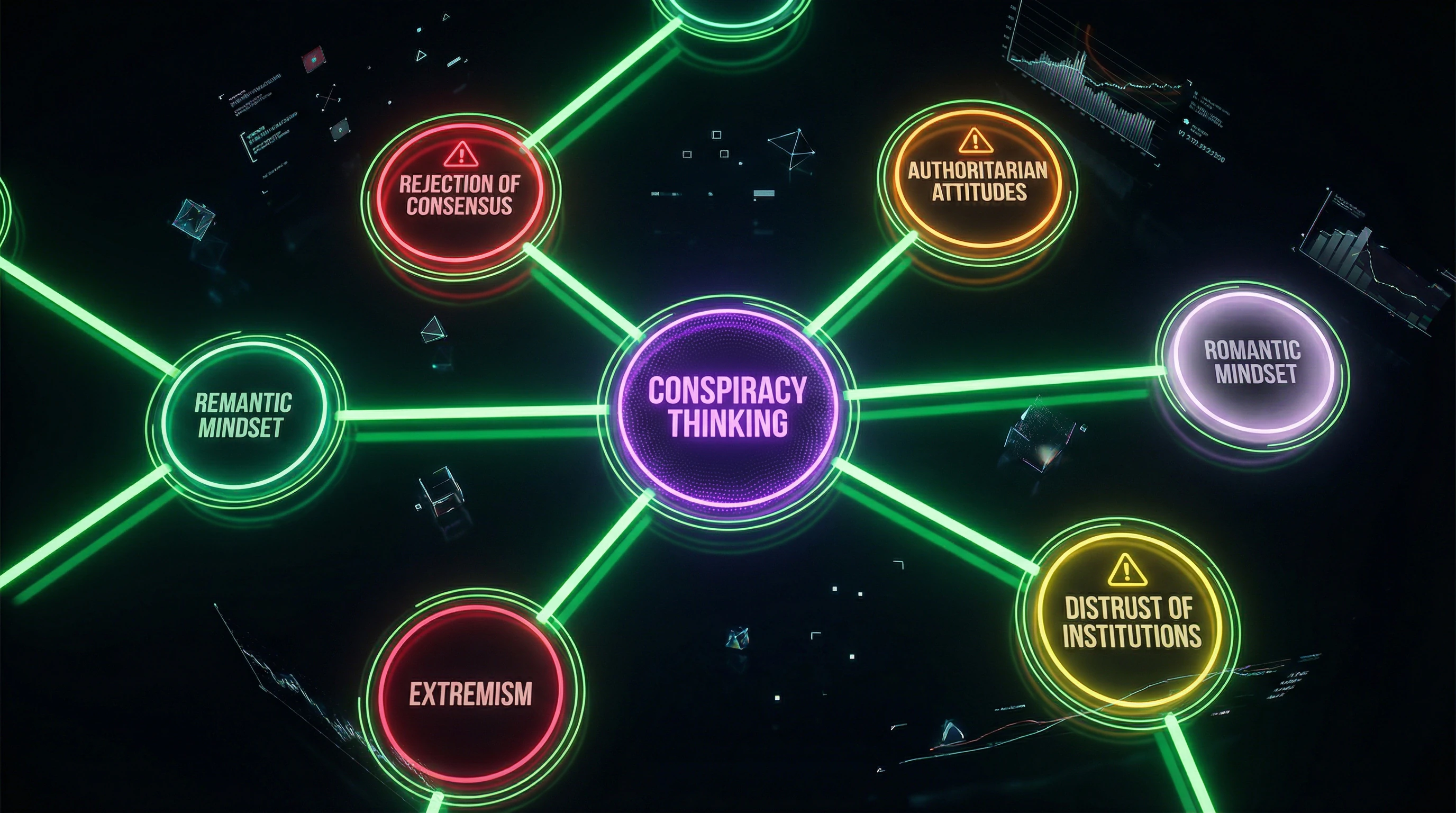
Mechanisms of Persuasion: How Conspiracy Thinking Exploits Cognitive Vulnerabilities in Human Reasoning
Conspiracy narratives are not random — they systematically exploit known cognitive vulnerabilities. Understanding these mechanisms is critical for developing effective counter-strategies. Learn more in the Cognitive Biases section.
🧩 Pattern Illusion and Agency Detection
The human brain evolved to detect patterns and agency (intentional actions) in the environment. This adaptation was useful for survival, but creates a systematic tendency to see patterns where none exist (apophenia) and to attribute intentional causality to random events.
Conspiracy narratives exploit these tendencies by offering explanations that satisfy our need to see order and intention in a chaotic world (S001).
🔁 Confirmation Bias and Echo Chambers
Confirmation bias — the tendency to seek, interpret, and remember information in ways that confirm existing beliefs. In the context of conspiracy thinking, people already inclined toward such reasoning selectively attend to supporting information while ignoring contradictory data.
Digital platforms amplify this effect through algorithmic content curation, creating echo chambers where conspiracy beliefs are constantly reinforced (S007).
- Algorithms show content matching the user's previous behavior
- User sees only confirming materials
- Belief strengthens through repeated exposure
- Contradictory information is filtered out or ignored
🧷 Need for Cognitive Closure and Intolerance of Uncertainty
People with high need for cognitive closure — the desire to have a definite answer to a question, any answer, rather than uncertainty — are more susceptible to conspiracy thinking. Conspiracy theories offer certainty in an uncertain world, simple explanations for complex events.
This psychological function is especially important during periods of social crisis, when uncertainty and anxiety are elevated (S001).
🧠 Emotional Reasoning and Romantic Mentality
Romantic mentality — characterized by prioritizing emotion over rationality, intuition over analysis, the mystical over the empirical — is a strong predictor of conspiracy thinking (S001). This mentality represents the "long historical shadow of romanticism" on contemporary political psychology.
| Cognitive Mechanism | Function in Conspiracy Thinking | Activation Trigger |
|---|---|---|
| Apophenia | Seeing hidden connections between events | Complexity, chaos, uncertainty |
| Confirmation bias | Selecting only supporting evidence | Prior beliefs, social environment |
| Need for closure | Accepting any explanation over uncertainty | Crisis, anxiety, social instability |
| Emotional reasoning | Trusting intuition and feelings over facts | Personal experience, cultural narratives |
Conspiracy thinking links these mechanisms into a unified system: uncertainty activates the need for closure, emotional reasoning replaces analysis, apophenia finds patterns, confirmation bias reinforces them. Each level amplifies the others.
Conflicts in the Evidence Base: Where Researchers Disagree on the Nature and Consequences of Conspiracy Thinking
Despite growing consensus on many aspects of conspiratorial thinking, there are areas where researchers disagree or where data remains ambiguous. More details in the section Debunking and Prebunking.
🔎 Causality Debates: Conspiracy Thinking as Cause or Symptom
There is debate about whether conspiratorial thinking is a cause of anti-democratic attitudes and extremism, or whether it is itself a symptom of deeper psychological and social factors.
| Position | Mechanism | Implication |
|---|---|---|
| Conspiracy thinking as cause | Belief in hidden conspiracy → radicalization → action | Intervention: debunk narratives |
| Conspiracy thinking as symptom | Social isolation, economic uncertainty → search for explanations → conspiracy thinking | Intervention: address root factors |
The first group of researchers argues that conspiracy thinking plays a causal role in radicalization. The second views it as an epiphenomenon, reflecting underlying psychological predispositions and social conditions (S008).
🧱 The Boundary Question: Where Healthy Skepticism Ends and Conspiracy Thinking Begins
There is no clear consensus on where the boundary lies between healthy skepticism toward authority and pathological conspiratorial thinking.
Blurring the line between criticism and conspiracy thinking can legitimize dangerous forms of thought, but abandoning skepticism leaves institutional abuses unchecked.
Some researchers emphasize the importance of critical attitudes toward official narratives, especially in the context of documented cases of institutional corruption and abuse (S010). Others warn that blurring this boundary can legitimize dangerous forms of conspiracy thinking. The problem is that both approaches contain real risks.
⚠️ Intervention Effectiveness: What Works in Combating Conspiracy Thinking
There is limited consensus on which interventions are effective for reducing conspiratorial beliefs.
- Direct refutation may strengthen beliefs through the backfire effect
- Carefully designed refutations show effectiveness in some contexts
- Additional research is needed to determine optimal strategies at individual and social levels
The range of results indicates that intervention effectiveness depends on context, audience characteristics, and how information is presented (S003). There is no universal solution.
Anatomy of Cognitive Traps: Which Psychological Vulnerabilities Conspiracy Narratives Exploit
Conspiracy narratives don't simply offer alternative explanations — they systematically exploit known cognitive biases and psychological needs. Understanding these mechanisms is critical for developing cognitive defenses.
⚠️ False Consensus Effect and Social Proof
The false consensus effect is the tendency to overestimate the degree to which others share our beliefs. In online conspiracy communities, this effect is amplified: participants are surrounded by people who share their views, creating an illusion of broad consensus.
This exploits the principle of social proof — the tendency to consider behavior correct to the extent that we see others demonstrating it (S007). The community becomes a mirror, reflecting one's own beliefs back with amplification.
🕳️ Illusion of Explanatory Depth
People systematically overestimate the depth of their understanding of complex systems. Conspiracy narratives exploit this illusion by offering simplified explanations that create a sense of understanding without the need to grapple with actual complexity.
When people are asked to explain in detail the mechanisms underlying their beliefs, the illusion often dissipates — but conspiracy communities rarely demand such detail.
🧠 Dunning-Kruger Effect in Epistemological Context
The Dunning-Kruger effect is a cognitive bias in which people with low competence overestimate their competence. In the conspiracy context, this manifests as confidence in the ability to "do your own research" and evaluate complex scientific questions without appropriate expertise.
The call to "do your own research" exploits this bias, creating an illusion of competence in people who lack the methodological tools for critical evaluation of evidence (S006). Compare this to protocols for investigating paranormal claims — those require actual methodology, not just "personal opinion."
🔁 Motivated Reasoning and Identity Defense
Motivated reasoning is a process in which emotional and motivational factors influence cognitive processes such that desired conclusions seem more likely. When conspiracy beliefs become part of a person's social identity, any threat to these beliefs is perceived as a threat to identity itself.
- Belief becomes integrated into worldview
- Worldview becomes part of self-identification
- Criticism of belief = criticism of self
- Defense mechanisms activate automatically
- Evidence is reinterpreted to support the belief
This transforms an epistemological question into a question of self-preservation. A person defends not an idea, but themselves. The mechanism works identically for free energy myths, quantum myths, and any other conspiracy narratives embedded in group identity.
Verification Protocol: Seven Questions That Will Dismantle a Conspiracy Narrative in Three Minutes
A systematic verification protocol allows you to quickly assess the plausibility of conspiracy claims. Based on principles of critical thinking and scientific methodology (S001).
✅ Question One: Is the Claim Falsifiable
Falsifiability is Karl Popper's criterion for scientific validity. A claim is falsifiable if you can imagine an observation or experiment that would disprove it.
Conspiracy theories are often structured so that any evidence against them is interpreted as part of the conspiracy. If a claim cannot be disproven in principle—it's not scientific and requires extreme skepticism.
✅ Question Two: Does the Explanation Require an Implausible Level of Coordination
Many conspiracy theories require thousands or millions of people to maintain absolute secrecy for decades. Empirical data on human behavior shows: such a level of coordination is practically impossible (S005).
Information leaks, disagreements, whistleblower motivations—all of these make global conspiracies highly unlikely. The more participants involved, the higher the probability of exposure.
✅ Question Three: Does the Theory Rely on Cherry-Picking Evidence
Cherry-picking means selecting only facts that confirm a hypothesis while ignoring contradictory data. This systematic error can make any narrative seem convincing.
- Check: Does the author consider alternative explanations
- Does he mention facts that contradict his theory
- Does he have criteria under which he would admit being wrong
✅ Question Four: Does the Theory Appeal to Authority Instead of Evidence
"A famous scientist said" or "a doctor with 30 years of experience claims"—these are not evidence. Appeal to authority only works if the authority is speaking within their area of expertise and their claims are verified by peer-reviewed research (S006).
Conspiracy narratives often use marginal experts or people who have lost credibility in mainstream science.
✅ Question Five: Does the Theory Use Unfalsifiable Logic
If every counterargument is interpreted as "proof of how deep the conspiracy goes," the logic becomes unfalsifiable. This is a sign not of scientific thinking, but of an ideological system (S002).
Any objection becomes part of the conspiracy—this isn't an argument, it's a thinking trap.
✅ Question Six: Does the Theory Require Belief in the Conspirators' Competence
Conspiracy theories often require simultaneously believing two contradictory things: that conspirators are both brilliant (covering their tracks) and foolish (leaving obvious clues for amateur theorists).
This logical contradiction indicates the theory is built not on evidence, but on narrative necessity.
✅ Question Seven: What Is the Cost of Error for Society
Even if a conspiracy theory has a 1% probability of being true, you need to assess the social consequences of its spread (S003). Theories about pharmaceutical company conspiracies lead to vaccine refusal; theories about climate control lead to inaction in the face of real threats.
The verification protocol is not a tool for humiliating conspiracy believers. It's a tool for protecting your own thinking from cognitive traps that are exploited by everyone—from marketers to politicians.
Start with yourself. Apply these seven questions to beliefs you consider true. If your theory withstands scrutiny—it will only become stronger.