 ⚛️ Quantum Mysticism
Pseudoscience: How to Distinguish Imitation from Real Knowledgeλ
Pseudoscience masquerades as science but avoids verification, doesn't follow the scientific method, and makes untestable claims, which can lead to dangerous decisions.
Overview
Pseudoscience mimics scientific form but avoids the main thing 🧩: testability and willingness to be refuted. It exploits misunderstanding of methodology, replacing evidence with beliefs and criticism with defensive rituals. The danger isn't in errors (science makes mistakes too), but in refusing self-correction—the mechanism that distinguishes knowledge from faith.
🛡️
Laplace Protocol: Critical thinking and understanding the scientific method are your defense against pseudoscientific manipulation. Demand empirical evidence, testability, and willingness to be refuted.
Reference Protocol
Scientific Foundation
Evidence-based framework for critical analysis
Navigation Matrix
Subsections
[alternative-history]
Alternative History
A methodology and genre exploring probable worlds through points of historical divergence, revealing the role of chance and human choice in shaping reality
Explore
[bio-genetics-myths]
Genetics Myths
Scientific analysis of common misconceptions about genetics: from genetic essentialism to the real capabilities of DNA testing and the role of epigenetics
Explore
[energy-devices]
Energy Devices
We examine real energy harvesting technologies and debunk pseudoscientific claims about "free energy" that violate the laws of thermodynamics.
Explore
[geometry-vibrations]
Geometry and Vibrations
An exploration of geometric patterns, mathematical proportions, and their manifestations in architecture, nature, and cultural traditions through the lens of scientific analysis
Explore
[paranormal-ufology]
Paranormal Phenomena and UFOlogy
Critical analysis of paranormal phenomena, UFO sightings, and cryptozoology through the lens of scientific method and documented research
Explore
[pseudo-psychology]
Pseudopsychology
Critical analysis of pseudoscientific psychological practices, popular literature, and methods that masquerade as scientific psychology but lack empirical foundation.
Explore
[quantum-mystification]
Quantum Mystification
Exposing the abuse of quantum physics in marketing, healing, and mysticism — how to distinguish real science from pseudoscientific manipulation
Explore
[torsion-fields]
Torsion Fields
Hypothetical fields associated with spacetime rotation, which modern physics considers purely theoretical objects without observable effects
Explore
[water-chemistry-myths]
Water Chemistry Myths
From hydrogen water to the water cycle — a scientifically grounded analysis of myths that persist even after formal chemistry education
Explore
Protocol: Evaluation
Test Yourself
Fact Checks
View All Claims →Claims & Analysis
Sector L1
Articles
Research materials, essays, and deep dives into critical thinking mechanisms.
⚛️ Quantum Mysticism 🧪 Pseudoscience
 ♾️ Free Energy and Perpetual Motion Machines
 🛸 Ufology and Contactees
 ⚛️ Quantum Mysticism
 🌀 Torsion Fields and Bioenergetics
 🏛️ Alternative History
 🧪 Pseudoscience
 ⚛️ Quantum Mysticism
 💭 Pseudopsychology
 💭 Pseudopsychology
 💭 Pseudopsychology
⚡
Deep Dive
What Hides Behind the Mask of Science: Anatomy of Pseudoscience
Pseudoscience consists of beliefs, practices, or claims presented as scientific but lacking empirical evidence, failing to follow the scientific method, and resisting reliable testing or falsification. Philosopher Kazakov defines it as a "transformed form of scientific knowledge"—a phenomenon only recently subject to systematic study.
The primary mechanism of pseudoscience is the imitation of scientific methodology without its actual application. The modern version doesn't copy the cognitive process itself but masquerades as applied research, exploiting public misunderstanding of how science works.
- Protoscience
- A developing field that hasn't yet achieved full scientific status but follows the scientific method and remains open to criticism. Strives toward scientific maturity.
- Deviant Science
- Legitimate scientific alternatives discussed within scientific structures and subject to the rules of scientific discourse.
- Pseudoscience
- Characterized by methodology that avoids scientific testing and makes unfalsifiable claims. Deliberately remains outside the scientific community and its quality control.
The distinction among them lies not in the novelty of ideas but in their relationship to testing: protoscience seeks it, deviant science debates it within the scientific community, pseudoscience avoids it.
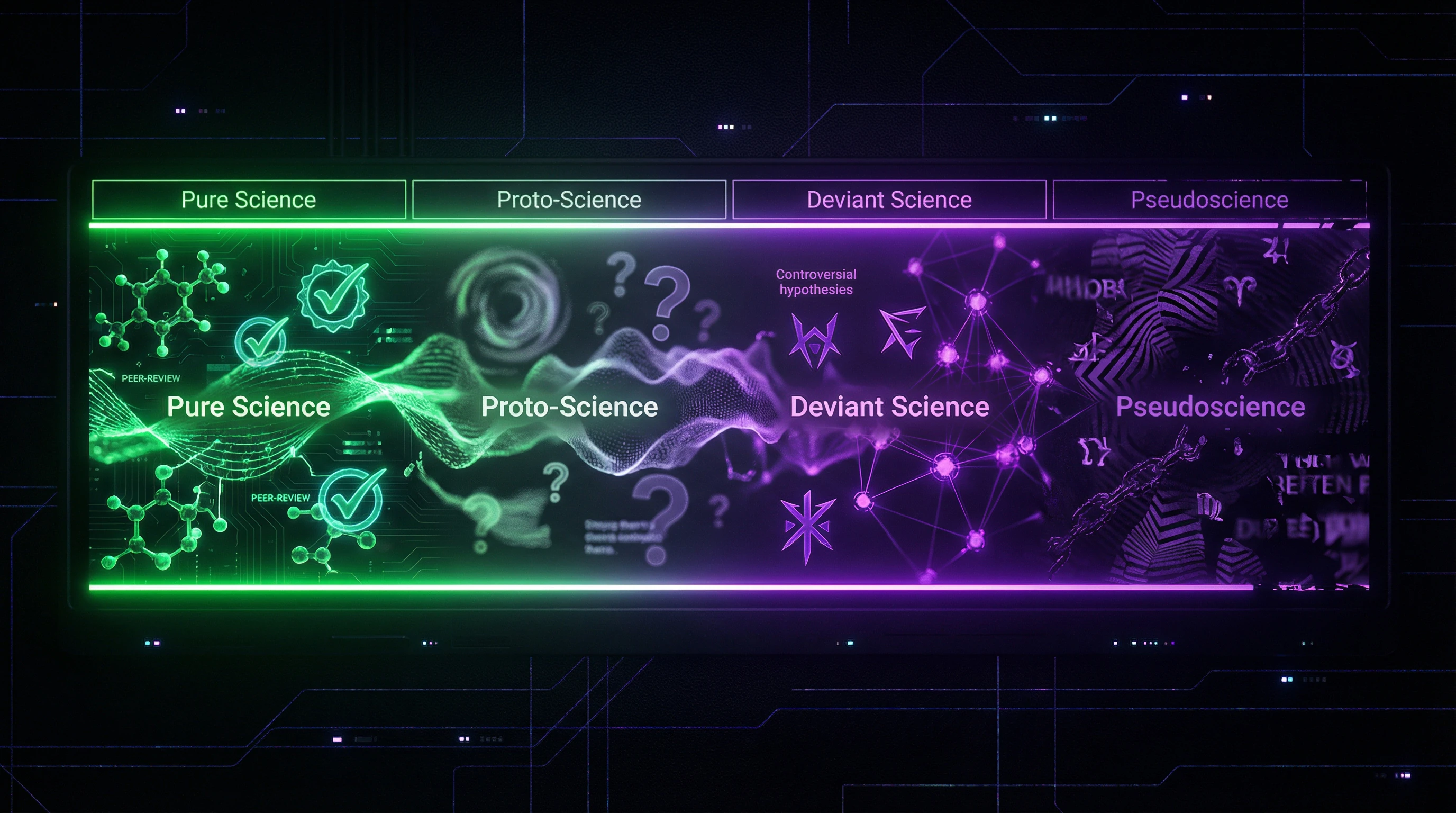
The Demarcation Problem: Where the Boundary Lies Between Science and Imitation
Popper's Criteria and the Principle of Falsifiability
The boundary between science and pseudoscience runs along a theory's capacity to be refuted. Karl Popper called this falsifiability: a scientific theory must make predictions that can be tested and, in principle, disproven by empirical observations.
Pseudoscience operates differently. Its claims are protected from refutation by vague formulations or ad hoc hypotheses—props that rescue the core idea from any criticism.
| Scientific Approach | Pseudoscientific Approach |
|---|---|
| Prediction doesn't match observation → revision or abandonment of theory | Prediction doesn't match → introduction of additional explanation protecting the theory |
| Formulation allows unambiguous testing | Formulation permits any interpretation of results |
Astrology demonstrates this clearly. When a prediction fails, the practitioner says: "cosmic influences were neutralized by other factors." The theory remains untouched, criticism deflected.
Empirical Testability and Reproducibility of Results
A scientific claim must make specific predictions testable through observation or experiment. Reproducibility means: another researcher, following the same methodology, will obtain the same result.
Pseudoscience fails these criteria. Its claims either cannot be empirically tested at all, or results collapse under independent verification.
- Control groups and blind studies filter out experimenter bias
- Statistical analysis separates pattern from chance
- Peer review filters methodological errors
- Critical expert evaluation checks the logic and validity of conclusions
Pseudoscientific work either isn't submitted for peer review or is rejected by scientific journals due to methodological deficiencies. Authors then accuse the scientific community of bias—a standard defensive move that itself serves as an indicator of pseudoscience.
15 Indicators of Pseudoscientific Theories: A Practical Recognition Toolkit
Methodological Red Flags
Based on Podymov's research, five key methodological indicators of pseudoscience can be identified.
- Absence of empirical evidence: claims are not supported by reproducible observations or experiments.
- Unfalsifiable assertions, constructed so that they cannot be disproven.
- Lack of peer review: work is not submitted to scientific journals or is systematically rejected by them.
- Cherry-picking data: selective use of evidence supporting claims while ignoring contradictory data.
- Reliance on anecdotal evidence: personal stories and isolated cases instead of systematic studies with control groups and statistical analysis.
These five characteristics form the methodological core of pseudoscience and allow it to be distinguished from legitimate scientific research.
Rhetorical and Structural Features of Pseudoscientific Discourse
Rhetorical indicators include appeals to ancient wisdom, claiming that knowledge was "known to the ancients" but has been lost. Conspiracy theories suggest that the scientific community suppresses "truth" for self-interested or ideological reasons.
| Rhetorical Feature | Mechanism of Action |
|---|---|
| Scientific-sounding jargon | Technical language applied incorrectly or meaninglessly to create an illusion of scientificity |
| Grandiose claims | Promise revolutionary breakthroughs or universal explanations without corresponding evidence |
| Ad hominem attacks | Directed at the person of critics rather than the content of criticism |
Structural features include lack of progress: the theory remains unchanged despite new data. Isolation from the scientific community manifests in practitioners working outside mainstream scientific institutions.
- Reversed burden of proof
- Demands that others disprove claims instead of providing their own evidence—inverts the logic of the scientific method.
- Conflation of science with ideology
- Combines scientific claims with political or religious agendas, making criticism difficult without accusations of bias.
- Commercial motivation
- Focuses on selling products or services rather than advancing knowledge—financial incentive often conceals the absence of a scientific foundation.
Common Myths About Pseudoscience and Their Refutation
The Myth of Untested Science as Synonymous with Pseudoscience
An untested hypothesis is not pseudoscience. Pseudoscience actively avoids scientific testing and formulates unfalsifiable claims that can neither be proven nor disproven.
Legitimate scientific alternatives are discussed within proper scientific frameworks. Pseudoscience is characterized precisely by its methodology, not by the novelty of ideas.
| Protoscience | Pseudoscience |
|---|---|
| Developing field that follows the scientific method | Mimics scientific methodology without following it |
| Accumulates empirical foundation | Exploits misunderstanding of the scientific process |
| Open to revision based on data | Protects beliefs from criticism |
The Myth of Pseudoscience's Harmlessness
Pseudoscience is not harmless entertainment. It leads to harmful decisions, waste of resources, and rejection of effective treatments.
The commercial motivation of pseudoscience focuses on selling products rather than advancing knowledge. This creates direct financial risks for consumers.
Scientific consensus does not mean closed-mindedness. Science requires extraordinary evidence for extraordinary claims—this is not an ideological barrier but a methodological standard.
The conflation of science with ideology, characteristic of pseudoscience, combines scientific claims with political or religious agendas, distorting the objectivity of knowledge.
Historical and Contemporary Examples of Pseudoscience
Phrenology and Alchemy: The Mechanics of Error Persistence
Phrenology claimed that skull shape predicts personality. No histological evidence. Alchemy mixed real chemical reactions with mysticism, rejecting systematic method.
Both examples demonstrate one thing: pseudoscience persists because it copies the appearance of science—terminology, authorities, claims to systematic approach—but ignores its core: testability and willingness to be wrong.
Pseudoscience exists not despite science, but because of its prestige. It parasitizes trust in the method without applying the method itself.
Modern Hotspots: From Mysticism to Technologism
Today pseudoscience rarely hides behind old masks. It has changed its costume.
| Domain | Imitation Mechanism | Actual Trap |
|---|---|---|
| Pseudopsychology | Tests, statistics, "scientific" method names | Unfalsifiability: any result "confirms" the theory |
| Quantum Mystification | Quantum mechanics + consciousness = "scientific" explanation of miracles | Substituting physics with philosophy without verification |
| Paranormal Phenomena | Documentation, "witnesses," pattern seeking | Absence of controlled reproduction conditions |
| Energy Devices | Technical jargon, diagrams, promises of efficiency > 100% | Violation of thermodynamic laws, but "hidden mechanisms" |
The key distinction of modern pseudoscience: it doesn't imitate the cognitive process, but imitates applied results. It promises working devices, healing, prediction—and explains failure not as methodological error, but as "insufficient belief," "interference," or "scientific conspiracy."
Kazakov defines pseudoscience as a "transformed form of scientific knowledge"—and this is precise. It doesn't emerge from nothing, but deforms real scientific ideas, extracting them from the context of testability and criticism.
Practical Recommendations for Recognizing Pseudoscience
For Researchers and the Public
Recognizing pseudoscience relies on multiple criteria: empirical testability, falsifiability, methodological rigor, expert evaluation, reproducibility of results.
What to look for in content: absence of empirical evidence, unfalsifiable claims, lack of peer review, selective use of data, reliance on anecdotal testimony.
- Appeals to ancient wisdom or "forgotten knowledge"
- Conspiracy theories as explanation for criticism
- Incorrect use of scientific terminology
- Grandiose promises without intermediate results
- Personal attacks on critics instead of addressing objections
The Role of Education in Combating Pseudoscience
Critical thinking is formed not through memorizing facts, but through understanding scientific method: how hypotheses are constructed, why reproducibility of results is nontrivial, what empirical verification means.
Structural features of pseudoscience—absence of theoretical progress, isolation from scientific community, reversed burden of proof, commercial motivation—must be explicitly analyzed in educational programs, not hidden behind general phrases about "being scientific."
Philosophical analysis shows: the demarcation problem remains open. Pseudoscience is not simply error, but a transformed form of scientific knowledge that borrows the rhetoric and structure of science while violating its logic. This requires constant attention and rethinking of recognition strategies.

Knowledge Access Protocol
FAQ
Frequently Asked Questions
Pseudoscience refers to teachings and practices that present themselves as science but don't follow the scientific method and lack evidence. It mimics scientific terminology and methodology but avoids empirical testing and isn't falsifiable. Pseudoscientific theories don't undergo peer review and aren't reproducible by independent researchers.
Real science makes testable predictions, follows rigorous methodology, and remains open to criticism through peer review. Pseudoscience makes unfalsifiable claims, avoids scientific testing, and doesn't change when new data emerges. The key difference lies in willingness to be disproven and reproducibility of results.
Main characteristics include absence of empirical evidence, unfalsifiable claims, and avoidance of peer review. Also typical are selective use of data, reliance on anecdotal evidence, and use of scientific-sounding jargon without real substance. Pseudoscience often appeals to ancient wisdom and conspiracy theories.
No, this is a common myth. Pseudoscience actively avoids scientific testing and deliberately formulates claims so they can neither be proven nor disproven. Real untested science (hypotheses) seeks verification and is willing to change based on facts.
Yes, pseudoscience can cause serious harm. It leads to incorrect medical decisions, rejection of effective treatment, and wasteful spending of resources. Belief in pseudoscientific theories undermines critical thinking and can have social and economic consequences.
The demarcation problem is the question of how to draw a clear boundary between science and pseudoscience. Karl Popper proposed the criterion of falsifiability: a scientific theory must be potentially disprovable. Modern approaches use multiple criteria: empirical testability, reproducibility, methodological rigor, and peer review.
Check for peer-reviewed publications, reproducibility of results, and authors' willingness to accept criticism. Watch for red flags: grandiose promises, conspiracy theories, attacks on critics, and unchanging theory despite new data. Real science is always open to testing and refutation.
Pseudoscience uses cherry-picking of data, ignoring contradictory facts. It relies on anecdotal evidence instead of systematic research and makes unfalsifiable claims. Absence of control groups, ignoring statistical significance, and inability to reproduce results are typical methodological failures.
Pseudoscience mimics scientific language to create an appearance of legitimacy and authority. Scientific-sounding jargon is used incorrectly or meaninglessly to impress non-specialists. Modern pseudoscience focuses on imitating applied research rather than fundamental science, exploiting the public's misunderstanding of scientific methodology.
Classic examples include phrenology (determining character by skull shape) and alchemy in its later forms. These teachings imitated scientific approaches but didn't follow empirical methods and made unfalsifiable claims. Many were popular in their time but didn't withstand scientific scrutiny.
Protoscience is an early stage in the development of a scientific discipline that may eventually become a fully-fledged science. Pseudoscience, however, does not strive for scientific rigor and does not evolve toward genuine science. Protoscience is open to methodological improvement, while pseudoscience remains unchanged and avoids testing.
No, that's a myth. Science remains open to new evidence but requires extraordinary evidence for extraordinary claims. Scientific consensus is based on accumulated data and can change when compelling facts emerge. The history of science is full of examples where established theories were revised based on new discoveries.
Education develops critical thinking and understanding of the scientific method, which helps recognize pseudoscientific claims. Knowledge of demarcation criteria, research methodology, and principles of evidence-based reasoning makes people resistant to manipulation. Scientific literacy is a key tool for protection against pseudoscience.
Lack of progress is a structural feature of pseudoscience. Pseudoscientific theories remain unchanged because they are not subjected to empirical testing and do not engage with scientific criticism. Real science constantly evolves and refines itself based on new data, while pseudoscience remains frozen in dogmatic assertions.
Verify the source of information and check for peer-reviewed publications on the topic. Look for independent research and opinions from experts at recognized scientific organizations. Be especially cautious of claims promising miraculous results, criticizing "mainstream science," or using conspiracy theories to explain lack of recognition.
Yes, this is called deviant science—when individual researchers or groups deviate from scientific standards. However, the system of scientific verification, peer review, and reproducibility typically identifies and corrects such deviations. The key difference is the scientific community's willingness to acknowledge and correct errors.