The microchip-in-vaccines theory is one of the most persistent myths of the COVID-19 pandemic, despite complete absence of technical feasibility and evidence. Research on vaccination information sources shows the myth spreads through social media and messaging apps, exploiting cognitive biases: fear of technology, institutional distrust, and illusion of control. We examine technical impossibilities, psychological mechanisms of belief, and a 60-second protocol for fact-checking any conspiracy theory.
🖤 In March 2020, as the world held its breath awaiting a COVID-19 vaccine, a myth was born in the digital space that would prove more resilient than many viral strains. The microchip-in-vaccines theory spread at a rate any real pandemic would envy—and unlike a virus, no immunity exists against it through critical thinking. This myth became the perfect case study for how technophobia, cognitive biases, and information bubbles create beliefs stronger than any facts. 👁️ The paradox: the chipping myth itself proved more dangerous than any hypothetical chip—it killed more people through vaccine refusal than any surveillance technology could ever theoretically harm.
Anatomy of a Conspiracy Theory: What Exactly the Microchip Myth Claims and Why Its Boundaries Are Deliberately Blurred
The vaccine microchip myth is not a monolithic theory, but a constellation of interconnected claims that adapt to audience and context. The basic version: COVID-19 vaccines contain microscopic chips or nanoparticles for tracking location, controlling behavior, or altering DNA. More details in the section Everyone Has Parasites.
More sophisticated variants link chipping to 5G networks, digital currencies, and global identification systems. Research (S004) shows: conspiracy narratives spread primarily through social media, where fact-checking is absent.
🧩 Core of the Myth: Four Basic Claims
- Claim 1: Physical Presence
- Vaccines allegedly contain microchips or nanodevices. The boundary between "micro" and "nano" is deliberately blurred—this allows shifting from one scale to another when refuted.
- Claim 2: Functionality
- Devices can transmit data about location and biometrics. The signal transmission mechanism remains unspecified—"through 5G," "through biofields," "through quantum entanglement."
- Claim 3: Global Control
- Chipping is part of a population control plan. This claim requires no evidence, as it appeals to general distrust of authorities and corporations.
- Claim 4: Personification
- The technology is linked to specific figures (Bill Gates, WHO, pharmaceutical corporations). Personifying the conspiracy makes it psychologically more convincing than abstract systems.
Each claim has dozens of variations. When one version crashes against facts, another takes its place—this makes the myth resistant to refutation.
🔎 Blurred Boundaries as a Defense Mechanism
A fundamental feature of the myth is the deliberate ambiguity of key terms. What is a "microchip"? In different versions, it could be a silicon transistor the size of a grain of sand, a graphene oxide nanoparticle, an RNA-modifying agent, or even an "energy marker."
Semantic fluidity makes the myth invulnerable to direct refutation: any proof of the absence of one type of device is met with the argument "but we were talking about a different type."
Systematic review methodology requires a clear definition of the phenomenon being studied—precisely what conspiracy theories avoid as the main threat to their existence. Epistemological analysis shows: a theory that cannot be refuted ceases to be a scientific hypothesis and becomes a belief.
🧱 Historical Genealogy: From RFID Panic to Pandemic Renaissance
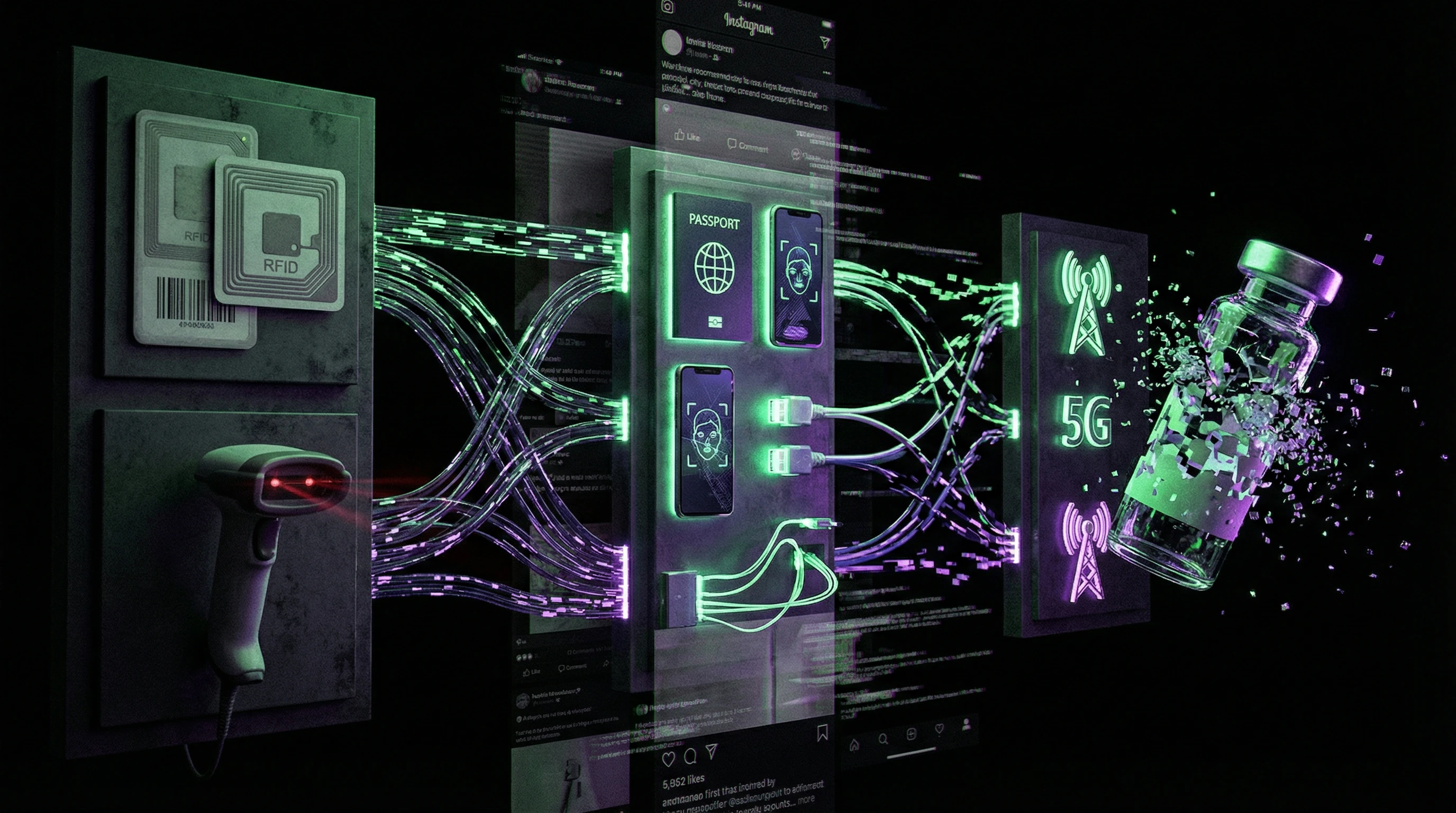
Fear of chipping was not born in 2020. Panic around RFID tags in the early 2000s, conspiracy interpretations of biometric passports, fears of a "digital concentration camp"—all this created the cultural soil for the vaccine chip myth.
| Period | Technology | Conspiracy Narrative |
|---|---|---|
| 2000–2010 | RFID tags in documents | Global citizen tracking system |
| 2010–2015 | Biometric passports | Digital identity control |
| 2015–2020 | Digital currencies, 5G | Preparation for total control |
| 2020–2024 | COVID-19 vaccines | Mass chipping under the guise of vaccination |
The COVID-19 pandemic provided the perfect context: mass vaccination, accelerated drug development, global coordination of government actions—everything looked like confirmation of long-standing fears. Analysis of vaccination information sources demonstrates: distrust of institutions becomes self-reproducing. Every refutation of the myth is interpreted as proof of conspiracy.
Steelmanning: Seven Most Compelling Arguments from Microchipping Proponents and Why They Work
To understand the myth's persistence, we must apply the "steelman" principle — examining not caricatured versions, but the strongest formulations of these arguments. This doesn't mean agreement, but requires intellectual honesty: understanding why people believe matters more than simple mockery. More details in the Bioresonance Therapy section.
Each argument below has internal logic and appeals to real technologies or historical precedents — precisely why they convince millions of people.
⚙️ First Argument: Microchip Technology Really Exists and Is Used
Proponents correctly point out that RFID chip technology has existed for decades and is actively used for animal identification, logistics, and contactless payment systems. Companies like Sweden's Biohax offer voluntary employee microchipping for office access.
This argument creates a false sense of plausibility: if the technology exists, why couldn't it be in vaccines? The problem lies in scale and context — the existence of automobiles doesn't mean they can be hidden in an aspirin tablet.
🔬 Second Argument: Research on Nanoparticles and Quantum Dots in Medicine
Real scientific research does indeed study using nanoparticles for drug delivery and quantum dots for biomarking. Publications about "digital vaccination certificates" based on fluorescent markers, funded by the Bill Gates Foundation, exist and are publicly available.
Proponents use these facts as "proof," ignoring the fundamental difference between an optical marker the size of a dot and a functional transmitting device. Nanoparticles in vaccines are used as adjuvants and carriers, but have no data transmission functions.
🕳️ Third Argument: Historical Precedents of Unethical Experiments
One of the strongest psychological arguments — references to real cases of unethical medical experiments: the Tuskegee syphilis study, MK-Ultra experiments, forced sterilization. These historical facts create legitimate distrust of medical and government institutions.
The argument goes: "If they did this before, why couldn't they do it now?" The problem is extrapolation: the existence of precedents doesn't prove a specific current claim, but creates an emotional foundation for distrust that's difficult to overcome with rational arguments.
📊 Fourth Argument: Accelerated Vaccine Development and Lack of Long-Term Data
COVID-19 vaccines were indeed developed in less than a year instead of the usual 5–10 years. This is an objective fact that generates legitimate questions about long-term safety.
Proponents use this uncertainty as space for projecting fears: if we don't know all the long-term effects, there could be anything, including chips. This argument exploits the cognitive bias of "gap-filling" — the brain's tendency to fill information absence with worst-case scenarios, especially under stress.
🧩 Fifth Argument: Coincidence of Vaccine Rollout with 5G Deployment and Digital Passports
The temporal coincidence of mass vaccination with 5G network deployment and discussions of digital health passports creates an illusion of causal connection. Proponents construct a narrative: vaccine chips will interact with 5G towers to create a global control system.
This argument demonstrates the classic "cum hoc ergo propter hoc" fallacy (together therefore because of), but its persuasiveness is amplified by real discussions about digital identification and vaccination QR codes (S004). Such coincidences go viral on social media precisely because of their narrative coherence.
🔎 Sixth Argument: Patents and Financial Interests of Pharmaceutical Corporations
Pharmaceutical companies earned billions in profits from COVID-19 vaccines, and some patents for drug delivery technologies mention nanoparticles and biosensors. Proponents interpret this as proof of hidden motives: if there's financial interest, there must be deception.
- This argument appeals to the real problem of conflicts of interest in the medical industry.
- But makes a logical leap from "possibility of abuse" to "fact of abuse."
- The presence of financial motivation requires enhanced oversight, but isn't proof of specific wrongdoing.
⚠️ Seventh Argument: Censorship and Suppression of Alternative Views
Removal of microchip posts from social media, account blocking, "misinformation" labels — all interpreted as proof of correctness: "If this were false, why suppress it so actively?"
This argument exploits reactance — the psychological tendency to value information more highly when access to it is restricted. The paradox is that both moderation and its absence can be interpreted as confirming the theory: moderation as censorship of truth, absence of moderation as proof that "they have nothing to hide."
Understanding these seven mechanisms of persuasiveness is the first step toward constructive dialogue. Not refuting arguments, but recognizing their psychological architecture allows development of more effective strategies for critical thinking and evaluating information sources about vaccination.
Evidence Base: What Physics, Biology, and Engineering Say About the Technical Feasibility of Vaccine Microchips
Moving from the psychology of belief to physical reality requires analysis of technical constraints. More details in the section Homeopathy.
The answer lies at the intersection of microelectronics, biomaterial compatibility, radio frequency engineering, and pharmaceutical technology. Between theoretical possibility and practical implementation lies a chasm that conspiracy theorists ignore.
The laws of physics don't bend to conspiracy narratives. Each technical limitation is not a question of current development level, but a fundamental property of reality.
📊 Physical Constraints: Needle Size vs. Functional Chip Size
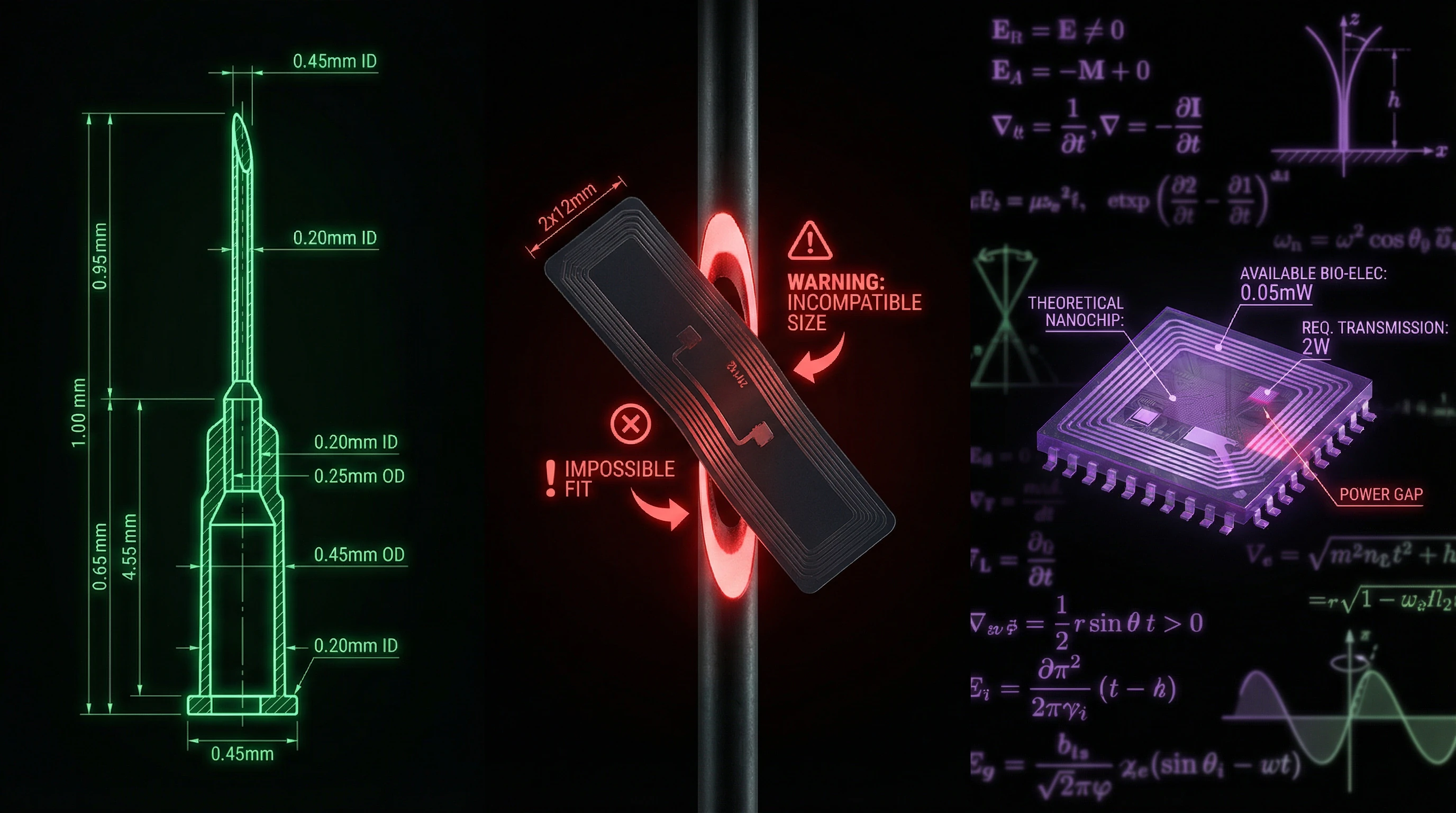
A standard needle for intramuscular injection has an internal diameter of 0.4–0.6 mm (23–25 gauge). This is the absolute physical limit for the size of any object introduced through it.
Modern minimum-size RFID chips (for animal implantation) measure 2×12 mm. They physically cannot pass through a vaccine needle. Theoretically possible nanochips smaller than 0.1 mm face a fundamental problem: they cannot simultaneously contain a power source, an antenna of sufficient size, and a processor.
⚡ Energy Paradox: Where Does the Chip Get Power
Any transmitting device requires energy. Passive RFID tags receive energy from an external reader and work at distances up to 10 meters—but require an antenna several centimeters in size.
Active transmitters with their own power source work at greater distances but require a battery thousands of times larger than any nanoparticle. The assumption of "bioelectric power from the body" ignores orders of magnitude: the human body generates milliwatts, while transmitting a signal over a distance of more than a meter requires watts.
| Device Type | Required Antenna Size | Power Source | Feasibility in Nanochip |
|---|---|---|---|
| Passive RFID | Several cm | External reader | Impossible |
| Active RFID | Several mm | Built-in battery | Impossible |
| Theoretical nanoparticle | <1 micrometer | Bioelectricity | Violates conservation of energy |
🧪 Biocompatibility and Immune Response
The human immune system evolved to detect and eliminate foreign objects. Any chip, even coated with biocompatible material, triggers an inflammatory reaction and encapsulation—the formation of connective tissue around the implant.
This process disrupts the functionality of any electronic device, blocking signal transmission. Medical implants (pacemakers, neurostimulators) solve this problem through surgical implantation into specially prepared tissues and use of materials that have undergone decades of testing.
📡 Radio Frequency Limitations
Antenna efficiency is directly related to its size relative to the wavelength of the transmitted signal. For transmission at mobile network frequencies (hundreds of MHz to several GHz), an antenna at least several millimeters long is required.
A nanoparticle measuring micrometers physically cannot be an effective antenna for these frequencies. Theoretically possible transmission at terahertz frequencies (where wavelength is comparable to nanoparticle size) faces another problem: such waves are absorbed by water and cannot pass through biological tissues for more than fractions of a millimeter.
This is not a question of technological development—these are fundamental properties of electromagnetic waves, described by Maxwell's equations.
🧬 Pharmaceutical Technology: What Vaccines Actually Contain
The composition of COVID-19 vaccines is fully disclosed and available for analysis. mRNA vaccines (Pfizer, Moderna) contain: synthetic mRNA, lipid nanoparticles for its delivery, buffer solutions, salts, and sugars.
Vector vaccines (AstraZeneca, Sputnik V) contain: adenoviral vector with spike protein gene, stabilizers, and preservatives. Each component has a specific biochemical function, confirmed by independent laboratories worldwide.
- Lipid Nanoparticles
- Fatty bubbles 80–100 nanometers in size that protect mRNA from degradation. They contain no electronic components, transmit no signals, and are completely broken down in the body within days. Conspiracy theorists sometimes call them "chips" due to ignorance of their function.
- mRNA
- A molecule encoding instructions for spike protein synthesis. Breaks down in the body within hours to days. Contains no electronic components whatsoever.
- Buffer Solutions and Salts
- Maintain pH and osmotic pressure. Standard components of any injectable medication.
🔎 Independent Verification: Why Chips Cannot Be Hidden
Vaccines are analyzed by thousands of independent laboratories, universities, regulatory agencies, and skeptical researchers worldwide. An electronic microchip, even nanoscale, has a unique structure of silicon, metals, and dielectrics.
Such a structure is instantly detected by electron microscopy, X-ray spectroscopy, and mass spectrometry methods. Over three years of mass vaccination, not a single laboratory has found anything resembling electronic components.
Concealing such a massive deception would require coordination of tens of thousands of independent scientists in hundreds of countries—a level of conspiracy that contradicts everything we know about human nature and the scientific community. For more on how to distinguish evidence-based medicine from manipulation, see information sources on vaccination.
Mechanisms of Causality: Why People Believe the Technically Impossible and How Conspiratorial Thinking Works
Understanding that the myth is technically absurd doesn't explain its persistence. Millions believe in vaccine chips not because they've studied antenna physics or lipid nanoparticle biochemistry, but because the myth satisfies deep psychological needs. Learn more in the Statistics and Probability Theory section.
Analysis of cognitive mechanisms shows that conspiratorial thinking isn't an intellectual defect, but an adaptive brain strategy under uncertainty that malfunctions in the 21st-century information environment.
🧩 Illusion of Control: How Uncertainty Breeds Conspiracy
The COVID-19 pandemic created a global situation of uncertainty and loss of control: an invisible threat, unpredictable disease progression, movement restrictions, economic instability.
Psychological research shows that under such conditions, the brain activates compensatory mechanisms to restore a sense of control. Conspiracy theory offers a simple explanation for a complex situation: not chaos and randomness, but someone's malicious intent.
Paradoxically, believing that "someone controls everything" is psychologically more comfortable than acknowledging the fundamental unpredictability of the world. The microchip myth provides an illusion of understanding and the possibility of "resistance"—refusing vaccination becomes an act of regaining control over one's own life.
🔁 Pattern Detection in Hyperdrive: When the Brain Sees Connections Where None Exist
The human brain evolved to detect patterns—this ability is critical for survival. But in an information-saturated environment, this mechanism produces false positives.
- Coincidence of vaccination with 5G rollout
- Bill Gates mentioned in contexts of both vaccines and digital technology
- Growing discussion of digital identification
The brain automatically connects these elements into a unified narrative—not a conscious process, but automatic work of neural networks seeking causal relationships. Research (S004) shows that social media algorithms amplify this effect, grouping related content and creating an illusion of systematicity where there are only random coincidences.
⚠️ Confirmation Bias and Information Bubbles: A Self-Reinforcing Cycle of Belief
Confirmation bias causes people to seek, interpret, and remember information that confirms existing beliefs while ignoring contradictory data.
| Observation | Believer's Interpretation | Actual Mechanism |
|---|---|---|
| Magnetic properties at injection site | Proof of chip | Inflammatory response and skin moisture |
| Fatigue after vaccination | Chip activation | Body's immune response |
| Illness coinciding with vaccination | Chip caused illness | Temporal correlation without causation |
A person who believes in the microchipping theory begins to see "evidence" everywhere. Social media information bubbles amplify the effect: algorithms show content the user is already prepared to accept, hiding contradictory information.
Meta-analysis (S005) demonstrates that attempts to debunk the myth often strengthen belief in it—the "boomerang effect." When people are shown facts contradicting their beliefs, they perceive it as an attack and cling even more tightly to the original version.
🎭 Social Identity and Belonging: Belief as a Group Marker
Conspiratorial thinking often functions as a marker of social identity. Believing in the microchipping theory isn't just a conviction about technology, it's a way of saying: "I don't trust official sources, I think critically, I'm aware of what they're hiding."
Research (S001) and (S006) shows that conspiratorial beliefs often correlate with distrust of institutions, but not with education level. This means belief in chips isn't a consequence of ignorance, but a result of social rupture and loss of trust in experts.
The community of believers provides psychological support, a sense of belonging, and a clear worldview. Leaving such a community means losing social identity and admitting you were wrong—psychologically, this is costly.
🔧 Why Facts Don't Work: When Logic Meets Emotion
Attempting to refute conspiracy through facts often fails because belief in chips isn't the result of logical analysis, but the result of emotional state and social belonging.
- Cognitive Dissonance
- When facts contradict beliefs, the brain experiences discomfort and activates defense mechanisms: denial, reinterpretation, searching for counterarguments. This isn't a conscious process of deception, but automatic psychological protection.
- Motivated Reasoning
- People don't analyze information objectively—they analyze it to protect existing beliefs and social identity. Facts that threaten identity are rejected faster.
- Illusion of Understanding
- The conspiratorial narrative creates a feeling that you understand a complex world. This is psychologically more powerful than admitting: "I don't know how this works, and I need to trust experts."
Effective communication requires not just facts, but rethinking social identity and restoring trust in institutions. This is a slow process that cannot be solved by one article or debate.
🧠 Cognitive Immunology: How to Protect Thinking from Conspiracy
Understanding these mechanisms allows developing strategies to protect against conspiratorial thinking—not through bans and condemnation, but through developing cognitive skills.
- Recognize your own cognitive biases: confirmation bias, illusion of control, pattern detection
- Distinguish correlation from causation—this is a key skill for critical analysis of medical data
- Verify information sources through evidence-based medicine, not fear manipulation
- Develop tolerance for uncertainty instead of seeking simple explanations
- Maintain critical attitude toward official sources, but don't fall into paranoia
Conspiratorial thinking isn't an enemy to be destroyed, but an adaptive mechanism that malfunctions. The task of cognitive immunology isn't to forbid people from thinking, but to teach them to think better.
Counter-Position Analysis
⚖️ Critical Counterpoint
Categorical refutations often miss real grounds for skepticism and underestimate the pace of technological change. Here's where the article's argumentation requires clarification.
Underestimating the Pace of Nanotechnology
The article relies on current technical limitations, but the development of injectable electronics (MIT, 2020) and biosensors shows that the boundary of what's possible is shifting faster than assumed. In 5–10 years, technologies that seem like science fiction today may become reality—and then categorical refutations will look naive.
Ignoring Legitimate Historical Reasons for Distrust
The article reduces belief in microchips to cognitive biases, overlooking documented history: Tuskegee experiments, forced sterilization, pharmaceutical company scandals (Vioxx, Thalidomide). Dismissing all skeptics as "conspiracy theorists" may alienate people with rational concerns based on real violations.
Weak Empirical Basis for Psychological Mechanisms
The reference to research on information sources (S004) doesn't provide sufficient empirical basis for claims about cognitive biases. Most assertions about "why people believe" are based on general psychological theory rather than specific research on vaccine conspiracies—EvidenceGrade=2 honestly reflects this weakness.
Omission of Real Digital Surveillance
The article creates a binary opposition "microchips are impossible vs everything else is normal," ignoring the gray zone. Facial recognition, contact tracing apps, health passports are already implemented—perhaps the fear of "chips" is an unarticulated protest against real digital surveillance, which the article mentions but doesn't analyze deeply.
Risk of Argument Obsolescence
The article relies on technical limitations of 2024–2025. If injectable biosensors for medical purposes (glucose monitoring, blood pressure) emerge, the context of the discussion will change. Confidence in "technical impossibility" may become an argument against us: "you said it was impossible, and now it exists—so you were lying before too."
FAQ
Frequently Asked Questions

Author of the Cognitive Immunology Hub project. Researches mechanisms of disinformation, pseudoscience, and cognitive biases. All materials are based on peer-reviewed sources.