 🚫 Anti-Vaccine Movement
Anti-Vaccine Movement: Myths vs. Scientific Consensus on Vaccine Safetyλ
The social movement challenging the effectiveness and safety of vaccines represents a significant threat to public health, despite overwhelming scientific evidence of immunization benefits.
Overview
Anti-vaccination movements challenge vaccine efficacy and safety despite scientific consensus — 🧬 the movement has existed since the 18th century and intensified during the COVID-19 pandemic. Mechanism of influence: cognitive biases, emotional arguments, and linguistic manipulation create measurable consequences for public health. The spectrum of positions ranges from radical refusal to selective skepticism.
🛡️
Laplace Protocol: Critical evaluation of vaccine information sources requires verification of peer review, research methodology, and separation of empirical data from opinions to counter emotionally persuasive but scientifically unfounded narratives.
Reference Protocol
Scientific Foundation
Evidence-based framework for critical analysis
Protocol: Evaluation
Test Yourself
Quizzes on this topic coming soon
Sector L1
Articles
Research materials, essays, and deep dives into critical thinking mechanisms.
🚫 Anti-Vaccine Movement 🚫 Anti-Vaccine Movement
 🚫 Anti-Vaccine Movement
 🚫 Anti-Vaccine Movement
 🚫 Anti-Vaccine Movement
 🚫 Anti-Vaccine Movement
⚡
Deep Dive
What lies behind the term "anti-vaccination" — from history to the present
Terminology and historical roots
Anti-vaccination is a social phenomenon that challenges the effectiveness, safety, and necessity of vaccination. The movement emerged simultaneously with vaccination itself in the 18th century and has periodically intensified over more than 200 years, reaching a new peak during the COVID-19 pandemic.
The term encompasses a wide spectrum of positions — from complete rejection of all vaccines to selective skepticism about specific vaccines. The historical persistence of these attitudes shows this is not a temporary phenomenon, but an ongoing challenge for public health systems.
- Vaccine skepticism
- Doubts about the necessity or safety of specific vaccines, often based on lack of information or exposure to misinformation. Classified as a significant threat to global health.
- "COVID deniers"
- A term that emerged during the COVID-19 pandemic, referring to active opponents of coronavirus vaccination.
Continuum of positions: from radical refusal to selective doubt
The anti-vaccination movement exists not as a monolith, but as a continuum. At one pole are absolute opponents of all forms of immunization, rejecting the very concept of vaccination as a medical intervention.
At the other are people with a selective approach, who may accept some vaccines but doubt the necessity or safety of others. Complete vaccine refusal is less common than partial vaccine hesitancy.
Most skeptics are not categorical opponents, but experience doubts based on lack of information or exposure to misinformation. Understanding this spectrum is critically important for developing effective communication strategies.
| Position | Characteristics | Prevalence |
|---|---|---|
| Radical refusal | Rejects all forms of vaccination as a concept | Rare |
| Selective skepticism | Accepts some vaccines, doubts others | Common |
| Hesitancy | Doubts due to lack of information | Widespread |

Scientific Consensus vs. Myths — What the Data Says About Vaccines
Proven Efficacy and Rigorous Safety Oversight
Vaccines undergo multi-stage testing: preclinical studies, three phases of clinical trials, and post-market surveillance. Pharmacovigilance systems track adverse effects throughout the entire period of use.
The scientific community has reached consensus: vaccines are among the safest and most effective medical interventions in history. Peer-reviewed studies consistently confirm that serious adverse effects are extremely rare, and their frequency is incomparable to the risks of complications from preventable diseases.
- Preclinical studies on animal models
- Phase I: safety and dosage (20–100 volunteers)
- Phase II: efficacy and side effects (100–300 participants)
- Phase III: efficacy confirmation (1,000–3,000 participants)
- Post-market surveillance (millions of users)
Risk-Benefit Analysis and Impact on Population Health
Risk-benefit analysis consistently demonstrates the overwhelming advantage of vaccination. Mass immunization has led to the eradication of smallpox and dramatic reductions in polio and measles.
The population-level effect of vaccination extends beyond individual protection: herd immunity protects vulnerable groups who cannot be vaccinated for medical reasons.
Anti-vaccine movements have measurable consequences: outbreaks of previously controlled diseases, increased morbidity in regions with low vaccination coverage. Economic analysis shows that every dollar invested in vaccination yields multiple returns in prevented treatment costs and reduced productivity losses.
Data on vaccine myths and their refutation are available in open sources. The mechanism of misinformation spread is not the absence of facts, but how emotions and social signals reshape the perception of available data.
Psychological Traps of the Mind — Why Emotions Beat Facts
Cognitive Bias in Perceiving Risks of Action vs. Inaction
People systematically overestimate risks from active intervention (vaccine side effects) and underestimate risks from inaction (disease complications), even when the latter are objectively higher. This cognitive bias is called "omission bias."
The mechanism is simple: rare but vivid events (side effects) are perceived as more significant than probable but abstract risks (infectious disease). The brain is evolutionarily tuned to concrete threats, not statistics.
A deficit of accurate information combined with active misinformation spread exacerbates these biases. Social media creates "echo chambers" where erroneous beliefs are amplified and circulate without verification.
Emotional Thinking vs. Rational Data Assessment
Fear and emotional reasoning systematically outweigh rational risk assessment. Medical evidence in the form of statistics loses to emotionally charged narratives about alleged harm.
The human brain responds more strongly to concrete stories than to abstract numbers. A story about a child with side effects has more impact than data on millions of successful vaccinations.
- Simply providing facts is often ineffective for changing beliefs, especially when they are tied to identity or group membership
- Cultural and regional variations in vaccine perception require adapted approaches to educational programs
- Effective countering of misinformation requires understanding psychological barriers and developing messages that appeal to both reason and emotion
Myths and Misinformation: How False Beliefs Spread Faster Than Facts
Common Misconceptions and Their Scientific Refutation
The anti-vaccine movement relies on persistent myths that contradict scientific consensus. The link between vaccines and autism is based on Andrew Wakefield's discredited study, retracted due to data falsification.
The myth of "immune system overload" from multiple vaccines ignores the fact that an infant's immune system can simultaneously respond to thousands of antigens. Studies by Harris Coulter, frequently cited by anti-vaxxers, have not received support from the scientific community due to methodological flaws.
| Myth | Spread Mechanism | Scientific Fact |
|---|---|---|
| Vaccines cause autism | Emotional fear for children + "researcher" authority | Study falsified and retracted; large meta-analyses disprove the link |
| Immune system is overloaded | Intuitive misunderstanding of immune response scale | Infants handle thousands of antigens simultaneously |
| Vaccines are insufficiently tested | Ignoring years of clinical trials | Rigorous testing and continuous safety monitoring |
Cognitive biases reinforce these myths: people overestimate risks from action (vaccination) relative to risks from inaction (disease). Emotional thinking prevails over rational assessment, especially when it concerns children.
The deficit of accurate information combined with active spread of misinformation creates an information vacuum that gets filled with pseudoscientific claims.
The Role of Social Media in Amplifying Myths
Digital platforms have accelerated the spread of anti-vaccine misinformation, creating echo chambers where false beliefs are reinforced. Social media algorithms are optimized for engagement, not accuracy, prioritizing emotionally charged content over scientifically sound information.
Anti-vaccine communities demonstrate high organization and use sophisticated communication strategies to attract new supporters. The COVID-19 pandemic led to explosive growth of such content, spawning the phenomenon of "COVID dissidents."
- The speed of misinformation spread on social media significantly exceeds the speed of rebuttals from official sources
- Visual content, infographics, and short videos prove particularly effective tools for misinformation
- Such content spreads more easily and is perceived as more convincing than text-based materials
- Algorithms amplify the effect by showing similar content to users with already-formed beliefs
The mechanism is simple: emotion → click → algorithm → more emotions. Facts require effort to understand; misinformation requires only agreement.
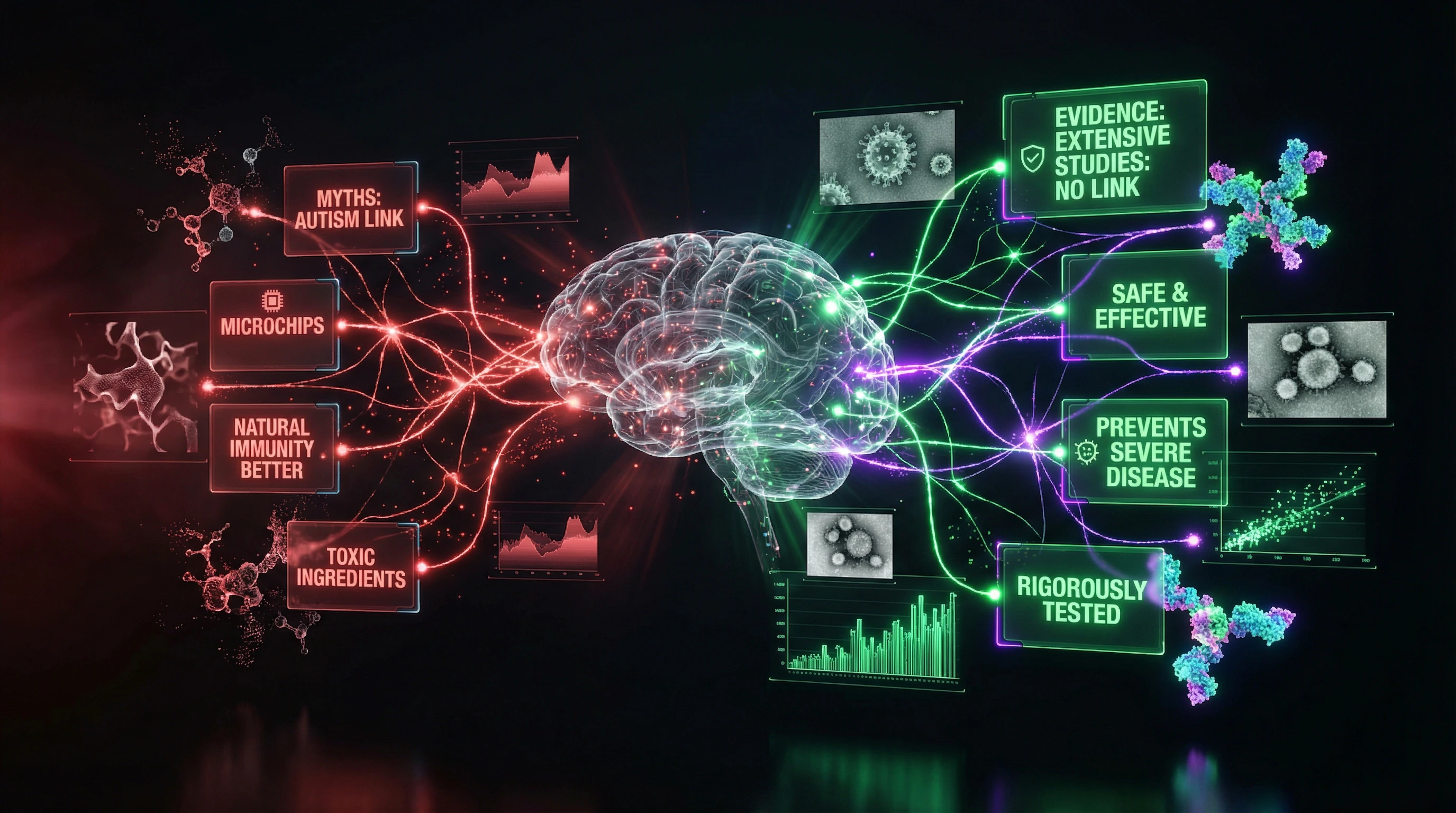
Linguistic and Communication Strategies: How Words Shape Beliefs
Manipulation of Consciousness Through Rhetoric
Anti-vaccination rhetoric employs redefinition of terms ("toxins" instead of "vaccine components"), emotionally charged vocabulary ("poison," "experiments on children"), and false dichotomy between "natural" and "artificial" immunity. Narratives are constructed around personal tragedies, creating emotional resonance that overshadows safety statistics.
Rhetorical strategies appeal to distrust of authorities and pharmaceutical companies through conspiratorial thinking. The image of the "informed parent" versus the "medical establishment" reinforces group identity and resistance to external information, while pseudoscientific terminology creates an illusion of scientific validity.
Words don't merely describe reality—they restructure perception. When a "component" becomes "poison," what changes is not the fact, but its cognitive category.
Challenges in Medical Communication
Medical professionals face a paradox: simply providing facts is often ineffective, especially when beliefs are tied to identity. The "backfire effect" phenomenon shows that direct refutation of myths can paradoxically strengthen false beliefs.
- Cultural and regional variations in vaccine perception require adapted approaches
- Narrative approach (stories of successful vaccination) persuades more effectively than statistics
- Trusting relationships between physician and patient create space for dialogue rather than confrontation
Effective communication requires addressing both reason and emotion. Research confirms: when healthcare workers listen rather than lecture, resistance decreases.
Public Health Consequences: The Cost of Vaccine Refusal
International Aspects and the Impact of the COVID-19 Pandemic
The anti-vaccination movement has been recognized by the WHO as one of the ten major threats to population health. Vaccine skepticism manifests in similar patterns across different cultures, but specific forms depend on historical and social context.
COVID-19 intensified anti-vaccination sentiment, creating the phenomenon of "COVID denialism" and mass resistance to coronavirus vaccination.
| Type of Consequence | Manifestation | At-Risk Groups |
|---|---|---|
| Epidemiological | Outbreaks of measles and other vaccine-preventable infections in regions with low vaccination coverage | Infants, immunocompromised individuals |
| Economic | Direct costs of treating preventable diseases + indirect losses from reduced productivity | Healthcare system, employers |
| Social | Erosion of herd immunity, need for additional information campaigns | Vulnerable population segments |
Policy Measures and Educational Strategies
Countering anti-vaccination requires a comprehensive approach: policy measures, educational programs, and improved medical communication. Policy approaches range from mandatory vaccination with limited exemptions to soft strategies of information and incentivization.
Educational programs must start early: scientific literacy in schools, teaching critical thinking skills for evaluating medical information.
Anti-vaccination exists on a spectrum—from radical refusal to moderate skepticism. Approaches must be differentiated, not universal.
Successful interventions include training healthcare workers for dialogue with vaccine-hesitant patients, creating accessible and reliable information resources, collaborating with social platforms to limit misinformation.
Long-term strategy requires restoring trust in medical institutions through transparency, accountability, and ongoing dialogue with the public. This is not a one-time campaign, but systematic work addressing the sources of distrust.

Knowledge Access Protocol
FAQ
Frequently Asked Questions
The anti-vaccine movement is a social movement that challenges the efficacy, safety, and necessity of vaccines. The movement exists on a spectrum from complete refusal to selective skepticism, emerged simultaneously with vaccination in the 18th century, and intensified particularly during the COVID-19 pandemic.
Yes, vaccines undergo rigorous testing and continuous safety monitoring. Scientific consensus confirms that risk-benefit analysis overwhelmingly favors vaccination. Immunization programs are effective when proper public health measures are followed.
Common myths include exaggeration of side effects, linking vaccines to autism, and pharmaceutical company conspiracies. These claims are not supported by scientific research and have been refuted by numerous peer-reviewed studies. Social media amplifies the spread of such misconceptions.
People prefer risks from inaction (disease complications) over risks from action (vaccine side effects) due to cognitive biases. Emotional thinking and fear outweigh rational risk assessment. Lack of accurate information is compounded by active disinformation.
Check the peer-reviewed status of studies, authors' academic reputation, and funding sources. Separate empirical data from opinions and examine research methodology. Consult official medical organizations and epidemiological data.
Anti-vaccine sentiment has measurable consequences for healthcare systems, including outbreaks of preventable infections. Declining vaccination coverage threatens herd immunity. The COVID-19 pandemic demonstrated the global scale of vaccine skepticism.
Use empathy and avoid confrontation while acknowledging their concerns. Provide verified facts from authoritative sources, focusing on protecting loved ones. Understand psychological barriers and cultural characteristics of your conversation partner for effective communication.
Anti-vaccine rhetoric employs manipulation of consciousness through emotionally charged language and oversimplification of complex medical concepts. Appeals to fear, conspiracy theories, and pseudoscientific terminology are utilized. Medical evidence struggles against emotionally persuasive narratives.
The COVID-19 pandemic revealed the phenomenon of "COVID dissidents"—an intensification of anti-vaccine sentiment. Research showed international patterns of vaccine hesitancy and the role of social media. This became a significant challenge for public health systems globally.
No, numerous large-scale studies have completely refuted any link between vaccines and autism. Wakefield's original study was retracted due to data falsification and conflicts of interest. This myth remains one of the most persistent despite scientific refutation.
Digital platforms accelerate the spread of vaccine misinformation through algorithms and echo chambers. Social media amplifies emotional narratives over scientific facts. This creates serious challenges for medical communication and educational strategies.
Evidence-based educational programs and improved vaccine access are effective. Transparency in safety data and community engagement are crucial. Media misinformation regulation must be combined with strengthening trust in healthcare systems.
Radical anti-vaccination involves complete rejection of all vaccines and active advocacy. Moderate skepticism includes selective vaccination or delayed immunization due to specific concerns. The movement exists on a continuum of positions with varying degrees of opposition.
Anti-vaccination sentiment appeared simultaneously with vaccination itself in the 18th century. The movement has periodically intensified throughout history, especially during mass vaccination campaigns. The modern wave is linked to the internet and the COVID-19 pandemic.
Medical historian Harris Coulter's research led to controversial conclusions about vaccine safety not supported by scientific consensus. His work is frequently cited by anti-vaccinationists but has not undergone rigorous peer-review validation. Modern science refutes his primary claims.
Herd immunity protects vulnerable individuals when a sufficient percentage of the population is vaccinated. Anti-vaccination reduces vaccine coverage, breaking down this protective barrier. This leads to infection outbreaks among the unvaccinated and those who cannot be vaccinated for medical reasons.