Anatomy of the claim: what exactly is asserted about turmeric and where the boundaries of scientific consensus lie
The central claim: curcumin (the active component of turmeric) possesses anti-cancer, anti-inflammatory, and neuroprotective properties, confirmed by "thousands of studies." This rests on a real scientific foundation — there truly are thousands of publications in PubMed and Scopus. More details in the section Alternative Oncology.
The critical problem: the overwhelming majority are in vitro experiments (on cell cultures) and animal studies, whose results do not automatically translate to the human organism.
Structure of the popular narrative
Typical argumentation is constructed in four layers:
- Ancient use in Ayurvedic medicine as proof of efficacy
- Laboratory studies demonstrating curcumin's antioxidant activity
- Mechanisms of action at the molecular level (NF-κB inhibition, inflammatory cytokine modulation)
- Anecdotal patient testimonials
This structure creates the illusion of a multi-level evidence base, though each level has critical limitations that are systematically ignored in popularization materials.
Bioavailability: test tube versus organism
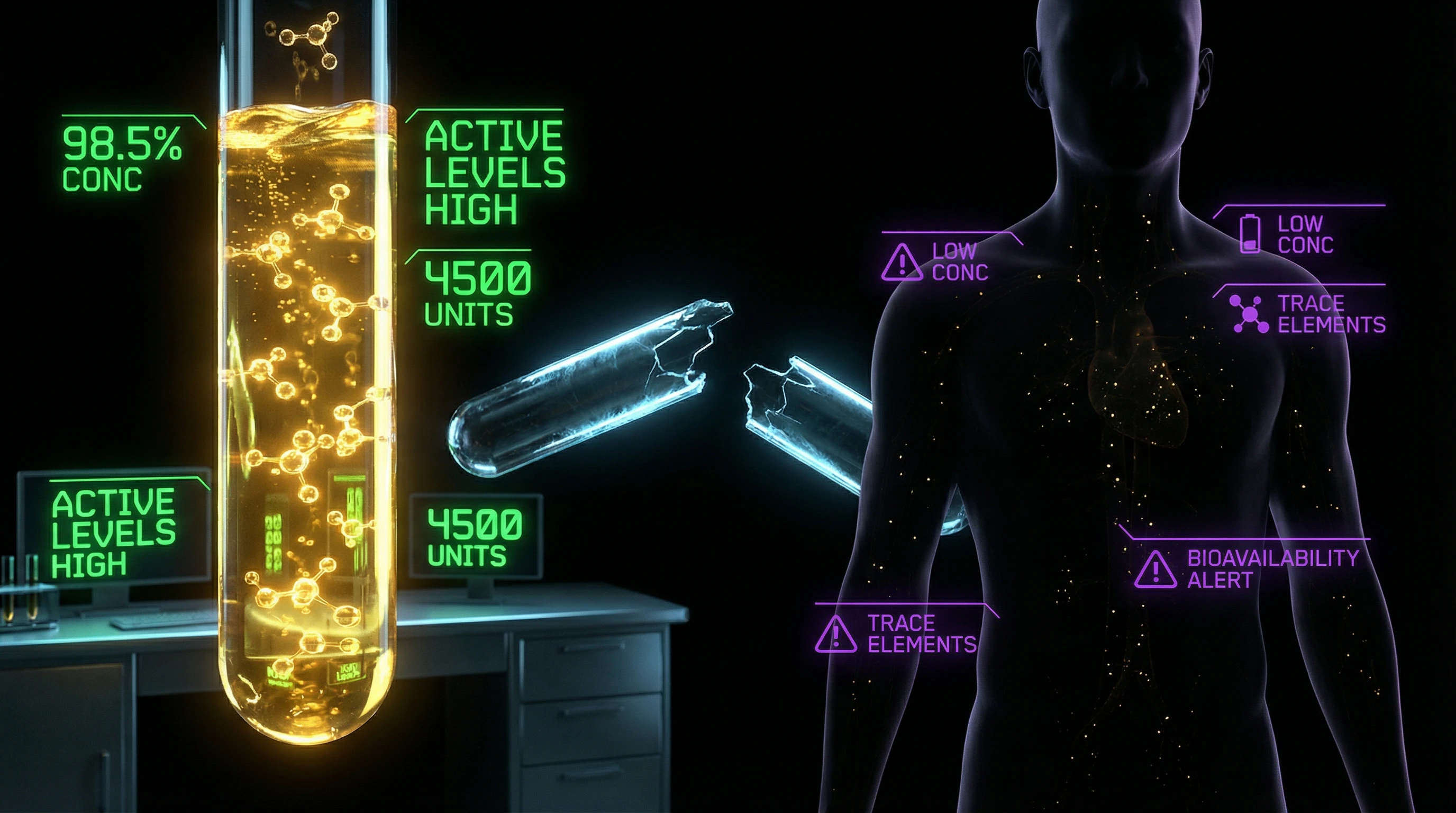
The fundamental difference between biochemical activity in vitro and clinical efficacy is determined by bioavailability. Curcumin demonstrates extremely low bioavailability with oral administration: it is rapidly metabolized in the liver and intestines, poorly soluble in aqueous environments, and has a short half-life (S002).
This means: concentrations achieved in human tissues with ordinary turmeric consumption or even high-dose supplements are orders of magnitude lower than those showing effects under laboratory conditions. Systematic reviews of pharmacokinetics confirm this gap, but the information rarely reaches mass audiences.
| Context | Curcumin concentration | Result |
|---|---|---|
| Cell culture in vitro | 10–100 μM | Pronounced anti-inflammatory effect |
| Blood plasma after supplement intake | 0.1–1 μM | Minimal or absent effect |
Hierarchy of evidence and curcumin's position
In evidence-based medicine, there exists a clear hierarchy: systematic reviews of randomized controlled trials (RCTs) at the top, then individual RCTs, cohort studies, case-control studies, and only then — laboratory experiments.
- For curcumin, a significant number of RCTs exist, but:
- Results are contradictory and often methodologically weak — small sample sizes, absence of long-term follow-up, use of non-standardized preparations with various formulas to enhance bioavailability (S001).
- Systematic reviews with strict inclusion criteria:
- Consistently conclude that evidence is insufficient for clinical recommendations (S007).
This does not mean curcumin is ineffective — it means the current evidence base is insufficient to transition from the category of "promising compound" to the category of "clinically recommended treatment." The distinction is critical.

Steel Man: Seven Most Compelling Arguments for Curcumin's Therapeutic Potential
Intellectual honesty requires presenting the strongest version of the opposing position. There are legitimate scientific grounds for continuing curcumin research, and ignoring these arguments would turn the analysis into a caricature. More details in the Detox Myths section.
🔬 Argument One: Reproducible Antioxidant and Anti-Inflammatory Activity at the Molecular Level
Curcumin demonstrates stable capacity to neutralize free radicals and modulate inflammatory pathways under controlled experimental conditions. Mechanisms include inhibition of cyclooxygenase-2 (COX-2), lipoxygenase, inducible nitric oxide synthase (iNOS), and the key transcription factor NF-κB, which regulates expression of pro-inflammatory genes (S002).
These effects are reproduced across different laboratories and cell lines, indicating genuine biochemical activity rather than an artifact of isolated experiments. The problem lies not in the absence of activity, but in translating this activity into clinically meaningful effects.
🧬 Argument Two: Epidemiological Correlations Between Turmeric Consumption and Disease Incidence
Population studies in regions with traditionally high turmeric consumption (India, some Southeast Asian countries) show lower rates of certain cancer types and neurodegenerative diseases compared to Western populations (S003).
While these correlations do not prove causation, they provide an epidemiological signal worthy of further investigation. The critical problem is the impossibility of isolating turmeric's effect from other components of traditional diet, genetic differences, and lifestyle factors.
📊 Argument Three: Positive Results from Individual Clinical Studies in Specific Conditions
Some RCTs demonstrate statistically significant effects of curcumin in osteoarthritis, mild to moderate depression, and metabolic syndrome. Studies using standardized turmeric extracts have shown efficacy comparable to ibuprofen in reducing pain in knee osteoarthritis.
Meta-analyses of these studies, despite methodological heterogeneity, indicate potential moderate effects. Limitations include small sample sizes (often fewer than 100 participants), short duration (4-12 weeks), and high risk of publication bias.
🧪 Argument Four: Development of New Formulations with Improved Bioavailability
Pharmaceutical research is actively working to overcome low bioavailability through nanoformulations, liposomal delivery systems, complexes with phospholipids (phytosomes), and combinations with piperine (a black pepper component that inhibits curcumin metabolism) (S005).
- Phytosomes
- Curcumin complexes with phospholipids that enhance intestinal absorption and cellular penetration.
- Nanoformulations
- Particles smaller than 100 nm that improve solubility and bioavailability by 20-fold or more.
- Critical Limitation
- Most of these formulations have not undergone large-scale long-term safety and efficacy studies.
🔁 Argument Five: Pleiotropic Effects and Potential for Combination Therapy
Curcumin acts on multiple molecular targets simultaneously (pleiotropy), which theoretically could be advantageous in complex multifactorial diseases where monotherapy with a single target is often insufficient.
Some studies examine curcumin not as monotherapy but as an adjuvant to standard treatment—for example, in combination with chemotherapy for cancer or with anti-inflammatory drugs for chronic inflammatory conditions. Preliminary data indicate possible synergistic effects and reduction of side effects from primary therapy, but these results require confirmation in large-scale studies.
🧾 Argument Six: Relative Safety and Low Side Effect Profile
At doses up to 8-12 grams per day, curcumin demonstrates a good safety profile in short-term studies, with minimal side effects (mainly mild gastrointestinal disturbances in a small percentage of participants) (S007).
From a risk/benefit perspective, even a moderate potential effect with low risk may be clinically justified for certain conditions, especially when alternatives are limited or have high toxicity. However, long-term safety of high doses and novel formulations remains insufficiently studied.
🧬 Argument Seven: Epigenetic Mechanisms and Prevention Potential
Research shows that curcumin can influence epigenetic mechanisms—histone modification, DNA methylation, microRNA expression—which regulate gene activity without altering the DNA sequence itself (S001).
These mechanisms are particularly interesting in the context of disease prevention and slowing age-related changes. Epigenetic effects may manifest at lower concentrations and have a cumulative character with long-term use, potentially explaining the discrepancy between acute clinical studies and long-term epidemiological observations.
- This research area is in early stages of development.
- Mechanistic links between epigenetic changes and clinical outcomes require further investigation.
- Long-term prospective studies are needed to validate the preventive effect hypothesis.
Evidence Base Under the Microscope: Systematic Analysis of Curcumin Research Quality and Reproducibility
Critical evaluation of the evidence base requires applying rigorous methodological criteria used in systematic reviews and meta-analyses. This approach allows us to separate reliable data from methodologically weak studies and identify systematic patterns in the literature. More details in the section Folk Medicine vs. Evidence-Based Medicine.
🧪 The Reproducibility Problem: Crisis in Natural Compound Research
Systematic analysis of curcumin research methodology reveals several critical problems. First, a significant portion of in vitro studies use curcumin concentrations (10–100 micromolar) that are unattainable in human tissues with oral intake even at high doses.
Pharmacokinetic studies show that peak plasma concentrations rarely exceed 1–2 micromolar even with intake of 8–12 grams of curcumin (S002). This means that most laboratory effects are observed at concentrations that lack clinical relevance.
Second, there's the problem of curcumin's chemical instability under physiological conditions. At neutral and alkaline pH (characteristic of the intestine and blood), curcumin rapidly degrades, forming various breakdown products. The observed biological effects may be related not to curcumin itself, but to its metabolites.
📊 Meta-Analyses of Clinical Studies: What the Aggregated Data Show
Systematic reviews and meta-analyses of curcumin RCTs for various conditions demonstrate a pattern of moderate effects with high heterogeneity between studies. For osteoarthritis, meta-analyses show statistically significant but clinically moderate pain reduction (standardized mean difference around 0.5–0.7), comparable to the effect of nonsteroidal anti-inflammatory drugs, but with fewer side effects (S006).
However, the quality of included studies is rated as low or moderate on the Jadad scale, with high risk of systematic bias. For oncological indications, systematic reviews consistently conclude that existing clinical data are insufficient for any recommendations (S001).
| Application Area | Evidence Level | Clinical Outcome |
|---|---|---|
| Osteoarthritis | Low–Moderate | Moderate pain reduction |
| Oncology | Very Low | Insufficient data |
| Cognitive Function | Low | Preliminary data |
| Inflammation (general) | Moderate | Variable results |
Most oncological studies are small pilot phase I–II trials evaluating safety and preliminary efficacy, but not the large-scale phase III studies necessary to prove clinical benefit.
🔎 Publication Bias and Conflicts of Interest
Analysis of curcumin research publication patterns reveals signs of publication bias: positive results are published significantly more often than negative ones. Funnel plots in meta-analyses demonstrate asymmetry, indicating insufficient publication of studies with null or negative results.
This distorts the overall picture of efficacy toward exaggerating the effect. A significant portion of studies are funded by curcumin supplement manufacturers or conducted by researchers with financial ties to the industry (S007).
- Publication Bias
- Asymmetric distribution of published results toward positive findings, which distorts meta-analyses and systematic reviews.
- Conflict of Interest
- Studies with financial ties to industry statistically significantly more often report positive results. This doesn't mean falsification, but indicates subtle methodological choices (design, endpoint selection, analysis) that bias results in a favorable direction.
🧾 The Standardization Problem: What Exactly Is Being Studied in Different Research
A critical methodological problem lies in the lack of standardization of curcumin preparations between studies. Different studies use incomparable formulations, making data aggregation unreliable.
- Whole turmeric powder with undetermined curcumin content
- Turmeric extracts with varying percentages of curcuminoids (typically 70–95%)
- Purified curcumin
- Synthetic curcumin
- Various formulations with enhanced bioavailability (nanoparticles, liposomes, complexes with piperine) (S005)
These preparations have radically different pharmacokinetics and cannot be considered equivalent. Meta-analyses combining studies with different formulations may produce distorted results due to this heterogeneity.
When researchers combine data on different substances under one name, they create an illusion of consensus where none exists. This is a classic mechanism for turning preliminary data into conviction.
The standardization problem is particularly acute for supplements, where regulation is less stringent than for pharmaceutical drugs. This means that even if you find a study with positive results, you cannot be sure that the product you purchase contains the same substance in the same form (S002).
Mechanistic Analysis: Causality, Correlation, and the Problem of Multiple Confounders
Distinguishing causal relationships from simple correlation is a fundamental epistemological problem in natural compound research. Curcumin demonstrates multiple biochemical activities, but translating these activities into clinical effects requires passage through several levels of biological complexity. More details in the Logical Fallacies section.
🔁 Translation Cascade: From Molecule to Clinic
The path from molecular activity to clinical effect includes four levels: biochemical (interaction with molecular targets), cellular (effects on proliferation, apoptosis, differentiation), tissue/organ (integration of effects into system function), organismal (clinically measurable outcomes).
At each level, compensatory mechanisms, feedback loops, and interactions with other systems exist that can nullify effects observed at the previous level. Most curcumin studies stop at the first two levels (S001), and extrapolation to the clinical level remains speculative.
Molecular activity in vitro is not a guarantee of clinical effect. It only guarantees that the molecule can interact with a target in a test tube.
🧷 Pleiotropy: When Multiple Effects Complicate Interpretation
Curcumin interacts with dozens, possibly hundreds, of different proteins and signaling pathways (S002). This pleiotropy creates a methodological problem: which of the observed effects are primary (direct interaction with target), and which are secondary or tertiary consequences?
Studies often focus on individual pathways (e.g., NF-κB), but ignore systemic interactions. Some effects of curcumin can be opposite in different contexts: antioxidant under some conditions and pro-oxidant in others, anti-inflammatory at low concentrations and pro-inflammatory at high ones.
| Context | Curcumin Effect | Mechanism |
|---|---|---|
| Low concentrations, oxidative stress | Antioxidant | Direct free radical scavenging |
| High concentrations, normal conditions | Pro-oxidant | Generation of reactive oxygen species |
| Acute inflammation | Anti-inflammatory | NF-κB inhibition |
| Chronic inflammation, adaptation | Uncertain | Cellular compensatory mechanisms |
This context-dependence is rarely accounted for in simplified popular interpretations.
🧪 Confounders in Epidemiology: Why Correlation Does Not Equal Causation
Epidemiological observations about lower disease incidence in populations with high turmeric consumption face the problem of multiple confounders. These populations differ not only in turmeric consumption, but also in genetic profile, overall dietary pattern (high vegetable and legume consumption, low red meat consumption), lifestyle (physical activity, social connections), environmental factors, access to healthcare, and socioeconomic status.
- The Isolation Problem
- It is statistically extremely difficult to isolate the effect of turmeric from multiple intertwined factors. Even multifactorial analysis does not guarantee accounting for all relevant variables.
- Reverse Causality
- People with certain genetic variants or health conditions may prefer or avoid turmeric, creating spurious correlation. This is especially likely in cultures where turmeric is traditionally used for specific ailments (S003).
- Healthy User Effect
- People who actively consume turmeric as a supplement are often more health-conscious overall and maintain other healthy habits that explain the observed differences.
Testing causality requires randomized controlled trials with sufficient power, long-term follow-up, and objective clinical outcomes. Most such curcumin trials are either small or show modest effects that can be explained by placebo or methodological artifacts.
- Check whether the variable was controlled in the original study
- Assess how likely reverse causality is in this context
- Find randomized trials that isolate the effect of turmeric
- Compare effect size in observational versus experimental studies
- Check whether the effect replicates across different populations and conditions
When observational data and experimental results diverge, this often indicates confounding rather than a true intervention effect.
Anatomy of a Cognitive Trap: Psychological Mechanisms That Transform Preliminary Data into Absolute Belief
The transformation of curcumin from an object of scientific study into an object of mass belief is a classic case of cognitive biases operating at individual and social levels. Understanding these mechanisms is critically important for developing immunity to medical misinformation. For more details, see the Scientific Method section.
Availability Bias: Why Vivid Stories Beat Statistics
The human brain is evolutionarily wired to respond more strongly to concrete, emotionally charged stories than to abstract statistics. A single story about someone who "cured cancer with turmeric" psychologically outweighs hundreds of studies showing no effect.
This availability heuristic is amplified in the social media era, where algorithms promote emotionally charged content. Anecdotal testimonials spread virally, while methodologically rigorous systematic reviews remain in academic journals, inaccessible to the general public.
Distorted perception of effect prevalence arises not from lack of information, but from the architecture of attention: the brain remembers what's easy to recall, not what's statistically probable.
Confirmation Bias and Motivated Reasoning
People facing serious diagnoses or chronic conditions experience strong motivation to find a solution, especially when standard medicine offers limited options or options with severe side effects.
This motivation activates confirmation bias: selective attention to information supporting the desired conclusion (turmeric is effective), while ignoring contradictory information. People remember positive reviews, interpret any improvement as resulting from turmeric intake, and explain deterioration through external factors.
| Mechanism | How It Works | Result |
|---|---|---|
| Availability heuristic | Easily recalled stories seem more frequent | Overestimation of effectiveness based on anecdotes |
| Confirmation bias | Seeking and interpreting information to favor desired conclusion | Ignoring contradictory data |
| Motivated reasoning | Motivation (hope for healing) drives logic | Rationalization of weak evidence |
Social Proof and Herd Effect
When enough people believe in turmeric's effectiveness, this itself becomes an argument. Social proof is a cognitive mechanism where we assume that if many people do or believe something, it must be correct.
In health contexts, this effect intensifies: if friends, family members, or online communities recommend turmeric, it's perceived as collective wisdom, even if none of them checked primary sources. Patient communities with similar diagnoses create closed ecosystems where alternative treatments become the norm.
Social proof works as a cognitive shortcut: instead of evaluating evidence, we ask "what are people like me doing?" and copy their choices.
Illusion of Control and Personal Responsibility Narrative
People psychologically prefer active action over passive waiting, even if the action is ineffective. Taking turmeric provides a sense of control over a disease that otherwise feels uncontrollable.
This mechanism is especially powerful with chronic conditions, where standard medicine can often only manage symptoms rather than cure. The narrative "I'm taking my health into my own hands" is psychologically appealing and reinforces commitment to the alternative method, even without objective improvements.
- Illusion of control
- Overestimation of one's own influence on events. When taking turmeric, any improvement is attributed to the supplement, though it may result from placebo, natural disease progression, or other factors.
- Personal responsibility narrative
- Belief that health depends on personal actions rather than biology. This motivates seeking "natural" solutions and creates guilt when treatment fails ("I didn't try hard enough").
Attention Economy and Financial Incentives
The dietary supplement industry is invested in spreading belief in turmeric's effectiveness. Marketing exploits all the cognitive mechanisms described above: vivid healing stories, social proof (testimonials), narratives of control and personal responsibility.
Financial incentives create information asymmetry: companies invest in popularizing preliminary research, while negative results remain unnoticed. This doesn't necessarily mean conscious deception—it's a natural result of the attention economy, where sensational claims receive more resources than skeptical analyses.
The turmeric cognitive trap isn't a conspiracy, but the result of interactions between evolutionary psychology, social dynamics, and economic incentives, each independently pushing people toward overestimating effectiveness.
Breaking the Chain: Critical Analysis Protocol
- Distinguish anecdotes from statistics. One story is a data point, not a trend. Demand systematic reviews and meta-analyses, not isolated cases.
- Check the study's funding source. Research funded by supplement manufacturers has higher risk of biased results (S002).
- Look for information on reproducibility. If the effect isn't reproduced in independent labs, that's a red flag.
- Assess biological plausibility. Can the mechanism of action explain the claimed effect, or does it require a miracle?
- Acknowledge your own motivation. If you're invested in turmeric working, this biases your evidence evaluation. Ask for a second opinion from a skeptic.
- Explore alternative explanations. Improvement may result from placebo, natural disease progression, lifestyle changes, or other factors.
Developing cognitive immunity requires not abandoning hope for healing, but redirecting that hope toward methods that have passed rigorous testing. This is psychologically harder but practically more reliable. For deeper understanding of misinformation mechanisms, see critical thinking and analysis of other pseudomedical narratives.