What the "water memory" concept claims — defining the boundaries of the impossible
The "water memory" concept asserts that water retains a structural or informational "imprint" of substances that were dissolved in it, even after dilution to the complete absence of molecules of the original compound (S014). This is not a hypothesis about weak interactions — it's a claim that solution properties depend on their history, not on current molecular composition.
This assertion forms the entire theoretical foundation of homeopathy and an industry with billions of dollars in revenue. If water cannot retain information, the foundation collapses. More details in the section Myths about psychosomatics.
Water memory is not just a scientific dispute. It's the boundary between physical chemistry and the belief that molecules can remember.
🧩 Ultramolecular dilutions: when statistics says "no"
Homeopathy uses dilutions of 12C, 30C and higher. A 12C dilution means the original substance is diluted by a factor of 10²⁴ — a number exceeding Avogadro's number (6.022×10²³), which is the number of molecules in a mole (S001). At such dilutions, the probability of even a single molecule of the original substance being present approaches zero.
Homeopathy claims that the therapeutic effect persists due to "water memory," which supposedly retains information about the dissolved substance (S003).
| Dilution | Dilution factor | Molecules of original substance |
|---|---|---|
| 6C | 10¹² | Single digits |
| 12C | 10²⁴ | ~0 (statistically) |
| 30C | 10⁶⁰ | 0 (absolutely) |
🔎 Proposed mechanisms: from hydrogen bonds to quantum domains
Proponents suggest three main mechanisms. First — changes in hydrogen bond structure: preparations supposedly create stable clusters of water molecules (S004). Second — quantum coherent domains: theoretical regions where quantum coherence supposedly persists long enough to store information (S011, S012).
The third mechanism — exclusion zones discovered by Pollack: regions of water with distinct properties near hydrophilic surfaces, which are sometimes invoked to explain memory (S011, S012).
- Hydrogen bonds
- Electrostatic interactions between water molecules. Water memory proponents suggest they can retain information about dissolved substances.
- Quantum coherent domains
- Hypothetical regions where quantum effects supposedly stabilize water structure. No experimental evidence exists for their presence under biological conditions.
- Exclusion zones
- Actually observed regions of water with increased ordering. Their role in water memory remains speculative.
⚠️ Why this matters: an industry built on the foundation of the impossible
Homeopathy depends entirely on the validity of the water memory concept. If water cannot retain structural information, the entire theoretical foundation collapses (S018). Understanding why water memory is impossible is critically important for evaluating alternative medicine claims.
This also applies to a broader class of pseudoscientific practices that appeal to "memory" or "informational fields." The mechanisms that destroy the water memory myth apply to them as well.
Steelman Analysis: The Strongest Arguments for Water Memory
Before examining the evidence against water memory, we must present the most convincing arguments of its proponents in their strongest form. This is the "steelman" principle — the opposite of a straw man, where we strengthen the opponent's position to then honestly refute it. More details in the section Miracle Supplements and Dietary Aids.
🧪 Argument 1: Thermoluminescence experiments show structural differences
Some researchers use thermoluminescence — the phenomenon of light emission when heating previously irradiated material — to study homeopathic solutions. Proponents claim that thermoluminescent profiles of homeopathic dilutions differ from control samples of pure water, allegedly indicating structural changes that persist in water.
This argument appeals to objective physical measurements rather than subjective clinical effects.
🔬 Argument 2: Pollack's exclusion zones demonstrate long-lived structures
Gerald Pollack discovered that near hydrophilic surfaces, exclusion zones (EZ) form — regions of water with altered structure from which dissolved particles are excluded. These zones can extend hundreds of micrometers and exist for relatively long periods.
Water memory proponents argue that if such long-lived structures are possible under special conditions, then analogous mechanisms could operate in homeopathic solutions, especially after the shaking procedure (potentization).
🧬 Argument 3: Quantum coherence in biological systems hints at possibility in water
Quantum coherence has been discovered in some biological processes, such as photosynthesis and bird navigation. Water memory proponents suggest that if quantum effects can persist in "warm and wet" biological systems longer than classical physics predicted, then quantum coherent domains in water could also exist long enough to store information.
This argument relies on cutting-edge quantum biology research but commits a logical error: the possibility of an effect in one system does not guarantee it in another, especially under fundamentally different conditions.
📊 Argument 4: Clinical trials show effects exceeding placebo
Some meta-analyses of homeopathy clinical trials claim that effects exceed placebo, albeit marginally. Proponents argue that if clinical effects are real, a physical mechanism must exist, and water memory is the most plausible explanation in the absence of active substance molecules.
This argument reverses the logic: from clinical effect to necessity of mechanism. However, it ignores alternative explanations — systematic errors in study design, placebo effect, and publication bias.
🧩 Argument 5: Water is an anomalous liquid with unique properties
Water indeed possesses numerous anomalous properties compared to other liquids: high heat capacity, anomalous density at 4°C, high surface tension. Water memory proponents argue that these anomalies indicate complex structural organization that we don't yet fully understand.
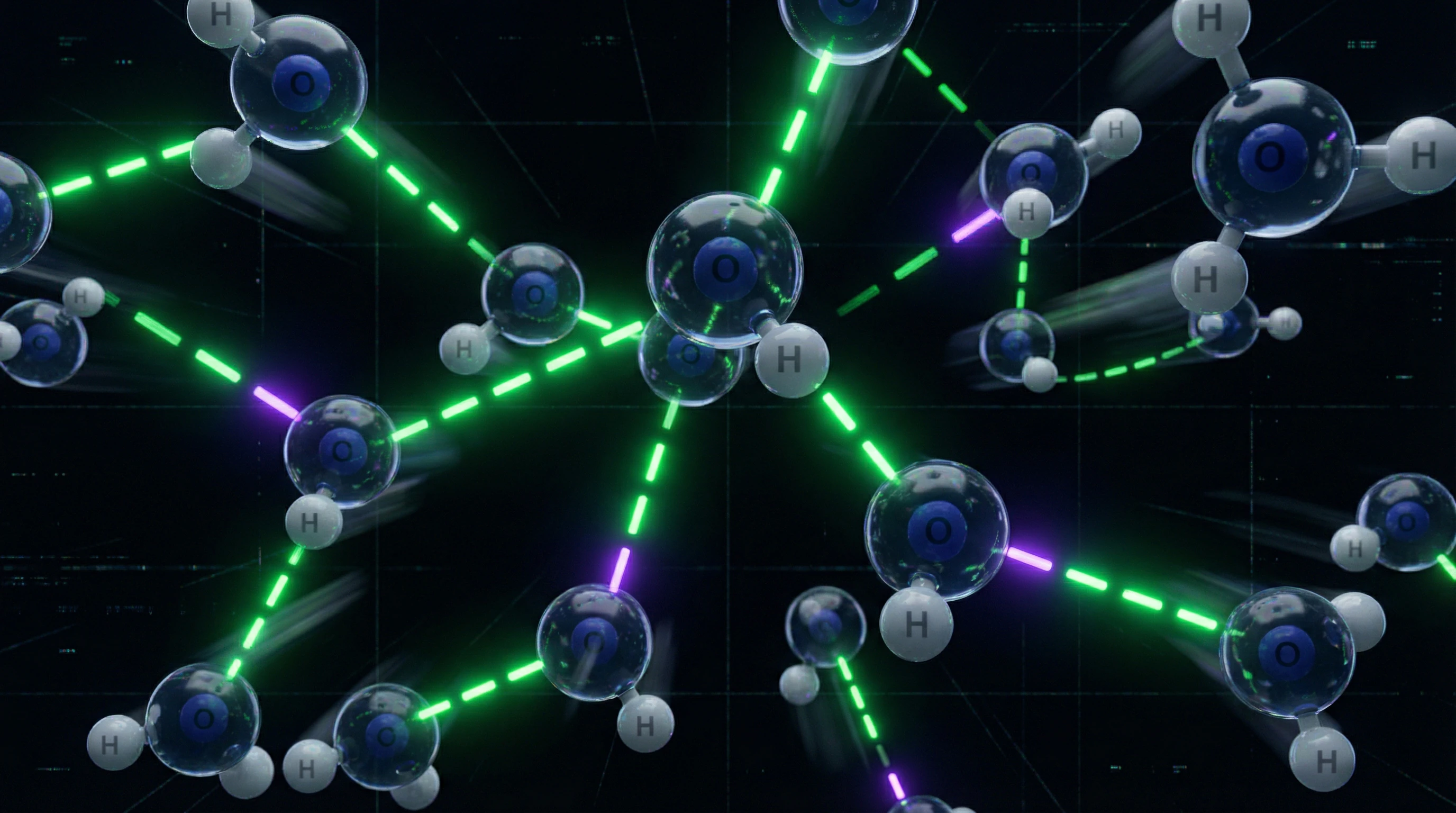
- Water forms hydrogen bonds, creating temporary molecular clusters
- These clusters constantly break apart and reform on picosecond timescales
- Proponents suggest that water memory may be another manifestation of this complexity
- However, anomalous properties are explained by known physicochemical mechanisms without invoking information storage
Evidence Base: Why Physical Chemistry Leaves No Room for Water Memory
The scientific consensus on water memory is unequivocal and based on fundamental principles of physical chemistry, thermodynamics, and molecular dynamics. Let's examine the key evidence against the possibility of long-term structural memory in liquid water. More details in the Fake Diagnostics section.
⏱️ Hydrogen Bond Timescales: Picoseconds vs. Hours
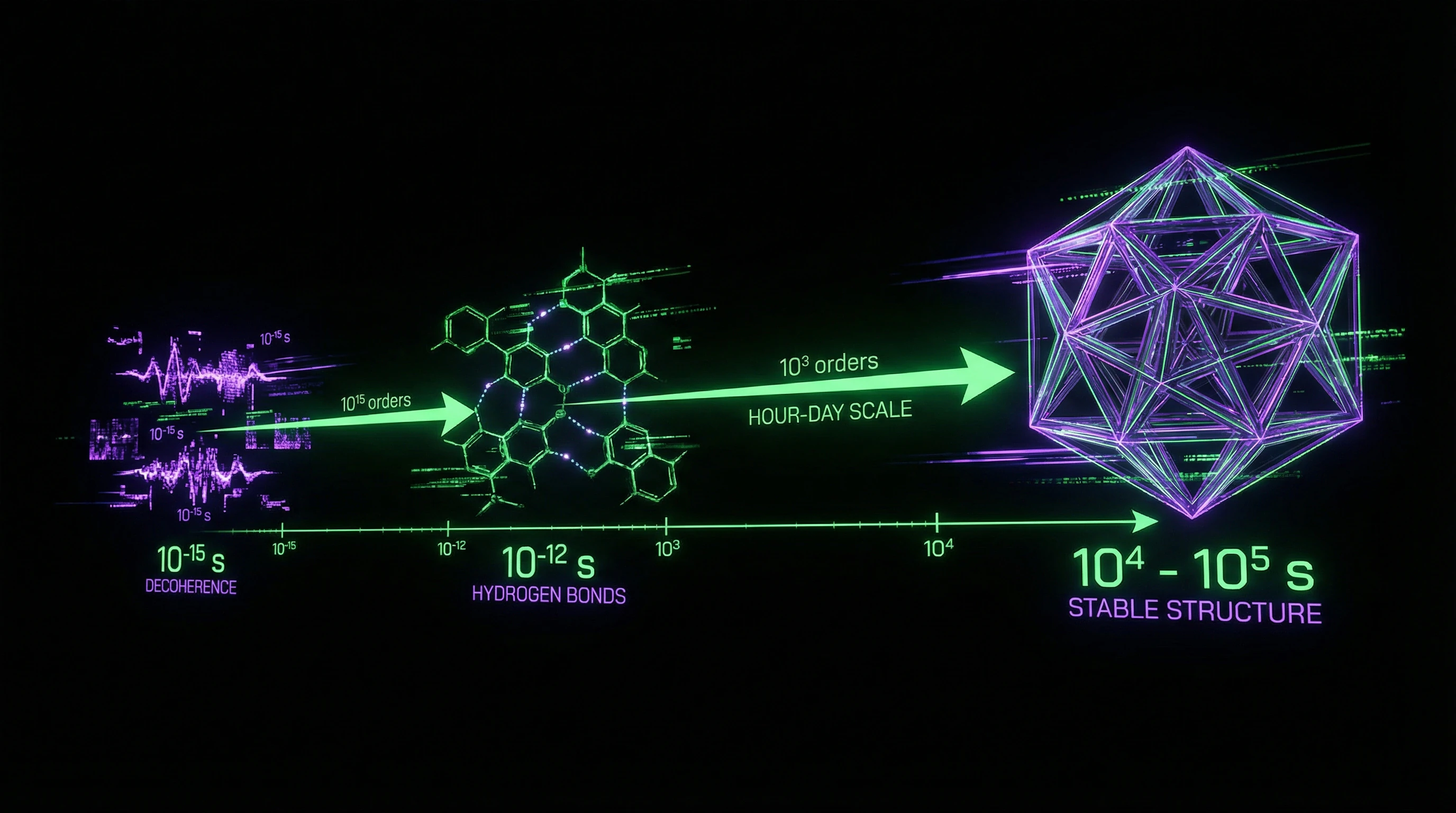
Hydrogen bonds in liquid water are extremely dynamic. Modern molecular dynamics and spectroscopy methods show that the lifetime of an individual hydrogen bond is on the order of 1–20 picoseconds (10⁻¹² seconds) at room temperature. This means each hydrogen bond breaks and reforms trillions of times per second.
Any "structural memory" based on hydrogen bond configuration would need to persist on timescales many orders of magnitude longer than the lifetime of the bonds themselves — this is thermodynamically impossible without an external energy source to maintain a non-equilibrium state (S002).
🌡️ Thermodynamic Constraints: Entropy Defeats Structure
The second law of thermodynamics requires isolated systems to tend toward maximum entropy. Any ordered structure in water not stabilized by chemical bonds or external fields will rapidly break down through thermal motion.
At room temperature, thermal energy (kT ≈ 0.025 eV) is sufficient to constantly disrupt weak interactions such as hydrogen bonds (energy ~0.1–0.3 eV). Preserving structural memory would require water to exist in a metastable state with an energy barrier preventing relaxation — but such barriers are absent in liquid water.
🔍 Quantum Coherence Limits: Decoherence in Femtoseconds
Detailed analysis of the possibility of quantum coherent domains in liquid water has shown that quantum decoherence in water occurs on femtosecond timescales (10⁻¹⁵ seconds) due to strong environmental interaction (S010).
- Even assuming the existence of quantum coherent domains, their size would be limited to a few nanometers
- The lifetime of such domains is femtoseconds, which is 15–18 orders of magnitude shorter than required to explain water memory in homeopathic solutions
- Ignoring these fundamental constraints has led this research area to acquire dubious scientific status
🧪 Absence of Reproducible Experimental Evidence
Despite decades of research, there is no reproducible experimental evidence for water memory that has withstood rigorous independent verification (S018). Thermoluminescence experiments mentioned by proponents have not passed independent replication.
Methodological problems — temperature control, sample purity, systematic errors — make interpretation of results questionable. The scientific consensus remains skeptical precisely because of this lack of reproducibility.
📉 Pollack's Exclusion Zones: Local Effects, Not Universal Memory
While Pollack's exclusion zones are real, they do not support the concept of water memory in homeopathy (S011). These zones form only near specific hydrophilic surfaces and require constant energy input (typically from light or heat) to maintain.
- Key Distinction
- Exclusion zones are a local surface effect requiring constant energy supply. They are not a property of bulk water and cannot persist in the absence of a surface and energy source.
- Structural Mismatch
- The structure of EZ-water differs from the structure that water with "memory" of a dissolved substance would need to have — this is simply a different physical phenomenon.
🎯 Clinical Effects of Homeopathy: Placebo and Methodological Artifacts
Systematic reviews of high-quality clinical trials show that homeopathy's effects are indistinguishable from placebo (S018). Meta-analyses claiming otherwise typically include studies with low methodological quality, small samples, and high risk of systematic bias.
Even assuming small clinical effects exist, they can be explained by contextual factors: consultation time, practitioner attention, natural disease course. The absence of clinical effects exceeding placebo eliminates the need to postulate water memory as a mechanism.
For a detailed breakdown of the mechanisms underlying this myth's popularity, see the article on homeopathy as a placebo industry.
Mechanisms of Delusion: Why the Water Memory Myth Persists
Understanding why the concept of water memory continues to exist despite scientific evidence requires analysis of the cognitive mechanisms and social factors sustaining this delusion. More details in the section Cognitive Biases.
🧩 Cognitive Trap 1: Intuitive Appeal of "Information in Water"
The idea that water can "remember" information is intuitively appealing because it aligns with our everyday experience of recording information on physical media. We know that computers store data, books preserve text, and brains retain memories — why shouldn't water do the same?
This analogy ignores a fundamental difference: all known information storage systems require stable structures (crystalline lattices in hard drives, covalent bonds in DNA, synaptic connections in neurons), whereas water is a dynamic liquid without such structures (S002).
⚠️ Cognitive Trap 2: Mystification of Quantum Mechanics
Mentioning "quantum effects" gives the water memory concept an appearance of scientific depth, exploiting the fact that quantum mechanics is counterintuitive and poorly understood by the general public. Proponents use real quantum phenomena (coherence in photosynthesis, entanglement) as rhetorical cover, without explaining why these effects cannot work in water due to decoherence.
This is a classic example of quantum mysticism — using quantum terminology to legitimize pseudoscientific claims. Real quantum mechanics and its popular interpretation are different things.
🕳️ Cognitive Trap 3: Anomalous Properties of Water as "Proof" of the Unknown
Water does indeed possess unusual properties, and this is used to create the impression that "we don't know everything about water yet," and therefore water memory is possible (S002). This is a logical fallacy: from the fact that water has anomalous properties, it does not follow that it can have any arbitrary properties we wish to attribute to it.
The anomalous properties of water (high heat capacity, density) are well explained within modern physical chemistry and do not require postulating memory.
- High heat capacity is explained by hydrogen bonds between molecules
- Anomalous density is related to the geometry of ice's crystalline structure
- Surface tension results from asymmetric distribution of electron density
- All these properties are predicted and reproduced in computer models without invoking memory
💰 Social Factor: Economic Interests of the Homeopathic Industry
Homeopathy is a multi-billion dollar industry with powerful economic incentives to maintain belief in water memory. Manufacturers of homeopathic products, practicing homeopaths, and related organizations have a financial interest in promoting this concept despite the absence of scientific evidence.
This creates a constant stream of misinformation masquerading as "alternative science." The mechanism is simple: the more implausible a concept, the more it needs protection from criticism, and therefore the more resources are required to promote it.
🎭 Social Factor: Appeal to "Naturalness" and Distrust of "Official Science"
Homeopathy is positioned as a "natural" and "gentle" alternative to "aggressive" conventional medicine, which resonates with people who distrust the pharmaceutical industry and the scientific establishment. Water memory becomes part of a narrative about "hidden knowledge" that "official science" allegedly ignores or suppresses.
- Real Problem
- Drug side effects, conflicts of interest in pharmaceuticals, insufficient funding for rare diseases
- False Solution
- Rejection of evidence-based medicine in favor of concepts without scientific foundation
- Cognitive Mechanism
- Legitimate criticism of the system is used to legitimize anti-scientific alternatives
This narrative exploits real problems in medicine but offers a false solution. Criticism of the pharmaceutical industry does not become more valid when used to defend concepts that contradict physical chemistry. Distrust of science, based on legitimate grievances against particular institutions, often transforms into denial of the scientific method itself — and this is exactly what water memory proponents count on.
The connection between these mechanisms and other pseudoscientific beliefs is obvious: quantum mystification, universal psychosomatics, and homeopathy as a placebo industry use the same cognitive traps and social levers.
Conflicting Sources and Areas of Uncertainty: Where the Data Diverges
The scientific consensus on water memory is unequivocal, but there are areas where sources diverge or where data is insufficient for definitive conclusions. More details in the Scientific Method section.
🧪 Divergence 1: Interpretation of Thermoluminescence Experiments
Some researchers report differences in thermoluminescent profiles of homeopathic solutions versus controls (S005), while critics point to methodological problems and lack of independent replication.
The uncertainty here is not about the existence of water memory, but whether the observed differences are real physical effects or measurement artifacts.
Scientific consensus leans toward artifacts, but definitive closure of the question requires more rigorous controlled studies (S005).
🔬 Divergence 2: Role of Nanostructures and Impurities
Some researchers suggest that effects attributed to water memory may be related to nanoscale impurities—glass particles from shaking, colloidal structures. This is an alternative explanation that does not require postulating water memory.
- Status of the Nanostructure Hypothesis
- Lacks convincing evidence. The area remains speculative; further research is needed for verification.
- Why This Matters
- If nanostructures are the real source of effects, this still doesn't save homeopathy: dilutions above 12C contain zero molecules of active substance and cannot create specific nanostructures.
📊 Divergence 3: Quality of Homeopathy Clinical Trials
Meta-analyses including all homeopathy studies sometimes show small effects. Analyses limited to high-quality studies show no effects exceeding placebo.
| Type of Analysis | Result | Interpretation |
|---|---|---|
| All studies (no quality filter) | Small effects | Reflects methodological heterogeneity, publication bias |
| High-quality RCTs only | Effect = placebo | Consensus based on this data |
The divergence reflects not real uncertainty about homeopathy's effectiveness, but differences in methodological rigor. Consensus is based on high-quality data.
⚠️ Where Real Uncertainty Exists
Uncertainty exists not in the question "does homeopathy work," but in the details of placebo mechanisms, including psychosomatic effects and social factors that enhance clinical response.
- Why placebo works even in blind designs (partially)
- How ritual and physician attention influence outcomes
- Boundaries between psychological improvement and physiological change
These questions are relevant to all of medicine, not just homeopathy. But they don't save the concept of water memory—they explain why patients report improvement despite the absence of active substance.
Verification Protocol: Seven Questions That Dismantle the Water Memory Myth in One Minute
When you encounter claims about water memory or homeopathy, use this checklist for quick credibility assessment. More details in the Secret Devices section.
- What is the concentration of active substance in the final solution? If dilution exceeds 12C (10²⁴), the probability of even one molecule of the original substance being present is virtually zero. Any claimed effects cannot be linked to molecular presence of the substance and require postulating water memory—a mechanism with no scientific confirmation (S001).
- What is the proposed mechanism for information retention in water? If the mechanism is based on hydrogen bonds, ask about the lifetime of these bonds (picoseconds). If on quantum coherence, ask about decoherence time (femtoseconds). If on "unknown effects," that's an admission of no mechanism.
- Have the results been independently reproduced? Science requires reproducibility. If experiments demonstrating water memory have not been successfully reproduced by independent laboratories using rigorous protocols, the results cannot be considered reliable.
- Is there placebo control and blinding? Without double-blinding and placebo control, results are subject to experimenter bias and expectation effects (S001). This is especially critical for subjective outcomes.
- Why doesn't the effect scale with dilution? If water memory is real, higher dilutions should produce stronger effects (according to homeopathic postulate). The absence of such a relationship indicates placebo.
- How do you explain the absence of effect in blind studies? When neither patient nor physician knows whether the patient is receiving a homeopathic remedy or placebo, the differences disappear. This is a classic sign of the placebo effect.
- Why don't the physicochemical properties of water change? Spectroscopy, X-ray diffraction, and other methods reveal no structural changes in "memory" water. If information is stored, it must leave a physical trace.
If most answers are evasive, appeal to "unknown science," or demand abandoning standard verification methods—you're facing not science, but homeopathy as a social phenomenon, not a medical fact.
Water memory is not an error in data, but an error in logic. It arises from conflating wishful thinking with reality, from insufficient control of variables, and from cognitive bias that affects even scientists when they venture beyond their discipline.
The verification protocol works because it doesn't require specialized knowledge. It requires only honesty with facts and willingness to accept that water is simply water.