
What homeopathy actually is: from historical roots to modern definitions
Homeopathy was developed by German physician Samuel Hahnemann in the late 18th century based on the principle "similia similibus curentur"—like cures like. According to this doctrine, a substance that causes symptoms in a healthy person can cure those same symptoms in a sick person if diluted repeatedly. More details in the section Detox and body cleanses.
The key feature of homeopathy is the process of "potentization"—sequential dilution of the original substance at ratios of 1:10 (decimal scale, D or X) or 1:100 (centesimal scale, C) with intermediate shaking (succussion).
🔎 The mathematics of disappearance: what C12, C30, and C200 dilutions mean
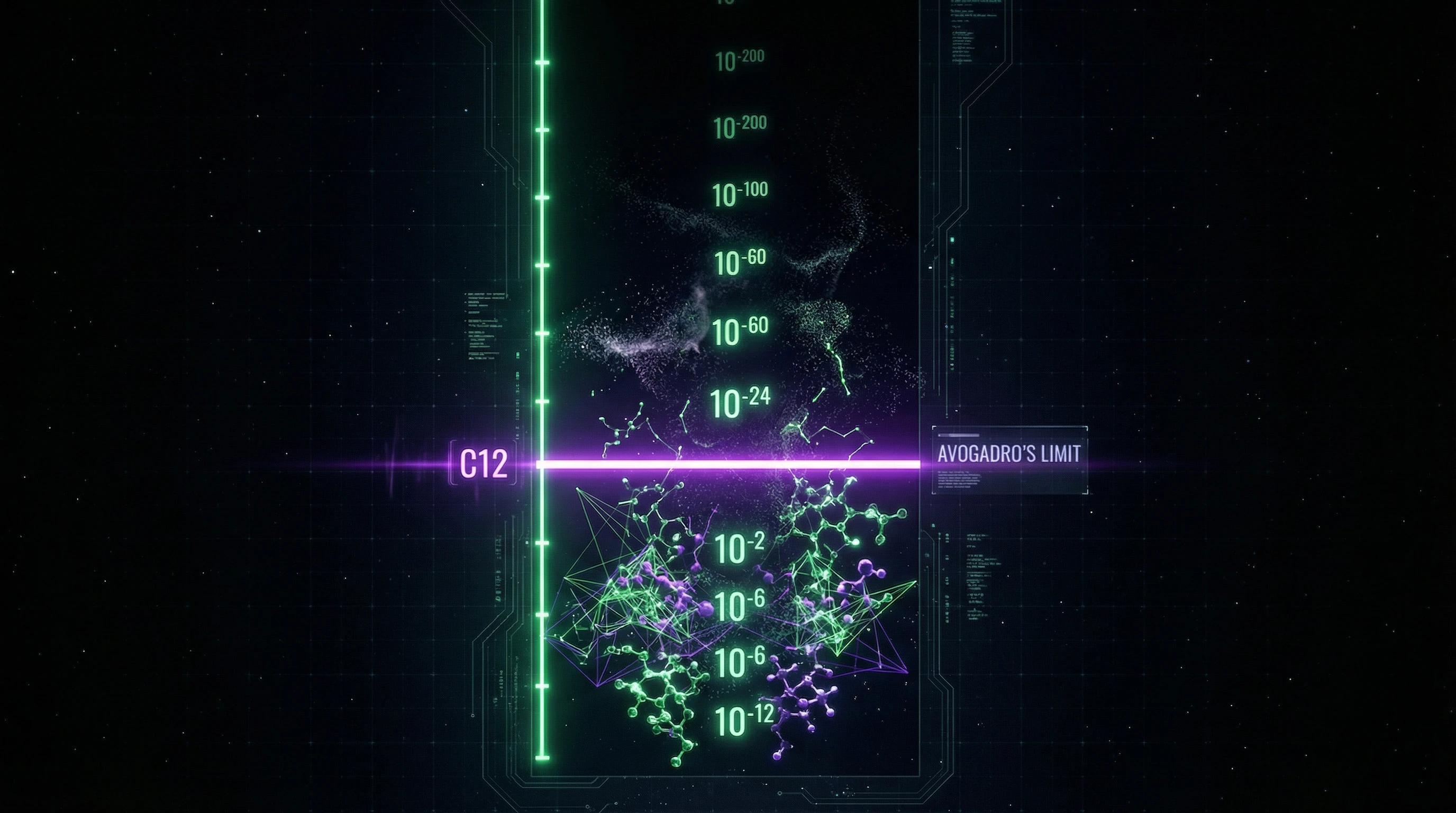
A C12 dilution means twelve sequential dilutions at a 1:100 ratio, yielding a final concentration of 10^-24. This corresponds to one molecule of the original substance in a volume exceeding the volume of Earth.
A C30 dilution (10^-60) means that to detect even a single molecule of the original substance, you would need to swallow a sphere of water with a diameter equal to the distance from Earth to the Sun, repeated billions of times.
Avogadro's number (6.022 × 10^23)—a fundamental constant defining the number of molecules in a mole of substance—makes any dilution above C12 statistically free of the original substance.
🧱 Three pillars of homeopathic doctrine
- Law of similars
- A substance that causes certain symptoms can treat diseases with similar manifestations.
- Potentization
- The greater the dilution, the more powerful the therapeutic effect—a direct contradiction to pharmacological dose-dependence.
- Individualization
- Selection of remedy not by diagnosis, but by the unique constellation of patient symptoms, including psychological and constitutional characteristics.
Homeopaths explain the action of ultra-diluted preparations through "water memory"—a hypothetical ability of water to retain information about substances dissolved in it even after their complete removal. More on the scientific consensus against this myth in the article on water memory.
⚙️ Boundaries of analysis: what's included in the scope of investigation
| Within scope of analysis | Excluded from consideration |
|---|---|
| Classical homeopathy (Europe, USA, Russia) | Complex preparations with D3–D6 dilutions (contain active concentrations) |
| Preparations with C12 dilutions and higher | Homotoxicology, anthroposophic medicine |
| Scientific validity of efficacy claims | Questions of sales legality and regulation |
The analysis is limited to preparations with C12 dilutions and higher, where the absence of molecules of the original substance is a mathematical certainty, not a subject of debate. We do not examine homotoxicology, anthroposophic medicine, and other systems using the term "homeopathy" in a modified sense.
The focus is exclusively on the scientific validity of efficacy claims. Questions of critical thinking in evaluating medical assertions remain central to the entire analysis.
The Steelman of Homeopathy: Seven Most Convincing Arguments from System Defenders
Before examining evidence against homeopathy, it's necessary to present its defense in the strongest possible form—this is called "steelmanning," the opposite of "strawmanning." Ignoring opponents' strongest arguments makes criticism intellectually dishonest and unconvincing to those who already believe in the system. More details in the section Miracle Supplements and Dietary Additives.
💎 Argument One: Millions of Patients Report Improvement
Homeopathy defenders point to the enormous number of patient testimonials claiming that homeopathic remedies helped them with chronic conditions where conventional medicine proved powerless. These stories often include detailed descriptions of symptoms before and after treatment, photographs, and medical documentation.
The argument is strengthened by the fact that many patients were initially skeptics and turned to homeopathy as a last resort. Particularly impressive are cases with infants and animals, where the placebo effect is supposedly impossible due to the absence of conscious expectations.
- Personal recovery stories with documentation
- Conversion from skepticism to conviction
- Examples with infants and animals as "proof" of independence from expectations
💎 Argument Two: Homeopathy Has Existed for Over 200 Years and Is Practiced Worldwide
The system created by Hahnemann has survived two industrial revolutions, world wars, the scientific revolution of the 20th century, and continues to develop. In India, homeopathy is integrated into the national healthcare system; in Germany and France, homeopathic remedies are sold in pharmacies alongside conventional medicines; in the United Kingdom, the Royal London Hospital for Integrated Medicine exists.
If the system were completely ineffective, it could not have competed with scientific medicine for two centuries and would not have received institutional support in developed countries.
💎 Argument Three: Positive Clinical Research Results Exist
Homeopathy supporters cite meta-analyses and systematic reviews showing statistically significant superiority of homeopathic remedies over placebo in some studies. They point to work published in peer-reviewed journals, including The Lancet (1997), where authors concluded that clinical effects of homeopathy are not completely explained by placebo (S002).
Defenders criticize the methodology of studies showing no effect, claiming that standard RCT (randomized controlled trial) protocols are unsuitable for evaluating individualized homeopathic therapy.
💎 Argument Four: Quantum Physics and New Discoveries About Water Properties
Some homeopathy defenders appeal to quantum mechanics, claiming that classical chemistry cannot explain all properties of matter at the submolecular level. They reference research on water structure, hydrogen bonds, coherent domains, and the supposed ability of water to form long-lived clusters capable of storing information.
They mention experiments by Jacques Benveniste (1988) and Luc Montagnier (Nobel laureate), which supposedly demonstrated electromagnetic signals from ultra-diluted DNA solutions. The argument is built on the premise that science doesn't yet understand all mechanisms, and absence of explanation doesn't mean absence of effect.
- Coherent Water Domains
- Supposed structures capable of preserving information about dissolved substances
- Electromagnetic Signals
- Allegedly detected in ultra-diluted solutions, explaining information transfer without molecules
- Quantum Effects
- Appeal to the incompleteness of classical chemistry as grounds for new mechanisms
💎 Argument Five: Safety and Absence of Side Effects
Unlike pharmaceutical drugs that cause serious side effects and drug interactions, homeopathic remedies have virtually no contraindications and are non-toxic even with overdose—a logical consequence of the absence of active molecules. Defenders claim that even if the effect is partially placebo, homeopathy provides a safe way to activate the body's own healing resources without risk of iatrogenic complications.
This argument is particularly strong in the context of chronic conditions where conventional treatment offers only symptomatic therapy with cumulative side effects.
💎 Argument Six: Holistic Approach and Patient Attention
A homeopathic consultation typically lasts 1-2 hours, during which the practitioner studies in detail not only physical symptoms but also emotional state, life circumstances, and constitutional characteristics of the patient. Defenders claim that this individualized approach itself has therapeutic value that standard studies don't account for.
They criticize conventional medicine for fragmenting the patient into separate organs and symptoms, ignoring psychosomatic connections, and 15-minute appointments where the doctor looks at the computer rather than the person. Here homeopathy is positioned as an alternative to critical thinking in medicine, restoring the human dimension of treatment.
💎 Argument Seven: Pharmaceutical Industry Conspiracy
The most emotionally charged argument claims that criticism of homeopathy is financed by pharmaceutical corporations losing billions due to cheap and safe alternatives to their toxic and expensive drugs. Defenders point to real cases of corruption in the pharmaceutical industry, manipulation of clinical trial data, and concealment of side effects.
They claim that the scientific community is biased against homeopathy not because of evidence, but because of economic interests and dogmatic adherence to a materialist paradigm incapable of accepting phenomena outside the reductionist model.
| Influence Mechanism | How It Works in the Argument |
|---|---|
| Real pharma scandals | Create credibility for conspiracy assumptions |
| Economic interests | Explain silence and criticism from scientific establishment |
| Appeal to paradigm | Position homeopathy as revolutionary and critics as conservative |
Evidence Base: What Systematic Reviews and Meta-Analyses of the Highest Quality Show
Systematic reviews and meta-analyses represent the pinnacle of the evidence hierarchy in medicine. They synthesize results from multiple studies to obtain the most reliable conclusions. A substantial body of such reviews has accumulated for homeopathy, allowing for definitive conclusions. For more details, see the section on Pseudo-Pharmaceuticals and Counterfeits.
📊 Shang Meta-Analysis (Lancet, 2005): 110 Studies and the Vanishing Effect
A study by Aijing Shang and colleagues in The Lancet (2005) analyzed 110 placebo-controlled trials of homeopathy and 110 comparable trials of conventional medicine. When analyzing all studies, homeopathy showed statistically significant superiority over placebo (odds ratio 0.88, 95% confidence interval 0.65–1.19).
When the analysis was restricted to large, high-quality studies, the effect disappeared completely. For the 8 largest homeopathy trials, the odds ratio was 0.88 (0.65–1.19)—statistically indistinguishable from placebo. The authors concluded: (S002) the clinical effects of homeopathy are placebo effects.
📊 Cochrane Reviews: The Gold Standard of Systematic Analysis
The Cochrane Collaboration produces systematic reviews of the highest methodological quality. A 2006 review on homeopathy for asthma (6 trials, 556 participants) concluded: insufficient evidence for reliable conclusions about efficacy. A 2012 review on homeopathy for labor induction found no suitable studies.
A 2015 review on homeopathy for dementia found no studies of sufficient quality. The systematic pattern is clear: as methodological requirements increase, evidence of efficacy disappears.
📊 Australian NHMRC Report (2015): The Most Comprehensive Analysis
Australia's National Health and Medical Research Council (NHMRC) conducted a large-scale review, analyzing 1,800 papers and 225 systematic reviews covering 68 clinical conditions. The methodology included evaluating only high-quality studies (low risk of bias, adequate sample size, appropriate controls).
There is no reliable evidence from human research that homeopathy is effective for treating the health conditions studied.
For 61 of 68 conditions, no studies of sufficient quality were found; for the remaining 7, high-quality studies showed no effect beyond placebo.
🧾 European Academies of Science (EASAC, 2017): Scientific Community Consensus
The European Academies' Science Advisory Council (EASAC), representing national academies from 28 EU countries, Norway, and Switzerland, published a statement on homeopathy in 2017. The document confirmed the conclusions of the Australian report: claims of homeopathy's efficacy beyond placebo effect are not supported.
EASAC criticized regulatory regimes that allow homeopathic products to be sold without evidence of efficacy. The statement emphasized that continued use of homeopathy undermines trust in science-based medicine and can lead to rejection of effective treatment.
🧪 Physical Impossibility: Why "Water Memory" Contradicts Fundamental Physics
The "water memory" hypothesis requires water molecules to form stable structures capable of storing information about previously dissolved substances. The lifetime of hydrogen bonds in liquid water is on the order of 10⁻¹² seconds (picoseconds). Any structural changes disappear almost instantaneously after removal of the dissolved substance.
Jacques Benveniste's experiments (1988), which allegedly demonstrated "water memory," were not reproduced by independent researchers. Nature sent a team to investigate, including illusionist James Randi, and found methodological errors and possible fraud. Luc Montagnier's work on "DNA teleportation" through electromagnetic signals was rejected by the scientific community due to non-reproducibility.
For more details on the mechanism of this myth, see the article on water memory.
🔬 The Reproducibility Problem: Why Positive Results Don't Replicate
A key criterion of scientific knowledge is reproducibility of results by independent researchers. Analysis of homeopathy studies shows a systematic pattern: small, low-quality studies more often show positive results, while large, high-quality studies with pre-registered protocols and rigorous control of biases find no effect.
| Study Characteristic | Probability of Positive Result | Interpretation |
|---|---|---|
| Small sample size (<50 participants) | High | Random fluctuations, insufficient statistical power |
| No pre-registered protocol | High | Possibility of p-hacking and manipulation of analysis methods |
| Large study (>500 participants) | Low | Sufficient power to detect real effect |
| Registered protocol, blinded allocation | Low | Minimization of systematic errors and bias |
This is a classic sign of publication bias and p-hacking—manipulation of data and analysis methods to obtain statistically significant results. Shang's meta-analysis demonstrated that the effect of homeopathy is inversely proportional to sample size and methodological quality—exactly what is expected if there is no real effect.
The connection between cognitive errors in data interpretation and decision-making is explored in more detail in materials on critical thinking and statistics.

Mechanisms of Action: Why Homeopathy "Works" Without Active Ingredients
The absence of pharmacologically active substances in homeopathic preparations does not mean an absence of clinical effects. The human body is a complex system with powerful self-regulation mechanisms, and the human brain is a machine for generating causal connections, even when none exist. Learn more in the Psychology of Belief section.
🧬 The Placebo Effect: Not "Nothing," But a Powerful Psychobiological Phenomenon
Placebo is not simply "absence of treatment," but an active intervention that triggers real physiological processes through expectations, conditioned reflexes, and contextual factors. Neuroimaging studies show that placebo activates the endogenous opioid system, dopaminergic reward pathways, and prefrontal cortex.
Placebo analgesia can be blocked by naloxone—an opioid receptor antagonist—proving this is not merely "imagining pain" (S002). The magnitude of the placebo effect depends on multiple factors: pill color and size, treatment cost, physician authority, ritual complexity, and cultural expectations.
| Placebo Factor | Enhancement Mechanism | How Homeopathy Exploits This |
|---|---|---|
| Consultation Duration | Physician attention = signal of importance | 1–2 hours vs. 10–15 minutes for standard appointments |
| Individualization | Sense of unique treatment | Selection of "constitutional type" |
| Exotic Theory | Complexity = authority | Dynamization, potentization, "water memory" |
| Price | Expense = value | Premium positioning |
🔁 Natural Disease Dynamics: Regression to the Mean and Spontaneous Remission
Most acute illnesses resolve on their own through the immune system. Chronic conditions are characterized by fluctuations: periods of exacerbation alternate with periods of remission.
Patients typically seek help at the peak of symptoms, after which their condition is statistically likely to improve regardless of intervention—this is called regression to the mean. If any treatment (including homeopathy) is started during an exacerbation, subsequent improvement will be erroneously attributed to the treatment. Controlled studies with placebo groups are necessary precisely to separate the effect of intervention from natural disease dynamics.
The absence of control in personal experience makes it impossible to determine the cause of improvement. This is not a failure of patient memory—it's a fundamental limitation of human cognition.
🧷 The Hawthorne Effect and Therapeutic Alliance: It's Not the Remedy That Heals, But the Relationship
The Hawthorne effect is the change in people's behavior when they know they are being observed or cared for. In a medical context, attention, empathy, and time spent by the physician create a therapeutic alliance that itself has healing effects, especially for conditions with a psychosomatic component.
Homeopathic consultations last 1–2 hours versus 10–15 minutes for standard appointments, creating the feeling that the practitioner truly listens and understands. This factor cannot be separated from the supposed effect of the remedy without appropriate controls. Studies show that the quality of physician-patient communication predicts clinical outcomes independently of treatment type (S006).
🧠 Cognitive Dissonance and Escalation of Commitment: Why It's Hard to Admit a Mistake
After a person has invested significant time, money, and emotional resources in homeopathic treatment, acknowledging its ineffectiveness creates cognitive dissonance—psychological discomfort from the contradiction between beliefs and reality.
- The brain resolves dissonance not by changing beliefs, but through rationalization
- "I got better, so it must have worked"
- "Without homeopathy it would have been even worse"
- "Conventional medicine didn't help, but this did"
Escalation of commitment—the tendency to increase investment in a failing strategy to justify previous expenditures—amplifies this effect. The more a person has spent on homeopathy, the stronger the motivation to believe in its effectiveness. This is not a weakness of mind, but a universal defense mechanism against cognitive dissonance, operating identically in scientists, physicians, and patients.
Homeopathy "works" not because the remedies contain active substances, but because it is optimized to trigger all these mechanisms simultaneously: placebo, natural recovery, therapeutic alliance, and psychological defense against admitting error.