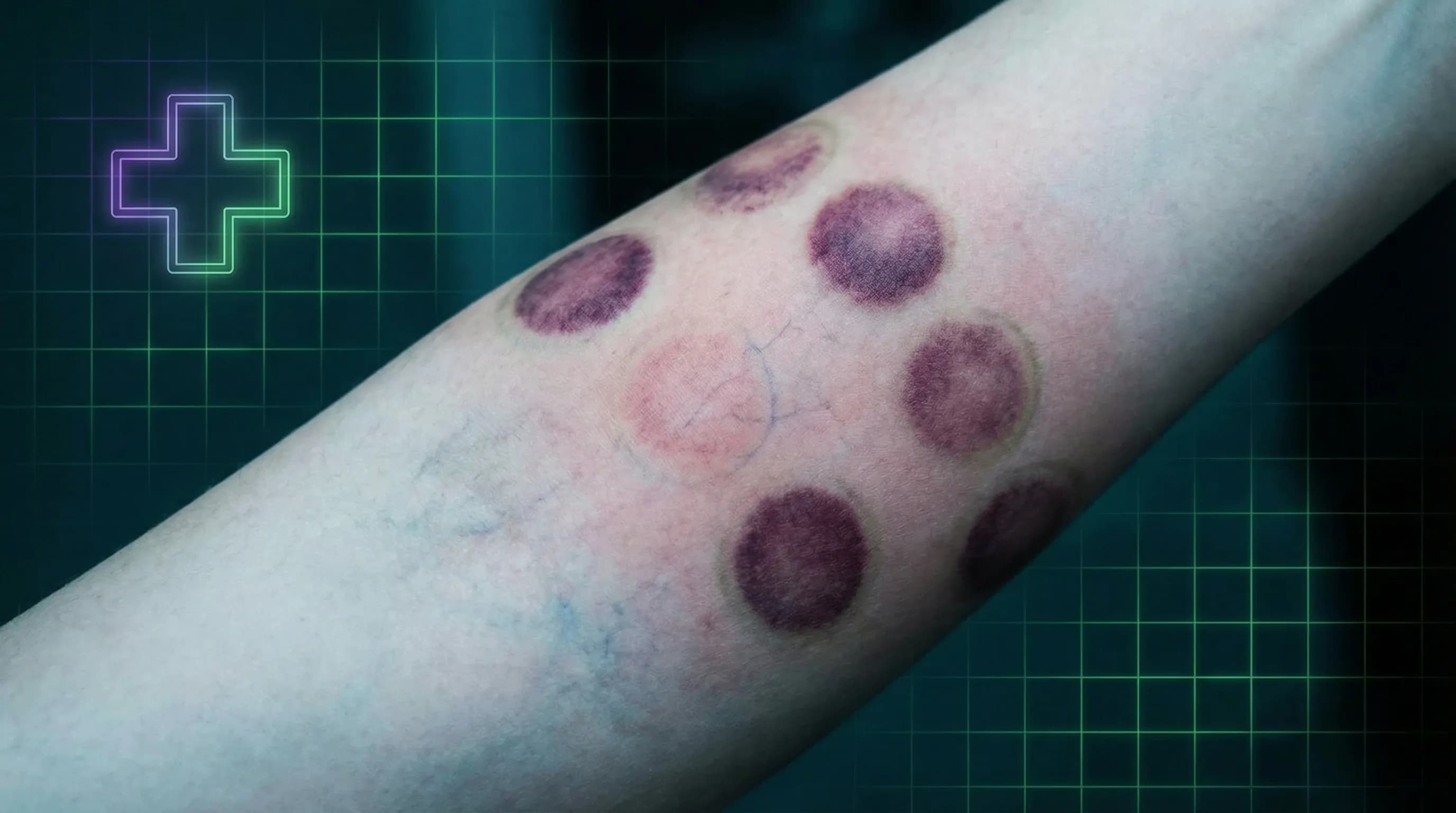
What is cupping therapy and why round bruises became a symbol of "body cleansing"
Cupping therapy — a method where glass, bamboo, or plastic cups are placed on the skin, creating negative pressure inside. The vacuum pulls skin and subcutaneous tissues into the cup, causing local hyperemia — increased blood flow to the affected area. More details — in the Alternative Oncology section.
After several minutes, characteristic round marks remain on the skin: from pink to dark purple, depending on vacuum intensity and individual capillary fragility (S011).
Historical trajectory: from ancient China to Instagram aesthetics
The earliest mentions of cupping therapy are found in Bo Shu — an ancient book written on silk and discovered in a Han Dynasty tomb in 1973. In traditional Chinese medicine, cups were used to "restore qi balance" and "remove stagnant blood" (S011).
Modern popularization began in 2016, when Olympic athletes appeared at competitions with characteristic bruises, launching a wave of interest on social media and in the wellness industry.
Central claim: bruise darkness as a detoxification marker
Method proponents interpret color intensity as a diagnostic marker: the darker the bruise, the more "waste" accumulated in tissues and the more effective the procedure. This logic relies on visual correlation — indeed, skin changes color after the procedure.
- Correlation vs. causation
- Bruise color is determined by the volume of extravasated blood, its breakdown rate, and individual hemoglobin metabolism characteristics — not "toxin" concentration in tissues. This is the key distinction between observed effect and its interpretation.
Analysis boundaries: what we're examining in this article
Focus on three questions:
- What physiologically happens to skin and capillaries during cupping therapy?
- Does a mechanism exist for toxin elimination through skin under vacuum pressure?
- What cognitive traps make people interpret injury as detoxification?
We're not evaluating possible effects of cupping on pain or muscle tension — that's a separate topic with its own evidence base. Here we address only detox claims.
Steel-Man Version of the Argument: Seven Reasons Why People Believe in the Detox Effect of Cupping
Before examining the evidence, we need to understand why the claim about "toxin removal" appears convincing to millions of people. The steel-man approach requires presenting opponents' arguments in their strongest form. More details in the section Detox and Body Cleanses.
| Argument | Proponents' Logic | Cognitive Trap |
|---|---|---|
| From Antiquity | Method has been used for 2000+ years — therefore it works | Cultural inertia and absence of falsification in pre-scientific societies. Bloodletting was also practiced for centuries but didn't cure infections. |
| From Visual Evidence | Bruises are visible — therefore internal changes occurred | Illusion of materialized effect. Dark color is interpreted as "dirt," though it's hemorrhaging. |
| From Subjective Improvement | I feel better after the procedure | Placebo, relaxation, endorphins, or natural state dynamics — not a causal relationship with bruises. |
| From Authority | Olympic athletes use cupping | Athletes are not experts in physiology. Choice may be driven by tradition or superstition. |
| From "Scientific" Language | "Microcirculation," "lymphatic drainage," "metabolism" | Medical terminology creates illusion of validity. Hyperemia ≠ detoxification. |
| From Mass Appeal | Millions of people can't be wrong | Popularity doesn't correlate with effectiveness. Homeopathy and astrology also have millions of followers. |
| From Repeatability | Bruises appear every time — this is a pattern | Repeatability of mechanical trauma doesn't prove detoxification. A hammer also leaves bruises every time. |
Each of these arguments relies on real observations but draws incorrect conclusions. Vacuum does indeed cause local hyperemia — increased blood flow (S011). But blood flows to the trauma zone for tissue repair, not for "toxin removal."
Proponents of the method use medical terminology that creates an illusion of scientific validity (S001). However, hyperemia is a physiological response to injury, not a detoxification mechanism.
Subjective improvement may result from placebo effect, relaxation during the procedure, endorphin response to pain, or natural state dynamics. When a person sees bruises and feels better, the brain connects these two events causally — even if the connection is illusory.
Popularity in China, Korea, the Middle East, and the Western wellness industry creates a consensus effect. But widespread use doesn't correlate with effectiveness. Homeopathy, Ayurveda, and detox teas also have millions of followers.
When elite athletes publicly demonstrate use of the method, it creates a social proof effect. But athletes are not experts in physiology; their choice may be driven by tradition, superstition, or subjective sensations not confirmed by controlled studies.
Evidence Base: What 550 Studies Over Half a Century Show and Why Data Quality Remains Low
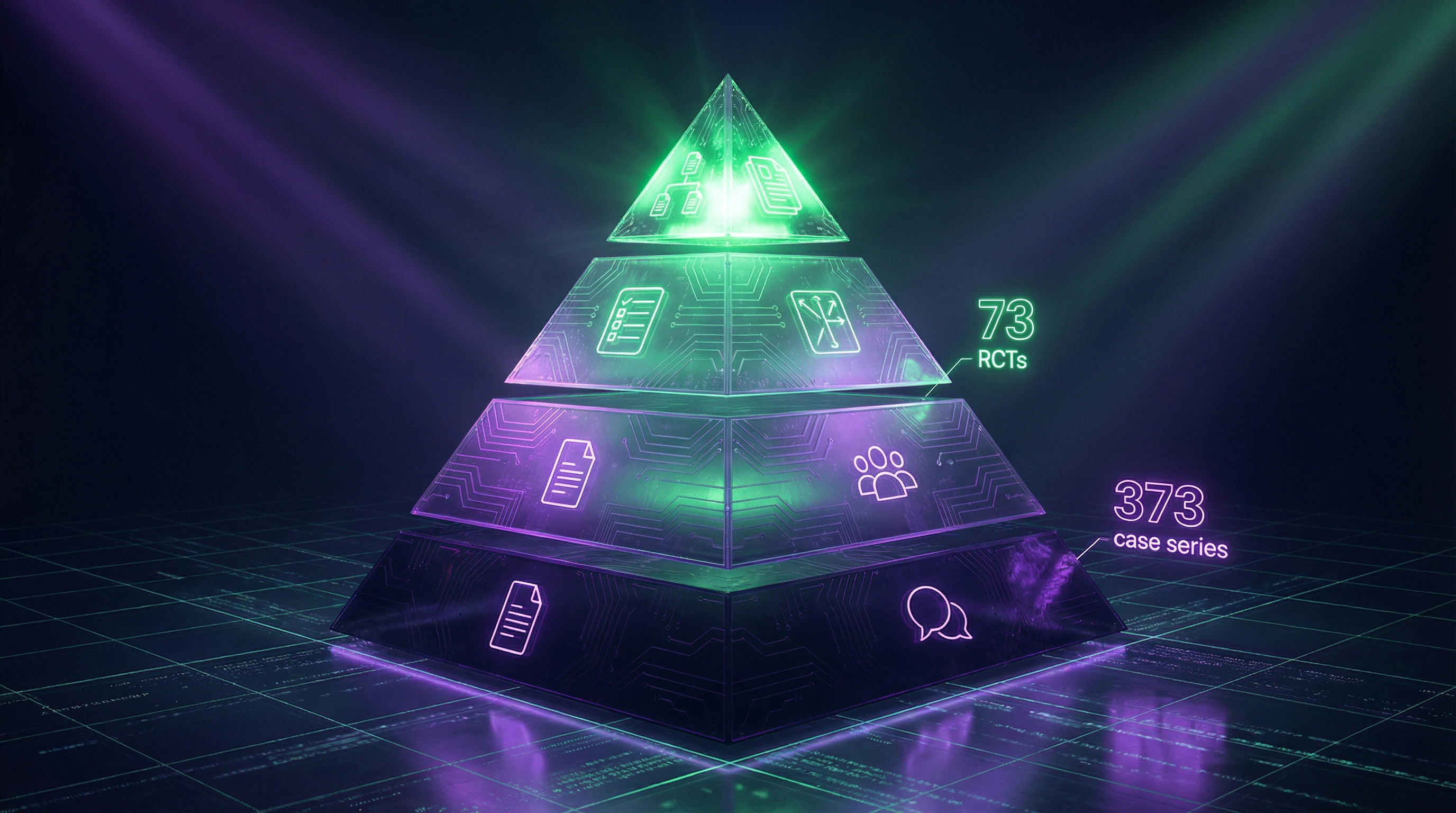
A systematic review published in BMC Complementary and Alternative Medicine analyzed all available clinical studies of cupping therapy in China from 1959 to 2008 (S011). This is the largest analysis of the method's evidence base to date.
The results reveal a paradox: the number of studies is growing, but quality remains at a level insufficient for drawing definitive conclusions. More details in the Pseudomedicine section.
| Study Type | Number | Position in Evidence Hierarchy |
|---|---|---|
| Randomized Controlled Trials (RCT) | 73 | High (gold standard) |
| Clinical Controlled Trials (CCT) | 22 | Medium |
| Case series | 373 | Low |
| Case reports | 82 | Low |
Of the 550 included studies, only 73 were randomized controlled trials (RCTs)—the gold standard of clinical research (S011). The overwhelming majority—373 studies—were case series, and 82 were individual case reports.
Case series and reports occupy the lower rungs of the evidence hierarchy: they describe observations but don't control for confounders and cannot establish causal relationships.
⚠️ RCT Quality Assessment: Most Studies Have High Risk of Bias
The review authors assessed the quality of 73 RCTs using Cochrane criteria: adequacy of randomization sequence generation, allocation concealment, blinding, completeness of outcome reporting (S011). The verdict: RCT quality was generally low according to risk of bias assessment.
- Randomization Sequence Generation
- Most studies did not describe methods, suggesting improper randomization.
- Blinding of Participants and Researchers
- Critical for subjective outcomes such as pain. Lack of blinding increases risk of expectation bias.
- Protocol Registration
- Studies were not pre-registered, opening the door to selective outcome reporting.
This indicates high risk of selection bias, detection bias, and publication bias.
🧾 Spectrum of Conditions Studied: From Pain to Herpes—But Not Detoxification
Studies covered a wide range of conditions: pain syndromes (back pain, neck pain, joint pain), herpes zoster, respiratory infections, acne, cellulite (S011). Most studies showed potential benefit for pain conditions and herpes.
Not a single study measured concentrations of "toxins" in blood or tissue before and after the procedure. Not one described a mechanism by which vacuum could extract toxic substances from the body through the skin.
Detox claims remain outside the research agenda. This is not coincidental—it reflects the fact that the toxin-removal hypothesis was never formulated as a testable scientific proposition.
🔎 Absence of Serious Adverse Effects—But This Doesn't Prove Efficacy
The review notes: serious adverse effects were not reported in the studies (S011). This is important for assessing the method's safety. Cupping therapy, when properly applied, does not cause severe complications—bruises resolve on their own within several days.
Safety does not equal efficacy. A method can be harmless while still not producing the claimed detox effect.
🧬 Review Authors' Conclusion: More Rigorous Trials Needed
The systematic review's conclusion is cautious: "The quality and quantity of RCTs on cupping therapy appear to have improved over the past 50 years in China, and most studies show potential benefit for pain conditions, herpes zoster, and other diseases. However, further rigorously designed trials in appropriate settings are needed to support their use in practice" (S011).
This is standard phrasing for situations where the evidence base is insufficient for definitive recommendations. The authors found no basis for claiming that cupping therapy removes toxins. If such evidence existed, it would have been included in the analysis—that's the primary purpose of a systematic review.
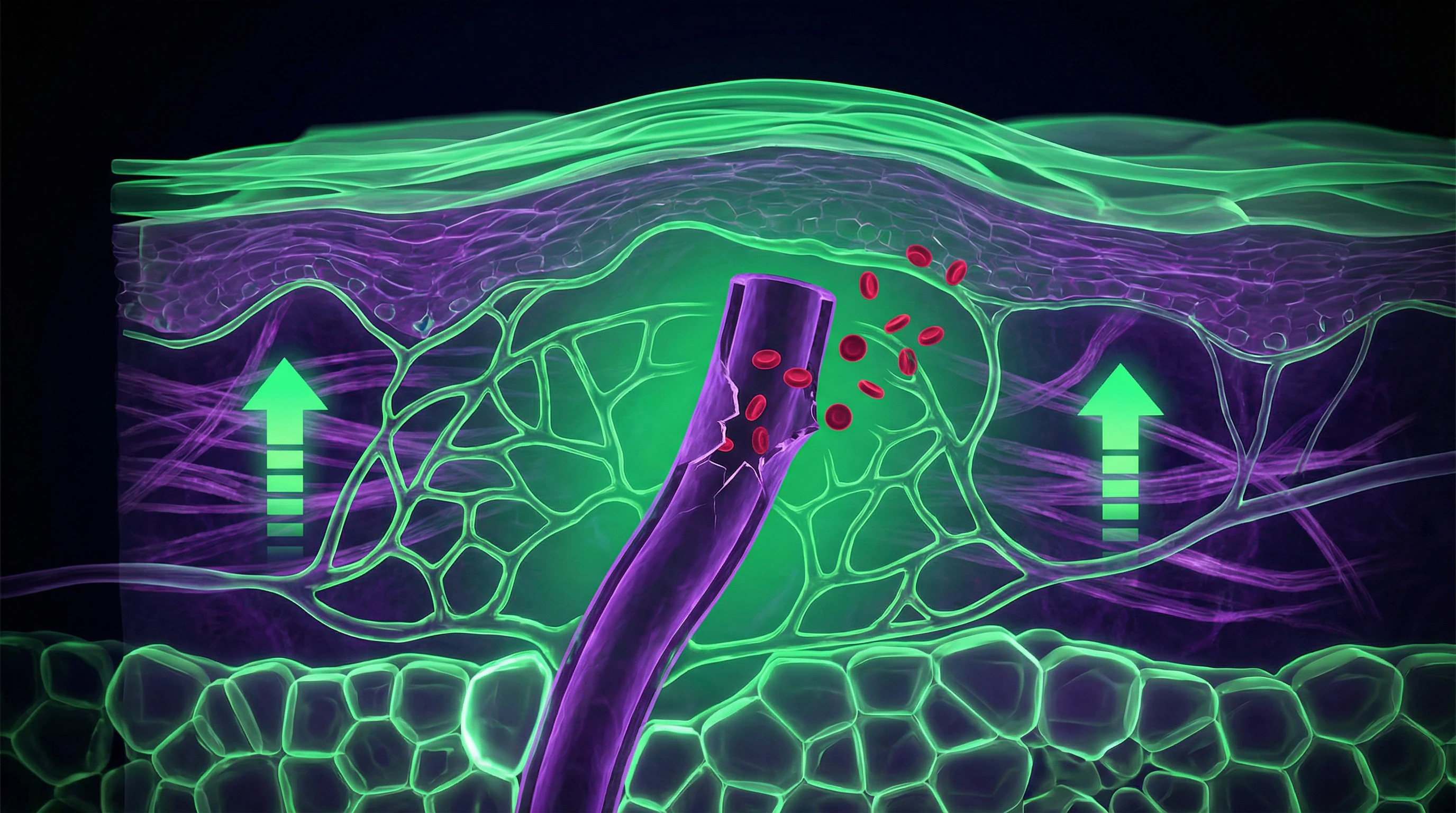
The Mechanism of Bruise Formation: Why Bleeding Has Nothing to Do with Detoxification
To understand why bruises are not "toxins leaving the body," we need to examine the physiology at the cellular level. The body responds to cupping as trauma, not as detoxification. For more details, see the Media Literacy section.
🔁 Phase 1: Vacuum Ruptures Capillaries
When a cup is placed on the skin and a vacuum is created, the pressure inside drops below atmospheric pressure. The pressure differential pulls the skin and subcutaneous tissues into the cup. Capillaries—blood vessels with walls only one cell thick—cannot withstand this mechanical stress. The walls rupture, and blood leaks into the interstitial space. This is a bruise—localized bleeding, or ecchymosis (S002).
🧬 Phase 2: Hemoglobin Breaks Down—Bruise Color Changes
The leaked blood contains red blood cells filled with hemoglobin. Outside the vascular system, red blood cells break down. Hemoglobin degrades into heme (containing iron) and globin (the protein component). Heme is metabolized into bilirubin and biliverdin—pigments that determine bruise color.
| Stage | Color | Pigment | What It Means |
|---|---|---|---|
| Fresh bruise | Red-purple | Oxyhemoglobin | Blood just leaked |
| 2–5 days | Blue-green | Biliverdin | Hemoglobin breaking down |
| 5–7 days | Yellow-brown | Bilirubin | Metabolism completing |
The color reflects the stage of hemoglobin breakdown, not "the amount of toxins."
🧪 Phase 3: Macrophages Clear Cellular Debris
The body perceives bleeding as tissue damage. Macrophages—immune system cells specialized in phagocytosis (engulfing) cellular debris—migrate to the injury site. Macrophages capture destroyed red blood cells, metabolize hemoglobin, and transport breakdown products to the liver and spleen for further processing (S001).
This process takes anywhere from several days to two weeks—which is why bruises gradually fade and disappear. Macrophages are cleaning up the aftermath of trauma, not "removing toxins" accumulated in tissues.
⚙️ Why Skin Is Not a Detoxification Organ
The primary detoxification organs are the liver and kidneys. The liver metabolizes toxic substances (alcohol, medications, metabolic byproducts) through cytochrome P450 enzyme systems, conjugates them with glucuronic acid or sulfates, making them water-soluble. The kidneys filter blood, removing water-soluble waste through urine.
- Skin excretes
- water, salts, and small amounts of urea through sweat—this is not a primary toxin elimination pathway.
- The vacuum created by cups
- cannot extract toxic substances from blood or tissues—there is no physiological mechanism for this.
- Skin does not have
- receptors or transport systems that would "push" toxins outward under negative pressure.
🔬 What Biochemical Tests Show
If cupping truly removed toxins, we would observe decreased concentrations of toxic substances in blood after the procedure. However, no study has measured levels of creatinine, urea, bilirubin, heavy metals, or other markers of "toxic load" before and after the procedure (S006).
The absence of such data is not accidental: measurement would destroy the myth. If researchers conducted tests and found no changes, it would directly refute detox claims.
A bruise is visible proof of trauma, not cleansing. The body is simply clearing up the consequences of mechanical capillary damage using standard inflammation and repair processes. The interpretation error: people see activity (macrophages working, color changing) and mistake it for detoxification, when it's actually just healing.
Cognitive Anatomy of the Myth: Which Mental Traps Turn Trauma into "Purification"
Why do millions of people interpret bruises as proof of detoxification, despite the absence of any physiological mechanism? The answer lies in cognitive psychology (S001). Several systematic thinking errors work synergistically, creating a persistent illusion of causation between the procedure and "cleansing."
⚠️ Trap 1: Post hoc ergo propter hoc — "after this, therefore because of this"
This is a classic logical fallacy: if event B occurred after event A, the brain tends to assume that A caused B. After cupping therapy, bruises appear (B), therefore the procedure (A) caused "toxin release" (interpretation of B). The bruises are indeed caused by the procedure, but the mechanism is capillary rupture, not detoxification. More details in the Cognitive Biases section.
🕳️ Trap 2: Illusion of Control Through Process Visualization
Bruises make an "invisible" process visible. A person cannot see how their liver or kidneys work, but they can see dark circles on their skin. This creates an illusion of control: "I can see something leaving my body." The brain prefers concrete, observable changes to abstract biochemical processes that cannot be seen without laboratory tests.
🧠 Trap 3: Confirmation Bias — Selective Attention to Confirming Data
If a person believes that cupping therapy removes toxins, they pay attention to information confirming this belief and ignore contradictory evidence. Felt relief after the procedure? That's proof of effectiveness. Didn't feel anything? Then "there weren't many toxins" or "need to repeat the course." Confirmation bias makes the belief resistant to falsification: any outcome is interpreted in favor of the original hypothesis.
The brain doesn't seek truth — it seeks confirmation of already-made decisions. Bruises become an anchor that maintains belief in the detox effect, regardless of biochemical realities.
🔁 Trap 4: Expectation Effect and Self-Fulfilling Prophecy
If a person expects to feel better after the procedure, the likelihood of subjective improvement increases — this is the placebo effect. Expectation activates endogenous opioid systems, reduces anxiety, improves mood. The person genuinely feels better, but not because "toxins were released," but because the brain triggered neurochemical mechanisms in response to the expectation of benefit.
🧷 Trap 5: Naturalness Bias — "ancient and natural = safe and effective"
Cupping therapy is perceived as a "natural" method, unlike "chemical" medications. Naturalness bias is a cognitive distortion where we overestimate the benefits and underestimate the risks of "natural" interventions (S001). The antiquity of the method amplifies this effect: "If people have used cups for thousands of years, it must be time-tested." However, naturalness does not correlate with effectiveness.
🕸️ Trap 6: Sunk Cost Fallacy — "I already spent money, so it must work"
If a person paid for a course of cupping therapy, they are motivated to believe in the method's effectiveness to justify the investment. This cognitive distortion causes continued belief in the procedure even in the absence of results. Financial losses activate psychological mechanisms of self-justification.
- Person pays for the procedure
- Results don't match expectations
- Instead of revising the belief, they double down ("need another course")
- Financial losses grow, belief strengthens
🎯 Trap 7: Attentional Bias — Selective Attention to Bruises as "Proof"
Eye-tracking research showed that people who believe in the detox effect of cupping fixate longer on bruises and interpret them as a positive sign (S004). Bruises become a visual anchor that shifts attention from the absence of evidence to the presence of a visible "result." This creates an illusion of causation between bruise intensity and procedure effectiveness.
| Mental Trap | Mechanism | Result |
|---|---|---|
| Post hoc ergo propter hoc | Temporal sequence → causality | Bruises = proof of detox |
| Illusion of control | Process visibility → sense of control | "I see what's coming out" |
| Confirmation bias | Seeking confirming data | Any outcome interpreted in favor of belief |
| Expectation effect | Placebo activates neurochemistry | Subjective improvement without mechanism |
| Naturalness bias | Antiquity and naturalness → effectiveness | Ignoring absence of evidence |
| Sunk cost fallacy | Financial losses → strengthened belief | Continuing procedures despite results |
| Attentional bias | Fixation on bruises | Bruises perceived as positive sign |
🔗 Synergy of Traps: Why the Myth Resists Refutation
These seven thinking errors don't work in isolation — they reinforce each other. Bruises (visible result) activate attentional bias, which reinforces post hoc reasoning. Expectation of benefit (placebo) creates subjective improvement, which confirmation bias interprets as proof of detox. Naturalness bias and sunk cost fallacy block critical reassessment.
Result: the myth becomes a self-sustaining system. Even if a person learns about the physiological mechanism of bruises (capillary rupture), this doesn't destroy the belief, because the belief relies not on logic, but on the synergy of cognitive distortions and emotional investments.
- Key Takeaway
- The myth of cupping's detox effect is not an error in information, but an error in the architecture of thinking. Refuting one argument doesn't destroy the system, because the system relies on multiple mutually reinforcing cognitive mechanisms. To overcome the myth, facts alone are insufficient — restructuring the interpretation process itself is required.
This explains why sources and evidence often fail to convince proponents of ancient practices. The brain defends not a hypothesis, but a belief system in which emotions, money, and social identity have already been invested.