
What is "Chiropractic Subluxation" — and Why Medical Subluxation Has Nothing to Do With It
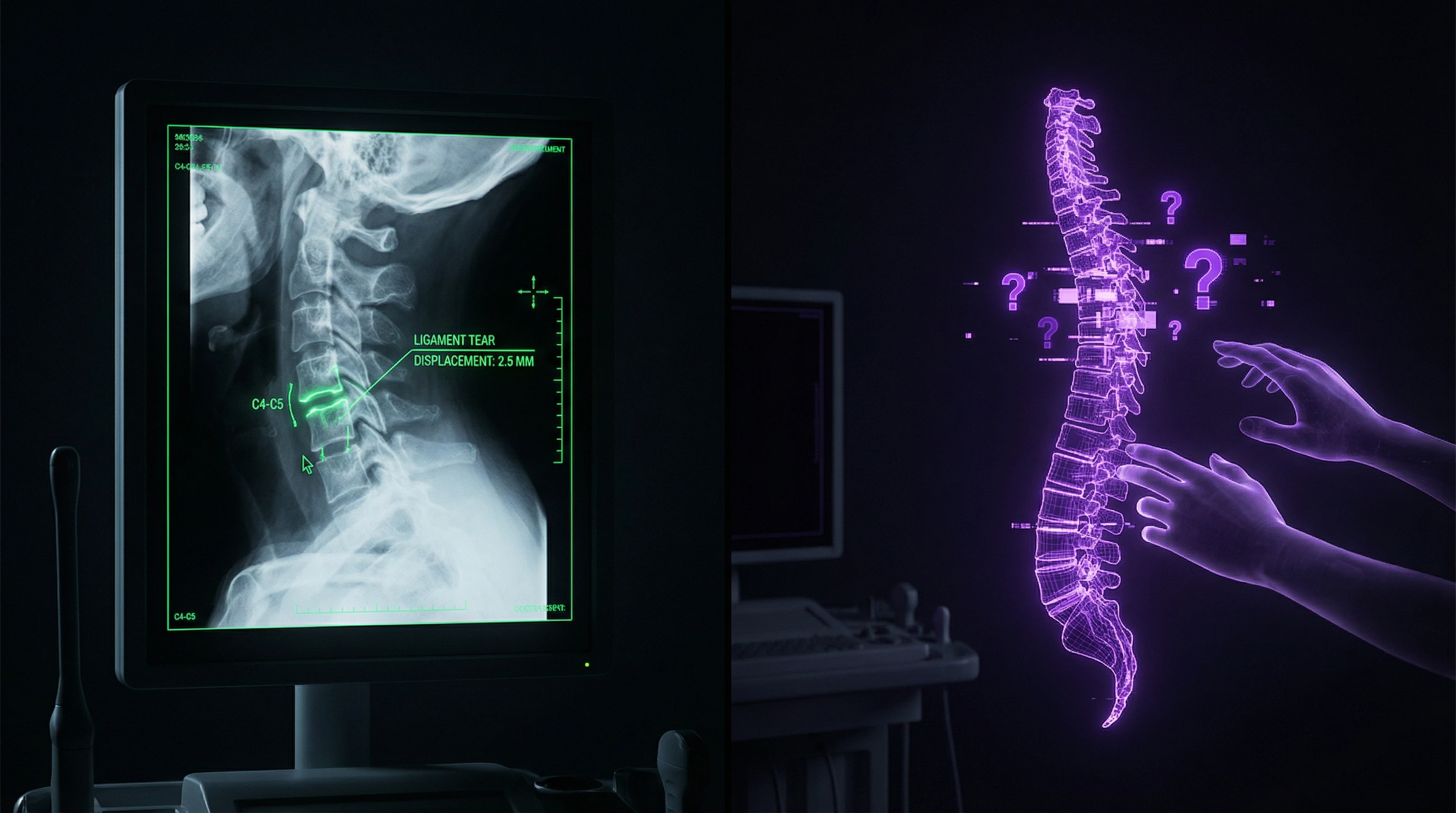
The term "subluxation" exists in two non-intersecting realities. In orthopedics, subluxation is a partial displacement of joint surfaces, visible on X-ray, with ligament tears and clinical symptoms (pain, limited movement, swelling). More details in the Fake Diagnostics section.
In chiropractic, "vertebral subluxation complex" (VSC) is a hypothetical functional spinal disorder that supposedly blocks nerve impulse transmission, causes "dysfunction" without structural damage, and is detected by chiropractor palpation.
| Criterion | Medical Subluxation | Chiropractic Subluxation (VSC) |
|---|---|---|
| Visibility on imaging | Yes, clear displacement | No, "the size of a pinhead" |
| Diagnosis | X-ray, MRI, CT | Palpation (subjective) |
| Anatomical consequences | Local (compression, ligament tears) | Universal (supposedly causes hundreds of diseases) |
| Symptoms | Acute pain, limited movement | May be absent for years |
| Conceptual basis | Anatomy and physiology | Vitalistic philosophy |
The key difference: medical subluxation is a trauma with clear anatomy and consequences. Chiropractic subluxation is a metaphysical concept claiming that a vertebra can "misalign" without visible changes on imaging, yet disrupt internal organ function through "nervous system interference."
The term was borrowed by chiropractic founder Daniel David Palmer in 1895 from osteopathy, but reinterpreted through vitalistic philosophy — the idea of "Innate Intelligence" governing the body through the nervous system (S006).
🔎 Five Signs That Distinguish Chiropractic Subluxation From the Real Thing
- Invisibility: VSC requires no radiological confirmation. Palmer claimed the displacement could be "the size of a pinhead" and unavailable to imaging.
- Universality: one subluxation supposedly explains hundreds of diseases — from migraines to diabetes. Medical subluxation has local consequences.
- Asymptomaticity: VSC can exist for years without pain. The patient learns about it only from the chiropractor. Real subluxation always involves acute pain.
- Hand diagnosis: the primary method is motion palpation, a subjective technique with result reproducibility at chance level (S004).
- Philosophical foundation: VSC is inseparable from the concept of Innate Intelligence — the idea that the body possesses inner wisdom blocked by subluxations. This is not physiology, but metaphysics.
⚠️ Why Terminology Confusion Is Not Accidental, But Strategic
Using a medical term for a non-medical concept creates an illusion of scientific validity. The patient hears "subluxation" and imagines an X-ray showing visible displacement. The chiropractor gains authority without presenting evidence.
This is a classic pseudoscientific legitimation technique — borrowing scientific language to mask speculation. Palmer deliberately avoided precise definitions to maintain interpretive flexibility: if subluxation isn't found on imaging, it's "functional"; if symptoms don't disappear after correction, "more sessions are required."
Historical documents reveal: in an 1902 letter, Palmer wrote that "subluxation is not what the anatomist sees, but what the chiropractor feels" (S008). This formulation makes the concept unfalsifiable — impossible to prove or disprove by scientific methods.
- Unfalsifiability
- A property of a statement that cannot be tested or refuted by experiment. If a theory predicts the same outcome regardless of what happens, it is not scientific. VSC falls into this trap: any outcome is explained by the presence or absence of subluxation.
- Pseudoscientific legitimation
- Using scientific terminology and methods to lend authority to unscientific ideas. Chiropractic borrows the language of neurology and anatomy but applies it to concepts lacking anatomical substrate.
Steel Version of the Argument: Five Reasons Why the Subluxation Concept Seems Convincing
Before examining the evidence, it's necessary to understand why the myth survives. Steelmanning is the reconstruction of the strongest possible version of an opponent's argument. Below are five reasons why chiropractic subluxation seems plausible even to skeptics. More details in the section Psychosomatics Explains Everything.
🧩 Argument 1: The Spine Is Indeed Connected to the Nervous System
The spinal cord runs through the vertebral canal, spinal nerves exit through intervertebral foramina. Nerve compression (for example, from a herniated disc) causes pain, numbness, muscle weakness.
The chiropractic logical leap: if nerve compression causes symptoms, then "micro-misalignment" of a vertebra can cause "micro-symptoms" — not pain, but "organ dysfunction." This argument exploits a real anatomical fact but extrapolates it beyond physiology.
Nerve compression sufficient to disrupt organ function is always accompanied by objective signs — altered reflexes, muscle atrophy, abnormalities on electromyography. "Asymptomatic compression affecting the liver" is an oxymoron.
🧩 Argument 2: Patients Report Improvement After Manipulations
Subjective reports are a powerful persuasion tool. A person comes in with back pain, the chiropractor "corrects the subluxation," the pain decreases. The causal relationship seems obvious.
- Natural Regression
- Most acute back pain resolves on its own within 2–4 weeks, regardless of treatment.
- Placebo Effect
- The treatment ritual, practitioner attention, and expectation of improvement activate endogenous opioids.
- Manual Therapy
- Can indeed temporarily reduce muscle spasm and improve mobility — but this doesn't require the subluxation concept. Physical therapists achieve the same results without metaphysics.
🧩 Argument 3: Chiropractic Is Institutionalized and Licensed
In the US, Canada, and Australia, chiropractors have licenses, university programs, and insurance coverage. This creates an illusion of scientific legitimacy: if it were quackery, the government wouldn't issue licenses.
Counterargument: institutionalization is the result of political lobbying, not scientific consensus. The American Medical Association (AMA) officially considered chiropractic an "unscientific cult" until the 1980s. Licensing occurred after antitrust lawsuits, not after presentation of evidence of effectiveness (S003). Institutions can legitimize practices without an evidence base — history is full of examples (lobotomy received the Nobel Prize in 1949).
🧩 Argument 4: Research Mentioning Subluxations Exists
A PubMed search for "vertebral subluxation" yields hundreds of results. This creates an impression of scientific activity.
But analysis shows: most articles are published in chiropractic journals (Journal of Manipulative and Physiological Therapeutics, Chiropractic & Manual Therapies), where peer review is conducted within the community. Independent systematic reviews find no evidence for the existence of subluxation as a clinical entity (S002).
Moreover, chiropractic research itself demonstrates a fundamental problem: the absence of a reliable method for diagnosing subluxations. Research showed that two chiropractors palpating the same patient agree on subluxation location only 30–40% of the time — this is the level of chance (S004).
🧩 Argument 5: Criticism Comes from "Competitors" — the Medical Establishment
The chiropractic community often frames criticism as a corporate attack by the pharmaceutical industry defending its monopoly. This narrative exploits distrust of "Big Pharma" and positions chiropractic as a "natural alternative."
The problem: criticism of subluxation comes not only from physicians but also from some chiropractors themselves. The reformist wing of the profession (evidence-based chiropractors) has abandoned the subluxation concept and focuses on manual therapy of the musculoskeletal system without vitalistic philosophy (S006). The conflict is not between medicine and chiropractic, but between evidence-based practice and dogma within chiropractic itself.
Compare with other alternative practices: veterinary osteopathy and Ayurveda demonstrate similar patterns — institutionalization without an evidence base, internal splits between traditionalists and reformists, appeals to "naturalness" as an argument.
Evidence-Based Anatomy of the Myth: What Research Shows About the Existence of Subluxations
Moving from arguments to facts. If chiropractic subluxation is a real phenomenon, there must exist: (1) a reliable diagnostic method, (2) anatomical or physiological correlates, (3) evidence of a causal relationship between "correction" and health improvement. Let's examine each point. More details in the Medical Devices and Diagnostics section.
📊 Subluxation Diagnosis: The Reproducibility Problem
The primary method for diagnosing VSC is motion palpation: a chiropractor palpates the spine, assessing "restricted mobility" and "tenderness." A study by Keating et al. (2000) analyzed the reliability of this method: 12 chiropractors examined 30 patients twice with a one-week interval (S009). Results:
| Type of Agreement | κ Coefficient | Interpretation |
|---|---|---|
| Intra-examiner (same chiropractor, two examinations) | 0.34 | Poor |
| Inter-examiner (different chiropractors, same patient) | 0.21 | Very poor |
| Clinical standard | > 0.80 | Acceptable |
Two chiropractors examining the same patient will give different diagnoses regarding subluxation location 70–80% of the time. The same chiropractor examining a patient twice will change their diagnosis in 60% of cases. Such a method cannot be the foundation of clinical practice—it's fortune-telling with medical terminology (S009).
🔬 Anatomical Search: Where in the Spine Does the Subluxation Hide
If VSC is a structural or functional disorder, it must have an anatomical substrate. Modern imaging methods (MRI, CT, functional MRI) allow visualization of the spine with sub-millimeter resolution. Studies of spinal anatomy, including the lymphatic network of the vertebral column (S011) and vertebral biomechanics (S010), do not reveal structures or mechanisms corresponding to the description of VSC.
Neurophysiology refutes chiropractic's central idea—"nerve impulse interference." Nerves don't work like wires that can be blocked by mechanical vertebral displacement.
Signal transmission in the nervous system is an electrochemical process with synaptic transmission. "Blocking" an impulse requires either axonal rupture, demyelination, or a neurotoxin. Mechanical pressure on a nerve causes pain (nociception) or paresthesia (numbness), but not "organ dysfunction without symptoms."
The autonomic nervous system is not controlled by the spine. Sympathetic and parasympathetic pathways have complex architecture with ganglia, feedback loops, and central regulation. The idea that "T5 vertebral displacement disrupts stomach function" ignores that stomach innervation includes the vagus nerve (exits from the skull, not the thoracic region), the celiac plexus, and the enteric nervous system of the gut (100 million neurons operating autonomously).
- The spinal cord is protected by multiple layers
- The spinal canal is filled with cerebrospinal fluid, and the spinal cord is suspended by denticulate ligaments. For a vertebral "micro-displacement" to affect a nerve, it would need to overcome several protective layers. Real compression (such as in spinal stenosis) causes myelopathy with clear neurological symptoms—leg weakness, gait disturbance, bladder dysfunction. This is not "asymptomatic liver dysfunction."
📊 Clinical Trials: Does Subluxation Correction Work
If chiropractic manipulations eliminate subluxations and restore health, this should be evident in controlled studies. Systematic reviews show: spinal manipulations are effective for acute nonspecific low back pain (effect comparable to NSAIDs and physical therapy), but there is no evidence of effectiveness for internal organ diseases (S002).
Studies of chiropractic treatment for asthma, hypertension, infant colic, and otitis showed no advantages over placebo. Key point: the effectiveness of manipulations for back pain does not prove the existence of subluxations—it's explained by neurophysiological effects (gate control theory of pain, reduced muscle tone) that don't require the VSC concept.
This is similar to situations in other areas of alternative medicine. For example, ayurveda may contain toxic substances, and veterinary osteopathy also operates without an evidence base. The mechanism is the same: the method claims credit for results explained by entirely different causes.

The Mechanism of Illusion: Why the Brain Believes in Invisible Subluxations
The VSC concept survives not through evidence, but through cognitive mechanisms that make it psychologically convincing (S005). Let's examine four key traps.
🧩 Trap 1: The Illusion of Causality (post hoc ergo propter hoc)
A patient comes in with a migraine, the chiropractor "finds a C2 subluxation," performs a manipulation, and a week later the migraine resolves. The brain automatically constructs a causal chain: manipulation → subluxation correction → migraine disappearance. More details in the Media Literacy section.
But migraines are episodic conditions with natural cycles of exacerbation and remission. The probability that the migraine would have resolved on its own (or due to weather changes, stress, sleep) is ignored. This is the classic "after, therefore because of" fallacy. A control group (patients without treatment) would show that improvement rates are identical.
The brain doesn't distinguish between "coincidence" and "cause" — it sees a sequence and fills the gap with meaning.
🧩 Trap 2: Confirmation Bias and Selective Memory
Patients remember cases when treatment "worked" and forget failures. A chiropractor sees 50 patients per week; 10 experience improvement (for any reason, including placebo and regression to the mean).
These 10 cases become "proof of effectiveness," while the remaining 40 are attributed to "insufficient sessions" or "complex cases." The brain doesn't keep statistics — it collects stories. One vivid success outweighs dozens of neutral outcomes.
- Remember success (emotionally vivid, confirms belief)
- Forget failure (emotionally neutral, contradicts expectations)
- Reinterpret neutral outcome as partial success
- Repeat cycle → reinforce belief
🧩 Trap 3: The Authority of Ritual and Somatic Focusing
A chiropractic session is a ritual: palpation, "diagnosis," manipulation with a characteristic crack (joint cavitation — the collapse of a gas bubble in synovial fluid, which has no therapeutic significance). The ritual creates a sense that "something important happened."
The patient focuses on their body, expects changes — and finds them (lightness in the back, improved mood). This isn't the effect of subluxation correction, but the effect of attention and expectation (S002). Research shows: simulated manipulation (without actual intervention) produces 60–70% of the effect of real manipulation.
| Ritual Component | Psychological Effect | Connection to Subluxation |
|---|---|---|
| Vertebral palpation | Perception of practitioner competence | None — practitioner feels normal structures |
| Crack during manipulation | Auditory confirmation of "correction" | None — this is gas cavitation, not correction |
| Diagnosis explanation | Narrative that explains pain | None — subluxation is invisible and unmeasurable |
| Recommendation for repeat sessions | Expectation of improvement, body focus | None — regression to the mean explains improvement |
🧩 Trap 4: Unfalsifiability and Protection from Refutation
The VSC concept is constructed so that it's impossible to refute (S006). If the subluxation isn't visible on X-ray — it's "functional." If symptoms don't disappear after correction — "more sessions are needed" or "there are other subluxations."
If the patient feels worse — "exacerbation before improvement." Any outcome is interpreted in favor of the theory. This is a hallmark of pseudoscience: a genuine scientific hypothesis must be falsifiable — there must exist observations that could refute it. For VSC, such observations don't exist by definition.
- Falsifiability
- The ability of a theory to be refuted by experiment or observation. If a theory explains all possible outcomes, it's not scientific — it's metaphysical.
- Why This Matters
- An unfalsifiable theory is protected from criticism, but also from development. It becomes belief, not knowledge. The patient cannot test effectiveness — only believe in it.
- Where the Trap Lies
- A chiropractor can honestly believe in VSC because the system is constructed to confirm itself. Criticism is perceived as misunderstanding, not as refutation.
A system that explains success and failure equally explains nothing — it only creates the illusion of explanation.
These four mechanisms work synergistically. A patient comes in with pain (real), receives ritual treatment (convincing), sees improvement (often natural), remembers success (selectively), believes the diagnosis (unfalsifiable) — and becomes an advocate of the system. The chiropractor sees a growing clientele and becomes more convinced. The system is self-sustaining not because it works, but because human psychology is designed to believe in working systems.
This isn't conspiracy or malicious intent. It's the natural result of how the brain processes information under uncertainty. Understanding these mechanisms is the first step toward cognitive immunization against such traps, whether in chiropractic, osteopathy, or any other system that promises healing through invisible corrections.
Historical Roots: How 1902 Metaphysics Became "Medical Practice" in 2026
To understand the myth's persistence, we need to return to its origins. The subluxation concept didn't emerge from clinical observations—it was constructed as a philosophical system. More details in the Epistemology Basics section.
🕳️ 1895–1902: From "Bonesetting" to Vitalistic Religion
Daniel David Palmer began as a magnetic healer—a mesmerism practitioner who claimed to heal through "magnetic energy manipulation." In 1895, he performed the first chiropractic manipulation, claiming he restored hearing to a deaf patient by "adjusting a vertebra."
Historical analysis shows: the patient (Harvey Lillard) wasn't completely deaf, and his improvement wasn't confirmed by medical records (S012). But Palmer saw this case as a revelation—if spinal manipulation could affect hearing, then the spine must be "the key to all diseases."
By 1902, Palmer developed a philosophical system: Innate Intelligence—an immaterial force governing the body through the nervous system. Subluxations block the flow of Innate, causing disease. Correcting subluxations restores the flow—and the body heals itself.
This isn't medical theory—it's vitalistic metaphysics, similar to the concept of "qi" in traditional Chinese medicine or "prana" in Ayurveda (S012). Like those systems, chiropractic postulates an invisible energy that can't be measured but supposedly governs health.
🕳️ 1906–1910: Father-Son Conflict, Philosophical Schism
Palmer's son, Bartlett Joshua Palmer (B.J. Palmer), took over Palmer School of Chiropractic and radicalized the doctrine. He claimed that 95% of all diseases were caused by subluxations, and chiropractic should replace medicine.
B.J. introduced the concept of "One Cause, One Cure" and forbade chiropractors from using any other methods—drugs, physical therapy, diet. This led to a schism: some chiropractors ("mixers") began integrating other methods, while others ("straights") remained faithful to the subluxation dogma (S012). The conflict continues to this day.
- Straights—orthodox chiropractors who believe in subluxation as the universal cause of disease and reject medicine.
- Mixers—pragmatic chiropractors who use manipulation combined with other methods and acknowledge subluxation's limitations.
- Result of the schism—the profession remains philosophically divided, hindering its scientific legitimation.
🕳️ 1963–1980: Struggle for Legitimacy and Legal Wars
The American Medical Association (AMA) in 1963 created a "Committee on Quackery" and launched an active campaign against chiropractic (S006). Chiropractors responded with lawsuits, claiming the AMA was monopolizing medicine and suppressing alternative approaches.
In 1987, in Wilk v. American Medical Association, chiropractors partially won—the court ruled that the AMA had acted anticompetitively. But this was a Pyrrhic victory: the court didn't confirm the scientific validity of subluxation, only protected chiropractors' right to exist as a profession.
Paradox: legitimacy through the legal system, not through science. Chiropractic gained licensed professional status not because it proved subluxation's effectiveness, but because it won in court against the AMA's monopoly (S004).
🕳️ 1980–2026: Institutionalization of the Myth
After the legal victory, chiropractic integrated into the healthcare system: it gained licensing, insurance coverage, and accreditation of educational programs. This created institutional interest in preserving the subluxation myth.
- Vitalistic Legacy
- The Innate Intelligence concept remains in chiropractic textbooks (S006), though it's called a "philosophical foundation" rather than scientific theory. This allows avoiding direct refutation.
- Economic Interest
- If subluxation is a real phenomenon requiring regular correction, then chiropractic becomes a permanent income source. If subluxation is a myth, the profession loses its purpose.
- Cognitive Inertia
- Generations of chiropractors have been trained to believe in subluxation. Acknowledging the myth means admitting their entire education was based on an error (S005).
Result: the subluxation myth survived not through evidence, but through institutional protection. It's embedded in licensing, insurance coverage, educational programs, and professional identity. Refuting it means dismantling the entire system.
This is a classic example of how an error, once institutionalized, becomes resistant to facts. Not because the facts are unconvincing, but because the system has economic and social interest in preserving it. As with veterinary osteopathy, professional identity often proves stronger than scientific integrity.