 🌿 Folk Medicine vs Evidence-Based Medicine
Traditional Practices Under the Microscope of Scientific Methodλ
How systematic reviews and meta-analyses help separate effective folk remedies from myths and build a bridge between tradition and evidence-based medicine
Overview
For centuries, humanity has relied on folk medicine — but historical use does not equal proven effectiveness. Systematic reviews and meta-analyses 🧬 allow us to objectively evaluate traditional practices: research shows that formal psychiatric treatment produces significantly better outcomes compared to folk therapy in patients with psychotic disorders. Modern science builds a bridge between tradition and evidence-based medicine, separating effective methods from myths.
🛡️
Laplace Protocol: Evidence-based practice integrates the best scientific data with clinical experience and patient preferences, rather than wholesale rejection of traditions. Systematic reviews minimize bias through explicit, reproducible methods, surpassing narrative reviews in objectivity of knowledge synthesis.
Reference Protocol
Scientific Foundation
Evidence-based framework for critical analysis
Protocol: Evaluation
Test Yourself
Quizzes on this topic coming soon
Sector L1
Articles
Research materials, essays, and deep dives into critical thinking mechanisms.
🌿 Folk Medicine vs Evidence-Based Medicine 🌿 Folk Medicine vs Evidence-Based Medicine
 🌿 Folk Medicine vs Evidence-Based Medicine
 🌿 Folk Medicine vs Evidence-Based Medicine
 🌿 Folk Medicine vs Evidence-Based Medicine
 🌿 Folk Medicine vs Evidence-Based Medicine
 🌿 Folk Medicine vs Evidence-Based Medicine
 🌿 Folk Medicine vs Evidence-Based Medicine
 🌿 Folk Medicine vs Evidence-Based Medicine
 🌿 Folk Medicine vs Evidence-Based Medicine
 🌿 Folk Medicine vs Evidence-Based Medicine
 🌿 Folk Medicine vs Evidence-Based Medicine
⚡
Deep Dive
Systematic Reviews as the Gold Standard for Evaluating Folk Practices
A systematic review is a synthesis of evidence that uses explicit, reproducible methods to search, select, and critically evaluate relevant studies. Unlike narrative reviews based on an author's subjective opinion, systematic reviews follow structured protocols to minimize bias.
This is particularly critical when evaluating folk medicine, where anecdotal evidence and cultural beliefs are often conflated with actual clinical data. Traditional or widespread use of folk remedies is not scientific proof of their efficacy or safety.
Poor studies combined together still yield poor evidence. The quality of a systematic review depends on the quality of the included studies.
Methodology: from question to conclusion
A quality systematic review begins with a clearly defined research question in PICO format: population, intervention, comparison, and outcome. This is followed by a comprehensive search strategy covering multiple databases and gray literature to avoid publication bias.
- Critical appraisal of methodological quality
- A mandatory stage where each study is checked for systematic errors, conflicts of interest, and design adequacy. Weak studies are either excluded or their weight in the final conclusion is reduced.
- Transparent reporting
- Documentation of the selection process, inclusion and exclusion criteria, and review limitations. This allows other researchers to verify and replicate the evaluation process.
PRISMA: the standard for separating myths from facts
The quality of systematic reviews varies significantly. Rigorous reviews require explicit methodology, comprehensive search strategies, and critical appraisal. Methodologically weak studies can be misleading.
| Sign of a quality review | Sign of a weak review |
|---|---|
| Clear protocol registered in advance | Methodology described vaguely or retrospectively |
| Search in 3+ databases + gray literature | Search in only one database or only published works |
| Independent quality assessment by two reviewers | Assessment by one author without verification |
| Compliance with PRISMA standards | Absence of standardized reporting |
Using standardized reporting protocols such as PRISMA helps distinguish quality reviews from poor ones and ensures reproducibility of results. This is a critical thinking tool: if review authors don't follow explicit methods, their conclusions are less reliable.

Meta-Analysis: From Multiple Studies to a Unified Effect Estimate
Meta-analysis is a quantitative method that combines results from multiple studies to obtain a unified effect estimate. It overcomes the limitations of individual studies with small sample sizes and reveals the true effect size of an intervention.
Network meta-analysis goes further: it compares multiple interventions simultaneously, combining direct and indirect evidence. For folk medicine, this is critical—direct comparisons with modern methods often simply don't exist.
- Combining results from different studies
- Accounting for differences in populations, dosages, and preparation methods
- Ranking interventions by efficacy and safety
- Detecting true effects through the noise of small samples
Quality Over Quantity
A common trap: thinking more studies = better evidence. Not true. A meta-analysis combining methodologically weak studies creates an illusion of scientific rigor but doesn't improve the quality of conclusions.
Combining bad data doesn't make it good—only more confidently wrong.
Heterogeneity: When Studies Tell Different Stories
Heterogeneity is the main challenge when analyzing folk practices. Patients differ, dosages vary, traditional remedy preparation methods differ, and outcome assessment methods are incomparable.
- Fixed-Effects Model
- Assumes one true effect; appropriate when studies are very similar.
- Random-Effects Model
- Allows the true effect to vary between studies; more realistic for heterogeneous data.
- I² Statistic
- Shows the proportion of variability caused by heterogeneity rather than chance. Above 50% is a serious signal.
Without accounting for heterogeneity, meta-analysis conclusions become unreliable. This is especially dangerous for folk medicine, where study conditions are often far from standardized.
Folk Medicine Under the Scientific Microscope: The Gap Between Tradition and Evidence
Traditional healing practices are passed down through generations based on cultural beliefs, anecdotal testimonials, and historical use, not controlled scientific research. Herbal remedies, spiritual practices, traditional treatment approaches—all are now undergoing systematic pharmacological evaluation.
The gap between tradition and evidence isn't a clash of worldviews, but a question of mechanism: what exactly works and why, separating real effects from placebo and cultural expectations.
The Hymenaea spp. Case: When Tradition Meets the Lab
Plants of the Hymenaea genus were traditionally used to treat fatigue, inflammation, respiratory and gastrointestinal disorders. Modern pharmacology allows us to identify active compounds, determine mechanisms of action, and assess safety profiles.
This approach demonstrates how science validates or refutes traditional practices based on objective data, not cultural authority.
Psychotic Disorders: Where Tradition Is Dangerous
Formal psychiatric treatment produces superior outcomes compared to folk therapy in treatment-naïve patients with psychosis. Psychotic symptoms and occupational functioning improve significantly after evidence-based intervention.
| Parameter | Formal Treatment | Folk Therapy |
|---|---|---|
| Symptom Reduction | Measurable improvement | Absent or delayed |
| Occupational Functioning | Recovery | Deterioration |
| Complication Risk | Managed | Uncontrolled |
This is a critical example where traditional practices aren't just less effective—they delay access to interventions that demonstrate measurable improvement in clinical outcomes.
Why Evidence Doesn't Defeat Tradition
Despite accumulating evidence of the superiority of scientifically validated approaches, traditional practices remain deeply rooted in some healthcare systems. There's a gap between evidence generation and practical implementation.
Implementing evidence-based practice faces unique cultural and systemic barriers, highlighting the complexity of transitioning from traditional to scientifically validated approaches even when compelling evidence exists.
The Evidence-Practice Gap: Why Science Doesn't Always Win Over Tradition
Compelling evidence of scientifically-based approaches' superiority doesn't guarantee their adoption. The gap between evidence generation and practical implementation remains a key challenge in modern healthcare.
Traditional practices maintain their position not due to lack of alternatives, but through entrenchment in social structures and institutional mechanisms that vary across cultural contexts.
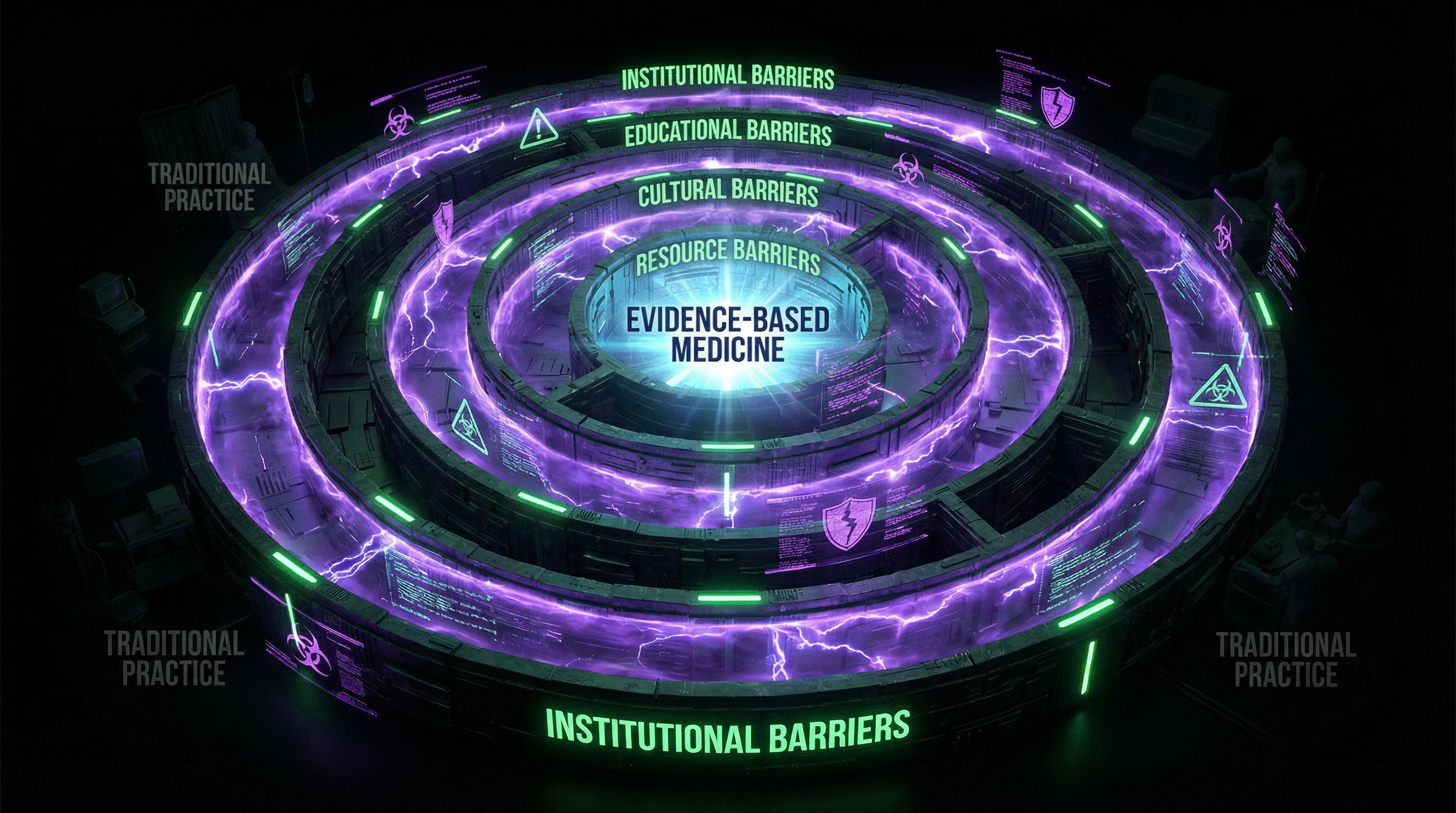
Implementation Barriers Across Cultural Contexts
Cultural factors create unique obstacles to transitioning toward evidence-based medicine, especially in regions with strong folk healing traditions. Patients often prefer familiar traditional methods even when informed about more effective alternatives—reflecting a deep connection between cultural identity and treatment choices.
Institutional inertia, insufficient resources for staff training, and resistance to change from practicing professionals form a multilayered barrier system that facts alone cannot overcome.
Evidence-Based Nursing Practice in China as a Model of Systemic Challenges
The implementation of evidence-based nursing in mainland China demonstrates specific cultural and systemic barriers characteristic of transitional healthcare systems. Hierarchical structure of medical institutions, limited access to international databases, and language barriers create additional obstacles to spreading scientifically-grounded practices.
- Simply having evidence is insufficient to change practice
- Comprehensive transformation of educational programs is required
- Modernization of information infrastructure is necessary
- Reorientation of institutional organizational culture is needed
This case shows: barriers lie not in the realm of knowledge, but in structures, incentives, and the social embeddedness of practices.
Popular Happiness Myths: When Recommendations Outpace Evidence
A systematic review of happiness-enhancing strategies revealed a significant gap between advice popularity and empirical support. Many interventions actively promoted as scientifically-grounded have weak or contradictory evidence bases.
The public receives recommendations based more on intuitive appeal and marketing potential than rigorous scientific evaluation.
Happiness-Enhancing Strategies: Evidence Variability
Analysis of popular recommendations showed uneven distribution of empirical support. Gratitude practice and social connections have moderate evidence bases, while certain positive thinking techniques demonstrate contradictory results.
Public discourse often presents all strategies as equally effective, ignoring differences in quality and quantity of supporting research.
The Gap Mechanism: From Laboratory to Life
The self-help and wellness industry relies on simplified interpretations of psychological research or extrapolates results from small laboratory experiments to real-world situations without sufficient justification.
This pattern is identical to the situation with folk medicine: traditional use or widespread adoption doesn't equal proven effectiveness. Systematic scientific evaluation is required to separate working interventions from placebo and marketing constructs.
- Check: Is there a systematic review or meta-analysis of the intervention?
- Assess sample size and research quality in the review.
- Distinguish: moderate support vs contradictory results vs absence of effect.
- Separate recommendation popularity from evidence strength.
Practical Checklists for Evaluating Evidence: Critical Thinking Tools
The quality of systematic reviews varies significantly. The ability to distinguish rigorous research from methodologically weak studies is critically important for making informed decisions.
Clear criteria exist for evaluating the reliability of evidence synthesis: methodological transparency, comprehensiveness of literature search, critical appraisal of included studies. Understanding these criteria allows informed patients to distinguish quality evidence from claims masquerading as pseudoscientific reviews.
Quality Criteria for Systematic Reviews
A high-quality systematic review should have a clearly formulated research question in PICO format (Population, Intervention, Comparison, Outcome), a comprehensive search strategy across multiple databases, and transparent inclusion/exclusion criteria.
- Critical appraisal of the methodological quality of included studies
- Analysis of heterogeneity in results
- Assessment of publication bias risk
- Verification of author conflicts of interest
- Documentation of review protocol prior to analysis
The number of studies in a meta-analysis is less important than their quality — pooling methodologically weak studies does not create strong evidence.
Integrating Evidence into Clinical Practice
True evidence-based practice integrates the best available research evidence with clinical expertise and patient preferences. This refutes the myth that evidence-based medicine ignores individual characteristics and turns treatment into mechanical protocol-following.
Practical implementation requires critical evaluation of evidence applicability to specific clinical contexts, consideration of local resources and cultural factors, and open discussion with patients about the limitations and uncertainties of existing evidence.

Knowledge Access Protocol
FAQ
Frequently Asked Questions
A systematic review is an analysis of research following a strict protocol with explicit methodology to minimize bias. Unlike regular reviews, it uses reproducible methods for searching, selecting, and evaluating sources. It's the gold standard for synthesizing scientific evidence in medicine and psychology.
Meta-analysis statistically combines results from multiple studies into a single effect estimate. This allows for more precise conclusions than individual studies and reveals common patterns. Network meta-analysis can compare multiple treatments simultaneously through direct and indirect evidence.
No, traditional use is not evidence of effectiveness or safety. Many folk remedies haven't undergone controlled trials, and their effects may be explained by placebo. Systematic evaluation often reveals a gap between traditional claims and actual results.
Formal psychiatric treatment significantly outperforms folk therapy in patients with psychotic disorders. After evidence-based treatment, psychotic symptoms and occupational functioning improve substantially more. This confirms the importance of scientifically validated approaches in psychiatry.
Cultural and systemic barriers exist between evidence generation and practical application. In regions like China, traditional practices are deeply embedded in the healthcare system. Adapted implementation strategies that account for local context are required.
No, the quality of systematic reviews varies considerably. Reliable reviews require explicit methodology, comprehensive search strategies, and transparent reporting following PRISMA standards. Low-quality reviews can mislead and produce erroneous conclusions.
Check for a registered protocol, completeness of search strategy, and risk of bias assessment of included studies. A quality review should follow PRISMA standards and include critical evaluation of methodology. Pay attention to authors' conflicts of interest.
Network meta-analysis simultaneously compares multiple interventions by combining direct and indirect evidence. It's useful when ranking multiple treatments that haven't been directly compared with each other. It's a powerful tool for clinical guidelines.
Hymenaea spp., traditionally used for fatigue and inflammation, is undergoing systematic pharmacological evaluation. Many herbal remedies are being studied for active components and mechanisms of action. However, most require additional controlled studies to confirm effectiveness.
A systematic review found that many popular happiness-boosting strategies have weak empirical support. A gap exists between mass recommendations and rigorous evidence of their effectiveness. Critical evaluation of behavioral interventions promoted to the general public is necessary.
No, this is a common myth. Evidence-based practice integrates the best scientific evidence with clinical expertise and patient values. Decisions are made collaboratively, taking into account individual preferences and circumstances. This is a three-component model, not a dictate of protocols.
Combination is possible, but requires caution and consultation with a physician. Some traditional remedies may interact with medications or mask symptoms of serious conditions. Priority should be given to methods with proven efficacy and safety.
Heterogeneity is assessed using statistical measures I² and the Q-test, which show variability between studies. High heterogeneity requires subgroup analysis or meta-regression to identify sources of differences. This is critical for interpreting pooled results.
This is explained by the placebo effect, natural disease progression, and psychological support. Healers spend more time, create rituals, and align with patients' cultural expectations. Controlled studies show that objective improvements are significantly higher with formal treatment.
Major barriers include lack of time, limited access to databases, and insufficient critical appraisal skills. In countries like China, cultural factors and entrenched traditional approaches add to these challenges. Systemic support and training are required to overcome these obstacles.
Yes, when including low-quality studies, publication bias, or incorrect statistical analysis. The principle of 'garbage in, garbage out' applies to meta-analysis as well. Critical evaluation of methodology and sensitivity of results is mandatory before accepting conclusions.