
What is bioresonance therapy for depression and why it remains on the periphery of clinical practice
Bioresonance therapy is positioned as an energy healing method that processes the electromagnetic information of the human body through the Mora Nova device and electrodes (S001). According to the definition from Experimental and Therapeutic Medicine, it is "an energy healing method that processes the electromagnetic information of the human body" (S001).
An alternative definition from Journal of Interdisciplinary Medicine describes it as "a holistic physical method used in the treatment of various diseases" (S008).
- Claimed scope of application
- A survey of practitioners in Turkey showed: 68% consider the method effective for smoking cessation, 97% for appetite reduction, 94% for metabolic balance, 99% for psychological influence, 89% for allergy treatment (S002).
Depression in the bioresonance context is defined as "a negative emotional state that can persist for short or long periods of time with varying degrees of severity" (S001). More precisely — a mood disorder ranging from extremely mild to severe forms that limits normal functioning (S001).
Mild and moderate depression become the primary target for bioresonance therapy precisely because in these cases placebo effect and natural remission can mask the absence of specific action.
Despite claims of broad applicability, bioresonance therapy is not included in any depression treatment guidelines from major psychiatric associations (APA, NICE, CANMAT). The reason is visible at the definitional level: absence of a clearly formulated, testable mechanism of action. More details in the section Extreme Diets and Miracle Cures.
| Element | Status in science | Problem |
|---|---|---|
| "Body's electromagnetic information" | Undefined | No operational definition in physiology or neurobiology |
| Mechanism of action | Not formulated | Impossible to create falsifiable hypotheses |
| Clinical guidelines | Absent | Does not meet evidence-based medicine standards |
For more on how digital packaging transforms physical impossibility into a commercial product, see the analysis of bioresonance therapy in 2025.
Steel Version of the Argument: Seven Strongest Cases for Bioresonance Therapy in Depression
Before examining the method's weaknesses, we must honestly present the most convincing arguments from its proponents. This is not a straw man, but a steel construction — a steelman argument that we will systematically test for strength. More details in the section Pseudo-Pharmaceuticals and Counterfeits.
🔬 Argument 1: Published Pilot Studies Exist with Positive Results
The scientific literature contains studies demonstrating positive effects. Source (S002) references work on the effectiveness of bioresonance methods for smoking cessation and allergic rhinitis. The presence of publications in indexed journals creates an appearance of scientific legitimacy.
Proponents of the method cite "evidence from peer-reviewed sources" as grounds for clinical application. This is a standard move: if an article is published, it must have passed expert review.
🧠 Argument 2: High Subjective Satisfaction Among Practicing Specialists
A survey of 300 practicing specialists in Turkey showed consensus: 99% believe that resonance therapy has a positive influence on human psychology (S002). Such a level of conviction among professionals working with the method daily is difficult to ignore.
If the method were completely ineffective, wouldn't practitioners have noticed this in their work? Specialist conviction is often perceived as indirect proof of effectiveness.
📊 Argument 3: Wide Range of Applications Suggests a Fundamental Mechanism
Proponents point out that if one method is effective for such diverse conditions — from addictions to metabolic disorders, from mental illnesses to allergies (S002) — this may indicate action on a fundamental level of bodily regulation.
The logic is simple: universality = deep action. Perhaps modern science simply doesn't yet possess the tools to measure these subtle electromagnetic interactions?
🧪 Argument 4: Parallels with Proven Electromagnetic Stimulation Methods
Source (S002) references research on the effectiveness of transcranial magnetic stimulation (TMS) for depression and Alzheimer's disease. If TMS is FDA-approved and works through electromagnetic influence, why couldn't bioresonance therapy act through similar mechanisms?
- TMS — a proven method of electromagnetic brain stimulation
- Bioresonance therapy also uses electromagnetic waves
- Both methods are positioned as non-pharmaceutical alternatives
- Conclusion: if one works, the other may work on a similar principle
🛡️ Argument 5: Absence of Side Effects Compared to Pharmacotherapy
Study (S001) notes that patients with severe depression receiving antidepressants are characterized by high dropout rates and low remission. Bioresonance therapy is positioned as a safe alternative without sexual dysfunction, weight gain, and withdrawal syndrome.
For patients with mild and moderate depression, where the risk/benefit ratio of antidepressants is debatable, this is a weighty argument. Safety is often perceived as sufficient grounds for choosing a method.
🧬 Argument 6: Holistic Approach Aligns with the Biopsychosocial Model
The definition of bioresonance therapy as a "holistic physical method" (S008) resonates with the modern understanding of depression as a multifactorial disorder. If depression is not simply a "serotonin deficiency," but a complex interaction of biological, psychological, and social factors, perhaps methods working on an "energetic" level address aspects that reductionist pharmacology misses?
| Reductionist Approach | Holistic Approach |
|---|---|
| Depression = neurotransmitter deficiency | Depression = imbalance at all levels |
| Treatment = targeted pharmacology | Treatment = restoration of harmony |
| Side effects are inevitable | Side effects are absent |
💎 Argument 7: Personalized Approach Through "Reading Individual Information"
Unlike standardized pharmacotherapy, bioresonance therapy allegedly "processes electromagnetic information" from the specific patient (S001), which theoretically allows for personalized treatment. In the era of precision medicine and pharmacogenetics, this argument sounds modern and attractive.
Personalization is one of the main trends in modern medicine. If bioresonance therapy offers an individual approach, it positions itself as a cutting-edge method, not an archaic relic.
Anatomy of the Evidence Base: What Studies Show Under Close Examination
Now let's examine each claim through the lens of evidence hierarchy, methodological quality, and reproducibility of results. For more details, see the section on Alkaline Diet.
📊 The Scale Problem: Pilot Studies as the Only Foundation
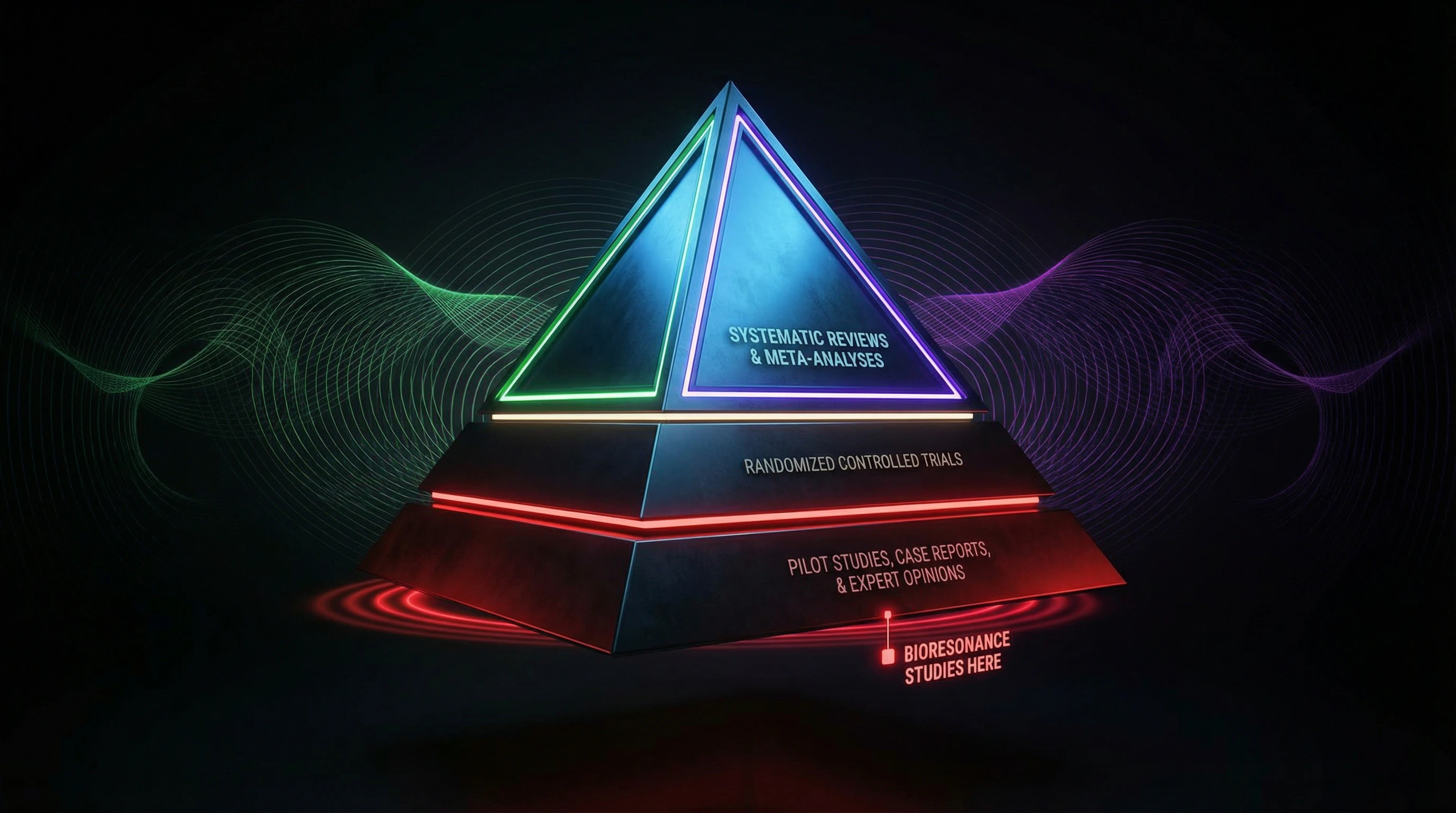
All mentioned bioresonance studies are designated as "PILOT study" (S002). Pilot studies by definition have small sample sizes and are designed to test feasibility, not to prove efficacy.
None have reached the level of full-scale randomized controlled trials (RCTs) with adequate statistical power. For comparison: antidepressant studies include hundreds or thousands of patients in multicenter Phase III RCTs.
| Study Type | Sample Size | Evidence Level | Bioresonance for Depression |
|---|---|---|---|
| Pilot Study | 10–50 participants | IV (low) | ✓ All available |
| Phase II RCT | 100–300 participants | II (moderate) | ✗ Absent |
| Phase III RCT | 300–3,000 participants | I (high) | ✗ Absent |
| Meta-analysis of RCTs | Thousands of participants | I (high) | ✗ Impossible |
🧾 Absence of Independent Replication
The gold standard of scientific validity is independent replication of results. The search revealed no systematic reviews or meta-analyses of bioresonance therapy for depression, indicating insufficient quality studies for evidence synthesis.
When results aren't replicated by independent laboratories, it doesn't mean the method is ineffective—it means its efficacy remains unknown. Science requires repeatability, not faith.
🔎 Methodological Red Flags in the Practitioner Survey
Study S002, demonstrating 99% practitioner conviction, contains critical limitations. This is an opinion survey, not a measurement of objective outcomes.
- Selection Bias
- The sample consists exclusively of resonance therapy practitioners—people financially and psychologically invested in the method's success (S002).
- Acknowledged Gaps in Experience
- 42% of participants had no experience treating visual disorders, 69.7% had none with nail lesions, 40% with solid tumors (S002). Yet the method is positioned as universal.
- Absence of Control Group
- No comparison with placebo, standard treatment, or no treatment.
🧪 The Specificity Problem: When a Method "Treats Everything," It Treats Nothing
The claim that one method is effective for smoking, obesity, depression, allergies, metabolic disorders, and mental illnesses (S002) should trigger skepticism. These conditions have radically different etiologies.
- Smoking—behavioral addiction with neurochemical component (nicotinic receptors).
- Allergies—immune system dysregulation (IgE-mediated reactions). See detailed analysis of bioresonance for allergies.
- Depression—disruption of neurotransmission and neuroplasticity.
A method that supposedly affects all these mechanisms through "electromagnetic information processing" either possesses an incredibly fundamental mechanism of action (which should have revolutionized biology) or has no specific action at all.
⚠️ False Analogy with Transcranial Magnetic Stimulation
The argument about parallels with TMS (S002) is a classic false analogy. TMS uses powerful, focused magnetic pulses (1.5–2 Tesla) to induce electrical currents in specific cortical areas, causing measurable neuronal depolarization.
Bioresonance therapy specifies neither the strength of impact, nor target structures, nor measurable physiological changes. Claiming both methods work because both use "electromagnetic fields" is equivalent to claiming homeopathy works because both it and intravenous infusions use "water." For more on digital packaging of such methods, see the analysis of bioresonance in 2025.
🧬 Absence of Long-Term Outcome Data
None of the cited studies provide data on long-term outcomes (6–12 months), relapse rates, or functional recovery. For depression, these metrics are critically important: short-term mood improvement may result from placebo effect, regression to the mean, or natural disease course.
Absence of evidence is not evidence of absence. But absence of attempts to obtain evidence after twenty years of method application is an eloquent signal.
Mechanism of Action or Mechanism of Delusion: Why "Electromagnetic Body Information" Explains Nothing
The central problem with bioresonance therapy is the absence of a plausible, testable mechanism of action. The term "processing electromagnetic information of the human body" sounds scientific but has no operational definition in physiology. More details in the Reality Check section.
🔬 What Is "Electromagnetic Body Information" in Terms of Measurable Quantities
The human body does generate electromagnetic fields—this is the basis of ECG (electrical activity of the heart) and EEG (electrical activity of the brain). However, these fields have specific characteristics: frequency, amplitude, spatial distribution.
EEG records oscillations in the 0.5–100 Hz range with amplitudes of 10–100 microvolts. To "process" this information for therapeutic purposes, four steps must be completed:
- Specify which parameters are being measured
- Explain how measured parameters relate to the pathophysiology of depression
- Describe what intervention is applied and how it modifies these parameters
- Demonstrate that the modification leads to clinical improvement
None of these steps have been completed in the bioresonance literature (S002, S003).
🧩 The Causality Problem: Correlation, Confounders, and Natural Course
Even if patients report improvement after bioresonance therapy, this does not prove causation. Depression has an episodic course—most episodes of mild to moderate depression spontaneously resolve within 3–6 months without treatment.
Regression to the mean: patients seek help at their worst moment, and any subsequent improvement may be mistakenly attributed to the intervention. Controlling for this effect requires a placebo-controlled design with sufficient statistical power—precisely what bioresonance studies lack.
🧷 Nonspecific Factors: Attention, Ritual, and Therapeutic Alliance
Any therapeutic interaction includes powerful nonspecific factors: practitioner attention, procedural ritual, patient expectations, therapeutic alliance. Studies of placebo effects in depression show that up to 30–40% of patients respond to placebo in short-term trials.
Bioresonance therapy, with its high-tech equipment, electrodes, and "scientific" terminology, creates ideal conditions for maximizing the placebo effect (S004). The high conviction of practitioners amplifies this effect through mechanisms of expectation and nonverbal communication.
| Factor | Bioresonance Therapy | Evidence-Based Methods (TMS, Antidepressants) |
|---|---|---|
| Specific Mechanism | Not defined | Neurotransmitter modulation / magnetic cortical stimulation |
| Side Effects | Absent | Headaches, nausea, seizure risk |
| Placebo Control | Rarely used | Standard study design |
| Regression to Mean Effect | Not controlled | Controlled by randomization |
🔁 Why Absence of Side Effects Is a Red Flag, Not an Advantage
The argument about absence of side effects seems like an advantage, but is actually indirect evidence of lack of specific biological action. In pharmacology, there's a principle: no effect without side effects.
Any intervention powerful enough to alter the pathophysiology of depression will have side effects, because biological systems are interconnected. Even TMS, despite its localized application, causes headaches, discomfort at the stimulation site, and seizure risk (S005). A method that "treats" without any side effects most likely exerts no specific biological effect at all.
For more on how digital packaging masks physical impossibility, see the analysis of the bioresonance market in 2025.
Conflicts of Interest and Uncertainties: Where Sources Diverge and What They Conceal
Critical analysis of the literature reveals not only weak evidence but also patterns characteristic of pseudoscience.
🕳️ Geographic and Linguistic Isolation of Research
A significant portion of bioresonance literature is published in journals with limited impact factors or in regional publications. Source (S002) — a study conducted exclusively in Turkey, published in the Turkish Journal of Traditional and Complementary Medicine.
The absence of research from leading academic centers in the USA, UK, Germany, or Scandinavia (where methodological standards are most rigorous) is a warning sign. This doesn't mean Turkish researchers are less competent, but geographic isolation makes independent verification and replication of results difficult. More details in the Media Literacy section.
When evidence concentrates in one region and isn't replicated in centers with stricter quality control, it indicates a systemic problem: either methodological or related to financial incentives.
📊 Absence of Protocol Registration and Selective Publication of Results
None of the cited studies mention pre-registration of protocols in clinical trial registries (ClinicalTrials.gov, ISRCTN). This opens the door to publication bias: studies with negative results remain unpublished, creating a false impression of efficacy.
In evidence-based medicine, pre-registration of protocols specifying primary and secondary outcomes is the standard for preventing HARKing (hypothesizing after results are known).
- The study is registered before data collection begins, specifying the primary outcome.
- Results are published regardless of whether they confirmed the hypothesis.
- Absence of registration allows researchers to change hypotheses and outcomes post hoc.
- This creates an illusion of efficacy through selective data presentation.
🧾 Conflicts of Interest: Who Funds Bioresonance Research
Sources don't disclose research funding information. Given that bioresonance therapy is a commercial service requiring expensive equipment (Mora Nova devices and analogs), there's a potential conflict of interest.
Equipment manufacturers have an interest in publishing positive results. Lack of transparency regarding funding and conflicts of interest violates scientific publication standards (ICMJE guidelines).
| Transparency Element | Evidence-Based Medicine Standard | Status in Bioresonance Literature |
|---|---|---|
| Funding Disclosure | Mandatory | Absent |
| Protocol Registration | Mandatory | Absent |
| Conflict of Interest Declaration | Mandatory | Absent |
| Independent Verification of Results | Standard | Not Conducted |
🔎 Omissions in Practitioner Survey: What Wasn't Measured
Study (S002) measures practitioners' beliefs but not objective patient outcomes. Questions weren't asked about the percentage of patients who didn't respond to treatment, relapse rates, comparison with control groups receiving standard treatment, or use of validated depression scales (HAM-D, BDI-II).
This means the study measures subjective perception of efficacy, not efficacy itself. Practitioners who've invested money in equipment and reputation have a motive to overestimate results.
- Publication bias
- Systematic error where only studies with positive results are published. Creates a false impression of method efficacy by concealing failures.
- HARKing (Hypothesizing After Results are Known)
- Formulating hypotheses after obtaining results. Allows researchers to present random findings as planned discoveries, increasing the probability of false-positive results.
- Conflict of Interest
- Financial or professional stake of a researcher in a particular outcome. Without disclosure of conflicts, it's impossible to assess study reliability.
Compare this with the approach of major medical centers, where every study undergoes independent review and is registered in advance.
🌐 Why Bioresonance Therapy Remains on the Periphery
Absence of registration in clinical trial registries, geographic isolation of publications, lack of conflict of interest disclosure, and omissions about methodological limitations — these aren't random deficiencies. These are patterns that systematically prevent independent verification and replication of results.
When a method can't be independently verified, it remains in the realm of belief, not science. This doesn't mean bioresonance therapy is ineffective — it means we don't know if it's effective, and the structure of the evidence base doesn't allow us to find out.
Absence of evidence is not evidence of absence. But absence of attempts to obtain evidence — that's a red flag.