
What the "Body Toxin Buildup" Concept Actually Promises — and Why Medicine Doesn't Recognize This Term
The concept of "body toxin buildup" claims that harmful substances — "toxins," "poisons," "waste products" — accumulate in the body, cannot be eliminated naturally, and require special cleansing procedures. Proponents link this to chronic fatigue, headaches, skin problems, excess weight, and poor mood. More details in the Pseudomedicine section.
Critically important: this term does not exist in scientific medicine. The International Classification of Diseases (ICD-10 and ICD-11) contains no such diagnosis. When dealing with actual intoxication — poisoning by a specific substance (lead, mercury, carbon monoxide, alcohol) — medicine uses precise terms with descriptions of mechanism of action, blood concentration, specific symptoms, and treatment protocols.
🧩 Semantic Ambiguity as a Defensive Mechanism
Detox proponents never provide a precise definition of "toxins." These could be "metabolic byproducts," "heavy metals," "pesticides," "preservatives," or simply "all the bad stuff." This vagueness makes the concept unfalsifiable: any symptom is explained by "toxin buildup," any improvement by successful "cleansing."
In real toxicology, every substance has clear characteristics: chemical formula, mechanism of action, half-life, target organs, threshold concentrations. Lead accumulates in bones and is measured through blood analysis; its toxic effect on the nervous system is well studied. But the "toxins" from detox advertising cannot be analyzed this way — because they're not specific substances, but a marketing abstraction.
🔬 What Actually Happens to Real Toxins: The Physiology of Detoxification
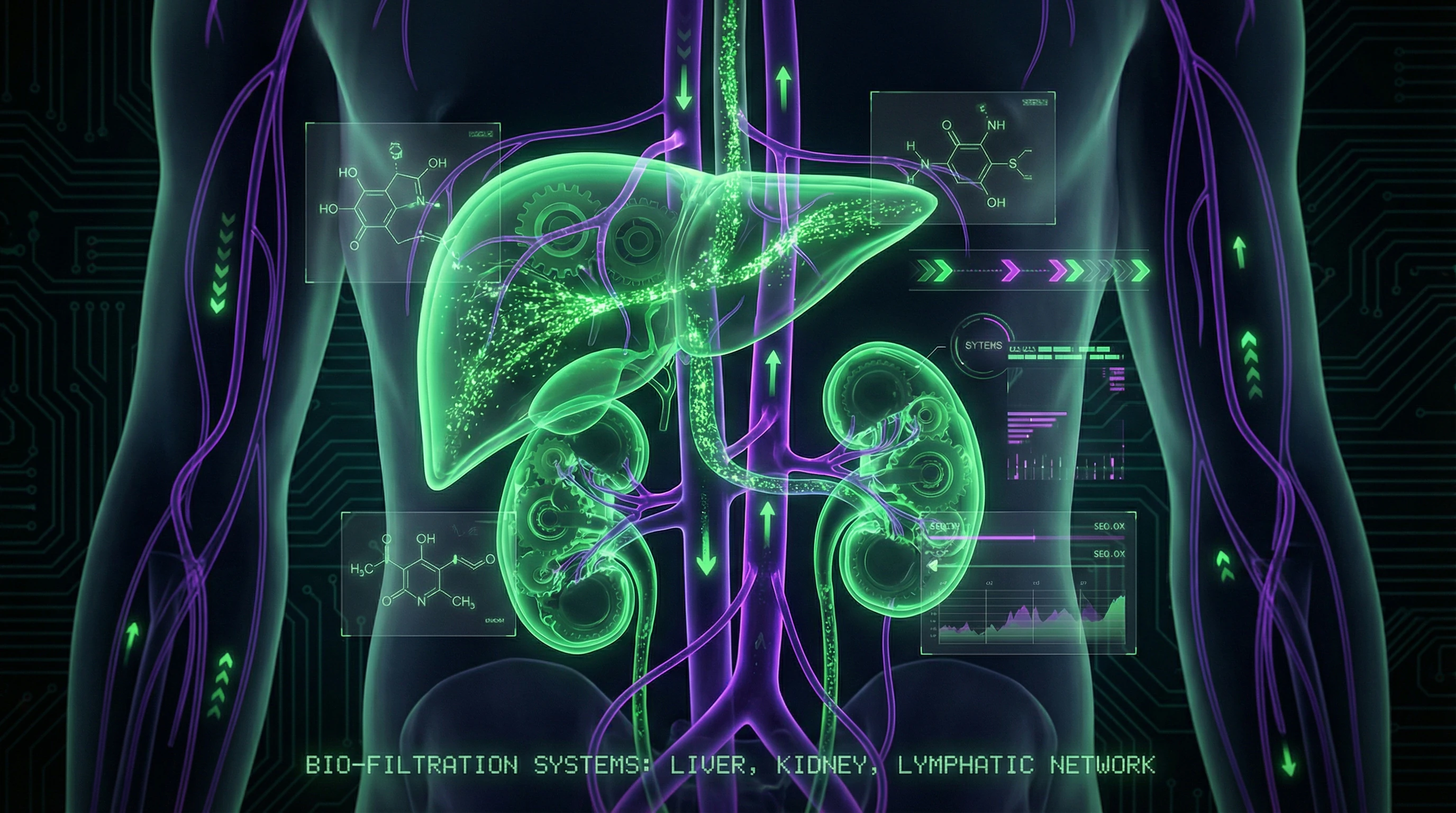
The body possesses a highly efficient multi-level detoxification system. The liver contains cytochrome P450 enzyme systems that convert fat-soluble toxins into water-soluble metabolites for elimination — this occurs in two phases: oxidation/reduction (Phase I) and conjugation with glutathione, sulfates, and glucuronic acid (Phase II).
- Kidneys
- Continuously filter blood, removing water-soluble metabolic waste and foreign substances.
- Lymphatic System
- Collects interstitial fluid and transports it for filtration.
- Intestines, Lungs, Skin
- Participate in eliminating various substances.
These systems work continuously, automatically, and require no "activation" by juices or enemas.
⚙️ Boundaries of Applicability: When Detoxification Is Actually Needed
Medical detoxification is a real procedure for specific clinical situations: acute poisoning by a known toxin, drug overdose, alcohol or substance dependence, kidney failure (hemodialysis), heavy metal poisoning (chelation therapy). Specific antidotes, extracorporeal detoxification methods, and supportive therapy are used — all under strict medical supervision.
| Medical Detoxification | Commercial Detox |
|---|---|
| Treats diagnosed condition | Creates illusion of problem |
| Preliminary tests and diagnostics | No preliminary testing |
| Medical supervision and monitoring | No medical oversight |
| Specific antidotes and methods | Universal "cleansing" programs |
Commercial detox programs are offered to healthy people without diagnosed intoxication. This is a fundamental distinction: medical detoxification treats a specific condition; commercial detox sells the illusion of a solution.
Steel Man Version of the Argument: Seven Most Compelling Arguments from Detox Proponents
Before examining the evidence base, it's necessary to present the arguments of detox proponents in their strongest form. This is the "steel man" principle—the opposite of a straw man. Only by refuting the strongest versions of arguments can critical analysis be considered complete. More details in the section Bioresonance Therapy.
⚠️ First Argument: The modern environment contains an unprecedented quantity of synthetic chemicals
Detox proponents point out that 21st-century humans are exposed to tens of thousands of synthetic substances that didn't exist in our species' evolutionary history: pesticides, plasticizers, industrial pollutants, food additives, pharmaceutical drugs. Research indeed finds traces of these substances in blood, urine, and adipose tissue in virtually all residents of developed countries.
Isn't it logical that the body needs help eliminating this chemical burden? This argument contains a factual core: we are indeed exposed to numerous anthropogenic substances. However, it makes a logical leap from "substances are present" to "they accumulate in dangerous quantities" and then to "commercial detox products help eliminate them." Each of these transitions requires evidence that is typically absent.
- Substances detected in the body → assumption of danger
- Danger assumed → conclusion about need for elimination
- Need for elimination → commercial products solve this
🧩 Second Argument: People report feeling better after detox programs
Millions of people claim they feel better after detox: more energy, clearer skin, better digestion, sharper thinking. Are all these testimonials simply self-deception?
Subjective reports about well-being are an important but insufficient type of evidence. They're subject to numerous biases: placebo effect, expectation effect, regression to the mean, lifestyle changes.
Detox programs often include abstaining from alcohol, more sleep, more water—factors that improve well-being on their own. People remember successes and forget failures. To establish causation, controlled studies with comparison groups are needed.
🔬 Third Argument: Some substances really do accumulate in the body
Heavy metals (lead, mercury, cadmium), persistent organic pollutants (dioxins, PCBs), and certain pesticides have long half-lives and can accumulate in adipose tissue and bones. This is scientific fact.
Don't detox programs help accelerate elimination of these substances? Yes, some substances accumulate. But the question is whether their concentrations reach toxic levels in ordinary people, and whether commercial detox products can affect their elimination. For most people, concentrations are significantly below toxicity thresholds.
Methods that actually accelerate heavy metal elimination (such as chelation therapy) are medical procedures with indications, contraindications, and side effects—not detox juices.
⚠️ Fourth Argument: Traditional medical systems have used cleansing for thousands of years
Ayurveda, traditional Chinese medicine, European humoral medicine—all included practices of bodily cleansing. Does millennia of experience across multiple cultures mean nothing?
- Appeal to tradition
- Logical fallacy: long history of use doesn't prove effectiveness. Bloodletting, trepanation, mercury preparations were used for centuries and proved ineffective or harmful under scientific scrutiny.
- Outdated physiological concepts
- Traditional notions of "cleansing" were based on humoral theory and the concept of "qi"—they don't correspond to modern understanding of biochemistry and anatomy.
🧠 Fifth Argument: Detox programs include beneficial lifestyle changes
Most detox programs recommend drinking more water, eating more vegetables and fruits, abstaining from alcohol and processed foods, getting more sleep, engaging in physical activity. All these recommendations are beneficial and scientifically supported.
This is a "stolen base" argument. Yes, these recommendations are beneficial—but they have nothing to do with the specific concept of "eliminating toxins." You can follow all these recommendations without buying detox products and without believing in toxic buildup. The problem is that the detox industry appropriates credit for the effects of general healthy habits, attributing them to their specific products.
🔎 Sixth Argument: Official medicine ignores prevention and functional disorders
Critics point out that conventional medicine focuses on treating diseases rather than prevention and health optimization. Detox programs fill this niche, helping people feel better before a diagnosable disease develops.
This is a false dichotomy. Evidence-based medicine actively engages in prevention: vaccination, cancer screening, risk factor control, nutrition and physical activity recommendations.
The problem isn't that medicine ignores prevention, but that the detox industry offers unproven methods under the guise of prevention. If a method lacks proven effectiveness, it doesn't become useful just because it's positioned as "preventive."
⚙️ Seventh Argument: Absence of evidence doesn't mean evidence of absence of effect
Detox proponents might say: "Yes, there are no large randomized studies. But that doesn't prove detox doesn't work—it's just understudied." This is a philosophically correct statement, often used in defense of alternative methods.
Formally this is true, but practically useless. By this logic we can't reject anything—from homeopathy to astrology—until we conduct an infinite number of studies. In reality, the burden of proof lies with those claiming a method's effectiveness.
If after decades of commercial use and billions in revenue the industry can't provide quality evidence, that itself is informative. Moreover, for many detox methods there are studies—and they show lack of effect or even harm. Liver and kidney detox remains marketing, not medicine.
What Systematic Reviews and Meta-Analyses Show: The Evidence Base for Detox Claims
Systematic reviews and meta-analyses represent the pinnacle of the evidence hierarchy in medicine. They synthesize results from multiple studies, assess quality, and draw generalized conclusions. For more details, see the section Myths About Psychosomatics.
When it comes to detox programs, the picture is unambiguous: there is no quality evidence of effectiveness.
🧪 Systematic Review Methodology: How Evidence Quality Is Assessed
A systematic review is a strictly structured process with predetermined study inclusion criteria, systematic database searches, bias risk assessment, and data extraction following a standardized protocol (S001, S005, S009).
Meta-analysis combines quantitative results from multiple studies to obtain a summary effect estimate.
- GRADE System
- Assesses evidence quality based on study design, risk of bias, consistency of results, directness of evidence, and precision of estimates (S005). Randomized controlled trials (RCTs) start with high quality, observational studies with low quality.
📊 Absence of Quality Research on Detox Programs: A Systematic Gap in the Literature
When researchers attempt to conduct systematic reviews of commercial detox program effectiveness, they encounter a fundamental problem: quality studies are virtually nonexistent.
Most publications on detox are descriptions of the body's natural detoxification mechanisms, studies of medical procedures for specific poisonings, or low-quality uncontrolled observations.
- Absence of control group — all participants receive the intervention, no comparison with placebo or no treatment
- Small sample size — 10–20 people
- Lack of randomization and blinding
- Subjective outcomes without objective measurements
- Conflict of interest — study funded by manufacturer
- Absence of long-term follow-up
🔬 What Detox Studies Measure — and Why These Measurements Are Incorrect
Many studies of detox products measure surrogate markers that have no proven connection to clinically significant outcomes. For example, they measure "antioxidant" levels in blood after consuming detox juice.
Increased blood antioxidant levels prove neither the presence of prior "oxidative stress" nor the clinical benefit of this increase. This is a classic endpoint substitution error.
Another example: measuring substances in urine or feces after a detox program and interpreting their presence as "toxin elimination." But these substances would be excreted without the program — this is normal excretory system function.
To prove accelerated elimination, you need a control group and measurement of the elimination rate of a specific substance, not just confirmation of its presence in excreta.
🧬 Detoxification Biomarkers: What Can Be Measured and What It Means
Real biomarkers of detoxification system function exist: cytochrome P450 enzyme activity, glutathione levels, glutathione-S-transferase activity, oxidative damage markers (malondialdehyde, 8-hydroxydeoxyguanosine), concentrations of specific toxins in blood or urine.
These markers are used in toxicological research and in diagnosing real intoxications. The problem is that commercial detox programs rarely measure these markers before and after intervention under controlled conditions.
| Measurement Scenario | What It Shows | Clinical Significance |
|---|---|---|
| Increased glutathione with normal baseline level | Biomarker change | Not proven |
| Changes within normal variability | Natural fluctuations | Not significant |
| Absence of control group | Unknown whether the same would occur without intervention | Cannot be assessed |
📊 Systematic Review of Detox Diet Studies: Conclusions from Independent Researchers
Several independent research groups have attempted to systematically assess evidence for detox diet effectiveness. The general conclusion: low-quality evidence, high risk of bias, absence of convincing data on benefits.
Most studies do not meet minimum quality standards for inclusion in meta-analysis. Notably, detox product manufacturers, with multi-billion dollar revenues, do not fund quality independent research on their products.
This contrasts with the pharmaceutical industry, which, despite all its problems, is required to conduct RCTs for drug registration. Detox products are sold as dietary supplements or food products, allowing them to bypass efficacy proof requirements.
The connection between the toxin buildup myth and detox product marketing becomes obvious when analyzing this asymmetry: high sales, low evidence requirements, absence of independent research. This is not coincidence, but a structural feature of the supplement and wellness industry market.
For comparison: the liver and kidneys have proven mechanisms for cleansing the body, but these mechanisms work constantly and do not require commercial interventions. When real detoxification is needed — in poisoning, overdose, toxin accumulation — medical procedures with proven effectiveness are used, not commercial detox programs.

Mechanisms of Delusion: Why the Toxin Buildup Concept Is So Convincing to Millions
The toxin buildup myth thrives not because it's true, but because it perfectly exploits features of human thinking. Understanding these cognitive mechanisms helps explain why rational arguments are often powerless against detox marketing. Learn more in the Cognitive Biases section.
⚠️ Cognitive Bias Number One: Illusion of Control Over an Invisible Threat
The toxin buildup concept offers a simple explanation for complex and frightening phenomena: poor health, chronic symptoms, fear of disease. Instead of multiple factors (genetics, lifestyle, stress, age, randomness) — one understandable cause: "toxins." And critically, this cause is controllable: you can "cleanse yourself."
The illusion of control is a powerful psychological need. People prefer the feeling that they're taking action, even if the action is ineffective, over a state of helplessness in the face of real complexity.
When a doctor says "your fatigue may be related to lack of sleep, stress, and a dozen other factors," it sounds honest but helpless. When a detox consultant says "your body is clogged with toxins, here's a cleansing protocol," it sounds like an action plan.
🔄 Cognitive Bias Number Two: Confirmation and Selective Attention
After a person starts a "detox," their brain activates a confirmation filter. Health improved — the detox is working. Got worse — it's a "healing crisis" (another marketing ploy). Nothing changed — the body is "cleansing slower than expected."
- Any improvement is interpreted as a result of the detox
- Any deterioration is explained by a "healing crisis" or insufficient protocol
- Absence of changes becomes proof of the need for more intensive treatment
- Coincidences (seasonal improvements, placebo, natural recovery) are attributed to the intervention
This isn't lying — it's the work of a normal human brain that seeks patterns and causal relationships even where they don't exist.
🎭 Cognitive Bias Number Three: Social Proof and Tribal Belonging
Detox communities create a sense of belonging to a group of the "enlightened" who "know the truth that Big Pharma is hiding." This activates deep social instincts: being part of a tribe, trusting group members more than outsiders.
When a person joins a detox community, they're not just buying a product — they're buying an identity and social status within a group of like-minded people.
Criticism of detox is perceived not as a scientific argument, but as an attack on the group to which the person belongs. Defending the idea becomes defending one's social position.
💰 Cognitive Bias Number Four: Investment and Cost Justification
A person has spent money on a detox program, supplements, consultations. Now their brain works to justify these expenses: "This can't be for nothing, so it must be working." The more spent, the more convincing the belief in results must be.
| Mechanism | How It Works | Result |
|---|---|---|
| Cognitive dissonance | Conflict between action (spent money) and belief (it doesn't work) | Belief changes in favor of action |
| IKEA effect | We value what we've invested effort in | Detox seems more valuable than it is |
| Sunk cost fallacy | Past investments justify new ones | Person continues spending to "not lose what's invested" |
🧬 Why Science Is Powerless Here
Rational arguments don't work against these mechanisms because they operate at a level below rationality — at the level of psychological needs, social identity, and emotional security.
A person who believes in detox doesn't believe in the science of toxins (there isn't any). They believe in the feeling of control, in belonging to a group, in justifying their expenses. This isn't a logic error — it's the psyche at work.
Effective health communication must offer an alternative to these psychological needs, not just refute facts.
Instead of "detox doesn't work," we need to offer: a sense of control through real actions (sleep, movement, nutrition), a community of people who understand science, and an honest explanation of health's complexity without false promises.