
What is the "alkaline diet" and dietary acid load: boundaries of the concept and key definitions
The alkaline diet is based on the hypothesis that foods directly alter blood pH (normally 7.35–7.45), and that "acidic" foods (meat, grains, cheese) cause chronic metabolic acidosis that destroys bones and promotes cancer. "Alkaline" foods (fruits, vegetables, nuts) supposedly neutralize this acid and restore health. More details in the section Folk Medicine vs. Evidence-Based Medicine.
Diet proponents measure urine pH, interpreting it as an indicator of blood pH (S004). This is the first trap: urine and blood are different environments with different regulatory mechanisms.
PRAL and NEAP: how dietary acid load is assessed
Dietary acid load (DAL) is a calculated value reflecting the potential of food to generate acid or alkali during metabolism. Two main indices: PRAL (potential renal acid load) and NEAP (net endogenous acid production).
- PRAL
- Accounts for protein, phosphorus, potassium, magnesium, and calcium content in foods. High PRAL indicates a diet rich in sulfur-containing amino acids (methionine, cysteine from meat, eggs) and phosphorus, which metabolize to sulfuric and phosphoric acids (S002).
- NEAP
- Protein-to-potassium ratio. Reflects the balance between acid-forming proteins and alkaline organic potassium salts from fruits and vegetables (S007).
Urine pH vs blood pH: concept substitution
The key error of the alkaline diet is equating urine pH with blood pH. The kidneys regulate acid-base balance by excreting excess acid or alkali in urine.
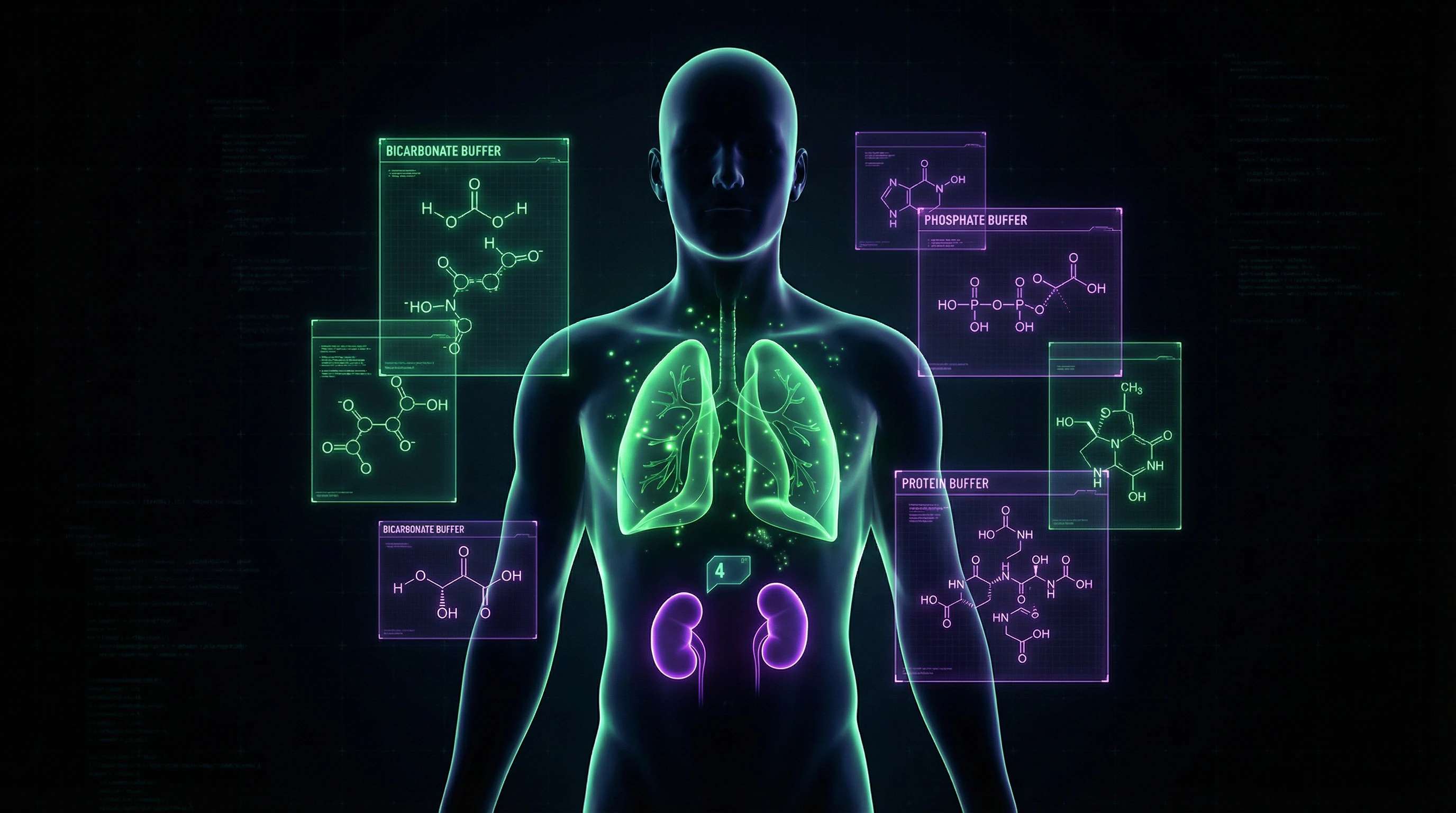
Urine pH can fluctuate from 4.5 to 8.0 depending on diet, hydration, and time of day, but blood pH remains in the narrow range of 7.35–7.45 thanks to buffer systems (bicarbonate, phosphate, protein) and respiratory compensation (CO₂ elimination through lungs).
A change in blood pH of even 0.1 units causes acidosis or alkalosis—conditions requiring medical attention (S004). Ordinary food cannot cause such a shift.
Metabolic acidosis vs "diet-induced acidification"
Metabolic acidosis is a clinical condition where blood pH drops below 7.35 due to acid accumulation (lactate in shock, ketones in diabetes) or bicarbonate loss (diarrhea, kidney failure). This is an acute or chronic disease diagnosed by blood gases, not by diet.
| Parameter | Metabolic acidosis (disease) | "Diet-induced acidosis" (hypothesis) |
|---|---|---|
| Blood pH | < 7.35 (critical deviation) | 7.35–7.45 (normal) |
| Bicarbonate | Decreased (< 15 mEq/L) | Lower end of normal (presumably) |
| Diagnosis | Blood gases, clinical symptoms | Not confirmed in healthy people |
| Mechanism | Systemic disease | Supposedly activates osteoclasts to release calcium from bones |
The concept of "diet-induced low-grade metabolic acidosis" suggests that high DAL creates subclinical acidosis that supposedly activates osteoclasts to release alkaline calcium salts from bones. However, in healthy people with normal kidney function, this mechanism is not confirmed (S006).
Steelman Arguments: Five Strongest Cases for the Alkaline Diet and Their Source Data
To honestly evaluate the concept, let's examine the most compelling arguments from alkaline diet proponents in their strongest formulation—not caricatured versions, but those grounded in actual research and physiological mechanisms. More details in the section Folk Medicine vs Evidence-Based Medicine.
🔬 Argument 1: High DAL Correlates with Increased Urinary Calcium Excretion
Numerous short-term studies show that diets high in protein and low in potassium increase urinary calcium excretion. A meta-analysis of randomized controlled trials (RCTs) confirmed: acidic diets significantly increase calcium excretion (standardized mean difference SMD = 0.47, p < 0.00001) and net acid excretion (NAE; SMD = 2.99, p = 0.003) (S003).
Mechanism: sulfuric acid from metabolism of sulfur-containing amino acids reduces calcium reabsorption in renal tubules, increasing its loss. This is an observed fact not disputed by critics.
🧪 Argument 2: Epidemiological Studies Link High NEAP with Fracture Risk in Women
Some cohort studies have found an association between high NEAP and increased fracture risk. For example, in a 2022 meta-analysis, the highest NEAP quartile was associated with a 28% increase in fracture risk (relative risk RR = 1.28, 95% CI: 1.12–1.47) compared to the lowest quartile (S001, S002).
These are observational data, but they encompass tens of thousands of participants and years of follow-up.
📊 Argument 3: High NEAP Associated with Lower Bone Mineral Density (BMD) in Spine and Hip
The same meta-analysis showed that the highest NEAP quartile was associated with lower BMD in the femur (weighted mean difference WMD = −0.01 g/cm², 95% CI: −0.02 to −0.00) and spine (WMD = −0.02 g/cm², 95% CI: −0.03 to −0.01) (S001, S002).
While absolute differences are small, they are statistically significant and may accumulate over decades.
🧬 Argument 4: Alkaline Supplements (Potassium Citrate, Bicarbonate) Improve Bone Metabolism Markers
RCTs with alkaline supplements (potassium citrate, sodium bicarbonate) showed reduced markers of bone resorption (CTX, NTX) and increased markers of bone formation (osteocalcin, PINP). A 2022 meta-analysis found that alkaline supplements significantly reduced CTX (SMD = −0.28, p = 0.02) and increased osteocalcin (SMD = 0.35, p = 0.04) (S003).
- Reduced bone resorption markers indicate slowed bone tissue breakdown
- Increased bone formation markers suggest activated restoration
- Effects observed in short-term RCTs, but long-term fracture data are absent
🧾 Argument 5: Chronic Kidney Disease (CKD) and Metabolic Acidosis: Proven Benefits of Alkaline Supplements
In patients with CKD stages 3–5, the kidneys' ability to excrete acid is impaired, leading to chronic metabolic acidosis (blood bicarbonate < 22 mmol/L). RCTs have shown that alkaline supplements (sodium bicarbonate, fruits and vegetables) slow CKD progression, reduce risk of end-stage renal disease, and improve bone metabolism (S008).
This is a clinically significant effect recognized by nephrologists. Alkaline diet proponents extrapolate these data to healthy individuals, suggesting that even subclinical acidosis is harmful.
Evidence Base: What Systematic Reviews from 2022–2025 Show About the Link Between DAL and Bones, Fractures, and Blood pH
The complete evidence picture includes contradictions, limitations, and results that do not support the alkaline diet hypothesis. More details in the Alternative Oncology section.
📊 2022 Meta-Analysis (Frontiers in Nutrition): Contradictory Results for PRAL and NEAP
A systematic review of 55 studies found that high NEAP was associated with increased fracture risk (RR = 1.28, 95% CI: 1.12–1.47), but high PRAL showed no significant association (RR = 1.14, 95% CI: 0.96–1.35). Two DAL indices that should measure the same phenomenon produce opposite results.
The authors note high heterogeneity (I² = 82–93% for NEAP) and caution: observational data do not prove causality (S001).
🧪 2022 Systematic Review of RCTs (Current Developments in Nutrition): No Effect of Acidic Diets on BMD
A meta-analysis of 28 RCTs (n = 2,023) evaluated the impact of acidic diets and alkaline supplements on bone health. Acidic diets increased calcium excretion but did not affect bone turnover markers (CTX, osteocalcin, parathyroid hormone) or BMD.
Alkaline supplements reduced CTX and increased osteocalcin but did not affect BMD in most studies (S002).
| Intervention | Biochemical Effect | Effect on BMD |
|---|---|---|
| Acidic diets | ↑ calcium excretion, ↑ NAE | None |
| Alkaline supplements | ↓ CTX, ↑ osteocalcin | None (majority) |
Authors' conclusion: despite biochemical changes, there is no convincing evidence that acidic diets harm bones or that alkaline supplements improve BMD in healthy individuals (S003).
🧾 2012 Review (Journal of Environmental and Public Health): No Evidence of Blood pH Changes
A systematic review by Schwalfenberg analyzed the literature on alkaline diets and concluded: the kidneys and lungs tightly regulate blood pH, and diet cannot override these mechanisms (S004).
- Blood pH in healthy individuals
- 7.35–7.45 (strict range). Diet does not alter this parameter (S004).
- Alkaline diet and cancer
- No studies show that changing urine pH or diet affects cancer risk (S005).
🔎 2024 Review (Pflügers Archiv): DAL and Chronic Diseases — Weak and Inconsistent Associations
A recent review summarized data on DAL and health: the link between DAL and osteoporosis, fractures, and muscle mass remains contradictory. Most associations disappear after adjusting for protein, calcium, vitamin D intake, and physical activity (S007).
High DAL often correlates with low intake of fruits and vegetables (sources of potassium, magnesium, vitamins), rather than direct "acidification." Observed effects may result from nutrient deficiencies rather than acid load per se.
📌 2025 Meta-Analysis (Nephrology Dialysis Transplantation): Alkaline Supplements in CKD, But Not in Healthy Individuals
A meta-analysis of 23 RCTs (n = 1,340) in patients with chronic kidney disease showed that alkaline supplements significantly increase blood bicarbonate, slow the decline in glomerular filtration rate, and reduce the risk of end-stage renal disease (S008).
- Results apply only to patients with CKD and metabolic acidosis (bicarbonate < 22 mmol/L).
- No evidence that healthy individuals with normal kidney function benefit from alkaline supplements.
- Mechanism: in CKD, kidneys cannot excrete acid; alkaline supplements compensate for this defect.

The Mechanism of Misconception: Why Correlation Between DAL and Fractures Doesn't Mean Causation
Associations between high DAL (especially NEAP) and fractures don't prove that acid load destroys bones. Alternative explanations lie behind the correlation. Learn more in the Epistemology Basics section.
🧬 Confounder 1: Protein — Friend or Foe of Bones?
High NEAP correlates with high protein intake, which increases calcium excretion but simultaneously stimulates IGF-1 (insulin-like growth factor-1) secretion — critical for bone formation.
Meta-analyses show: adequate protein intake (1.0–1.2 g/kg/day) is associated with higher BMD and reduced fracture risk in older adults (S007). With calcium intake > 800 mg/day, protein doesn't increase fracture risk (S002, S007).
High DAL may be a marker of high protein intake, which protects bones rather than harms them. The effect depends on calcium sufficiency.
🔁 Confounder 2: Fruits and Vegetables — Source of Potassium or Vitamins?
Low DAL (alkaline diet) correlates with high fruit and vegetable intake, rich not only in potassium but also in vitamin K, magnesium, vitamin C, carotenoids, and polyphenols.
- Vitamin K (especially K2)
- activates osteocalcin and reduces fracture risk
- Magnesium
- necessary for vitamin D activation
- Vitamin C
- critical for collagen synthesis
All these nutrients are independently linked to bone health (S007). The protective effect may result from these components specifically, not from reduced acid load.
🧷 Confounder 3: Lifestyle and Socioeconomic Status
People with low DAL (high fruit, vegetable, nut intake) more often have higher socioeconomic status, engage in more physical activity, don't smoke, and have lower BMI.
| Factor | Impact on Fractures | Controlled in Studies? |
|---|---|---|
| Physical activity | Reduces risk independently | Rarely fully |
| Smoking | Increases risk | Often insufficiently |
| BMI | Protective effect when elevated | Often not accounted for |
| Socioeconomic status | Correlates with all above | Rarely controlled |
Most observational studies don't fully adjust for these confounders (S002, S007).
🧪 Why Do PRAL and NEAP Give Different Results?
PRAL accounts for mineral composition of food (calcium, magnesium, potassium, phosphorus), while NEAP considers only protein and potassium. NEAP correlates more strongly with protein intake and may be a marker of overall diet quality (high NEAP = high protein, low fruit/vegetable intake) rather than true acid load.
PRAL, which more accurately reflects metabolic acid load, shows no association with fractures (S001, S002). This challenges the hypothesis that acid destroys bones.
Conflicts and Uncertainties: Where the Data Contradict Each Other and Why We Can't Give a Definitive Answer
The evidence base for the alkaline diet is full of contradictions that prevent categorical conclusions. Each layer of data—from biochemistry to clinical outcomes—tells a different story. For more details, see the Scientific Method section.
Observational Studies vs RCTs
Cohort studies show an association between high NEAP and fractures, but RCTs with acidic diets or alkaline supplements do not confirm effects on BMD in healthy individuals (S003). This is a classic example where correlation is not confirmed in interventional studies.
Confounders (age, physical activity, overall diet) may explain the association in observational data but disappear in RCTs with controlled variables.
Short-Term Biochemical Effects vs Long-Term Outcomes
Alkaline supplements reduce bone resorption markers (CTX) in short-term RCTs (2–6 months) but do not improve BMD in long-term studies (1–3 years) (S003). Initial resorption reduction may be compensated by physiological adaptation, or markers simply may not reflect actual changes in bone mass.
| Time Horizon | What Changes | Clinical Meaning |
|---|---|---|
| 2–6 months | CTX ↓ (resorption marker) | Signal, not guarantee |
| 1–3 years | BMD unchanged | Marker did not predict outcome |
Effect Depends on Baseline Calcium and Vitamin D Status
Some studies show that the negative effect of high DAL manifests only with low calcium intake (< 800 mg/day) or vitamin D deficiency (< 20 ng/mL) (S002, S007). DAL is not an independent risk factor but an effect modifier of other nutrients.
- Effect Modifier
- A variable that strengthens or weakens the relationship between cause and effect. If DAL harms only with calcium deficiency, then calcium is the modifier, not DAL itself.
- Clinical Implication
- The recommendation "avoid acidic foods" is incomplete without context: for someone with adequate calcium, this may be irrelevant.
Population Heterogeneity
Most studies have been conducted in postmenopausal Caucasian women. Data for men, young adults, and other ethnic groups are limited. The effect of DAL may vary by age, sex, and genetics (polymorphisms in genes regulating acid-base balance) (S007).
- Postmenopausal women: estrogen ↓ → bone resorption ↑ → DAL may exacerbate.
- Young adults: estrogen/testosterone normal → buffering systems work more efficiently → DAL may be neutral.
- Men: limited data, but bone resorption lower → mechanism may differ.
Without stratification by sex, age, and ethnicity, any conclusion remains preliminary.
Cognitive Anatomy of the Myth: Which Thinking Errors and Persuasion Techniques Does the Alkaline Diet Exploit
Why is the alkaline diet myth so persistent despite weak evidence? Let's examine the cognitive traps and rhetorical techniques. More details in the Fact-Checking section.
⚠️ Error 1: Substitution of Thesis — Urine pH ≠ Blood pH
Diet proponents measure urine pH with test strips and interpret the result as an indicator of blood pH. This is a logical error: urine pH reflects kidney function in excreting acid, not blood pH. Acidic urine (pH 5–6) with high DAL is a sign of normal kidney function, not "body acidification" (S004), (S007).
🧠 Error 2: Appeal to Nature — "Natural = Beneficial"
The alkaline diet is positioned as the "natural" ancestral diet, rich in plant foods. However, Paleolithic diets varied greatly: from high-protein (Inuit, 70–80% calories from meat) to high-carbohydrate (tropical populations, lots of fruits and tubers). There is no single "natural" diet (S007).
Nature has no opinion on nutrition. Adaptation to environment — yes, universal recipe for health — no.
🔁 Error 3: False Dichotomy — "Acidic vs Alkaline"
Dividing foods into "acidic" (bad) and "alkaline" (good) ignores the complexity of nutrition. Dairy products have high PRAL (acidic), but are rich in calcium and protein that protect bones. Whole grains have moderate PRAL, but are rich in magnesium, fiber, and phytonutrients.
| Food | PRAL (Acidity) | Protective Nutrients | Conclusion |
|---|---|---|---|
| Milk | High | Calcium, protein | Acidic, but beneficial for bones |
| Whole grains | Moderate | Magnesium, fiber | Neutral, but nutritious |
| Leafy greens | Low | Magnesium, vitamin K | Alkaline and beneficial |
🧬 Error 4: Mechanistic Thinking Without Compensatory Mechanisms
The logic "acid → bone resorption → osteoporosis" ignores that the body is not a passive system. Kidneys increase bicarbonate reabsorption, lungs regulate CO₂, blood buffer systems maintain pH in the range of 7.35–7.45 regardless of diet.
Osteoporosis develops with calcium deficiency, vitamin D deficiency, lack of physical activity, and hormonal imbalances — not from "acidification" (S001).
💬 Error 5: Social Proof and Appeal to Authority
The alkaline diet is popularized by celebrities and "holistic doctors," creating an illusion of consensus. However, popularity does not equal evidence. Association with detox myths and techno-esotericism amplifies the effect: if a diet sounds both "scientific" and "natural," critical thinking shuts down.
- Social Proof
- If many people believe it — it must be true. In reality: the majority can be wrong, especially if information spreads through social media rather than peer-reviewed sources.
- Appeal to Authority
- "Dr. X recommends the alkaline diet." In reality: authority is relevant only within their area of expertise. An actor or athlete is not a nutritionist.
- Confirmation Bias
- People notice health improvements and attribute them to the alkaline diet, ignoring other factors (placebo, lifestyle improvements, regular eating patterns).
🎯 Why the Myth Persists
The alkaline diet exploits three cognitive weaknesses: desire for simple explanations of complex phenomena (osteoporosis, fatigue), distrust of conventional medicine, and the drive to control one's health. The diet offers all three: a simple mechanism (pH), an alternative (nature vs pharma), and action (measure pH, change diet).
The problem isn't plant-based food — it's beneficial. The problem is the false mechanism and ignoring real factors: self-testing urine pH creates an illusion of control but doesn't affect bone health or blood pH.