
Occultism and Hermeticism: Hidden Knowledge at the Intersection of Science and Mysticismλ
A study of esoteric traditions from ancient Hermeticism to modern occultism, their influence on scientific thought and transformations in the 19th-20th centuries
Overview
Hermeticism and occultism are esoteric traditions that have influenced Western thought and science for centuries. Hermeticism (texts of Hermes Trismegistus) builds a philosophical-religious system on the principle of "as above, so below" 🧩 — the correspondence between macrocosm and microcosm. Occultism encompasses alchemy, astrology, and magic; historians of science document its trace in Newton's work, whose alchemical experiments laid the foundation for theories of gravitation.
🛡️
Laplace Protocol: This material is based on academic research, including the works of Mircea Eliade and historians of science. It is important to distinguish between the historical Hermetic tradition and its modern interpretations from the 19th-20th centuries, which, according to scholars, differ significantly from the more rigorous ancient teachings.
Reference Protocol
Scientific Foundation
Evidence-based framework for critical analysis
Protocol: Evaluation
Test Yourself
Quizzes on this topic coming soon
⚡
Deep Dive
Philosophical Foundations of Hermeticism: From Ancient Texts to the Principle of Unity
Corpus Hermeticum and Ancient Sources of Wisdom
Hermeticism is based on a corpus of texts from the 2nd–3rd centuries CE, attributed to Hermes Trismegistus—a figure merging the Greek Hermes and Egyptian Thoth. This is not mysticism, but a rationalized system of esoteric knowledge: methodical study of hidden laws of the cosmos through correspondences between levels of reality.
Hermetic texts exerted significant influence on Western philosophy, especially during the Renaissance. The core teaching—treatises on the nature of the divine, cosmology, anthropology, and spiritual transformation—forms a coherent worldview.
- Historical Stratification of Hermeticism
- Early Hermetic teachings were characterized by philosophical rigor, which degraded in later 19th–20th century interpretations. The distinction between ancient Hermeticism, Renaissance reinterpretation, and modern occultism is not merely chronological, but qualitative: each layer added speculation and simplified the original principles.
The Principle of Correspondence Between Macrocosm and Microcosm as the Foundation of Hermetic Philosophy
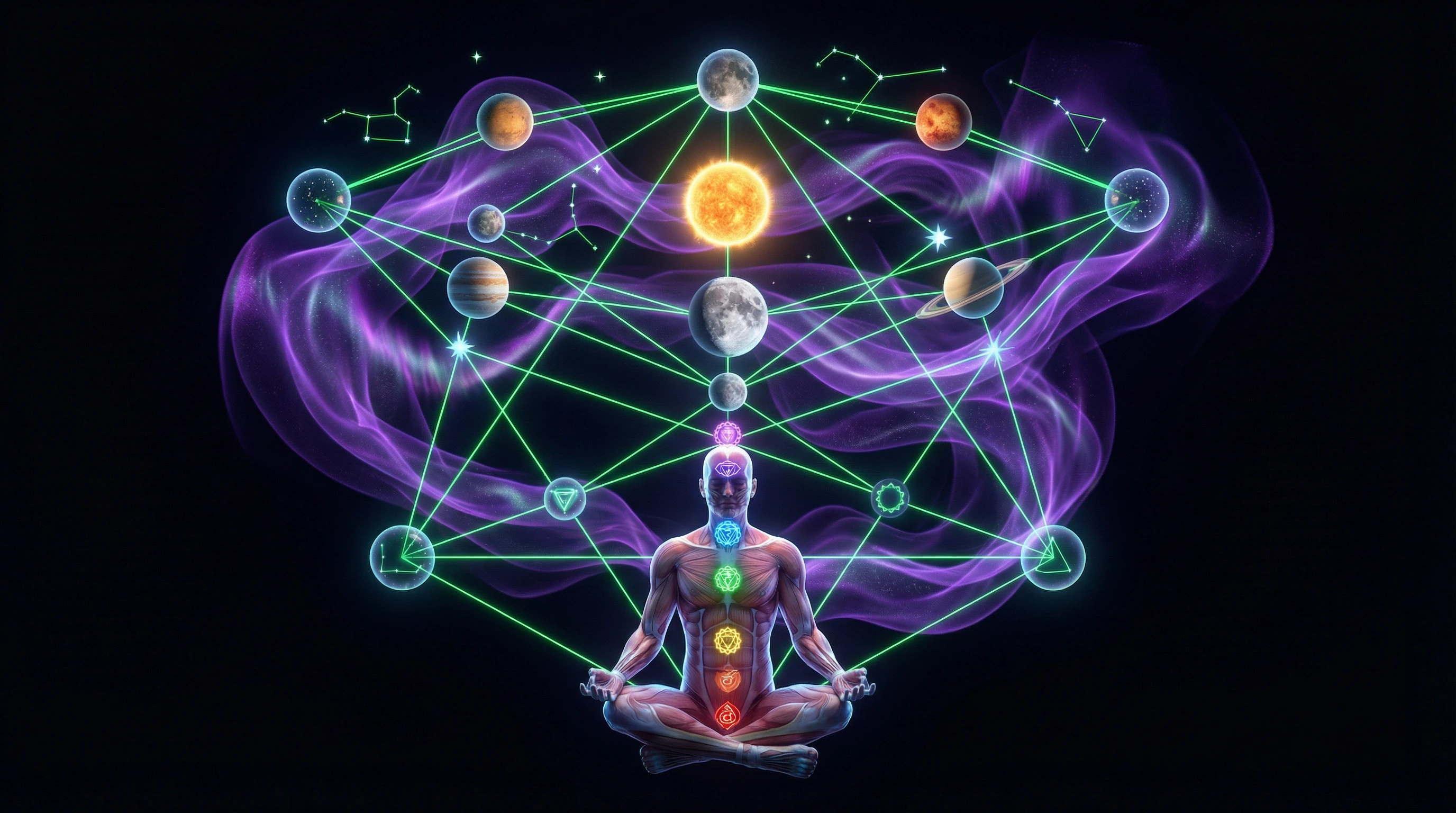
The central principle of Hermeticism: "as above, so below." The human being is a miniature copy of the universe, containing all its elements and laws. This is not a metaphor, but an assertion of structural and functional analogies between cosmic processes and internal states of consciousness.
The principle of correspondence suggests that knowledge of the cosmos is possible through self-knowledge—and vice versa. This created a theoretical foundation for alchemy, astrology, and natural philosophy, linking celestial phenomena with terrestrial processes.
Hermetic philosophy is not limited to abstraction. It offers practical application through symbols, rituals, and meditation—a path of spiritual transformation through understanding correspondences. This distinguishes it from purely theoretical systems.
| Level of Reality | Hermetic Approach | Practical Consequence |
|---|---|---|
| Cosmos (macrocosm) | Structured system of laws | Astrology, natural philosophy |
| Human (microcosm) | Reflection of cosmic principles | Alchemy, meditative practices |
| Correspondence | Analogy as a tool of knowledge | Symbolic systems, rituals |
Contemporary researchers see in this principle an attempt to create a universal explanatory model linking physical, psychological, and spiritual phenomena. The mechanism operates through analogy: if the microcosm reflects the macrocosm, then changing one's internal state should influence external events—hence the belief in the magical efficacy of rituals and meditations.
Occultism as a System of Hidden Knowledge: Boundaries and Practices
Alchemy, Astrology, and Magical Practices in the Structure of Occultism
Occultism is a system of esoteric practices encompassing alchemy, astrology, magic, and mystical traditions. Unlike Hermeticism as a philosophical-religious system, occultism covers diverse methods of working with hidden forces of nature and consciousness.
Alchemy combined practical chemical experiments with symbolic work on spiritual transformation, using metallurgical processes as metaphors for inner changes. Astrology served as a system for understanding cosmic influences on fate and character, based on the principle of correspondence between celestial and terrestrial phenomena.
- Ceremonial magic — developed by Éliphas Lévi in the 19th century; revived interest in ritual practices and symbolic systems.
- Theurgical practices — Martines de Pasqually created the Order of Knight-Masons Elect Priests of the Universe as a structured system for working with hidden laws.
- Systematization of Hermeticism — Papus (Gérard Encausse), a French physician and occultist, became a key figure in codifying modern occult knowledge.
These traditions asserted the possibility of systematic study and application of hidden laws of nature through special techniques and rituals.
Distinctions Between Occultism, Mysticism, and Esotericism
Occultism, mysticism, and esotericism are separate, though overlapping phenomena requiring methodological differentiation.
Mysticism focuses on direct personal experience of union with the divine through contemplation. Occultism assumes a rationalized approach: systematic study, symbolic systems, practical application of techniques. Esotericism is a broader term for any "inner" knowledge accessible only to initiates.
Occult traditions of the 19th–20th centuries, despite claims of continuity with ancient teachings, represent a significant departure from the more rigorous earlier Hermetic traditions, as noted by religious scholar Mircea Eliade.
Contemporary researchers emphasize the need to distinguish between academic study of these traditions and the position of practitioners: these perspectives assume different criteria for evaluating validity and significance. Occultism claims the status of an alternative yet systematic form of knowledge, which distinguishes it from spontaneous mystical experience and makes it an object of historical-philosophical analysis.
The Influence of Hermeticism on the Scientific Revolution: Newton's Case
Isaac Newton's Alchemical Research and Its Scale
Isaac Newton devoted a significant portion of his intellectual life to alchemical research—a fact long concealed in traditional histories of science. His manuscripts contain extensive alchemical notes, experiments, and commentaries on hermetic texts, demonstrating systematic study of this tradition.
Newton viewed alchemy not as primitive pseudoscience, but as a path to understanding fundamental principles of nature. His research included practical experiments with substances and study of alchemy's symbolic system as a language for describing natural processes.
It is impossible to fully understand Newton's scientific achievements without accounting for his hermetic and alchemical interests, which shaped his conceptual frameworks.
This discovery challenges the simplified narrative of purely rational development of modern science and reveals the complex interaction between esoteric traditions and the scientific method.
Hermetic Concepts in the Formation of Gravitational Theory
The concept of action at a distance, central to Newtonian gravitational theory, has parallels with hermetic notions of hidden forces and sympathetic connections between objects. The hermetic idea of an all-pervasive spirit or ether linking all parts of the cosmos may have influenced Newton's understanding of gravitational interaction.
- Hermeticism postulates the existence of invisible forces connecting the cosmos
- Newton formulates gravity as action at a distance without visible mechanism
- The conceptual foundations of the theory are rooted in natural philosophy that acknowledges hidden correspondences
- The boundary between "scientific" and "occult" knowledge proves permeable
While Newton formulated his theories in mathematical form, his conceptual foundations were partially rooted in hermetic natural philosophy. This demonstrates that in the early period of the scientific revolution, the categories of "scientific" and "occult" were significantly less separated than modern conceptions suggest.
Hermeticism as Conceptual Foundation of the Scientific Revolution
The influence of hermeticism on scientific thought is not limited to Newton's case, but represents a broader phenomenon of interaction between esoteric traditions and emerging experimental science. Researchers point to the need for revising the history of science to account for the role of alchemical, astrological, and hermetic concepts in the development of scientific theories.
Revising the history of science does not mean rehabilitating occult practices as scientific methods, but requires acknowledging the historical complexity of modern science's formation and its conceptual roots in various intellectual traditions.
This analysis shows: the scientific revolution did not emerge from a vacuum of rationality, but grew from soil where hermetic ideas about hidden forces and universal correspondences served as the conceptual framework for new theories.
The Occult Revival of the 19th Century: From Salons to Secret Orders
Éliphas Lévi and the Systematization of Ceremonial Magic
Alphonse Louis Constant, known by the pseudonym Éliphas Lévi, transformed 19th-century Western occultism into a rationalized system. His "Dogme et Rituel de la Haute Magie" (1854–1856) positioned magic as a methodical science of nature's hidden forces, rather than as mystical revelation.
Lévi synthesized Kabbalah, alchemy, and Hermeticism into a unified conceptual framework. This move reflected the era's characteristic drive to reconcile esoteric traditions with scientific worldview—magic had to appear as a discipline, not superstition.
Magic as a science of hidden forces—this is an attempt to legitimize occultism through the language of rationality, not despite it.
Papus, Martines de Pasqually, and the French Occult School
Gérard Encausse (Papus), a French physician and occultist, systematized Hermetic teaching for mass audiences through numerous organizations. Martines de Pasqually, founder of the Ordre des Chevaliers Maçons Élus Coëns de l'Univers, combined Masonic hierarchy with theurgical practices.
Both figures embodied one strategy: transform spontaneous mystical experience into structured instruction with clear hierarchies of initiation. However, scholar Mircea Eliade noted a paradox: 19th–20th century teachings proved "significantly less rigorous and convincing" than earlier Hermetic traditions.
- Organized structure (orders, degrees of initiation)
- Systematized knowledge (textbooks, doctrines)
- Mass accessibility (salons, publications)
- Paradox: audience expansion → dilution of rigor

Secret Orders and Hermetic Societies: The Structure of Esoteric Knowledge
Freemasonry and Esoteric Traditions
Freemasonry serves as a channel for transmitting Hermetic ideas into modernity through ritual practice and philosophical doctrine. The symbolic system, degrees of initiation, and concept of spiritual transformation link Freemasonry directly to Hermeticism.
Key figures of the occult revival were active Freemasons who used organizational structure to disseminate esoteric teachings. But here's the critical point: speculative Freemasonry preserves symbolic tradition, while its occult interpretations often add elements historically absent from Masonic practices.
| Type of Freemasonry | Source of Knowledge | Relationship to Hermeticism |
|---|---|---|
| Speculative | Historical tradition | Organic development of symbolism |
| Occult | Synthesis + reinterpretation | Layering of new meanings |
Theosophy, Spiritualism, and Syncretic Movements
Helena Blavatsky's Theosophical Society (1875) proposed a synthesis of Eastern and Western traditions under the guise of universal ancient knowledge. 19th-century Spiritualism, though distinct from classical Hermeticism, created a cultural context for accepting ideas about hidden forces and invisible worlds.
Modern occultism is characterized by eclecticism: combining elements from various traditions without strict adherence to historical authenticity. This isn't synthesis—it's layering without compatibility testing.
Comparative studies reveal parallels between Eastern and Western philosophical paradigms in esoteric traditions, indicating genuine cross-cultural influences. But parallels aren't proof of a single source—they're the result of convergent development.
Critical Analysis of Modern Interpretations: Degradation or Transformation
Mircea Eliade on the Degradation of Hermetic Tradition
Religious historian Mircea Eliade critically assessed modern occultism as a simplification and distortion of rigorous hermetic traditions. He pointed to the loss of philosophical depth and the replacement of systematic practice with eclectic borrowing from various sources.
This critique reflects an academic discussion about the distinction between historical hermeticism (Corpus Hermeticum and related texts) and modern occult revivals. A methodological approach requires differentiation between the study of historical traditions and the evaluation of contemporary practices claiming continuity with ancient teachings.
Degradation or transformation — not a rhetorical question, but a methodological one: we must distinguish between loss of content and its reformatting for a new cultural context.
Falsification of Ancient Teachings and the Problem of Authenticity
Researchers note the problem of "falsification" in modern occultism, where new teachings are presented as ancient traditions without historical justification. Many texts and practices attributed to classical or medieval sources are actually products of the 19th-20th centuries.
- Source verification — comparison with original documents and dating
- Distinguishing historical texts from modern reconstructions
- Acknowledging the process of tradition transformation in new cultural contexts
This problem creates methodological challenges for the academic study of esoteric traditions. The need for distinction does not mean denying the value of modern esoteric movements, but requires honesty regarding their historical roots.

Knowledge Access Protocol
FAQ
Frequently Asked Questions
Hermeticism is a philosophical-religious tradition based on texts attributed to Hermes Trismegistus. It teaches about the correspondence between the macrocosm (universe) and microcosm (human), spiritual transformation, and hidden knowledge. Hermeticism has significantly influenced Western philosophy, alchemy, and early science.
Occultism is a broader category of esoteric practices, including alchemy, astrology, magic, and various mystical traditions. Hermeticism is a specific philosophical-religious system within occultism. They overlap, but Hermeticism has a clear textual foundation in the Corpus Hermeticum.
Historians of science confirm that alchemy and Hermeticism significantly influenced Newton's theories about forces and gravity. Newton actively engaged in alchemical research, which disproves the myth of purely rational scientific development. His manuscripts show deep study of Hermetic texts and occult practices.
No, this is a common misconception. Historical evidence shows complex interaction between Hermetic thought and scientific development, especially in Newton's work. Occult traditions often claimed systematic study of nature through alternative methods. They represented a rationalized approach to esoteric knowledge, distinct from pure mysticism.
Éliphas Lévi was a 19th-century French occultist who revived interest in ceremonial magic. He became a key figure in the modern occult revival, systematizing magical practices. His works laid the foundation for many contemporary esoteric movements and secret societies.
This is the fundamental idea that the macrocosm (universe) and microcosm (human) reflect each other. The famous formula "as above, so below" expresses this concept. The principle is used to understand the connection between cosmic processes and human nature, forming the basis of alchemy and astrology.
Begin by reading the Corpus Hermeticum in a quality translation with commentary. Study the historical context of Hermeticism's development from antiquity to the Renaissance. It's important to distinguish authentic ancient texts from modern 19th-20th century interpretations, which often distort the original teachings.
Yes, Freemasonry incorporates Hermetic and esoteric elements into its symbolism and rituals. Many Masonic orders, especially of higher degrees, use Hermetic philosophy. Figures like Martines de Pasqually founded Masonic systems with explicit Hermetic content.
Eliade criticized modern 19th-20th century occultism, noting that earlier teachings were "considerably more rigorous and convincing." He pointed to the degradation of tradition and simplification of complex ancient concepts. Modern interpretations often represent a significant deviation from authentic Hermeticism.
Yes, individual study of Hermetic philosophy is possible through primary sources and academic research. However, traditionally many practices were transmitted within secret societies and orders. Modern practitioners can study meditation, alchemical symbolism, and Hermetic principles independently.
No, that's an oversimplification. Alchemy represented a complex system combining practical experiments with spiritual transformation. It included philosophical, psychological, and mystical aspects alongside material operations. Alchemical research made real contributions to the development of chemistry and medicine.
Papus (Gérard Encausse) was a French physician and occultist, a key figure in modern Hermeticism of the late 19th century. He systematized occult knowledge, founded several esoteric orders, and wrote influential works on Tarot and Kabbalah. His activities contributed to popularizing Hermetic ideas in Russia and Europe.
Yes, there are parallels and mutual influences between Western Hermeticism and Eastern philosophical systems. Comparative studies reveal similar concepts in Indian, Chinese, and Hermetic traditions. The Theosophical movement of the 19th century actively synthesized Western occultism with Eastern teachings.
Hermes Trismegistus is a legendary figure, a synthesis of the Greek god Hermes and the Egyptian Thoth, god of wisdom. Attributing texts to this mythical author gave them the authority of ancient wisdom. In reality, the Corpus Hermeticum was created in Hellenistic Egypt in the 2nd-3rd centuries CE by various authors.
Study academic research that dates and analyzes texts using scientific methods. Authentic ancient texts have historical context and philological confirmation. Many 'ancient' teachings from the 20th century are modern inventions, confirmed by the absence of manuscript tradition and anachronisms in content.
During the Renaissance, Hermeticism became a crucial intellectual movement, influencing philosophy, art, and early science. Marsilio Ficino's translation of the Corpus Hermeticum in 1463 generated enormous interest. Hermetic ideas inspired thinkers such as Giordano Bruno and Paracelsus, shaping Renaissance humanism.