 ✨ Magic and Rituals
Magic and Rituals: From Ancient Practices to Modern Diagnosisλ
Exploring magical systems and ritual practices through the lens of academic science and cultural anthropology, from ancient Egyptian temple rites to modern diagnostic methods
Overview
Magic and rituals represent complex symbolic systems that have served for millennia as mechanisms of cultural transmission and social integration. Contemporary research examines magical practices not as superstitions, but as pragmatic sign systems with real social and psychological effects. From ancient Egyptian temple rites to Slavic folk magic, from the theories of Frazer and Malinowski to modern diagnostic methods using runes and Tarot—this field unites academic rigor with practical application.
🛡️ Laplace Protocol: This section is based on peer-reviewed academic sources and recognized scientific theories. We distinguish descriptive analysis of cultural phenomena from claims of supernatural efficacy, maintaining a critical perspective when examining both historical and contemporary practices.
Reference Protocol
Scientific Foundation
Evidence-based framework for critical analysis
Protocol: Evaluation
Test Yourself
Quizzes on this topic coming soon
Sector L1
Articles
Research materials, essays, and deep dives into critical thinking mechanisms.
✨ Magic and Rituals ✨ Magic and Rituals
⚡
Deep Dive
Theoretical Foundations of Magic and Ritual: Three Scientific Paradigms
Contemporary scientific understanding of magic and ritual rests on three fundamental approaches that have reconceptualized magic as a complex symbolic system with real social and psychological functions.
Malinowski's Functional Approach: Magic as Control Mechanism
Bronisław Malinowski demonstrated through his study of the Trobriand Islanders that magic serves practical functions by providing control mechanisms in situations of uncertainty. Magical rituals are activated precisely where rational technologies prove insufficient—in deep-sea fishing, but not in the safe lagoon.
Magic does not contradict rational knowledge but complements it in specific contexts. The Trobrianders possessed practical seafaring skills but used magic as an additional psychological resource for anxiety reduction.
This model explains the persistence of magical practices even in modern societies with advanced science and technology.
Bayburin's Symbolic-Semiotic Perspective: Ritual as Sign System
Albert Bayburin developed a semiotic approach, viewing ritual as a sign system that creates and maintains cultural meanings. Rituals function as mechanisms of cultural transmission and social recognition, encoding information about statuses, boundaries, and identities.
- Semiotic Space of Ritual
- Rituals create a special space where actions acquire symbolic meanings unavailable in ordinary contexts. Their purpose is not practical results but the production of cultural meanings.
- Distinction from Functionalism
- While Malinowski saw magic as a tool for psychological control, Bayburin showed that rituals possess their own logic, independent of utilitarian goals.
Frazer's Ritual-Mythological Complex: Myth as Ritual Explanation
James Frazer proposed a theory according to which myths arise from ritual practices and serve as their explanation. Rituals are primary, myths are narrative interpretations that give them meaning and legitimacy.
| Component | Function | Connection |
|---|---|---|
| Ritual | Practical action | Embodies myth |
| Myth | Narrative framework | Explains ritual |
| Complex | Integrated system | Mutual reinforcement |
This interconnection explains the persistence of both mythological narratives and ritual forms—they support each other within a unified cultural mechanism. Frazer's model is particularly productive for analyzing calendrical rites and initiation rituals, where mythological structure clearly determines ritual sequence.
Magic in Ancient Civilizations: From Temples to Hellenism
The magical practices of ancient civilizations demonstrate remarkable continuity and structural similarity, despite geographical and temporal distance. Research into ancient Egyptian, shamanic, and Hellenistic magic reveals universal patterns and culturally-specific adaptations of magical systems.
Temple Magic of Ancient Egypt: Institutionalization of Sacred Knowledge
Ancient Egyptian magic represented a highly developed institutional system, integrated with religious and state structures. Temple priests served as professional magicians, mastering complex ritual techniques and texts, including the "Pyramid Texts" and the "Book of the Dead."
Magical practices encompassed protection of the pharaoh, maintenance of cosmic order (maat), healing, and funerary rituals. Egyptian magic was based on the concept of heka—divine power accessible through proper performance of rituals and recitation of formulas.
- Magical texts demonstrate a sophisticated symbolic system, where words, gestures, and material objects form a unified ritual complex.
- The institutionalization of magic within temple structures ensured the preservation and transmission of magical knowledge across millennia.
- The Egyptian system created a precedent for subsequent esoteric traditions.
Shamanic Practices and Their Evolution: Ecstatic Techniques of Transformation
Shamanism represents one of the oldest and most widespread forms of magical practice, based on techniques of altered states of consciousness and mediation between worlds. Shamanic practices include ecstatic journeys, healing rituals, divination, and communication with spirits.
Research shows structural similarities in shamanic traditions from Siberia to the Americas, pointing to common cognitive and cultural foundations of magical experience.
The evolution of shamanic practices demonstrates the adaptation of basic techniques to various cultural contexts and social structures. In some societies, shamanism remained an individual practice; in others, it transformed into institutionalized priestly systems.
Contemporary research reveals the neurophysiological mechanisms of ecstatic states and their therapeutic potential, confirming the functional effectiveness of shamanic techniques.
Hellenistic Magical Traditions: Syncretism and Systematization
The Hellenistic period marked an unprecedented synthesis of Egyptian, Greek, Jewish, and Near Eastern magical traditions, creating the foundation for the Western esoteric tradition. The Greek Magical Papyri demonstrate complex ritual systems combining elements from various cultures into syncretic practices.
Hellenistic magic is characterized by the systematization of magical knowledge, the creation of grimoires, and the development of theoretical justifications for magical operations. A key feature was the development of individualized practices accessible beyond temple and priestly structures.
| Period | Nature of Magic | Knowledge Bearers | Accessibility |
|---|---|---|---|
| Ancient Egypt | Temple-based, institutional | Priestly class | Limited (elite) |
| Shamanism | Ecstatic, mediatory | Selected practitioners | Community |
| Hellenism | Syncretic, systematized | Individual magicians | Expanded (written instructions) |
The magical papyri contain detailed instructions for personal use, including spells, amulet recipes, and ritual procedures. This period laid the groundwork for medieval ceremonial magic and modern occult systems, ensuring the continuity of magical traditions across millennia.
Slavic Folk Magic: Word, Action, and Calendar
Slavic magical tradition is a system of practices embedded in everyday life and the calendar cycle. Verbal formulas, ritual actions, protective techniques, and ceremonies form a unified semiotic network where each element reinforces the others.
Magic of the Word: Incantations as Performative Utterances
An incantation in Slavic culture is not merely text, but a performative utterance that changes reality through pronunciation. The structure is strict: opening, main part describing the desired result, closing seal.
Magical effectiveness depends on three factors: precision of text reproduction, observance of ritual conditions, status of the practitioner. Violation of any reduces effectiveness.
Word + Action: Multi-Level System
Incantations are never spoken in a void. They are accompanied by specific actions: tying knots, burying objects, circumambulations, fumigations, use of ritual objects.
| Component | Function | Examples |
|---|---|---|
| Verbal | Encodes intention, sets direction | Incantation, formula, invocation |
| Actional | Materializes intention, creates symbolic map | Knot, circumambulation, ablution |
| Material | Anchor for magical action | Amulet, herb, ash |
| Temporal | Synchronizes with cosmic cycles | Moon phase, time of day, day of week |
Integration of these levels creates a closed system: word sets meaning, action materializes it, object fixes it, time amplifies it.
Protective Magic: From Home to Body
Protection is the central function of Slavic magic. Home, livestock, harvest, family members are guarded from evil eye, curses, and "evil forces." Protective techniques are multi-layered.
- Material charms: amulets, talismans, embroidered symbols on clothing
- Verbal formulas: incantations, prayers, apotropaic phrases
- Ritual actions: fumigation of home, boundary circumambulation, water sprinkling
- Spatial markers: sacred corner, threshold, windows as entry points for harm
The system works on the principle of redundancy: if one level of protection fails, another activates.
Healing Magic: Diagnosis Through Magic
Illness in the Slavic paradigm often has a magical cause: evil eye, curse, taboo violation, spirit's anger. Healing magic includes diagnosis and treatment.
Modern research shows real therapeutic effects of many healing practices — not through magic, but through psychosomatic mechanisms and pharmacological properties of plants. Expectation of healing activates immune responses; herbs contain bioactive substances. The magical narrative amplifies both effects.
Healing practices include incantations for specific illnesses, ritual ablutions, use of herbs and natural materials. Diagnosis is often conducted through divination or observation of animal behavior.
Calendar Rituals: Time as Magical Resource
The Slavic calendar is structured through critical points: solstices, equinoxes, agricultural cycles, Christian holidays. Each point is a liminal period when boundaries between worlds become permeable.
Yuletide, Maslenitsa, Ivan Kupala, Harvest Festival — these are not merely holidays, but windows of magical effectiveness. During these periods rituals work more powerfully because social order weakens and cosmic forces activate.
- Winter Solstice (Yuletide)
- Boundary between old and new year, death and rebirth of the sun. Magical actions aim to ensure the return of light and fertility. Divinations are especially accurate.
- Spring Equinox (Maslenitsa)
- Transition from winter to summer, awakening of the earth. Rituals of effigy burning symbolize destruction of the old and summoning of fertility. Magic is directed toward crop protection.
- Summer Solstice (Ivan Kupala)
- Peak of solar power, maximum magical activity. Rituals include jumping over fire, searching for magical herbs, marriage divinations. Protective magic is especially intense.
- Autumn Equinox (Harvest Festival)
- Completion of harvest, preparation for winter. Rituals of thanksgiving and protection from hunger. Magic is directed toward preservation and conservation.
Calendar rituals demonstrate how magic, mythology, and social organization form a unified system. They don't merely reflect cosmic cycles — they reproduce traditional ways of life, synchronizing human activity with natural and social rhythms.
Key mechanism: folk magic works through social consensus. When the community believes in the effectiveness of a ritual and participates in it, a collective field of expectation is created that amplifies psychosomatic effects and social cohesion. Magic here is an instrument of cultural memory and social reproduction.
Divination and Diagnostic Systems: From Runes to Tarot Cards
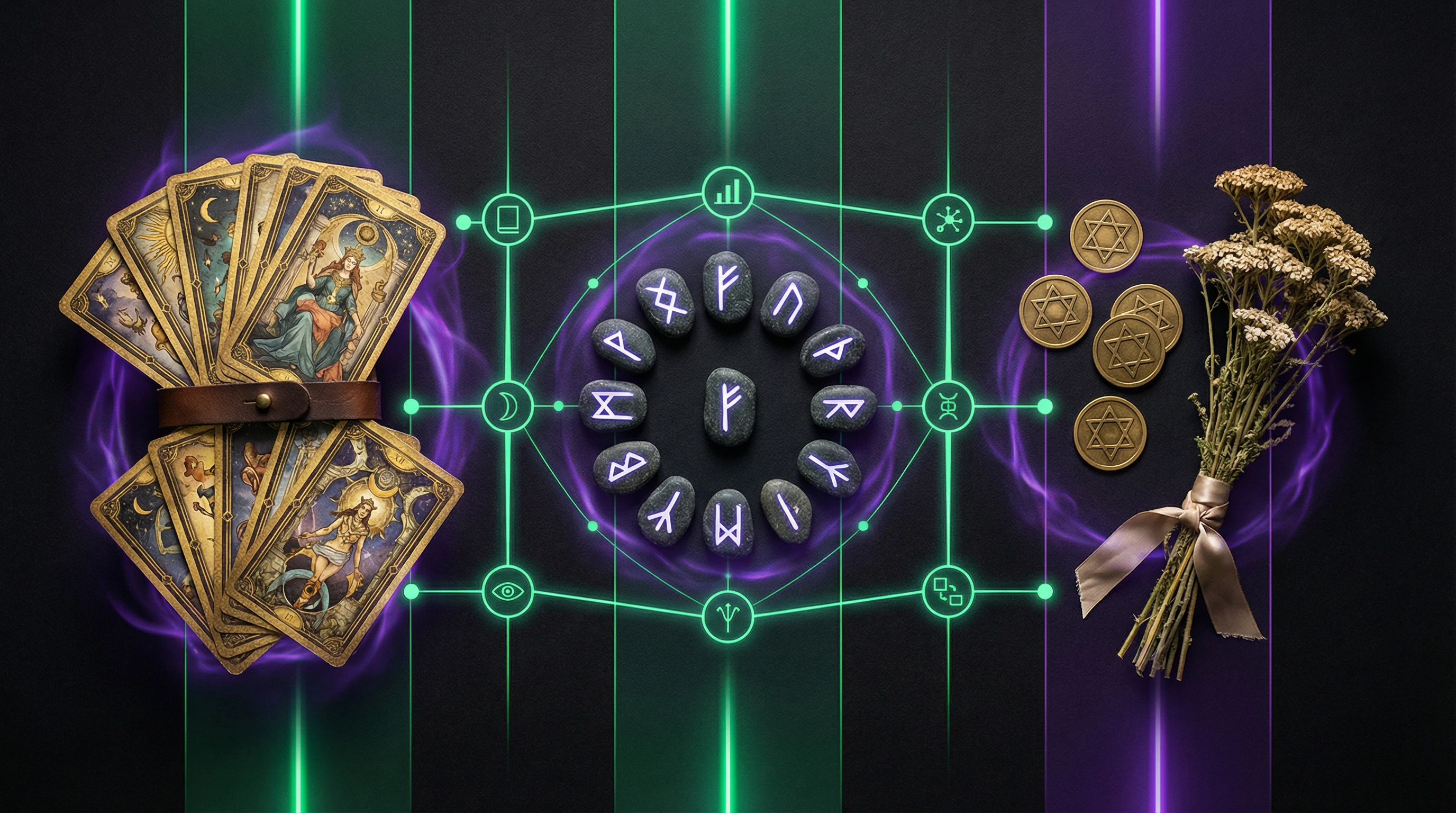
Ancient symbolic systems function as semiotic mechanisms for analyzing hidden influences. Scandinavian runes, Tarot, and Lenormand are structured sign systems, each with its own logic of interpretation.
Diagnostic magic relies on the principle of correspondences between symbols and real phenomena, translating abstract questions into concrete symbolic configurations.
Scandinavian and Witch Runes in Diagnostics
Runic systems include the Elder Futhark of 24 symbols and expanded sets of witch runes for identifying magical influences. Each rune carries multilayered meaning: phonetic, symbolic, and magical aspects.
The methodology involves analyzing rune positions, their interactions, and reversed meanings to determine the nature of influence—curses, evil eye, or energetic blockages. Witch runes focus on identifying specific magical operations and their sources.
Tarot and Lenormand in Diagnostic Practice
Tarot is a 78-card system divided into Major Arcana (archetypal principles) and Minor Arcana (everyday situations). This provides multilevel analysis of magical influences: their nature, source, timeframe, and neutralization methods.
Lenormand, a 36-card system, features a more concrete and literal symbolic language. Combinatorial logic, where meaning forms through card combinations, creates detailed narratives about magical influences.
Methodology for Identifying Magical Influences
The diagnostic protocol includes four stages:
- Formulating the question with maximum clarity
- Selecting a divination system appropriate to the type of inquiry
- Performing the spread according to the chosen methodology
- Multilevel interpretation of results
The key principle is triangulation: using multiple methods to confirm diagnosis and eliminate interpretation errors. Experienced practitioners analyze not only direct symbol meanings but also their interactions, positional context, and intuitive impressions.
Documenting results and conducting repeat checks at specific intervals allows tracking the dynamics of magical influences and the effectiveness of protective measures.
Ritual as Cultural Mechanism: From Initiation to Social Integration
Rituals are complex cultural mechanisms that transmit knowledge, integrate people into community, and transform them psychologically. Their persistence is explained not by supernatural influence, but by the psychological, social, and symbolic processes they trigger.
Initiation and Recognition in the Mysteries
Initiatory rituals are formalized transitions from one social or spiritual status to another, accompanied by symbolic death and rebirth. In ancient mysteries (Eleusinian, Orphic, Mithraic), initiation granted access to esoteric knowledge and created a new identity for the initiate.
The structure of initiation consists of three phases: separation (detachment from former status), liminality (threshold state), and aggregation (integration in new capacity). This creates profound psychological transformation and establishes social legitimacy of the new status in collective consciousness.
Social Functions of Ritual Practice
| Function | Mechanism | Result |
|---|---|---|
| Identity reinforcement | Collective participation, emotional synchronization | Strengthening of group cohesion and trust |
| Boundary marking | Symbolic separation of "us" and "them" | Consolidation of social hierarchies |
| Time structuring | Calendar rituals, points of cultural memory | Rhythmization of collective life |
| Transition management | Rituals of birth, marriage, death | Conflict minimization, continuity of order |
Psychological Aspects of Ritual Efficacy
Rituals operate through several psychological channels: creating controlled space under conditions of uncertainty, activating deep symbolic structures, and inducing altered states of consciousness.
Ritual actions reduce anxiety through the illusion of control and predictability—especially critical in life crises when real control is impossible.
Repetitive patterns of movements, sounds, and symbols induce trance states that facilitate access to unconscious material and emotional release. Symbolic dramatization of internal conflicts allows participants to reframe personal experience within collective cultural meanings.
This psychological architecture explains why ritual practices remain effective regardless of whether the participant believes in their supernatural origin. The mechanism operates at the level of symbol, group, and nervous system—requiring no metaphysical premises.
Contemporary Transformations of Magical Practices: Between Tradition and Innovation
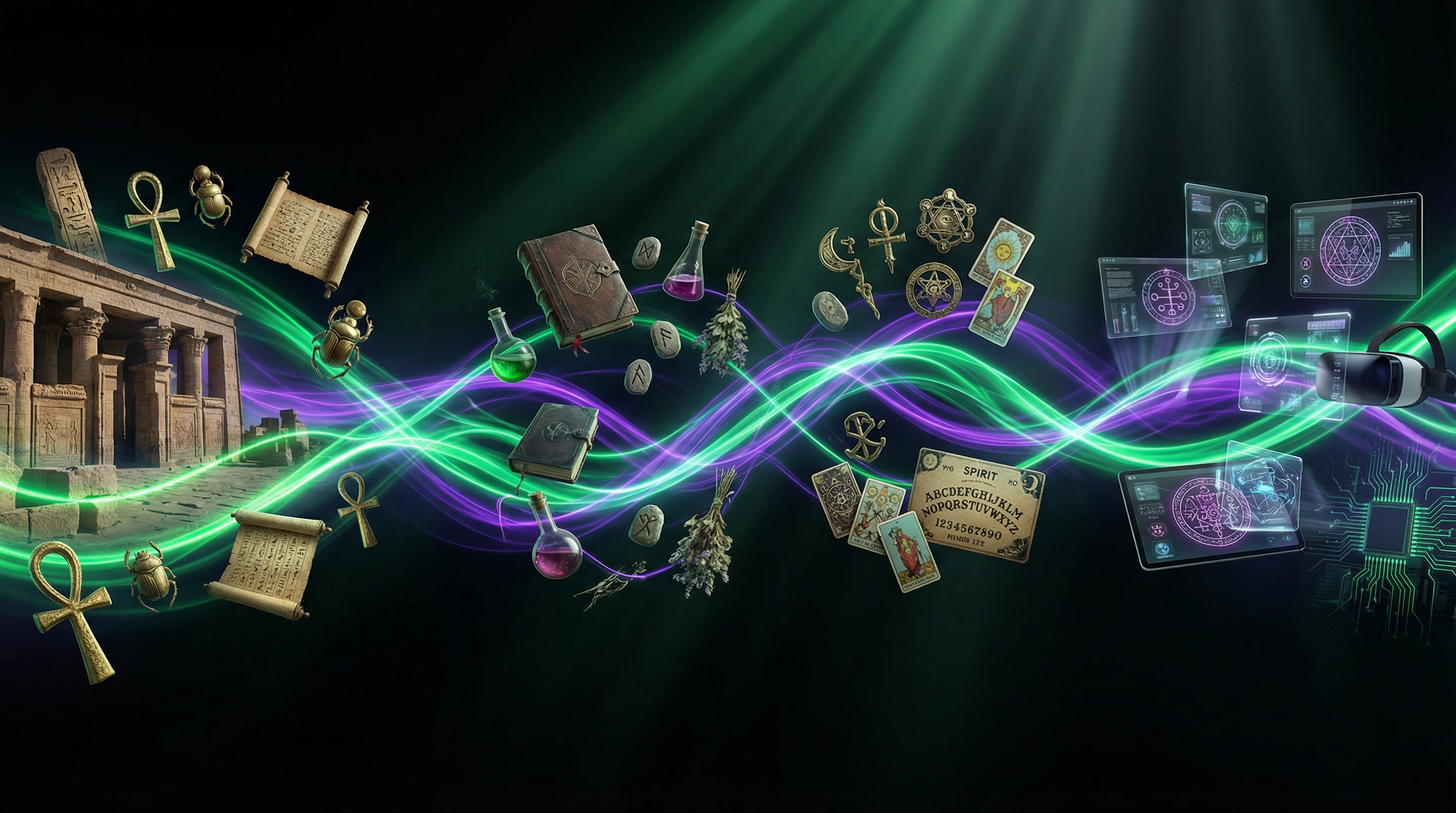
Magical and ritual practices demonstrate remarkable adaptability, maintaining structural continuity while adapting to changing cultural contexts. Contemporary practices integrate traditional symbolic systems with new technologies and social forms, creating hybrid models.
Globalization and digitization do not eliminate magical practices but transform the methods of their transmission, legitimation, and application. Analysis of these transformations reveals persistent cross-cultural patterns and universal psychological needs that magic and ritual continue to satisfy.
Adaptation of Traditional Systems to Modernity
Traditional magical systems adapt through reinterpretation of symbols, simplification of ritual forms, and integration with psychological concepts. Runic magic, originally connected to Scandinavian cosmology, is now used within individual spiritual practice and psychological self-discovery.
The key adaptation mechanism is preservation of symbolic structure while changing interpretive frameworks. This allows traditional systems to remain relevant for new generations of practitioners.
Tarot evolved from playing cards through 19th-century occult systems to a modern tool for psychological reflection and coaching. Symbolic continuity provides legitimacy, while new interpretive contexts ensure relevance.
Digitization of Magical Practices
Digital technologies create new forms of magical practice: online readings, virtual rituals, mobile divination apps, and digital grimoires. Algorithmic systems for generating readings reproduce traditional logic of randomness, but in a digital environment.
| Aspect | Traditional Form | Digital Form |
|---|---|---|
| Knowledge transmission | School, teacher lineage | Online communities, open resources |
| Ritual action | Physical space, material objects | Virtual space, interfaces |
| Access | Geographically limited | Global, but authenticity concerns |
Online practitioner communities create new forms of collective ritual and knowledge exchange, overcoming the geographical limitations of traditional schools. Digitization democratizes access to esoteric knowledge, but simultaneously creates problems of authenticity, teaching quality, and preservation of traditional transmission lineages.
Cross-Cultural Patterns and Universals
Comparative analysis of magical systems reveals universal structural elements: use of symbolic correspondences, ritual creation of sacred space-time, invocation of supernatural forces, and manipulation of material objects as carriers of meaning.
- Initiatory structures — rites of passage, transformation of practitioner status
- Calendar cycles — synchronization with cosmic and social rhythms
- Apotropaic practices — protection from harm and negative influences
- Symbolic correspondences — connection between microcosm and macrocosm
These elements are found in cultures from ancient Egypt to Slavic folklore, indicating common psychological and social needs. The universality of basic magical principles—sympathy, contagion, symbolic substitution—testifies to deep cognitive mechanisms underlying magical thinking.
Understanding these universals explains both the persistence of magical practices and the ease of their cross-cultural borrowing and syncretism. Magic adapts because it addresses fundamental tasks of human consciousness and social organization.
Knowledge Access Protocol
FAQ
Frequently Asked Questions
Magic is a symbolic system of practices aimed at influencing events through ritual actions and words. Modern science views it as a complex cultural mechanism with real social and psychological effects, not merely superstition. It functions as a pragmatic sign system operating within the semiotic space of culture.
Ritual is a formalized symbolic action with cultural meaning, not simply repetitive behavior. It encodes and transmits cultural knowledge, creates social bonds, and manages participants' psychological states. Rituals function as semiotic systems, unlike everyday habits.
Three key approaches: Malinowski's functionalist view (magic provides control in uncertain situations), Bayburin's symbolic-semiotic approach (rituals as sign systems), and Frazer's ritual-mythological framework (myths explain ritual practices). All three theories recognize magic as an important cultural mechanism, not mere delusion.
No, this is a myth. Contemporary divination and diagnostic magic practices maintain structural connections with ancient systems, adapting traditional methods to modern conditions. Research shows remarkable continuity of magical practices from Ancient Egypt through Slavic traditions to the present day.
No, academic research does not confirm the supernatural efficacy of magic. Science studies magic as a cultural phenomenon and symbolic system with real social effects. Researchers distinguish between studying magic's cultural role and questions about its paranormal properties.
No, magical practices are deeply embedded in specific cultural matrices. They cannot be understood or effectively applied outside their social, religious, and historical context. Each magical system reflects its culture's unique worldview.
Rune diagnosis involves formulating a clear question, selecting spreads (Scandinavian or witch runes), and interpreting symbols within situational context. It's important to distinguish between emic (practical) and etic (research) perspectives. The methodology requires knowledge of the cultural context of runic systems and their traditional meanings.
Tarot uses archetypal symbolism for deep psychological analysis, while Lenormand provides more concrete, literal answers about situations. Both systems are applied to identify magical influences, but Tarot works better for complex psychological patterns, Lenormand for practical questions. The choice depends on the type of diagnostic task.
An effective protective ritual requires clear intention, symbolic actions (purification, boundary creation), and repeatability for reinforcement. Slavic tradition employs word magic (incantations), protective objects, and calendar alignment. Psychological conviction and cultural rootedness of the practice enhance its effectiveness.
In Ancient Egypt, magic was integrated into the temple system and state religion, not separated from it. Priests practiced ritual magic to maintain cosmic order (maat), healing, and protection. Egyptian magic demonstrates a high degree of institutionalization and connection with literate culture.
It's an interconnected system where myths provide narrative frameworks for ritual actions, and rituals embody mythological narratives. According to Frazer's theory, myths arise from ritual practices and explain them. This concept demonstrates the inseparability of narrative and action in traditional cultures.
No, that's an outdated view. Shamanic practices represent a complex system of altered consciousness techniques, cosmological concepts, and social functions. Contemporary research shows their evolution and adaptation, not primitiveness. Shamanism has influenced the development of many religious traditions.
Calendar rituals in Slavic and other traditions use magical practices to ensure fertility, protection, and prosperity at key moments of the year. They connect natural cycles with ritual actions, creating cultural rhythm. These rituals demonstrate the pragmatic function of magic in agrarian societies.
Rituals work by creating structure in uncertainty, activating symbolic associations, and enabling group synchronization. They reduce anxiety, strengthen sense of control, and create altered states of consciousness. Repetition and formalization reinforce psychological effects independent of supernatural beliefs.
Modern technologies create new forms of magical practices: online divination, digital altars, virtual ritual spaces. Traditional systems adapt to digital environments while preserving symbolic structure. This demonstrates the flexibility of magical practices and their capacity for transformation while maintaining cultural core.
Yes, cross-cultural research reveals common patterns: use of symbols, ritual actions, altered states of consciousness, and belief in connections between symbolic and material realms. However, specific forms are always culturally specific. Universality reflects shared human cognitive mechanisms, while differences reflect unique cultural contexts.