
Folk Magic: Traditional Practices in Cultural Contextλ
Research into magical practices embedded in traditional culture and transmitted through oral tradition across various ethnic and regional contexts.
Overview
Folk magic — not a chaos of superstitions, but a system of practices with internal logic: protection, healing, divination, calendar rituals. Transmitted orally, operates through symbols 🧩 and social roles, embedded in everyday life. Academic perspective reveals cultural coherence where laypeople see only "grandma's charms".
🛡️
Laplace Protocol: Folk magic is analyzed as a cultural phenomenon using interdisciplinary methods from anthropology, folklore studies, and religious studies, with particular attention to ethical aspects of researching living traditions and respect for knowledge transmission rights.
Reference Protocol
Scientific Foundation
Evidence-based framework for critical analysis
Protocol: Evaluation
Test Yourself
Quizzes on this topic coming soon
⚡
Deep Dive
Three Historical Stages of Folk Magic: From Syncretism to Science
Pre-Christian Origins and Syncretism
In the initial stage, folk magic existed as an inseparable part of religious worldview. Magical practices and sacred rituals formed a unified system of interaction with the world, where appeals to natural forces, ancestral spirits, and deities through incantations, sacrifices, and calendar rituals were not perceived as separate "magical" activity.
This syncretism persisted for centuries even after Christianization. Dual faith emerged: Christian saints replaced pagan gods, church holidays overlaid the agricultural calendar, creating hybrid forms of religious practice.
Medieval Interaction Between Church and Magic
The medieval period was characterized by complex relationships between the official church and folk magical practices. The boundary between acceptable ritual and condemned witchcraft remained fluid.
The church simultaneously fought against "pagan superstitions" and integrated elements of folk magic into its own rituals, creating consecrated amulets, prayer-incantations, and protective rites.
Healers and wise folk occupied an ambivalent position in rural communities: their services were in demand for healing, protection from curses, and solving everyday problems, but the church officially condemned their activities as heretical.
- White Magic
- healing, protective practice approved by the community
- Black Magic
- harmful practice condemned by church and society
This duality led to the formation of a stable classification that persists in folk consciousness to this day.
Modern Academic Systematization
Academic study of folk magic began in the 19th century with the work of ethnographers and folklorists. Systematic scientific methodology only formed in the second half of the 20th century.
| Period | Approach | Unit of Analysis |
|---|---|---|
| 19th Century | Descriptive | Folkloric Text |
| Mid-20th Century | Structural | Incantation as System |
| Late 20th Century | Interdisciplinary | Ritual as Complex of Symbols, Words, and Objects |
The contemporary stage is a period of academic systematization, when folk magic became the subject of research at the intersection of anthropology, religious studies, semiotics, and cultural studies. Post-Soviet scholarship demonstrates an evolution in terminology: from the concept of "incantation" as the primary unit of analysis to "ritual" as a complex system of symbolic actions.
Foundational works by researchers laid the groundwork for comparative study of magical traditions and enabled a transition from describing individual practices to analyzing their mechanisms, social functions, and cultural contexts.

Classification of Magical Practices: From Ethics to Function
White, Gray, and Black Magic: Ethical Typology
Traditional classification of magic by ethical criteria distinguishes white magic (healing, protection, blessings), black magic (curses, hexes, harmful rituals), and gray magic (practices with ambivalent purposes, such as love spells or manipulation of will).
This typology reflects not the objective properties of rituals, but the cultural evaluation of the practitioner's intentions and consequences for the target of influence.
In Slavic tradition, a healer and a sorcerer could use identical incantations and ritual actions, but with opposite purposes: removing a curse instead of casting one, protecting instead of harming. The boundary between categories is often blurred—the same specialist could practice both healing and harmful magic depending on social demand and payment.
Operative Magic and Healing
Operative magic is oriented toward achieving specific practical results: curing diseases, ensuring harvest, protecting livestock, attracting luck or love.
Folk healing as a form of traditional medicine constitutes the most widespread and socially legitimate category of magical practices, integrating empirical knowledge of herbs with ritual actions and verbal formulas.
Studies of villages in the Gainovsky district demonstrate that folk magic functions as part of everyday rural life: consulting a healer is perceived as naturally as visiting a doctor in urban culture.
- Diagnosis through divination or intuition
- Application of herbal decoctions
- Reading incantations over water or food
- Protective rituals to prevent recurrence
Protective Magic and Amulets
Protective magic represents an extensive complex of preventive practices aimed at preventing harmful influence, diseases, misfortunes, and evil spirits through the use of amulets, talismans, incantations, and ritual actions.
A.D. Tsendina's monograph on Mongolian tradition describes in detail protective amulets (tarni), protective texts, and evil-averting rituals that formed the foundation of everyday magical practice from the 16th to 20th centuries.
| Accessibility Level | Form of Practice | Characteristics |
|---|---|---|
| Mass | Material Objects | Herb bundles, consecrated items, embroidery with symbols—accessible to every housewife |
| Universal | Non-material Practices | Incantations at the threshold, sprinkling with holy water, sign of the cross—democratic and require no specialist |
| Specialized | Complex Rituals | Ceremonies requiring consultation with specialists |
Regional Traditions: Cultural Diversity of Folk Magic
Slavic Folk Magic
Slavic magical tradition is integrated with the agrarian calendar, ancestor cult, and Christian ritual practices, creating a syncretic complex of practices. W.F. Ryan's foundational study "The Bathhouse at Midnight" systematizes Russian folk magic through categories: sorcerers and witches as social roles, folk divination (with cards, wax, mirrors), omens and calendar predictions connected to church and natural cycles.
The central role of verbal formulas-incantations — they were transmitted orally from teacher to student with strict rules for preserving text and context of recitation. The bathhouse as ritual space occupied a special place: here healing sessions, divinations, and midwifery were conducted, since the bathhouse was considered a threshold place between the world of the living and the world of spirits.
Mongolian Magical Tradition
Mongolian folk magic of the late medieval and modern periods (16th–20th centuries) — a synthesis of shamanic, Buddhist, and Turkic elements, documented in written sources: books of omens, dream books, divinatory texts, and descriptions of protective amulets. A.D. Tsendina's research reveals specific features: a developed system of dream interpretation with detailed classification of symbols, astrological prediction methods based on Buddhist cosmology, and material culture of amulets with dharani texts and images of protective deities.
| Parameter | Slavic Tradition | Mongolian Tradition |
|---|---|---|
| Knowledge Transmission | Oral, rigid text fixation | Written, better preservation |
| Social Roles | Sorcerers, witches, healers | Lama-astrologers, folk healers |
| Sources of Power | Agrarian calendar, ancestors, Christianity | Buddhism, shamanism, astrology |
Social organization included professional lama-astrologers and folk healers who used simplified versions of Buddhist rituals combined with pre-Lamaist shamanic techniques.
African American Hoodoo
Hoodoo — an African American folk magic tradition formed through the synthesis of West African magical practices, elements of European folk magic, and Christianity under conditions of slavery and the post-slavery American South. Despite its cultural significance, hoodoo remains one of the least researched magical traditions in academic literature, reflecting the broader problem of marginalization of African American cultural heritage in scholarly discourse.
- Use of roots, herbs, and minerals for magical purposes (rootwork)
- Creation of mojo bags with magical ingredients
- Working with spirits of ancestors and saints
- Practice of "crossroads" as places of power
Italian American Practices
Italian folk magic, transformed in immigrant communities of North America, demonstrates processes of adapting traditional practices to a new cultural context. This tradition preserves Mediterranean elements: belief in the "evil eye" (malocchio), protective rituals using olive oil and water, veneration of saints as intermediaries in magical operations, and transmission of knowledge through family lines, predominantly from woman to woman.
In the American context, Italian folk magic partially lost its connection to the agrarian calendar but strengthened protective and healing aspects, responding to the needs of urban immigrant communities.
Material Culture of Magic: Objects, Texts, and Natural Substances
Plant Magic and Herbalism as the Foundation of Practical Magic
Plant magic constitutes a fundamental layer of folk magical practice, where each plant possesses specific properties and is applied in strictly defined contexts. In Slavic tradition, particular significance is held by wormwood (protection from evil spirits), thistle (warding off curses), St. John's wort (healing and purification), and fern (treasure-seeking on Midsummer Night).
Plant gathering is regulated by a complex system of rules: time of day, moon phase, calendar dates, and ritual formulas spoken during harvesting. This transforms herbalism into a comprehensive magico-botanical system, where healers transmit knowledge through oral tradition, encompassing not only identification and application, but also mythological narratives explaining the origin of healing properties.
Each plant is not merely an object, but a node in a network of rules, times, and verbal formulas. Violation of collection protocol nullifies the magical effect.
Protective Objects and Amulets in Everyday Practice
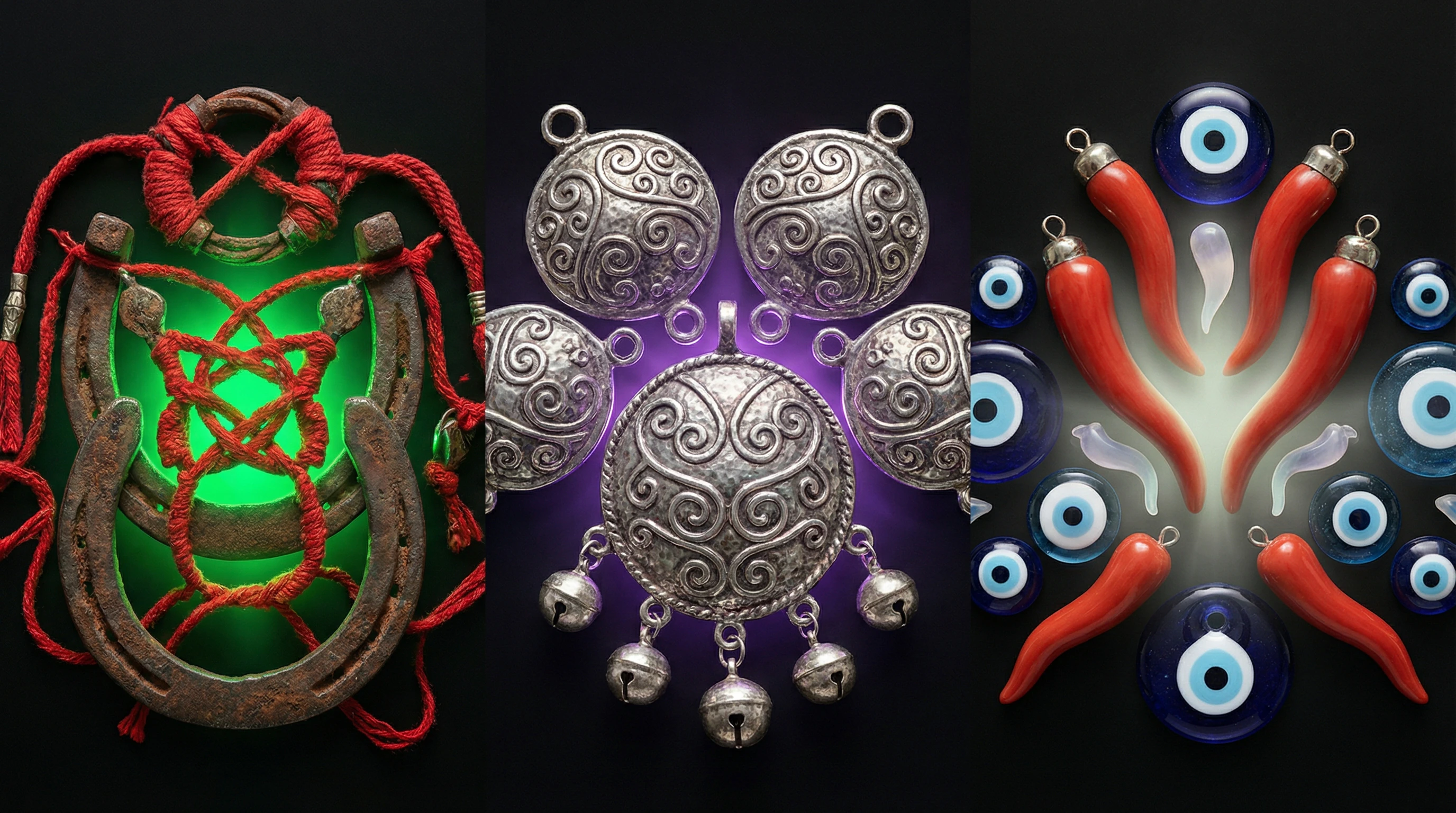
Protective magic materializes in diverse objects, from simple natural materials to complex composite amulets, each designed for a specific threat.
| Tradition | Primary Objects | Protection Mechanism |
|---|---|---|
| Mongolian | Dharani texts, deity images, composite amulets | Combination of minerals, metals, organic materials |
| Italian-American | Corno (horn), red ribbons, garlic | Protection from malocchio (evil eye) |
| Slavic | Body crosses, prayer pouches, knot magic (nauzy) | Threshold protections: horseshoes, knives, salt, grain |
Magical Texts and Dream Books as Written Fixation of Oral Tradition
Written magical texts represent a late fixation of oral tradition, creating hybrid forms between folk practice and literate culture. Mongolian magical texts from the 16th–20th centuries include dream books, divinatory manuals, omen texts, and instructions for crafting protective amulets, often borrowing structure from Tibetan Buddhist literature while adapting content to local beliefs.
Slavic incantations, though transmitted predominantly orally, were recorded in manuscript collections, demonstrating stable formulaic structures: opening (invocation of powers), main body (description of desired result), and sealing (formula of inviolability).
- Opening
- Invocation of magical forces or personages (saints, spirits, natural phenomena). Establishes contact with the source of power.
- Main Body
- Description of the desired result in imperative or conditional mood. Encodes intention into linguistic form.
- Sealing
- Formula of inviolability, often containing an oath or magical seal. Fixes the result and prevents reversal.
W.F. Ryan's study "The Bathhouse at Midnight" — the most comprehensive analysis of Russian magical texts (720 pages), covering folk magic, witchcraft, divination, and calendar predictions. Demonstrates how oral tradition is encoded in written forms, preserving the structure and logic of original practices.
Social Dimensions of Folk Magic: Roles, Gender, and Knowledge Transmission
Practitioner Roles: Healer, Witch, and Sorcerer in Social Structure
Folk magic creates specialized social roles that differ in function, status, and community perception of the practitioner. The healer occupies a legitimate position in rural communities, practicing "white magic"—treating illnesses, removing curses, assisting in childbirth, and protecting livestock.
Witches and sorcerers are associated with "black magic"—casting curses, harmful spells, and connections with malevolent forces. Their social status is ambivalent: the community simultaneously fears their power and may seek their help in critical situations.
The same practitioner may be perceived as a healer by their clients and as a sorcerer by their opponents. This reflects the relativity of ethical categories in folk magic.
Gender Dynamics in Magical Practices
Gender distribution of magical roles varies across cultures but reveals common patterns. In Slavic tradition, women dominate in healing, midwifery, love magic, and protection of domestic space, while men more often practice livestock magic, military charms, and blacksmith sorcery.
- Slavic Tradition
- Women: healing, midwifery, love magic, home protection. Men: livestock magic, military charms, blacksmith sorcery.
- Italian-American Tradition
- Knowledge transmitted through female lines (grandmother → granddaughter, mother → daughter), men occupy peripheral roles in transmission.
- Mongolian Tradition
- Less gender specialization in textual magic (amulets, protective texts), but gender division persists in shamanic practices.
Italian-American tradition transmits knowledge predominantly through female lines, with transmission often occurring on Christmas Eve and accompanied by ritual restrictions. Mongolian tradition shows less gender specialization in textual magic but maintains gender division in shamanic practices.
Knowledge Transmission and Apprenticeship in Oral Tradition
Transmission of magical knowledge follows specific rules that differ from ordinary education. The fundamental principle—knowledge loses power with widespread dissemination—means transmission occurs selectively, often to a single apprentice, and is accompanied by prohibitions on disclosure.
Training includes not only memorizing texts and techniques but also initiation—ritual introduction to practice that may include fasting, isolation, encounters with spirit helpers, or symbolic death and rebirth.
In Hainault villages, folk magic functions as part of everyday rural life, where learning occurs through observation and gradual participation rather than formal apprenticeship.
Research Methodology for Folk Magic: Academic Approaches and Ethical Challenges
Source Evaluation and Ethical Considerations in Studying Living Traditions
Research on folk magic requires critical evaluation of sources that vary in origin, reliability, and the cultural position of the author. Academic sources provide methodological rigor but miss practical details accessible only to insiders.
Ethnographic research faces the problem of practices changing under observation and ethical dilemmas: publishing sacred knowledge, violating prohibitions on disclosure, exploiting informants. African American hoodoo, despite its cultural significance, remains marginalized in academic research.
Insider knowledge and academic rigor rarely coincide—researchers choose between completeness and methodological purity.
Cross-Cultural Comparative Analysis of Magical Systems
Comparative analysis reveals both universal elements of magical thinking and culturally specific variations shaped by religious context, ecology, and social structure.
| Level of Analysis | Content |
|---|---|
| Universal Patterns | Sympathetic magic (like affects like), magical power of words and names, protective objects, ritual purification. |
| Cultural Differences | Slavic magic integrates Christian elements with pre-Christian beliefs; Mongolian—Buddhist concepts with shamanic practices; Italian-American—Catholic veneration of saints with Mediterranean apotropaic traditions. |
Methodologically, it's important to distinguish superficial similarity of practices from deep structural kinship, analyzing not only actions but their cultural interpretations.
Emic and Etic Perspectives in Interpreting Practices
The distinction between emic (insider) and etic (outsider) perspectives is critical for adequate interpretation of magical practices. The emic approach focuses on how practitioners themselves understand their actions, using their own categories—for example, the distinction between "removing a curse" and "casting a curse" has fundamental significance for practitioners.
The etic approach applies external analytical categories (anthropological, psychological, sociological), enabling comparison of practices across cultures and identifying common mechanisms, but risks reductionism and misunderstanding cultural logic.
- Emic Perspective
- Understanding practices through the internal logic of the tradition, practitioners' own categories, their interpretations and meanings. Risk: impossibility of cross-cultural comparison.
- Etic Perspective
- Applying external analytical frameworks to identify common mechanisms and theoretical understanding. Risk: reductionism and distortion of cultural meaning.
- Integrated Approach
- Using both perspectives sequentially: first understand the logic from within, then apply analytical categories while preserving cultural context.

Knowledge Access Protocol
FAQ
Frequently Asked Questions
Folk magic is a system of magical practices embedded in traditional culture and transmitted orally, practiced by ordinary people rather than specialized priests. It focuses on practical goals: protection, healing, divination. It differs from ceremonial magic in its accessibility and everyday application.
The classification is based on ethical intention and outcomes: white magic is directed toward helping and healing, black magic toward causing harm. Gray magic occupies an intermediate position, with its ethical evaluation depending on context. This categorization system appears in various Slavic and European traditions.
A folk healer is a traditional practitioner who practices folk medicine using magical elements: incantations, herbs, rituals. Folk healers transmitted knowledge orally, often within families or through apprenticeship. Their role included treating illnesses, removing curses, and protection from evil forces.
No, this is an oversimplification. Folk magic represents a complex syncretic system combining pre-Christian, Christian, and local elements. Research shows fluid boundaries between magical practices and religious ritual, especially in rural contexts. Practices constantly evolve and adapt.
Amulets function as material carriers of protective symbolism, activated through ritual or incantation. Their effectiveness is based on cultural belief in the ability of certain objects, symbols, or texts to deflect negative influences. Mongolian and Slavic traditions developed extensive systems of protective objects.
Traditionally, knowledge was transmitted through oral instruction from an experienced practitioner, ensuring proper understanding of context and ethics. Independent study from books is possible but requires a critical approach to sources and understanding of cultural context. Academic research recommends distinguishing between scholarly works and popular guides.
Operative magic is practical magic directed toward achieving specific results: attracting luck, love binding, crop protection. It forms the foundation of folk magical practices as distinct from theoretical or ceremonial magic. It includes the use of incantations, ritual actions, and magical objects.
The Slavic tradition is characterized by strong Orthodox influence, a developed system of incantations, and a special role for the bathhouse in rituals. Mongolian magic emphasizes dream books and divinatory texts, African American hoodoo uses specific African and Christian elements. Each tradition has unique cosmologies and materials.
Yes, folk magic is a recognized field of academic research in ethnography, anthropology, and folklore studies. Key works include Ryan's 720-page study of Russian magic and Tsendina's monograph on the Mongolian tradition. Contemporary methodology requires distinguishing between emic (insider) and etic (outsider) perspectives.
No, this is a common misconception. Significant differences exist between cultural traditions: Slavic, Mongolian, African American, Italian American. Each has unique practices, materials, and symbolic systems. Migration and cultural contact lead to further transformation of practices.
Gender dynamics vary by region, but women often dominated healing, midwifery, and household protective magic. The witch archetype reflects ambivalent attitudes toward female magical power. Knowledge transmission frequently followed matrilineal lines, especially in family traditions.
Hoodoo is an African American folk magical tradition focusing on practical spellwork and use of roots, herbs, and minerals. Voodoo is a religion with a pantheon of spirits and structured rituals. Hoodoo remains an understudied field despite its cultural significance.
Distinguish between academic research (peer-reviewed journals, university presses) and popular practitioner guides. Check for citations to primary sources, fieldwork, and critical analysis. Beware of romanticization, cultural appropriation, and commercialization of traditional practices.
The medieval church saw magic as competition to its spiritual authority, but boundaries between church ritual and folk magic were fluid. Many practices incorporated Christian prayers and saints. Research by Gurevich demonstrates complex interaction rather than simple opposition.
No, this is a misconception. Folk magic represents complex symbolic systems with internal logic and cultural coherence. Academic research reveals sophisticated taxonomies and purposeful applications. The term "primitive" reflects colonial prejudices rather than the actual complexity of traditions.
Practices evolve through migration, cultural contact, and new contexts—for example, the transformation of Italian magic in American immigrant communities. Post-Soviet scholarship shows a shift from "incantation" to "ritual" as an analytical framework. Traditions are not static but constantly adapt to changing conditions.