 ✨ Magic and Rituals
Ritual Magic: Structured Practice of Reality Transformation Through Symbolic Actionsλ
A discipline that seeks to change reality through conscious, symbolically charged ceremonial actions, distinguished from spontaneous magic by its structured approach and systematic procedures.
Overview
Ritual magic is a technology of control through symbol: 🧩 rehearsed gestures, verbal formulas, strict sequence of actions. The practitioner believes that the structure of the ceremony itself changes reality — not through divine intervention, but through "correct" execution of protocol. Roots trace to Hermeticism, Kabbalah, alchemy; modern schools (Golden Dawn, Thelema) systematized the process to the level of engineering discipline.
🛡️
Laplace Protocol: Material draws primarily from sources on Western magical traditions. Presents both practical perspectives of practitioners and academic cultural analysis. Important to distinguish between historical claims, contemporary practices, and verifiable outcomes.
Reference Protocol
Scientific Foundation
Evidence-based framework for critical analysis
Navigation Matrix
Subsections
[folk-magic]
Folk Magic
Research into magical practices embedded in traditional culture and transmitted through oral tradition across various ethnic and regional contexts.
Explore
[magic-rituals]
Magic and Rituals
Exploring magical systems and ritual practices through the lens of academic science and cultural anthropology, from ancient Egyptian temple rites to modern diagnostic methods
Explore
[occultism-hermeticism]
Occultism and Hermeticism
A study of esoteric traditions from ancient Hermeticism to modern occultism, their influence on scientific thought and transformations in the 19th-20th centuries
Explore
[witchcraft]
Witchcraft
An exploration of the historical evolution of witchcraft from early medieval European folklore through the witch-hunt era to contemporary healing practices and academic reinterpretation.
Explore
Protocol: Evaluation
Test Yourself
Quizzes on this topic coming soon
Sector L1
Articles
Research materials, essays, and deep dives into critical thinking mechanisms.
✨ Magic and Rituals ✨ Magic and Rituals
⚡
Deep Dive
Ritual Magic: A Structured System for Changing Reality Through Symbolic Actions
Ritual magic is a discipline aimed at changing reality through conscious, symbolically charged actions. Unlike spontaneous magic, it requires a structured, ceremonial approach and precise execution of established procedures.
Practitioners perceive it not as theatrical performance, but as a real tool for influence through conscious application of specific techniques. Contemporary practice includes active study and adaptation of Western traditions within the context of English-speaking esoteric communities.
Ritual magic is not spontaneous action, but a systematic discipline requiring precision, understanding of symbolism, and consistent execution of procedures.
Verbal Formulas and Incantations as the Foundation of Magical Influence
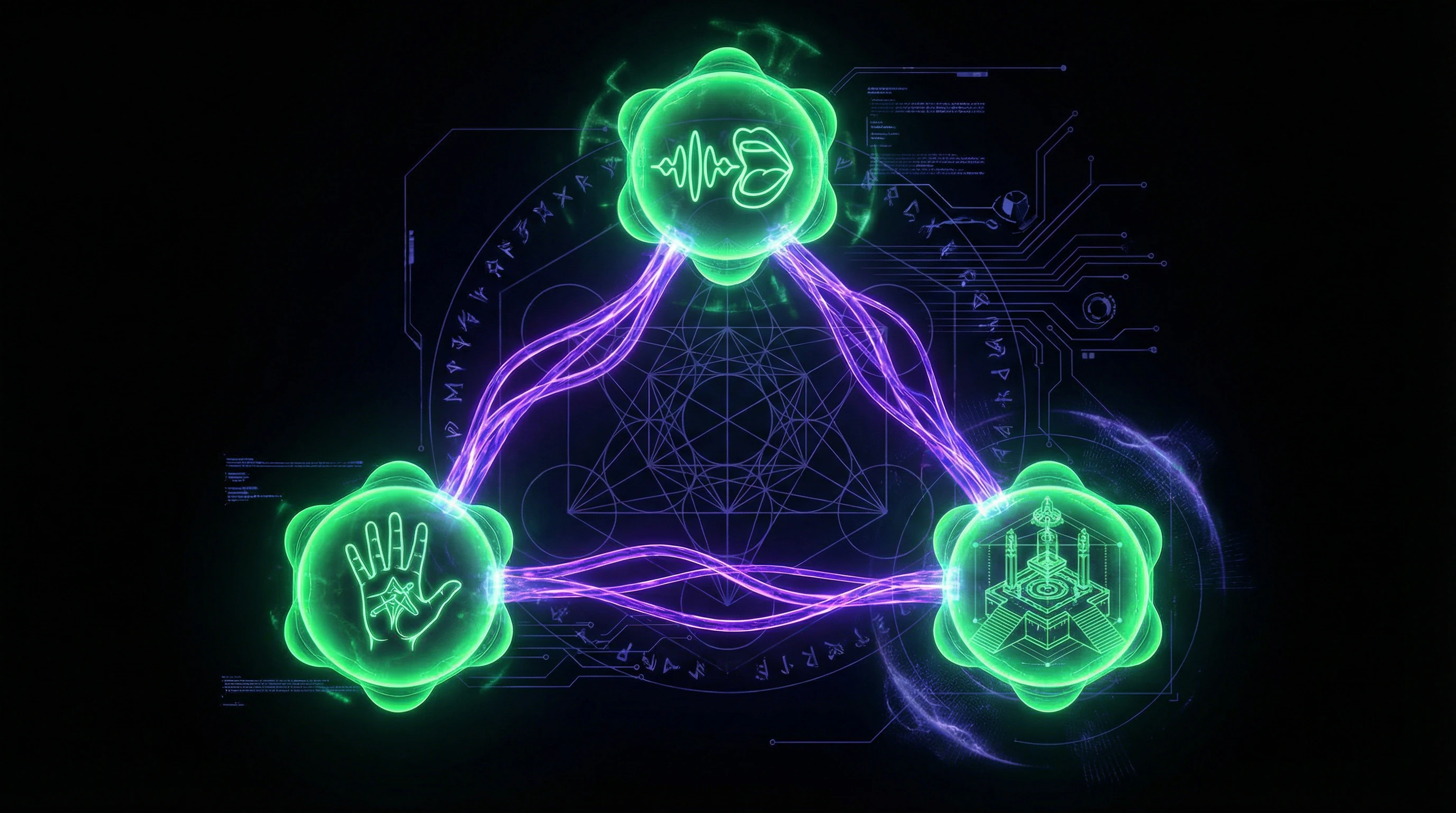
Verbal formulas, or incantations, constitute a fundamental component of ritual magic—specially structured verbal constructions designed to activate magical processes. They range from brief invocations to elaborate magical chants, each with a specific functional purpose.
Precision of pronunciation and understanding the symbolic meaning of words are considered critically important for ritual effectiveness. Magical chants often include elements of ancient languages, names of deities or spiritual entities, and specific sound patterns that, according to tradition, resonate with particular energetic frequencies.
- Mechanical repetition vs. conscious application
- Western magical traditions emphasize the necessity of not merely mechanical repetition of formulas, but deep understanding of their symbolic content and context. The distinction between theoretical study and practical application remains significant in contemporary practice.
Magical Gestures and Ceremonial Structures
Magical gestures form the second key component of ritual practice—from simple finger movements to complex physical actions performed in strictly defined sequences. Ceremonial structures include creation of the magic circle, invocation of forces, and systematic procedures forming a protected space for magical work.
| Ritual Element | Function | Nature of Execution |
|---|---|---|
| Magic circle | Defining boundaries of ritual space, protection from unwanted influences | Basic practice, follows established traditions |
| Physical actions | Coordination with verbal formulas and visualization | Multi-level system of influence |
| Verbal formulas | Activation of magical processes | Requires precision and understanding of symbolism |
Systematic study of these techniques requires time and practice, which underscores the distinction between theoretical knowledge and practical mastery. Physical actions in ritual are coordinated with verbal formulas and visualization, creating a multi-level system for influencing reality.
Typology of Magical Practices: From Applied Rituals to Intellectual Traditions
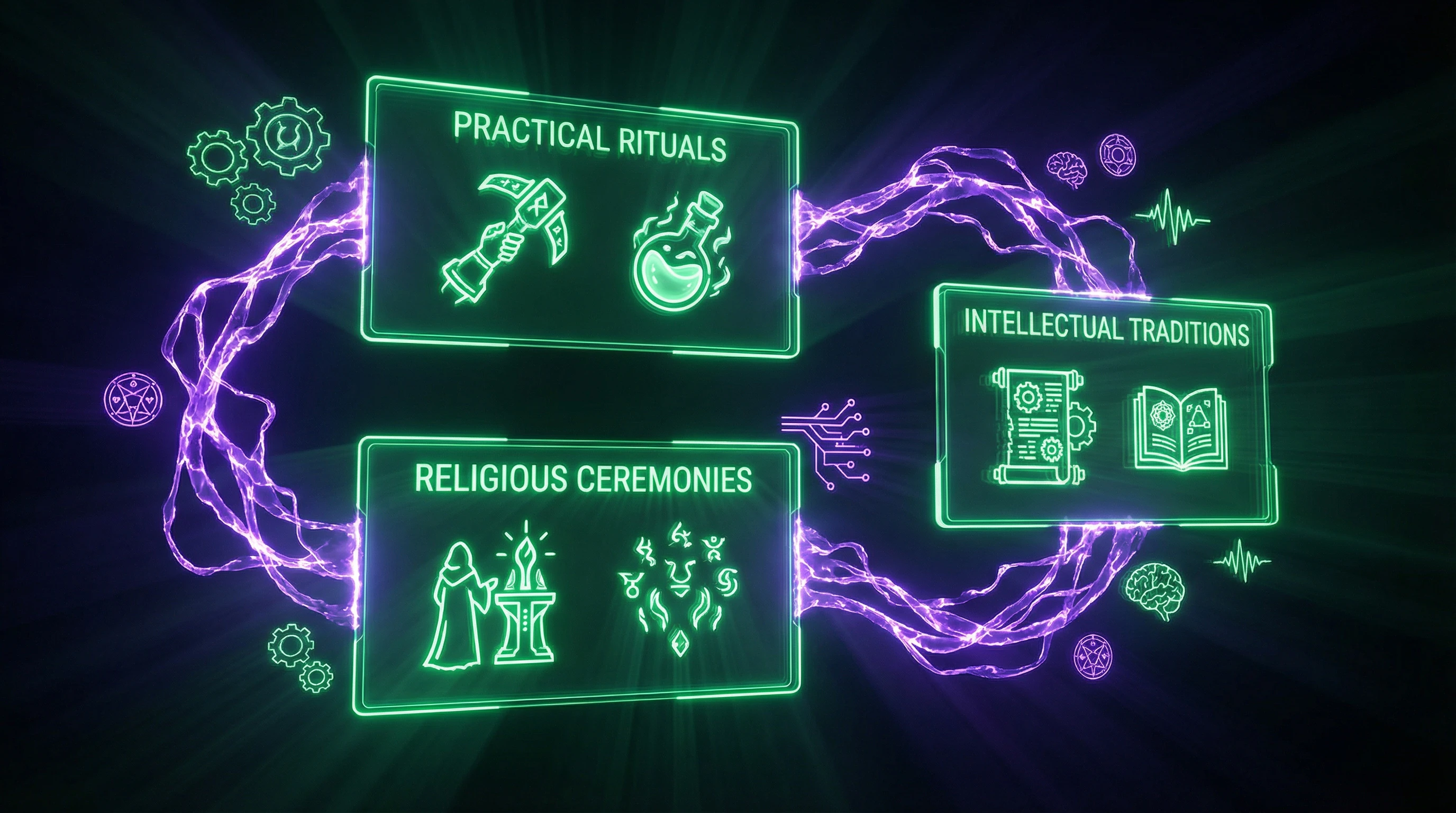
Ritual magic is not a monolith, but a set of practices with different goals and methodologies. Academic classification identifies three categories: practical rituals (concrete results), religious and mystical rites (spiritual development), and intellectual traditions (Hermeticism, Kabbalah, alchemy).
The distinction between them is critical: confusing a practical ritual with a mystical rite means incorrectly assessing the mechanism and expected outcome.
Magical Rituals for Practical Goals
Practical rituals are the most common category. They target concrete results: financial prosperity, protection, influence over circumstances, interpersonal relationships.
Practitioners view them not as symbolic actions, but as tools for real impact. The structure is clear: goal definition → tool preparation → creation of protected space → protocol execution.
- Precise goal definition (not a vague desire, but a specific outcome)
- Selection of method appropriate to the task (requires knowledge of symbolic systems)
- Preparation of materials and tools
- Creation of isolated space
- Sequential execution of actions according to protocol
Effectiveness, according to practitioners, depends on three factors: precision of execution, concentration of intention, and adherence to traditional forms. Western traditions emphasize that carelessness in details disrupts the entire mechanism.
Religious and Mystical Rites
This category is distinguished by spiritual orientation and the goal of consciousness transformation, rather than changing external circumstances. They aim at inner development, connection with higher powers, achievement of mystical states.
Mystical rites function as a way of life and a method of interacting with reality at a deeper level, rather than as a tool for solving specific problems.
They include meditation, visualization of sacred symbols, work with altered states of consciousness. The emphasis shifts from outcome to the process of spiritual growth and expansion of perception.
Integration with Freemasonry and fraternal organizations demonstrates the connection between ritual magic and organized spiritual movements.
Intellectual Traditions: Hermeticism, Kabbalah, and Alchemy
These are complex philosophical systems that unite theory with symbolic practice. Each offers its own cosmology and method of working with reality.
- Hermeticism
- Based on the texts of Hermes Trismegistus. Offers a cosmological model and principles of correspondences between levels of reality. Key principle: "as above, so below."
- Kabbalah
- A structured system for understanding the divine through the symbolism of the Tree of Life and the Sephiroth. Requires extensive study of symbolic correspondences.
- Alchemy
- Often perceived as proto-chemistry, but in the context of magic—a system of spiritual transformation. Chemical processes serve as symbols of inner changes.
These traditions require deep understanding of complex symbolic systems—this distinguishes them from straightforward practical rituals. Historically, they have influenced the development of Western esoteric thought and remain the foundation of contemporary magical practices.
Western Traditions and Systematic Study: From Theory to Practice
Western magical traditions require a systematic approach: not spontaneity, but regular practice under the guidance of mentors or according to established instructions. English-speaking practitioners adapt these methods while preserving the ceremonial structure.
Circle Casting and Invocation of Forces
The magic circle is the foundation of Western ceremonial magic. It serves simultaneously as protection and container for energies.
Procedure: physical or visualized delineation of boundaries, consecration of space, connection with the four directions or elements. Precision is critical for safety and effectiveness.
- Delineate boundaries (physically or visually)
- Consecrate the space
- Establish connection with elements/directions
- Invoke forces or entities
Invocation follows circle creation—structured contact with energies, deities, or spiritual beings. Western traditions distinguish between invocation (bringing force into oneself) and evocation (manifesting force outside oneself), each requiring specific techniques and precautionary measures.
Systematic study includes understanding hierarchies of spiritual beings, corresponding symbols, and proper formulas of address—this is not intuition, but protocol.
Skill Development and the Distinction Between Study and Practice
Magical skills require extended training and practice. Reading books is necessary but not equivalent to practical experience of performing rituals and working with energies.
Western traditions are organized into degree systems: practitioners advance from basic techniques to complex practices. The systematic approach includes regular exercises in visualization, meditation, breathwork, and concentration development.
- Magical Journal
- A tool for tracking progress, analyzing results, and identifying patterns in work. Practitioners note its importance for skill development.
- Researcher vs. Practicing Magician
- The distinction remains significant in esoteric communities: academic interest is not always accompanied by personal practice. These are different competencies with different outcomes.
Academic Perspectives and Cultural Analysis of Ritual Magic
Ritual Magic as Cultural Form of World Mastery
Academic research by Dr. Helen Sullivan examines ritual magic as a cultural form of "domesticating" the world, connected with Hermeticism, systems of ritual magic, alchemy, and Kabbalah. This perspective positions magical practices not as a marginal phenomenon but as a stable form of engaging with reality.
Ritual magic functions simultaneously as a way of life and method of knowledge—a systematized attempt to structure chaotic experience through symbolic actions and ceremonial frameworks.
Magical practices maintain presence in contemporary English-speaking esoteric communities, demonstrating adaptation of Western traditions to local cultural contexts.
Academic analysis identifies three categories: magical rituals oriented toward practical results; religious and mystical ceremonies of spiritual orientation; intellectual traditions of Hermeticism and Kabbalah. This differentiation is critically important for understanding the diversity of magical practices and avoiding their simplified perception as a single phenomenon.
Connection with Freemasonry and Fraternal Traditions
Historical research documents the integration of ritual magic with Freemasonry and other fraternal traditions, forming a complex network of esoteric practices and organizational structures.
- Masonic lodges functioned as custodians and transmitters of ceremonial traditions
- Ritual practices served as teaching methods and mechanisms of social identification
- Ancient symbolic systems were adapted to modern contexts through initiatory systems
This connection reflects a broader pattern of institutionalization of magical knowledge through closed societies, where initiatory systems ensured both knowledge transmission and social consolidation.
Contemporary Practice in English-Speaking Context
Commercial Market for Instructional Materials
The English-speaking ritual magic market is built on systematic works by established authors and contemporary practitioners. Michael John Greer, Donald Tyson, and Dion Fortune set the tone: systematized guides available through bookstores and online platforms.
Commercialization of esoteric knowledge democratizes access but creates a disconnect from the traditional model of transmission through personal mentorship in initiatory organizations. Publications are positioned as practical guides for self-study—this raises questions about quality and authenticity of information.
Popularization of previously closed knowledge transforms the learning structure: from teacher-student hierarchy to horizontal access through print and web. Effect: more practitioners, but less control over interpretation.
Esoteric Communities and Adaptation of Western Traditions
English-speaking communities don't simply copy Western traditions—they adapt them. Hermeticism, Kabbalah, and local magical systems interweave into hybrid practices.
Adaptation requires not just translation of texts, but recontextualization of symbolic systems. Practitioners distinguish academic study of magic from personal practice—the former doesn't guarantee the latter.
- Translation of Western texts (Hermeticism, Kabbalah)
- Contextualization of symbolic systems within English-speaking culture
- Creation of hybrid practices combining foreign and local elements
- Separation between theoretical knowledge and practical application
Myths, Misconceptions, and Critical Analysis of Efficacy
Theatricality versus Real-World Change
A common misconception views ritual magic as purely theatrical activity, whereas practitioners position it as a discipline for actual reality modification through conscious action. This fundamental divergence reflects an epistemological conflict between materialist worldview and magical realism, where symbolic actions are considered to possess causal power.
Practitioners assert: ritual efficacy depends on correct execution of techniques, skill development, and adherence to ceremonial structures, not on belief or self-suggestion.
Distinctions Between Types of Magical Practices
Critical analysis reveals clear distinctions between ritual magic, spontaneous magic, religious rites, and folk practices, which are often erroneously conflated in public perception.
Ritual magic is distinguished by its structured, ceremonial character, requiring systematic training and development of specific skills. Conflating these categories creates conceptual confusion that impedes adequate understanding of each tradition and its methodologies.
- Ritual magic — structured, requires training and skill development
- Spontaneous magic — impulsive magical acts without prior preparation
- Religious rites — embedded in institutional belief systems
- Folk practices — transmitted through cultural traditions, often without formalization
Problems of Efficacy and Result Verifiability
Source analysis reveals a critical shortage of empirical research on ritual magic efficacy. Peer-reviewed academic work is rare, ethnographic studies of actual practitioners minimal.
Sources demonstrate commercial bias: materials oriented toward book sales predominate, while critical academic analyses of efficacy claims are lacking. Practitioner perspectives may lack the critical distance necessary for objective outcome assessment.
| Obstacle | Consequence |
|---|---|
| Terminological issues (cross-linguistic) | Conflation of distinct magical traditions |
| Absence of standardized assessment methods | Impossibility of verifying efficacy claims |
| Lack of cross-cultural comparisons | Absence of context for outcome analysis |
| Minimal psychological research | Unclear mechanisms of ritual impact |
Cross-cultural comparisons with other magical traditions, psychological studies of ritual practices, and ethnographic research on contemporary practitioners are necessary. The distinction between historical claims, contemporary practices, and verifiable outcomes remains critically important for academic analysis of this phenomenon.
Knowledge Access Protocol
FAQ
Frequently Asked Questions
Ritual magic is a discipline aimed at altering reality through conscious symbolically charged actions. It differs from spontaneous magic through its structured ceremonial character and includes verbal formulas, magical gestures, and systematic procedures. Practice requires creating a circle, invoking forces, and following specific traditions (S1, S3).
Magical rituals focus on practical results and altering reality, while religious ceremonies are spiritually oriented. There's also a third category—intellectual traditions like Hermeticism and Kabbalah. All three types use ceremonial structures but differ in goals and philosophy (S2, S5).
Three key components: verbal formulas (incantations and magical chants), magical gestures (from finger movements to complex actions), and ceremonial structures. Western traditions particularly emphasize creating the magic circle and systematic invocation of forces. All elements must be performed consciously and in a specific sequence (S1, S3).
Study and practice are different things, and reading books doesn't equal actual practice. Sources like the works of Michael Greer and Donald Tyson provide instructions, but systematic skill development is required. Western traditions emphasize the necessity of gradual training and practical experience (S3, S6).
No, practitioners view it as a discipline for actual reality alteration through conscious action. This common misconception underestimates the seriousness of the approach. Academic research shows that ritual magic functions as a cultural form of "taming" the world and a method of interacting with reality (S4, S6).
Major traditions include Hermeticism, Kabbalah, and alchemy, which form the philosophical foundation of practice. Connections to Freemasonry and other fraternal traditions are also noted. These systems represent not only practical methods but complete ways of life and knowledge (S2, S4).
Creating the circle is a foundational practice in Western ceremonial magic, involving tracing boundaries and consecrating space. The process requires concentration, use of specific tools, and recitation of invocation formulas. Detailed instructions are found in works on Western traditions but require practical mastery (S3, S6).
Empirical studies of practitioners and verifiable results remain limited in academic literature. Existing sources focus on cultural analysis and description of practices rather than measuring effectiveness. This remains one of the key gaps in research in this field (S5, S6).
Michael John Greer is known for instructional works, Donald Tyson for accessible explanations of practices. Victor Amphitheatrov wrote "Higher Ritual Magic," and Elizabeth Marion Butler researched historical occult traditions. In the academic sphere, Dr. Sullivan stands out with cultural analysis (S5, S6).
There's an active commercial market for instructional materials and guides in English. Esoteric communities adapt Western traditions to local contexts. Practice maintains presence in English-speaking occult circles, though ethnographic research remains insufficient (S5, S6).
No, this is a common misconception—there are clear distinctions between ritual magic, spontaneous magic, religious rites, and folk practices. Each type has its own methods, objectives, and philosophical foundations. Ritual magic is characterized by its structured and ceremonial nature (S2, S6).
Development of concentration, memorization of verbal formulas, and mastery of ceremonial procedures are required. Western traditions emphasize systematic training and gradual development of abilities. It's important to distinguish between theoretical study and practical application, which requires regular exercises (S3, S6).
No, contemporary practice involves active study, skill development, and adaptation of Western traditions. While roots extend to historical systems, the practice evolves and changes. This is a living discipline, not a frozen set of ancient rules (S5, S6).
Research notes the integration of ritual magic with Freemasonry and other fraternal traditions. Both systems employ ceremonial structures, symbolism, and graduated initiation. However, specific details of this connection require additional investigation (S4, S5).
While traditional practice includes specific tools for creating circles and conducting ceremonies, some approaches allow for simplification. Conscious intention and proper execution of verbal formulas and gestures remain key. However, Western traditions typically emphasize the importance of a complete ceremonial set (S1, S3).
Existing sources have a commercial bias or are written by practitioners without critical distance. Academic peer-reviewed works are limited in number, and ethnographic studies of contemporary practitioners are rare. This represents a significant gap in scholarly understanding of the phenomenon (S5, S6).