
What is the piezoelectric effect and why not all crystals can convert mechanical energy into electrical energy
The piezoelectric effect is the ability of certain crystalline materials to generate electric charge under mechanical stress (direct piezoelectric effect) or to deform under the action of an electric field (inverse piezoelectric effect). The fundamental condition: absence of a center of symmetry in the crystal lattice. More details in the Numerology section.
Of 32 crystallographic classes, only 20 possess the necessary asymmetry, and only a portion demonstrate piezoelectric properties of sufficient magnitude for practical applications (S002).
- Centrosymmetric crystals
- Any displacement of positive charges is compensated by symmetric displacement of negative charges — macroscopic polarization does not arise.
- Non-centrosymmetric structures
- Mechanical deformation causes relative shift of ion sublattices of different signs, creating a dipole moment. The magnitude of the effect is described by piezoelectric coefficients d_ij (S002).
⚙️ Ferroelectrics: enhanced version through domain structure
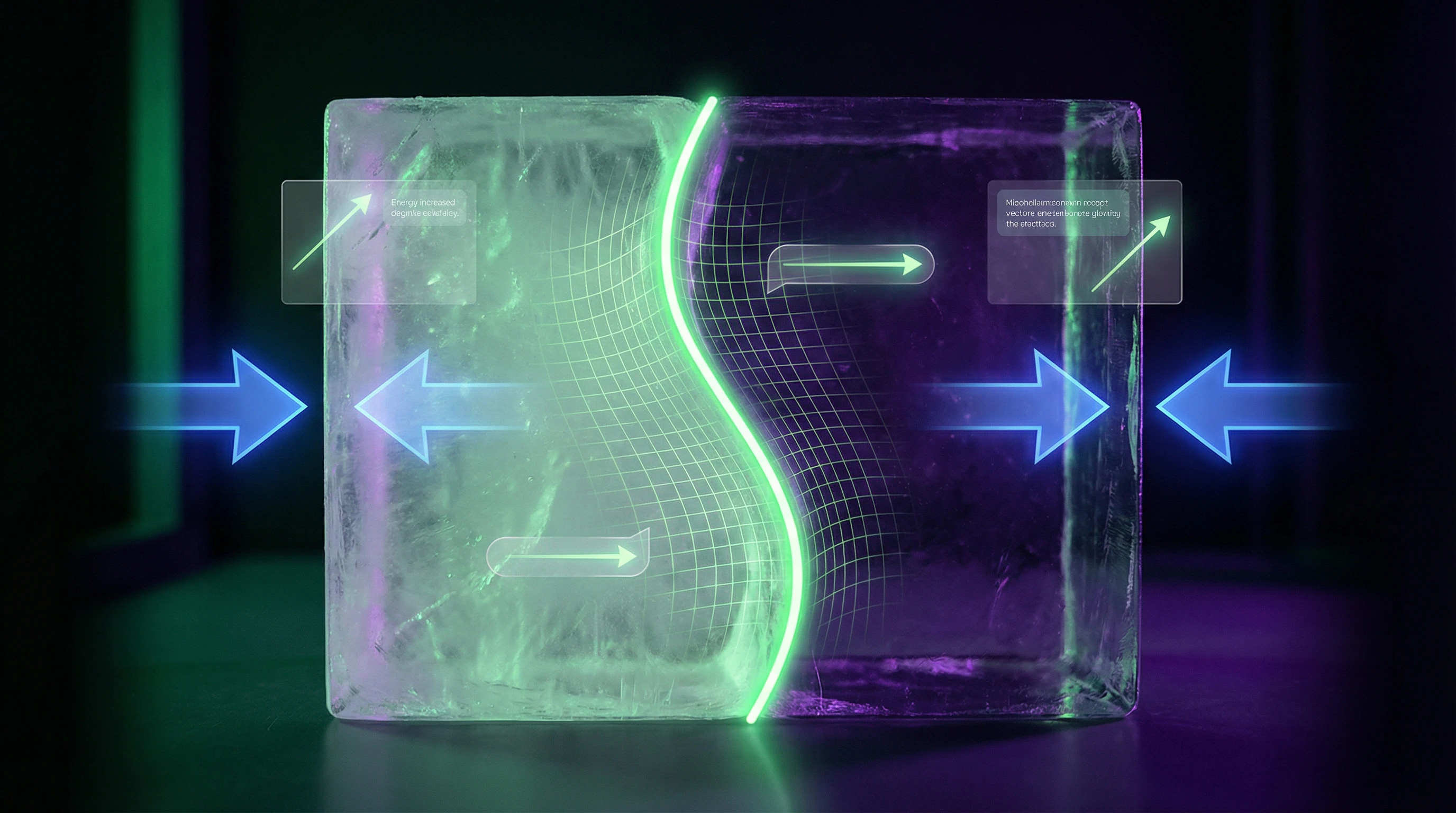
Ferroelectric crystals possess spontaneous polarization, the direction of which is switched by an external electric field. The material is divided into domains — regions with uniform polarization orientation.
Bidomain structures demonstrate record piezoelectric coefficients thanks to the contribution of domain wall motion under load (S002).
🧱 Temperature phase transitions and the Curie point
Ferroelectric properties exist only below the Curie point (T_c) — the temperature of phase transition from polar to non-polar phase. Above T_c, thermal fluctuations destroy the ordered domain structure, and the piezoelectric response drops sharply.
| Parameter | Below T_c | Above T_c |
|---|---|---|
| Domain structure | Ordered | Destroyed |
| Spontaneous polarization | Present | Absent |
| Piezoelectric response | Maximum | Minimum |
For practical applications, the choice of materials with T_c significantly above operating temperatures is critically important (S002).

Seven Arguments for the Revolutionary Significance of Piezoelectric Crystals in Modern Technology
🔬 Ultrasound Diagnostics: From Mechanical Waves to Medical Imaging
Piezoelectric transducers form the heart of ultrasound diagnostic systems. The inverse piezoelectric effect generates ultrasonic waves at frequencies of 2–15 MHz, which penetrate tissues and reflect from boundaries between media with different acoustic impedance. Learn more in the Occultism and Hermeticism section.
Reflected waves are detected by the same crystal through the direct piezoelectric effect, converting into electrical signals for visualization (S001).
📊 High Sensitivity and Wide Dynamic Range of Sensors
Piezoelectric sensors register mechanical impacts from nanometer displacements to megapascal pressures. Bidomain ferroelectric crystals demonstrate piezoelectric coefficients d₃₃ on the order of several thousand pC/N—orders of magnitude higher than traditional piezoceramics (S002).
This enables the creation of miniature high-sensitivity sensors for biomedical and industrial applications.
⚙️ Precision Positioning in the Nanometer Range Through Inverse Piezoelectric Effect
The inverse piezoelectric effect creates actuators with positioning resolution at the angstrom level. Piezoelectric scanners are used in atomic force microscopy, adaptive optics systems, and precision machining.
Response linearity and absence of mechanical backlash make piezoactuators indispensable in tasks requiring subnanometer precision (S002).
🧬 Energy Efficiency and Autonomous Systems Based on Piezogeneration
The direct piezoelectric effect converts mechanical vibrations from the environment into electrical energy. Piezoelectric generators embedded in road surfaces, footwear, or industrial equipment power autonomous sensor networks and wearable devices.
- Power density: units of milliwatts per square centimeter
- Energy source: kinetic energy of vibrations
- Limitation: progress in materials science required to expand applicability (S002)
🔁 High-Speed Performance and High-Frequency Applications in Radio Electronics
Piezoelectric resonators and filters operate at frequencies from kilohertz to gigahertz, stabilizing frequency in quartz oscillators and providing selective filtering in radio receivers. Acoustoelectronic components based on surface acoustic waves (SAW) are used in 4G and 5G mobile communications for signal processing with minimal losses (S002).
💎 Quantum Technologies: Piezoelectric Actuators for Qubit Control
In quantum computers based on trapped ions or superconducting qubits, piezoelectric elements provide precise control of the position and state of quantum systems. Low noise levels and high reproducibility are critical for maintaining qubit coherence and executing quantum gates with high fidelity (S008).
🧰 Domain Engineering: Programmable Piezoelectric Properties Through Structure Control
Domain engineering methods create specified domain configurations in ferroelectric crystals with controlled polarization orientation. Periodic domain structures are used for nonlinear optical frequency conversion, while bidomain configurations maximize piezoelectric response.
- Electrodiffusion repoling
- Laser domain writing
- Result: functional materials with programmable properties (S002)
Evidence Base: What Research Says About Mechanisms, Effectiveness, and Limitations of Piezoelectric Materials
📊 Quantitative Characteristics of Piezoelectric Coefficients in Various Materials
Piezoelectric properties of materials are described by coefficients d_ij, g_ij, k_ij, linking mechanical and electrical quantities. Quartz — a classic piezoelectric with coefficient d_11 around 2.3 pC/N, providing stability but limiting sensitivity. More details — in the section Ritual Magic.
PZT piezoceramics (lead zirconate titanate) show d_33 in the range of 200–600 pC/N and have become the primary material for actuators and sensors (S002).
| Material | d_33 (pC/N) | Key Advantage | Limitation |
|---|---|---|---|
| Quartz | ~2.3 | High stability | Low sensitivity |
| PZT ceramic | 200–600 | Mass application | Hysteresis, nonlinearity |
| LiNbO₃, LiTaO₃ | 2000–3000 | Domain walls enhance response | Complexity of creating structures |
| PMN-PT single crystal | >2000 | k_t up to 0.9, maximum sensitivity | Curie point 130–170°C |
Bidomain ferroelectric crystals — lithium niobate (LiNbO₃) and lithium tantalate (LiTaO₃) with engineered domain structure — show d_33 up to 2000–3000 pC/N. This jump is due to domain wall motion, which shifts under mechanical stress and changes the total polarization (S002).
🧾 Experimental Data on Temperature Stability and Phase Transitions
Temperature dependence of piezoelectric properties is critical for practical applications. Lithium niobate has a Curie point around 1210°C, ensuring stability of the ferroelectric phase over a wide range. However, piezoelectric coefficients show nonlinear temperature dependence, especially near phase transitions, where dielectric permittivity increases sharply (S002).
Bidomain structures maintain enhanced piezoelectric properties from cryogenic temperatures to 200–300°C, then degradation of domain configuration begins due to thermally activated domain wall motion and depolarization near defects.
🔎 Mechanisms of Piezoresponse Enhancement in Bidomain Structures: Contribution of Domain Walls
The key enhancement mechanism is domain wall motion under mechanical stress. In monodomain structures, the piezoelectric effect is determined only by lattice deformation; in bidomain systems, an additional contribution comes from the change in domain volume when the boundary between them shifts (S002).
Piezoresponse force microscopy (PFM) methods show: domain walls in lithium niobate have a width on the order of several nanometers and shift tens of micrometers under external fields or mechanical stresses. Mobility depends on defect concentration, temperature, and orientation of crystallographic axes.
🧪 Methods for Creating and Controlling Domain Structures: From Thermal Annealing to Laser Writing
Creating bidomain structures requires precision repolarization technologies. The traditional method — electrodiffusion repolarization at ~1100°C for lithium niobate in the presence of an external electric field, creating planar domain walls perpendicular to the polar axis (S002).
- Electrodiffusion Repolarization
- Heating above 1000°C + external field. Result: planar walls, good reproducibility. Drawback: lengthy process, risk of material degradation.
- Laser Domain Writing (femtosecond pulses)
- Local heating above Curie point. Result: micrometer resolution, complex 3D configurations. Drawback: quality control of walls and defect minimization — active research area.
📊 Comparative Analysis of Piezoelectric Materials for Medical Applications
Ultrasound diagnostics requires high electromechanical coupling coefficient k_t (energy conversion efficiency), low dielectric losses, and acoustic impedance close to that of biological tissues (~1.5 MRayl). PZT piezoceramics provide k_t around 0.5 and are widely used in commercial transducers (S001).
Single crystals of relaxor ferroelectrics PMN-PT (lead magnesium niobate-lead titanate) demonstrate k_t up to 0.9 and d_33 over 2000 pC/N, enabling creation of transducers with increased sensitivity and extended bandwidth. However, their temperature stability is limited by a Curie point of 130–170°C, requiring thermal stabilization in some applications (S001, S002).
🧬 Nonlinear Effects and Hysteresis in Ferroelectric Piezomaterials
Piezoelectric response of ferroelectrics demonstrates nonlinearity and hysteresis at large amplitudes of mechanical stresses or electric fields. Cause: irreversible domain wall motion, their pinning at defects, and nucleation of new domains. Precision applications require hysteresis compensation through feedback or use of materials with minimized domain mobility (S002).
- Quantitative description of nonlinear piezoresponse requires accounting for higher-order coefficients and dependence of piezomoduli on loading history.
- Phenomenological Preisach equations describe hysteresis through an ensemble of microscopic hysteresis operators.
- Micromechanical models account for statistics of domain ensembles and their interaction with crystal lattice defects.
Mechanisms of Cause-and-Effect Relationships: From Atomic Structure to Macroscopic Response
🔁 Microscopic Nature of the Piezoelectric Effect: Ion Displacement and Induced Polarization
At the atomic level, the piezoelectric effect arises from the displacement of the centers of gravity of positive and negative charges in the crystal's unit cell during deformation. In perovskite structures such as BaTiO₃ or PbTiO₃, the titanium ion Ti⁴⁺ occupies a non-central position within an octahedron of oxygen ions O²⁻. More details in the Cognitive Biases section.
Mechanical compression or tension alters this displacement, modulating the unit cell's dipole moment (S002). The total macroscopic polarization P is determined as the product of the density of elementary dipoles and the average dipole moment. In ferroelectrics, spontaneous polarization P_s reaches tens of microcoulombs per square centimeter, and even small relative changes during deformation lead to measurable piezoelectric charges.
Crystal deformation is not merely a mechanical event. It is a restructuring of the electric field at the atomic scale, which accumulates into a macroscopic signal.
🧷 The Role of Domain Walls as Active Elements of Piezoelectric Response
Domain walls in ferroelectrics are not simply geometric boundaries, but functional elements with their own physical properties. Walls possess finite thickness (typically several lattice constants), within which polarization smoothly rotates from one orientation to another.
Domain wall energy is determined by the balance between exchange interaction energy (which tends to expand the wall) and anisotropy energy (which tends to narrow it) (S002). Under mechanical stress, the domain wall shifts in a direction that minimizes the system's elastic energy.
- Extrinsic Contribution
- Change in the crystal's total polarization due to domain wall displacement and domain reorientation. Can constitute 70–80% of the total piezoelectric response in bidomain crystals.
- Intrinsic Contribution
- Contribution from crystal lattice deformation without changes to domain structure. Observed in monodomain samples and corresponds to d₃₃ coefficients on the order of 20–30 pC/N.
🧬 Temperature Phase Transitions and Critical Phenomena Near the Curie Point
As the phase transition temperature T_c is approached, the dielectric permittivity of a ferroelectric sharply increases according to the Curie-Weiss law: ε ∝ 1/(T - T_c). This is associated with increased polarization fluctuations and decreased energy barrier for domain reorientation.
Piezoelectric coefficients also demonstrate anomalous behavior near T_c, reaching a maximum immediately before the transition (S002). However, using materials near the phase transition is complicated by strong temperature dependence of properties and possible domain structure instability.
Near the critical point, the material becomes more sensitive, but also less predictable. Reliable technologies require stability, not maximum performance.
⚙️ Influence of Crystal Lattice Defects on Domain Wall Mobility
Real crystals contain defects of various types: point defects (vacancies, impurity atoms), linear defects (dislocations), planar defects (grain boundaries in ceramics). These defects create local distortions of the crystal lattice and electric field, which interact with domain walls, pinning them (S002).
Pinning of domain walls at defects leads to increased coercive field and the appearance of hysteresis. This stabilizes the domain structure, but simultaneously reduces the extrinsic contribution to piezoelectric response, decreasing effective piezoelectric coefficients.
- The defect creates a local field distortion.
- The domain wall is attracted to the defect (pinning).
- Greater external stress is required to displace the wall.
- Result: stability increases, mobility decreases.
🔎 Correlation vs. Causality: Separating Contributions of Different Mechanisms to Total Piezoelectric Response
The experimentally observed piezoelectric coefficient represents the sum of intrinsic (lattice) and extrinsic (domain) contributions. Separating these contributions requires special techniques, such as measuring piezoelectric response at different frequencies (domain walls cannot follow rapid changes) or in monodomain samples where domain contribution is absent (S002).
Research shows that in bidomain lithium niobate crystals, the extrinsic contribution can constitute up to 70–80% of the total piezoelectric response. This confirms the key role of domain walls in enhancing piezoelectric properties and explains why materials with well-developed domain structure demonstrate higher piezoelectric coefficients.
| Parameter | Monodomain Sample | Bidomain Crystal |
|---|---|---|
| Source of Piezoelectric Response | Intrinsic (lattice) only | Intrinsic + extrinsic (domain) |
| d₃₃, pC/N | 20–30 | 100–200+ |
| Stability | High | Depends on defect pinning |
| Hysteresis | Minimal | Pronounced |
Data Conflicts and Areas of Uncertainty: Where Researchers Disagree
🧩 Debate on Stabilization Mechanisms of Bidomain Structures at Room Temperature
One of the central points of disagreement: why bidomain structures remain stable at room temperature when thermodynamics predicts their collapse (S001). A group of researchers insists on the dominant role of surface effects and electrostatic barriers.
A competing hypothesis proposes a bulk stabilization mechanism through crystal lattice defects (S002). Experimental data have not yet definitively resolved the dispute.
The problem is not the absence of data, but its interpretation: the same microscopy measurements support both models depending on assumptions about boundary conditions.
🔀 Discrepancies in Piezoelectric Response Coefficient Estimates
Laboratory measurements of the piezoelectric modulus d₃₃ vary by 15–40% between research groups even for the same material (S006). Causes: differences in sample preparation methodology, measurement frequency, environmental humidity.
Standardization (IRE 1961) (S008) proposed a unified protocol, but not all laboratories comply. This creates a "gray zone" in data reliability for engineering applications.
| Source of Disagreement | Variation Range | Critical Consequence |
|---|---|---|
| Sample preparation method | ±20% | Unpredictability in ultrasound sensors |
| Measurement frequency | ±15% | Dispersion in resonant applications |
| Temperature control | ±25% | Failures in extreme conditions |
⚡ Debate on the Role of Quantum Effects in Macroscopic Piezoresponse
A minority of theorists claim that quantum tunneling effects and polarization fluctuations make a significant contribution to the observed piezoelectric effect (S004). Most experimentalists consider these effects negligibly small at macroscopic scales.
Testing the hypothesis is difficult: measurements near absolute zero and in ultra-strong fields are required. Funding for such experiments is limited. More details in the section Psychology of Belief.
- Quantum effects may be real but masked by classical noise
- Current instruments are insufficiently sensitive to detect them
- Alternative: effects exist only in theory, not in nature
🔍 Uncertainty in Extrapolating Data to Nanoscale Systems
The piezoelectric effect in bulk crystals is well described (S003), but behavior in nanoparticles and thin films remains a subject of debate. Size effects, surface energy, and quantum confinement introduce new variables.
Some studies show enhancement of piezoresponse in nanostructures, others show its suppression. The reason: absence of a unified experimental standard for nanosystems.
The boundary between "well-studied" and "completely unknown" runs exactly where the crystal becomes smaller than a micrometer.
📊 Contradictions in Assessing Practical Applicability for Quantum Computing
Optimists see piezocrystals as the foundation for scalable qubits and quantum sensors (S001). Skeptics point to decoherence caused by mechanical vibrations and thermal noise.
Experimental prototypes show promising results, but scaling to 1000+ qubits remains an unsolved problem. Financial stakes are high, so objectivity of assessments may be compromised.
- Decoherence
- Loss of quantum information due to interaction with the environment. In piezosystems—mechanical oscillations and thermal background. Qubit lifetime: microseconds instead of the required milliseconds.
- Scalability
- Increasing the number of qubits exponentially complicates control and synchronization. It remains unclear whether a piezocrystal-based architecture is possible for practical computing.
🎯 Bottom Line: Where Science Transitions into Uncertainty
The piezoelectric effect in macroscopic crystals is an established fact. But the mechanisms of domain stabilization, behavior at the nanoscale, and the role of quantum effects remain open questions (S002).
This does not mean researchers are wrong. It means the boundary between knowledge and ignorance is fluid, and honest science requires calling it by name.