 💠 Crystals and Talismans
Objects and Talismans: Symbols of Luck in Culture and Everyday Lifeλ
From ancient amulets to modern gaming artifacts — exploring the role of protective objects across different contexts: from sports mascots to art objects and virtual talismans.
Overview
Talismans exist at the intersection of matter, symbol, and psychology 🧩: from Olympic mascots to virtual artifacts in MMORPGs, from artisan "guardian" sculptures to knitted charms and bull figurines in banks. There's no scientific proof of magic, but their cultural role is immense—personal rituals, collective identity, placebo effect through confidence. We examine the mechanisms: why an object becomes a symbol of luck, how belief works, and where the line lies between cultural value and unverified promises.
🛡️
Laplace Protocol: This section is based on analysis of cultural practices, game mechanics, and commercial offerings. Academic research on the anthropology of talismans and the psychology of superstitious behavior requires additional study of specialized scientific databases.
Reference Protocol
Scientific Foundation
Evidence-based framework for critical analysis
Protocol: Evaluation
Test Yourself
Quizzes on this topic coming soon
Sector L1
Articles
Research materials, essays, and deep dives into critical thinking mechanisms.
💠 Crystals and Talismans 💠 Crystals and Talismans
 💠 Crystals and Talismans
⚡
Deep Dive
Talismans in Gaming Culture: From Virtual Artifacts to Collectible Items
The modern gaming industry has transformed the concept of talismans into a complex system of virtual objects, where each item possesses measurable characteristics and influences gameplay. In massively multiplayer online role-playing games (MMORPGs), talismans function as equipment slots that determine character parameters—from attack speed to defensive stats.
Gaming communities actively discuss optimal combinations of these objects, creating detailed guides for selecting characteristics like haste or versatility for different gameplay roles.
Equipment Mechanics in MMORPGs and the Slot System
In games like World of Warcraft, the "trinket" category represents specialized equipment slots that players fill with items offering unique bonuses. These virtual talismans aren't merely decorative elements—they mathematically impact combat effectiveness through a system of secondary statistics.
| Game Context | Stat Priority | Selection Strategy |
|---|---|---|
| Raid Content | Stability, damage, survivability | Maximize primary stats |
| PvP Combat | Reaction speed, adaptability | Hybrid sets for different situations |
| Resource Farming | Speed, efficiency | Specialized equipment |
Players conduct detailed analysis, comparing items by critical strike, haste, and mastery ratings to achieve optimal balance for their character class. The community has developed sophisticated calculators and simulators to determine the most effective equipment combinations.
Stat Optimization and Collecting Culture
Collecting gaming talismans has evolved into a distinct aspect of gaming culture, where an object's value is determined not only by its statistical performance but also by its acquisition rarity. Players spend hundreds of hours farming specific items, building personal collections of unique equipment.
Possessing a rare talisman demonstrates the owner's experience and achievements—this reproduces the traditional relationship with talismans as special objects possessing symbolic value beyond utilitarian function.
This dynamic shows how gamification translates traditional concepts of luck and protection into the language of measurable metrics, while preserving the psychological mechanism: owning a rare object creates a sense of exclusivity and control over the gaming experience.

Olympic Mascots and Sports Symbolism: From Munich to the Present
Olympic mascots are an institutionalized form of symbolic objects, where each mascot carries the cultural code of the host country and becomes a recognizable brand of a global event. Simultaneously, they function as commercial products, educational materials, and cultural artifacts that preserve the memory of athletic achievements.
History of Olympic Mascots as Cultural Markers
The first Olympic mascots appeared in 1968, but official status was granted to Waldi the dachshund at the 1972 Munich Games, symbolizing the endurance and agility of athletes. Since then, each host country has created unique characters reflecting national identity.
- Panpan the Panda (Beijing, 2008)
- Reflected China's connection to nature and world heritage; became one of the most recognizable Olympic symbols.
- Mythological Creatures (Tokyo, 2020)
- Integrated Japanese cultural tradition into contemporary sports context.
- Waldi (Munich, 1972)
- First official mascot; established the precedent of national symbolism in Olympic branding.
Mascots transform into material carriers of Olympic history through mass production and collecting, creating a tangible connection between spectator and event.
Educational Significance of Sports Symbols
Educational institutions integrate Olympic symbolism through interactive formats: students participate in quizzes, identifying mascots from various Olympics and explaining their cultural significance. Such activities develop knowledge of world history, geography, and intercultural communication.
- Identification of mascots and their national codes
- Analysis of symbolic evolution across decades
- Discussion of branding's role in shaping collective memory
- Creation of original mascot concepts to develop creative thinking
Olympic mascots work as entry points into deeper themes of national identity and symbolic communication—a student who remembers Panpan the panda begins to understand how countries use sporting events for cultural diplomacy.
Student competitions often include assignments to design mascots, developing understanding of how visual symbols encode and transmit cultural meanings to a global audience.
Art Objects as Modern Talismans: From Galleries to Office Spaces
Contemporary art reinterprets the concept of talismans, creating original objects positioned as carriers of energy and protective symbols for personal and public spaces.
Artists develop collections under names like "Guardians," presenting sculptures and art objects as functional talismans for homes and offices. These works balance between aesthetic value and symbolic function, offering buyers not merely decorative items, but objects with attributed protective properties.
The strategy combines traditional beliefs with the contemporary art market: the ancient concept of apotropaic objects is adapted to demand for material symbols of luck.
Original "Guardians" Collections and Protection Symbolism
Artistic collections of contemporary talismans often consist of series of unique handcrafted objects, each created as an individual "guardian" for a specific space.
Artists use diverse materials—from ceramics to textiles—and position their works as sources of positive energy and protection. Exhibitions take place in galleries and are promoted through social media, where artists emphasize the uniqueness of each object and its ability to "protect" the owner.
- Materials: ceramics, textiles, mixed media
- Promotion channels: galleries, social media, exhibitions
- Positioning: uniqueness + symbolic protection
- Target audience: buyers seeking aesthetics and symbolism simultaneously
Art Objects in Public Space and Corporate Symbolism
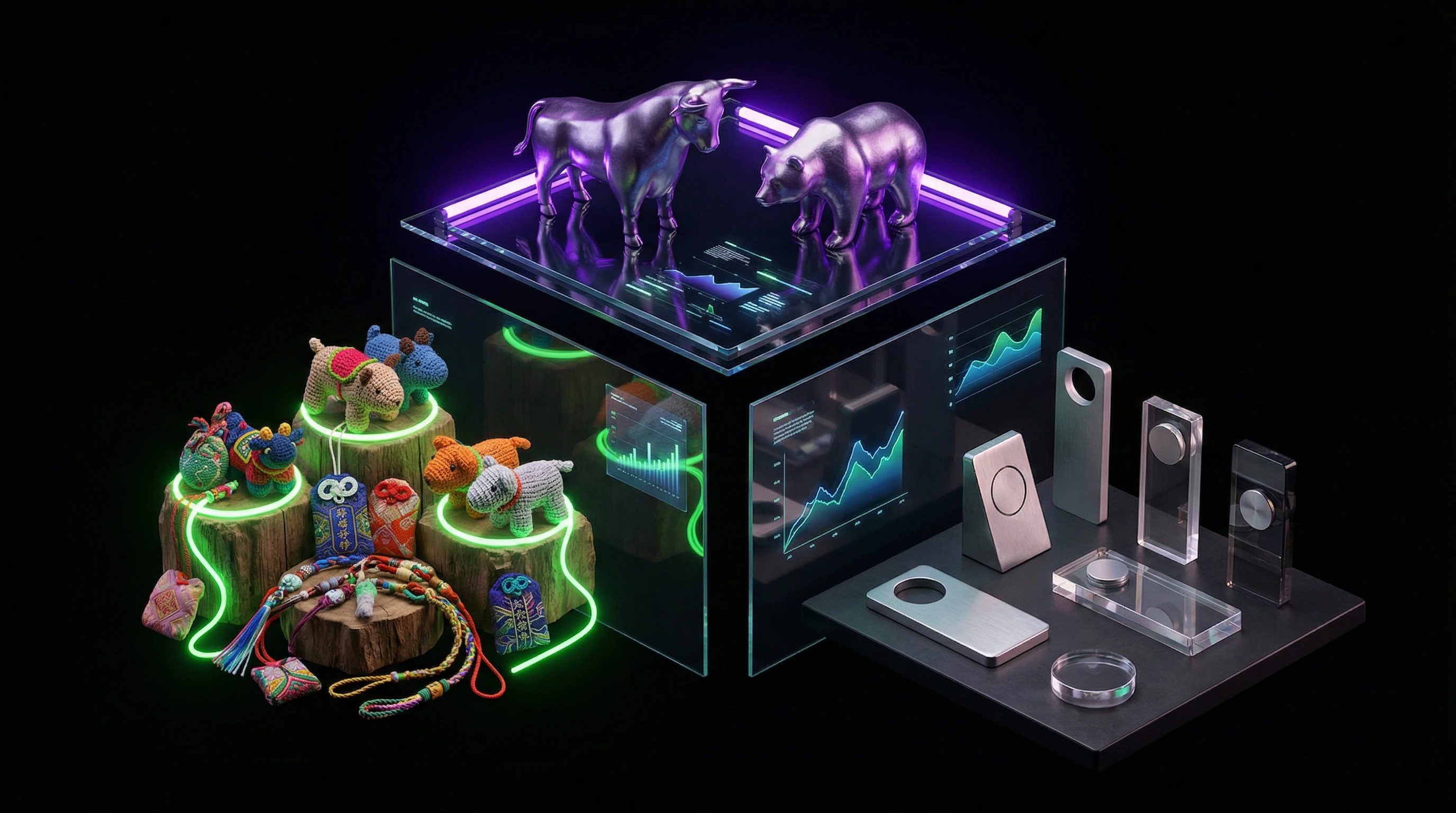
The commercial sector actively uses the talisman concept, placing sculptures of bulls and bears in offices and financial institutions as symbols of success and prosperity.
These objects function as corporate talismans, intended to attract business luck and create an atmosphere of confidence for employees and clients. The decorative talisman market includes a wide spectrum of items—from handcrafted knitted toys to monumental sculptures for office lobbies.
Manufacturers position these objects as "bringing success" and "charging with energy," using the language of traditional beliefs to market contemporary decorative products. This reflects sustained demand for material symbols of luck in corporate culture.
Handmade Talismans and Corporate Success Symbols in the Modern Market
Business Success Symbols and Their Functions
Corporate talismans occupy a special place in business culture, where material objects create an atmosphere of confidence and attract luck. Bull and bear sculptures in financial company offices function simultaneously as decorative elements and psychological anchors for employees.
Manufacturers position these objects as "energy-charging" and "bringing success," using the language of traditional beliefs to market contemporary products. Monumental sculptures create a company's visual identity, transforming abstract concepts of success into tangible forms.
A corporate talisman works not through magic, but through anchoring: an employee sees a symbol of strength—and this influences their decisions and self-confidence.
The Handmade Talisman Market and Its Positioning
The decorative talisman market includes knitted toys, artistic objects, and animal figurines. Artists position handcrafted works as sources of positive energy and protection, which is reflected in exhibition descriptions and commercial offerings.
E-commerce platforms offer mass-produced decorative talismans, demonstrating sustained global demand for material symbols of luck. Handmade objects are positioned as more "energetically charged" due to the craftsperson's individual approach, though these claims lack empirical foundation.
- Mass-produced items—affordable pricing, mass production, standardized symbolism
- Handcrafted works—premium segment, uniqueness, appeal to the maker's "personal energy"
- Corporate commissions—brand customization, integration into corporate culture
The price difference between a mass-produced talisman and a handmade version reflects not magical properties, but rarity, authorship, and the psychological value of uniqueness to the buyer.
Psychological Mechanisms of Belief in Protective Objects
The Placebo Effect and Confidence Through Material Symbols
Belief in the protective properties of talismans functions through psychological mechanisms similar to the placebo effect: subjective confidence influences behavior and perception of outcomes.
In gaming communities, players attribute "lucky" properties to certain equipment items based on subjective experiences of successful sessions. This creates stable preference patterns independent of the items' objective characteristics.
The materiality of an object amplifies the psychological effect: the physical presence of a talisman provides a constant reminder of intention or goal, which influences motivation and persistence through self-fulfilling prophecy mechanisms.
Corporate talismans create an atmosphere of confidence for employees and clients, functioning as visual anchors for positive expectations and collective identity.
Cultural Anthropology of Material Symbols
Talismans are a universal cultural phenomenon of materializing abstract concepts of protection, luck, and identity through physical objects.
- Olympic mascots function as symbols of national identity and sporting values, creating an emotional connection between spectators and the event.
- Different cultural contexts attribute protective properties to different types of objects—from religious amulets to secular symbols of success.
- The commercialization of talismans reflects the transformation of traditional beliefs into consumer practices, where ancient concepts of protection adapt to market logic.
This flexibility of the human capacity to imbue material objects with symbolic meaning demonstrates how cultural meanings become embedded in objects independent of their physical properties.
Critical Analysis of Effectiveness and Scientific Approach to Talismans
Absence of Empirical Evidence for Protective Properties
Peer-reviewed research confirming objective effectiveness of talismans in attracting luck or providing protection does not exist. All available materials — gaming forums, commercial offerings, social media — are based on subjective testimonials and marketing claims without scientific foundation.
Gaming communities discuss equipment combinations based on game mechanics, not magical properties. This demonstrates a rational approach even in contexts where talisman terminology is used.
The significant gap between popular perceptions of talismans and scientific study of this phenomenon indicates the need for specialized research in anthropology and psychology.
Distinction Between Symbolic and Magical Value
The symbolic function of objects — creating emotional connections, expressing identity, materializing intentions — has real psychological and social significance independent of belief in supernatural effects.
Commercial sources conflate symbolic and magical value, using the language of traditional beliefs to promote decorative items. This creates potential for consumer manipulation through exploitation of superstitions.
- Study psychological mechanisms of belief in protective objects
- Analyze cultural functions of material symbols
- Research social practices associated with talismans
- Avoid unsubstantiated claims about objective effectiveness
A scientific approach to talismans should focus on these four directions, separating real psychological effects from claims of supernatural influence on external circumstances.
Knowledge Access Protocol
FAQ
Frequently Asked Questions
These are character equipment slots that affect stats and combat effectiveness. In games like World of Warcraft, players optimize item combinations to maximize speed, attack power, or defense. The community actively discusses the best builds for different classes and playstyles.
No scientific evidence exists for the magical effects of talismans. Their effect is explained by psychology: belief in a protective object increases confidence and reduces anxiety, which indirectly improves outcomes. This is a classic placebo effect, working through self-suggestion.
Official Olympic mascots are symbolic characters reflecting the host country's culture. They serve educational purposes, helping schoolchildren learn about sports history and geography. Mascots become collectible items and tourist souvenirs.
Bull and bear figurines are popular as symbols of financial growth and stability. Choose objects that resonate with corporate values: custom art pieces emphasize creativity, classical sculptures convey solidity. The key is the symbol's personal significance to the team.
Artisan pieces are unique, created by hand with the maker's personal energy invested. They're valued by collectors for their individuality and craftsmanship, unlike factory copies. In the handmade amulet market, price reflects labor investment and artistic value.
Key parameters are haste, critical damage, and bonuses to class primary stats. Players analyze synergy between items to reach stat breakpoints. Optimal builds depend on character role: tank, healer, or damage dealer.
Available sources contain no peer-reviewed academic studies on this topic. Serious investigation would require ethnographic research, psychological experiments, and historical analysis from specialized databases. Current mentions are limited to forums, commercial sites, and social media.
These are artisan sculptures positioned as contemporary talismans for home and office. Artists use various materials and techniques, creating unique objects with symbolic meaning. Works are presented at exhibitions and sold through galleries and online platforms.
This is an ancient psychological mechanism for seeking control over uncertainty. A material symbol provides a sense of security and reduces stress in unpredictable situations. Cultural anthropology shows the universality of this phenomenon across all societies.
Yes, online games have a developed culture of collecting rare equipment items. Players spend hundreds of hours farming unique talismans, trading them, and displaying them in profiles. Some virtual items sell for real money.
No, an object's age doesn't grant it supernatural properties. Antique amulets hold historical and cultural value, but their 'power' is a projection of the owner's belief. Archaeological finds matter to science, not magical practices.
Artisan pieces are sold at exhibitions, galleries, and marketplaces like Etsy. Mass-market options are available on Amazon, eBay, and souvenir shops. Check seller reviews and request photos of the actual item before purchasing.
Schools use Olympic symbols for quizzes and competitions on sports history. Students study the cultural significance of mascots from different countries, broadening their perspectives. This makes learning interactive and memorable through tangible objects.
Symbolic value is cultural meaning recognized by society without belief in the supernatural. Magical value assumes literal belief in an object's paranormal influence. The former is studied by science, the latter relates to personal convictions without evidence.
Choice depends on purpose: wood and ceramic are eco-friendly for home décor, metal is durable for jewelry. Handmade artisans use natural fabrics, stones, polymer clay. Quality craftsmanship and personal connection matter more than the material itself.
There's no direct physical influence, but the psychological effect is real. Athletes with a 'lucky' item feel more confident, improving focus and reducing pre-competition anxiety. This works through ritual and self-conditioning, not magic.