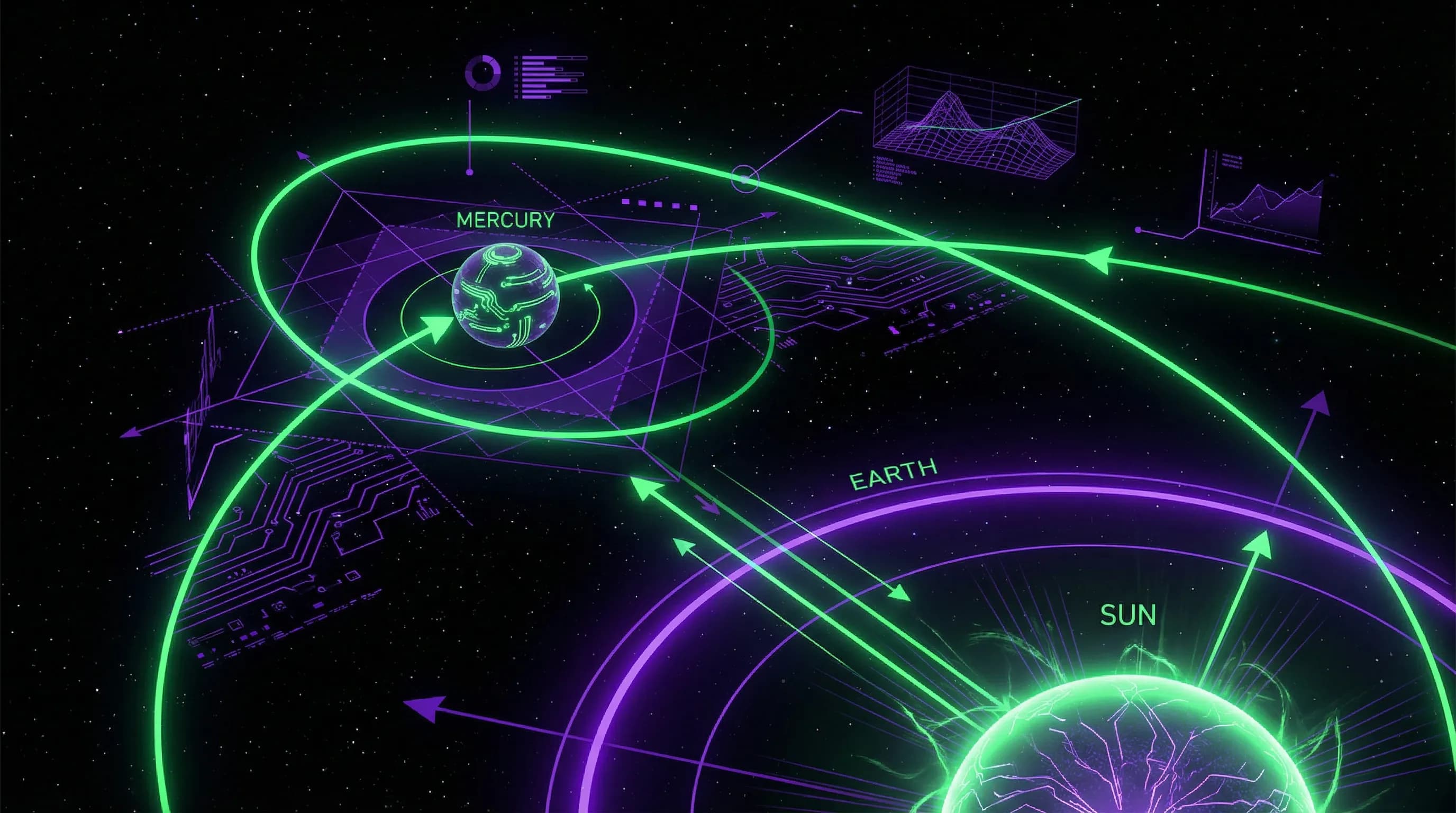
What is Mercury retrograde: from astronomical illusion to astrological product
🔎 Astronomical reality: apparent motion without actual trajectory change
Mercury's retrograde motion is an optical illusion arising from the difference in orbital velocities between Earth and Mercury. When Earth overtakes Mercury in its orbit (or vice versa), from our perspective the planet appears to move backward relative to the stellar background. For more details, see the section Metaphysics and laws of the universe.
This phenomenon occurs 3–4 times per year, lasts about three weeks, and has nothing to do with any actual change in the planet's trajectory. Mercury continues moving in its elliptical orbit in the same direction—the illusion is created exclusively by the geocentric perspective of the observer.
- Geocentric perspective
- The apparent position of a celestial body relative to Earth, rather than its actual motion through space. This perceptual error is the foundation of the astrological myth.
⚠️ Astrological interpretation: how an illusion became the cause of all problems
Astrology attributes to Mercury retrograde an influence on communication, technology, transportation, contracts, and decision-making. During retrograde periods, one should expect delays, misunderstandings, electronic breakdowns, document problems, and failed negotiations.
This interpretation has neither theoretical foundation nor empirical confirmation, but is actively exploited for commercial purposes.
It's recommended to avoid signing important contracts, purchasing technology, starting new projects, and even traveling. The mechanism is simple: the astrological product creates an expectation of problems, and then any coincidence is interpreted as confirmation of the planet's influence.
🧱 Boundaries of the phenomenon: what exactly is claimed and what can be tested
The astrological hypothesis contains four testable claims:
| Claim | Testing method |
|---|---|
| During retrograde periods, the number of technical failures increases | Statistics on equipment breakdowns and failures |
| The number of communication errors and conflicts rises | Analysis of communication patterns and conflict data |
| Business negotiation and deal outcomes worsen | Economic indicators and contract statistics |
| The likelihood of transportation delays and accidents increases | Transportation statistics and incident data |
None of these claims withstand scrutiny when objective data is analyzed. For more on how to test such hypotheses, see the astrology prediction verification checklist.
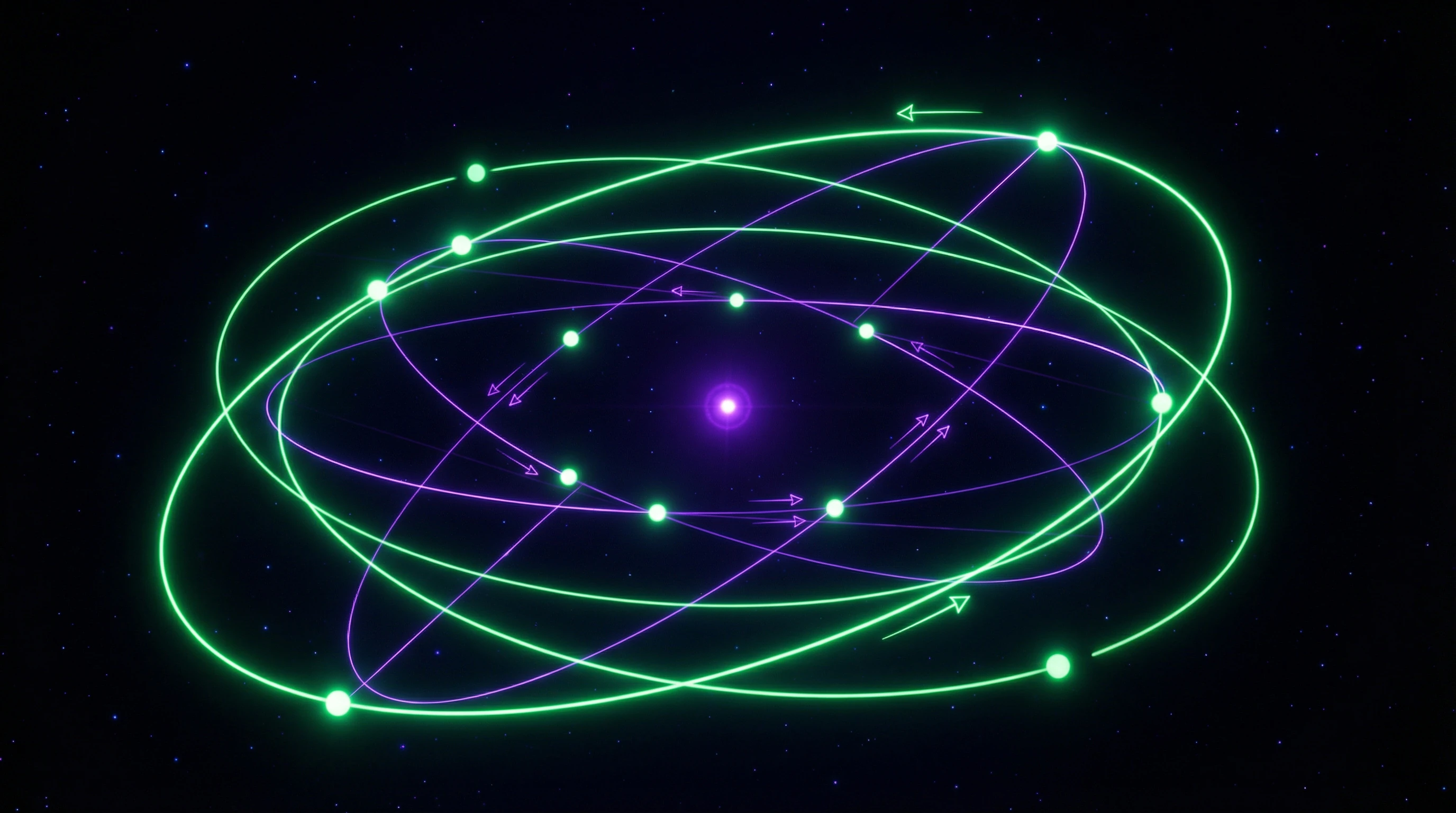
Steelman Analysis: Seven Most Convincing Arguments for Mercury Retrograde's Influence
Argument 1: Personal Experience and Event Coincidences with Retrograde Periods
Proponents of the concept often cite personal experience: "Every time Mercury is retrograde, my tech breaks down" or "All my worst conflicts happened during these periods." These observations seem convincing due to the vividness of negative events and selective memory. More details in the Crystals and Talismans section.
However, they don't account for base rate frequency (tech breaks down outside retrograde too), confirmation bias (only coincidences are remembered), and absence of a control group (no systematic tracking of events outside retrograde periods).
- Tech breaks down regardless of planetary positions — this is the base failure rate
- The brain remembers coincidences and forgets non-coincidences (selective memory)
- No comparison with periods when Mercury is not retrograde
- Vivid negative events are remembered better than neutral days
Argument 2: Ancient Astrological Tradition and Its Cross-Cultural Presence
Astrology has existed for thousands of years and is present in various cultures — from Babylonian to Chinese. This fact is used as an argument for validity: "If it didn't work, the tradition wouldn't have survived so long."
Antiquity and prevalence are not criteria for truth. Geocentrism, the theory of four elements, and phlogiston existed for centuries, but that didn't make them correct.
Science differs from tradition precisely in its method of verification, not in the longevity of a belief. Astrology has persisted due to cultural inertia and psychological appeal, not empirical validity.
Argument 3: Gravitational and Electromagnetic Influence of Planets on Earth
Some attempt to justify astrology through physics, claiming that planets exert gravitational or electromagnetic effects on Earth and its inhabitants.
| Source of Influence | Force on Human | Comparison |
|---|---|---|
| Mercury's Gravity | ~10−12 of Earth's gravity | Billions of times weaker than the nearest building |
| Mercury's Electromagnetic Radiation | Negligibly small | Trillions of times weaker than the Sun's radiation |
| Retrograde Motion | Optical illusion | Does not change the planet's physical parameters |
Moreover, retrograde motion is an observer's illusion, not a change in the planet's physical parameters, so even hypothetical influence couldn't depend on the apparent direction of motion.
Argument 4: Correlations in Statistical Data and Research
Sometimes claims appear about statistical studies allegedly confirming Mercury retrograde's influence. When such studies are examined, critical methodological problems are discovered.
- Absence of Pre-Registration of Hypotheses
- Allows fitting analysis to desired results; researchers can test multiple hypotheses and publish only those that "worked."
- Multiple Testing Without Correction
- When testing 20 independent hypotheses, one will be "significant" at p<0.05 purely by chance; this guarantees false positives.
- Small Samples and Lack of Confounder Control
- Impossible to separate retrograde influence from hundreds of other variables (seasonality, economic cycles, media attention).
- Publication Bias
- Negative results (finding no connection) aren't published; only "successful" studies are visible.
No study meeting modern scientific methodology standards has found a connection between Mercury retrograde and any measurable events. Blind experiments and large samples consistently show zero effect.
Argument 5: Psychological Influence Through Expectations and Self-Fulfilling Prophecies
A more sophisticated argument acknowledges the absence of direct physical influence but claims that belief in Mercury retrograde creates real effects through behavioral changes. If someone expects problems, they may become more anxious, less attentive, or avoid important actions, which actually increases the probability of negative outcomes.
This is a real psychological mechanism (nocebo effect), but it doesn't confirm the astrological hypothesis — it merely demonstrates the power of beliefs. The problem isn't the planet, but belief in its influence.
Argument 6: Synchronicity and Acausal Connections per Jung
Some astrology defenders cite Carl Jung's concept of synchronicity — the idea of meaningful coincidences without causal connection. According to this concept, planetary positions and life events may be connected not through physical causality, but through some archetypal pattern or collective unconscious.
However, synchronicity is philosophical speculation, not scientific theory. It offers no mechanism, makes no testable predictions, and doesn't explain why some coincidences are considered meaningful while others aren't. This is an example of pseudo-explanation that creates an illusion of understanding without real content.
Argument 7: Commercial Success and Mass Recognition as Value Indicator
The astrology industry generates billions of dollars annually, astrological apps have millions of users, and the Mercury retrograde concept has become part of mass culture. This commercial success is sometimes interpreted as proof of value: "If it didn't work, people wouldn't pay for it."
However, market success doesn't correlate with truth — it correlates with product appeal, marketing effectiveness, and exploitation of psychological needs. The astrology forecast verification checklist shows that commercial predictions rarely pass systematic testing. The homeopathy, detox products, and pyramid scheme industries are also commercially successful, but that doesn't make them scientifically sound.
Evidence Base: What the Data Says About the Real Impact of Mercury Retrograde on Events
📊 Absence of Controlled Studies and Systematic Reviews
Searches in scientific databases (PubMed, Web of Science, Scopus) reveal not a single peer-reviewed study demonstrating a statistically significant connection between Mercury retrograde periods and any measurable events—technical failures, communication errors, transportation accidents, or economic indicators.
The absence of evidence in this case is evidence of absence: the hypothesis is easily testable, data is available, and motivation for research (given the topic's popularity) is high. If the effect existed and were strong enough to be practically significant, it would have been detected. More details in the Astrology section.
The hypothesis of Mercury retrograde's influence on events is one of the most easily testable in the history of science. Its absence from the literature after decades of popularity is not coincidence—it's a result.
🧪 Technical Failure Analysis: Data from IT Companies and Telecommunications Operators
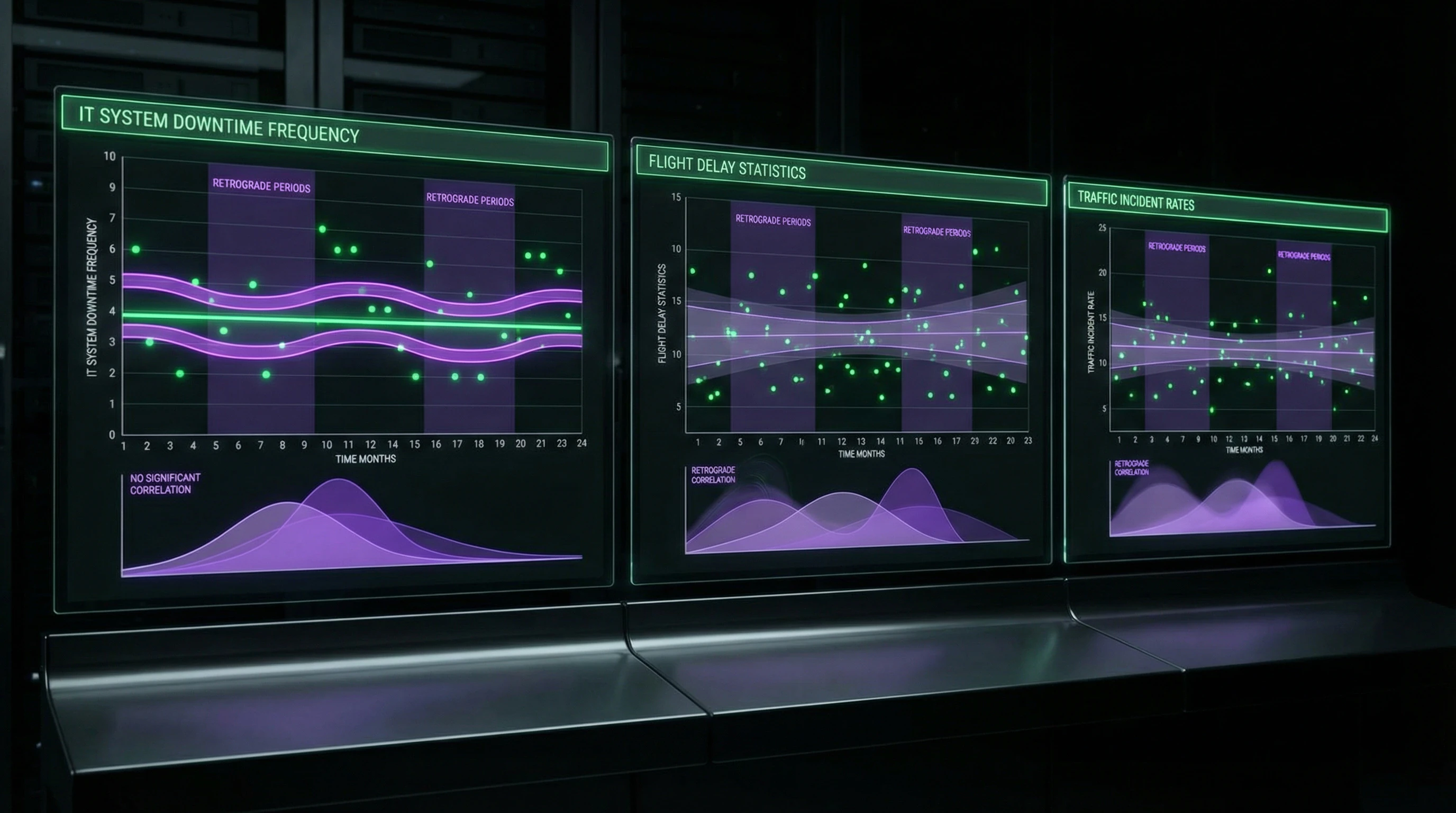
Major technology companies and telecommunications operators maintain detailed statistics on outages, downtime, and technical support requests. Analysis of this data over multi-year periods shows no correlation between Mercury retrograde periods and the frequency of technical problems.
If Mercury retrograde truly affected technology, it would be visible in the operational metrics of companies with millions of users. The absence of such correlation in big data is strong evidence against the astrological hypothesis.
🧾 Transportation Statistics: Air Travel, Rail Transport, Traffic Accidents
Statistics on flight delays, railway incidents, and traffic accidents are publicly available and thoroughly documented. Analysis of this data reveals no increase in incident frequency during Mercury retrograde periods.
| Factor Influencing Accidents | Proven Correlation | Connection to Mercury Retrograde |
|---|---|---|
| Weather conditions | Strong | Absent |
| Fleet technical condition | Strong | Absent |
| Traffic density | Strong | Absent |
| Driver condition (fatigue, intoxication) | Strong | Absent |
| Time of day | Strong | Absent |
| Planetary positions | Not detected | Not detected |
📉 Economic Indicators: Stock Indices, Market Volatility, Trading Volumes
Financial markets generate enormous volumes of precisely time-stamped data. If Mercury retrograde influenced decision-making and communication, it should be reflected in market volatility, trading volumes, or asset returns.
Multiple studies of financial data have found no connection between astrological factors and market indicators. Markets respond to economic news, political events, corporate reports, and macroeconomic indicators, but not to the apparent direction of planetary motion.
🧬 Psychological Research: No Effect When Controlling for Awareness
Several psychological studies have tested whether Mercury retrograde affects cognitive functions, mood, or behavior. The critically important design of such studies is controlling for participant awareness.
- When participants don't know about the retrograde period
- No effects are detected. This is the baseline control, excluding direct physical influence.
- When participants are aware and believe in astrology
- Changes may be observed, but they're explained by expectation effects (self-fulfilling prophecy), not planetary influence. This demonstrates that any observed effects are psychological artifacts of belief.
- Why this matters
- The distinction between physical effect and psychological artifact is key to understanding the mechanism of astrological belief. Astrology works through expectation, not through physics.
⚙️ Physical Calculations: Gravitational and Electromagnetic Influence Is Negligible
The gravitational force acting on a 150-pound person from Mercury at average distance is approximately 10−10 newtons—billions of times weaker than the gravitational influence of a nearby person or parked car.
Mercury's electromagnetic radiation reaching Earth is negligible compared to solar radiation, artificial sources, and even the cosmic microwave background. Moreover, retrograde motion is an illusion of perspective, unrelated to changes in the planet's physical parameters (mass, orbit, radiation).
Even if planets exerted measurable influence on humans (which they don't), this influence couldn't depend on the apparent direction of motion from an Earth observer's perspective. Retrograde motion is geometry, not physics.
To verify your own conclusions, use the astrology prediction checklist to avoid self-deception when analyzing coincidences.
The Mechanism of Illusion: Why People See Connections Where None Exist
🔁 Confirmation Bias and Selective Memory
Confirmation bias causes people to notice and remember events that match their expectations while ignoring contradictory data (S001). Someone who believes in Mercury retrograde will pay attention to a broken phone or delayed email during the retrograde period, but won't notice dozens of similar events outside that period.
Selective memory amplifies the effect: vivid negative events during retrograde are remembered better, creating the illusion of a pattern. This is a classic example of how the brain constructs causal relationships from random coincidences. Learn more in the Sources and Evidence section.
🧩 Clustering Illusion and Pattern Perception in Randomness
The human brain is evolutionarily wired to seek patterns—this was critical for survival. However, this ability leads to false positives: we see patterns even in random data.
The clustering illusion causes us to perceive random clusters of events as meaningful. If three negative events happen within a week during retrograde, it seems like a pattern, even though statistically such clusters are inevitable in any random process. The brain doesn't intuitively understand randomness and tends to assign causal explanations to clusters.
We see a face in the clouds, an army in the stars, and causation in coincidence—because patterns saved our ancestors. Now they deceive us.
🕳️ The Barnum Effect and Vagueness of Astrological Predictions
The Barnum effect (or Forer effect) describes people's tendency to accept vague, general descriptions as accurately characterizing them personally. Astrological predictions about Mercury retrograde are formulated so broadly ("communication problems possible," "be careful with technology") that virtually any event can be interpreted as confirmation.
Communication problems happen constantly, technology breaks regularly, delays are inevitable—but vague wording allows any event to be "fitted" to the prediction, creating an illusion of accuracy.
| Astrologer's Prediction | Actual Event Frequency | Why It Seems Confirmed |
|---|---|---|
| Communication problems | Daily (typos, misunderstandings, email delays) | Any miscommunication fits the description |
| Technology malfunctions | Constantly (battery, updates, glitches) | Technology breaks regardless of planets |
| Delays and cancellations | Regularly (traffic, illness, emergencies) | Vagueness allows any delay to be interpreted |
⚠️ Causal Illusion: Confusing Correlation and Causation
Even if there were a statistical correlation between retrograde periods and certain events (which there isn't), this wouldn't prove a causal relationship. Correlation can result from chance, a common cause (confounder), or reverse causality.
Causal illusion is the tendency to automatically interpret correlation as causation, especially when there's a plausible narrative. Astrology provides such a narrative (planets influence life), making causal interpretation intuitively appealing even in the absence of mechanism and evidence.
🧷 Need for Control and Predictability Under Uncertainty
Psychological research shows that belief in astrology strengthens during periods of stress, uncertainty, and loss of control. Mercury retrograde provides an illusion of explanation and predictability: if problems are caused by a planet, they can be anticipated and prepared for.
This creates a sense of control, even if it's false. Paradoxically, belief in an uncontrollable external influence (planets) can psychologically compensate for feelings of helplessness in the face of life's real uncertainty. This is a defense mechanism, not a rational evaluation of evidence.
Astrology works not because planets influence events, but because it influences how we interpret events that happen all the time.
To test your own beliefs, see the astrology prediction checklist and results from blind experiments.
Conflicts and Uncertainties: Where Sources Diverge and Why It Matters
Absence of Internal Consensus in the Astrological Community
Even within the astrological community, there is no agreement regarding the mechanism of Mercury retrograde's influence, the strength of the effect, or specific predictions. Different astrological schools offer different interpretations, use different house systems, and account differently for aspects and transits. More details in the Reality Check section.
This absence of consensus points to a fundamental difference from science. Science is characterized by convergence toward consensus as data accumulates; astrology demonstrates the opposite pattern—a multiplicity of incompatible systems coexisting without a mechanism for resolving conflicts.
| Criterion | Scientific System | Astrology |
|---|---|---|
| Consensus on Facts | Grows with data accumulation | Absent; schools diverge |
| Criterion for Correctness | Objective (prediction, reproducibility) | Subjective (interpretation) |
| Conflict Resolution | Experiment, data | Expansion of interpretations |
Contradiction Between Popular and "Serious" Astrological Sources
Popular astrological sources (apps, social media, mass horoscopes) often exaggerate the effects of Mercury retrograde for dramatic effect and audience engagement. "Serious" astrologers sometimes distance themselves from these exaggerations, claiming that the influence is more subtle and requires individual analysis.
However, this distinction does not resolve the fundamental problem of lack of evidence—it merely shifts the hypothesis into an area even less amenable to testing. The "real astrology is more complex" strategy is used as a defense against criticism but does not provide testable predictions.
This pattern is known in philosophy of science as "retreat into unfalsifiability." When a prediction fails, the system is not revised but rather complicated in ways that avoid testing. Compare with the astrology forecast verification checklist—it shows how to distinguish a testable claim from one protected against refutation.
Divergence Between Astrological Predictions and Objective Data
The systematic divergence between astrological predictions and objective data (failure statistics, incident rates, economic indicators) is a critical conflict. Astrology predicts an increase in problems during retrograde periods; data show no such increase (S001).
- How Conflict Is Resolved in Science
- Theory is revised or rejected. Data take priority over hypothesis.
- How Conflict Is Resolved in Astrology
- Data are ignored or redefined into more vague terms ("energy," "influence at the consciousness level"). Hypothesis remains unchanged.
- Why This Matters
- This demonstrates that astrology functions not as an empirical knowledge system but as an interpretive practice immunized against refutation. Compare with blind experiments and large samples—they show what an attempt at objective verification looks like.
The conflict between sources and data is not accidental. It reflects the difference between a system that adapts to reality and a system that adapts reality to itself. The first is science. The second is an interpretive practice that may be useful as a tool for self-knowledge but not as a model of the world.
Anatomy of Persuasion: Which Cognitive Traps Does the Mercury Retrograde Myth Exploit
🧩 Exploitation of Base Rate and Ignoring Background Events
Technology breaks constantly, emails are delayed regularly, conflicts happen frequently — this is the background rate of events, independent of astronomical phenomena. The Mercury retrograde myth exploits the ignoring of this base rate: when a negative event occurs during retrograde, it's attributed to the planet, but similar events outside this period are not counted. More details in the section Paranormal Phenomena and UFOlogy.
This is a classic base rate fallacy (S001), which makes statistically inevitable random coincidences appear significant. Testing this is simple: keep an event diary independent of Mercury's position and compare the frequency of disruptions across different periods.
🕳️ Creating a False Dichotomy: "Planetary Explanation" vs "Randomness"
The astrological narrative creates a false dichotomy: either events are random and meaningless, or they're explained by planetary influence. This ignores the real causes of events — technical factors, human errors, social processes, seasonal activity fluctuations.
Between "the planet influences" and "pure randomness" lies the entire domain of causality, which astrology simply skips.
🎯 Selective Attention and Confirmation Bias
People notice coincidences that confirm the Mercury retrograde hypothesis and ignore contradictory examples. If an email is delayed during retrograde — it's "proof". If an email is delayed on another day — it's simply forgotten or reclassified as an exception.
This mechanism works independently of any real connection (S002). Even with complete randomness, people will find patterns if they only look for confirmations.
📋 Protocol for Testing Your Own Thinking
- Write down a Mercury retrograde prediction before the period (specific event, date, life area).
- Keep an event diary during this period and during a control period without retrograde.
- Count the frequency of events in both periods (quantity, not quality).
- Compare with the base rate over the past 6 months.
- Check whether there are alternative explanations (seasonality, social factors, technical cycles).
🔗 Social Amplification and Network Effect
The Mercury retrograde myth spreads not because it's true, but because it's socially useful. It creates a common language, unites people in interpreting events, gives a sense of control and predictability in a chaotic world.
When millions of people talk about the same phenomenon, it creates an illusion of validity (S007). Social confirmation becomes stronger than empirical verification.
💡 Psychological Function: Illusion of Control
- Illusion of Control
- The belief that random events can be predicted or prevented through astrological knowledge. Function: reduces anxiety about uncertainty.
- Narrative Coherence
- Astrology provides a ready-made plot for explaining life events. Function: the brain prefers a bad explanation to no explanation.
- Social Belonging
- Belief in Mercury retrograde marks belonging to a particular group. Function: strengthens social bonds and identity.
These functions are real and psychologically powerful. They explain why people believe even when data contradicts the belief. Criticism must offer an alternative that performs the same function — explanation, control, belonging.
For more on self-deception mechanisms, see the article on blind experiments and the forecast verification checklist.