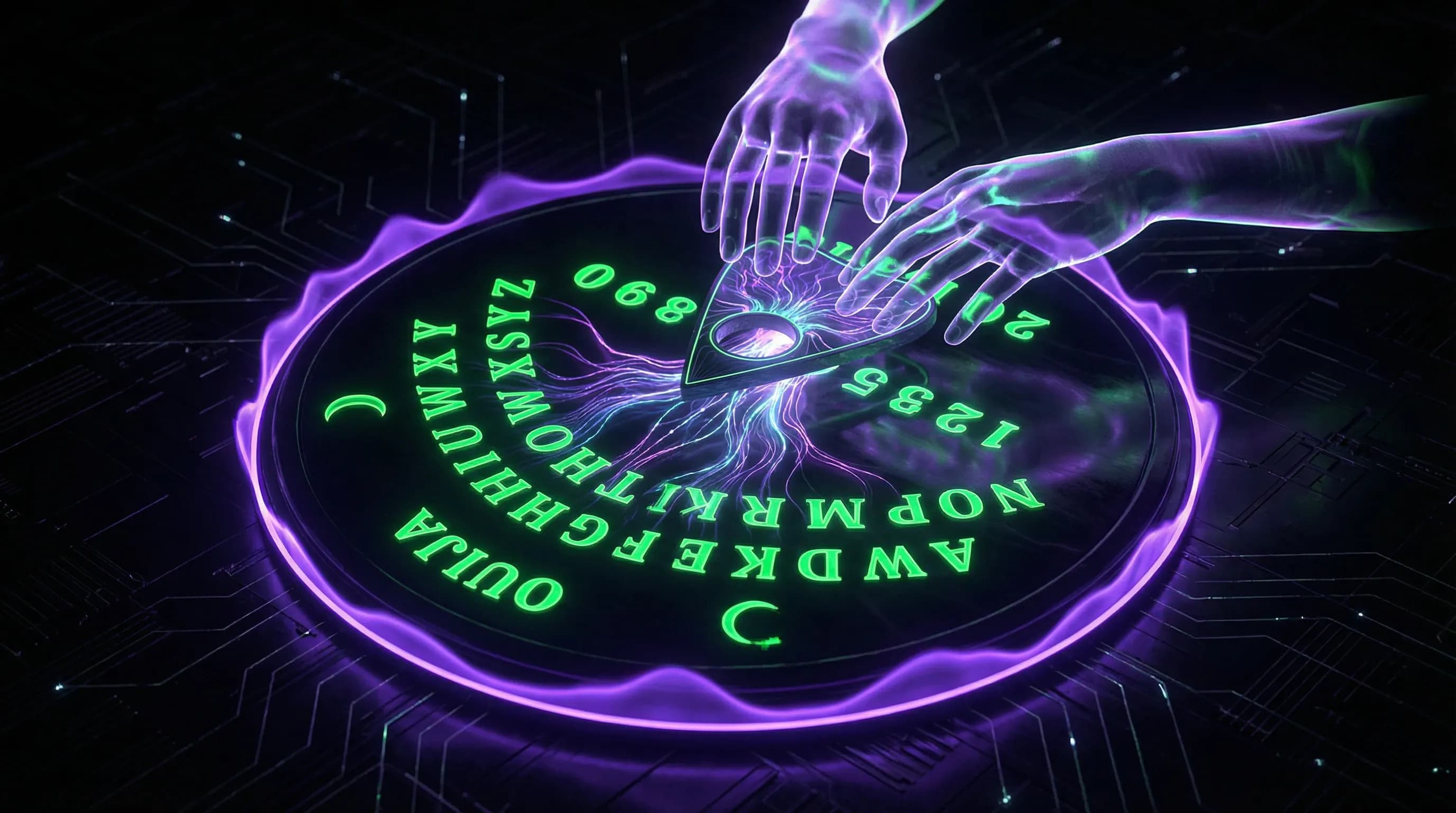
What is the ideomotor effect — and why the Ouija board became its perfect demonstration
The ideomotor effect — a phenomenon where the thought of movement causes the movement itself without conscious intention. The term was introduced by British physiologist William Carpenter in 1852, describing involuntary muscle contractions when concentrating on the idea of an action (S001).
The Ouija board exploits this mechanism with surgical precision: participants focus on a question, expect an answer, imagine possible letters — and their hands begin moving toward those letters with micro-movements they don't recognize as their own. More details — in the Esotericism and Occultism section.
🧩 From spiritualism to neuroscience
The Ouija board emerged in the context of the 19th-century spiritualist movement. Spiritualism spawned an entire industry of automatic writing devices — planchettes, talking boards, and other séance apparatus (S007). Brandon Hodge, the leading historian of these devices, has assembled a collection of over 200 planchettes and talking boards, documenting the evolution of "spirit communication" technologies.
The sinister reputation of the Ouija board is a relatively recent phenomenon. The modern image of the board as a portal for evil spirits was largely shaped by popular culture, especially the film "The Exorcist" (1973).
🔬 Mechanism without mysticism: a chain of micro-movements
The ideomotor effect works through micro-movements that fall below the threshold of conscious perception. When several people place their fingers on the planchette, each produces tiny, involuntary muscle contractions in response to their expectations.
- Summation of micro-movements
- These micro-movements sum together, creating sufficient force to move the planchette. Critically important: each participant genuinely doesn't realize they're pushing the planchette, because the movements occur without conscious motor intention (S001).
- Universality of the mechanism
- The ideomotor effect underlies dowsing, pendulums for "determining baby's gender," automatic writing, and numerous other practices interpreted as paranormal. In all cases, one principle operates: expectation of a result activates motor programs that produce that result without conscious control.
🧠 A window into the architecture of action
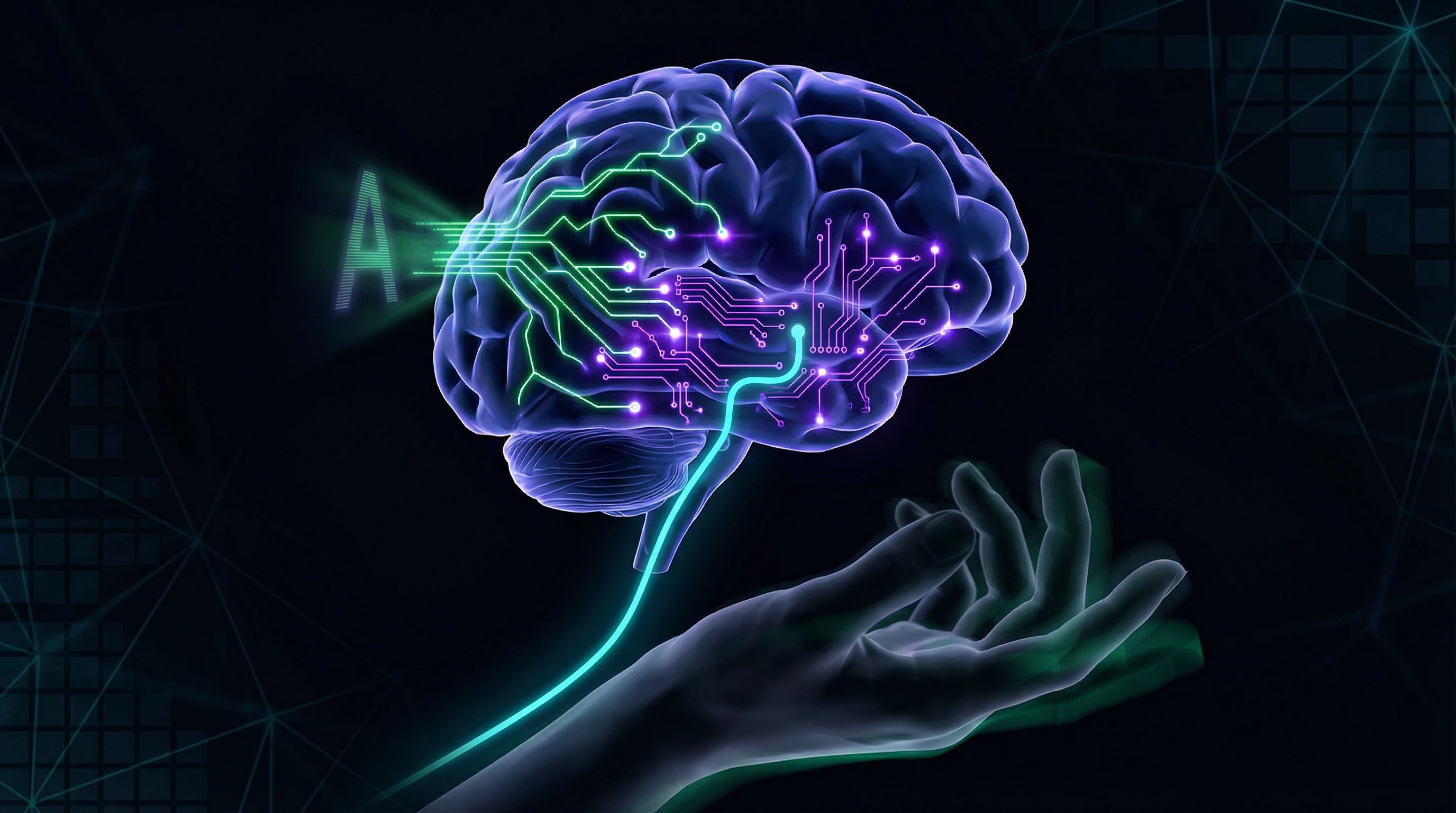
The ideomotor effect isn't just a curiosity. It's a fundamental property of how the brain plans and executes actions. Modern theories of motor control assert that every action is planned not through commands to muscles, but through representation of the desired perceptual effect (S002).
When you reach for a cup, your brain doesn't encode a sequence of muscle contractions — it represents an image of your hand holding the cup, and the motor system automatically generates movements to achieve that image. The Ouija board demonstrates this mechanism in pure form: participants imagine letters, words, answers — and their motor system dutifully produces movements toward these representations.
The only difference is that in ordinary actions we're aware of the intention to move, while in ideomotor effects this intention remains subthreshold, creating the illusion of external control.
Steelman Arguments: Five Reasons Why People Continue to Believe in Paranormal Explanations
To understand the persistence of the Ouija board myth, we need to examine the strongest arguments of paranormal proponents — not in caricature, but in their most convincing version. This is what philosophers call a "steelman argument": the maximally strong formulation of an opponent's position. More details in the Astrology section.
⚠️ Argument from Subjective Certainty: "I Know for Sure I Didn't Move My Hand"
The most powerful argument is the direct experience of participants. People using Ouija boards sincerely claim they didn't control the planchette's movement. This isn't a lie — it's a genuine phenomenological experience.
Participants feel that the planchette moves on its own, pulls their hands, has its own will. This subjective certainty is so strong that it withstands even direct explanation of the ideomotor effect: "Maybe it works that way for others, but in my case I definitely didn't move my hand."
The strength of this argument lies in its reliance on a fundamental property of consciousness: we trust direct experience more than abstract explanations. If I don't feel myself moving my hand, then I'm not moving it — this logic seems irrefutable from within the experience.
🧩 Argument from Information Specificity: "The Board Revealed Facts No One Could Have Known"
The second strong argument involves cases where the board allegedly communicates information unknown to participants. Stories about the board naming a deceased relative or predicting an event circulate in enthusiast communities.
Convincingness is amplified by confirmation bias: "hits" are remembered, "misses" are forgotten. Moreover, memory of "what we knew before the session" is extremely unreliable — we often don't realize what information we already had in our subconscious.
| Mechanism | How It Works | Why It Seems Convincing |
|---|---|---|
| Confirmation Bias | We remember coincidences, forget errors | Creates illusion of accuracy |
| Memory Unreliability | Don't remember what we knew before | Information seems new |
| Apophenia | See patterns in random data | Coincidences seem like patterns |
🔁 Argument from Collective Experience: "All Participants Felt the Same Thing"
When multiple people simultaneously experience the same phenomenon, it creates a powerful sense of objectivity. If all session participants independently report that the planchette moved on its own, this is perceived as mutual validation of the experience.
Social proof is one of the strongest cognitive mechanisms: we tend to trust the reality of what other people experience together with us. The collective nature of the experience makes it more resistant to skepticism.
This argument is especially strong in the context of group sessions, where participants are emotionally synchronized, in a state of heightened attention, and mutually reinforce each other's expectations. Research shows that (S001) joint use of the board increases inter-brain synchronization between participants, which can be perceived as evidence of external influence.
👁️ Argument from Cultural Universality: "This Phenomenon Exists in All Cultures"
Practices of automatic writing, spiritualist séances, and devices for "communicating with spirits" exist across various cultures and historical periods. Japanese Kokkuri-san practice, European spiritualist séances, African rituals — all use similar mechanisms.
This creates the impression that the phenomenon reflects something real, not just a cultural artifact. If people in different societies independently develop similar practices, this may indicate a universal experience requiring explanation.
- Universality of Cultural Practices
- Practices exist in different cultures → seems like they reflect a real phenomenon.
- Trap of the Argument
- Fails to distinguish between universality of cultural practices and universality of cognitive mechanisms that these practices exploit. The ideomotor effect is a universal brain mechanism, so any culture can "discover" it independently.
⚙️ Argument from Therapeutic Effectiveness: "Ideomotor Therapy Works"
Ideomotor techniques are used in clinical practice — for example, to treat chronic pain. Research on the application of ideomotor therapy for chronic neck pain showed positive results (S008).
If ideomotor effects produce real therapeutic changes, this can be perceived as proof that the mechanism has access to "deep" levels of the psyche inaccessible to conscious control. This argument conflates the effectiveness of the technique with the validity of the theoretical explanation.
The fact that ideomotor therapy works doesn't mean the Ouija board communicates with spirits — it only means that involuntary movements can be therapeutically useful, which is completely consistent with neuroscientific explanation. The mechanism is the same; the interpretation is different.
Evidence Base: What Research Says About Motor Imagery and Action Planning
Contemporary neuroscience of action offers a radical revision of what we call "motor imagery." The key thesis: what is traditionally described as "imagining movement" is actually the representation of a desired perceptual effect, not a motor program per se. More details in the section Tarot and Cartomancy.
📊 Rethinking Motor Imagery: It's Not About Motor Control
A systematic review argues that connections between imagery and overt action arise not because action imagery is inherently motoric, but because action planning is inherently imaginistic and occurs in terms of the perceptual effects one wants to achieve (S002). The authors state directly: "The term 'motor imagery' is a misnomer for what is more accurately described as 'effect imagery'" (S002).
This represents a fundamental shift in understanding the architecture of action. The traditional model assumed the brain first forms a motor command (a sequence of muscle activations) and then executes it. The new model asserts: the brain first forms an image of the desired outcome (hand holding cup, ball flying into basket, letter "A" appearing under the planchette), and then the motor system automatically generates movements to achieve that image.
- The brain encodes the desired perceptual outcome, not a sequence of muscle commands
- The motor system automatically generates movements corresponding to that image
- Awareness of intention arises in parallel with activation, not prior to it
🧪 Experimental Evidence for Effect-Based Action Control
Arguments for effect-based theories of action are supported by a large body of evidence (S002). This evidence includes:
- Skill acquisition studies show that people learn to associate actions with their perceptual consequences, rather than with motor patterns directly
- Neuroimaging studies demonstrate that brain areas active during action imagery substantially overlap with areas encoding perceptual effects, not just motor cortex
- Interference experiments show that imagining the perceptual effect of an action influences performance of that action more strongly than imagining the movements themselves
- Motor cortex research suggests that motor commands may be proprioceptively encoded target states for limbs (S002)
Actions are represented in terms of their intended effects, which then activate the motor behavior with which they are associated.
🧾 Meta-Analysis of Motor Imagery Effects on Performance
Motor imagery—mental practice, mental training, or motor imagery training—affects subsequent performance. Meta-analyses confirm this effect (S002). This form of training is recommended by most professional coaches.
Critically important: these effects require no paranormal explanation. If action planning occurs through imagining effects, then practicing effect imagery directly trains the action planning mechanism. The Ouija board works on the same principle: imagining a letter activates the motor program for moving toward that letter.
🧬 Evidence for Overlap Between Imagery and Execution
The review authors examine evidence for overlap between imagery and execution through a new lens and argue that it arises because every action we perform is planned, initiated, and controlled through an imagery-like process (S002). This does not mean that imagery "activates motor programs" in the traditional sense.
This means that action execution itself is a process of imagining an effect followed by automatic movement generation. This model explains why the ideomotor effect arises so easily: the difference between "imagining a letter" and "moving toward a letter" is not qualitative but quantitative—a matter of activation intensity and the threshold of intention awareness.
- Intention Awareness Threshold
- The level of neural network activation at which we begin to consciously recognize that we want to perform an action. When activation is strong enough but remains below this threshold, ideomotor movement occurs—we move but don't consciously recognize that we initiated the movement.
- Activation Intensity
- The strength of the signal in the action planning system. Weak activation may go unnoticed; strong activation crosses the awareness threshold and is perceived as intentional action.
The Mechanism of Causality: Why Imagination Becomes Movement Without Conscious Control
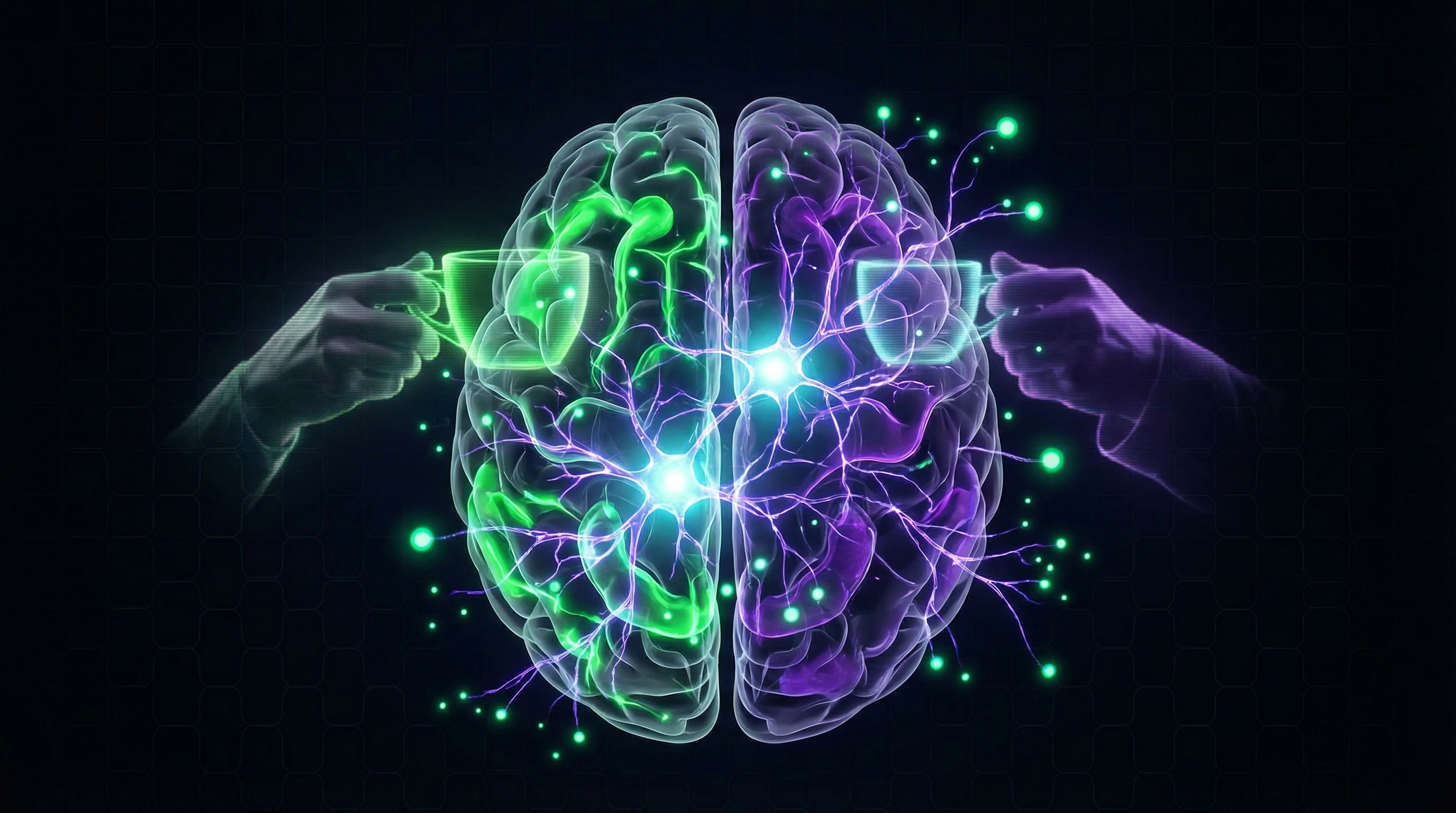
The ideomotor effect operates through the distinction between causality and correlation. The key lies in analyzing confounders: factors that simultaneously influence both imagination and movement. For more details, see the Sources and Evidence section.
🔁 Direct Causal Link: From Effect Image to Motor Activation
Effect-based action theory posits a direct chain: representation of perceptual effect → activation of motor programs associated with that effect. This connection forms through learning—each action and its observable result strengthens the association between the image and the motor program.
On the Ouija board, the mechanism is concrete: a participant sees the letter "A," represents the planchette moving toward "A," and this representation automatically activates micro-movements in the direction of "A." Critically: activation occurs without conscious decision—the effect image itself serves as the trigger (S004).
⚙️ The Role of Expectations and Context: Modulating the Activation Threshold
The ideomotor effect doesn't arise in a vacuum. Its intensity depends on contextual factors that modulate the activation threshold of motor programs.
| Factor | Mechanism | Effect on Threshold |
|---|---|---|
| Participant expectations | Pre-set anticipation of planchette movement | Threshold lowers |
| Social context | Conformity pressure, synchronization with others | Threshold lowers |
| Emotional arousal | Anxiety, fear, interest increase motor readiness | Threshold lowers |
| Attentional focus | Concentration on board and letters strengthens representation | Threshold lowers |
| Authorship uncertainty | Lack of clear feedback about who is moving | Threshold lowers |
These factors aren't confounders in the statistical sense, but parts of the causal mechanism. The ideomotor effect emerges precisely because context creates conditions for subthreshold motor activation.
🧷 Absence of Sense of Agency: Why Movement Doesn't Feel Like "Mine"
The central puzzle: why don't participants feel they're moving the planchette themselves? The answer lies in the mechanism of sense of agency—the subjective experience of causality over one's own actions.
Sense of agency arises when there's correspondence between intention, action, and outcome. In the ideomotor effect, this correspondence is disrupted at all levels.
Intention remains subthreshold—the participant doesn't consciously register a decision to move. Action occurs through micro-movements, individually imperceptible. The outcome (planchette movement) is perceived as an external event. Social context offers alternative explanations: "others are doing it" or "spirits are doing it" (S002).
Absence of sense of agency doesn't mean absence of causality. Participants really are moving the planchette—they simply don't realize it, because the agency mechanism isn't activated with subthreshold intentions.
👁️ Confounders and Alternative Mechanisms
Effect-based theory is compelling, but requires accounting for alternative factors:
- Muscle tremor
- Prolonged hand suspension over the board creates micro-tremors that may be perceived as planchette movement. This isn't the ideomotor effect, but a physiological artifact.
- Physical board artifacts
- Uneven surface, tilt, planchette friction create preferential movement directions independent of participant intentions.
- Conscious deception
- In some cases, participants intentionally move the planchette while pretending not to. This requires separate analysis of motivation and social dynamics.
- Conformity and synchronization
- Participants may subconsciously follow others' movements, creating the illusion of a coherent "message" (S001). This amplifies the ideomotor effect but doesn't replace it.
These factors don't negate the ideomotor effect—they modulate it. The core mechanism remains: representation of an effect activates motor programs without conscious intention.
Conflicts and Uncertainties: Where Sources Diverge and What Remains Unclear
Despite the compelling nature of ideomotor theory, areas of disagreement and uncertainty exist in the literature. For more details, see the section Epistemology Basics.
🧩 Debates About the Nature of Motor Imagery
Not all researchers agree with the radical reconceptualization of motor imagery. Traditional motor control neuroscience continues to use the term "motor imagery" and assumes it involves simulation of motor commands, not just perceptual effects.
This divergence is critical: if imagery is command simulation, then the Ouija board requires explanation through the brain's predictive models (S002). If it's only anticipation of effects, the ideomotor mechanism becomes sufficient.
| Position | Mechanism | Implication for Ouija |
|---|---|---|
| Motor simulation | Brain rehearses commands to muscles | Requires predictive action model |
| Perceptual simulation | Brain anticipates sensory consequences | Ideomotor effect explains movement |
🔄 Inter-Brain Synchronization: Artifact or Phenomenon?
A 2019 study found oscillation synchronization between participants using the Japanese Kokkuri-san board (S001). However, it remains unclear whether this synchronization is the cause of joint movement or its consequence.
The critical question: do brains synchronize because both participants anticipate the same movement, or does synchronization itself generate coordinated action? Current data don't distinguish between these scenarios.
⚠️ Haptic Illusions: The Boundary Between Perception and Action
A series of studies proposed explanation through haptic illusions (S003, S007, S008)—distortions of tactile perception during joint touch. But a methodological conflict arises here: is haptic illusion the cause of movement or its description?
- If illusion is the cause: why does it arise specifically during joint touch, not solitary touch?
- If illusion is a description: what explains the movement itself before the illusion arises?
- Can ideomotor effect and haptic illusion operate simultaneously?
No source offers a definitive answer to this triad.
🌀 Unconscious Knowledge: How Is It Encoded and Transmitted?
Research shows that the Ouija board can express participants' unconscious knowledge (S004). However, the mechanism remains murky: how does information a person doesn't consciously know reach their motor system?
The paradox: the participant doesn't know the answer, but their hand writes it. This requires explanation beyond classical ideomotor theory.
Three models are possible, but none are fully confirmed: (1) information is stored in implicit memory and activated through motor imagery; (2) the brain processes sensory signals below the threshold of awareness and converts them into action; (3) social pressure and group expectations modulate motor control without participants' awareness.
📍 Where New Research Is Needed
Current literature leaves three critical gaps: (1) direct comparison of ideomotor effect and haptic illusions in a single experimental design; (2) real-time neuroimaging during joint board movement; (3) tests distinguishing prediction of motor commands from prediction of sensory effects.
Until then, the Ouija board remains a useful demonstration of the ideomotor mechanism, but not a fully explained phenomenon.